
Your Genes, a Common Virus, and the Reserve You Can Rebuild

A ReBalU client guide from SOD Sciences Inc. A plain-English guide to what the APOE4 gene, latent HSV-1, and your antioxidant reserve mean for long-term brain health, and how the ReBalU test, treat and retest protocol closes the loop.
For more information please contact joe@sodsciences.com and dan@sodsciences.com.
The one-paragraph version
About one in four people carries a version of a gene called APOE4. Most people also carry a very common cold-sore virus called HSV-1. Neither is a problem on its own. But together, and especially in a body whose natural antioxidant reserve has been quietly worn down, they can raise the risk of long-term memory decline. The good news is that the reserve is not fixed. It can be measured, supported with the substrates the body already uses to build its own defenses, and re-measured to confirm the support is working. That closed loop, test, treat with what the body itself makes, then retest, is what ReBalU does.
Why this matters to you
Most brain-health advice you have seen is written for the average person. The problem is that you are not the average person. Your genes are yours, your history of infections is yours, and how much reserve you have left after decades of daily stress is yours. A guide written for the average person cannot tell you whether the antioxidant you are taking today is one your body can actually use, or whether it is being wasted. ReBalU is built around that specific question.
The reserve is the variable. Genes set the ceiling. Life sets the load. What matters is the headroom in between, and that is what we measure.
The mechanism at a glance: how genes, a virus, and reserve fit together
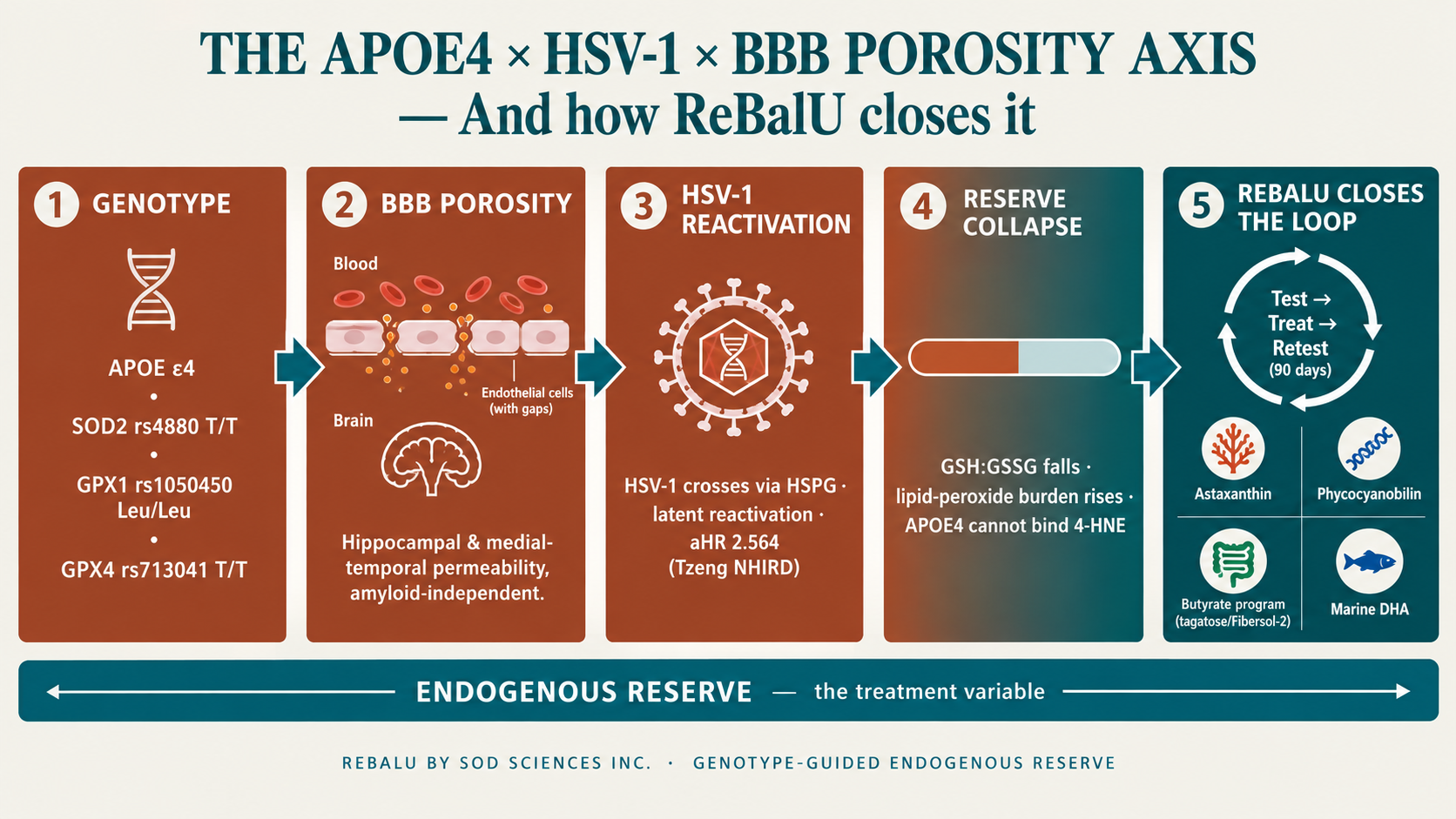
The five panels move from left to right. Stage 1 is what you inherit. Stage 2 is what those inherited genes do to the wall that protects your brain. Stage 3 is why a very common virus becomes a specific problem for that particular wall. Stage 4 is where your reserve gets consumed. Stage 5 is the one you can act on: the test, treat and retest loop that measures the reserve and rebuilds it with substrates your body uses to make its own defense.
Stages 1 and 2: the genes, and the wall they build
APOE4, in plain English
APOE is a gene that helps move fats around your body, including in your brain. It comes in three common flavors, called ε2, ε3 and ε4. About one in four people carries at least one copy of ε4. The ε4 version is missing a specific piece of chemistry, two sulfur-containing amino acids called cysteines, that the ε2 and ε3 versions carry. Those missing pieces matter because they are the same kind of chemistry your body uses to soak up a harmful byproduct of oxidative stress called 4-HNE.
In other words, APOE4 is not just a risk gene. It is a gene that leaves you slightly short on one specific defense chemistry, the same defense chemistry that your antioxidant reserve is built on.
The blood-brain barrier, the wall around your brain
Your brain is protected by a very tight lining of cells inside the blood vessels that feed it. This is the blood-brain barrier. In APOE4 carriers, that lining is measurably more porous, even in people whose memory is still perfect and whose brains show no signs of Alzheimer's disease. The porosity appears first, and it appears in the exact parts of the brain that matter most for memory: the hippocampus and the medial temporal lobe.
Three other genes in your antioxidant system, SOD2, GPX1 and GPX4, can each carry a version that lowers your defensive capacity by a further 20 to 40 percent. When you carry the lower-capacity version of those alongside APOE4, the porous wall has less support behind it. This is not a death sentence. It is a description of your specific starting point.
Stages 3 and 4: a common virus, and a reserve that shrinks
Why HSV-1 is the virus that matters here
HSV-1 is the cold-sore virus. Most adults carry it. After the first infection it goes dormant in nerve cells and reactivates from time to time, sometimes visibly as a cold sore, often invisibly. It is not a rare or exotic infection. It is one you probably already have.
The catch is that HSV-1 uses a particular doorway to enter cells, molecules on the cell surface called HSPGs. APOE4 changes how those doorways behave. A large ten-year study in Taiwan of 8,362 adults with severe HSV-1, compared with 25,086 matched controls, found their risk of long-term dementia was about 2.5 times higher. In the same study, adults who had received standard antiviral treatment for their HSV-1 had roughly a tenfold reduction in that risk compared with untreated carriers. Whether an antiviral is right for you is a conversation between you and your doctor, not something ReBalU prescribes. But the data explains why HSV-1 is the virus we pay attention to for the APOE4 story, and not, for example, HPV, which does not show the same effect.
The reserve, and what actually gets consumed
Every time your body deals with oxidative stress, from a poor night's sleep, a viral flare-up, a stressful week, a metabolic problem or a heavy night of drinking, it draws from a reserve. The main currency of that reserve is a molecule called glutathione, and the useful way to measure it is the ratio of its fresh form to its used form, written GSH:GSSG.
In APOE4 carriers, the reserve is drawn down faster and refilled less efficiently, because the APOE4 protein itself cannot help clear 4-HNE the way ε2 and ε3 can. This is why the same daily life can leave one person with plenty of reserve and another person, ten years later, with very little. The reserve is not the disease. But it is the variable you can measure, and it is the variable you can move.
Stage 5: what ReBalU actually does
ReBalU is not a pill and it is not a diagnostic test. It is a protocol: a repeating loop that turns your genes and your reserve into a specific, measurable and adjustable plan.
Step 1: test
A one-time saliva test reads your APOE, SOD2, GPX1 and GPX4 genotype. A blood draw, stabilized at the point of collection using a technique designed specifically for glutathione, NEM in a K3EDTA tube, measures your current GSH:GSSG. Where relevant, we also look at plasma butyrate, plasma DHA, and in some cases whether you are HSV-1 seropositive and at what titer.
Step 2: treat, with substrates your body already uses
Instead of overwriting your body's systems with drugs, ReBalU supplies the substrates your body uses to build its own defense. In APOE4 carriers, the substrate set is specific and evidence-guided.
Astaxanthin, 6 to 12 mg a day, from Haematococcus pluvialis microalgae. A lipid-soluble antioxidant that crosses into the brain and scavenges the exact lipid peroxides APOE4 cannot bind.
Phycocyanobilin, 100 to 400 mg a day, from AFA-Klamath microalgae. A second lipid-soluble antioxidant that supports the same defense chemistry from a different angle.
A butyrate program of tagatose, Fibersol-2 and high-methoxyl pectin. It feeds the gut bacteria that make butyrate, which supports the barrier around the brain.
Refined marine-microalgal DHA. The omega-3 your brain is built from, and that your body uses to make its own resolution mediators.
Selenium, for carriers of GPX4 rs713041 T/T, in an amount sufficient to support the GPX4 enzyme.
An added sleep lane, for carriers of SOD2 rs4880 T/T with signs of sleep-breathing issues, that addresses overnight low-oxygen episodes.
Step 3: retest, in about 90 days
The whole point of the loop is that it is a loop. About 90 days after you start, we re-measure your GSH:GSSG and the other markers, and we adjust the substrate dose in either direction based on what actually moved. Retesting continues on a quarterly cadence. If the reserve is not moving, we change the plan. This is what makes it a protocol and not a supplement bottle.
What this is, and what it is not
What ReBalU is
A stratification-and-substrate protocol that reads your specific genotype, measures your specific current reserve, supports it with substrates your body uses to build its own defense, and re-measures on a fixed cadence to confirm the support is working. It is designed to be a partner to your physician, not a replacement.
What ReBalU is not
ReBalU does not prescribe antiviral medications. Where the HSV-1 conversation is relevant, that decision is between you and your treating clinician. The study data explains why the conversation is worth having, but the prescription is not ours. ReBalU is also not a diagnostic tool for Alzheimer's disease. It measures a reserve you can move. It does not diagnose a disease you may or may not develop.
A few common questions
If APOE4 is genetic, can anything really change my risk? Yes. The porous barrier and lower defense chemistry are inherited. The reserve behind them is not. It is built and rebuilt every day out of substrates you eat, breathe and sleep with. The reserve is where the leverage is.
Why not just take vitamin C or a general antioxidant? Studies have shown that water-soluble antioxidants like vitamin C help cognition in APOE4 non-carriers but do not help in APOE4 carriers. The APOE4 problem is a lipid-peroxide problem in the brain, which is why the ReBalU substrate set is lipid-soluble and crosses the blood-brain barrier.
Do I need to know my HSV-1 status? Only if the conversation is relevant to you. The Taiwanese study is the reason we care. The antiviral decision is a physician conversation, not a ReBalU prescription.
How long before I see the reserve move? The first meaningful retest is at about 90 days. If the reserve is not moving by then, the plan changes. That is the point of the loop.
Next step
If you would like to know your specific starting point on this axis, ask about the ReBalU stratification panel. It is a saliva test plus a stabilized blood draw. The result comes back as a plan you can act on, not a probability you cannot.
This guide summarizes ReBalU's framework for educated non-specialist clients. It is for informational and educational use only, is not medical advice, and does not create a physician-patient relationship. ReBalU by SOD Sciences Inc.
This document presents a scientific hypothesis for discussion. It is not medical advice. The proposed intervention has not been evaluated by the FDA and is not intended to diagnose, treat, cure, or prevent any disease. If you have memory concerns, a cold sore or other HSV-1 symptoms, or questions about antiviral treatment, speak with your own physician, and nothing here is a reason to delay or decline care you have been offered. Talk to your physician before starting any supplement, especially if you take other medications or are pregnant.