Their Exit, Your Entry: Anthropic's $1.96 Billion Warning for OpenAI

Seven founders sold at $83. The first public trade was $111.50. Before OpenAI comes to market, here is what Anthropic's IPO says about who gets cash, who gets time and who gets the price on the screen.
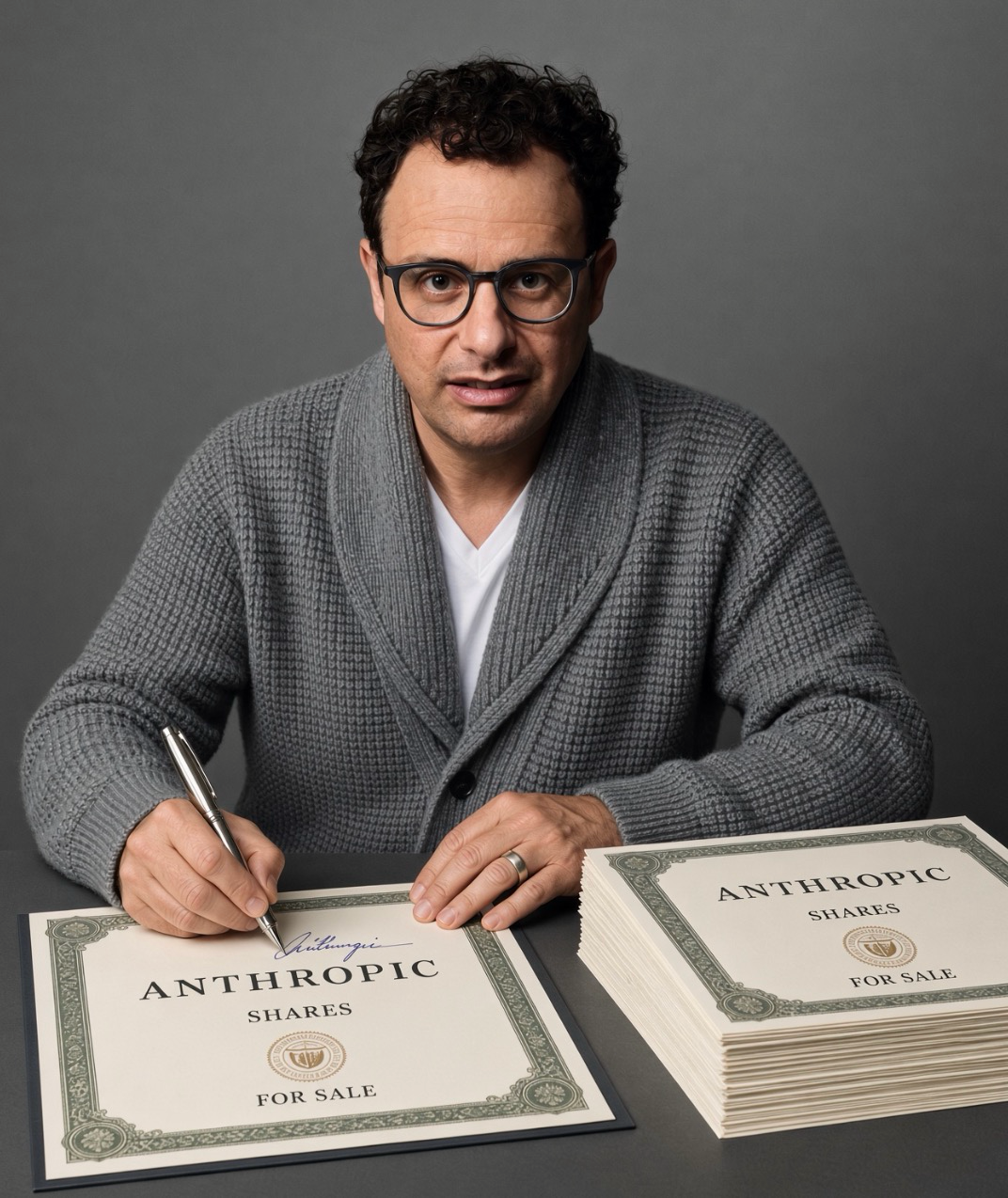
Seven people sold $1.96 billion of Anthropic stock at its IPO: the seven people who founded the company, according to Anthropic's final prospectus and closing announcement. Each sold exactly 3,378,378 shares at $83, about $280.4 million apiece before the underwriting discount and taxes. If you missed the allocation and bought the first trade on Nasdaq, you paid $111.50 for a share that closed Friday at $88.91. The founders got their price. You had to live with yours.
That is the part of an IPO celebration worth remembering when OpenAI comes to market. The word "public" makes it sound as though everyone has finally been invited into the same deal. They haven't. For a founder, the transaction converts years of paper wealth into cash. For the company, it buys time to pay its bills. For the person buying on the exchange, it delivers neither cash nor time. It delivers a share at the price on the screen.
What the insiders actually sold
The percentages depend on the question. Who sold the existing shares in the deal? The founders sold 100% of them. How much of the whole IPO did they represent? 2.10%. Dario Amodei, Daniela Amodei, Tom Brown, Jack Clark, Jared Kaplan, Sam McCandlish and Christopher Olah each sold the same number; together their 23,648,646 shares accounted for the entire secondary portion of the 1.127 billion-share completed IPO, including the underwriters' fully exercised option. The other 97.90% were newly issued shares: about $91.6 billion of the $93.5 billion in gross proceeds went to Anthropic.
The CEO and president alone, Dario and Daniela Amodei, sold 6,756,756 shares, worth $560.8 million gross: 28.57% of the founder sales and 0.60% of the entire IPO. Across all seven, the shares sold represented 1.39% of their combined pre-IPO beneficial Class A holdings, excluding shares Dario controlled solely by voting proxy; individually the sales ranged from about 1.38% to 1.40%. They kept substantial exposure. They also converted nearly $2 billion into cash without giving up the Founder LLC share carrying 50.1% of the vote on matters submitted to stockholders generally; the Long-Term Benefit Trust separately elects a majority of the board, as the prospectus explains. That is a remarkable deal for the sellers. It is not the deal the public bought.
Nor was this the first chance for insiders to sell. The filing says Dario and Daniela Amodei sold in private tender offers in June 2025 and April 2026, and CFO Krishna Rao also sold in April; it gives the total purchases for those tenders, not each person's proceeds. Those earlier sales are separate from the $1.96 billion the seven founders sold at the IPO.
The IPO pop you couldn't necessarily buy
Start with the same 100 shares in two accounts. At the $83 offer price, they cost $8,300 and were worth $8,891 on Friday: a $591 paper gain. At the $111.50 opening trade, they cost $11,150 and were worth the same $8,891: a $2,259 paper loss, or 20.3%. The first buyer was still ahead 7.1%; the second needed the stock to climb back to $111.50 just to break even. The $28.50 opening premium never went to Anthropic to hire a researcher or buy a chip. An exchange purchase pays the seller.
Who got the lower price? CNBC reported that Anthropic prioritized institutions with which it had relationships and that about 15% of the offering went to retail, below the roughly 20% initially expected. Some individual investors got $83 shares, and the tape does not identify who sold to the first buyer. But the distinction is real: a headline can celebrate a gain from a price that many readers never had the opportunity to pay.
Wall Street's $550 million payday was in the fee, not the greenshoe
The seven founders sold stock. The 22 banks sold an underwriting service. The difference matters: the syndicate earned $550 million in gross fees on the $81.34 billion base offering, about 0.68%; Anthropic paid roughly $536.7 million and the selling founders paid $13.3 million, according to the prospectus and Reuters' fee breakdown. The banks had committed to buy the base shares and could share their spread with securities dealers; the fee is revenue, not a disclosure of what they kept after costs.
Goldman Sachs and Morgan Stanley each underwrote 200.9 million shares; Reuters put each lead bank's expected share of the fee pool at roughly 20.5%, more than $110 million apiece. J.P. Morgan and Citigroup each underwrote 98 million shares, or 10% of the base deal; those are commitments to buy and distribute stock, not a bank-by-bank accounting of net profit. There were overlapping interests: affiliates of Goldman, Morgan Stanley and J.P. Morgan held Anthropic securities and also had roles arranging its credit agreement, but none of those banks was named as a selling stockholder in the IPO. Getting paid to bring a company public is not the same as cashing out a stake in it.
The greenshoe gave the syndicate a way to sell more shares at $83 than it initially bought, then cover the difference. Anthropic's base deal was 980 million shares; the option covered another 147 million, exactly 15%, and Morgan Stanley was the stabilization agent. Think of one extra share already sold at $83. If the stock trades at $80, the bank can buy it back at $80, earning a $3 gross trading gain before costs while putting a buy order into a falling market. If the stock rises, the bank can exercise the option and buy the share from Anthropic at $83 rather than chase it in the market. The $80 example is hypothetical; price support was permitted, not promised.
Here's what actually happened: the syndicate exercised the option in full, buying 147 million new shares from Anthropic at $83, or $12.201 billion in additional gross proceeds for the company, per Anthropic's closing announcement. The prospectus explicitly says the underwriters received no discount or commission on those shares and shows the same underwriting fee with or without exercise. An extra share sold at $83 and covered at $83 earns no spread. The real advantage for the banks was the right to cover at $83 if the stock ran up. The public buyer at the opening trade had no such protection.
That is the imbalance worth criticizing. The syndicate did not need the stock to stay above the offer price to earn its fee; the investor who bought shares needed a higher price to make money on a sale. You don't have to invent a greenshoe windfall to ask whose definition of a successful IPO made the headlines.
The $900 billion question: who pays after the IPO?
Call it a liquidity event for the founders, not a liquidation of Anthropic. The founders got $1.96 billion gross; the company estimated it would keep about $117 billion net from the IPO and the concurrent private placement together, with the underwriters' option exercised in full. Against that, Anthropic disclosed $900.9 billion in purchase and lease commitments, almost all for compute and infrastructure: $70.7 billion due in the twelve months after September 30, 2026, and $451.6 billion expected before the end of 2030, including that first year; substantially all the rest falls in 2031 through 2045. Of the total, $186.2 billion was subject to termination rights or conditions before service begins, not an amount Anthropic can simply deduct at will. The new financing alone was larger than the first year's scheduled commitments. That buys time; it doesn't show what customers will pay when the next bills arrive.
The best argument against calling this a distressed exit is that Anthropic's operations generated $6.6 billion of cash in the first nine months of 2026, versus $2.0 billion used a year earlier. The best argument for caution is that its compute commitments generally come due whether it uses the capacity or not, while 79% of revenue in those nine months came from consumption: customers paying for what they used. At September 30, Anthropic had $13.8 billion of revenue left to recognize on noncancelable customer contracts, about $10.4 billion of it expected over the next twelve months, compared with that $70.7 billion of supplier commitments due over the same period. The difference is not a funding shortfall: it leaves out future pay-as-you-go sales and renewals, and booked revenue is not cash in the bank. It tells you which side has made the longer promise. If demand disappoints, customers can cut usage faster than Anthropic can cut its bills.
The $26 billion private placement alongside the IPO illustrates why the answer can be hard to see. Seven industry players, including Google, Nvidia, Microsoft and AMD, bought Anthropic stock at the $83 offer price. A chipmaker can earn money selling equipment even if the equity investment ultimately disappoints. A public buyer who owns only the stock has no chip sale to fall back on. Paying the same price does not mean making the same bet.
OpenAI has its own version. Amazon reported investing $50 billion in OpenAI preferred stock and an eight-year, $100 billion expansion of OpenAI's existing $38 billion AWS agreement, with obligations tied in part to chip performance, in its quarterly filing. The money is real; so is the order. What is not real is the idea that the investment and the order are two independent confirmations of demand. Show me the customer without a seat on either side of that deal who renews and pays out of an operating budget.
Even Sam Altman's warning was narrower, and more useful, than the claim that only two companies buy AI compute. He identified OpenAI and Anthropic as drivers of major demand growth, and later told Semafor that competing chipmakers were forecasting orders as though each would win much of the same business. Among businesses on Ramp, just 1% accounted for 80% of observed spending with the two labs, according to the Ramp Economics Lab; that is a sample, not the entire AI market. There can be a shortage of compute today and too many suppliers borrowing against the same projected order tomorrow. In the IPO pitch, I'd ask to see those orders counted once.
Oracle can finance the building. Who pays for the empty months?
"Oracle has secured all the funding we need to fulfill our contract with OpenAI," the company told investors Friday. Pay attention to the word "we." Oracle had sold roughly $10 billion of equity and $10 billion of notes, including bonds carrying an 8.65% coupon out to 2046. Its reassurance answers whether Oracle can fund construction. It says nothing about the margin OpenAI will earn using the building, or what the hardware will be worth when the next generation arrives.
The exposure is sharper for the specialist GPU landlords known as neoclouds. CoreWeave disclosed that at its September floating-debt balance, a one-percentage-point change in rates could move quarterly interest expense by about $41 million; it uses swaps to mitigate some of that risk. Nvidia has also agreed, subject to contract terms, to buy qualifying CoreWeave capacity left unsold through April 2032. A lender can sensibly lend against Nvidia's promise. An equity buyer should not mistake it for evidence that independent customers wanted every GPU.
The weak link can break without a single AI user canceling. A missed facility-lease deadline made a $34.9 billion Anthropic agreement with Lambda terminable by either side; neither had given notice, and Anthropic said in its prospectus that it did not intend to terminate. Nscale, reportedly weighing an IPO delay into 2027, disclosed Anthropic agreements worth up to $44.6 billion dependent on delivery and service availability, and said it still needed project financing. I expect some neoclouds to postpone or reprice their offerings, not all of them to cancel. Interest comes due on debt already drawn even if a customer cannot yet be billed.
Some of the public never ordered the stock
A household near a proposed campus can decline the IPO. It cannot decline a grid upgrade on its electric bill if regulators let the utility charge it there. In November's national exit poll, 76% of voters opposed a new data center in their own community; of 54 local measures decided this year through November 20, voters favored limits in 53, including advisory votes rather than just binding restrictions, by Ballotpedia's count. That isn't a national vote against ChatGPT. It is a warning about who gets asked to pay for it.
Georgia shows what it costs to answer that objection. Under an approved contract in Effingham County, OpenAI pays the full cost of the infrastructure needed to serve its project, and Georgia Power can reduce delivery by up to 1,000 megawatts during periods of high demand. OpenAI's broader promise to protect ratepayers and publish site-level water and power use covers future campuses it owns and operates, not automatically every partner-owned facility supplying it. An IPO prospectus should separate operating sites, permitted sites with signed power contracts, and sites that still need the neighbors' consent. Those are three different assets. I wouldn't pay the same price for all three.
What valuation can OpenAI defend at its IPO?
OpenAI has confidentially filed a draft S-1; CFO Sarah Friar said in November it would "continue to look in '27," not that it had promised to list by May. The strongest case for buying is a business, not a ticker: Friar told CNBC of 1.2 billion weekly users and an enterprise business that doubled in a quarter. But look at what happened in the September quarter: revenue rose about 50% to $10 billion, and the adjusted operating margin improved from negative 150% to negative 109%, yet the implied operating loss widened from $10.1 billion to $10.9 billion, according to investor materials reviewed by the Wall Street Journal. That is an operating measure, not cash burn. It shows how OpenAI can lose less on each dollar of sales and still lose more dollars.
My six-month call: OpenAI can probably keep buying compute through May 2027 without an IPO. March brought $122 billion of committed capital, not a current bank balance; Forge Global records an $11 billion November financing at a $1.25 trillion valuation, a first close that Reuters reported fell short of the original target of up to $30 billion. A company forecast reported in September did not project exhausting the March capital until 2028. That is a reason not to predict a spring cash crisis, not a verified runway: I'd want unrestricted cash on hand and the next two quarters' unavoidable payments before putting a date on it.
OpenAI can hit its sales plan and still need another investor
Anthropic's $900.9 billion is not OpenAI's bill. OpenAI's own plan is sobering enough: management projected about $840 billion of cumulative revenue, roughly $856 billion of compute and infrastructure spending through 2030, and $278 billion of cumulative negative free cash flow over 2026 to 2030, according to a company presentation reported by the Financial Times. Those are forecasts, not signed purchase minimums; the $278 billion is the forecast cash consumed, not an extra bill to add to the $856 billion. Even if management hits its sales plan, it expects to use cash, not generate it, over those five years.
Now suppose cumulative sales come in just 10% below plan. That is $84 billion less revenue; how much more financing OpenAI would need depends on collections and which costs it could actually avoid. The model can work if paying customers keep renewing, more of the reserved capacity earns revenue, and the cost of answering a request falls faster than the price OpenAI can charge. If it cuts prices to fill the machines while its minimum payments stay fixed, usage can break records and shareholders can still do poorly.
That's how a financing problem reaches the IPO buyer without the company ever going bust. If Anthropic needs more equity on worse terms, OpenAI doesn't inherit its bills, but its bankers will have to explain why the market should pay more for a similar bet. Before listing, OpenAI can accept a lower offer price and limit insider sales, or delay and seek private financing or slow the build where its contracts allow. After listing, if it needs to raise the same sum at a lower share price, it must issue more shares, diluting holders who don't participate. I'd judge the IPO by whether its net proceeds to the company can carry it to the point where customers fund the business. A dollar paid to a selling insider gets it no closer.
Anthropic's lock-up calendar
A portfolio manager doesn't have to pay OpenAI's asking price to own a frontier AI lab. They can buy Anthropic instead. The comparison I'd use is not Anthropic's opening trade. It's the price buyers are willing to pay as more of its early holders get the right to sell.
The next fixed date is December 15, 2026, when up to 303 million more Anthropic shares become eligible for sale, according to the final prospectus. By February 2, the first five fixed releases alone cover up to 1.627 billion shares, or 1.44 times the 1.127 billion shares sold in the completed IPO. Those totals count shares eligible for sale, not sell orders. A lock-up expiring does not itself dilute existing shares or put cash in the company's hands.
| Earliest eligibility date | Newly eligible on that date, up to | Running total of these five releases, up to |
|---|---|---|
| November 19, 2026 | 315 million shares | 315 million |
| December 15, 2026 | 303 million shares | 618 million |
| January 5, 2027 | 303 million shares | 921 million |
| January 19, 2027 | 353 million shares | 1.274 billion |
| February 2, 2027 | 353 million shares | 1.627 billion |
Up to the stated number of Class A and Class N shares become eligible on each date. Share counts link to the lock-up terms in Anthropic's final prospectus.
The opening-day release covered up to 10% of the locked holdings of non-founder directors and officers and current and former employees and consultants; the next four fixed dates are staged releases for other pre-IPO holders. The counts use the issuer's rounded totals for Class A and Class N combined: Class N converts one-for-one on a qualifying public sale and is counted once; the 313,253,007 Class N shares sold in the concurrent private placement have separate resale restrictions and are excluded.
The larger releases run from the public earnings announcement, not the quarter-end. "Second trading day" means the second full Nasdaq trading day after the announcement; the other numbered offsets are calendar days and roll forward if they fall on a non-trading day.
| Earliest date or contractual trigger | Newly eligible Class A and N shares, up to |
|---|---|
| Second trading day after full-year 2026 results | 1.7 billion shares |
| Days 13, 27, 41, 55 and 69 after full-year 2026 results | 480 million shares on each of five dates |
| Earlier of the second trading day after Q1 2027 results or immediately after the May 17, 2027 close (day 180) | 3.0 billion shares |
| Days 34, 48, 62 and 76 after Q1 2027 results | 447 million shares on each of four dates |
| Second trading day after Q2 2027 results | 558 million shares |
| Days 27, 41, 55, 69 and 83 after Q2 2027 results | 502 million shares on each of five dates |
| Earlier of the second trading day after Q3 2027 results or immediately after the November 18, 2027 close (day 365) | 1.9 billion shares |
The day-180 and day-365 releases also cover the founders' remaining lock-up windows. Figures cover all eligible holders in each tranche, not just the founders.
For the seven founders, the next scheduled window is the Q1/May trigger, not December 15: each founder and the other signatories to that founder's agreement may then transfer up to 29% of their covered holdings, measured as of October 31, 2026; the remaining founder lock-up ends at the Q3/November trigger, subject to exceptions. The 3.0 billion and 1.9 billion figures cover all eligible holders in those tranches, not just the founders; insider-trading rules, securities laws and any underwriter waivers still apply.
What the calendar means for OpenAI's price
If OpenAI markets its IPO while Anthropic holders are selling, the two groups are competing for the same portfolio dollar. If Anthropic keeps growing but trades at a lower multiple as those shares find buyers, I'd ask what margin or growth advantage justifies paying a premium for OpenAI. If Anthropic holds its valuation on heavy volume after a release, that is a better test of demand than a first-day pop. Several large releases are tied to earnings announcements, so I'd read the results before blaming the sellers for a price move. There's no automatic haircut to OpenAI's value on any of these dates.
Before I'd buy, I'd want four answers on the same page: how much the company keeps after serving a renewing customer; how unrestricted cash and net IPO proceeds compare with bills it cannot defer; which sites have power, on what terms; and who is selling, how much, and when the rest can sell. Let those answers set the price. If they don't support the private valuation, I'd expect a lower price, a smaller secondary sale, or a delay. None of those is a verdict against AI.
The founders earned the right to sell. The public owes them neither a buyer nor a price. When OpenAI's turn comes, ask the question the opening bell won't answer: if this is such a good exit for the people who know the business best, what makes it a good entry for me?
Research and analysis only, not personalized financial advice. Consult a qualified financial advisor before making investment decisions.
The authors hold positions in securities mentioned and reserve the right to buy or sell shares at any time without notice.