SoftBank: The Stock Can Break Before the Parent Does


Our call: a fall in Arm can force difficult sales and punish Tokyo shareholders. It takes a cash shortfall or a contractual breach to put the parent in default. A parent credit and Tokyo equity stress test of SoftBank Group Corp. (Tokyo: 9984).
Where Arm starts to constrain SoftBank
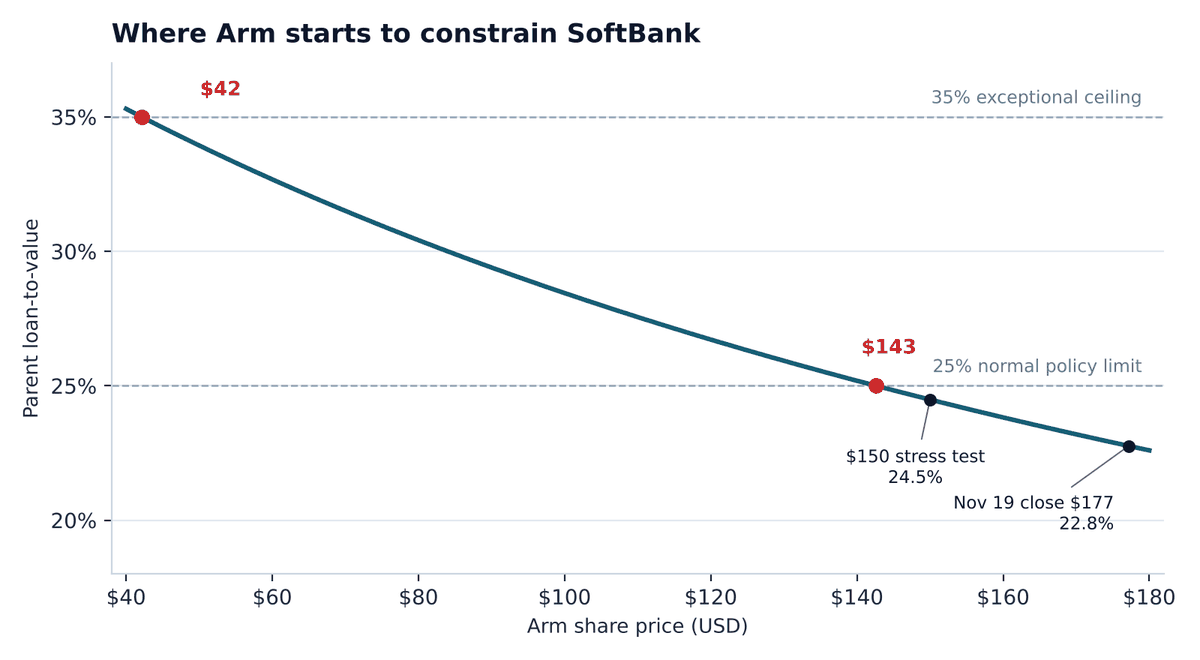
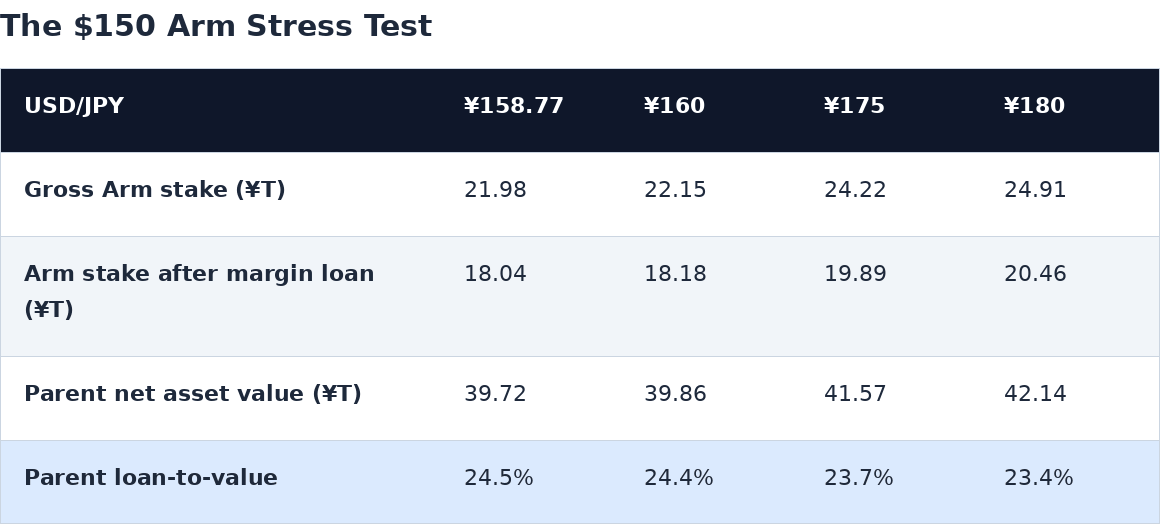
At this exchange rate, Arm at roughly $143 reaches the 25 percent normal limit, and roughly $42 reaches the 35 percent exceptional ceiling on paper. Neither is a default price.
What the $10 billion actually changed
SoftBank paid the final OpenAI tranche on October 1 through Vision Fund 2. September's senior notes had already raised the money. Do not add the debt twice.
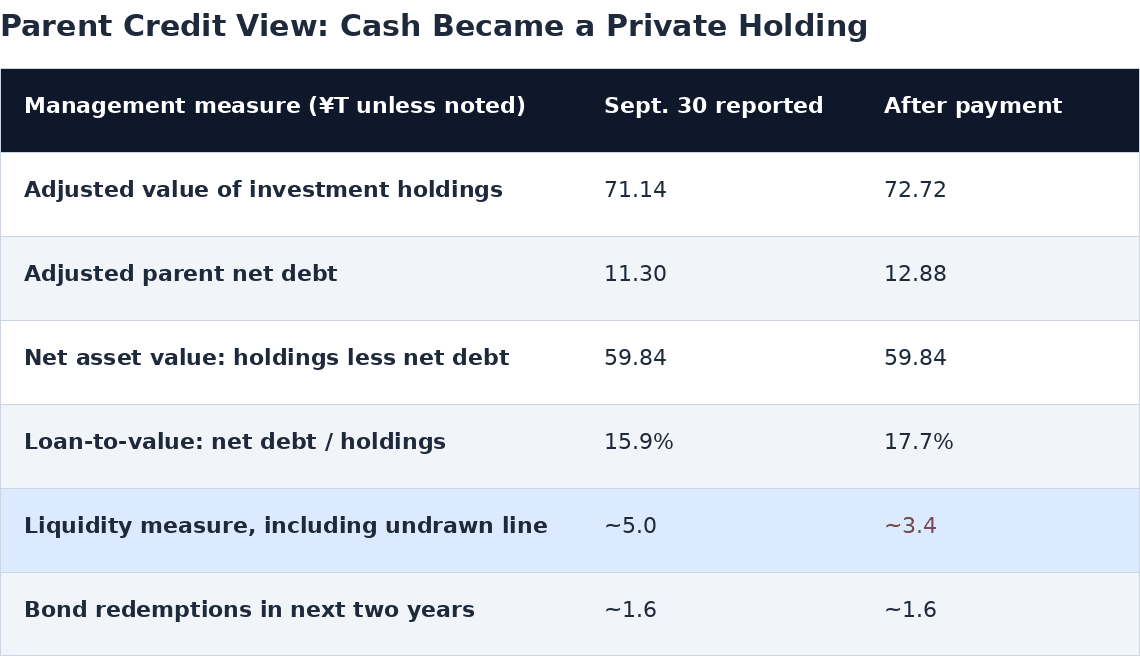
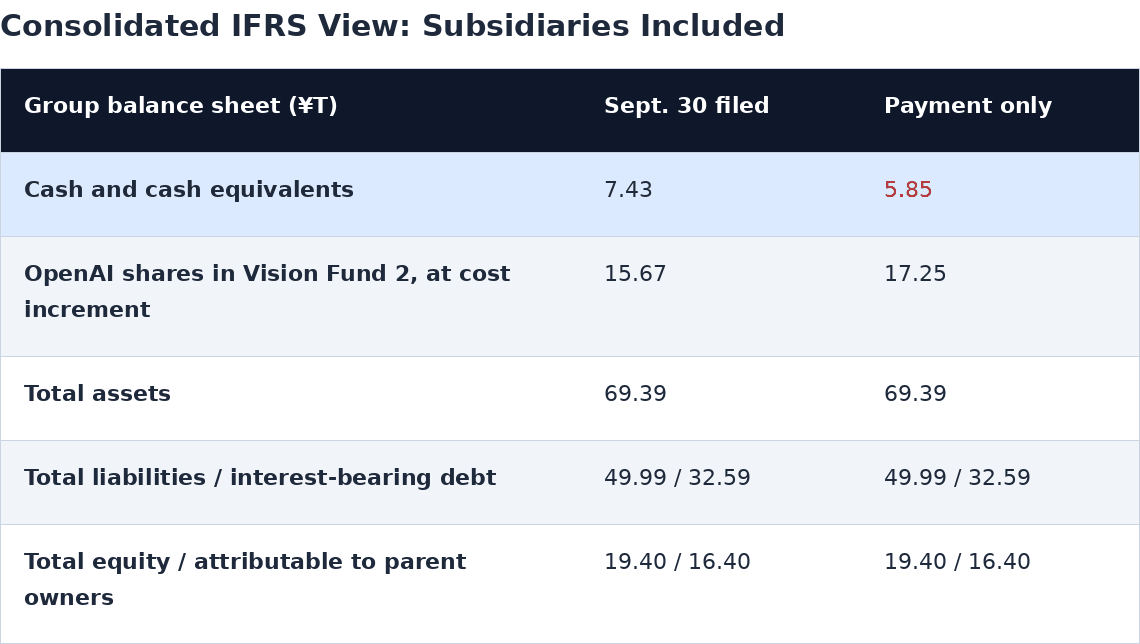
Why it matters. The payment did not destroy ¥1.58T of net worth at closing. It did remove ¥1.58T of immediately spendable money. Management's separate November 9 market update put September NAV at ¥44.7T using selected new prices, not a full November balance sheet.
Which lender can call the parent?
A loan against Arm and a loan guaranteed by SoftBank are different claims. The difference matters most when creditors all want cash at once.
Arm: collateral at risk, not a parent guarantee
Kronos pledged 769.0 million Arm shares. At $150, they are worth $115.4 billion. Against a $25 billion facility, that is about 21.7 percent even if fully drawn. Both sides are in dollars, so a weaker yen raises their yen values but does not improve the collateral ratio.
The facility is nonrecourse to SoftBank Group Corp. A sufficient price decline can require more collateral or early repayment by the borrower, and lenders can enforce against pledged assets. SoftBank could voluntarily support the loan to protect control of Arm. The figures do not reveal the contract's margin-call price.
What does reach the parent
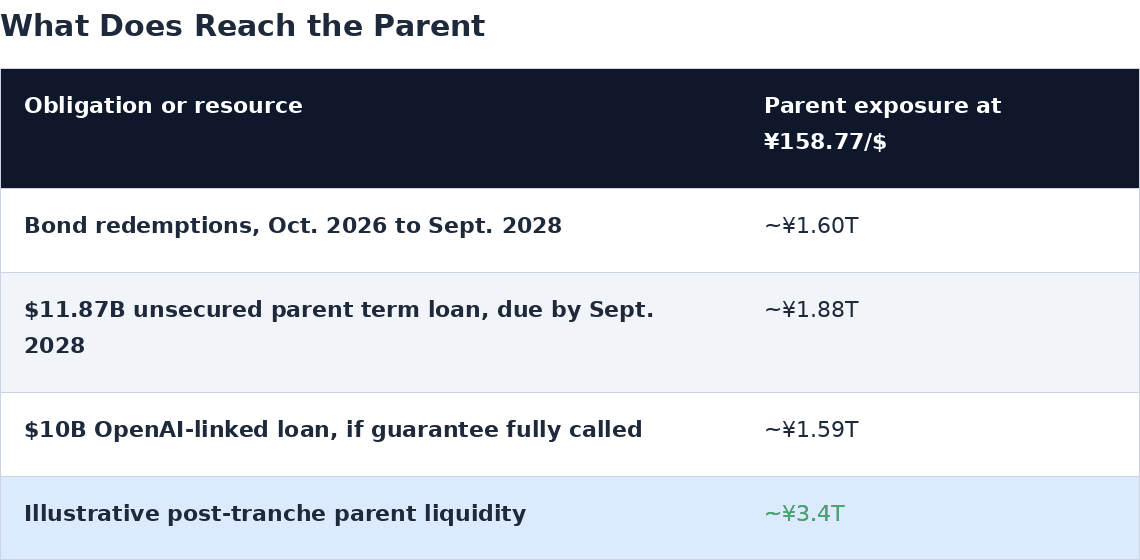
The unsecured term loan plus two years of bonds total roughly ¥3.48T: close to, or slightly more than, the static ¥3.4T liquidity measure even before interest. A full guarantee call would take those claims above ¥5T. They are not all due today. The guarantee references OpenAI, not Arm, and the full call is a stress assumption, not a demand.
The legal tests are separate. Certain debt requires parent cash and deposits to cover the next 12 months' bond redemptions at the March and September tests, and defined senior net debt to stay below 70 percent of eligible holdings quarterly, under Note 23 of the annual report. Different definitions apply, so the published 25 percent loan-to-value limit cannot establish legal headroom.
Shareholders can lose before lenders do
The Tokyo-listed parent is a claim on what remains after debt. As Arm falls, that residual shrinks. Investors can also pay less for each yen of it if the next sale looks rushed.
How a 26 percent NAV loss becomes a 41 percent share-price loss
Start with Arm's November 19 close of $177.17, the November 20 yen rate of ¥158.77 per dollar and SoftBank Group's Tokyo close of ¥3,025. Our post-payment model gives ¥43.70T of NAV. At $100 Arm it gives ¥32.40T, a 25.9 percent decline, holding the rest of the portfolio unchanged.
If the Tokyo shares keep their starting price-to-NAV multiple, the same 25.9 percent fall implies about ¥2,240 a share. If investors also pay 20 percent less per yen of NAV than before, the fall compounds to 40.7 percent, or roughly ¥1,790. Neither the multiple compression nor the share price is a forecast. This is how the equity bear case can work without a missed bond payment.
How much might SoftBank have to sell?
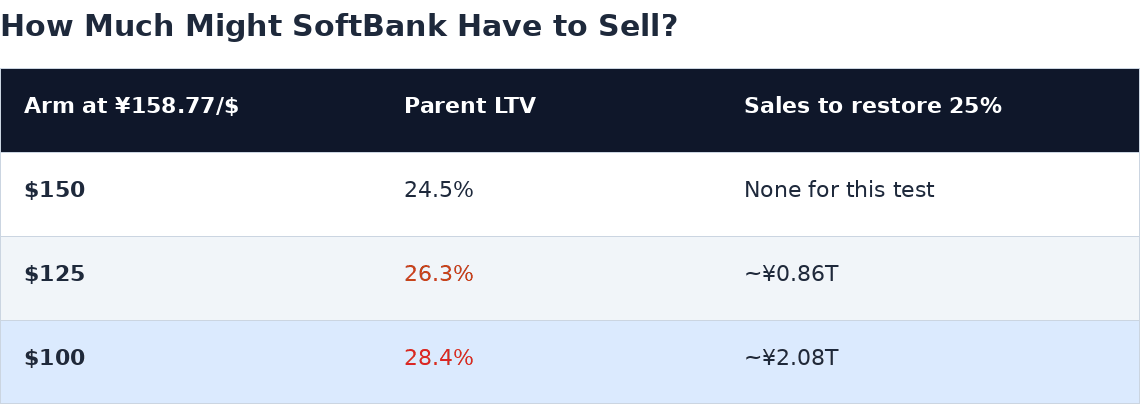
What could go first? Slow new discretionary investments, sell accessible listed stakes, or seek fund distributions. Part of the telecom holding already backs debt. Roughly 154 million Arm shares fall outside the disclosed 769 million-share pledge, but that is not proof they are unrestricted or can be sold without moving the market. Private OpenAI shares are a poor substitute for same-day cash.
For scale, raising ¥2.08T entirely by selling Arm at $100 would take roughly 131 million shares before costs. That is most of the shares outside the disclosed pledge, even before any block-sale discount.
Default is a tail risk, not a stock target
Our judgment for the next 12 to 24 months: severe equity pressure and asset sales are more plausible than parent payment default. That view depends on access to refinancing and saleable assets.
Put the odds in context
SoftBank reported BB+ long-term bond ratings from both S&P and Fitch as of November 10. For scale, S&P's global BB category had average cumulative default rates of 0.5 percent at one year, 1.7 percent at two years and 5.6 percent at five years over 1981 to 2025. Those are broad historical peer rates, not a BB+ notch estimate, a SoftBank probability or a forecast conditional on Arm at $150.
What would change our call?
First, the assets weaken together. Arm falls while a lower OpenAI valuation reduces private holdings and triggers collateral or prepayment on the separate parent-guaranteed loan. A fall in Arm alone does not produce the same cash demand.
Second, refinancing closes. A Japanese equity crash reduces sale proceeds. A 6 percent yield on Japan's 30-year government bond would not reset existing fixed coupons, but new debt could be costlier or unavailable. A weaker yen also makes unhedged dollar payments costlier in yen.
Finally, cash cannot arrive by the deadline. Pledged shares cannot simply be sold free of lender claims. If new financing, timely asset sales, available cash and waivers all fall short of a parent maturity or guarantee payment, a payment default is possible even with positive portfolio NAV.
What to watch. Actual parent cash against the next 12 months of maturities, renewal of the 2028 term loan, cash collateral demands, and whether asset sales are voluntary or made against a deadline. Those tell us more about default than any single Arm quote.
Model key, in trillions of yen. Other adjusted holdings equal 71.14 minus 38.16, or 32.98. Post-payment net debt equals 11.30 plus 1.5796. Holdings equal 32.98, plus 1.5796, plus 922,733,999 Arm shares times the Arm price times USD/JPY divided by one trillion, minus the Arm margin loan of 3.89694 times USD/JPY divided by 157.35. Loan-to-value equals net debt divided by holdings. At deep stresses, collateral remedies, taxes, hedges and other marks would invalidate a static path. Inputs are from SoftBank's Q2 FY2026 financing and investor presentations, interim report and FY2026 annual report, its October 1 OpenAI closing release, its bond ratings page, Arm's 20-F, S&P's 2025 annual default study, Nasdaq and Tokyo closing prices, and November 20 exchange rates.
Research and analysis only, not personalized financial advice. Consult a qualified financial advisor before making investment decisions.
The authors hold positions in securities mentioned and reserve the right to buy or sell shares at any time without notice.