
Your Body Is an Economy, Not a Snapshot

What a famous economist can teach us about how the ReBalU protocol looks at your health. SOD Sciences, Inc. Plain-English Edition.
The one-paragraph version
About a hundred years ago, an economist named Joseph Schumpeter said something that upset his profession: you cannot understand an economy by taking its picture. An economy is a living, moving thing. It grows by constantly tearing down old ways and building new ones, and the moment it stops doing that, it starts to die. The ReBalU protocol says the same thing about your body's defense system. A single blood test is a snapshot. What matters is the movie: where your defenses are heading, how they bounce back after a hard week, and whether your body still has the ability to clean out what is broken and rebuild. This paper explains why those two ideas are really the same idea.
1. Meet the economist
Joseph Schumpeter was born in 1883 in what is now the Czech Republic and ended his career at Harvard. He is best remembered for two words: creative destruction. His big argument was that the standard economic model of his day, which pictured an economy sitting in a neat, balanced state where everything sold and nobody made an unusual profit, described a world that does not exist. Real economies never sit still. Capitalism, in his account, is by its nature a method of economic change, something that never is and never can be stationary, which is why he called stabilized capitalism a contradiction in terms.
He also said you cannot judge an economy at a single moment. Because every important change takes considerable time to reveal its true features and ultimate effects, he argued, there is no point in appraising the process at a given point in time. Instead, "we must judge its performance over time."
Hold onto that sentence. It is the whole reason ReBalU works the way it does.
2. Meet your body's defense budget
Every cell in your body burns fuel, and burning fuel throws off sparks. Scientists call these sparks oxidative stress or free radicals. In small, controlled amounts, the sparks are useful. They are signals that tell cells to clean house, repair and toughen up. In large uncontrolled amounts, they burn things down.
Your body keeps the sparks in check with a set of built-in fire extinguishers. The most important one is a molecule called glutathione. Think of your glutathione as a bank balance, your reserve. Every stress in life makes a withdrawal: a bad night's sleep, a virus, a few drinks, an inflammatory flare-up, surgery, sleep apnea that starves you of oxygen all night. A healthy body makes deposits fast enough to keep the balance up. A body under too many withdrawals at once starts running low.
ReBalU measures that balance. But, and this is the key point, it does not measure it once.
3. The snapshot problem
Most lab tests work like this. They draw your blood, compare your number to the normal range for the general population, and tell you whether you pass. That is the snapshot. It is the economic model Schumpeter rejected: one picture, one balance, one verdict.
Here is why it fails. Two people can have exactly the same glutathione number today. One of them had a high balance last month and is sliding downward fast. The other had a low balance and is climbing. The snapshot cannot tell them apart. A normal number in a person whose reserve is being drained every night is not normal at all.
ReBalU does what Schumpeter said economists should do. It judges the process over time. You test, you treat, and you test again. Each new result is compared with your own earlier results, not with a crowd of strangers. The protocol looks at your level, your direction, how quickly you recover after a documented stress, and whether a worrying pattern shows up once or keeps showing up. That is the movie, not the snapshot.
4. Innovation is recombining, not inventing
Schumpeter had an unusual definition of innovation. He said the innovator is not the inventor. Innovation is taking things that already exist and combining them in a new way, which in his words meant combining the same materials and forces differently to produce other things, or the same things by a different method. The railroad was not a new invention. Steam engines and iron rails already existed. Putting them together changed the world.
The ReBalU formula is built the same way. There is no exotic new drug in it. It combines four well-known, food-grade ingredients: a natural sugar called tagatose, a soluble fiber called Fibersol-2, a fruit pectin, and oil from marine microalgae, the same source fish get their omega-3 from. None of these is new. The combination is. Together they feed the good bacteria in your colon so that your own body produces a compound called butyrate, and they deliver the omega-3 fat DHA. Those two, working together, switch on the genes that rebuild your defenses.
That word together matters, as the next section explains.
5. Change comes in waves, not one thing at a time
Schumpeter noticed that big changes in an economy do not arrive one at a time. They arrive in clusters. He asked why entrepreneurs appear in groups rather than singly across every interval, and answered that the appearance of one or a few makes it easier for others to follow, and those for more again in ever-increasing numbers. One breakthrough opens the door for a dozen more. He called this a "swarm."
Your body works the same way. No single pill rebuilds a defense system. ReBalU's approach depends on several inputs arriving at once and reinforcing each other: butyrate from your own gut, DHA from the microalgae oil, and physical activity like regular walking, which sends small, healthy bursts of oxidative stress that train the body to strengthen its defenses. Each on its own does a little. Together they are a swarm.
The same is true in reverse. One stress rarely tips a person over. Several stresses landing at the same time, a virus on top of poor sleep on top of a bad diet, is what drains the reserve. ReBalU's research describes millions of Americans as primed but not tipped. Their reserve is narrow, but they are still standing. What knocks them down is the swarm of overlapping stresses, not any single one.
6. Creative destruction: why the body needs to tear things down
Now the famous idea. Schumpeter said the essential fact about a healthy economy is that it revolutionizes its own structure from within without pause, destroying the old and creating the new as a continuous process. Old businesses fail so that new ones can use their workers, buildings and capital. Recessions hurt, but they do necessary work. He described an economy's ups and downs as natural, comparing them to a heartbeat.
Your body runs on creative destruction too. Damaged cells need to be cleared out. Worn-out parts inside cells need to be recycled. Those controlled bursts of oxidative stress we mentioned are the signal that starts the cleanup. A body that never experiences any stress never gets the signal to rebuild.
This leads to a surprising conclusion that ReBalU takes seriously. You cannot fix a low reserve by flooding the body with antioxidant pills. That is like a government that bails out every failing business. It feels protective, but it stops the cleanup and rebuild from happening. ReBalU's goal is not to eliminate oxidative stress. It is to make sure your reserve is deep enough to absorb the stress, do the cleanup, and come back stronger. Balance and headroom, not suppression.
Schumpeter drew a line between a normal recession, which clears the way for renewal, and a depression, where failures cascade and the recovery mechanism itself breaks down. In the body, the normal recession is a stress you recover from. The depression is what happens when overlapping stresses drain a reserve that was already thin, and the body can no longer recover on its own.
7. Zombie cells and the Frankenstein problem
Here is where the comparison gets most interesting.
As we age, some cells stop dividing but refuse to die. Scientists call them senescent cells. A friendlier term is zombie cells. They sit in your tissues pumping out inflammatory signals that damage their neighbors. In Schumpeter's world, they are the companies that neither go bankrupt nor innovate. They just absorb resources and drag down everyone around them. A healthy economy clears them out. A healthy body does too. An aging body loses the ability.
ReBalU's approach to zombie cells is more refined than Schumpeter's blunt gale. Instead of one act of destruction, it sorts cells into four situations.
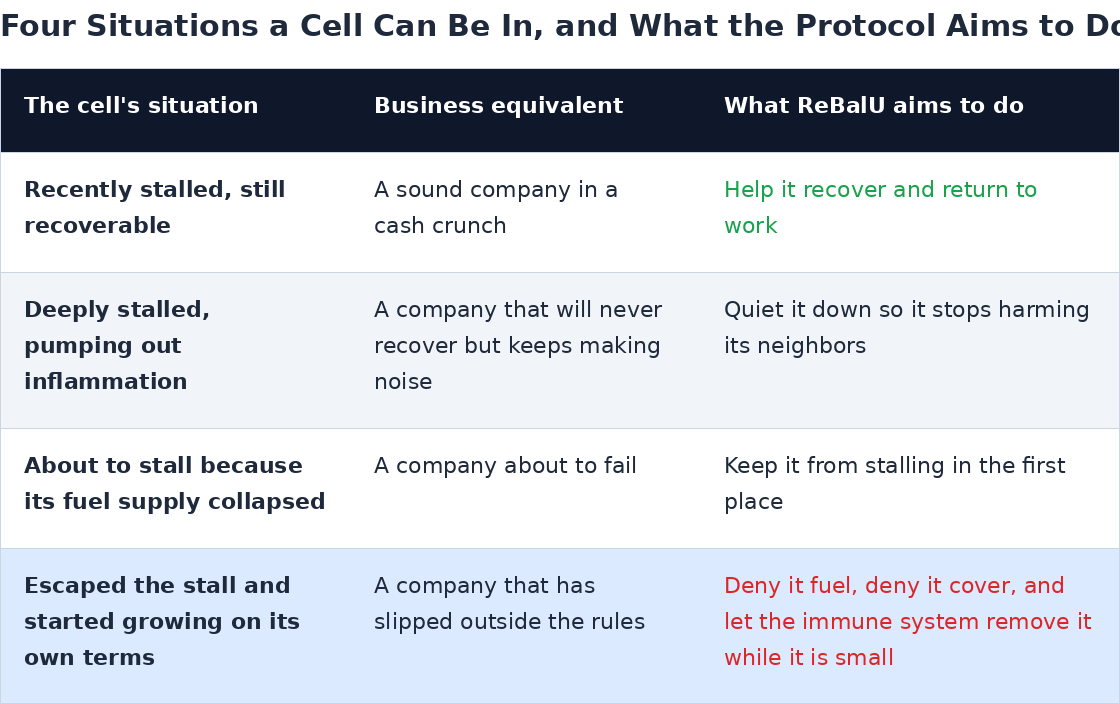
That last row is what we call the Frankenstein problem. A zombie cell has been stopped for a reason. It carries damage the body does not want copied. If you simply wake it up and let it divide again, you risk creating something worse. A cell that resumes dividing with its damage intact, and has also learned to ignore the stop signal, is a cancer risk. That is Frankenstein's monster, assembled from parts that should have stayed still.
ReBalU's answer is the discipline Victor Frankenstein never had: do not abandon what you have revived. The protocol uses three safety gates. First, it restricts the specific fuel supply that a runaway cell needs to grow, which is one reason the formula uses tagatose rather than ordinary sugar. Second, it refuses to hand cells extra antioxidant protection beyond what their own genes provide, because tumors use exactly that kind of cover to survive. Third, it feeds the immune system, through butyrate and DHA, so that it can find and remove the runaway cell while it is still tiny. A short set of follow-up blood and stool tests tells the doctor whether those gates are holding.
Schumpeter would have recognized this. He saw bankers, not just competition, as the economy's gatekeepers. They decide which new ventures get money and which are refused. Refusing credit is the quiet form of creative destruction. A doomed venture is not smashed. It is simply denied the means to grow. ReBalU's first gate is a credit refusal aimed at a cell that wants unlimited fuel.
8. Eighty-one starting hands and five ways to play them
Schumpeter refused to explain an economy with a single variable. He tracked several kinds of innovation, several cycle lengths, and the history behind them all at once. ReBalU is built the same way.
Everyone inherits a version of four key defense genes. Think of them as four fire extinguishers guarding four different parts of the cell: one for the power plant, meaning the mitochondria, one for the main floor, one for the outer walls, and one that handles fat and DHA delivery. Each gene comes in three common versions, and three versions across four genes gives 81 possible inherited combinations. You are born with one of the 81, like a starting hand in cards.
ReBalU groups the 81 hands into five lanes that guide how closely a doctor should watch and what to focus on: Resilient, Compensated, Monitor, Active management, and a highest-attention lane for people who inherited the weaker version of several genes at once.
Two rules keep this honest. First, your starting hand is not your fate. It sets your ceiling, but your daily life sets the load, and your reserve is the headroom in between. Someone with a strong hand and a punishing lifestyle can have less reserve than someone with a weak hand who takes care of it. The measured reserve, not the genetic label, drives the decision. Second, the five lanes are a working hypothesis. ReBalU's own research plan says that if the lanes turn out not to change how people respond to treatment, they should be collapsed into a single recommendation rather than kept for show. Schumpeter's critics accused him of imposing more pattern on the data than the data could support. One called his cycle theory "Pythagorean moonshine." ReBalU's rule is designed to avoid earning the same criticism.
9. How systems decline: too much of one thing
Schumpeter's most controversial prediction was that capitalism would decay not because it failed but because it succeeded. As big companies got bigger and innovation became routine, the small, scrappy firms that drove renewal would be squeezed out. Progress would be handed to teams of trained specialists producing what was required in predictable ways, and the system would "break to pieces under the pressure of its own success." The problem was not stress. It was the loss of variety in the sources of renewal.
The body declines the same way, and ReBalU's research has a clear example. Populations in East Asia mostly inherited a weaker version of the mitochondrial defense gene, yet stayed healthy for generations on a varied, fiber-rich, fermented diet that kept their gut bacteria producing protective compounds. When Western diets arrived, and especially when artificial sweeteners and energy drinks took over, that variety collapsed. The genes did not change. The diverse inputs that had propped up the reserve did. A monoculture diet is the biological version of a monopoly: efficient in one narrow way and fragile in every other.
The same lesson applies to treatment. Taking one antioxidant compound in a large dose is Schumpeter's routine administration. It does the body's job for it instead of prompting the body to do its own job, and it can switch off the very signals that drive rebuilding. Fast improvement on one number at the expense of the whole system is decline dressed up as progress.
It even applies to organ transplants. A new kidney, heart or liver is like a huge injection of capital into a struggling economy. It buys time, but it does not change the person's inherited genes or remove the daily stresses that wore out the original organ. ReBalU's transplant research therefore keeps tracking reserve after the operation instead of treating surgery as the finish line.
10. Where the comparison should not be pushed too far
Good analogies know their limits. Three matter here.
Schumpeter thought decline was inevitable. ReBalU does not. He believed capitalism's success would erode its own foundations no matter what anyone did. ReBalU's whole premise is that your genes set a ceiling but your state is changeable, and that being primed is not the same as being tipped. The protocol exists to prove that decline within your ceiling is not destiny.
Economic destruction is a brawl. Biological destruction is a procedure. In Schumpeter's world, new firms simply outcompete old ones. In your body, cell removal is carefully controlled and switched on by specific signals. When it runs out of control, it becomes disease. Creative destruction is healthy in the body only when it stays controlled and reversible.
The economy has entrepreneurs. The body does not. Schumpeter's hero is a person who makes new combinations happen. Inside your body, the closest thing is a set of genetic programs that build new defenses when signaled. In the ReBalU system as a whole, the entrepreneur is the doctor running the test, treat and test loop: introducing a new combination, watching what happens over time, and adjusting.
11. The bottom line
Schumpeter taught economists that a healthy economy is not one that sits in balance. It is one that keeps the ability to tear down what is broken and build something better, and it loses that ability when too much depends on too few sources of renewal. ReBalU says the same thing about your body. Health is not a number that falls inside a normal range. It is the depth of your reserve and your body's continued capacity to clean up, rebuild and recover, measured over time, one person at a time.
What this paper is and is not
The 81 genetic combinations describe inherited starting points, not 81 diseases, and the five lanes are working categories for monitoring, not proven risk scores. The link between these genes and specific health outcomes has not yet been validated in clinical trials, and the direction of one of the four genes depends on a person's selenium status. ReBalU does not claim to reverse deep cell aging, lengthen telomeres, or treat or prevent cancer. This paper compares two ways of thinking about living systems. It is not medical advice.
Sources
Fraser Institute, The Essential Joseph Schumpeter.
Essential Scholars, Business Cycles: Understanding the Ebbs and Flows of the Economy.
Schumpeter, Capitalism, Socialism and Democracy, Chapter 12, "Crumbling Walls."
St John, Schumpeter's "Pythagorean Moonshine": Business Cycles.
Cato Institute, A Celebrated and Puzzling Book.
SOD Sciences internal materials: the ReBalU redox-reserve and life-stressor thesis; the Four-Locus Permutation Matrix and East Asian redox-reserve whitepaper; the cellular-senescence method-of-use track; and the transplant reserve research design.
This document presents a scientific hypothesis for discussion. It is not medical advice. The proposed intervention has not been evaluated by the FDA and is not intended to diagnose, treat, cure, or prevent any disease. Talk to your own physician before starting or stopping any supplement or treatment, and nothing here is a reason to delay or decline care you have been offered.