
Yen and Japanese Equities: Significant Decline Ahead


Japan cannot refund its debt without higher rates. The stock market and the currency pay for it.
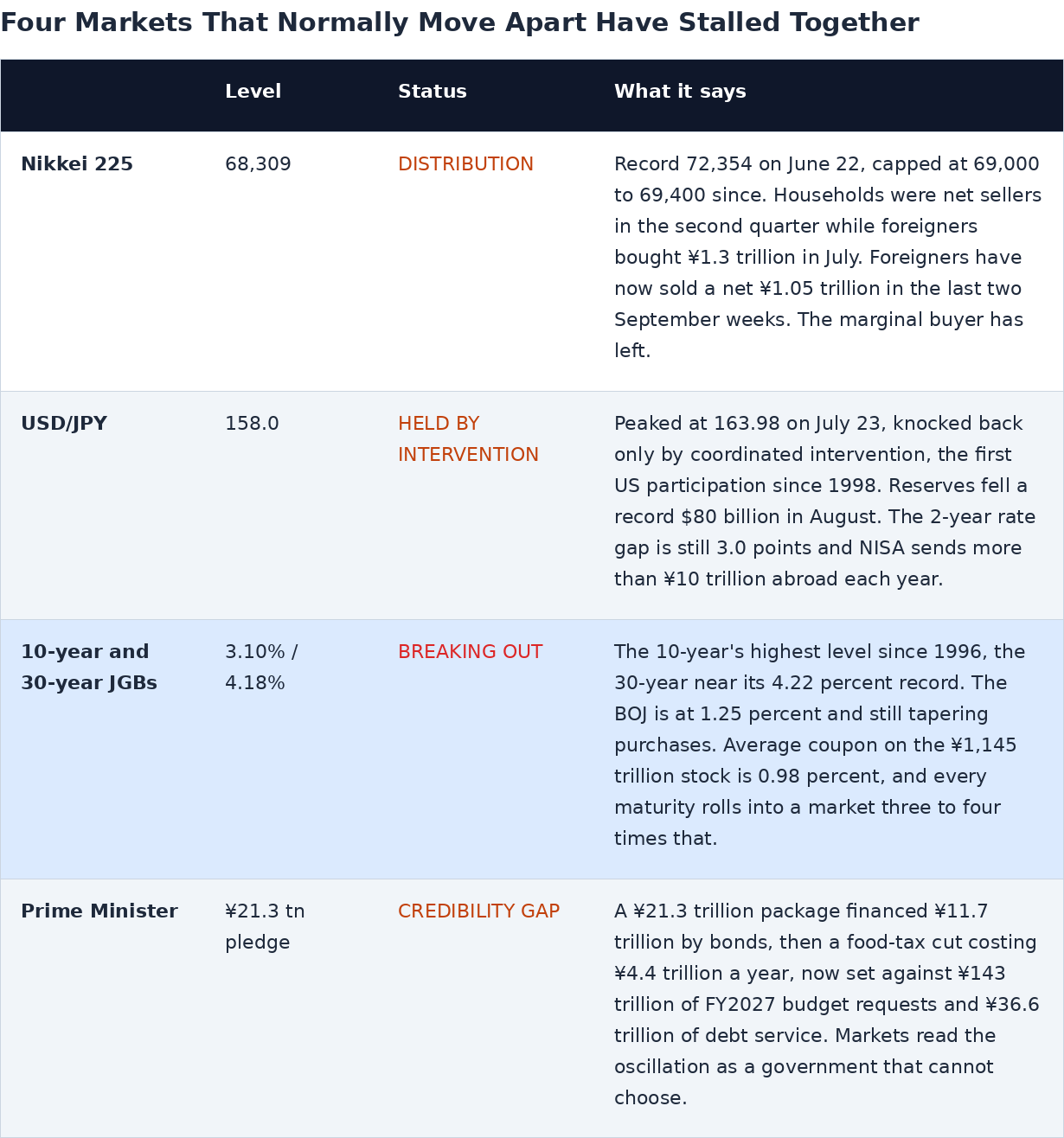
Four markets that normally move against each other have stalled together. The Nikkei has gone sideways under 69,000 after a 60 percent run, with households selling to foreigners and foreigners now selling too. The yen sits at 158 only because the Ministry of Finance has sold 27.1 trillion yen of reserves this year to hold the 160 line. The 10-year JGB is at 3.10 percent, its highest since 1996, and the 30-year is a few basis points from its 4.22 percent record. And the Prime Minister is hedging on the stimulus that got her elected, caught between a 21.3 trillion yen package and a debt-service bill the Ministry of Finance now budgets at a 3.8 percent assumed rate. When bonds, stocks and the currency all stop at once, the market is telling you something has to give. This note says what, and why.
Why the refunding cannot happen without higher rates
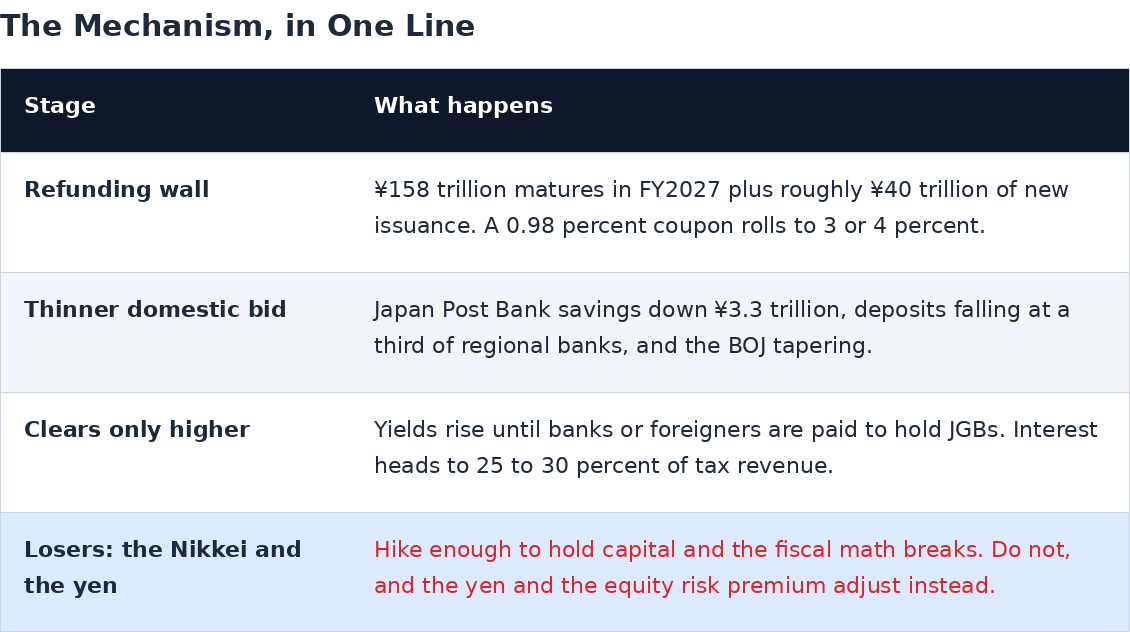
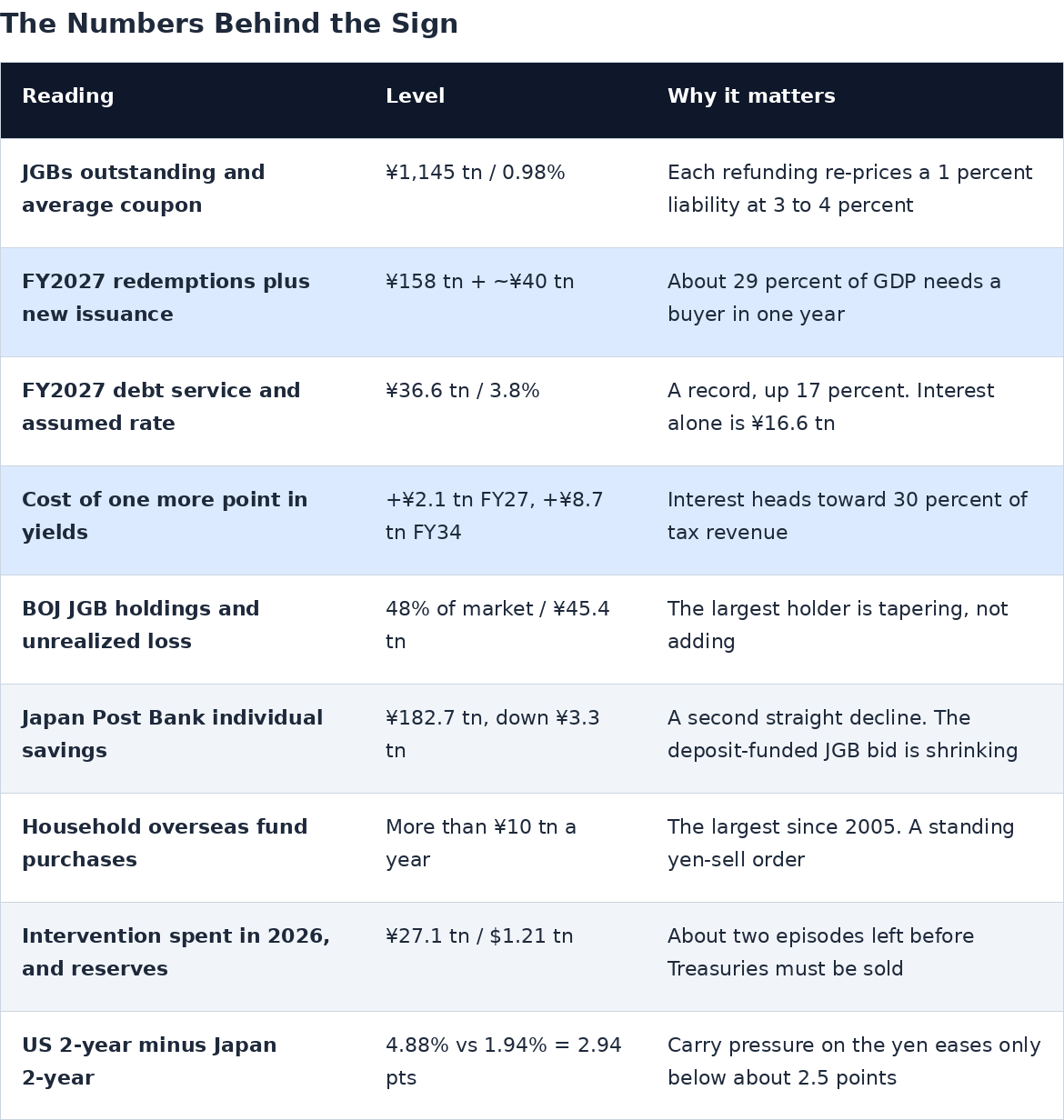
Japan's debt problem is not the stock of debt. It is the coupon on it. The government owes 1,145 trillion yen at an average coupon of 0.98 percent, with 158 trillion maturing in the fiscal year that begins next April. Every yen rolls into a market where the 10-year pays 3.10 percent and the 30-year 4.18 percent.
The Ministry of Finance has conceded the arithmetic. Its FY2027 request lifts the assumed rate to 3.8 percent and debt service to a record 36.6 trillion yen, with each further point of yield adding 2.1 trillion in year one and 8.7 trillion by FY2034.
The buyers who absorbed this at any price are leaving. The Bank of Japan, holder of 48 percent of JGBs, is tapering while carrying 45 trillion yen of unrealized losses. The deposit-funded banks are losing deposits: Japan Post Bank's individual savings fell 3.3 trillion yen last year, and individual deposits are shrinking at nearly a third of regional banks. Households are moving cash into global and US equity funds at more than 10 trillion yen a year, and each purchase is a yen sale. With the central bank, the banks and the households all stepping back, the clearing price for 200 trillion yen of annual issuance is higher, not lower.
What declines, and how far
Nikkei 225. The run from the 52-week low of 45,042 to the 72,354 record is the structure being distributed. Loss of the 67,000 gap confirms it. The September low of 63,492 is the first stop, then the retracements of the run: 61,900 at 38.2 percent, 58,700 at 50 percent and 55,500 at 61.8 percent, a 15 to 20 percent decline from here. In August 2024 a smaller shock took the index down 12 percent in one session.
USD/JPY. A close above 160 reopens the July high of 163.98. The Ministry has roughly two episodes of liquid firepower left. Past that it must sell Treasuries, which raises US yields and widens the differential it is fighting. The working zone for the next leg is 165 to 170, where intervention capacity, not economics, sets the ceiling.
Why the yen and stocks lose together
In August 2024 the yen and the Nikkei moved in opposite directions. The BOJ hiked, the carry trade unwound, the yen surged and stocks crashed. This time the driver is fiscal risk premium and household outflow, not cheap carry, so a weaker yen no longer lifts exporters. It raises import costs, pushes JGB yields up, and forces the BOJ toward hikes that hit bank and insurer balance sheets.
Both exits lead to the same place. Hike fast enough to hold capital at home, meaning about 2.5 percent against a Fed pause, and debt service climbs 5 to 7 trillion yen a year while equity multiples compress. Do not, and the yen takes the adjustment and foreign holders of Japanese stock sell to protect dollar returns. The refunding gets done either way. The price is paid in the currency and the equity market, which is why both are flashing at once.
Confirms the break. A Nikkei close below 67,000. A USD/JPY close above 160. The 30-year JGB above 4.22 percent. A super-long auction tail.
The only reset. The BOJ at 2.5 percent or higher with the Fed on hold, taking the 2-year gap under 2.5 points, at a cost of 5 to 7 trillion yen a year in debt service.
For discussion purposes only. Not investment advice, a recommendation, or a solicitation to buy or sell any security, currency or instrument. Figures are closing readings of October 1 and 2, 2026 unless noted, drawn from published Ministry of Finance, Japan Post Bank, exchange and market sources believed reliable but not independently verified. Price levels, retracement targets and policy paths set out here are the authors' expectations and may prove wrong.
The authors hold positions in securities mentioned and reserve the right to buy or sell shares at any time without notice.