
Buy With Both Hands


The real rate catches the 99-year clock: the hike scored, the war premium has a November expiration, and the monster move is queued behind a single catalyst with a date on it. A JD Unfiltered Special Report. The scorecard, the long bond, the premium, the corridor, the call.
"I'm not in the forward guidance business."
Kevin Warsh, Chairman of the Federal Reserve, September 16, 2026
I. The Scorecard: Three Calls, Three Hits
The September 12 whitepaper, The Real Rate on the 99-Year Clock, made three specific, dated, falsifiable calls. Score them before writing another word.
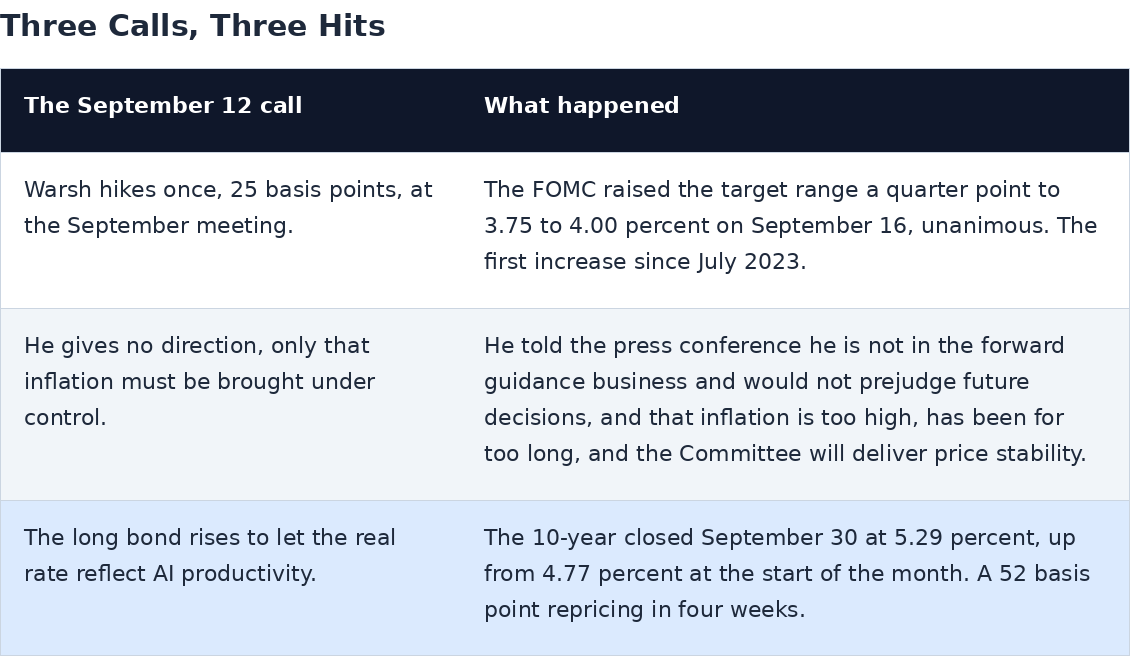
He went further than the script. Warsh refused to submit a rate projection to the dot plot, rejected the practice of officials previewing their outlooks in speeches, and when asked whether policy was now restrictive relative to the neutral rate, dismissed the concept as "useful academically" with no bearing on the decision. The hike itself was unanimous and widely anticipated. One sentence from the transcript is the whole doctrine: "inflation is a choice," and the Committee had just taken a step toward delivering it. No path, no promise, no premise. Exactly the Strong-style discipline the whitepaper forecast: act, say nothing, let the tape do the talking.
II. The Long Bond: Not Scared, Shopping
The consensus read on a 5.29 percent 10-year is fear, meaning fiscal worry, term premium, indigestion. The consensus is reading the wrong century. The long bond is rising for the same reason it rose in the mid-1920s. The return on capital in the real economy has gone vertical, and the sovereign has to compete for money against its own boom.
Put numbers on the competition. Goldman Sachs' new framework for AI compute returns uses a baseline hurdle of 15 percent annualized return on invested capital for the six hyperscalers' 2026 to 27 buildout, roughly $42 billion per gigawatt of capacity, needing about $1.42 trillion in cumulative revenue by 2028 to 30 to clear the bar, and concludes the hyperscalers are almost certainly already earning above that baseline on existing capex. Amazon told investors its servers break even in roughly three years and then generate significant cash for two to three more. The buildout this competes for is not small. Goldman's baseline model has AI capex at $765 billion in 2026, growing to $1.6 trillion annually by 2031.
When private capital can earn 15 percent and better building the machine that electrifies the service economy, the United States Treasury does not get to borrow for ten years at a 1 percent real rate. It must pay a real rate that respects the marginal return on capital. That is not a crisis. That is the natural rate moving to meet 5 to 6 percent productivity growth, the same migration that carried the 1920s real rate toward its 1927 level near 4.5 percent. Today the real 10-year sits in the 2 to 3 percent range against the underlying inflation measures: about 2.9 percent against core CPI, about 2.3 percent against core PCE. The model says it finishes the year at 3 to 4 percent. The bond math says there are only two ways to get there. Yields rise further, or inflation falls. The answer is the second, and the evidence is already in the August internals.
The long bond is not voting against America. It is demanding its share of the boom.
III. The Premium: The War Premium Is the Inflation
Open the August CPI release and perform the autopsy. Headline inflation ran 3.4 percent over twelve months. Core, stripping food and energy, ran 2.4 percent, down from 2.5. The entire overshoot above target, to the first decimal, is the war: energy up 16.3 percent year over year, gasoline up 27.4 percent. Warsh's own hawkish evidence is the same story wearing a uniform, with the Bloomberg Commodity Index up more than 30 percent this year and diesel up 83 percent. That is not an overheating economy. That is a seven-month war in the Strait of Hormuz running through every gas pump and delivery truck in America.
Now look at what the war cannot reach, meaning the domestic engine the Fed actually controls.
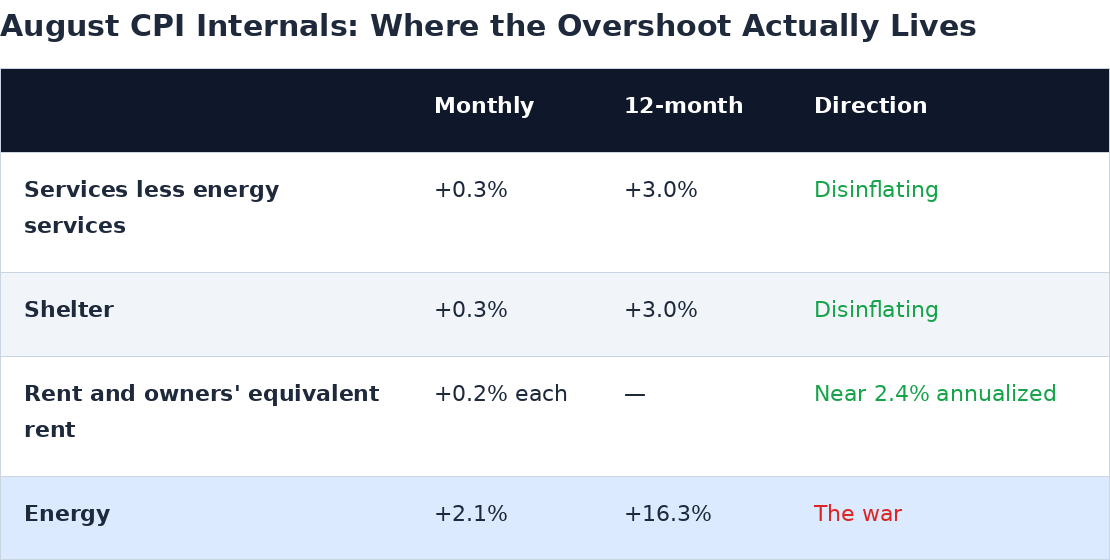
Shelter at 3.0 percent with rent and owners' equivalent rent printing 0.2 percent a month is a pipeline, not a plateau. The monthly pace annualizes near 2.4 percent, which means the twelve-month shelter number mechanically grinds lower every month as old, hotter prints roll off. Services ex-energy at 3.0 percent is the lowest-resistance path down as AI compresses the cost of service delivery, and this is where the electrification analogy pays in cash. And the August PCE confirmed the turn before the consensus saw it: core PCE printed 3.0 percent against a 3.3 percent forecast, headline 3.4 against 3.7 expected. The next three months should show service disinflation and shelter disinflation dramatically, because they already started in the data nobody read past the headline.
Strip the war, and the United States is a 2.4 percent inflation economy, falling, with a Fed chair hiking into it to retire the last argument against him.
IV. The Catalyst: November, Where the Premium Meets the Calendar
Everything above holds whether or not Tehran signs anything. The timing of the monster move is the one input that depends on the war, so be precise about what the tape says.
Brent traded back through $100 this week as talks stalled, with the expiring November contract settling at $103.50 while the more active December contract sits at $98.03, the curve itself pricing the premium as a front-loaded, fading thing. The diplomatic tracker reads the same way. A memorandum of understanding was signed, the end of the war formally declared, and the terms have been eroding through kinetic incidents since, with the strategic logic on both sides pointing to survival at least until the November midterm elections. Analysts see no deal before the midterms, and Fitch sketched in June what the other side of a deal looks like: Hormuz reopening and Iranian barrels returning.
The model's claim stands. The war premium dies in November. Not because peace is guaranteed, but because every actor's incentive converges there. The administration wants cheap gasoline after the midterms, Tehran wants sanctions relief it cannot request while the election makes concession impossible, and the oil curve is already leaning into exactly that resolution. When the premium fades, the 16.3 percent energy print does not go to zero. It goes negative. Headline CPI does not drift toward core. It crashes through it. By March, with the shelter pipeline draining, services compressing and the energy base effect inverting, 1 to 2 percent headline inflation is not a stretch. It is arithmetic.
V. The Corridor: Trapped Between 4 and 5.5, By Design
Assemble the machine. If March inflation prints 1 to 2 percent and the real rate settles at 3 to 4 percent, where AI-era capital returns say it belongs, then the 10-year is trapped in a 4.0 to 5.5 percent corridor. Not pinned. Trapped, by design, between two walls the doctrine built.
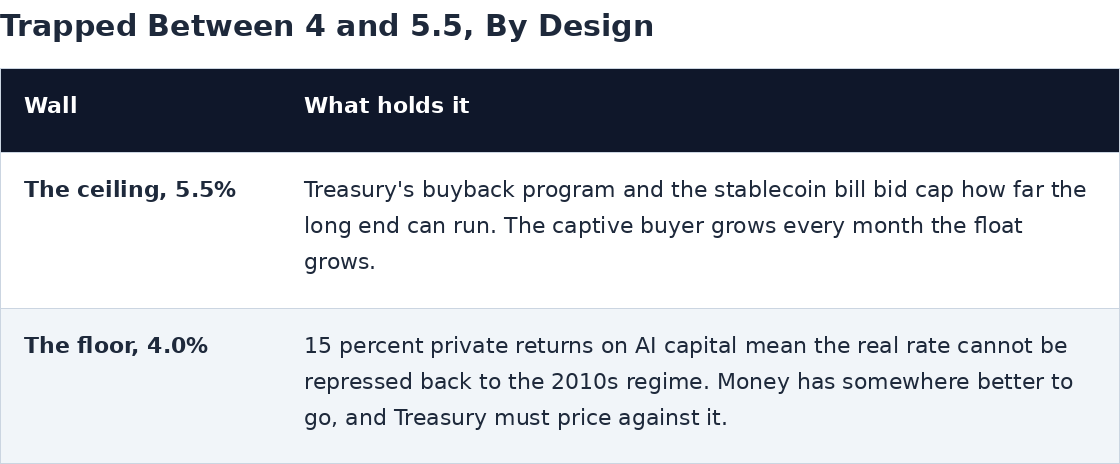
A 5.29 percent 10-year against 3.4 percent inflation looks restrictive. The same 5.29 percent against 1.5 percent March inflation is a 3.8 percent real rate, precisely the 1927 reconvergence the whitepaper mapped, achieved not by yields falling but by the war premium evaporating out of the denominator. The level of the nominal 10-year stops mattering. The corridor holds at both edges, and every asset that feared the long bond gets repriced against a real rate that certifies the boom instead of threatening it.
VI. The Call: The Coiled Spring
This is the setup the 99-year clock has been pointing at all year. The hike is in. The chair has no forward guidance to walk back and no dot in the plot to defend. He is free to stand down the moment the standard is satisfied, and the standard is being satisfied in the shelter and services data right now. The premium that manufactured the entire inflation overshoot has a November expiration written into the oil curve and the electoral calendar. And the vertical year, 1928 equals 2027, is next on the tape.
The crowd sees 5.29 percent and $100 oil and calls it a wall of worry. The model sees a coiled spring: disinflation already loaded, a premium about to fade, a real rate rising for the most bullish reason a real rate can rise, and a Fed chair who just spent his credibility buying the one thing bull markets die without, which is anchored expectations at the start of a productivity boom.
The monster move is not coming eventually. It is queued behind a single catalyst with a date on it. Be bold. Buy with both hands.
The honest ledger, as always. If the talks collapse into escalation rather than stalemate, the premium persists and the March inflation window slips a quarter. If shelter re-accelerates against the pipeline, the corridor's logic weakens. And if Warsh mistakes the fading premium for his own handiwork and keeps hiking into the disinflation, he writes the 1928 acceptance-desk chapter early. Watch those three. Everything else is noise in front of a freight train.
This report is the opinion and market commentary of JD Unfiltered, published for informational and discussion purposes. It is not investment advice, a recommendation to buy or sell any security, or a solicitation of any kind, and it does not take account of any reader's objectives or circumstances. Rate, inflation, oil and index projections are outputs of the JD Unfiltered framework rather than predictions of certainty, and the dated calls in this report may prove wrong. Figures are drawn from public releases and third-party reporting believed reliable but not independently verified. Readers should do their own work and consult their own advisers before acting.
The authors hold positions in securities mentioned and reserve the right to buy or sell shares at any time without notice.