Follow the Paperwork: The Case That Tesla and SpaceX Are Headed for One Ticker

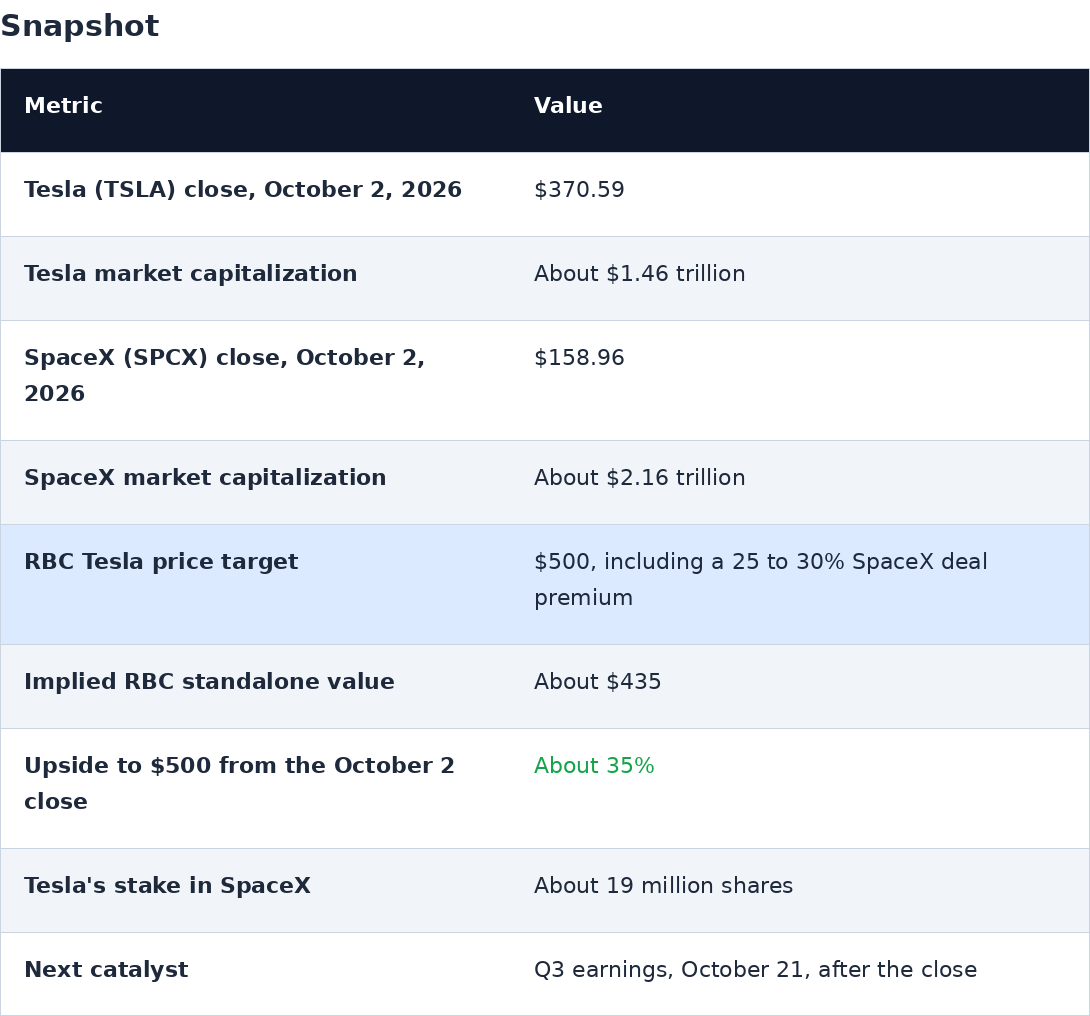
The hurdles to a combination are being cleared one at a time. This piece lays out the evidence trail, the obstacles that remain, and why $500 is the right target for Tesla. TSLA, SPCX. JD Unfiltered Research.
Disclosure: the author holds shares and options in both Tesla and SpaceX. See the full disclosures at the end of this report.
The Berkshire Blueprint
In 1971, Warren Buffett's empire was a tangle. He and his wife personally owned 13 percent of Blue Chip Stamps. Berkshire Hathaway, in which the Buffetts held 36 percent, owned another 17 percent. Diversified Retailing, 42 percent owned by the Buffetts, held 16 percent more, and Diversified also owned Berkshire shares. Capital, management and deal flow moved across the entities long before the legal structure caught up.
The cleanup came in two steps. Berkshire absorbed Diversified Retailing at year-end 1978, lifting its Blue Chip stake to about 58 percent. In 1983, Blue Chip itself was merged in. Buffett reported in that year's letter that the deal "went off without a hitch." Less than one-tenth of 1 percent of either company's shares voted against it, and no holder sought appraisal.
The lesson for Tesla and SpaceX is about sequence. When one controlling mind runs several companies that share people, customers and capital, the operating merger comes first and the legal merger follows. Chamath Palihapitiya has said a Tesla and SpaceX combination would "create the Berkshire Hathaway of the modern century." The more useful point is that Musk appears to be following Buffett's sequence, and the operating merger is already far along.
Our view is that a combination is coming. The open questions are structure and timing, not direction.
The Breadcrumbs
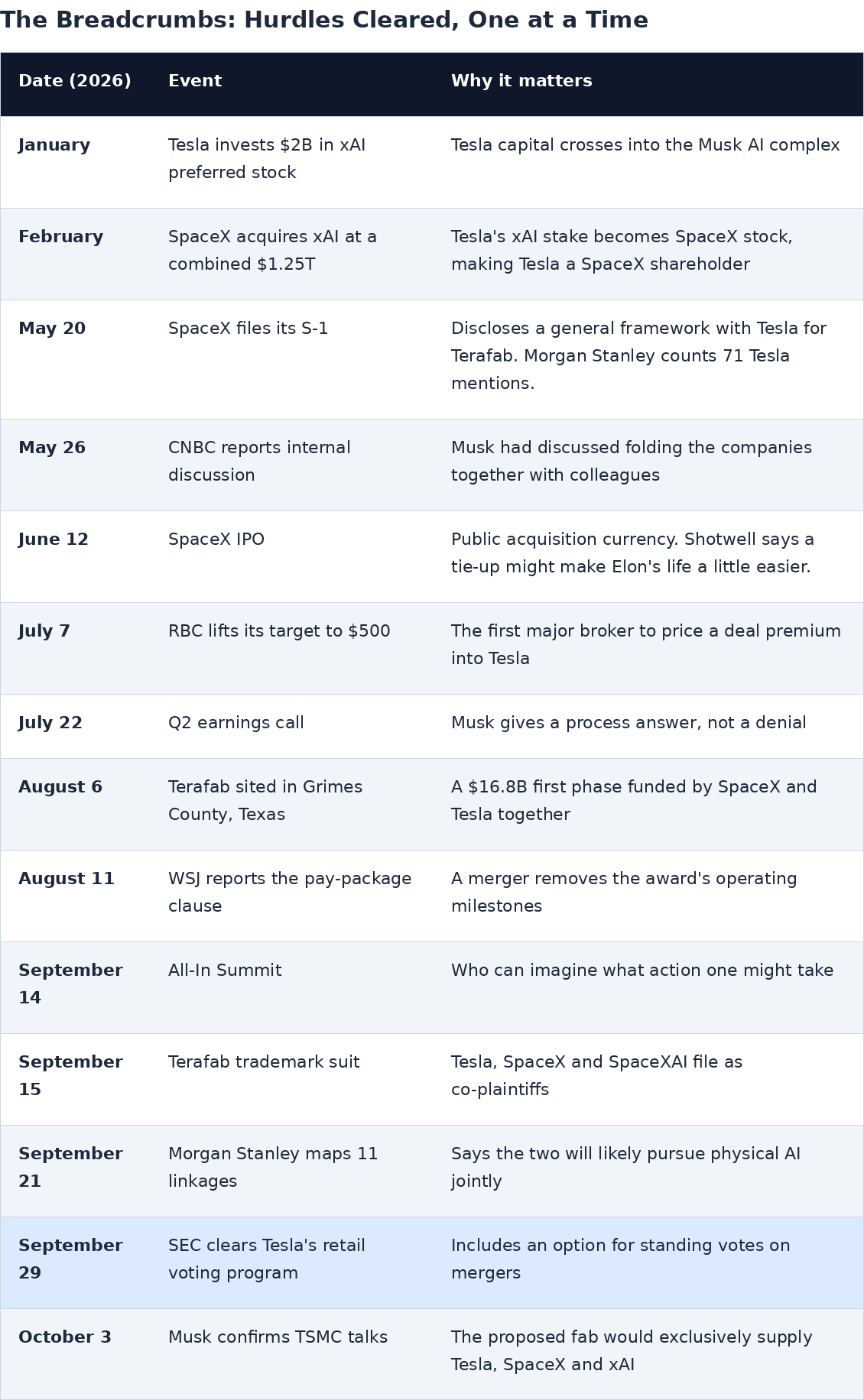
None of the items below proves a deal on its own. Read in order, they show a steady pattern of hurdles being cleared and doors left open.
The earnings call answer
On July 22, Wells Fargo's Colin Langan asked directly whether combining the companies made sense. Musk pointed to growing overlap between the two businesses, especially around Terafab, which he described as a gigantic project, then said the companies obviously cannot talk about combining, and that "it's got to be done with the appropriate process."
He then handed the question to general counsel Brandon Ehrhart, who described numerous beneficial transactions between the two companies and a relationship deepened through an investment and a framework agreement.
Executives who want to kill a rumor say no. Musk talked about process and passed the question to his lawyer. That is how a CEO answers when a conflicted transaction may come before an independent committee and he cannot be seen negotiating it in public.
The All-In answer
Eight weeks later, Musk was asked on stage why the companies remain separate. He opened with mock surprise that nobody had ever asked, then said that with all the collaboration on so many levels, "who can imagine what action one might take." The sarcasm acknowledges the question, and the second sentence closes no doors.
Hurdles Already Cleared
One: acquisition currency
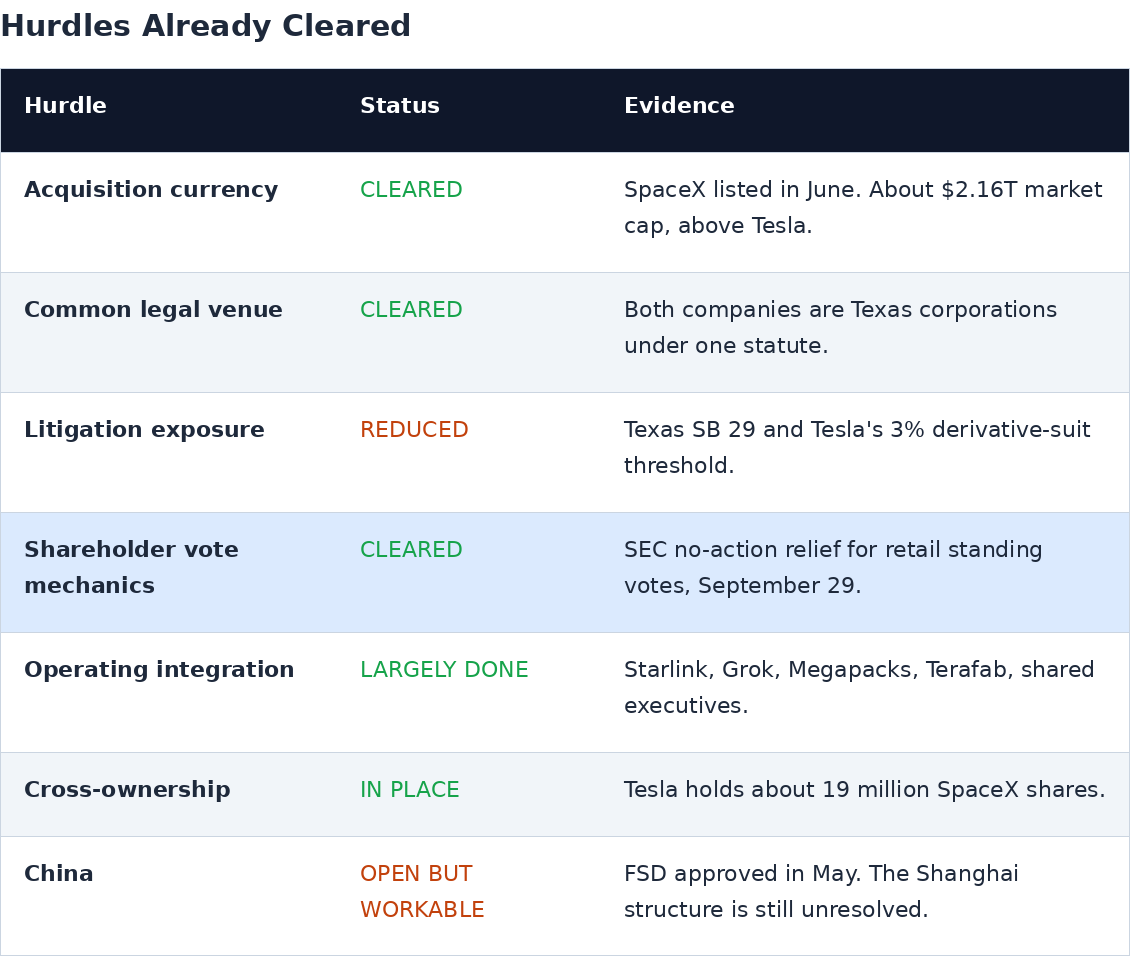
Before June, SpaceX had no listed stock to pay with. It now trades at roughly $2.16 trillion, well above Tesla's $1.46 trillion, and above its $135 offering price. Insider lockup expirations have passed without the feared rout. The acquirer and its currency now both exist.
Two: one state, one rulebook
SpaceX converted from a Delaware to a Texas corporation effective February 14, 2024, and Tesla followed later that year. A combination would be governed by a single statute, the Texas Business Organizations Code.
That statute has since moved in management's favor. Texas SB 29, signed in May 2025, codifies the business judgment rule, permits early court rulings on director independence, and lets companies set ownership thresholds for derivative suits. Tesla adopted a 3 percent threshold, and a shareholder proposal to repeal it failed at the November 2025 meeting. At current prices, 3 percent is a stake of more than $40 billion.
Compare the SolarCity precedent. Tesla's 2016 all-stock purchase of SolarCity, with Musk on both sides, drew Delaware litigation that ran until 2023. Musk still won, as the Delaware Supreme Court affirmed the deal as entirely fair. The legal overhang that followed SolarCity is now considerably smaller.
Three: the vote
This is the most underappreciated development of the quarter. On September 29, the SEC granted Tesla no-action relief for its Issuer Voluntary Retail Voting Program on the same day the request was filed. Tesla's letter says the request followed "months-long" discussions with SEC staff.
Retail holders can now sign up for a standing instruction to vote with the board's recommendation, and one option covers every matter, including mergers. Recent history shows why that matters. Retail support carried Musk's 2025 pay package over ISS and Glass Lewis opposition. And the board made no recommendation on the xAI investment proposal, which drew 1.06 billion votes for and 916 million against, but more than 473 million abstentions counted as votes against, and it failed.
Low retail turnout is the single biggest procedural risk to a Tesla merger vote. A standing instruction tied to the board's recommendation addresses exactly that problem.
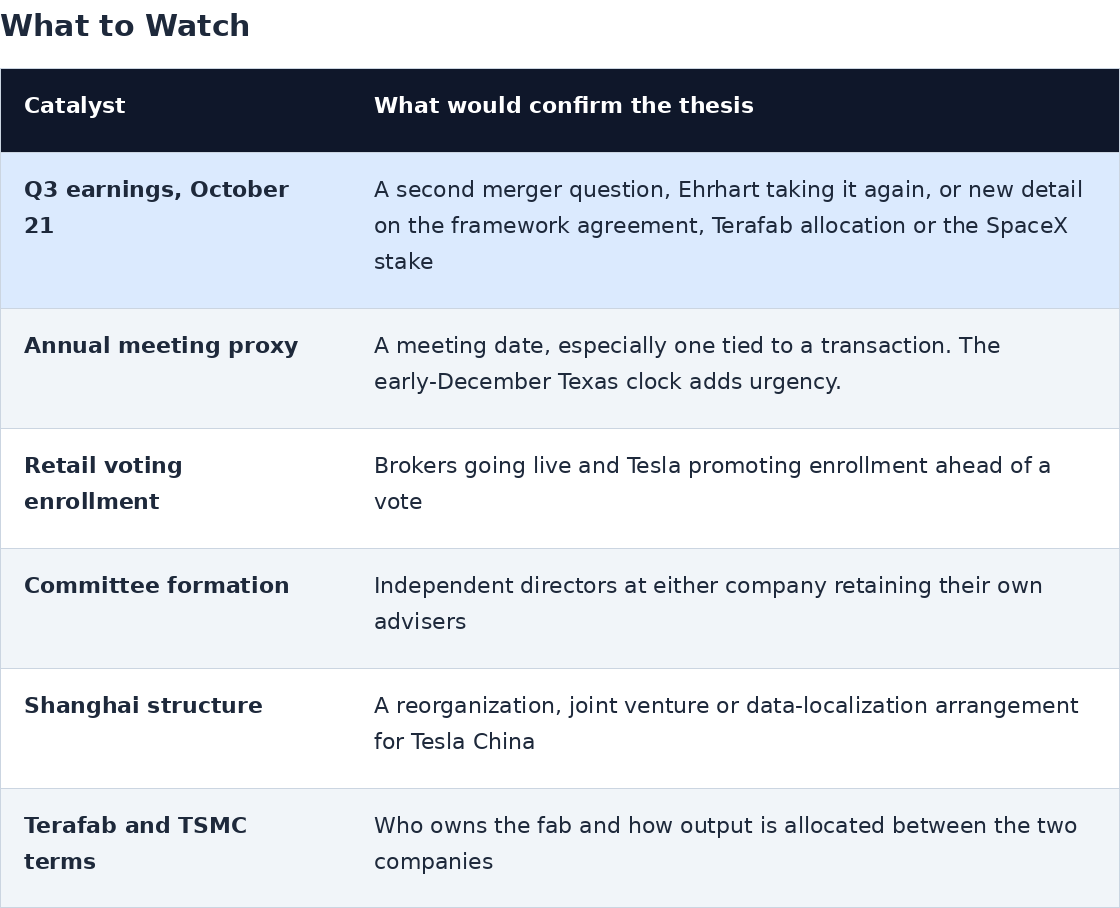
The timing also lines up. Tesla has not set a date for its 2026 annual meeting and no proxy is on file. Under Texas law, a shareholder can petition for a court-ordered meeting after 13 months, which for Tesla falls in early December. A company preparing a transformational vote has good reason to fold it into the meeting it has not yet called.
Four: the operating merger is largely done
Morgan Stanley's SpaceX analyst Adam Jonas mapped 11 areas of linkage: chips and AI hardware, energy storage, vehicles and components, agentic platforms, solar, materials engineering, vendors, connectivity, cross-ownership, culture and talent. His summary was that "SpaceX gives Tesla compute, connectivity and capital," while Tesla supplies robots, data, energy and manufacturing in return.
Starlink in every Tesla. Musk said Starlink is going into Cybercab and will soon be integrated into all Tesla vehicles, so that robotaxis do not go missing in cellular dead zones. Tesla filed a patent in December 2025 for an RF-transparent roof built to house satellite hardware.
Grok inside Tesla. SpaceX's Grok runs in Tesla vehicles, and Musk called it "the big model that is the manager of Digital Optimus."
Energy. SpaceX and xAI bought $506 million of Megapacks and $131 million of Cybertrucks in 2025, then $295 million more of Megapacks in the second quarter of 2026 alone.
Chips. Terafab is a joint $16.8 billion first phase that could reach $119 billion. On October 3, Musk confirmed he is in talks with TSMC on a captive facility serving only his companies.
People. Musk and Ira Ehrenpreis sit on both boards, and Charles Kuehmann runs materials engineering at both.
Terafab deserves emphasis. Once both companies depend on a single captive chip supply, every wafer allocation becomes a related-party decision that needs a price, a priority and an independent sign-off, and each one invites a lawsuit. Common ownership removes that friction permanently. Integration this deep makes the arm's-length structure harder to run than a merger would be.
Five: China is workable
China was always the hard problem, and it remains one. The direction has improved, though. Tesla's FSD launched in China in May 2026 after years of delay, one week after Musk accompanied the US presidential delegation to Beijing. Beijing granted a sensitive, data-dependent approval while a SpaceX combination was being openly discussed. That is not consent to a merger, but it shows the relationship can bear weight.
The Incentive
Musk's 2025 CEO Performance Award contains a change-in-control clause that drops the operating milestones. In a deal, each of the 12 tranches tests only market value, measured at the greater of the last close or the per-share deal price, and vests immediately if it clears. A transaction valuing Tesla at $2 trillion, about $506 per share, would vest the first tranche of about 35.3 million shares without a single robotaxi milestone.
Critics will call this a conflict, and an independent committee will have to address it. For an investor judging the odds, the point is simpler. The person who controls the decision has a clear financial reason to make it, and the figure where his incentive pays lines up almost exactly with the Street's merger-adjusted target.
What Still Stands in the Way
A credible thesis has to name its risks.
No process artifacts yet. No special committee, banker engagement, 8-K or S-4 has been disclosed. Musk does not always telegraph, though. The xAI deal went from public rumor on January 30 to a signed all-stock agreement on February 2.
Shanghai. Gigafactory Shanghai produces over 950,000 vehicles a year and supplies more than half of global deliveries. Musk called the WSJ report of a China split absurdly fake news. Some ring-fencing structure for a US defense contractor that owns a Chinese manufacturing base is still required, and the market has not seen it yet.
Governance arithmetic. Musk holds about 85 percent of SpaceX voting power and about 20 percent of Tesla. RBC notes he would control more than 50 percent of a combined entity, which is why Tesla holders will demand a premium.
Exchange-ratio sensitivity. When both stocks fell in late July, Fortune calculated that SpaceX would be "hugely overpaying" for Tesla. Relative prices will set the timing as much as strategy will, and SpaceX's rebound to about $159 helps the acquirer.
Tesla's standalone numbers. Second-quarter revenue rose 25.5 percent to $28.24 billion, but operating income fell 56.9 percent to $398 million. A weak standalone story strengthens the case for a combination but limits downside protection if a deal slips.
None of these is a wall. Each is a negotiating problem with a known toolkit: an independent committee, a majority-of-the-minority vote, a Shanghai ring-fence and a premium.
Why $500
RBC's Tom Narayan set his $500 target to include a 25 to 30 percent premium to then-current trading levels and a 15 percent premium to the stock's intrinsic value, owing to a potential SpaceX acquisition scenario, and named an all-share SpaceX purchase at a 20 to 30 percent premium as the most likely structure. A 15 percent premium to intrinsic value puts RBC's standalone figure at about $435.
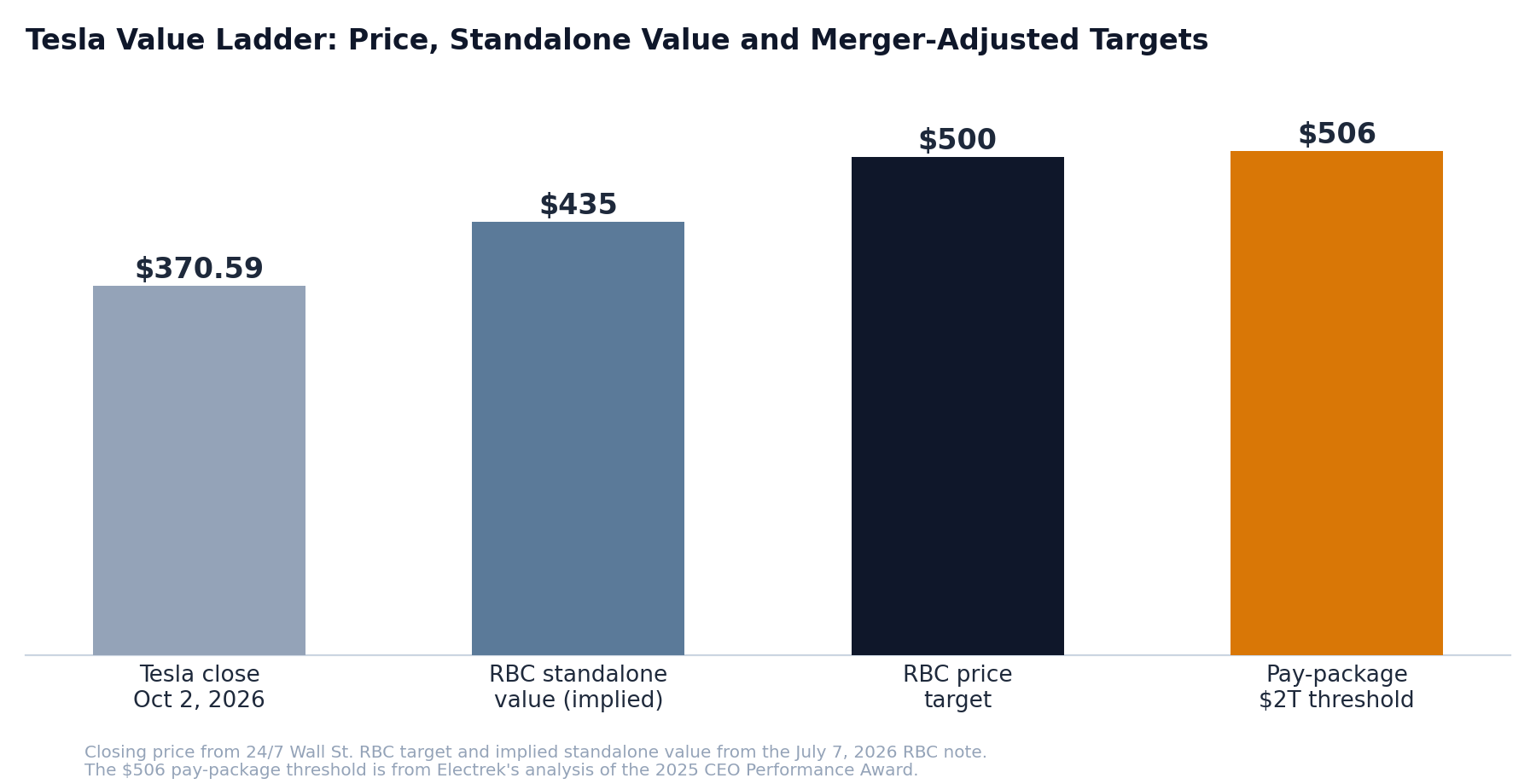
The entry price has improved. When RBC set $500, Tesla traded at $419.77. At $370.59 it trades about 15 percent below RBC's own standalone value. The deal premium is not priced in, and neither is part of the standalone value.
Two methods give the same answer. The broker's premium math gives $500. The pay-package math gives about $506 at a $2 trillion Tesla valuation. When the analyst's model and the controlling shareholder's incentive land within 1 percent of each other, the target is well supported.
The exchange ratio is workable. At $500 per Tesla share and SpaceX at $158.96, the ratio is about 3.15 SpaceX shares per Tesla share, implying roughly $2 trillion for Tesla. SpaceX would issue about 92 percent more stock, leaving SpaceX holders with about 52 percent of the combined company and Tesla holders with about 48 percent. That is close to a true merger of equals, and a split an independent committee can defend.
What to Watch
Conclusion
Buffett did not merge Berkshire, Diversified Retailing and Blue Chip because a banker pitched it. He did it because running one economic enterprise through three legal shells had become more trouble than it was worth. Tesla and SpaceX are at that point now. They share chips, power, connectivity, AI models, engineers, directors, a courtroom, a home state and a cross-holding. In the past four months the acquisition currency has been created, the legal venue unified and the vote mechanics cleared by the SEC.
What remains is mostly execution: a committee, a ratio, a Shanghai solution and a date. Follow the paperwork. Our target is $500.
Important Disclosures
Position disclosure. The author holds shares and options in Tesla, Inc. (TSLA) and Space Exploration Technologies Corp. (SPCX) as of the date of publication. The author may buy, sell, add to, reduce, hedge or close these positions, including options positions, at any time before or after publication and without notice. The author has a financial interest in the securities discussed and may benefit from price movements that follow publication. Readers should treat this article as the opinion of an interested party.
No investment advice. This article is for informational and educational purposes only. It is not investment, legal, tax or accounting advice, and it is not a recommendation or solicitation to buy, sell or hold any security or derivative. It does not take into account the investment objectives, financial situation or needs of any reader. Consult a qualified, licensed financial adviser before making any investment decision.
Opinion and price target. The views expressed, including the view that a Tesla and SpaceX combination is likely and the $500 target, are the author's opinion. The $500 figure is a third-party analyst target published by RBC Capital Markets that the author endorses; it is not an RBC endorsement of this article. No merger, merger agreement, exchange ratio or transaction price has been announced by either company. The exchange-ratio and ownership figures are illustrative calculations based on public prices and estimates, not reported terms.
No affiliation or compensation. JD Unfiltered and the author are not affiliated with Tesla, SpaceX, xAI, Elon Musk, RBC Capital Markets, Morgan Stanley or any other company or firm cited. The author received no compensation from any issuer, underwriter or third party for preparing or distributing this article.
Forward-looking statements. This article contains forward-looking statements about potential corporate transactions, regulatory outcomes, valuations and market prices. Such statements involve significant risks and uncertainties, and actual results may differ materially. The author undertakes no obligation to update this article as circumstances change.
Options risk. Options involve substantial risk and are not suitable for all investors. Option holders can lose the entire premium paid, and certain options strategies can result in losses greater than the initial investment. Event-driven positions tied to a possible merger can lose value rapidly if a transaction is delayed, restructured or abandoned.
Information and accuracy. Information is drawn from public sources believed to be reliable, including company filings, transcripts and news reports, but its accuracy and completeness are not guaranteed. Market data is as of the October 2, 2026 close unless otherwise noted. Past performance is not indicative of future results. All investments involve risk, including loss of principal.