
Paris, 1926 Again: The Bond Market Has Already Voted on France


The wall of money is back in Paris, France now borrows above Italy, and two hard dates in October decide what happens next. JD Unfiltered Research.
The Original Wall of Money
In the summer of 1926, France had cycled through a string of short-lived governments since the Cartel des gauches won the May 1924 elections, with the first Herriot cabinet falling after just nine months. Herriot blamed the "wall of money," the bankers and bondholders who refused to keep rolling French paper. By July 1926, wholesale prices were rising at an annualized rate of 350 percent and merchants were quoting deals in sterling as the franc collapsed. Raymond Poincaré was recalled as Prime Minister and Finance Minister on July 23, the franc was stabilized de facto that year, and the law of June 25, 1928 fixed it at roughly one-fifth of its prewar gold value.
A century later the wall of money is back in Paris. The difference is that this time the bond market is not only questioning France. It is repricing duration everywhere, including Treasuries.
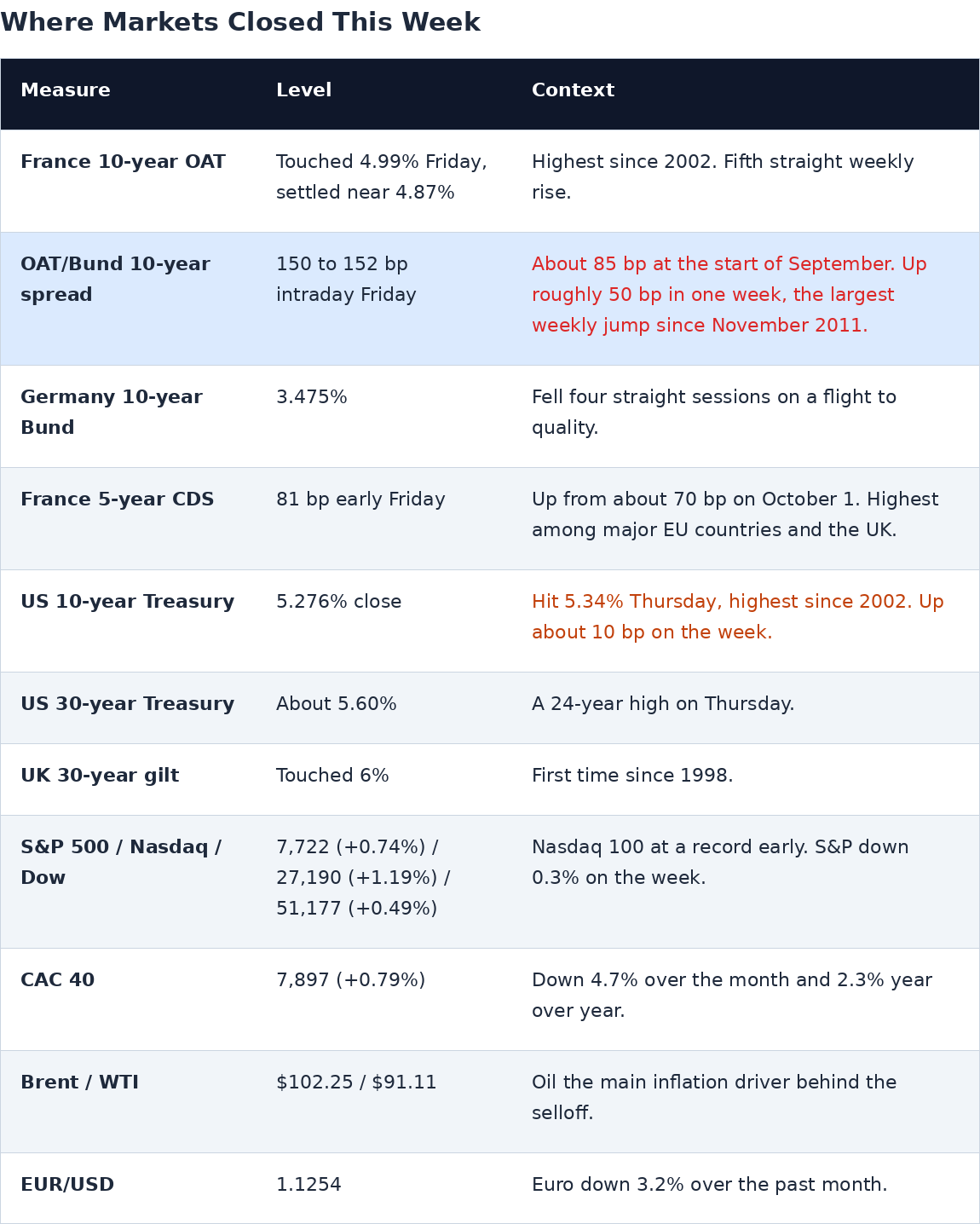
Snapshot: Where Markets Closed This Week
What Happened in Paris
The trigger was Prime Minister Sébastien Lecornu's 2027 draft budget, presented Thursday. Politico reports it proposes 43 billion euros in savings, including 9 billion of state spending cuts, a pension indexation freeze and an extension of the large-company surtax worth 5 billion, aimed at cutting the deficit from an estimated 5.4 percent of GDP in 2026 to 5 percent in 2027. The market's verdict was that this is too little, too late, and politically fragile.
The numbers explain why. Public debt hit 119 percent of GDP at the end of June, the highest since 1946, and is projected at 121.7 percent in 2027, with debt interest rising 12 billion euros in a single year to 91 billion, on Le Monde's figures. The deficit will sit at or above 5 percent for a fifth straight year, the largest in the euro area, and the tax burden rises for a third consecutive year to 44.2 percent of GDP. France plans to issue more than $380 billion of medium and long-term debt next year into a market already short duration.
The politics are worse than the arithmetic. There is no majority in the Assembly, Lecornu's two predecessors lost their jobs trying to pass budgets, and the plan effectively depends on Marine Le Pen's National Rally not toppling the government. Lecornu has not ruled out passing the budget by ordonnance, which would be a first under the Fifth Republic. The National Rally formed a Senate group for the first time after last Sunday's elections, and Le Pen leads the spring presidential race on a platform of tax cuts and a lower retirement age, while Jean-Luc Mélenchon is campaigning on having the central bank cancel its holdings of French debt.
Macquarie's Thierry Wizman summed up the trade. CDS pricing says the spread widening is about default risk, and the spread is a "guilty verdict" on the direction of French presidential politics. He puts the odds that a National Rally presidency damages the 2028 budget and credit perceptions near 50 percent. Fidelity's fixed income CIO added that hedge funds, now roughly half of activity in European government bonds and often levered, contributed significantly to the speed of the move.
Why the ECB Is Not Coming
The market's backstop assumption is the ECB's Transmission Protection Instrument. Do not count on it. The TPI requires a move that is both unwarranted and disorderly. France's move tracks fundamentals and has come in measured, news-driven steps, France is under an excessive deficit procedure, and the TPI has never been used, even when Italian spreads passed 200 basis points in 2022. Bundesbank President Joachim Nagel said Thursday that the ECB's tools protect price stability and do not target spread levels, and Bank of France Governor Emmanuel Moulin has warned against betting on a rescue.
The ECB is also tightening into the stress. Euro area inflation jumped to 3.8 percent in September, a three-year high and above the 3.6 percent consensus, driven by energy. The ECB has hiked twice since June, and markets expect four more hikes over the next year. UBS's Reinout De Bock framed it well: inflation risk, term premium, and fiscal and political uncertainty "are now reinforcing one another."
Effects on Europe
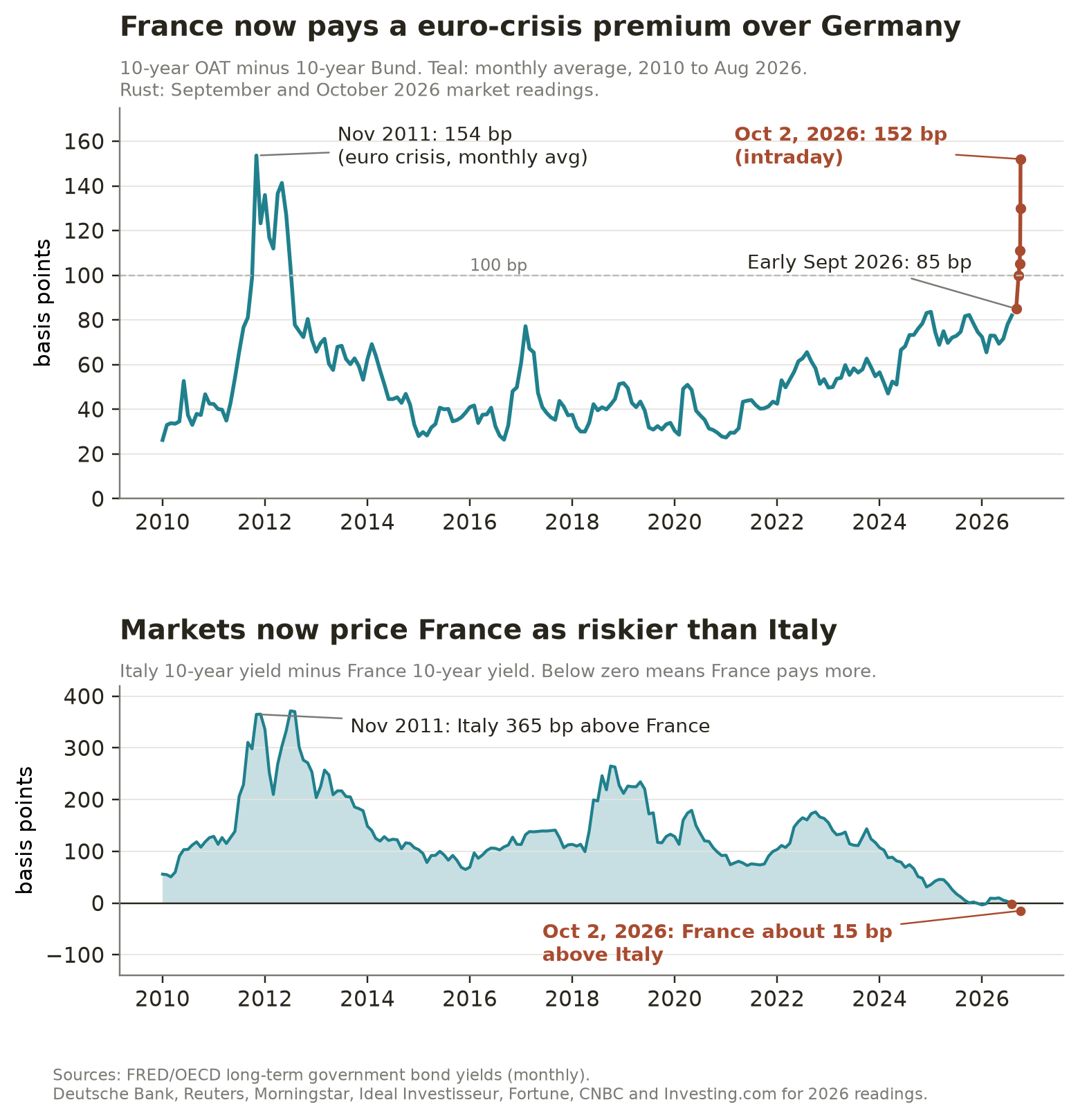
French risk is now priced wider than Italy and Greece, a historic inversion of the periphery map. Italy's spread widened to about 110 basis points this week, Greece to 95 and Belgium to 80. European investment-grade credit spreads reached almost 90 basis points, the widest since April.
The sovereign-bank link is the channel to watch. French banks led Thursday's decline, with Crédit Agricole, BNP Paribas and Société Générale each down more than 2 percent, and the euro fell even as French yields rose, which is the signature of capital leaving rather than being attracted by higher rates. Friday brought relief, with the CAC up 0.8 percent, the DAX up 1.1 percent and the Stoxx 600 up 0.7 percent, but the rally was led by AI-linked names such as STMicroelectronics, up 6.5 percent, and Schneider Electric, up 3.6 percent, rather than by domestic French cyclicals.
Analysts still see this as a France-specific credit event rather than 2012. Carmignac's Marie-Anne Allier says Italy in 2018, when BTP spreads went from about 130 basis points to 300, is the better comparison, since there is no serious redenomination or breakup discussion. Note that Pictet's stress case of 150 basis points before the presidential election, published only a week ago, has already been reached intraday.
Effects on the United States
France is the sharpest expression of a global duration selloff, not its sole cause. The US 10-year rose almost 90 basis points in the third quarter, the biggest quarterly rise this century, driven by the Iran-war oil shock, heavy government issuance, US debt above $40 trillion and $220 billion of hyperscaler bond issuance year to date. Barclays describes the Japan, France and US bond markets as feeding off one another, and the oil-to-Treasury yield correlation is at its tightest since 1990.
Three transmission channels matter for US investors.
Rates. Treasuries are not acting as the safe haven. Bunds caught the flight-to-quality bid. Treasuries sold off alongside OATs and gilts, and Friday's dip below 5.17 percent after payrolls reversed to a 5.276 percent close.
The Fed. September payrolls rose just 29,000 against 90,000 expected, with 60,000 of downward revisions and unemployment at 4.2 percent. The odds of an October 27 to 28 hike fell to about 13 percent from 69 percent a week earlier, though economists still expect a December hike after September's move to 3.75 to 4.00 percent.
Dollar and flows. A weaker euro and a crowded, levered hedge fund base in European sovereigns raise the risk that losses in Paris force selling elsewhere. Vanguard's Ales Koutny describes France as a long-term degrading credit whose demand can disappear in a crisis.
US equities absorbed all of it. The S&P 500 bounced from a two-week low Thursday and the Nasdaq 100 printed a record Friday, with Aviva noting that AI-linked sectors have been insulated by strong earnings.
The Two Catalysts: The Budget Vote and Moody's
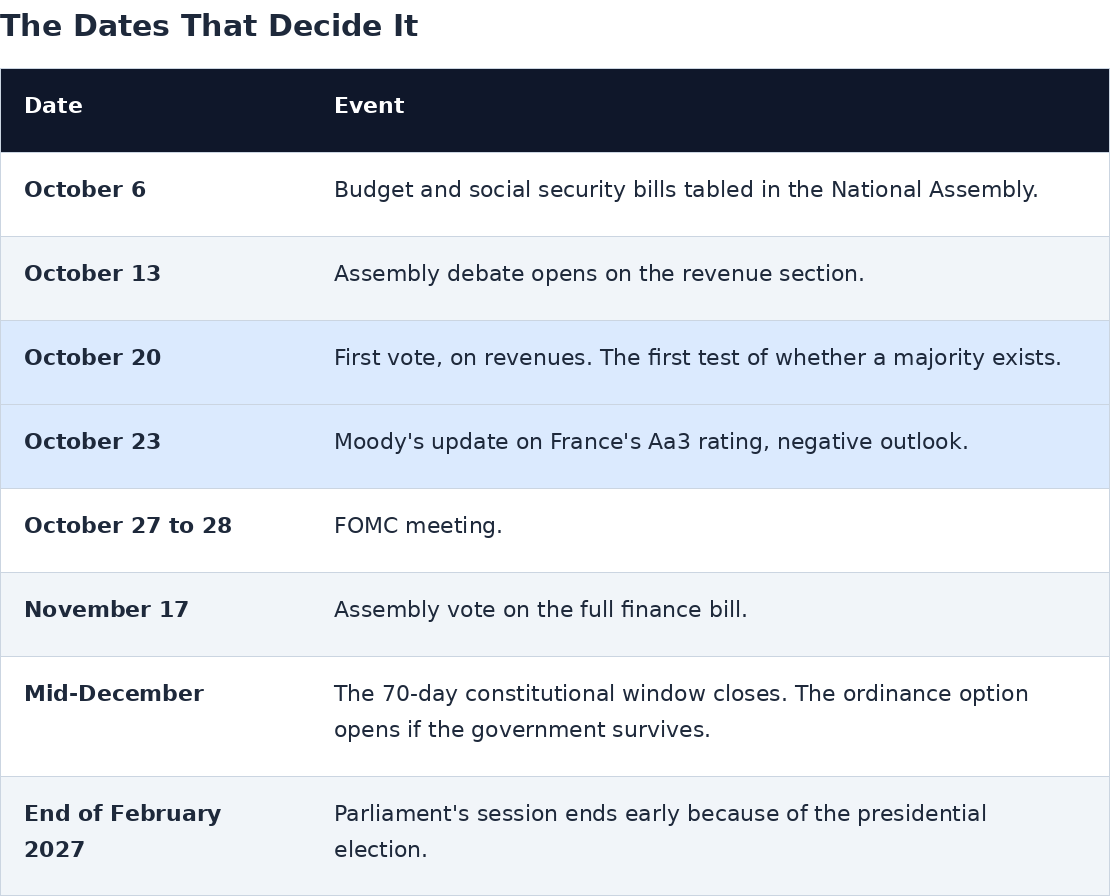
The next three weeks put two hard dates on the French trade: the first budget vote on October 20 and Moody's rating decision on October 23.
Catalyst one: can Lecornu get a budget?
Lecornu has four routes, and each carries a different price for bondholders.
A negotiated vote. In September, Lecornu promised no Article 49.3 and no ordinances, and that "at the end, there will be a vote," provided there is no parliamentary obstruction. The Socialists, whose refusal to back a censure motion saved last year's budget, on Friday demanded changes without delay and called any deal with the National Rally a "political and moral fault."
Article 49.3. This is MUFG's base case: a somewhat modified budget, with parts forced through without a vote, as in recent years. The 2026 budget was adopted that way on February 2 after censure motions failed. The catch is that 49.3 automatically triggers no-confidence motions, and survival needs either the Socialists or the National Rally to abstain. Natixis calls a Socialist abstention unlikely, while the National Rally is more open, with red lines on pensions. If the government falls, the bill dies and the next cabinet starts over.
A special law. A rollover of the 2026 budget buys time, but a finance ministry report warns of "unprecedented budget paralysis" and a deficit at least half a point wider. France has used special laws in both 2025 and 2026.
Ordinance. If Parliament has not acted within 70 days, the government can enact its budget without a vote, something never done under the Fifth Republic and seen by legal experts as a nuclear option likely to trigger censure. Unlike 49.3, the budget would survive the government's fall.
The swing vote is Marine Le Pen. She has proposed a "golden rule" of at least 0.5 percentage points of deficit reduction a year, and MUFG argues the National Rally may let a budget through to show it is ready to govern. That is the market's best near-term outcome and its worst long-term signal: the bond market would be relying on the party it fears most for 2027.
Even a passed budget is built on soft assumptions. It assumes 1.0 percent growth, which the High Council for Public Finance calls optimistic and Natixis puts at 0.8 percent, and an average 10-year yield of 4.3 percent against the 4.9 percent already printed. Every 100 basis points adds 3.4 billion euros to 2027 interest costs. BNP Paribas estimates that waiting until 2028 to start consolidating would push debt to 126 percent of GDP by 2032.
Our read: the October 20 revenue vote is the tell. A clean pass with National Rally abstention should compress the spread back toward 120 to 130 basis points. A defeat, or an early 49.3 that invites a censure motion, keeps 150 in play into Moody's.
Catalyst two: Moody's on October 23
Moody's is the last of the big three still rating France in the double-A category. It holds France at Aa3 with a negative outlook, while Fitch, S&P and Scope sit at A+. On Friday, three weeks before its decision, Moody's called passage of the budget "highly uncertain." It also said political fragmentation after the election will make consolidation no easier, that the next move is more likely to be a downgrade, and that the key factor it is assessing is whether France's institutions can tackle its policy difficulties despite a fragmented parliament. Publishing that language this close to a decision is a signal in itself.
A one-notch cut to A1 would put France in single-A at all three major agencies for the first time. Morningstar DBRS, at AA with a negative outlook, would be the only major agency left in double-A. The forced-selling math matters more than the headline. Rating-restricted mandates typically set thresholds at the bottom of a category, so holders requiring double-A have usually needed two separate downgrades before selling. Jefferies' Mohit Kumar said a year ago that investors he spoke with would cut holdings once two agencies had France at single-A, a process that takes months as investment committees act. That line has already been crossed with Fitch and S&P. A Moody's cut removes the last argument for double-A treatment, and the selling would show up as a slow bleed through the first half of 2027 rather than a one-day gap. It would coincide with France's issuance program of more than $380 billion.
The offset is that France already trades wide of its ratings. It yields more than Italy, Spain and Greece, all rated lower, so much of a downgrade is in the price. Our read: a downgrade on October 23 is the base case and largely priced. The bigger surprise would be an affirmation with a stable outlook, which would require a credible vote on October 20.
The 1926 parallel
The 1926 rescue came when the markets forced the parties into a unity government under Poincaré. In 2026 the equivalent would be the National Rally choosing to look responsible rather than bring down the government. If Le Pen lets the budget pass, it will look like a Poincaré moment. Bondholders should remember that the party being trusted to deliver it promises lower retirement ages and tax cuts once in power.
The Reliving the 1920s Read
The book maps 2020 to 1921, which places 2026 at 1927 and 2027 at 1928. This week fits that calendar more closely than most observers will appreciate, with one important break.
Where the analogue holds
France as Europe's fiscal problem child. The 1924 to 1926 sequence of collapsing governments, a funding strike by bondholders and a currency crisis is the closest historical precedent for today's hung parliament, five prime ministers in roughly five years and an openly hostile bond market. Then the left floated a capital levy. Today Mélenchon proposes cancelling central bank holdings of French debt. The fiscal crisis is running on roughly the same 1924 to 1926 rhythm, now pressing into the 2027 election.
1927: European strain becomes American ease. In May 1927, the Bank of France under Émile Moreau began converting sterling balances into gold and dollars, squeezing London. That pressure led to the July 1927 Long Island meeting of Strong, Norman, Schacht and Moreau's deputy Rist, after which Strong pushed through a discount rate cut even though he was already worried about speculation in US stocks. That ease is widely blamed for fueling the 1928 to 1929 rally. Friday echoed that mechanism: global bond stress plus a soft jobs print knocked the odds of an October Fed hike from 69 percent to 13 percent, and the Nasdaq rallied 1.2 percent to records. European trouble is again pushing US policy toward patience, which is fuel for US risk assets.
The American mega-winner. In the 1920s, European instability drove capital to New York. Today the CAC is down year over year while US technology indexes print highs, and the euro has lost 3 percent in a month. The relative winner leg of the thesis is being confirmed in real time.
The sovereign-bank nexus. Poincaré's 1926 stabilization used a sinking fund to pull short-term government bills out of the money market, which disrupted the large Paris banks that relied on that paper for liquidity. French banks are again the first equity casualties of French sovereign stress.
Where the analogue breaks
Treasuries were the safe asset in 1927. Today they are part of the problem. The 1927 playbook worked because US long rates were low and stable, and cheap money went into equities. A 5.3 percent 10-year and a 5.6 percent 30-year are a valuation headwind the 1920s market never faced. The book's call that the S&P and Dow roughly double from June 2026 levels by August 2028 needs the long end to stabilize. Equities can climb through a tightening Fed, as they did in 1928, but a disorderly term-premium repricing is a different risk.
The rate path has diverged from the book. The July edition modeled roughly 100 basis points of Fed cuts in 2026. Instead the Fed hiked in September and the ECB has hiked twice and is priced for more. The cleaner framing is that the monetary leg is running about a year ahead of the equity calendar, meaning 1928's tightening has arrived in 2026. That is consistent with the companion AI financing article, which already has credit conditions running ahead of the 2028 equity peak, and it should be stated as a later revision rather than as the book's original call.
The stabilizer is missing. In 1926 France produced a Poincaré: a credible national unity government that cut some direct taxes, including the top income tax rate, and made consolidation politically palatable. Today's plan raises the tax burden, defers the hard choices to the next government, and the front-runners are not fiscal hawks. Until a Poincaré figure appears, the 1926 rescue has no modern counterpart.
What it means for the narrative
The French crisis is best used as supporting evidence for the book's geopolitical and relative-winner legs, and as a disclosed stress test of the monetary leg. The 1927 lesson to emphasize is that Europe's fiscal and monetary strain did not stop the American boom. It extended it, by pulling capital to the US and pushing the Fed toward accommodation. The risk to flag is that the bond market, not the Fed, is now setting US financial conditions, and that is the variable that would falsify the 2028 call earlier than the book's calendar implies. With the S&P at 7,722, reaching the 8,500 marker from the September open letter by year-end requires roughly a 10 percent gain in one quarter.
What to Watch
One. The October 20 revenue vote. The first hard read on whether Lecornu has a majority, or will need 49.3 and survive the censure motions that follow.
Two. Moody's on October 23. A cut to A1 puts France at single-A across all three major agencies. An affirmation with a stable outlook would be the upside surprise.
Three. The 150 basis point spread level and the OAT/BTP inversion. A sustained close above 150 moves France from Pictet's stress case into uncharted territory.
Four. Plumbing signals. Carmignac flags short-dated OATs, auction demand, liquidity and French bank credit spreads.
Five. US CPI and the October 27 to 28 FOMC. Fitch's Olu Sonola says CPI "remains the report that matters most."
Six. Oil. Brent above $100 is the common driver across Paris, London, Tokyo and New York, and the EU is considering a French proposal to release diesel and crude stocks.
Disclosures
This article is for informational and educational purposes only. It is not investment advice, a recommendation, or a solicitation to buy or sell any security, sovereign bond, derivative, or other financial instrument.
The authors, their affiliated entities, family members, and clients may hold, or may buy or sell, positions in securities, bonds, currencies, or instruments referenced in this article, including government bonds, equity indices, and individual equities, before or after publication. Neither the authors nor their affiliates received compensation from any company, government, or issuer mentioned.
Information is drawn from sources believed to be reliable, but it is provided without warranty as to accuracy or completeness. Market data reflect published sources as of October 2, 2026, and intraday figures vary by provider. Past performance is not indicative of future results, and historical analogies are illustrative only.
This article contains forward-looking statements, including views on interest rates, central bank policy, fiscal outcomes, elections, and market levels. Actual results may differ materially. Reliving the 1920s is a JD Unfiltered book by Joseph M. Salvani and Daniel J. Walsh; references to its framework reflect the authors' views, and revisions made after the July 2026 edition are identified as such.