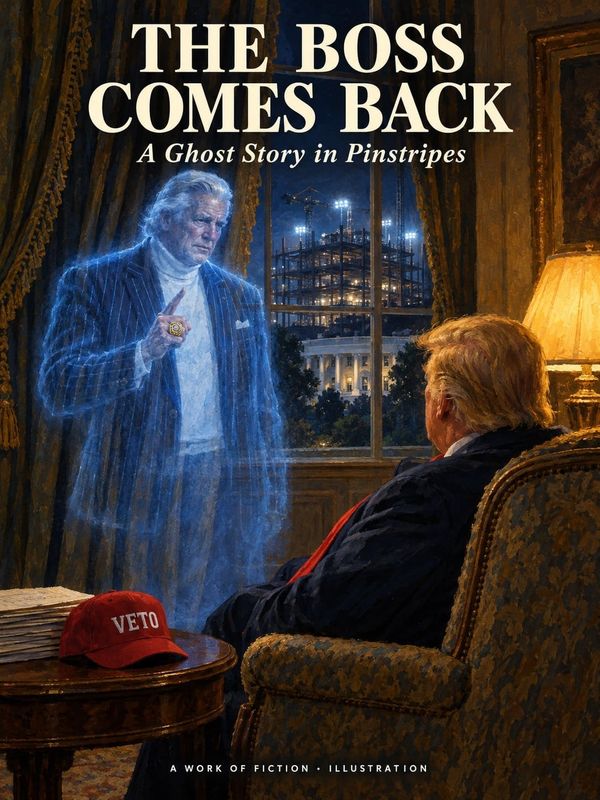
Who Really Owns NVIDIA, and Who Pays When the Founder Walks Out

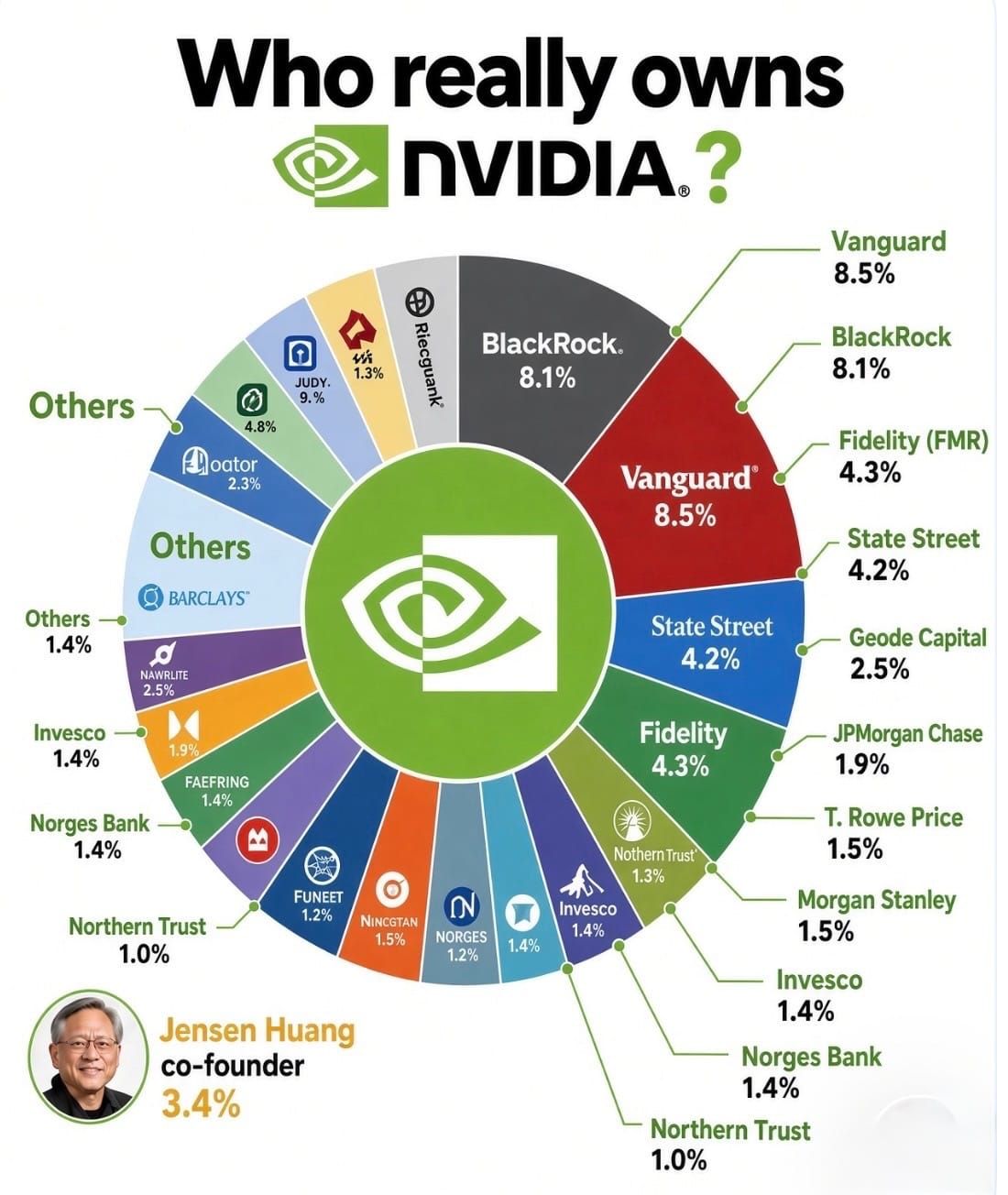
Thirty-three years after co-founding it, Jensen Huang has no formal role at NVIDIA. He is still one of its largest shareholders. The bigger story is who owns the rest: index funds, public pensions and the 401(k) accounts of tens of millions of savers who never chose to make a bet on one man.

A board has seen this before
On August 6, 2010, Hewlett-Packard announced that Mark Hurd had resigned as chairman and chief executive after a board-supervised investigation found he had violated the company's standards of business conduct. The board named its CFO, Cathie Lesjak, interim CEO, and she kept the finance job. The stock fell more than 7 percent the following Monday, its steepest drop in six years, CNBC and Bloomberg reported. The board then went outside for a permanent successor, and fired him 11 months later.
Sixteen years later, NVIDIA's board is running a close version of the same play: a conduct-driven exit, a CFO serving as interim CEO, a newly separated chair and an open search. The difference is scale. HP was a large company. NVIDIA is the second-largest weight in the S&P 500 and sits inside nearly every diversified retirement account in the country. That changes who pays for the board's next decision.
The week that changed NVIDIA
On November 11, 2026, NVIDIA's board accepted Huang's resignation as president, CEO and director, effective immediately. The company's Form 8-K gave no reason. Colette Kress, 59, CFO since 2013, became interim CEO and keeps the CFO role. Harvey C. Jones, 73, a director since 1993, became chair of the board. The board said it will consider internal and external candidates for the permanent job. The resignation capped a fast-moving sequence.
October 9, 2025. The New York Times first reported Huang socializing in Taiwan with Alice Huang, no relation, a former executive at Singapore data-center firm Megaspeed. US officials suspect her of working for Chinese intelligence. China's foreign ministry has called the allegations groundless, and she has not been charged.
November 5, 2026. The chairs of the House China, Foreign Affairs and Intelligence committees asked Huang for a closed-door briefing on November 18.
November 8. NVIDIA's board opened an independent investigation. Huang told employees he had been unfaithful and apologized.
November 9. Shares fell as much as 8.8 percent intraday and closed down 4.27 percent at $178.67, erasing roughly $192 billion in value while the broader market rose. A shareholder class action was filed the same day.
November 11. After a Wall Street Journal report that the board was preparing to remove Huang, the stock fell more than 9 percent after hours. Reports of a second affair, with an NVIDIA executive, followed.
November 12. The resignation was announced before the open. The stock fell as much as 14 percent to $148.80, its lowest level since June 2025, then recovered most of that to close at $166.19.
November 13. Shares slipped again, trading near $160 at midday and below a $4 trillion market value, Yahoo Finance reported.
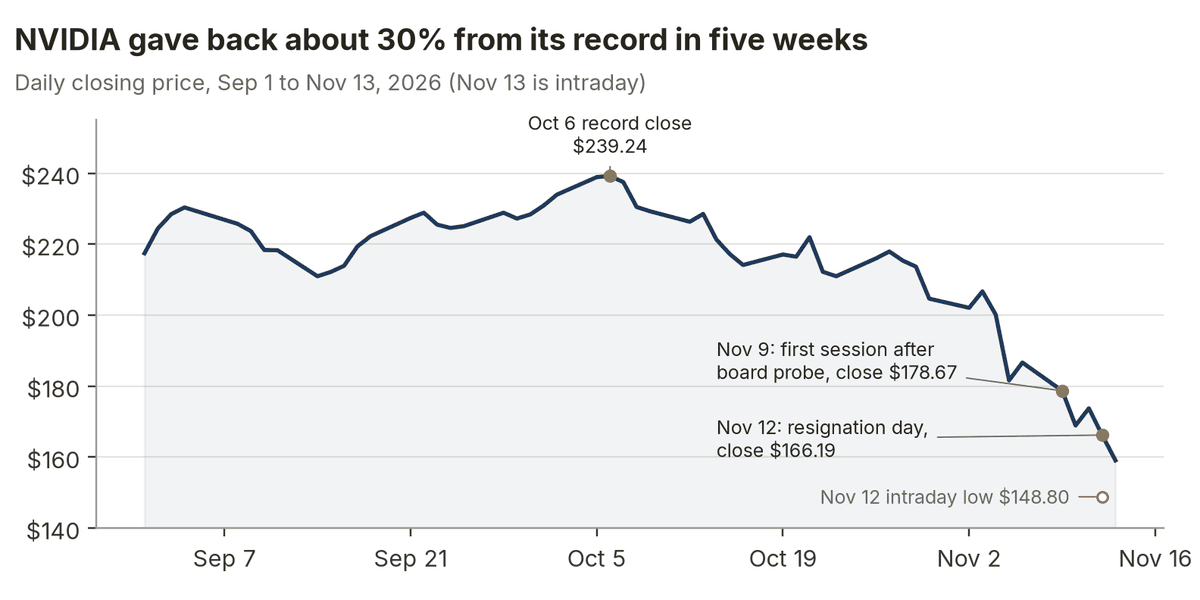
From the October 6 record close of $239.24 to Thursday's close, the stock fell 30.5 percent. On about 24.1 billion shares, that is roughly $1.76 trillion of market value, more than the entire market capitalization of all but a handful of US companies.
So who actually owns it?
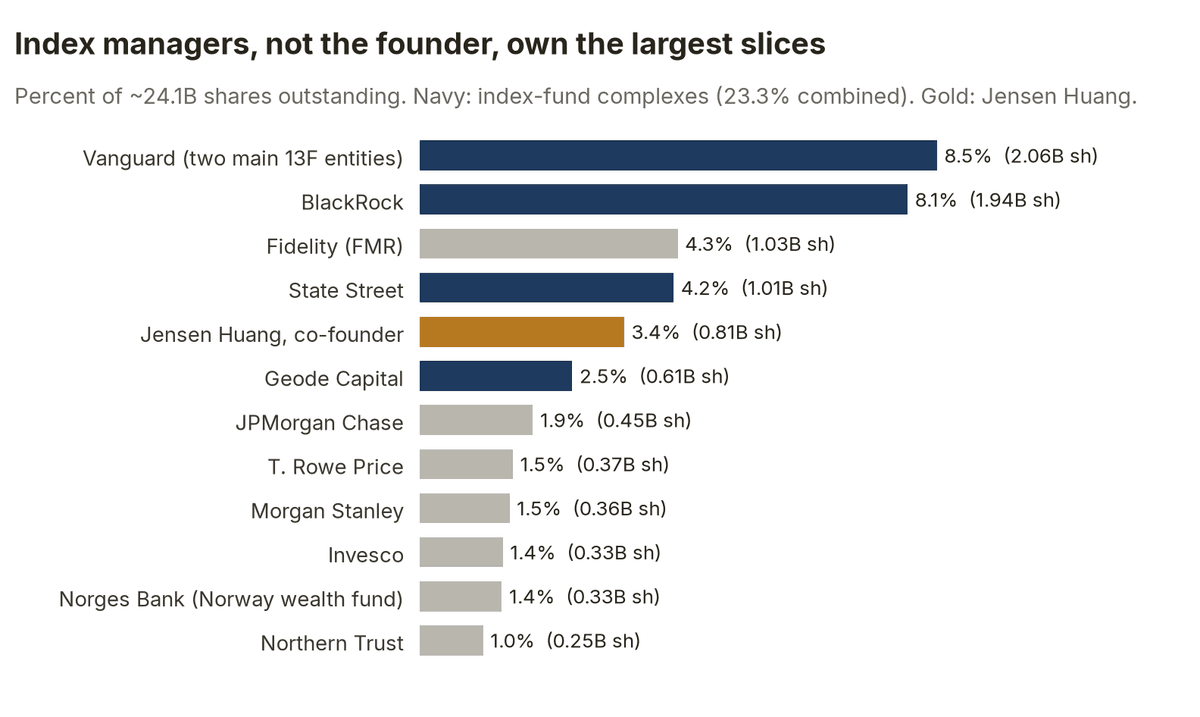
NVIDIA is owned mostly by index-fund managers, not by its founder. The chart below updates the widely shared ownership infographic with the latest 13F filings and drops Huang's CEO label, since he now holds his stake as an outside shareholder. Four index-fund complexes, Vanguard, BlackRock, State Street and Geode, together hold about 23.3 percent of the company, roughly seven times Huang's stake.
Vanguard is the largest holder. The infographic split it into two lines. Combined, its two main 13F entities hold about 2.06 billion shares, ahead of BlackRock's 1.94 billion. Vanguard's January 13G put its group-wide stake at 9.3 percent, according to Fintel.
Fidelity has moved up. FMR now reports about 1.03 billion shares, roughly 4.3 percent of the company and slightly more than State Street, after adding about 3 percent in its latest filing.
Third-quarter filings are still landing. The 13F deadline is mid-November, so some managers show September 30 positions and others still show June 30.
The long tail is enormous. At least 3,600 managers have reported NVIDIA positions as of September 30, on top of millions of retail accounts.
Huang's stake. About 813 million shares, worth roughly $135 billion at Thursday's close. He remains the largest individual shareholder, with no seat on the board and no role in management.
The indexes: the shock passes straight through
Thursday showed how much of the market now rides on one company. NVIDIA is about 6.1 percent of the S&P 500 at Thursday's close, and the top ten stocks are 37 percent of the index, Yahoo Finance reported. It was 7.10 percent of SPY as recently as November 6. Here is how the main benchmarks absorbed the news.
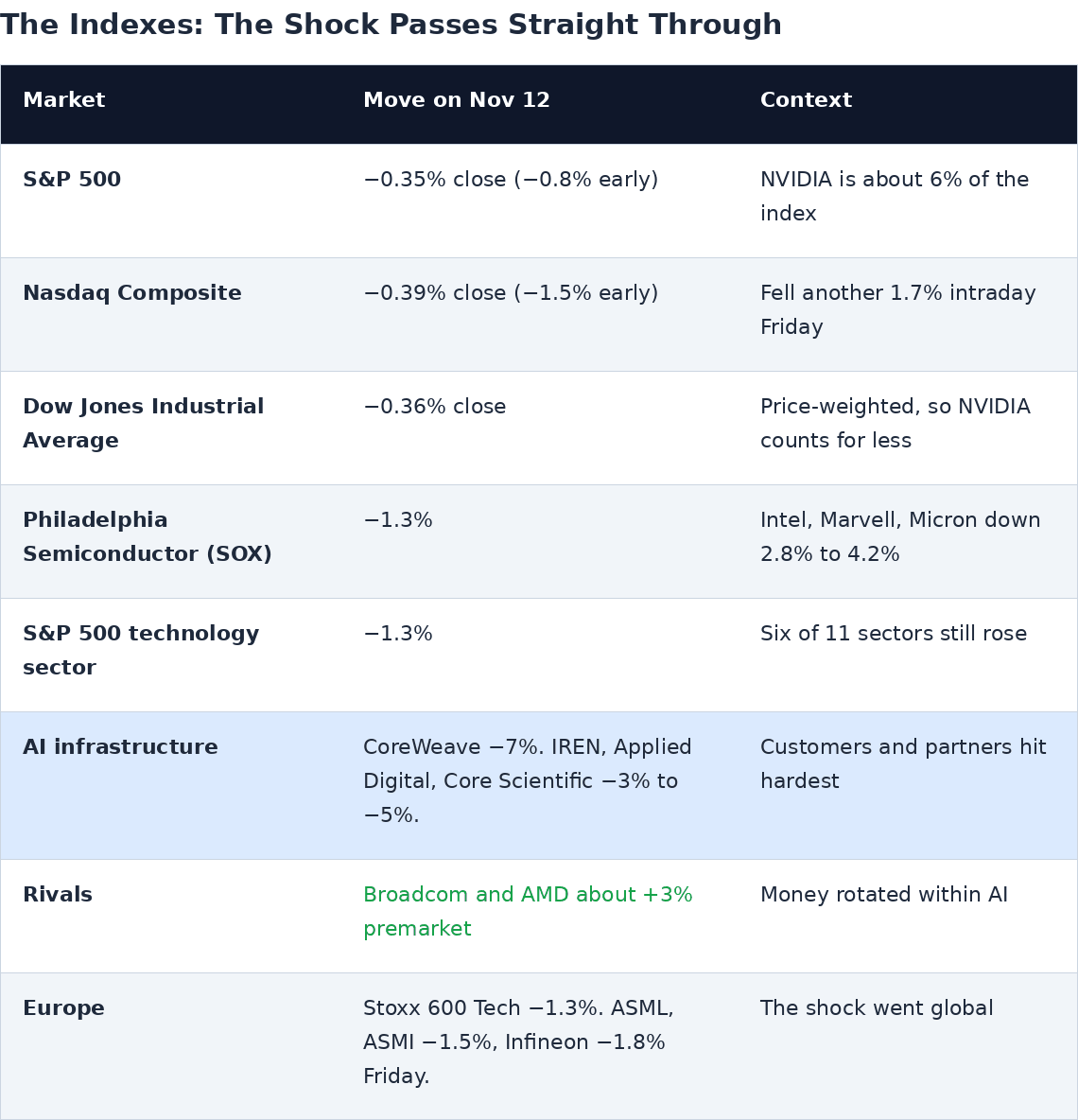
The pain did not ease on Friday. By late morning, the Nasdaq-100 tracker QQQ was down 2.0 percent, the technology sector fund XLK down 3.0 percent and the VanEck Semiconductor ETF down 4.8 percent, while SPY gave up 0.9 percent.
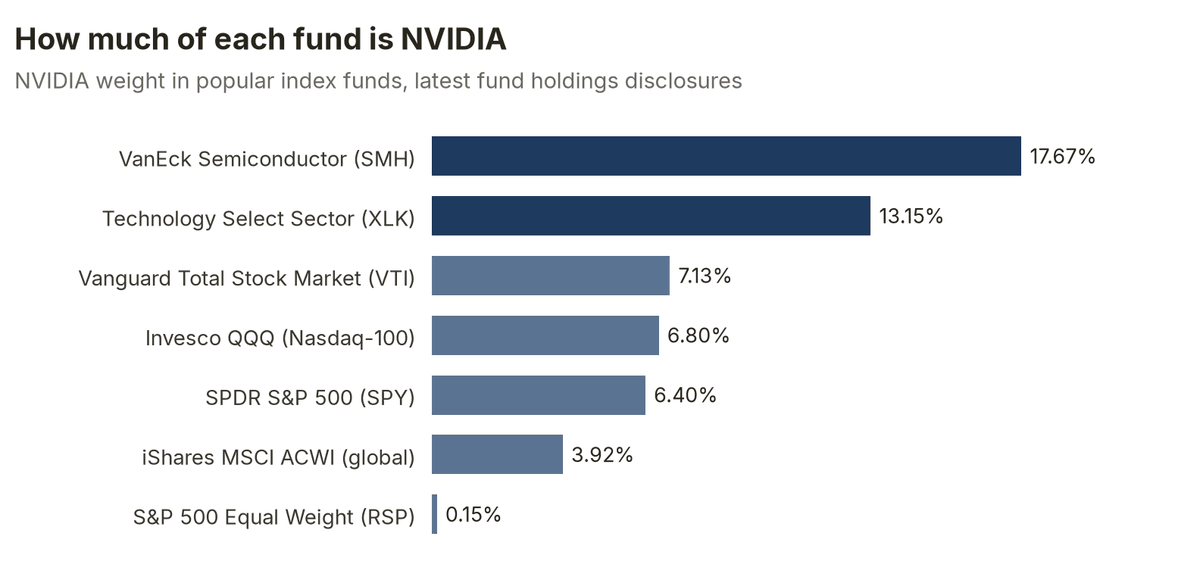
What the numbers mean for anyone who owns a fund:
Cap-weighted funds pass the shock straight through. At a 6 percent weight, roughly $600 of every $10,000 in an S&P 500 fund is NVIDIA, so a 10 percent move in the stock moves the fund about 0.6 points. Sector and semiconductor funds carry two to three times that. Equal-weight funds hold it at about 0.15 percent and barely notice.
Nobody is forced to sell. A CEO change does not trigger removal from any index. Cap-weighting trims NVIDIA's weight automatically as the price falls, so passive funds do not dump shares. That also means there is no forced buyer if the stock keeps falling.
This is a rotation, not an exit from AI. Broadcom and AMD rose while NVIDIA fell. Investors kept the bet on AI spending and cut the bet on one company's leadership.
Concentration cuts both ways. NVIDIA supplied 15.5 percent of the S&P 500's total return in 2025, according to an SEC filing by Franklin Financial. The same mechanics that lifted index funds on the way up now pass a governance shock to every saver who owns them.
Pension funds, 401(k)s and the savers who never chose this
This is where the story reaches ordinary people. Americans held $51.2 trillion in retirement assets at the end of June, including $10.8 trillion in 401(k) plans, $1.6 trillion in 403(b) plans, $1.2 trillion in the federal Thrift Savings Plan and $7.1 trillion in state and local government pension plans, on Investment Company Institute figures. Target-date funds, the default option in most 401(k) plans, held $4.8 trillion at the end of 2025, Morningstar reported. Their US stock sleeves generally track the same broad indexes that carry NVIDIA as a top holding.
Public pensions
Public pension funds that file 13F reports disclose their directly held NVIDIA shares. Applying the stock's decline from the October 6 record to Thursday's close to those reported positions gives a sense of the paper losses.
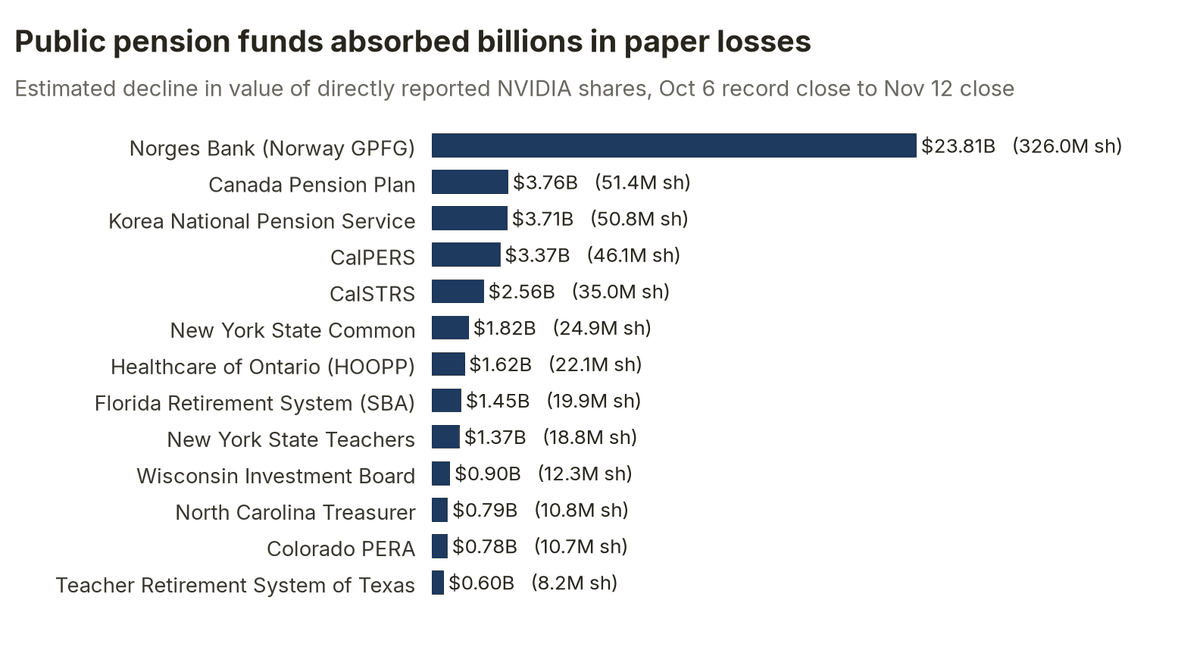
Norway's Government Pension Fund Global, managed by Norges Bank, is the largest pension-type holder at about 326 million shares, roughly $24 billion lower since the peak.
CalPERS saw part of this coming. The largest US public pension cut its NVIDIA position by about 40 percent in the first half of 2026, from 76.4 million to 46.1 million shares, yet NVIDIA was still 5.2 percent of its US listed holdings, Bloomberg reported.
Florida's retirement system, run by the State Board of Administration, reports about 19.9 million shares directly, a paper decline of roughly $1.45 billion. New York's two big state funds together are down more than $3 billion.
Korea is a case study in retail and pension overlap. The National Pension Service reported about 50.8 million shares, and roughly 800,000 Korean retail investors hold some $13.65 billion of NVIDIA, the Korea Times reported.
The average public plan is less exposed than an index fund. The Reason Foundation estimates NVIDIA is about 2.5 percent of the average public pension's assets, because equities are only about 46 percent of those portfolios. On $7.1 trillion of state and local pension assets, that implies roughly $180 billion of NVIDIA exposure and a paper decline on the order of $55 billion since the peak, by our estimate.
401(k)s, IRAs and the federal Thrift Savings Plan
Reason Foundation's Leonard Gilroy puts the typical American's exposure to NVIDIA at 3 to 5 percent of their retirement savings, depending on how they invest, Fortune reported. Applied to $10.8 trillion in 401(k) plans, that is roughly $320 billion to $540 billion riding on one stock, and a 30 percent decline implies paper losses of roughly $100 billion to $165 billion across 401(k) accounts alone. That is our arithmetic, not a measured figure, and it excludes IRAs.
Federal workers and service members feel it through the TSP's C Fund, which tracks the S&P 500 and held $507.9 billion as of May, including C Fund money inside the lifecycle funds. At a 6 to 7 percent weight, $30 billion to $35 billion of that money tracks NVIDIA, which implies a paper hit on the order of $10 billion since the peak. Overseas, UK commentators estimate NVIDIA is about 5 percent of a typical tracker fund, so a 30 percent fall trims about 1.5 percent from a pension's equity holdings, The Observer reported.
What the drop cost a $100,000 balance
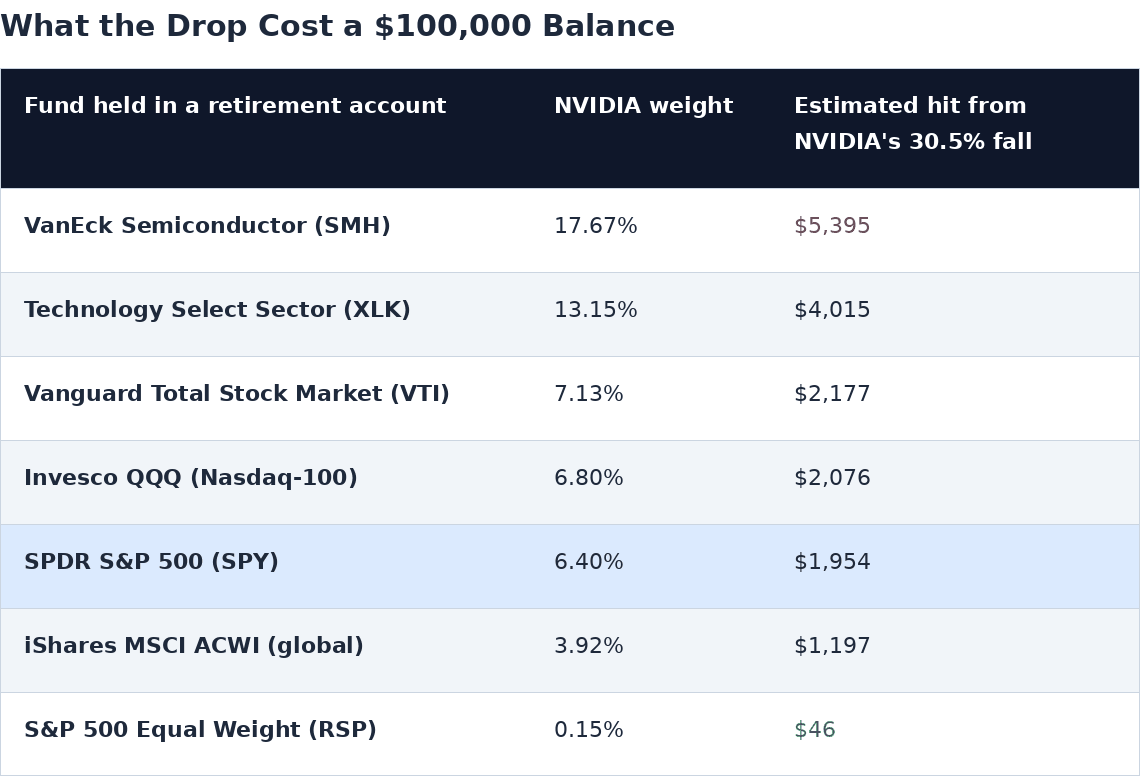
For most savers the right reaction is to check, not to panic. Look at the top ten holdings of every fund in the account, add up the NVIDIA overlap, and decide whether that concentration is a choice or an accident. Retirement money is invested for 20 to 40 years. The risk worth managing is concentration, not this week's headline.
Active managers have to make a call
Active holders such as Fidelity, T. Rowe Price, Capital Group and Wellington can do what index funds cannot: decide. These are the questions they are weighing.
Is the discount an opportunity? Some strategists point to a forward P/E near 13 with revenue growing about 60 percent a year, and Main Street Research sees support at $165. Morningstar kept its $310 fair-value estimate while the investigation was under way.
How much is the founder worth? Dan Ives of Yorkville Ives values NVIDIA at $300 a share with Huang and $225 without him, a 25 percent key-person discount, Business Insider reported. At Thursday's close, the stock already trades well below the no-Huang figure.
Does the strategy still fit? Some funds are built around founders. Founder ETFs told Axios it would sell NVIDIA if Huang exited.
The big shareholders now hold the governance cards
With Huang off the board, NVIDIA's direction is in the hands of its directors and, ultimately, the shareholders who elect them. That puts the passive giants in an unusual spotlight. Vanguard, BlackRock and State Street cannot sell, but they vote at every annual meeting, and their stewardship teams answer to the pension funds and 401(k) sponsors whose money they manage.
Critics have pointed to a board built around the founder. The New York Times reported that four of the board's 10 directors were longtime Huang allies. The company had warned shareholders that it relied heavily on long-serving executives and did not have a succession plan in place. Huang ran a famously flat organization, with around 60 direct reports and no visible heir. Appointing an independent chair and a CFO-turned-interim-CEO is the board's first answer. How it runs the search will tell the big holders whether that answer is enough. Expect pension funds such as CalPERS and the New York funds, which have long pressed for board independence, to be vocal.
Shareholders who lost money may have a claim
The proposed class action, filed through the Rosen Law Firm, covers investors who bought NVIDIA between October 9, 2025 and November 8, 2026. It alleges that NVIDIA's statements about its relationship with Megaspeed were materially false and misleading, and that the undisclosed relationship posed a material risk to the company's reputation and business. The deadline to seek lead-plaintiff status is January 8, 2027, and no class has been certified. It is a civil securities case, separate from the board's inquiry and from any federal review, and none of its claims has been tested in court. Institutional holders, including public pensions, often seek lead-plaintiff roles in cases of this size.
Huang himself
Huang remains a top-five holder with a stake of about 3.4 percent. His roughly $135 billion position is down about $59 billion from the October peak, and he now holds it as an outside shareholder rather than as the person running the company. Any decision to keep or sell that stake will be read as a signal, and a large sale would add supply to a stock already under pressure. The House committees' requested November 18 briefing still stands.
Our thesis: who runs NVIDIA's next chapter
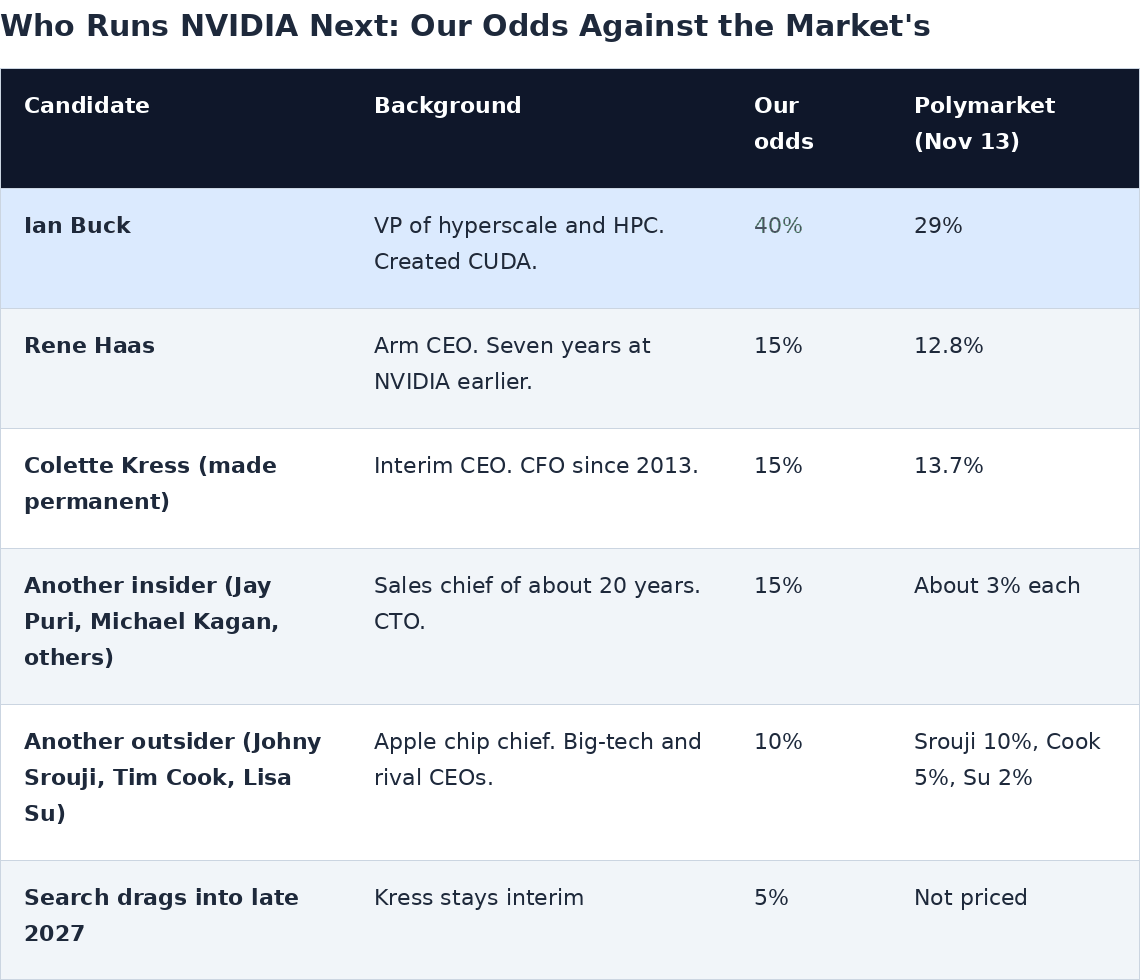
Our call: NVIDIA's next permanent CEO will be an insider engineer, most likely Ian Buck. Colette Kress stays as CFO, and the board under Harvey Jones replaces Huang's one-man structure with a real executive team. We expect a name in the first half of 2027. This is our opinion, not a forecast the company has endorsed.
Why an insider wins. NVIDIA's moat is software and relationships, not just chips. Buck, a 22-year veteran with a Stanford PhD, created CUDA, the platform that ties AI developers to NVIDIA hardware, and now runs its largest businesses. An outsider would have to learn the technology and the customer relationships while the stock is under pressure. HP's 2010 search is the cautionary tale: the outside hire lasted 11 months. The board's own language stresses continuity, promising operations, customer commitments and the roadmap "without interruption."
Why not the obvious outsiders. Lisa Su runs NVIDIA's fiercest rival and has distant family ties to Huang. Tim Cook, whom President Trump has touted, is not a chip operator. Arm's Rene Haas is the credible outside pick: he spent seven years at NVIDIA and knows its culture. Author Tae Kim has argued for Haas or Buck.
Why Kress stays interim. She has Wall Street's trust and has run the finances since 2013. Analysts mostly see her as a steady hand, not the long-term product leader. Ives expects her to serve about a year.
What each outcome means for shareholders
Insider engineer plus Kress, our base case. The roadmap, CUDA and customer relationships carry on. The stock can close part of the gap between today's price and the $225 to $300 range Ives sees as earnings confirm demand.
Outside CEO. Expect a reshuffle into a conventional management structure and possibly tighter capital discipline, since Kress reportedly pushed back on Huang's largest AI financing commitments. The market may discount the uncertainty at first.
A long, messy search. Interim drift, more departures or new findings from the investigation would keep a discount on the stock and on the AI trade, and on every index fund that holds it.
What would change our mind: the tone of Tuesday's earnings call; any exit by Buck, Jonah Alben or other senior engineers; new outside directors joining the board; and what the board's investigation finds.
What to watch next
Tuesday, November 17, after the close. Fiscal third-quarter results, the first with Kress leading the call. Management guided to revenue of $108 billion, plus or minus 2 percent, and consensus sits near $108.8 billion in revenue and $2.47 in EPS. Guidance and any update on the CEO search will matter more than usual.
Wednesday, November 18. An all-company meeting called by Kress, and the requested congressional briefing with Huang.
Late November. The remaining third-quarter 13F filings will show which active managers and pensions sold into the decline.
The investigation and lawsuit. Whether the board's probe finds any compromise of national security or company secrets, which the board has said it has no reason to believe happened.
The bottom line
The question everyone is asking is who will shape NVIDIA's next chapter: its shareholders, its next CEO or the team Jensen Huang built. The ownership chart gives a partial answer. The shareholders who matter most are giant index managers. They cannot sell, they vote at every meeting, and they hold NVIDIA on behalf of teachers, firefighters, federal workers and tens of millions of 401(k) savers. For those savers, the lesson is not about one executive's private life. It is about concentration. When one stock is 6 to 7 percent of the market's main index and a fifth of a popular semiconductor fund, a governance failure at one company becomes everyone's problem.
This article is for information only and is not investment advice. Ownership figures come from recent SEC 13F filings, which lag by up to 45 days and change daily with prices. Pension and retirement loss figures are estimates based on reported positions and index weights. Prediction-market odds are not forecasts. Statements about the circumstances of Jensen Huang's departure and about Alice Huang are attributed to published reporting and official statements; she has not been charged, and the class action's allegations have not been tested in court.
The authors hold positions in securities mentioned and reserve the right to buy or sell shares at any time without notice.