
Apple + NVIDIA: AI's Combined Leader

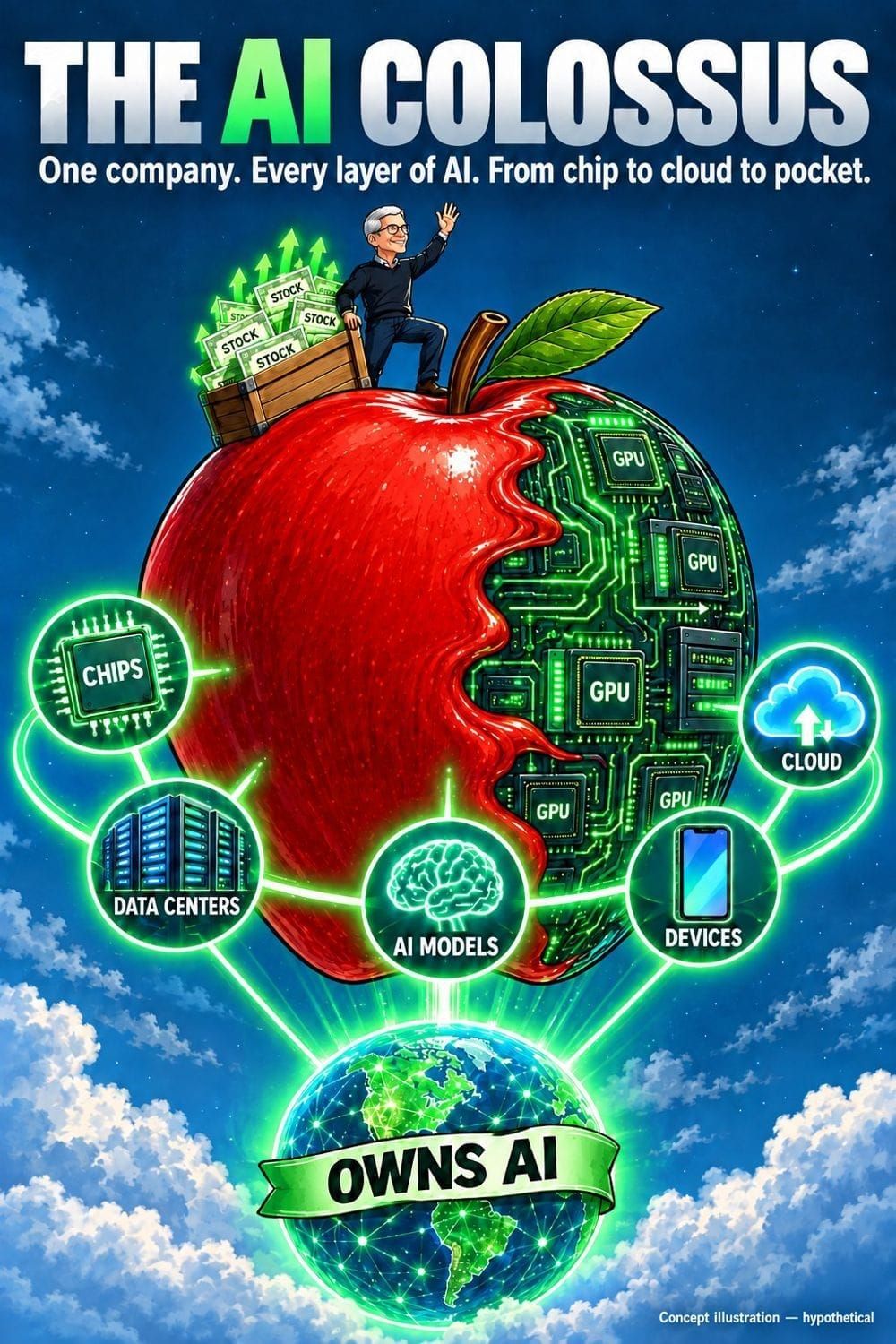
The case for a hypothetical all-stock combination now, with Tim Cook leading NVIDIA as an Apple subsidiary. A strategic discussion draft. No such proposal has been made by Apple, NVIDIA or anyone named here.
Executive summary
This paper sets out a strategic case for Apple CEO John Ternus to propose an all-stock acquisition of NVIDIA at a 57.5 percent and 42.5 percent ownership split, with Tim Cook leading NVIDIA as an Apple subsidiary.
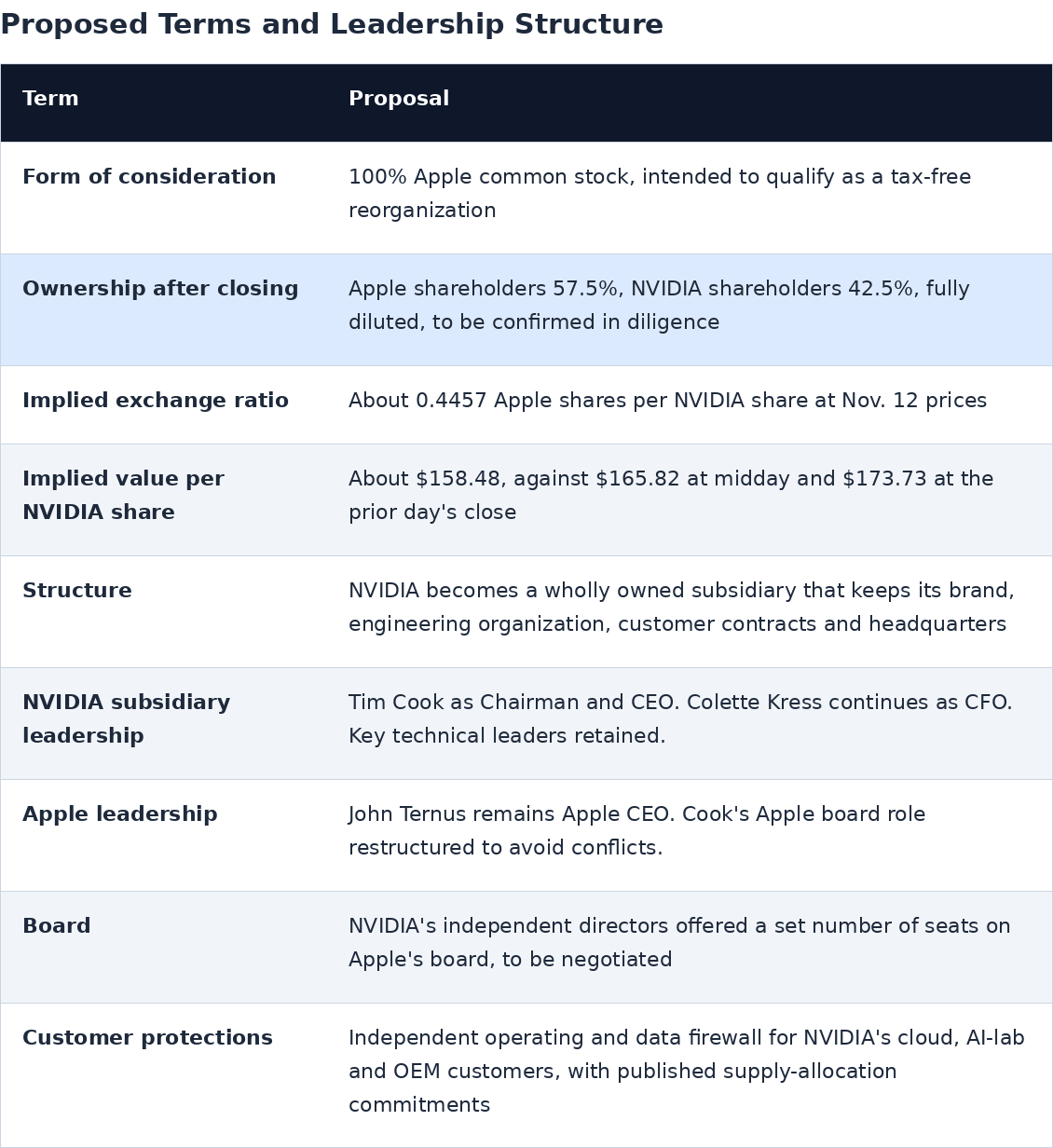
The proposal. Apple acquires 100 percent of NVIDIA in a tax-free, all-stock merger. Apple shareholders own 57.5 percent of the combined company and NVIDIA shareholders own 42.5 percent. NVIDIA becomes a wholly owned, separately managed Apple subsidiary. Tim Cook, Apple's former CEO and current executive chairman, becomes Chairman and CEO of the NVIDIA subsidiary. John Ternus remains CEO of Apple.
The case in brief
NVIDIA has no permanent leader. Jensen Huang resigned today as CEO and director, effective immediately. CFO Colette Kress is interim CEO, and the board has opened an internal and external search, NVIDIA announced.
The market is pricing that uncertainty. NVIDIA trades at $165.82, down 4.55 percent today and 31.9 percent below its 52-week high of $243.37. Apple trades within 1.1 percent of its own 52-week high, so Apple's stock is at peak strength as a currency.
The leadership answer is already public. President Trump said "only one man" could replace Huang, naming Tim Cook, TechCrunch reported, and a Yale leadership scholar made the same case in Time.
Apple's most urgent gap is AI. Bloomberg framed AI as "Job No. 1" for Ternus, and he has pressed his software chief to move faster.
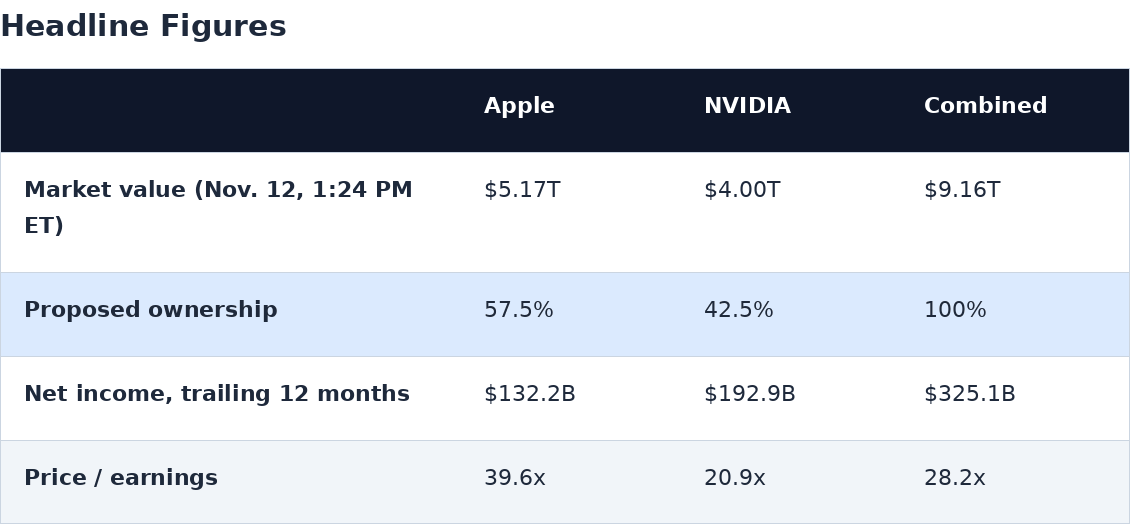
The numbers favor Apple. NVIDIA brings 59.3 percent of combined net income but would receive 42.5 percent of the shares, lifting Apple's earnings per share by about 41.4 percent before synergies.
Why now: six timing factors
Large strategic combinations usually fail on timing, price or people. Today all three line up in Apple's favor at once.
1. A leadership vacuum at NVIDIA
Huang co-founded NVIDIA 33 years ago and held about 3.61 percent of the company. His resignation came after reports of an affair with a woman US authorities suspect of spying for China, and a second relationship with a subordinate. The board named Harvey Jones its first-ever board chair, Reuters and NVIDIA reported. A board that has just lost its founder, with an interim CEO who is still also the CFO, is more open to a credible succession solution than it will be after a new CEO is installed.
2. A discounted entry price
Reuters reported NVIDIA shares fell more than 12 percent in early trading, on course to erase about $500 billion of value. At midday the stock was 31.9 percent below its 52-week high. The business has not changed; the leadership risk has. Apple can buy the business while the market discounts the risk Apple is best placed to remove.
3. Apple's currency is at its strongest
Apple trades at 39.6 times earnings against NVIDIA's 20.9 times, and near its 52-week high. Paying in stock valued at almost double the target's earnings multiple is the cheapest way to buy earnings Apple will ever see.
4. A ready-made successor with public backing
Cook succeeded a larger-than-life founder once before, and as executive chairman he already handles Apple's relationships with policymakers and China. Those are exactly the issues now facing NVIDIA, whose crisis has a national-security dimension.
5. A new Apple CEO with an AI mandate
Ternus took over on Sept. 1, 2026, according to Apple. A transformational move early in a tenure sets direction and fits his reported push to accelerate AI beyond fixes to Siri.
6. A short window before facts change
NVIDIA reports fiscal third-quarter results on Nov. 17, and Kress addresses employees as interim CEO on Nov. 18, Semafor reported. A strong report or a quick permanent appointment would narrow Apple's advantage. Approaching the board before the search advances keeps Apple's proposal at the center of it.
Proposed terms and leadership structure
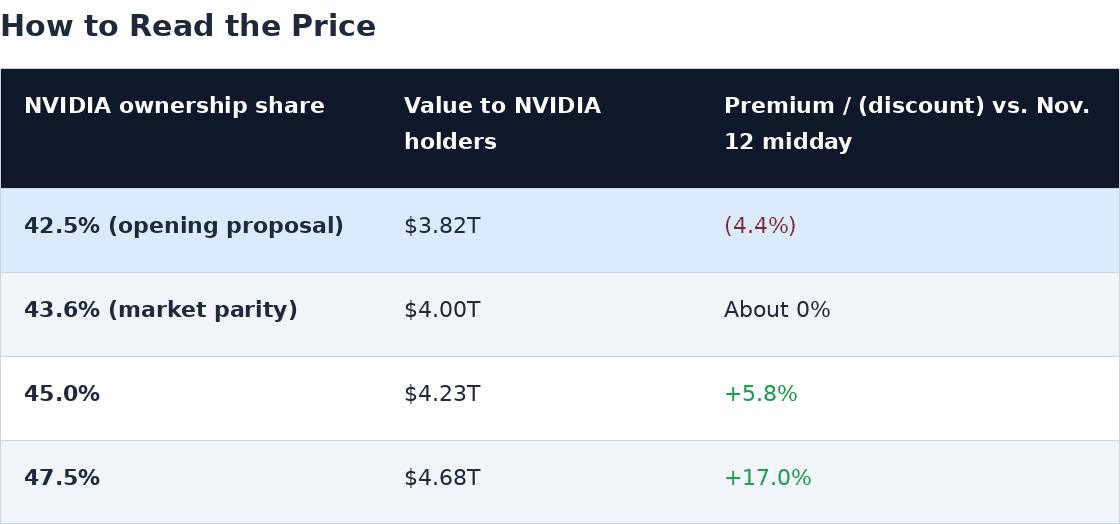
How to read the price
At a 57.5 to 42.5 split, NVIDIA holders would receive Apple stock worth about $3.82 trillion at Apple's current price, 4.4 percent below NVIDIA's midday market value and about 8.8 percent below the prior day's close. That makes 57.5 to 42.5 an aggressive opening position. Apple's case to NVIDIA's board has to rest on certainty and leadership rather than premium, and Apple should be prepared to move.
Financial rationale
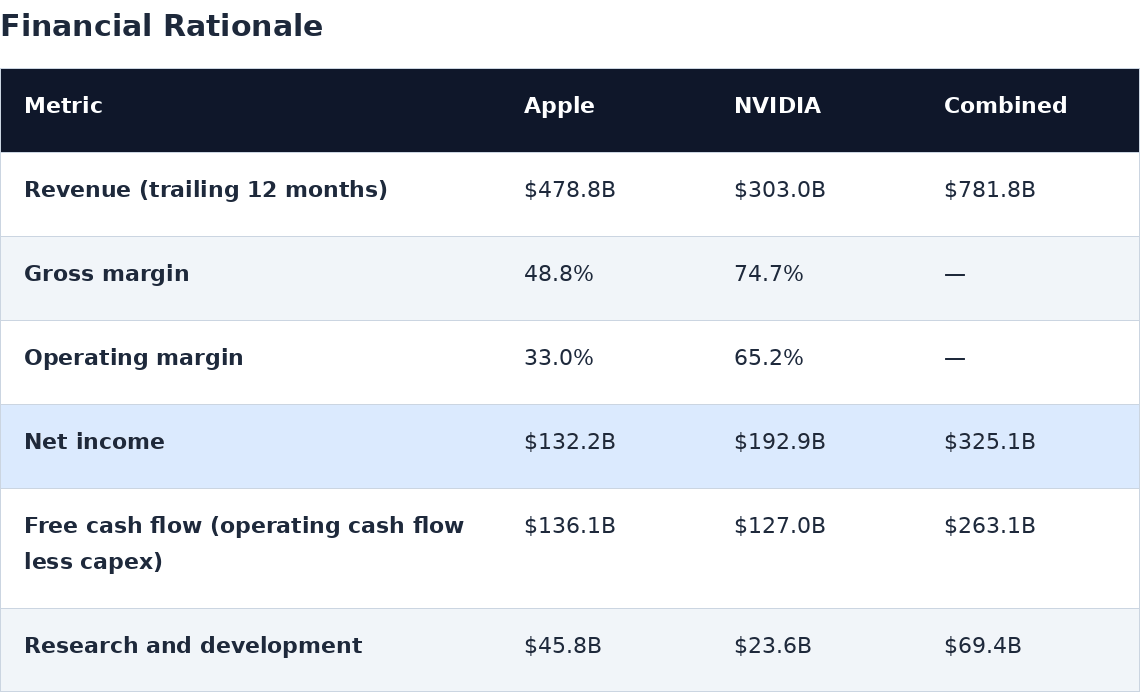
Earnings per share up about 41 percent. Apple holders would own 57.5 percent of $325.1 billion in net income, against $132.2 billion standalone, before any cost or revenue synergies.
Lower blended valuation. The combined company would trade at about 28.2 times earnings at today's prices, against Apple's 39.6 times, leaving room for the market to re-rate it upward.
No debt and no cash strain. An all-stock deal needs no acquisition debt or cash outlay. Apple holds only about $77 billion in cash and short-term investments.
Better margins. NVIDIA's 74.7 percent gross margin and 65.2 percent operating margin lift the blended profitability of the whole company.
Doubled cash generation. About $263 billion of combined free cash flow funds AI infrastructure, buybacks and dividends at a scale no rival can match.
A $99 billion strategic portfolio. NVIDIA's stakes include OpenAI at $30 billion, Intel, SpaceX and CoreWeave, CNBC and NVIDIA's filings show. Its private holdings are largely carried at cost less impairment, so their book value may understate their worth.
Earnings-quality caveat. NVIDIA's first-half other income of $24.1 billion, mostly gains on equity securities, inflates its net income relative to operating profit, according to its latest 10-Q. On operating profit alone the accretion is smaller but still substantial, and diligence should rebuild the math on that basis.
Business rationale
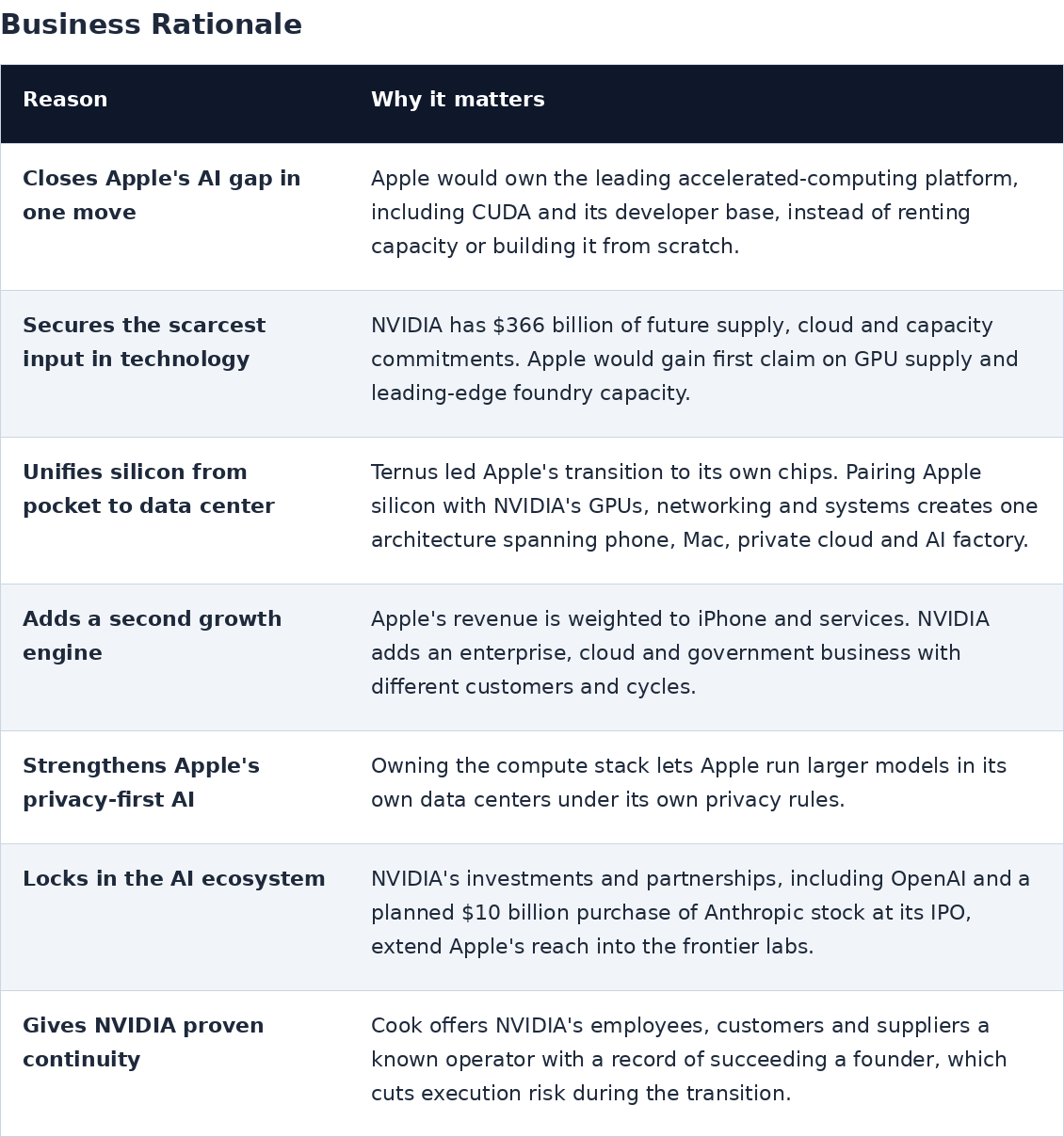
Why NVIDIA's board should engage
Certainty over a search. Instead of a months-long search during a crisis, shareholders get a named, proven CEO immediately.
A stake in a larger, more diversified company. NVIDIA holders keep 42.5 percent of a $9.2 trillion company with Apple's consumer franchise and balance sheet behind the AI business.
Policy credibility. NVIDIA's crisis has a national-security dimension. Cook's government and China relationships, and the public endorsement of him as a successor, can help stabilize regulator and customer confidence.
Room to negotiate. If the board requires a premium, a move to 45 percent, about 5.8 percent above market, still leaves Apple with strong earnings accretion.
Key risks and mitigants
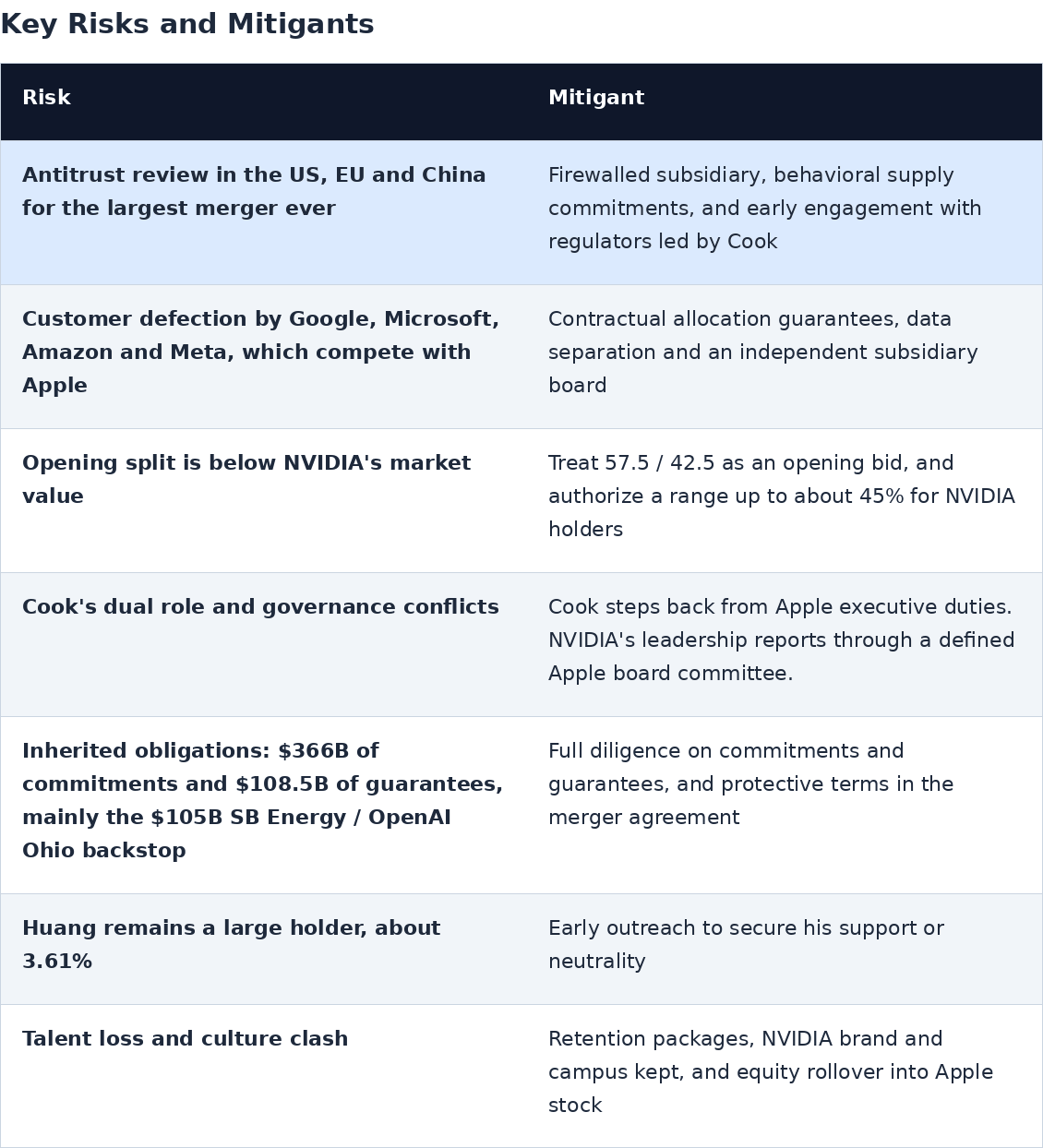
Recommended next steps
Within 48 hours. Apple board authorization to explore. Retain financial and antitrust advisers. Confirm Cook's willingness and his Apple governance arrangements.
Before Nov. 17 earnings. Confidential outreach from Ternus and Cook to NVIDIA chair Harvey Jones with a non-binding proposal at 57.5 to 42.5 and a defined negotiating range.
Weeks 1 to 4. Mutual due diligence covering supply commitments, lease guarantees, the private investment portfolio, the Anthropic purchase commitment, export controls and the matters behind Huang's departure.
Weeks 4 to 8. A definitive agreement, voting support from major holders, and pre-filing meetings with the FTC, DOJ, the European Commission and China's SAMR.
Bottom line. The scarcest asset in AI has just lost its founder, its stock is discounted, and the leader most often named to succeed him already works for Apple. Apple's high-multiple stock makes an all-stock deal sharply accretive, and the window may close once NVIDIA reports on Nov. 17 or names a permanent CEO.
Important note. This document is a strategic analysis of a hypothetical transaction, prepared from public information and market data as of the afternoon of Nov. 12, 2026, including NVIDIA's announcement and Form 10-Q, Apple's newsroom, and reporting by Reuters, TechCrunch, Bloomberg, CNBC and Semafor. It is not investment, legal or tax advice, and it does not reflect any actual proposal, discussion or intent by Apple, NVIDIA or any individual named. Statements about the circumstances of Jensen Huang's resignation are attributed to published reports. Market prices change continuously, and all values should be refreshed before use.
The authors hold positions in securities mentioned and reserve the right to buy or sell shares at any time without notice.