The Boss Comes Back

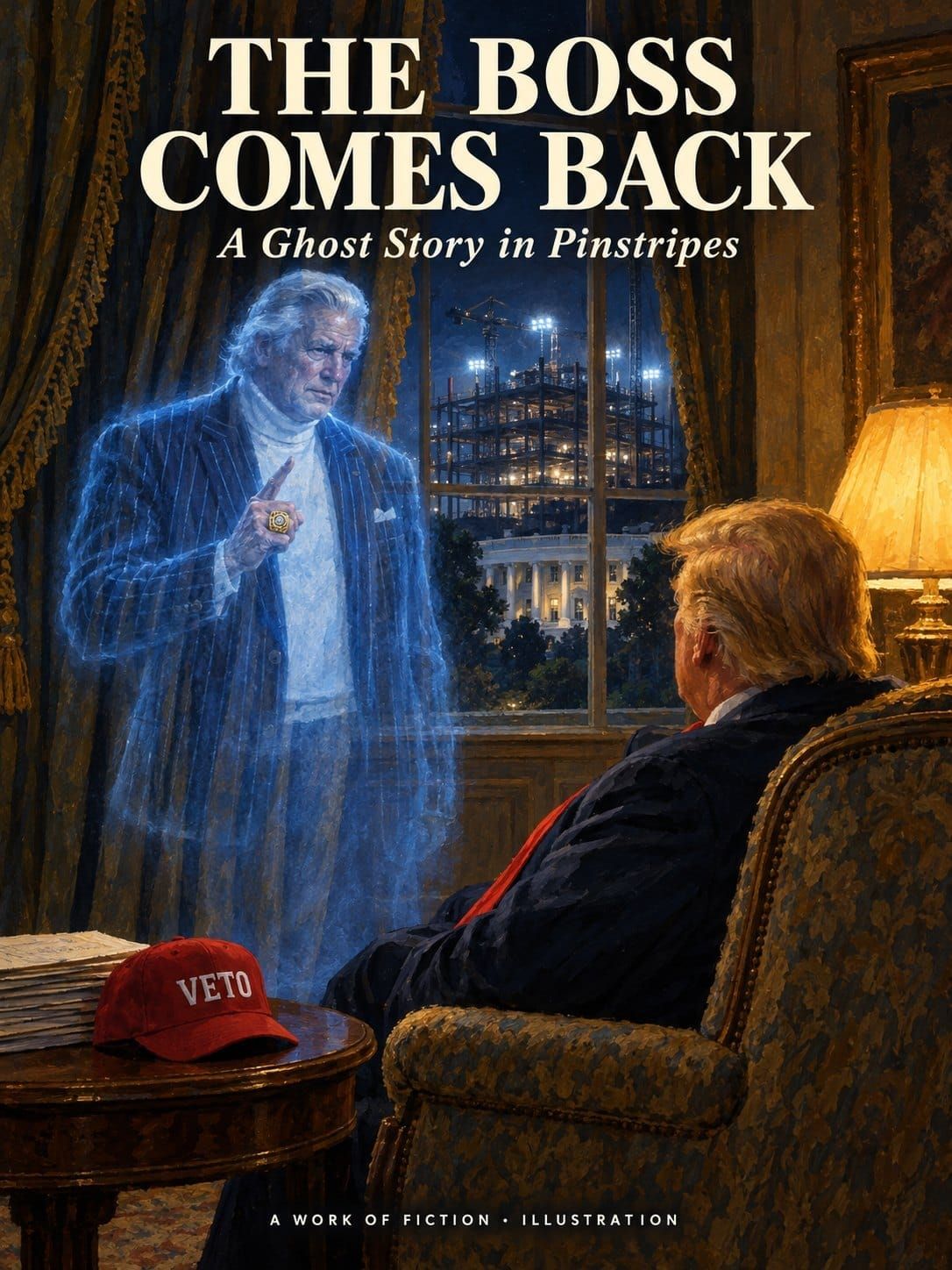
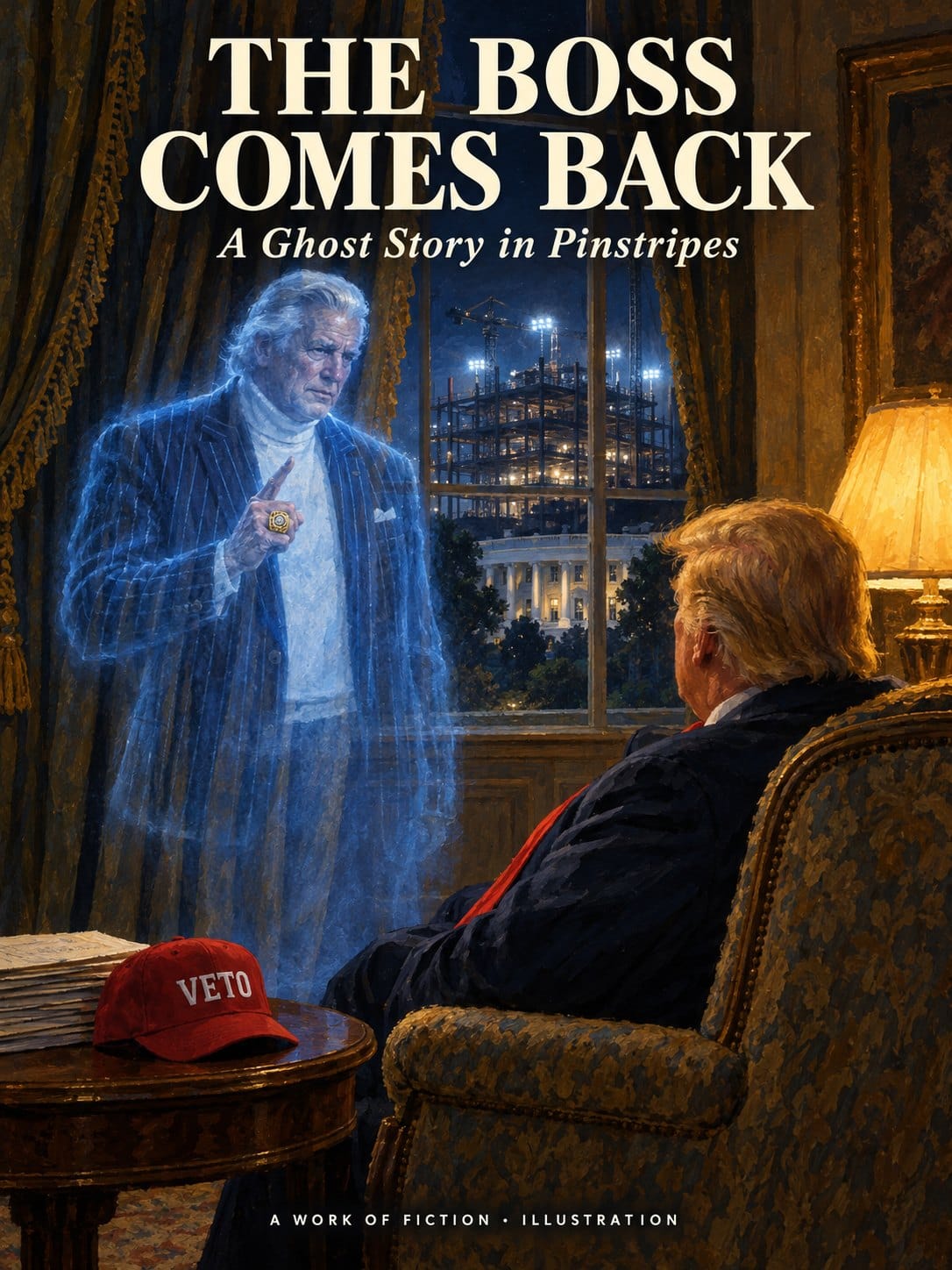
A ghost story in pinstripes. A work of fiction: the conversation imagined here never took place. Public events referenced, including Stephen Miller's appointment as chief of staff announced on November 6, 2026, are drawn from news reporting. Steinbrenner's visit, Trump's change of mind, and all dialogue, private scenes and characterizations are invented.
I. The Residence, Friday, 11:40 P.M.
The televisions had been turned off at last. All evening every channel had run the same graphic: Stephen Miller's face beside the words NEW CHIEF OF STAFF. The Truth Social post had gone out that afternoon. Susie had sent her resignation the night before and cleared out by six. Miller would start Monday morning.
Donald Trump sat alone in the yellow light of a single lamp. A stack of Natalie's printouts lay face-down on the side table: Kansas, South Carolina, Iowa, Maine, Ohio, North Carolina, Texas. Seven Senate seats. The House gone by a margin the networks were still counting three days later. On the arm of the chair sat the red cap he had posted on Wednesday, white block letters across the front: VETO.
He picked it up, looked at it, and set it down again.
Outside, past the colonnade, the steel skeleton of the new ballroom stood against the floodlights. The final beam had gone in earlier that week. It had seemed like a good omen at the time.
"Big crowds," he said to the empty room. "Tremendous crowds. You couldn't transfer the love."
"No," said a voice from the doorway. "You never can."
II. The Visitor
He was standing by the window as if he had always been there: a broad man in a navy blazer and a white turtleneck, silver hair combed straight back, a World Series ring catching the lamplight. He looked the way he had looked in the owner's box in 1996, the year it all came back.
Trump did not stand. He did not call for the Secret Service. Later he would not be able to explain why.
"George."
"Donald." George Steinbrenner walked across the carpet and looked down at the cap. "Mr. Veto. That's cute. You know who that reminds me of? Billy Martin. Every time I hired Billy, the first thing he did was tell the papers who he was going to fight."
"You hired him five times."
"I fired him five times, too. That's the part people forget." George lowered himself into the chair across from Trump, and the cushion did not move. "You lost, Donald. Don't tell me about the crowds. Don't tell me if you'd been on the ballot. I know what a big crowd and an empty scoreboard look like. I owned the Yankees in the 1980s."
III. The Best Team in the City
"We had the best team," Trump said. "The economy is doing great. The market's up. It was the oil. Iran. It's temporary."
"You think I don't know that speech? I gave that speech for a decade." George leaned forward. "Let me tell you about 1986. My Yankees won more games in the eighties than anybody in baseball. Anybody. And the whole city was wearing Mets hats. Gooden, Strawberry, Hernandez. They won the World Series and two million people went to their parade. From '84 to '92 the Mets outdrew me every single year. I had the better ballclub and they had the love."
"So what did you do?"
"I did exactly what you want to do right now. I chased the back page. Every morning I read the Post and the News, and if the Mets were on the back I made a move. Traded kids for veterans. Signed guys I didn't need. Fired managers to get the headline back." He shook his head slowly. "Four losing seasons. Attendance dropped under two million. I made the team worse trying to beat the Mets in the newspaper."
Trump looked at the cap.
"Your Mets right now are named Ron DeSantis and JD Vance," George said. "And they've both been on the back page all week. DeSantis is calling it an extinction-level event and telling everybody Florida held the line. Your own vice president is telling the world 'the reason we lost is the war.' You want to fight them both in the papers. Don't. That's what I did in 1987."
IV. Don't Dig for Dirt
"Vance," Trump said. The word came out flat. "The morning after. On X."
"I know. A guy who blames the owner in the papers the morning after a loss is a guy protecting his own contract. You're not wrong about him." George held up a hand. "But listen to me, because this is the one I care about most. They're coming after you now. The new Oversight fellow already said it: the family, the immigration people, the companies, all of it, day one. Don and Eric are going to spend two years in hearing rooms."
"It's a witch hunt."
"Maybe. You know what I did when a fight like that got under my skin? Winfield. I paid a two-bit gambler forty thousand dollars to dig up dirt on my own ballplayer. That's what got me thrown out of baseball. Not losing. Not the managers. Digging." George's voice dropped. "July 30, 1990. They put it on the scoreboard during the game, and twenty-four thousand people in my own ballpark stood up and cheered for ninety seconds. I'll hear that sound for the rest of eternity, Donald."
He let it sit.
"Veto their bills if they're bad. That's your right. But you do not go after the investigators. You don't dig. You don't fight the commissioner. You hire the best lawyers in the country and let them be boring. That's how you survive two years of hearings."
V. The Best Thing That Ever Happened to Me
"So what am I supposed to do? Sit there?"
George laughed, the big laugh from the old Stadium press conferences.
"You want to know the best thing that ever happened to the New York Yankees? Me getting banned."
Trump frowned.
"I'm serious. The night before the ban took effect, I put Gene Michael back in as general manager. Stick. I'd hired him and fired him as manager twice already; we fought like cats. But with me out of the building, Stick did the thing I never let anybody do. He left the kids alone. No panic trades in July. When teams called for Bernie Williams, he hung up. I'd wanted to trade Bernie. He traded Roberto Kelly for Paul O'Neill. He drafted a skinny shortstop out of Kalamazoo named Jeter. He kept Rivera, Pettitte, Posada." George spread his hands. "The most meddlesome owner in the history of the sport had to be thrown out of his own building before his farm system could build a dynasty. That's the truth, and I didn't like hearing it either."
"I'm not getting banned."
"No. You've got something worse. You've got a calendar. Twenty-second Amendment. You can't be reinstated. So you've got to give yourself a ban on purpose. You need a Gene Michael, and you need to stay out of his way."
VI. Monday Morning
"You read the news," Trump said. "I made the move. Susie's out. Stephen starts Monday."
"I read it." George's voice was flat. "'Stephen's been with me from the beginning.' 'He gets it.' 'Great manager.' Last month you said Susie had zero chance of being replaced. Now she's gone and your deputy has the job."
"Stephen's loyal. He's tough. He's brilliant."
"I know. That's what scares me." George leaned forward. "Let me tell you about 1985. Sixteen games into the season, I fired Yogi Berra and brought back Billy Martin. Fourth time. The guy I knew. The guy who agreed with me. Same fights, same headlines, and we finished second. After a loss, the most natural thing in the world is to promote the man who already agrees with you. It feels like strength. It's the opposite."
"The base loves Stephen."
"The base didn't lose you Tuesday. Nine out of ten voters said the cost of living. You lost at the gas station, Donald, and you just promoted the head of border security." George ticked it off on his fingers. "And the Oversight fellow already told you his first targets: the family, the immigration people. Who built the immigration operation? Stephen. You just put the man they most want under oath in the office next to yours. Every subpoena to him lands in the West Wing."
Trump said nothing.
"Stephen's a great coach," George said, more gently. "Keep him coaching. The border, policy, the speeches. A big title, a big office, real power over his side of the field. Stick never fired my scouts; he made them better. But you don't make your toughest coach the general manager the week after you lose the city."
"Susie," Trump said.
"She's tired, Donald. She beat cancer this year, she promised you a win, and the whole town wanted her head. You gave her a soft landing in the political operation. Good. That was the right call. The wrong call is who you put in her chair."
VII. Clueless Joe
"You need a general manager." George sat back. "Let me tell you about the best hire I ever made. 1995. I'd gone through twenty managers. I let Buck Showalter's contract run out, and I called a guy who'd been fired by the Mets, fired by the Braves, fired by the Cardinals. Losing record. Fifty-five years old, sitting at home watching games on TV. The Daily News put it right on the back page: CLUELESS JOE."
"Torre."
"Torre. Four World Series in five years. Twelve years in the postseason. Hall of Fame. All because I hired the guy everybody in town was laughing at." George pointed at Trump. "Who's the guy the whole town says you'd never hire?"
Trump was quiet for a long moment.
"Ron."
"Ron."
"He ran against me. Ron DeSanctimonious. He called our Iran policy gaslighting, the day before the election."
"Billy Martin called me worse than that in print, and I hired him five times. Reggie and I couldn't be in the same room, and in 1993 I brought him back and retired his number. Yogi didn't speak to me for fourteen years, so I drove to his museum and apologized to his face, because the Yankees needed Yogi in the building." George leaned in. "I never once asked whether a man liked me. I asked whether he could win for me. Ron is the only Republican who held a big state Tuesday night. The only one of the ten biggest states that'll still have a Republican governor. That's your Clueless Joe."
VIII. The Terms
"It's announced," Trump said. "It's on Truth Social. If I pull it back, they'll say I flip-flopped. They'll say the Boss doesn't know what he's doing."
"I hired Billy Martin five times and fired him five times. They called me a madman, a tyrant, a lunatic. You know what nobody called me after 1996?" George waited. "A loser. Nobody remembers the Monday press release, Donald. They remember October." He glanced at the clock on the mantel. "And Stephen doesn't start until Monday. You've got a weekend. I put Stick Michael back in charge the night before my ban took effect. The biggest move of my life happened in twenty-four hours. Plenty can change by Monday."
"So what do I tell Stephen?"
"You tell him the truth. He's the best policy man you've got, and you need him on the field, not behind a desk signing everyone's calendar. You make him the most powerful deputy in the building. Then you call Tallahassee."
"Chief of staff," Trump said slowly, testing it. "Ron. He'd never take it."
"He'll take it if you make it real. He's not a kid looking for a job. He's a free man in January, and his odds tripled overnight. He's got a good lane sitting outside throwing rocks at you. So you have to give him something better than the lane." George counted on his fingers, the way he used to count championships.
"One. A real portfolio, in writing. Domestic. Congress. Prices. The investigations. You keep the world. You keep Iran. He runs the team.
"Two. He picks his own people. Stick didn't inherit my scouts; he hired his own. If Ron walks in and the whole building still answers to somebody else, he's a manager with no say over the roster.
"Three. An end date. Call it a turnaround mandate for 2027. Everybody knows he's leaving by the end of summer to run. You announce that up front, and when he goes, it's a graduation, not a divorce.
"And four, the hard one." George looked at him evenly. "You sit beside him, not across from him. Joe and I sat side by side on the bench. Co-guys in charge. When I yelled, he nodded and did it his way anyway. You have to let him do it his way."
"The Senate would never confirm him for anything now."
"That's the beauty of it. Chief of staff doesn't need the Senate. After January, it's the only big job in this building you can give him without fifty-four Democrats voting on it."
IX. Three Wins on His Watch
"So he comes in. Then what?"
"Then he wins, fast, and everybody sees it. Three things." George held up his fingers again.
"Gas. You said it yourself to that CNBC fellow: not the war, the price. Fans don't read box scores; they read the scoreboard. Every gas station in America is a scoreboard, and right now it says you're losing. That number comes down in 2027 or nothing else matters.
"Houses. That Talarico kid from Texas, the one who just took LBJ's seat, he's already saying he'll work with you on housing because you're a builder. Take him up on it. You and Ron and a Democrat from Texas signing a bill to build millions of homes. Let the papers figure out how to make that a bad story.
"And the hearings. Ron's a Harvard lawyer and a prosecutor. He sat next to a SEAL commander in Fallujah and made sure every mission was done by the book. Bronze Star. Let him run the defense like that. Calm. Legal. Boring. Every day the hearings are boring is a day you win."
"He wasn't a SEAL."
"I know he wasn't, and so does everybody who served with him. So don't let anybody say he was. 'Legal adviser to the SEAL commander in Fallujah, Bronze Star' is better than any made-up version, because nobody can knock it down."
X. The Builder and the Trophy
Trump stood and went to the window. The floodlights on the ballroom beams buzzed faintly.
"If he does all that, he gets the credit," he said. "He runs in '28 on my record."
"Now you're thinking like an owner." George came to stand beside him, though his reflection did not appear in the glass. "Let me tell you the saddest part of the whole Yankee story. Stick Michael built that dynasty. Every piece. And he wasn't the general manager when we won in '96. He'd stepped down. He went to scouting. The guy who built it watched the parade from the sidewalk."
"So Ron's Stick Michael."
"Ron's afraid he's Stick Michael. That's why he'll want wins that finish while he's still in the building, with his name on them. Give them to him. A bill he signs off on. A gas price he can point to. Because here's what you don't understand yet." George turned to face him. "You don't win this by keeping the credit. You win it by sharing it. If Ron goes to Iowa in January of '28 saying, 'I ran Trump's White House the year it turned around,' then every vote he gets is a vote for your record. That's the only third term the Constitution lets you have."
XI. 2007
"And if he gets too popular?"
George's face changed. For the first time all night, he looked his age.
"That's the one I got wrong," he said quietly. "Joe got popular. More popular than me. The mayor loved him. The fans loved him. Even the manager of the Red Sox stood up for him. And it got under my skin. By 2007 I was old and the boys were running things, and they offered Joe one year at a pay cut with incentives, an offer you make so a man will say no. He said no. He walked. Four World Series rings, and he left through the side door." He shook his head. "I should have stopped it. I didn't."
"So what do I do?"
"You let Ron leave in 1996, not 2007. You throw him a party. You stand at the podium and say he did a great job, the best job, and you mean it. You let him go while you still like him. That's the whole trick. Every man who works for a big personality eventually gets too popular. You don't fight it. You plan for it."
XII. The Two Floridians and the Kid
"Marco," Trump said. "Marco's doing great. He stayed out of it."
"Marco's smart. Kept his head down and stayed off the trail. But he's your national security adviser and he cheered for the war, and that's going to follow him." George shrugged. "You've got two Floridians who get along. Put them in the same building. Let them work out who goes first. Ron at the top and Marco second, or Marco waits for '32. If they settle it under your roof, they don't split Florida in a primary and hand the whole thing to a vice president who blamed you on day one."
"And Ivanka?"
George smiled, the first gentle thing he had done all night.
"I left the team to Hal. Not to my best manager. To my son. Different jobs, Donald. The family owns the franchise; the professional runs the dugout. If you want her to carry the name someday, that's the ownership line. Ron's the manager. Don't confuse the two, and don't let them confuse it either."
XIII. Finish the Series
"Iran," Trump said. "I'd do it again. I told them that. You didn't have a choice."
"Fine. You started the series. Now win it." George's voice hardened. "October 2000. Subway Series against the Mets. I told my general manager, 'You'd better win, or else.' I had couches trucked over to Shea because I didn't like the visitors' clubhouse. I could not lose to the Mets. And we beat them four games to one and celebrated on their own field." He jabbed a finger toward the window, east, toward an ocean and a war. "If Iran gives in, if the oil comes down, the people who left you on Tuesday will come back. If it drags into '28, you will have handed the city to the Mets. There's no tie in this one."
XIV. The Letter
The lamp flickered. Trump realized the room had grown colder, and that George was standing farther away than he had been a moment ago.
"George. Wait."
"I wrote you a letter once. 1989. On Yankee letterhead. You found it and showed everybody in January." George was by the door now, half in shadow. "I said, you articulate the truth. I said you ought to run for president someday and set the whole thing right."
"I remember."
"You did the first part twice. This is the second part. Setting it right isn't winning the next headline, Donald. It's building something that wins after you're gone. I learned that from a skinny GM, a manager the papers laughed at, and a kid from Kalamazoo. It took me getting thrown out of my own ballpark to learn it."
"You'll come back?"
"The Boss always comes back," said George Steinbrenner. "That's the whole story."
Then the doorway was empty.
XV. 2:31 A.M.
Donald Trump sat for a long time in the yellow light.
Then he picked up the red VETO cap, turned it over in his hands, and dropped it into the wastebasket beside the chair.
He reached for the phone.
"Get me Tallahassee," he said. "No, I know what time it is. Tell him it's the Boss."
He paused, the receiver against his ear.
"And first thing in the morning, get me Stephen. Tell him he's still on the team. Tell him Monday's going to look a little different."
The end.
This is a work of fiction. The conversation imagined here never took place. Real public events and some public statements referenced are drawn from news reporting; Steinbrenner's visit, Trump's change of mind, and all dialogue, private scenes and characterizations are invented.