
Volcker Mark II or Colossus Mark I?


The Winner Colossus by a Mile!
Executive Summary
Christopher Wood's latest GREED & fear and the JD Unfiltered Colossus Doctrine describe the same 2026: a Treasury that has displaced the Fed as the marginal price-setter in US rates, long-bond buybacks that behave like QE without being QE, a Fed chair who will accommodate rather than fight, an AI capital-spending cycle carrying half of real GDP growth, and a gold price that keeps rising. On the facts, there is almost nothing to argue about.
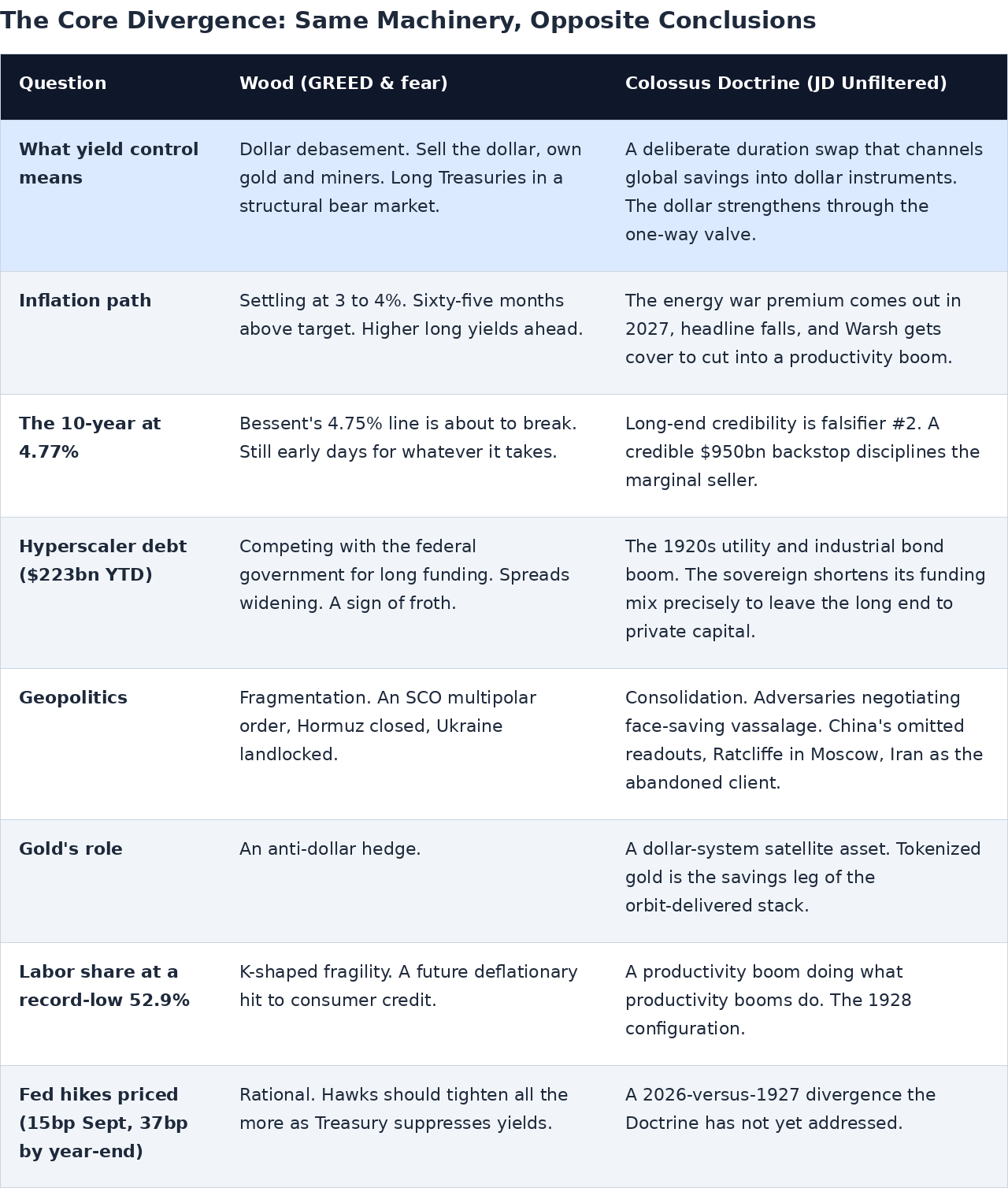
On what the facts mean, the two frameworks point in opposite directions. Wood reads yield control as dollar debasement and concludes that investors should sell the dollar, own gold, treat long Treasuries as a structural bear market, and expect inflation to settle between 3 and 4% with higher long yields ahead. The Colossus Doctrine reads the same yield control as a deliberate duration swap that channels global savings into dollar instruments, expects the energy war premium to come out of headline inflation in 2027, and expects a Warsh Fed to ease into a productivity boom on the 1928 template.
This report sets the two side by side, then makes the case against Wood's conclusions using, wherever possible, Wood's own exhibits. It closes by conceding the points where his data genuinely hit the Doctrine's named falsifiers, and by setting the three dates that will settle the argument.
The core findings.
Wood's debasement thesis contradicts the monetarism he endorses. A bills-for-bonds maturity swap funded from the Treasury General Account creates no reserves and adds nothing to M2. Under the Miran, Ireland and Roubini cross-check that Wood praises, it cannot be debasement.
Wood's own money-supply chart argues against his inflation call. His Exhibit 8 shows M2 and the Divisia aggregates growing in the mid-single digits, nowhere near the 2020 and 2021 surge. A monetarist reading says today's 3 to 4% inflation is not monetary. It is a supply shock, and every inflation datapoint in his note after page 9 is Hormuz or the Black Sea.
Wood forecasts a monetary regime from a war premium. Diesel up 62% year to date, the crack spread at $105 a barrel, Qatari LNG down 96%. That is the wedge the Doctrine identified in August. If it closes, the settling range closes with it.
Wood's AI and labor-share arguments are the Doctrine's 2027 disinflation case. He cannot hold that AI will let firms produce more output with less labor and that inflation is structurally higher at the same time, and he resolves the tension only with the words "for now."
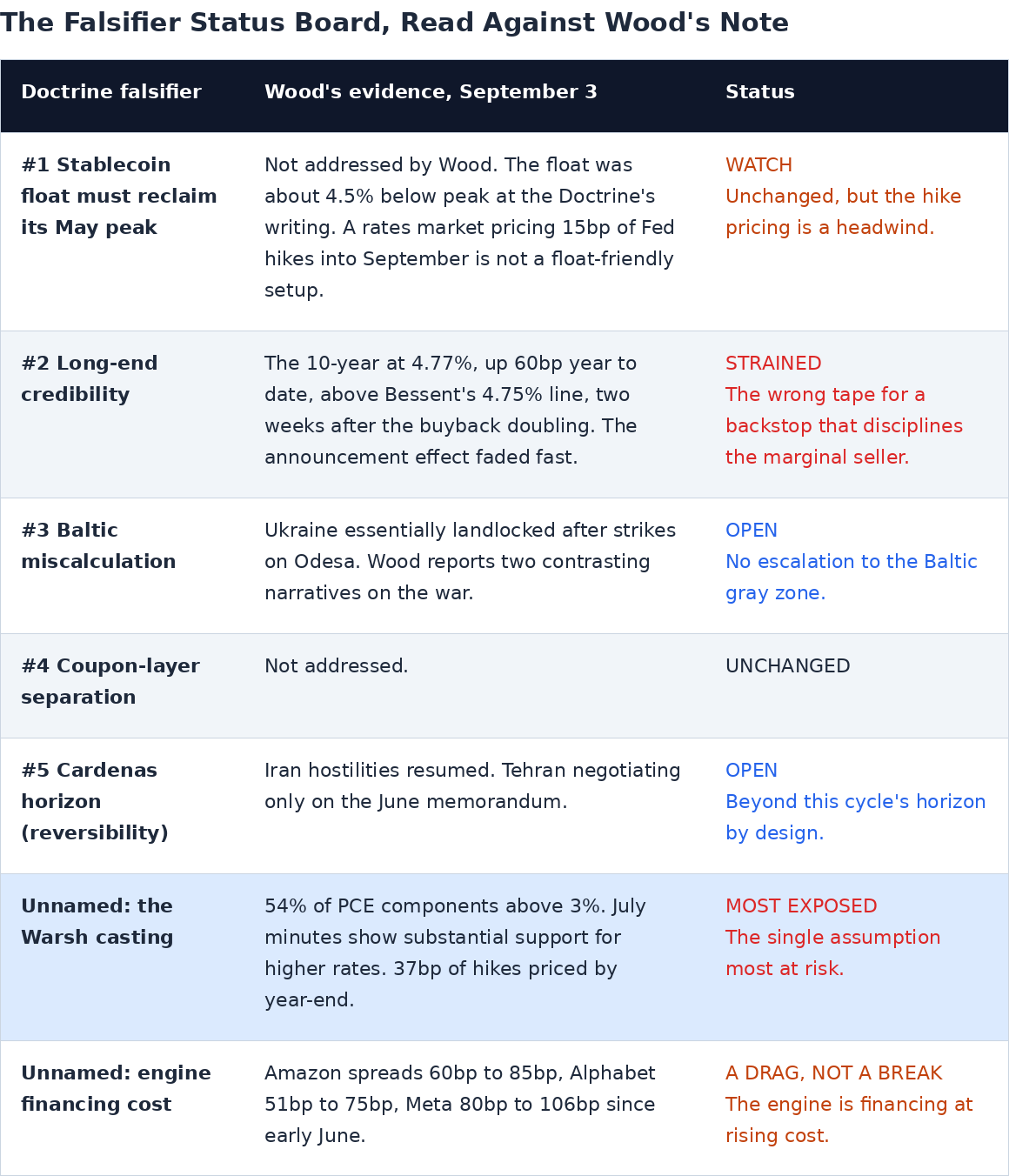
Wood's data nonetheless hit three of the Doctrine's five falsifiers. The 10-year at 4.77% two weeks after the buyback doubling, the stablecoin float still below its May peak, hyperscaler spreads widening, and a rates market pricing Fed hikes are all real. The Doctrine's casting of Warsh as Benjamin Strong is the single assumption most exposed.
Part I: Where Wood and the Doctrine Agree
It is worth being precise about the size of the common ground, because it is large. Both frameworks were written in the same fortnight, from the same tape, and both reached the same description of the machinery.
Treasury, not the Fed, is now the marginal actor in US rates. Wood's formulation is that Treasury has become more important than the Fed. The Doctrine calls it "the fusion of Treasury and Fed into a single policy desk."
Buybacks funded from the TGA are QE-adjacent. Wood cites David Zervos on the strong similarities between the two. The Doctrine calls it "Operation Twist without the Fed" and traces the circuit: stablecoin float and money-fund cash buy bills, bill proceeds fill the TGA, and the TGA retires 10, 20 and 30 year bonds.
Warsh accommodates Treasury. Wood assumes it until proven otherwise. The Doctrine assumes it by construction. Warsh is the Benjamin Strong of the 2026 accord, and the August 19 buyback doubling is the August 5, 1927 discount-rate cut, ninety-nine years and fourteen days apart.
AI capex is the real-economy engine. Wood puts it at 1.02 percentage points, or 48%, of real GDP growth in the four quarters to the second quarter of 2026, in his Exhibit 11. The Doctrine calls it the factory-electrification engine of the cycle.
Gold goes up. Both are long. They differ only on why, which turns out to matter.
Money supply is back on the table. Wood welcomes Warsh's view that money has something to do with monetary policy, and the Hudson Bay paper on a return to monetarism. The Doctrine has run an M2 and monetary-base confirmation dashboard since July for exactly the same reason.
Part II: The Core Divergence
Same machinery, opposite conclusions. The table isolates the eight questions on which the frameworks part.
Part III: Where Wood Is Wrong
Most of the case against Wood can be built from his own exhibits. Each point below states his position first, then the problem with it.
1. He calls a maturity swap debasement while championing monetarism
What Wood says. Wood concedes the buybacks are not technically QE, then argues that Treasury's evident desire to control yields is fundamentally inflationary in the dollar-debasement sense. Two pages later he endorses the Hudson Bay paper's view that the information in the money stock should be the Fed's cross-check, and observes that a hardline monetarist would treat interest rates as only a symptom of monetary policy.
Why it does not hold. The buyback mechanism is bills for bonds. The TGA is filled by bill issuance and used to retire long bonds. No reserves are created. Nothing is added to M2, Divisia M2 or Divisia M4. Under the monetarist framework Wood spends two pages praising, a duration swap that leaves the money stock unchanged cannot be debasement. He is using a monetarist lens to reach a non-monetarist conclusion. If interest rates are only a symptom, then a policy that changes the shape of the yield curve without changing the quantity of money is, by his own logic, not inflationary.
2. His own Exhibit 8 refutes his inflation call
What Wood says. Wood argues that anyone watching M2, Divisia M2 or Divisia M4 in 2020 and 2021 would have seen the inflation risk building, and that the Powell Fed's failure to look was the original sin.
Why it does not hold. Agreed. Now apply the same chart to 2026. Exhibit 8 shows all three aggregates growing in the mid-single digits, roughly 5 to 7% year on year, against a 25 to 30% spike in 2020 and 2021. If money is the cross-check, the cross-check says today's 3 to 4% inflation is not monetary. That leaves only one candidate, and it is the one the rest of his note documents in detail: a supply shock.
3. He documents the war premium and then treats it as structural
What Wood says. Inflation is settling in the 3 to 4% range, consistent with nominal GDP running at a 5.7% trend, and higher long-term bond yields lie ahead.
Why it does not hold. Look at what he cites after page 9. US retail diesel up 21% since early July and 62% year to date, in Exhibit 18. The diesel crack spread from $53 a barrel in mid-June to $105, in Exhibit 19. Qatari LNG cargoes outside the Gulf down 96% year on year since the March attack, in Exhibit 17. The Bloomberg grains subindex up 23% off its June low on Black Sea port strikes, in Exhibit 20. Every inflation datapoint is Hormuz or Odesa. That is exactly the wedge the Colossus Doctrine identified on August 29: energy is holding real growth near 1.5% and headline CPI at 3.4%. Venezuelan barrels routed into the Strategic Petroleum Reserve and an Iranian resolution attack that wedge directly. Wood is projecting a supply shock forward as if it were a monetary regime.
4. He argues AI is deflationary and labor share is collapsing, then forecasts higher inflation
What Wood says. Even on the most bullish forecasts for AI monetization, he writes, wage compensation stays under pressure precisely because that success means more can be produced with less labor input. Labor share is at a record-low 52.9% and, on Dario Amodei's predictions, is heading much lower, with strongly deflationary implications.
Why it does not hold. He is describing a productivity boom with disinflationary output effects. That is the 1920s configuration and the Doctrine's 2027 setup, in Wood's own words. You cannot hold that view and a structural 3 to 4% inflation view simultaneously. Wood resolves the contradiction by saying that "for now" the AI capex cycle is inflationary because of the physical inputs it requires, energy above all. Which is the war-premium point of the previous section, restated. Strip out energy and his framework yields disinflation.
5. He reads the SCO communiqué at face value
What Wood says. The 26th SCO heads-of-state meeting in Bishkek, with Xi and Putin present, made the shifting power dynamic clear and called for a more representative and just multipolar world order.
Why it does not hold. Communiqués are the face-saving layer. The 1927 template resolves confrontation through accommodation dressed as sovereignty, and the evidence runs the other way from Wood's reading: China's own readout omitting rare earths after the May summit, Russia and China trade growth halving, Sinopec forced onto Russian crude only because the US blockade cut Iranian supply, the PBOC banning yuan stablecoins outright. Wood's own Exhibit 5 makes the point for him. Japanese nominal GDP has run at 4.2% for three years and the Bank of Japan still will not hike aggressively. That is subordination to the dollar-rate architecture, not multipolarity.
6. He admits his Iran call was wrong and does not update
What Wood says. GREED & fear had expected an extended holding period, or de facto truce, on Iran, on the reasoning that the Trump administration would want an unpopular war out of the headlines heading into the midterms. Hostilities have resumed instead.
Why it does not hold. The truce did not materialize. The Doctrine's abandonment scenario explicitly warned that "the transition itself can spike the oil price before it settles it." Wood's diesel and LNG data are consistent with the Doctrine's stated path. A forecaster whose central case has just failed should either re-examine the framework or explain why the failure is temporary. Wood does neither. He moves on to diesel prices and folds them into a structural inflation call.
7. The hyperscaler crowding-out point cuts against him
What Wood says. The five hyperscalers have issued $223bn of bonds this year against $108bn in all of 2025, and their demand for long-term funding now competes with the federal government's.
Why it does not hold. If private issuers are competing with Treasury for long-duration savings, the rational sovereign response is to shorten its own funding mix and vacate the long end. That is what Bessent is doing, and it is why the duration machine exists. Wood presents the competition as a problem for Treasury. It is the reason for Treasury's policy, and it is the 1920s pattern: the state funds short while private capital funds the utilities, the factories and, today, the data centers.
8. The dollar call has no counterparty
What Wood says. The more successfully yields are controlled, whether by manipulation or outright yield-curve control, the stronger the case for selling the dollar and owning gold and gold mining stocks.
Why it does not hold. Selling the dollar requires something to buy. Wood's own note describes 10 and 30 year JGB yields at 30-year highs with a Bank of Japan reluctant to hike, Singapore REITs derated by US yields for reasons that have little to do with Singapore, and a Europe and Asia about to be dependent on replacement LNG into the heating season. Foreign rate convergence is the Doctrine's two-stage event. An initial carry unwind weakens the dollar, then recessionary tightening abroad sends capital back into US assets and dollar stablecoins. Wood is describing stage one and calling it the trend. The Japan comparison also undercuts his debasement argument. Bank of Japan yield-curve control was central-bank balance-sheet expansion. Treasury buybacks are not.
Part IV: Where Wood Lands a Punch
A framework that names its falsifiers has to check them when the data arrive. Wood's note, read against the Colossus Doctrine's five named falsifiers, produces the following status board.
The Warsh problem
The Doctrine casts Warsh as Benjamin Strong, easing into a boom on the 1927 and 1928 template. Wood's evidence says the FOMC may not cooperate: a majority of PCE components running hot, a committee with substantial appetite for higher rates, and a market pricing a hike into the September 15 and 16 meeting. If the Fed hikes while Treasury buys the long end, the result is a flattener, not a coup de whiskey. That is a genuine 2026-versus-1927 divergence, and the Doctrine has not yet addressed it. The honest position is that the casting of Warsh is the single assumption most exposed to the next two weeks of data.
Where Wood is right on the description and wrong on the conclusion
Wood's description of the K-shaped economy is accurate and important. Real compensation of employees down 0.2% year on year in July, real consumption up 2.1%, the savings rate down to 3.0%, in his Exhibits 9 and 10. Consumption is being carried by wealth, not wages. The Doctrine does not dispute this. It disputes the inference. In 1928 the same configuration held, and it was the fuel of the melt-up leg, not its refutation. The Doctrine's own terminal date, an August 2028 peak followed by a rapid repricing, already prices the fragility Wood describes. The difference is timing. Wood treats the fragility as a reason for caution now. The Doctrine treats it as the reason the cycle ends in 2028.
Part V: The Scorecard Ahead
Three dates settle most of this argument.
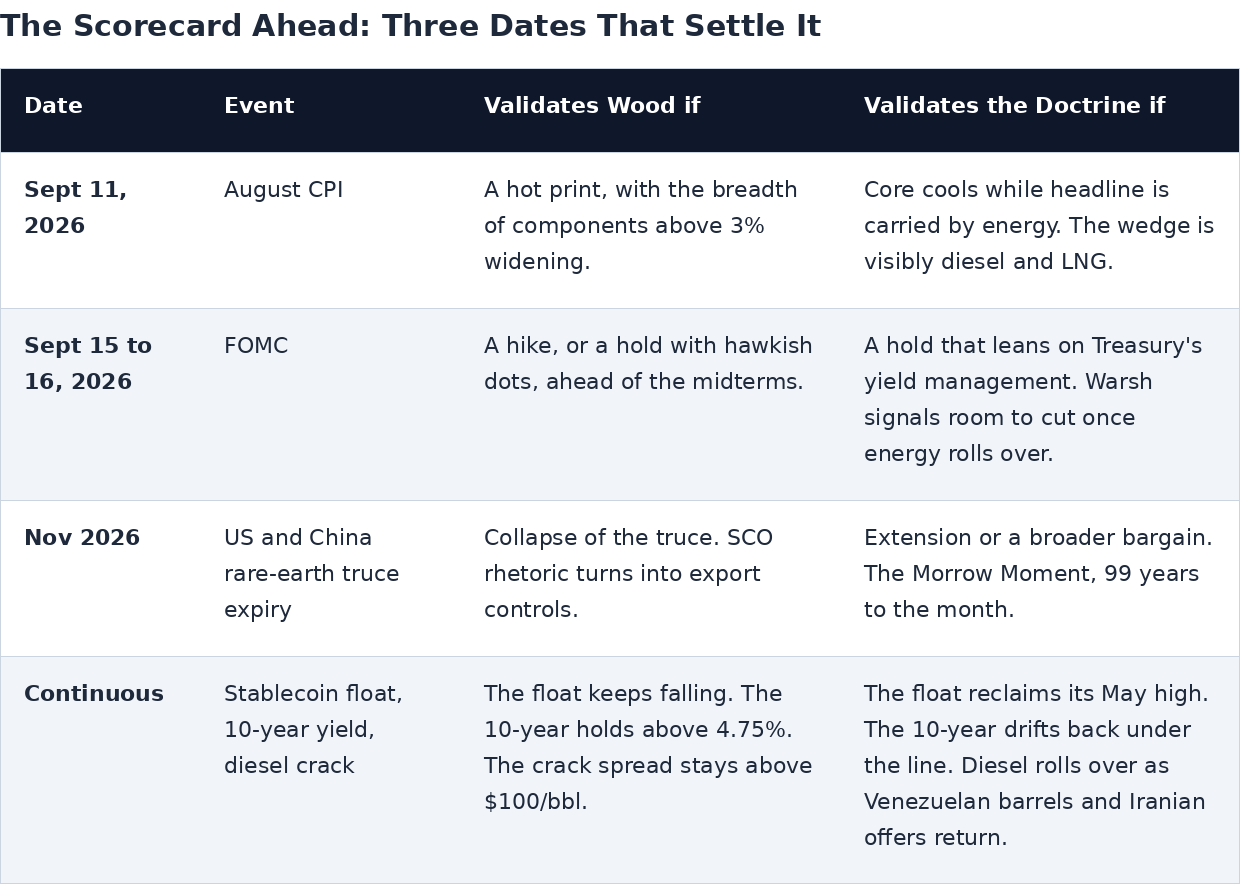
A hot CPI followed by a hike validates Wood's near-term read and strains the Doctrine's casting of Warsh. A hold, a truce extension and a rolling-over diesel price validate the Doctrine, and leave Wood having forecast a monetary regime from a supply shock. Either way, the disagreement is now specific enough to be settled by the calendar rather than by rhetoric, which is the most useful thing a rival framework can offer.
This report presents a historical-analog framework and macro thesis for research and discussion purposes. It is a response to a third-party research note and characterizes that note for the purpose of commentary and criticism. It is not investment advice. Forward projections are outputs of the JD Unfiltered framework, not predictions of certainty.
The authors hold positions in securities mentioned and reserve the right to buy or sell shares at any time without notice.