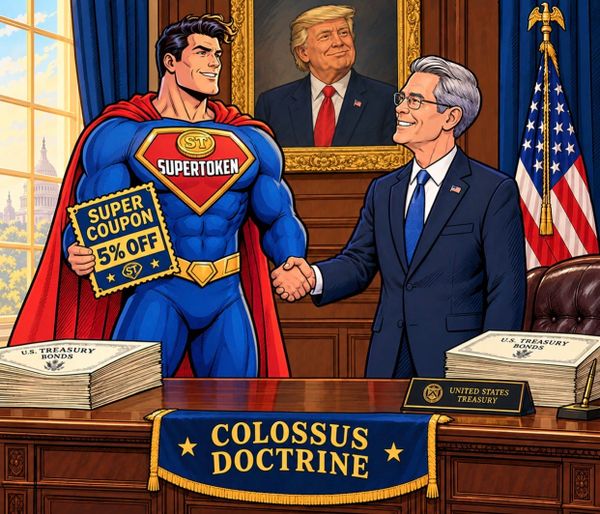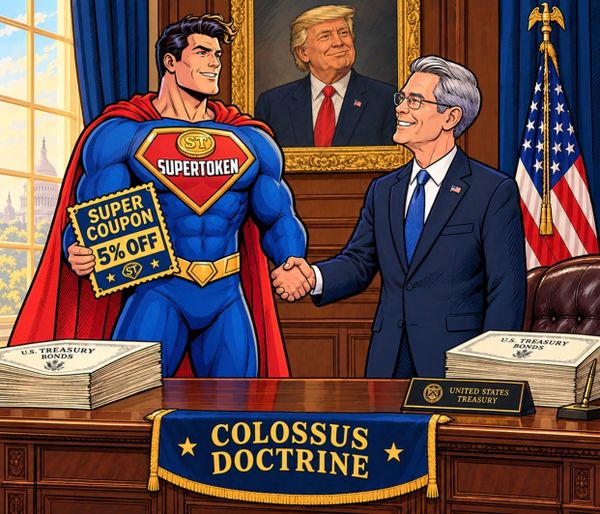
"Ridiculous, Sam?"

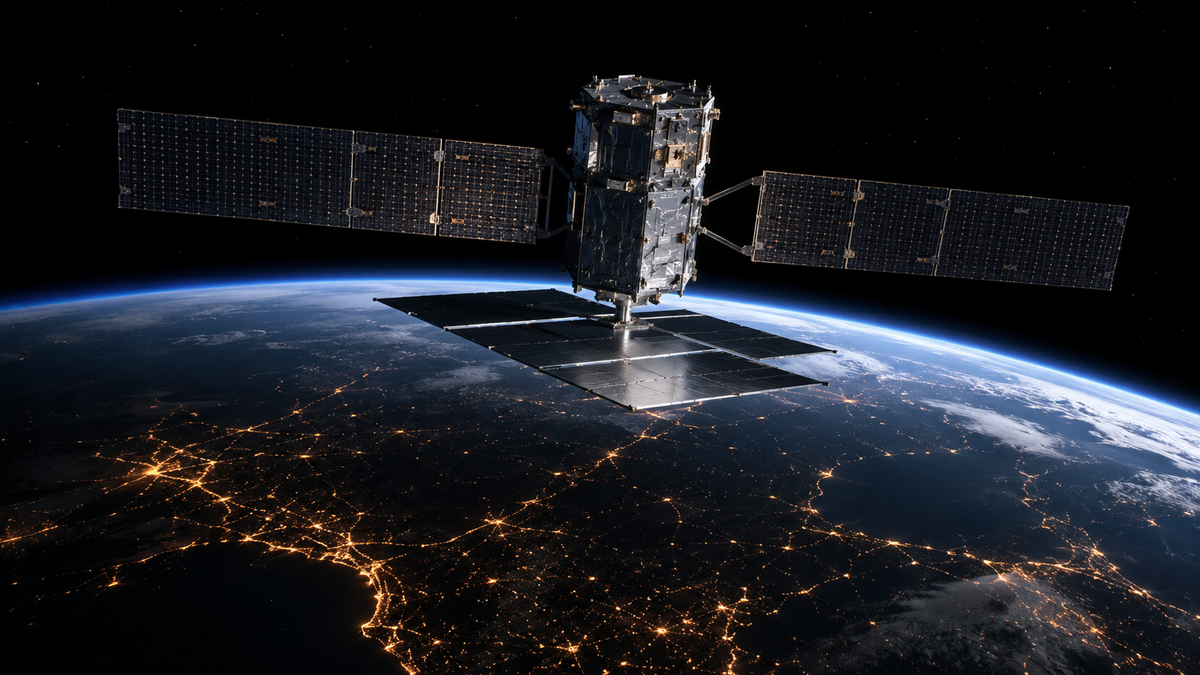
The two-week arc from orbital data centers to the Cursor cutoff.
Part One. The Manifest.
In February, OpenAI CEO Sam Altman was asked about Elon Musk and Jeff Bezos and their plans to build data centers in orbit. His answer was one word. "Ridiculous."
He backed it up, in remarks reported by Techzine. "If you just do the rough math of launch costs relative to the cost of power we can do on Earth, we are not there yet." And the closer. "Orbital data centers are not something that's going to matter at scale this decade."
Six months and twenty days later, Musk answered him. Not with a tweet. With a spacecraft.
The Answer Has a Name. Starmind AI1.
On August 4, 2026, during SpaceX's first ever earnings call as a public company, Musk told investors that SpaceX would build its AI infrastructure exclusively on Nvidia. He called the Vera Rubin architecture "the best AI computer" and confirmed the partnership runs deep. Nvidia already owns roughly 122.8 million Class A shares of SpaceX worth approximately $21 billion, a stake carried over from Nvidia's earlier xAI investment before SpaceX absorbed xAI in an all-stock deal.
Three weeks later, Musk put a quarter on it. Per Bloomberg: "SpaceX, in partnership with Nvidia, has designed a space optimized Vera Rubin NVL72 system for launch to orbit in Q4 next year, with significant scale in 2028."
The satellite is called Starmind AI1. Here is what is actually being built.
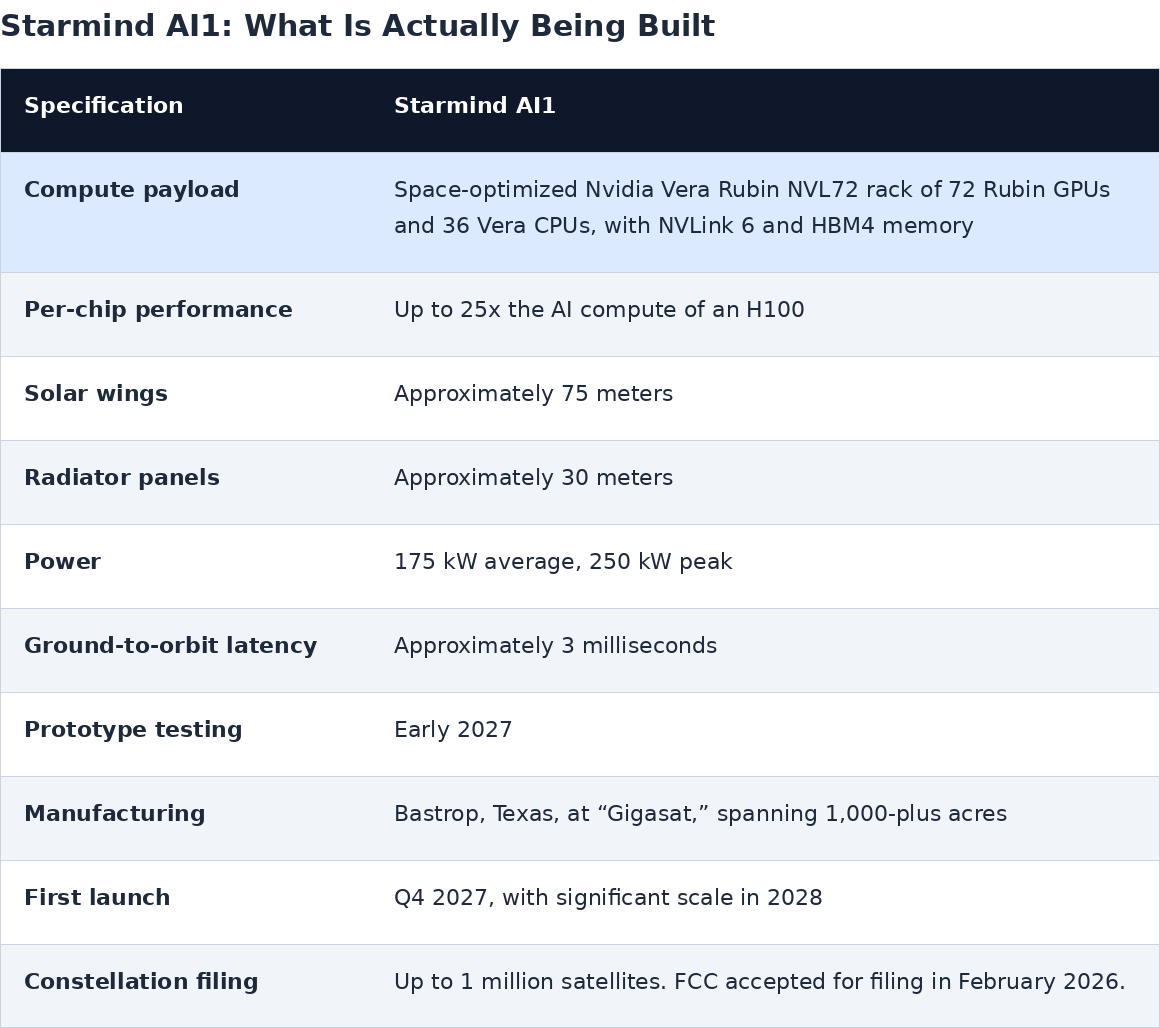
Musk described the space rack as "significantly simpler, lower cost, denser and lighter than a traditional rack." This is not a lifted-and-shifted terrestrial server. It is a purpose-built orbital compute node, co-engineered by the company that makes the chip and the company that owns the launch stack, the satellite factory, and the laser mesh.
Why Orbit Solves Every Terrestrial Constraint at Once
Every argument for orbital compute maps directly to a binding constraint on ground-based AI today.
Solar power. In a dawn-dusk sun-synchronous orbit, a satellite stays illuminated more than 95 percent of the time. No power purchase agreements, no batteries at scale, no waiting on a nuclear restart or a natural gas peaker.
Speed. Reference design latency to ground is roughly 3 milliseconds, competitive with regional cloud. Internal GPU-to-GPU fabric on the NVL72 runs at the same terabyte per second scale as the terrestrial rack.
No grid strain. Zero interconnect queue. Terrestrial AI factories are already being measured in gigawatts, and the actual bottleneck on Nvidia's 2027 roadmap is not silicon. It is grid queues in Virginia, Texas, and Arizona. Orbit skips the queue entirely.
No water cooling. Heat rejects as infrared through radiator panels. Musk noted in a February conversation with Dwarkesh Patel that raising operating temperature by roughly 20 K can cut radiator mass in half, one of the small design choices that rewrites the whole economic model.
No noise, no NIMBY, no land. No cooling tower drone at 3 a.m., no local permitting fight, no zoning board, no community lawsuit over a 500 MW campus next to a subdivision.
Every one of these is a constraint Altman's own build in Abu Dhabi, which reportedly needs the energy equivalent of five nuclear reactors, is fighting head on.
The Honest Asterisks
Musk skeptics have real points, and I will name them.
Radiation. Commercial Nvidia silicon is not rad-hardened. Proton and heavy ion bombardment can flip bits, corrupt calculations, and eventually kill circuits. Solutions exist. Shielding, error-correcting memory, redundant compute, fault isolation. All at a cost.
Heat at scale. Radiating hundreds of kilowatts from a spacecraft has literally never been done. The 30 meter radiator panels and the higher operating temperature design are a bet, not a proven capability.
Launch economics. Independent analysis pegs breakeven for orbital compute at $250 to $1,000 per kilogram for combined launch and spacecraft cost, comfortably below current dedicated Falcon 9 pricing, but exactly the number Starship is engineered to hit.
That last point is the whole game. This is why the story belongs to SpaceX and not to AWS, not to Microsoft, not to Google Cloud. Only one company on Earth builds the rocket, the satellite bus, the laser inter-satellite mesh, the AI anchor tenant in xAI and Grok, and now, with Nvidia, the rack. The economics work only when a single vertically integrated operator controls all five layers. Musk is the only person on the planet who does.
Who Joins Elon. The Race Board.
Musk is not alone above the weather. In a single week this summer, filings for roughly 105,000 satellites hit the FCC, a land grab above the atmosphere that most equity analysts are still not pricing.
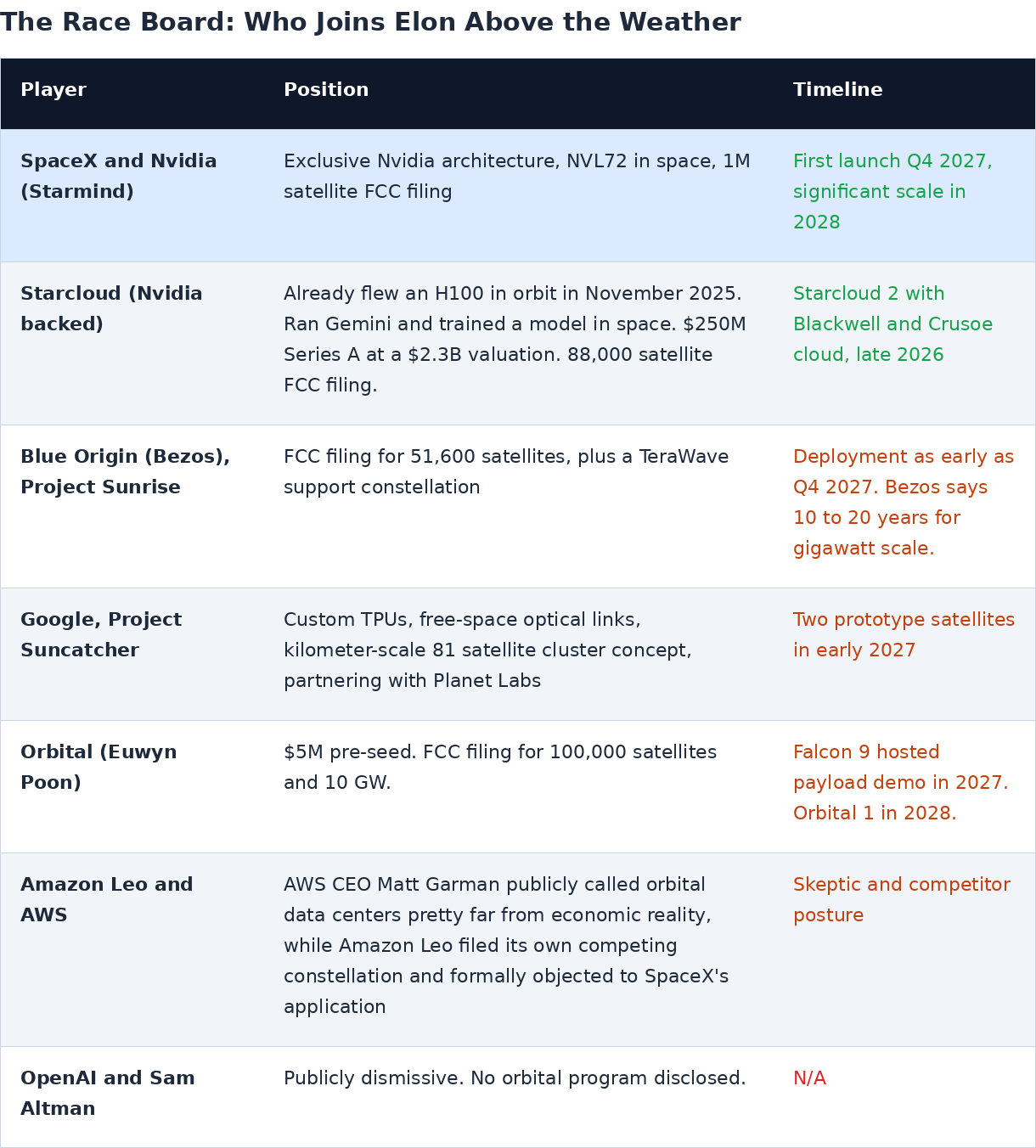
Bezos has a rocket, but New Glenn cadence still trails Starship. Google has the chip in TPU form but no launch stack. Amazon has an objection filing but no credible orbital compute program of its own. OpenAI has a February quote.
Cost and Efficiency. The Real Prize.
Nvidia-backed Starcloud, which put the first Nvidia H100 into orbit in November 2025, has published a claim of roughly 10x energy cost reduction for orbital AI versus terrestrial. Layer on the following. Starship reusability drives launch cost toward Musk's stated targets. Bastrop Gigasat produces satellites at Starlink cadence. Starlink's operational laser mesh is the only free-space optical backbone at scale today. Nvidia's Vera CPU claims 1.8x the agentic workload throughput of x86. Combined, the terrestrial cost advantage Altman anchored his "ridiculous" call on begins eroding well inside the decade, the very decade he said it would not.
Part Two. "I Couldn't Care Less."
Days after the Starmind news dropped, the Musk Altman feud found a new gear.
On Friday, August 28, OpenAI told SpaceX it is ending Cursor's access to its models on November 12, and that its next flagship model, Astra, will never ship through Cursor at all.
The stated reason, in OpenAI's own words. "We are making this choice because we cannot be confident that SpaceX will use our technology within our terms of service, based on our experience with Elon Musk's companies violating contracts."
Context. SpaceX closed its $60 billion all-stock acquisition of Cursor on August 14, the largest venture-backed startup acquisition on record. Cursor is now a wholly owned SpaceX subsidiary. OpenAI invoked the change of control clause fourteen days later. Its basis, as reported by Forbes, is Musk's own trial testimony that xAI used OpenAI outputs to train through distillation.
Musk's response on X on Saturday. "I couldn't care less. Scam Altman and Greg Stockman are utterly untrustworthy assholes who stole an open source nonprofit."
That is where the personalities are. Now the map.
The Operational Blast Radius
Cursor CEO Michael Truell says OpenAI models are only about 5 percent of Cursor user traffic. Cursor is already rerouting developers to Grok, Anthropic's Claude, and Google's Gemini. Anthropic has publicly pledged additional compute. So the operational hit is small and absorbable inside a quarter.
The strategic hit is not.
The Strategic Blast Radius
One. Cursor is the most widely used AI coding tool for professional software engineers. SpaceX just bought its distribution to the exact audience Nvidia, AWS, Microsoft, and OpenAI have spent five years fighting for. OpenAI's decision confirms it publicly. You do not fire a customer you can afford to keep.
Two. Cursor is not a peripheral asset. It is a distribution surface for whatever gets built on the compute layer, terrestrial or orbital. Owning it means owning the last mile between an AI model and the engineer who deploys it. Part Three lays out the full picture. Cursor is one of six layers now inside the same balance sheet.
Three. OpenAI cutting off Cursor is a supplier retreating from a distribution channel it does not own. In a normal market that is a losing move. Cursor absorbs it in a quarter. OpenAI loses a channel permanently.
Four. Astra will not ship through Cursor. Fine. Grok Code, trained on the largest GPU cluster on Earth today and soon supplemented by orbital compute, will. That is the actual competition, and OpenAI just walked off the field.
Part Three. The Bigger Frame. SpaceX Owns the Substrate.
Everything up to this point argues about a specific fight. Orbital data centers, February to now, Altman versus Musk. That is the small question. The big question is already settled and has nothing to do with AI.
The debate about whether AI belongs in orbit misses the point. Whoever owns the mass-to-orbit curve owns the substrate for whatever gets built up there, whether that is communications, compute, defense, remote sensing, position navigation and timing, or something the market has not named yet. SpaceX owns the mass-to-orbit curve. Everything else is just customers.
That is the through line the AI story is a subset of. Look at the layers SpaceX already controls, and notice that AI is only one of them.
One. Launch. Falcon 9 flew the overwhelming majority of successful orbital mass to low Earth orbit in the last twelve months. Starship extends the same curve by an order of magnitude the moment it certifies for commercial payloads. Every competitor in every category above, from Starcloud to Amazon Kuiper to European sovereigns, is either a customer of SpaceX for launch or lags behind on cadence and cost. Rockets are the toll booth. SpaceX owns the toll booth.
Two. Bandwidth. Starlink is already the largest satellite ISP in history. Over 7,000 satellites operational, over 6 million subscribers, direct-to-cell rolling out with T-Mobile in the United States and a growing list of carrier partners abroad. In categories the terrestrial internet cannot reach, aviation, maritime, rural, disaster, Starlink is not a competitor. It is the market.
Three. Defense and national security. Starshield is the classified sibling of Starlink. The NRO's proliferated architecture runs on SpaceX satellite buses launched on SpaceX rockets. The U.S. government has effectively outsourced the next generation of its overhead space layer to a single vendor. Sovereign customers, Ukraine, Taiwan, allied militaries, have followed the same logic.
Four. Compute. Starmind AI1, Vera Rubin exclusive with Nvidia, $21 billion cross shareholding, FCC filing for up to a million satellites, launch inside the decade Altman said would not matter. This is the layer everyone is arguing about. It is the fourth layer, not the first.
Five. Distribution. Cursor. $60 billion, closed August 14, wholly owned. The coding tool professional engineers actually use is now a SpaceX subsidiary. Whatever gets built on the orbital compute layer ships through a distribution surface Musk owns.
Six. Anchor demand. xAI and Grok inside the tent. Starlink subscribers as a captive addressable base. Government contracts on Starshield. SpaceX does not have to convince a market to show up. The demand is prebuilt on all three sides, consumer, enterprise, sovereign.
The pattern is not about AI. It is about every layer of the space economy that generates rent, launch, bandwidth, defense, compute, distribution, being colonized by one balance sheet. Altman's February quote is not just wrong about orbit. It is the last defense of a terrestrial worldview in which the internet, AI, telecom, and defense are separable industries competed for by separate companies. In orbit they are not. They are one company's product portfolio.
The inevitability follows directly. Because the launch curve compounds and nobody else is close, any new orbital use case, and there will be use cases we cannot name today, will emerge inside a market where the physical substrate is already captured. Whether the traffic on that substrate is inference, bandwidth, imagery, missile warning, or a workload not yet invented, the rent goes to the same balance sheet. That is what SpaceX owning space actually means. Not a metaphor. An accounting fact.
Part Four. What Chapel Hill Just Said.
SPCX closed Thursday, September 3 at $149.74, up $9.03 or 6.4 percent on the day, on volume of 120.7 million shares. Not a rounding error. Not a shrug. A reprice. The market watched Chapel Hill and voted.
On September 1 and 2, the U.S. hosted the G20 Innovation Ministerial in Chapel Hill, North Carolina, at the Carolina Inn. Commerce Secretary Howard Lutnick and OSTP Director Michael Kratsios chaired. Elon Musk and David Sacks appeared by video Tuesday. Jensen Huang, Sam Altman, Mark Zuckerberg, and Anthropic co-founder Tom Brown sat with Lutnick for fireside chats. The conversation turned into the clearest public statement to date on the physical infrastructure required for AI, and the constraints already binding it.
The framing that came out of the ministerial is the one this piece has been building toward.
From Huang, per Tech Xplore. "In the end, what every single country will have to recognize is that AI is infrastructure, just as it's water, roads, electricity, the internet." Then a number. According to KuCoin News, Huang told ministers that one gigawatt of AI infrastructure costs $50 to $60 billion to build, and should carry the same policy urgency as power grids and highways.
From Altman, per Nation Press, on the same stage, the same day. "It would be approximately as bad of an idea to say we're not gonna have AI in our country as it was to say we're not gonna have electricity in our country, you know, back 100 plus years ago." And the closer. "For sure, I think it is not negotiable. You have to use it."
And two more names on the same panel made the substrate thesis concrete. Anthropic co-founder Tom Brown described the AI physical buildout as potentially larger than the railroad boom, and said the principal bottlenecks are now data centers, electrical power, and construction labor. Musk warned of a potentially significant AI power shortfall as soon as next year. Mark Zuckerberg said Meta is already struggling to find enough skilled tradespeople to build the data centers it wants.
Read those sentences together. The bottleneck the CEO of the world's most valuable chipmaker is pricing at $50 to $60 billion per gigawatt, a co-founder of Anthropic is describing as a railroad scale industrial buildout, the CEO of Tesla is warning will run short of power inside twelve months, and the CEO of Meta is saying he cannot find enough electricians and pipefitters to build. Four of the largest AI operators in the world, on the same stage, telling ministers the same thing. Power, land, grid, and labor are the binding constraints. Not chips. Not models.
That is the substrate thesis, said out loud by the incumbents. And it is exactly the constraint SpaceX designed around. Solar in orbit does not queue for a grid interconnect. Radiator panels in vacuum do not compete with a data center for water rights. A satellite factory in Bastrop does not need permits for a substation. The competitors who spent the panel telling the G20 how much they need are the ones who need it most. The one who built the alternative did not need to be there in person.
Two things about that Altman line are worth flagging.
First, he did not repeat the word ridiculous. Not about orbit, not about anything. Seven months after the February quote that titles this piece, Altman spent his G20 slot arguing that AI is infrastructure a country cannot afford to skip. That is Musk's argument, not February Altman's.
Second, he acknowledged that governments "retain the right to choose whether to build or lease data centre infrastructure." That is a small phrase carrying a large concession. In February the assumption was that all data center infrastructure would sit on Earth, on grids Altman's own capital was building. Once you concede that governments may buy compute as a service instead of building it, you have also conceded that where the compute physically lives, whether on the Arabian Peninsula or in low Earth orbit, is a purchasing decision, not an ideological one.
Put those two Altman lines next to the February quote and the contradiction is direct. Ridiculous requires the location of the rack to matter. Not negotiable admits it does not. If AI is electricity and every country has to have it, the demand curve Altman just described is larger than any terrestrial grid queue can serve on his timeline, and the founder he called ridiculous is the only one with a factory, a rocket, a mesh, and an Nvidia exclusive pointed at that gap.
Huang priced the alternative on the same stage. $50 to $60 billion to stand up one gigawatt on Earth. Starmind AI1 is 250 kilowatts of Vera Rubin in orbit at launch, with an FCC filing for a million satellite constellation, no land, no water, no grid queue, and solar 95 percent of the time. When the world's most valuable chipmaker publicly benchmarks the terrestrial cost curve while separately handing SpaceX exclusive access to the same rack in low Earth orbit, he is telling the market the two paths compete on economics, not viability. Ridiculous means one path does not exist. Huang just priced both.
And Huang closed the loop for Musk. Regulate "actual and pragmatic harm," not "hypothetical theoretical harm," the Nvidia CEO told the ministers, per Tech Xplore, which noted he was echoing comments Musk had made from the same podium the previous day. Same stage, same message, 24 hours apart. The world's most valuable chipmaker publicly aligned with the founder of the company it just handed exclusive access to a $21 billion cross balance sheet.
Back to the tape at the top of this section. A 6.4 percent single day move on 120.7 million shares in a name capitalized at roughly a trillion dollars is not noise. It is the market watching the G20 panel say power, land, grid, and labor are the binding constraints on AI, watching Nvidia's CEO put a $50 to $60 billion price on one terrestrial gigawatt, and marking the one company that already escaped those constraints up more than six percent in a single session. The Cursor cutoff is behind the stock. Chapel Hill is now in front of it.
One nuance worth flagging on the OpenAI side. November 12 is OpenAI's proposed date, not a firm one. OpenAI's own statement calls it "proposed," its help center notes the official termination date is still to be confirmed between the two companies, and that Cursor may choose to end access sooner. That is 76 days of negotiating leverage sitting between the two sides. Cursor can walk earlier and control the narrative. OpenAI cannot extend without Cursor's consent.
The Bottom Line
In February Sam Altman said orbital data centers were ridiculous.
This week his company cut off a developer tool because it is now owned by the man building them, and yesterday he took the G20 stage and reframed AI as electricity a country cannot afford to skip. He did not repeat the word ridiculous.
Musk answered the February quote with a 250 kilowatt spacecraft, an exclusive with the world's most valuable chipmaker, a $21 billion cross shareholding, a 1,000 acre satellite factory, an FCC filing for a million satellite constellation, and a launch date inside the decade Altman said would not matter.
But the AI story is a subset of a larger one. SpaceX already owns launch, bandwidth, defense, compute, distribution, and demand. Any orbital use case worth building, named or unnamed, gets built on that substrate and pays rent to that balance sheet. Whether the twenty-first century's most valuable digital infrastructure is AI or communications or something not yet on the roadmap, one company has already captured the layer beneath it.
Whether the first Starmind flies exactly in Q4 2027 or slips to 2028, since SpaceX's own S-1 said "as early as 2028," is a quarter level question. The strategic question is already settled.
The binding constraint on AI is no longer chips. It is power, water, land, grid, and now distribution.
Orbit solves the first four. Cursor solves the fifth. The only company on Earth that owns the rocket, the factory, the mesh, the chip deal, the anchor customer, and the code editor is the one Sam Altman just called ridiculous.
That is not a quote that ages well.
Not investment advice. The authors hold positions in securities mentioned and reserve the right to buy or sell shares at any time without notice.