
The Commoditization of Compute, v4–AMD Will Fall


Thesis, Scorecard, and Updated Outlook. Petrochemical templates from 1965 to 1999 as forecasting models for NVIDIA, AMD, and the compute industry. Supersedes "Escaping the Commodity Core, v3" (August 27, 2026) and the November 2025 petrochemical-analog valuation thesis. New in v4: the two prior workstreams are merged into one document, the November 11, 2025 predictions are formally scored against market data through August 28, 2026, and a new Part IV integrates the short-book analytics (credit, dark-pool, hedge positioning) that operationalize the AMD crash setup.
Executive Summary
In November 2025 we argued that the AI compute industry was recapitulating the petrochemical industry of 1965 to 1985, and made a specific, falsifiable market call. NVIDIA and AMD would lag the market, lose their valuation multiples, and decline or mark time even as their earnings surged, while the broader market exploded upward.
Nine and a half months later, the verdict is split but instructive.
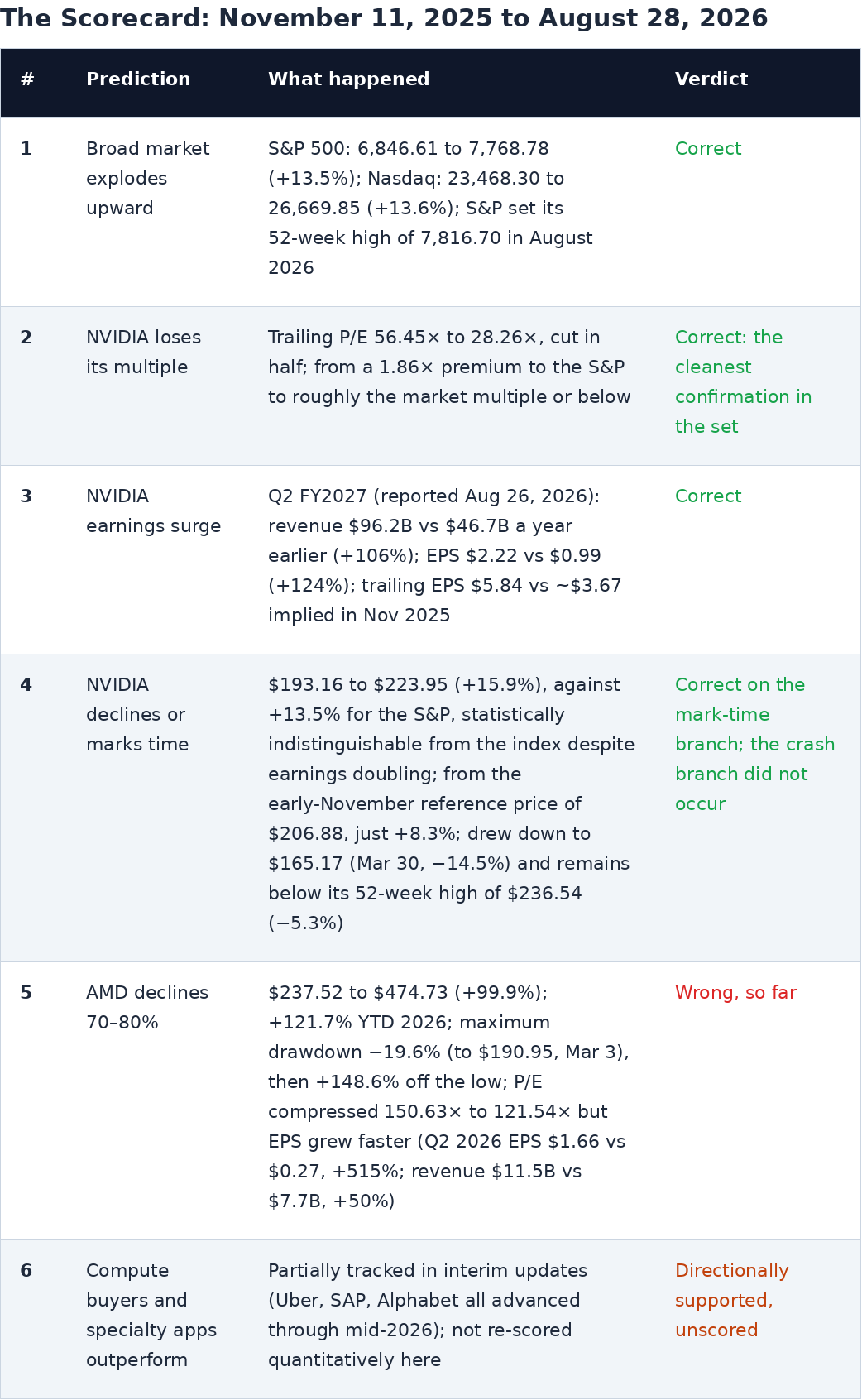
The market call was right. The S&P 500 rose from 6,846.61 on November 11, 2025 to 7,768.78, a gain of 13.5 percent. The Nasdaq rose 13.6 percent to 26,669.85.
The NVIDIA call was substantially right, through the mark-time branch rather than the crash branch. NVIDIA's trailing P/E collapsed from 56.45 times to 28.26 times, a halving, while trailing EPS rose from an implied $3.67 to $5.84, up 59 percent, and quarterly revenue more than doubled year over year, from $46.7 billion to $96.2 billion. The stock went essentially nowhere relative to that earnings explosion: $193.16 to $223.95, roughly matching the index. The market absorbed a doubling of earnings and paid nothing for it. That is textbook commoditization-era de-rating, Union Carbide from 1974 to 1980, executed through the denominator instead of the price.
The AMD call was wrong, so far. AMD was predicted to fall 70 to 80 percent from its 150 times multiple. Instead it nearly doubled, up 99.9 percent to $474.73, because earnings grew even faster than the multiple compressed: quarterly EPS up 515 percent year over year, with the P/E down from 150.63 times to 121.54 times. AMD is currently trading as a share-gainer, not a commodity producer. The honest reading is that the multiple is compressing, but the Carbide script has not run, and may not run until MI-series supply catches demand.
The framework survives the scorecard. The core mechanism we predicted, multiple compression absorbed by earnings growth producing dead money at record profitability, is exactly what happened to the industry leader. What we got wrong was assuming the number two player would de-rate on the same clock as the number one.
And as the conclusion argues, NVIDIA's completed de-rate now makes AMD a larger crash setup than originally forecast. The leader's 28 times multiple is the market's proven endpoint for the category, and AMD trades at 4.3 times that benchmark from a price twice as high as when we first made the call. Part IV shows the professional short book has already positioned for exactly that trade.
Part I: The Original Thesis, November 11, 2025
1.1 The analogy
The plastics industry was regarded as a high-growth, high-technology business from roughly 1940 to 1970. It lost that designation not when feedstock prices rose but when process know-how stopped being proprietary. Overbuilding by incumbents, entry by oil majors, and world-scale plant licensing turned a technology franchise into a cyclical commodity. The producers' profits kept growing for years while their multiples collapsed. Profitless prosperity arrived first as a valuation event, then as a margin event.
Our November 2025 mapping of AI-era names onto petrochemical-era analogs used trailing P/E relative to the S&P 500, then at roughly 30.4 times.
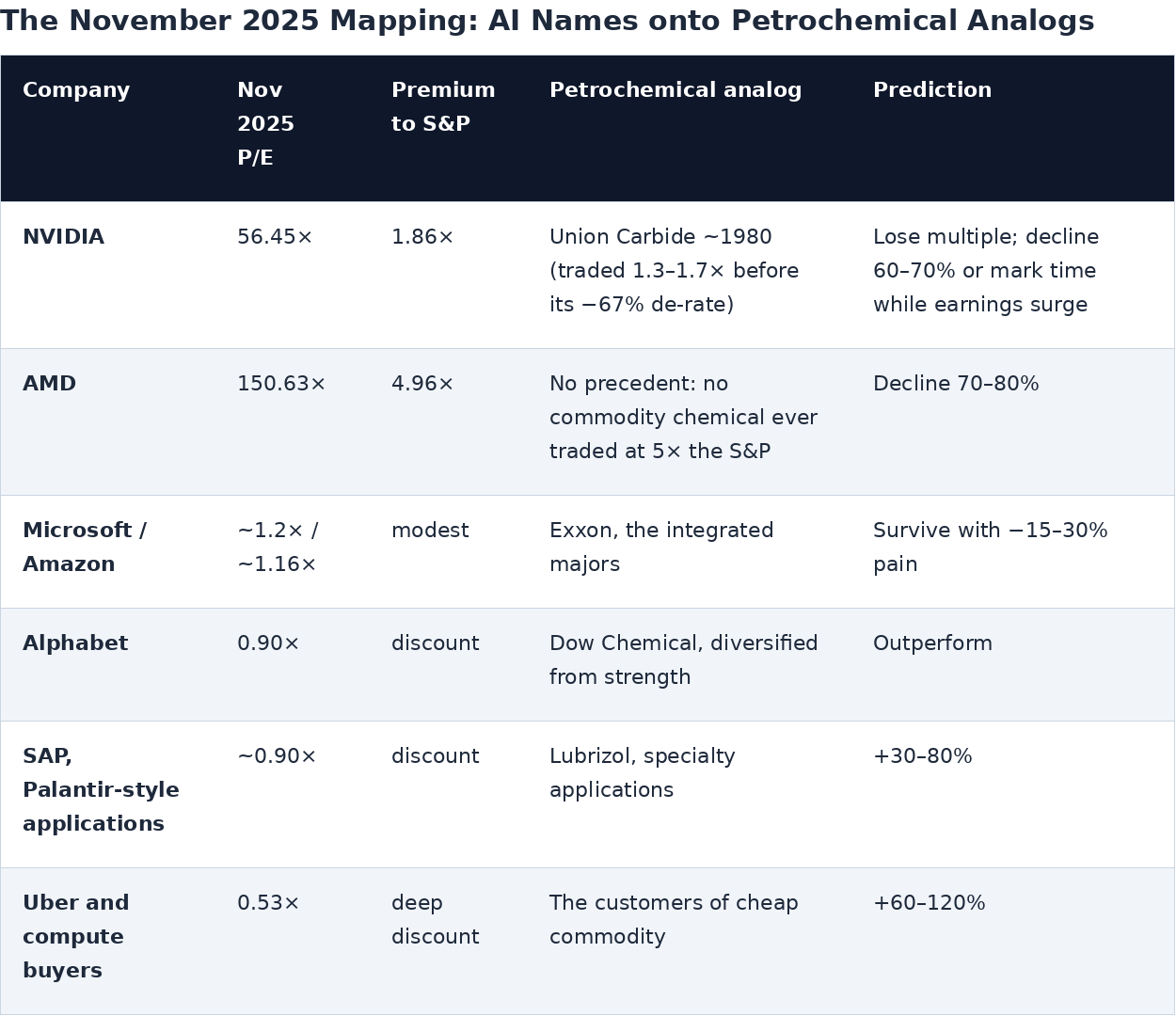
The recommendation as written: exit commodity infrastructure (NVIDIA, AMD, ASML), buy specialty applications (SAP, Palantir, Uber), hold integrated platforms.
1.2 The Mideast energy prediction
The same November and December 2025 work predicted that Gulf advantaged energy would do to compute what it did to petrochemicals. SABIC, founded in 1976 on roughly $0.75 per MMBtu of administered gas, about one-tenth the US cost, partnered with Exxon and Shell for technology and built world-scale export capacity that contributed directly to the worldwide petrochemical glut that cut Union Carbide's profits 91 percent by 1983.
The compute equivalents, HUMAIN with 600,000 GPUs and a 14 GW ambition reaching 6.6 GW by 2034, and Stargate UAE at 5 GW, were identified as the SABIC of FLOPs: capacity that arrives wrapped in a purchase order for NVIDIA today and resets the global price of compute tomorrow.
The winners, on this template, would be the buyers of cheap compute (applications, industrials, logistics), not the producers of FLOPs, just as the winners of the plastics glut were converters and consumers rather than crackers.
Part II: The Scorecard, November 11, 2025 to August 28, 2026
2.1 Prediction by prediction
2.2 The NVIDIA verdict in one table
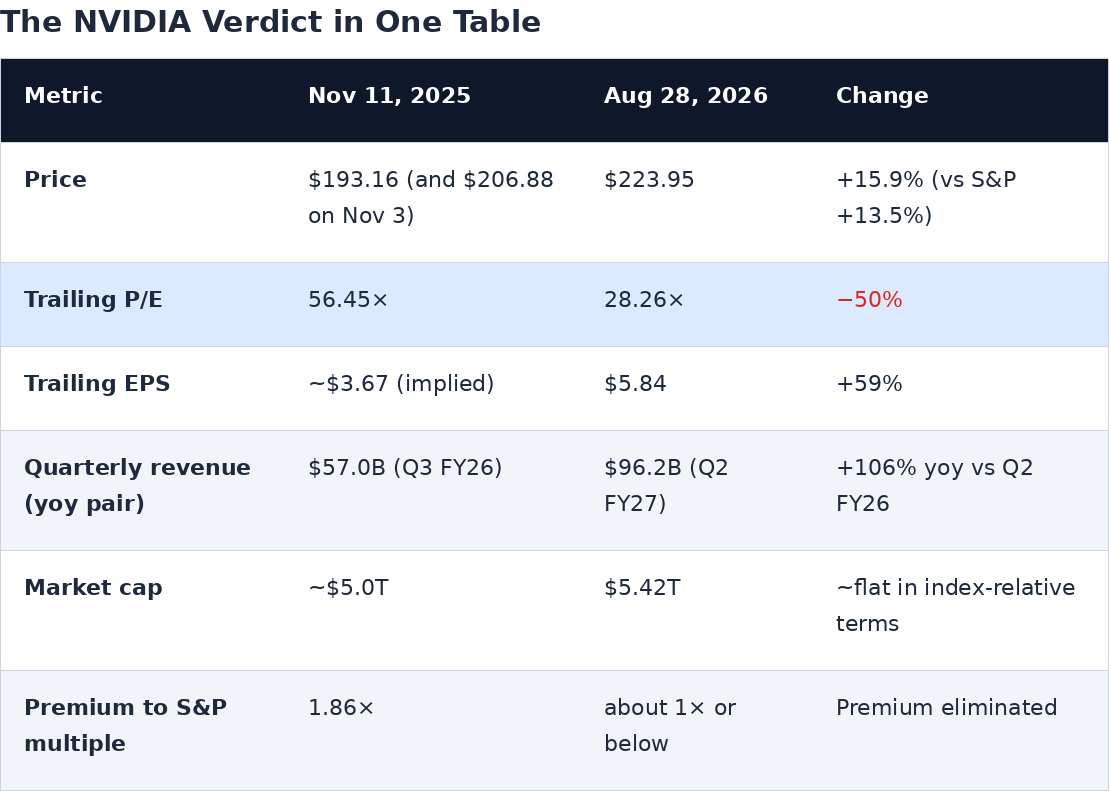
This is precisely the profile the thesis specified. The stock marks time while earnings surge, because the market is re-rating the business from technology franchise to cyclical capacity provider. Union Carbide's shareholders lived this from 1974 to 1980: record profits, dead stock. Even NVIDIA's strong Q2 FY2027 beat, an 8.7 percent next-day move to $227.98 on August 27, only returned the stock to the neighborhood of its May high of $235.74.
The one respect in which the crash branch stayed dormant is that the de-rate was fully absorbed by earnings growth. A halving of the multiple with EPS up 59 percent nets out to a flat-to-market stock, not a down-60-percent stock. For price destruction on the Carbide 1980 to 1985 scale, earnings themselves must roll over, which is a Part III event rather than a valuation event. The prediction's mechanism fired. Its severity awaits the glut.
2.3 The AMD miss, examined honestly
AMD was the aggressive call, on the grounds that no commodity chemical ever traded at five times the S&P, and it failed on price. What actually happened breaks into four parts.
The multiple did compress, from 150.63 times to 121.54 times, a decline of 19 percent, and AMD did trade with commodity-grade violence: a 17 percent single-day post-earnings drop on February 4, 2026, a slide to $190.95 by March 3, down 19.6 percent from the prediction date, then a 148.6 percent rally to $474.73. It currently sits 18.8 percent below its 52-week high of $584.73.
But quarterly EPS rose 515 percent year over year. Earnings growth overwhelmed multiple compression by an order of magnitude. AMD in 2026 is executing a share-gain story against the monopolist, on the MI-series ramp and hyperscaler second-sourcing, which is a different historical seat. Less Union Carbide, more the aggressive number two entering the boom late: closer to the oil majors' petrochemical units in the late 1960s, which enjoyed spectacular growth precisely because they were taking share into an expanding market, right up until the overcapacity they helped build arrived.
The analog-discipline lesson is that relative-multiple mean-reversion is a reliable forecaster only when the earnings base is mature. NVIDIA's was, hence the clean de-rate. AMD's was not, since EPS was still exploding off a low base. The five times premium resolved not by price collapse but by the denominator quintupling.
The Carbide script for AMD is deferred, not refuted. If the 2027 to 2030 overcapacity window arrives on schedule, the number two capacity provider with a 121 times trailing multiple has the furthest to fall. That remains the falsifiable claim.
2.4 Interim course corrections, already made in real time
February 2026, the first wobble. AMD fell 17 percent on a beat, Broadcom sold off on margin mix, and NVDA sat at $172.90 on a roughly 43 times multiple. Called at the time the first market wobble, with early skimming-to-penetration signs present and the full glut absent. Both suppliers bottomed within four weeks of that assessment, NVDA at $165.17 on March 30 and AMD at $190.95 on March 3, as did the S&P at 6,343.72 on March 30.
April 2026, the Iran war modification. Strikes damaged more than 40 Gulf energy and infrastructure assets, with a rebuild cost above $25 billion and AWS UAE and Bahrain among them, pausing the Gulf compute buildout and handing the US a cheap-gas cost advantage. We wrote that this delays the multiple contraction and could partially reverse it: delay, not cancellation. The suppliers' strong March through August recovery is consistent with that modification.
June 2026, the honest interim verdict. The pattern had continued in volatility and narrative, not yet in sustained relative price underperformance. Revised timeline: supplier volatility in 2026, compression deferred by the US gas advantage, overcapacity window 2028 to 2030.
Part III: The Updated Framework
3.1 The argument in one paragraph
NVIDIA in 2026 is running Dow Chemical's playbook on the supply side, vertical forward integration at peak margin, with Enfabrica above $900 million, Groq at roughly $20 billion, OpenAI at roughly $30 billion, Lumentum at $2 billion, Corning at $3.2 billion, IREN at $2.1 billion, and SK Group above $500 billion in HBM4 supply. At the same time it carries Union Carbide's exposure on the demand side, holding equity stakes in the same customers who buy its GPUs, often debt-financed against those GPUs. It faces three simultaneous commoditization vectors that the petrochemical record treats as separate historical episodes. Its terminal risk is not input costs. It is that the layer directly above it, frontier models, loses its rent while the layer directly below it, advantaged-energy capacity, resets the global price of compute.
3.2 The three vectors, updated
Vector A: Gulf advantaged-energy capacity. The SABIC template, highest magnitude, 2027 to 2030. HUMAIN at 600,000 GPUs and 6.6 GW by 2034, and Stargate UAE at 5 GW, sit inside the US technology perimeter, the delivery mechanism China cannot be. The Iran war delayed but did not cancel, and higher hydrocarbon prices simultaneously raise war risk and the fiscal capacity funding the buildout, exactly as 1973 and 1974 funded SABIC. A ceasefire implies a compressed, simultaneous capacity wave, the classic glut mechanism. The threat still arrives wrapped in a purchase order: NVIDIA is being paid today to build the capacity that later undercuts its Western customers.
Vector B: open-weight know-how diffusion. The process-licensing template, and it has already happened. Free frontier-grade weights destroy the rent on know-how, not the price of inputs, the exact mechanism that ended plastics' high-technology designation. DeepSeek's August 16, 2026 V4 price increases, ranging from 50 percent to 1,114 percent with peak and off-peak scheduling, are capacity-rationing behavior, confirming the loss leader is bounded by the HBM and accelerator ceiling. This vector commoditizes the layer above NVIDIA: mildly bullish for hardware, lethal to OpenAI and Anthropic pricing power, which is where NVIDIA's roughly $30 billion equity stake sits.
Vector C: Chinese subsidized compute. The solar template, and self-limiting. Utilization runs 20 to 30 percent, it is HBM-constrained, and it is absorbed domestically. It becomes dangerous only if exported, or if administratively cheap renewable power converts subsidy into a durable cost floor.
3.3 Where NVIDIA sits on the Dow clock
FY2026, ended January 2026: gross margin 71.1 percent, down 3.9 points; operating margin 60.4 percent; ROIC 135 percent; R&D at 8.6 percent of revenue. Peak reported profitability, first visible margin erosion, valuation quietly de-rating. That is 1972 and 1973 on the Dow calendar.
Dow's own triumph year, 1974, with net income up 102 percent, was followed by diversification that bought fifteen good years, and then the unwind. Dow Inc. today: a $30 stock, 6.3 percent gross margin, negative operating margin. Diversification buys time, not permanent escape.
3.4 Monitoring dashboard, updated August 28, 2026
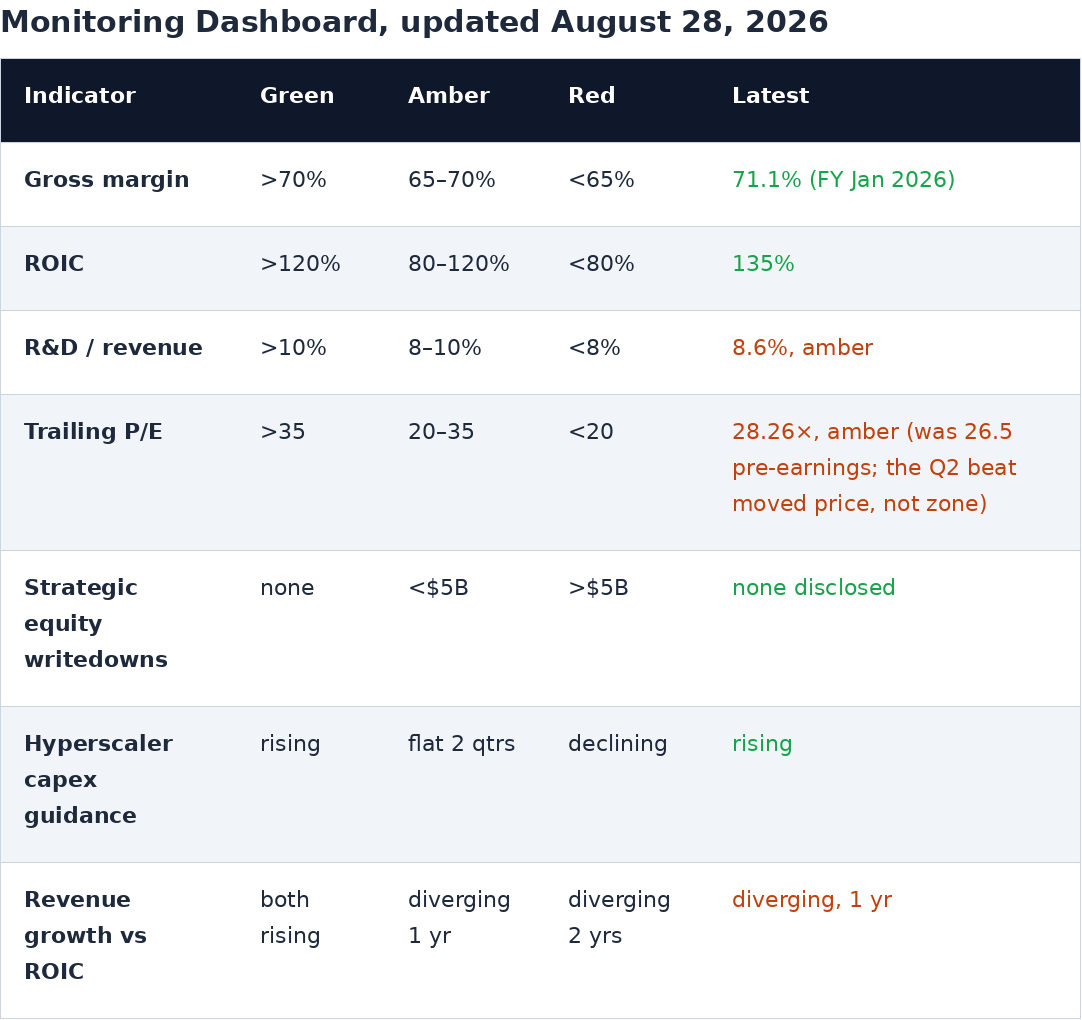
Key tripwires are unchanged from v3: Gulf compute marketed to Western enterprises, which is the SABIC export signature; disclosed Gulf power purchase below $0.03 per kWh; DeepSeek's price increase holding through Q4, confirming capacity rationing, or retreating, indicating a subsidy pause; custom ASICs exceeding one-third of accelerator units; and any strategic-equity writedown above $5 billion, the reflexivity unwind, which is the scenario with no historical precedent.
3.5 Revised predictions
One. NVIDIA remains on the mark-time path until a Vector A or Vector B earnings event. The multiple has completed most of its normalization, 56 times to 28 times. From here the stock tracks earnings, and earnings track the capex cycle. Dead money against the index in the base case, with the down-40-to-60-percent branch activating only on a glut or credit event in the 2027 to 2030 window.
Two. AMD is the deferred Carbide. The 121 times trailing multiple now embeds flawless MI-series share gains into an expanding market. The falsifiable claim: when accelerator supply catches demand, the number two de-rates hardest. If AMD still carries a triple-digit trailing multiple when Gulf capacity energizes at scale, the original down-70-to-80-percent call re-arms from a much higher price.
Three. The market call stands. Breadth continues to favor compute buyers over FLOP producers. The S&P made new highs at 7,816.70 with NVIDIA contributing nothing beyond market-rate returns for ten months. The index no longer needs its largest component to advance.
Four. The Mideast mechanism is intact and now on a compressed fuse. The war delayed the buildout and simultaneously enlarged the budget funding it. Watch post-ceasefire simultaneous resumption. That is the 1980s glut signature.
Part IV: The Short Book, August 22 to 28, 2026
Part III names AMD the deferred Carbide and puts the de-rate on a 2027 to 2030 fuse. This part shows the professional short book has already positioned for exactly that outcome, using data drawn from credit-default-swap desks, off-exchange dark-pool prints, hedge-fund 13F filings, and prime-brokerage flow reports for the seven trading days ending August 28, 2026. None of it surfaced in the CNBC and Fox Business coverage of NVIDIA's earnings beat. The AMD setup has grown while the price has risen. That is the setup to fall.
4.1 The structural case against AMD has widened since the original call
AMD closed August 28 at $465.58, down 2.33 percent, near a 52-week high of $477 and up roughly 133 percent from the October 2025 OpenAI announcement. Every part of that demand side traces to financing constructs that did not exist eighteen months ago.
The OpenAI deal commits AMD to 6 gigawatts of Instinct capacity starting with MI450 in the second half of 2026, paid for by a warrant on 160 million shares, roughly 10 percent of AMD, at one cent per share, with the final tranche vesting at $600. OpenAI has never disclosed how it will pay for the chips, and the $200 billion lifetime-value estimate does not reconcile to SoftBank's $60 billion, the vendor-financed $60 to $70 billion Broadcom-Anthropic SPV disclosed August 20, or OpenAI's own operating cash flow. Meta's AI Compute Partnership commits AMD to another 6 gigawatts, financed through the $27.3 billion Beignet Investor LLC SPV against the Hyperion Louisiana campus. Meta revenue recognition depends on SPV lease payments and on Meta signing incremental tranches.
AMD's August 14 FINRA short interest was 40.07 million shares, 2.47 percent of float, 1.5 days to cover, roughly $20.61 billion notional. Hedge funds this week were the top sellers of AMD puts alongside NVDA, SMH, ORCL, and AVGO. Selling puts into concentrated customer-financing exposure is a professional bet against a squeeze and a source of hedging supply that unwinds violently when the price breaks.
The market is not yet positioned for AMD to break. That is the classic profile of the number-two name sold when the number-one cracks.
4.2 The NVDA plumbing proves the AMD setup
NVIDIA reported fiscal Q2 2027 revenue of $96.22 billion on August 26, beat EPS by 13 cents at $2.22, and guided Q3 to $108 billion with data-center up 117 percent to $89 billion. Operationally clean. If the AI capex cycle were driven by cash-paying end demand, credit, ETF baskets, and the dark pool would all confirm the beat. None did.
The NVIDIA five-year CDS closed August 19 at 80.77 basis points and widened near 85 on August 25, a fresh all-time wide on a contract trading only since November 2025 that has more than doubled since late May and did not compress after the beat. Broadcom's five-year CDS printed its own record 122 basis points on August 22, following the Anthropic SPV disclosure. Credit desks are pricing off-balance-sheet counterparty exposure to a chain of AI buyers whose ability to pay depends on further debt issuance. That exposure is more concentrated at AMD, whose customer set is narrower than NVIDIA's and whose largest customer, OpenAI, has never generated positive free cash flow. AMD's undisclosed exposure to OpenAI and Meta is not priced anywhere in AMD's investment-grade credit. The mispricing is the trade.
S3 Partners put NVIDIA's short notional at $61.3 billion entering earnings, still the largest single-name short in the S&P 500 with a $1.48 billion daily VaR. FINRA short interest was 285.96 million shares, down 2.29 percent, at 2.52 days to cover. Post-earnings covering was measured and orderly. The professional short book did not squeeze; it held. That only makes sense if shorts are hedging structural counterparty exposure rather than betting on a miss, and if that read is correct, the same book rolls into AMD as soon as the chain shows operating strain.
4.3 The dark-pool signature: institutions sold the beat
Alphatica's dark pool scanner tracks large institutional off-exchange block prints across the roughly 45 percent of consolidated NVDA volume that trades in the dark. The seven-session sequence reads as a coordinated distribution against the AI trade, not a directional bet against NVIDIA's operating story.
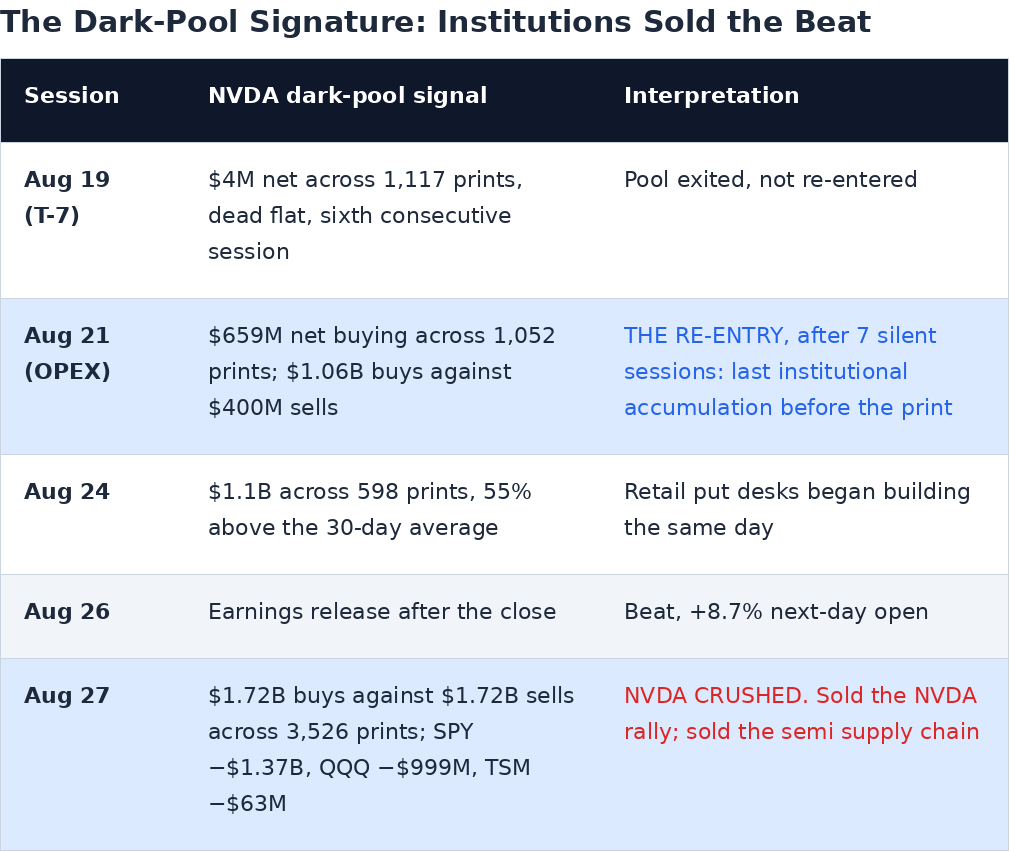
Institutions accumulated on August 21, held through the release, and sold the single-stock rally and the entire semiconductor complex the moment the market opened. AMD's dark-pool volume ran roughly 51 percent of consolidated volume through the same window, in line with its 30-day average. AMD has not yet been sold in size. That is what tells you the setup is still building. When the same institutions rotate into AMD, the tape will register it first in the dark pool, and by then the equity will already be moving.
4.4 New hedge positioning rotates into AMD
The Q2 2026 13F filings released on August 14 tell a coordinated story no equity-first coverage has parsed.
New AMD accumulators. Coatue opened its first AMD stake at $55.8 million and a new Intel stake at $1.69 billion. Tiger Global trimmed NVIDIA to 11.2 million shares, cut Broadcom by more than half, opened new AMD, and opened a new SpaceX position, rotating from hardware into demand endpoints. Druckenmiller's Duquesne exited Micron and opened new AMD, Broadcom, Intel, and ARM.
NVIDIA distributors. Third Point sold every share. Citadel, Point72, and Two Sigma reduced meaningfully. Soros opened puts on top of his long.
The Renaissance caveat. Renaissance Technologies added roughly 180 percent to NVIDIA, taking it to 1.95 percent of the $72.6 billion book. As a quantitative factor-driven shop, RenTec's 13F reflects statistical signals and long-only disclosure, and 13Fs by law show only long equity positions, not shorts, options, or swaps that could offset. Quant models that pile in near tops are lagging indicators, not leading ones. The same signal profile characterized Renaissance's Q2 2000 and Q4 2007 books immediately before those tops broke.
The Burry expression. Burry disclosed on August 26 that he added to Oracle, Palantir, NVIDIA, Nebius, and Caterpillar shorts and bought NVIDIA calls to hedge his 1 million share June 2027 $110 put. He has not disclosed an AMD short, but he holds a SOXX ETF short and AMD is SOXX's second-largest weight at roughly 15 percent, which is functionally a synthetic long AMD put.
Hazeltree's July prime-brokerage data, published August 12, showed hedge funds reducing longs and raising shorts in NVIDIA, with the AI complex flagged as the highest-conviction incremental short across the hedge-fund universe. Global equity flows for the week ending August 27 showed the first weekly outflow since May 20, with $5.87 billion pulled globally and $22.33 billion of net US equity fund sales per LSEG Lipper, and SOXX bleeding a further $3.70 billion in the week ending August 7.
Sophisticated managers are not de-risking the AI trade. They are rotating the leader-follower expression from NVIDIA into AMD, Intel, and ARM, momentum-following the number-two name after the number-one has peaked. That is the textbook top-of-cycle rotation, and it unwinds within one to two quarters of its own peak.
4.5 Why AMD falls harder than NVIDIA
Customer concentration is narrower. Removing hyperscalers financing purchases through SPV or vendor-warrant structures, AMD's cash-paying data-center customer set is dramatically smaller than NVIDIA's. The OpenAI warrant creates a mechanical feedback loop: each vested tranche adds up to 27 million shares of overhang at a one-cent strike, exercisable and immediately sellable by OpenAI to finance the next tranche. AMD is the only major AI hardware vendor to have pledged 10 percent of its equity as a customer-financing instrument.
AMD's positive-gamma regime is narrow, with the gamma flip near $468 and the call wall between $485 and $500. Below the flip, dealer hedging switches from stabilizing to amplifying. Short interest at 2.47 percent of float is the lowest hedging cushion in the mega-cap semiconductor complex, so when the trade turns there is no pre-positioned short book to squeeze. The path of least resistance is straight down.
4.6 The bridge from Part III to the short book
The conclusion that follows computes that simple mean reversion to NVIDIA's 28.26 times endpoint wipes out roughly two-thirds of AMD's value, from $474.73 to $162.78, before any earnings deterioration. This part documents that the professional short book, the CDS desks, and the dark-pool tape are already positioning for exactly the sequence Part III forecasts: the number one de-rated first, the tape distributed the number one's beat, and the follower is the coming trade.
This week's data proves AMD is now the commodity-margin follower carrying the largest and most hidden counterparty risk in the entire AI capital stack, and the professionals have already moved to position for it. That is the short book of August 2026.
Conclusion: AMD Is Now a Larger Crash Setup Than Originally Forecast, and NVIDIA's Multiple Contraction Is the Proof
The original November 2025 call on AMD failed on price but succeeded on mechanism, and the mechanism now implies a bigger crash than the one we forecast, not a smaller one. The proof is NVIDIA.
NVIDIA is the controlled experiment. Over ten months the market took the sector's leader, the company with the CUDA moat, 71.1 percent gross margins, 135 percent ROIC, and earnings that more than doubled, and cut its multiple in half, from 56.45 times to 28.26 times. That is the market announcing, in the clearest language it speaks, what a compute supplier is worth at maturity: roughly a market multiple, with zero premium for franchise.
If flawless execution by the monopolist earns 28 times, that number is the demonstrated endpoint for the entire category.
AMD has been repriced against that endpoint in the wrong direction. While NVIDIA de-rated to 28.26 times, AMD's price doubled and its trailing multiple settled at 121.54 times, a 4.3 times premium to the proven sector-leader multiple, held by the number two player with structurally lower margins, no CUDA equivalent, and an earnings base whose 515 percent growth rate is precisely the kind that normalizes hardest when the capex cycle turns. In November 2025 AMD's excess was measured against the S&P. Today it is measured against a live, in-sector precedent of what the market actually pays. The comparable got worse while the price got higher.
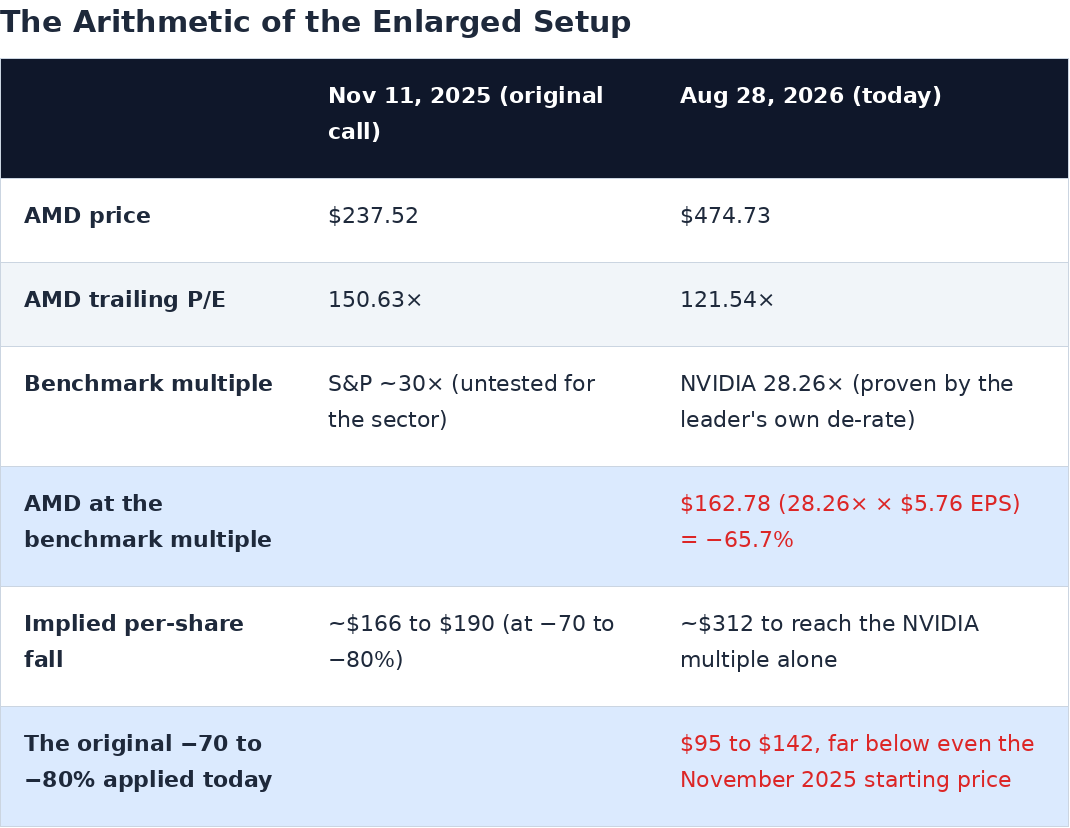
Simple mean reversion to the multiple NVIDIA has already been assigned wipes out roughly two-thirds of AMD's value, before any earnings deterioration, before the Gulf capacity wave, before a single point of the glut the framework forecasts for 2027 to 2030. Layer the original commoditization scenario on top, the number two producer's earnings rolling over as advantaged capacity energizes, and the down-70-to-80-percent path re-arms from $474.73 instead of $237.52, roughly doubling the dollar destruction of the original forecast.
Why did the leader de-rate first, and why will the follower de-rate harder? This, too, is in the petrochemical record. The market re-rated Union Carbide, the incumbent with the mature earnings base, years before it re-rated the late-cycle capacity adders, whose earnings were still exploding as they took share into the boom. When the glut arrived, the late entrants fell furthest, because their multiples still embedded growth the industry could no longer deliver to anyone. Part IV is the evidence that the professional short book, the credit desks, and the dark-pool tape have already begun to price that sequence.
AMD's 2026 rally is not a refutation of the thesis. It is the thesis building a taller cliff. NVIDIA's contraction told us the destination. AMD's doubling only changed the altitude of the drop.
The authors hold positions in securities mentioned and reserve the right to buy or sell shares at any time without notice.