
Japan's Deposit Drain: An Early Bank-Run Tremor That Backs Bessent's Confidence


The drain has started. Japan's household deposit base has already begun to empty while the aggregate still hides it. Why the exit is underway, why the rails just opened, and what would turn a quiet drain into a run. A verified-first thesis briefing, with every claim graded Verified, Directional, or Scenario.
Executive Summary
For three decades, Japanese household savings sat inert in zero-yield deposits. That era is ending, and the data now shows the first stage of an exit already in motion. This briefing makes one disciplined claim: the drain has started at the household level, even though the headline aggregates still look calm. The gap between those two facts is the entire opportunity, and the entire risk.
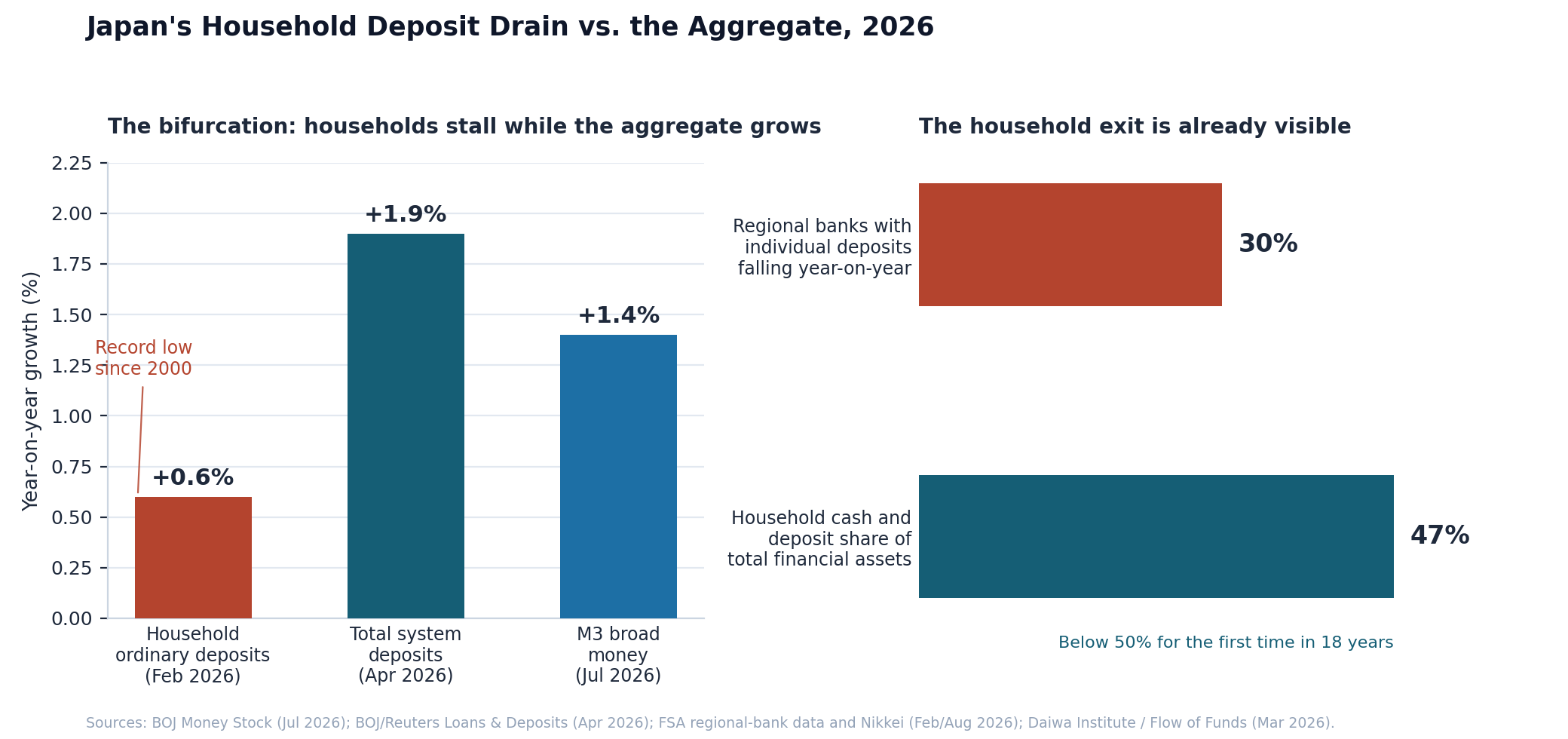
Verified. Households are already leaving. Individual deposits are falling year-on-year at roughly 30% of regional banks. Household ordinary-deposit growth hit +0.6% in February 2026, the lowest since records began in 2000. The cash-and-deposit share of household assets fell to 47%, below 50% for the first time in 18 years.
Verified. The aggregate is masking it. Total system deposits still grew +1.9% and M3 +1.4%, near a record, because corporate deposits are rising fast enough to offset the household drain. Watch the household series, not the headline.
Verified. The rails just opened wider. In the same month, Japan's FSA removed the institutional per-transaction cap on stablecoins and stood up a dedicated Crypto Assets and Stablecoins Division. That cleared the runway for institutional-scale dollar-stablecoin flows rather than restricting them.
Scenario. The catalyst is not yet pulled. If a trusted forecaster explicitly ties the yen call to deposit flight, sentiment could cascade from a quiet household drain into a currency-and-bank run. This has not happened. It is the identified trigger to watch, not a current fact.
There is a second reason to care about these prints. Washington's dollar strategy needs sustained demand for Treasuries and for dollar-stablecoin reserves, and the confidence behind that strategy has always looked unearned to critics who cannot name where the buying is supposed to come from. Japan is one credible answer. The household deposit data is the first hard evidence that the pool has started to move, which makes this an early tremor rather than a forecast.
1. The Drain Is Real, and Already Underway
The single most important fact in this briefing is that the exit is no longer hypothetical at the household level. The series that best captures ordinary savers, individual deposits, has rolled over.
Household ordinary demand deposit growth fell to +0.6% year-on-year as of February 2026, the lowest reading since comparable data began in 2000. As of August 2026, individual deposits are declining year-on-year at nearly 30% of regional banks, per FSA data, with commentary openly asking whether a ¥100 trillion deposit shift is beginning. Japan Post Bank individual deposits fell about ¥2.3 trillion in FY2024 and ¥4 trillion in FY2025, an accelerating drain at the nation's largest deposit-taker. And the household cash-and-deposit share of total financial assets fell to 47% by end-March 2026, below 50% for the first time in 18 years, while the household savings rate turned negative at −5.9% in the first quarter of 2026.
This is the empirical crack the thesis predicted. Ordinary savers are no longer inert. Whether the money is moving into equities, foreign assets, dollar stablecoins, or gold tokens, the behavior that anchored ¥1,000 trillion in place for a generation has broken.
2. Why the Aggregate Hides It
Anyone watching only the headline money numbers would conclude nothing is happening. That is the trap. The aggregate is being held up by a different actor than the one that is leaving.
The corporate offset
Total bank and shinkin deposits still grew +1.9% year-on-year to ¥1,080.7 trillion in April 2026, and M3 broad money was +1.4%, near a record, through July 2026. The Japan Research Institute makes the mechanism explicit. Individual deposits are falling while non-individual corporate deposits rise, so total deposit volume is essentially unaffected.
The time-deposit surge is a corporate, rate-sensitive move
The most-cited reassuring number, quasi-money or time deposits up +4.3%, does not contradict the drain. It reinforces it. With households the ones leaving, that surge is disproportionately corporate treasuries chasing the BOJ's rate hikes. The time-deposit growth is not households being anchored by yield. It is companies rate-shopping while households head for the door. Corporates have already proven they are rate-sensitive and fast-moving, a preview of how quickly balances relocate once the incentive flips toward dollars.
The money multiplier confirms a regime change, not a crisis, yet
The money multiplier, M3 divided by the monetary base, has jumped to roughly 2.96 from 2.51 a year ago, an increase of 18%, as the BOJ drains the base through quantitative tightening at −13.8% year-on-year while broad money keeps growing. This is monetary normalization: money creation shifting back from central-bank base expansion to private-bank credit. Crucially, a weak yen is not deadly for the multiplier or for M3. If anything it is mildly stimulative. The event that would be genuinely deadly for broad money is the exodus itself, deposits leaving the system offshore and draining the base banks lend against. That is the regime flip to watch, and Section 6 sets out the number that marks it.
3. The Rails Just Opened, and the Rush Is Enabled
Timing is everything, and Japan chose this moment to widen the pipe rather than close it. In a single month, the state cleared the runway for institutional-scale dollar-stablecoin flows.
On August 24 and 25, 2026, the FSA removed the ¥1,000,000 per-transaction ceiling that had confined second-category stablecoin operators to retail-sized transfers, explicitly to unlock institutional use cases. Effective August 7, 2026, it stood up a dedicated Crypto Assets and Stablecoins Division, consolidating and elevating supervision of exactly these flows. And since June 1, 2026, foreign-issued trust-type stablecoins such as USDC have been formally recognized as Electronic Payment Instruments usable in Japan.
The honest read is that this is deregulation timed to institutional demand. The rush is not on because the door was shut. It is enabled because the door was just opened wider, at the precise moment household balances have begun to move. Supply-side friction is falling as demand-side pressure builds.
4. The Escape Routes Are Open
For the wealthy, there is no wall to climb. There is only reporting and tax to manage.
No capital controls. Yen to dollar conversion and offshore transfer are free under FEFTA, subject only to post-transaction reporting at ¥30 million, a ¥1 million physical-carry declaration, and a ¥50 million offshore-asset annual report.
A yield chasm. Dollar-stablecoin lending has paid roughly 5% to 10% against about 0.33% on a yen bank deposit, a gap ordinary savers can now see and act on.
A detection gap for the sophisticated. Self-custody wallet-to-wallet transfers and direct merchant spending generate no domestic report, though CARF, in force since January 1, 2026, and CRS increasingly capture the licensed on-ramps and offshore accounts.
The result is a wealth-tier bifurcation. The wealthy can exit freely today. Average savers still face per-operator holding caps and blocked cards, for now.
The exits are being actively marketed, to both tiers
The escape routes are no longer just legal. They are being sold. Licensed operators are marketing US-dollar stablecoins and tokenized gold directly to Japanese savers, and the channel is widening by the week. As of the FSA's late-August roster there are now two registered Electronic Payment Instrument operators, SBI VC Trade with USDC, RLUSD and JPYSC, and newly registered Coincheck with USDC. SBI is advertising a headline initial yield near 10% and a steady-state yield near 5% on USDC lending, against about 0.33% on a bank deposit.
Our view, and this is a prediction rather than a verified count, is that the individual deposit flight has already started, and that both the wealthy and the average Japanese saver are already participating in the domestic marketing of US-dollar stablecoins and gold tokenization. The wealthy move first and freely. The average saver follows through the very retail on-ramps, SBI, Coincheck, and the merchant-payment pilots, that were built and advertised this year. The household deposit data, with record-low ordinary-deposit growth, a negative savings rate, and the cash share breaking below 50%, is exactly the empirical signature we would expect if that participation were already underway. This is a directional call to be confirmed by the next individual-deposit prints, not a settled fact.
5. The Catalyst: When Belief Moves the Herd
A quiet drain becomes a run when the people savers trust say so out loud. The mechanism is sentiment, and the names that matter are identifiable.
The structural bears are the backbone. Daisuke Karakama, Mizuho's chief market economist, is the digital-deficit and structural-yen-weakness voice, and the single most important name. Emin Yurumaz is independent with huge retail reach, calling ¥150 the new normal with a ¥200 tail. Vikram Murarka of Kshitij is the accuracy-leading bear at ¥170. Takeshi Fujimaki carries the yen-collapse tail.
The institutional moderates are the ones who must capitulate. Nomura, MUFG, BofA Japan and Daiwa currently cluster at ¥152 to ¥158. The tipping signal is two or more of them revising sharply weaker in the same window, or any trusted voice explicitly tying the yen call to deposit flight.
This is the one link in the chain that has not yet fired. It is a scenario, not a fact. It is also the fastest-moving variable. A currency run and a bank run in Japan would be the same event, because the asset savers would flee, yen deposits, is the funding base of the banking system.
Belief is the trigger. The drain is already the loaded chamber.
Why the forecasters are about to be forced to name it
Our view, again a prediction, is that the deposit drain is about to become a central subject for yen forecasters. Not because sentiment shifts on its own, but because the arithmetic forces it. The BOJ held its policy rate at 1.0% on July 31 and is now signaling a possible hike toward 1.25% in September. But there is a hard ceiling on how far it can go. With one of the largest sovereign-debt loads on earth, every increment of rate rise raises the government's own interest bill and crimps the prime minister's stimulus program. The central bank cannot defend the yen with rates without breaking the budget. That is the box.
The stock, bond and yen markets already understand the deeper dependency. Japan's debt has always relied on Japanese savers to finance it. Domestic deposits are the quiet base that funds the JGB market at yields no foreign buyer would accept. If those savers begin routing into US-dollar stablecoins and gold tokens instead, the financing base for the debt itself starts to thin, and the bond, equity and currency markets can begin to crack together, because they rest on the same foundation.
Something has to give. The BOJ can either defend the yen with rates and blow the budget, or protect the budget and let the yen slide, which accelerates the very deposit flight that thins the debt base. Our expectation is that the pressure keeps pushing capital toward the US dollar and US markets. Japanese savers effectively run out of their own markets and keep going where the yield, the liquidity and the store of value are. We see a major crack coming in 2028, but expect an early tremor now. This is a scenario call, graded as such, and the household prints are the seismograph to watch.
6. The Strategic Prize and the Tripwire
Japan's households hold roughly ¥1,150 trillion, about $7.5 trillion, in cash and deposits. Even a partial migration into dollar instruments, whether Treasuries, US equities, USDC or tokenized gold, represents one of the largest pools of mobilizable savings on earth, from a single jurisdiction with no capital controls. For a US Treasury seeking sustained demand for dollar assets and dollar-stablecoin reserves, $7.5 trillion from one open country is a structurally significant prize. That is a thesis interpretation, not a claim about anyone's stated intent.
Why this is the early tremor
The case against the current dollar strategy has always been arithmetic rather than ideological. Someone has to absorb the issuance, and the usual buyers are either constrained or shrinking. That objection is what makes the Japanese household balance sheet worth watching so closely. It is the one pool large enough, liquid enough and unfenced enough to matter at the scale required, and it is the pool that has just started to move.
What is new in this data is not the size of the prize. That has been on the table for years. What is new is direction. Household deposits are no longer inert, the savings rate has turned negative, the cash share has broken below 50%, and the regulatory pipe was widened in the same month. Confidence in the dollar strategy looks very different if the largest mobilizable savings pool in the world has begun, quietly and without a headline, to point in your direction. That is the tremor. The earthquake would be Section 5's catalyst firing.
The single number that signals the regime flip
The drain becomes systemic the moment the household exit outruns the corporate offset. Empirically that shows up as M3 rolling over, flat or declining, while the money multiplier keeps climbing, with broad money contracting even as the base shrinks faster. That divergence means deposits are leaving the system rather than rotating within it. Through July 2026 it has not happened. M3 is still growing. But the household leading indicator has already turned.
What is being watched, on the data calendar
A live weekly monitor now tracks five fronts: the ¥1 million holding cap on the supply side, merchant acceptance, foreign exchange and yield and enforcement, forecaster sentiment, and the empirical tripwire, which is the hard BOJ and FSA deposit data. It alerts the moment any fresh individual or household deposit print lands, covering BOJ Deposits by Depositor quarterly around mid-November, Loans and Deposits monthly around the 9th to the 13th, and Flow of Funds around late September, and it flags the M3 regime-flip divergence.
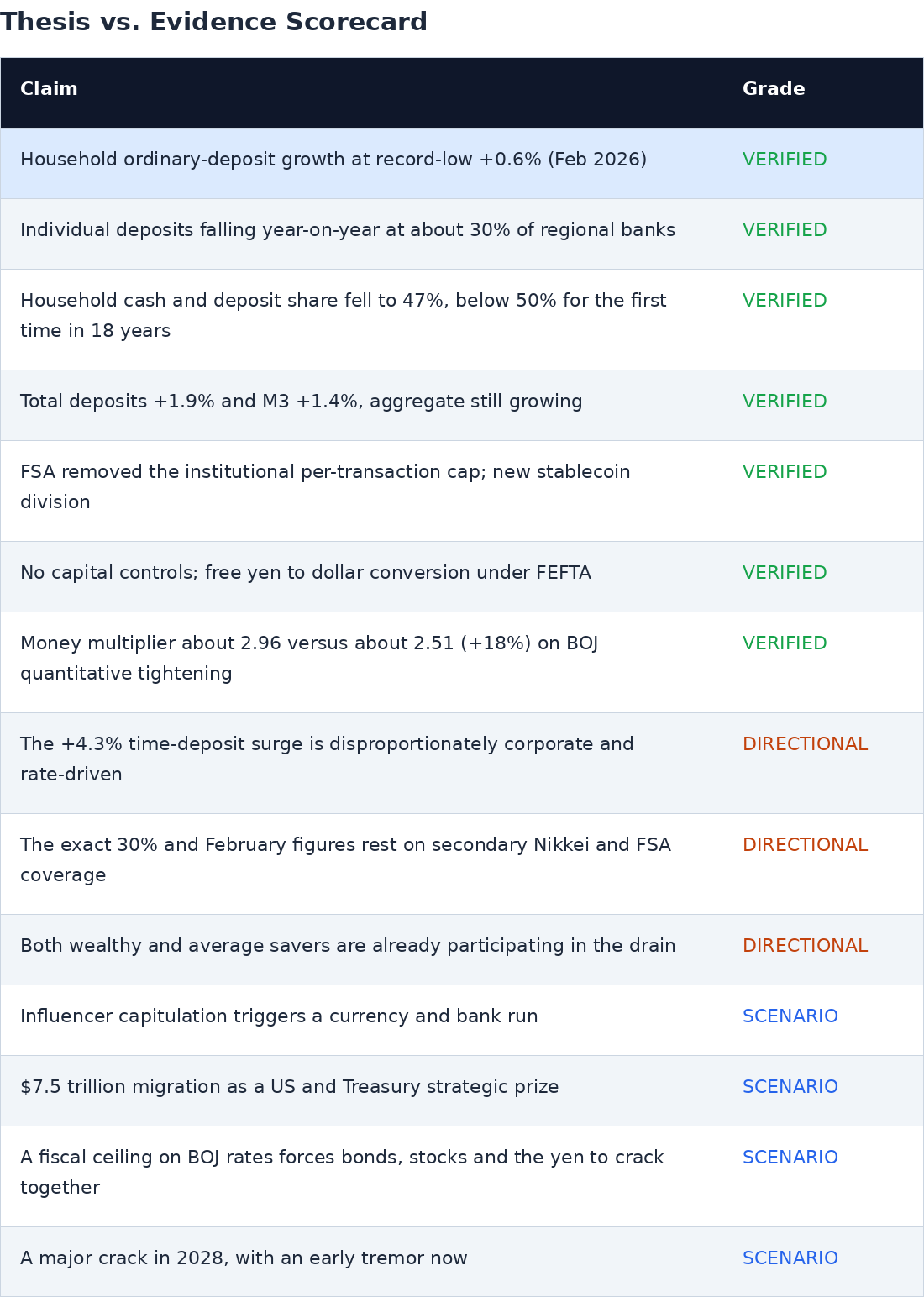
7. Thesis vs. Evidence Scorecard
Every load-bearing claim, graded honestly. Verified means confirmed in the cited sources. Directional means supported, but from secondary or partial data. Scenario means a plausible future, not a current fact.
Bottom Line
The thesis is no longer waiting to begin. At the household level it is already kinetic. Deposits are draining, the savings rate is negative, the cash share has broken below 50%. The aggregate hides it because corporates are filling the hole, and the money multiplier is climbing on deliberate quantitative tightening rather than flight. The rails were just widened, the escape routes are open, and the only unlit fuse is sentiment. When a trusted voice names the flight, the loaded chamber fires, and $7.5 trillion from a single open country begins to move.
Watch the household deposit prints. They are the leading edge, and they have already turned.
This briefing grades every load-bearing claim as Verified, Directional or Scenario. Verified figures were checked against the underlying BOJ, FSA, Nikkei, Reuters and Daiwa Institute reporting; where a figure rests on secondary coverage of primary data it is graded Directional. Directional and Scenario items are interpretation and forecast, not established fact. Nothing here is investment advice.
The authors hold positions in securities mentioned and reserve the right to buy or sell shares at any time without notice.