
The Morrow Moment


Executive Summary
Between January and August 2026, the United States executed a sequence of political, military, and monetary moves that, taken together, constitute the consolidation of American economic hegemony: hemispheric energy control, adversary accommodation, and a fiscal-monetary architecture that channels global savings into the dollar system. The JD Unfiltered 99-year clock, which maps the 1921 to 1930 productivity-boom cycle onto 2020 and onward at a constant 99-year offset, predicted that 2026 would replay 1927. This report documents the degree to which that mapping is now being confirmed in real time, not loosely, but at the level of specific months, specific institutions, and specific instruments.
The political spine of 1927 is replaying on schedule. An oil confrontation with a southern neighbor, resolved through banker-diplomacy into face-saving vassalage. The January 2026 capture of Nicolás Maduro and the August 28 announcement of majority US control over 65 billion barrels of Venezuelan reserves map onto the 1927 Mexican oil confiscation crisis and its resolution through Ambassador Dwight Morrow.
The financial spine of 1927 is also replaying on schedule. A summer accord among monetary authorities followed by deliberate easing into a productivity boom. The July 1927 Long Island central bankers' conference and Benjamin Strong's August 5, 1927 discount-rate cut find their counterparts in the May 2026 installation of Kevin Warsh as Fed chair and the August 19, 2026 doubling of Treasury long-bond buybacks.
The monetary instrument of each era is being scaled by deliberate policy architecture. The dollar bankers' acceptance then, the dollar stablecoin now, with a private adoption-incentive layer emerging to accelerate it.
The decisive test of the mapping arrives in November 2026, when the US and China rare earth truce expires: 99 years to the month after the Mexican Supreme Court ruling of November 1927 that converted confrontation into accommodation.
If the November window resolves into a durable US-China accommodation, the Morrow Moment, the model's 1928 equals 2027 melt-up leg becomes the operative scenario, and the same clock continues ticking toward the 1929 equals 2028 terminal phase.
The 99-Year Clock: Method and Current Standing
The JD Unfiltered analog locks the mapping at a constant 99-year offset: 1921 equals 2020, 1922 equals 2021, 1927 equals 2026, 1928 equals 2027, 1929 equals 2028. The framework treats the two eras as parallel productivity-boom cycles, each powered by paired engines: a real-economy engine compounding from private technology, factory electrification then and AI diffusion now, and a monetary engine dependent on enabling legal architecture, dollar bankers' acceptances then and statute-backed dollar stablecoins now.
The model's operating path targets a 2027 melt-up analogous to 1928, an August 2028 peak, a late-2028 crash of roughly half, and a recovery to prior peak by late 2029, with the analogy deliberately broken at the 1930 to 1932 depression phase, on the argument that full-reserve regulated stablecoins and a modern Fed prevent fractional-reserve money destruction.
Through August 2026, the mapping has been validated primarily on financial data: index behavior, volatility structure, and the growth of the dollar-token float. What 2026 has now added is something the model did not require but strongly predicted, which is political confirmation. The events of the past eight months align with 1927 not merely in kind but in sequence and, in several cases, in calendar month.
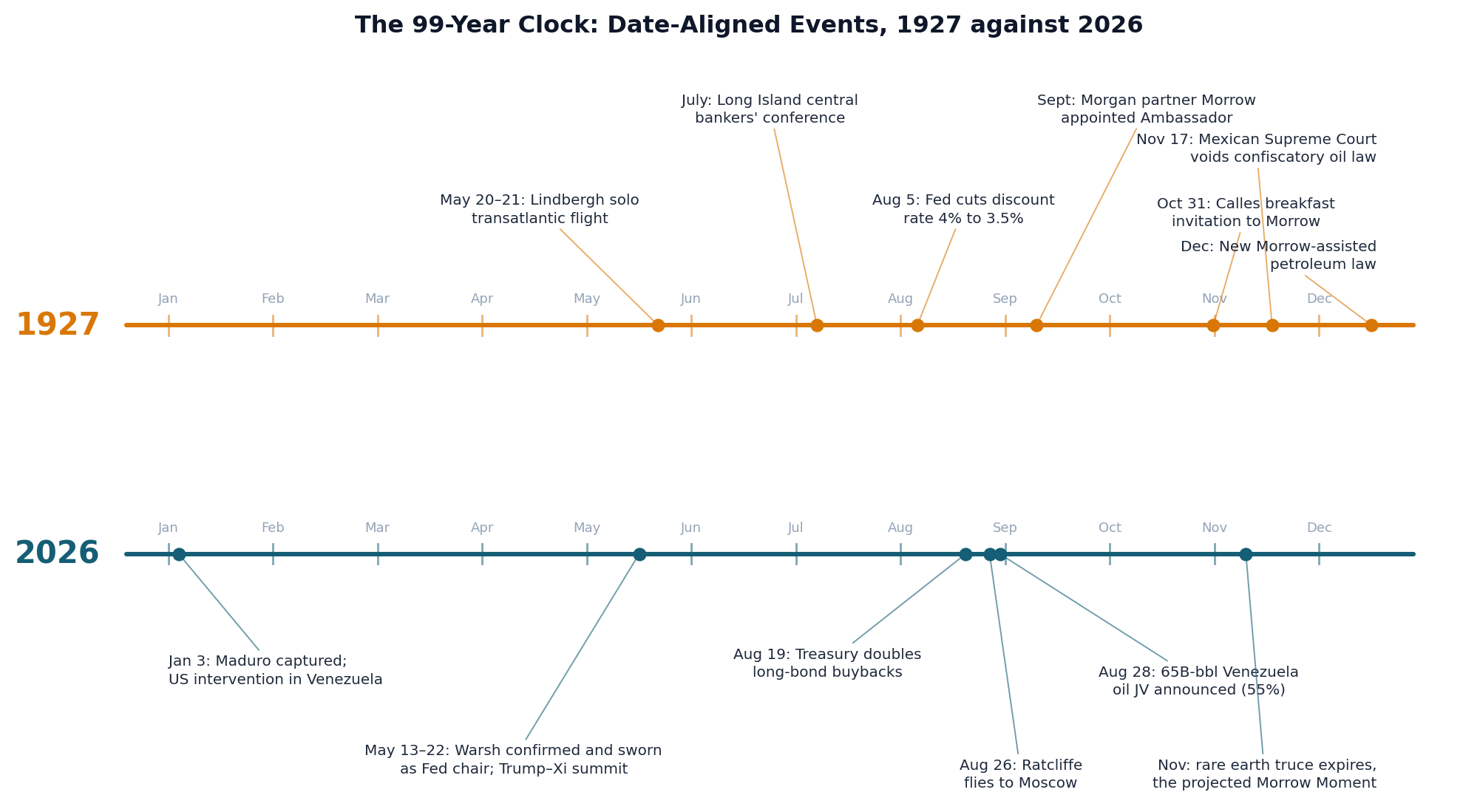
Part I: The Political Chain
The Hemispheric Consolidation: Venezuela as Mexico
The 1927 crisis: Mexico's petroleum laws under President Plutarco Elías Calles threatened confiscation of American oil holdings, bringing the two countries to the edge of confrontation after a decade of wrangling over subsoil rights. Washington's response was not invasion but a hybrid of pressure and dealmaking that ended with American capital re-secured inside a Mexican legal wrapper.
The 2026 sequence has been more forceful but structurally identical in its endpoint. On January 3, 2026, US forces struck Caracas and captured President Nicolás Maduro, flying him to New York to face narco-terrorism charges, the most forceful assertion of the administration's hemispheric doctrine, framed by the White House as a Trump Corollary to the Monroe Doctrine. Eight months of interim administration and oil sales followed, with more than $13 billion collected from Venezuelan crude sales by July and early proceeds remitted to Caracas under a January framework.
Then, on August 28, the settlement: majority US control of more than 65 billion barrels of proven reserves, against Venezuela's world-largest 303 billion, announced as the biggest oil deal in world history, negotiated by Secretary of State Marco Rubio and Secretary Pete Hegseth with interim president Delcy Rodríguez, at no cost to the American taxpayer, through a partnership with private business. The structure disclosed the following day: a 55 percent US share in a joint venture with a private Venezuelan company, spanning 17 strategic fields, with rights to buy oil at cost and purchases routed into the Strategic Petroleum Reserve. Venezuela's side of the ledger: a projected $209 billion to the state treasury and nearly $100 billion in private investment. Chevron and other US majors are expected to sign field-investment agreements within days.
The structural rhyme with 1927 is precise. In both cases, the concession is wrapped in the weaker party's own institutions: Calles's Supreme Court and Congress then, an interim Venezuelan presidency and a private Venezuelan company now. In both cases, the instrument was private capital deputized by the state: the House of Morgan then, unnamed private business partners and Chevron now. And in both cases, the opposition called it what it functionally was. Venezuelan opposition figures describe the arrangement as a land grab executed by a rapacious, mafioso United States, while economist Ricardo Hausmann argues an illegitimate interim government cannot constitutionally alienate hydrocarbons. Those objections echo, nearly verbatim, Mexican nationalist objections to the Calles-Morrow settlement, which was itself repudiated by expropriation eleven years later.
The Banker-Envoy: Ratcliffe as Morrow
In September 1927, Coolidge appointed Dwight Morrow, a senior partner of J.P. Morgan and Co. rather than a career diplomat, as Ambassador to Mexico, an appointment that reflected the deliberate use of financial statecraft in place of military confrontation. Within days of arriving, Morrow was breakfasting with President Calles. The October 31, 1927 invitation is preserved in the State Department record, and the personal channel he opened became the mechanism through which the crisis was resolved.
Ninety-nine years later, almost to the season: on August 26, 2026, CIA Director John Ratcliffe made a surprise trip to Moscow. Sources describe the trip as a warning to Russia against attacking NATO members, particularly Estonia, Latvia, and Lithuania, and against deepening support for Iran. Former Estonian president Toomas Hendrik Ilves reads the trip as primarily about Iran, and Baltic governments pointedly downplayed any change in threat perception.
Either reading fits the Morrow template: a non-diplomat envoy dispatched to the adversary's capital to open a direct channel, converting a season of war warnings, with US intelligence having assessed Russia could test NATO within weeks, into the opening move of a negotiation.
The Vassalage Bargain: China
The 1927 template resolves confrontation not through the adversary's defeat but through its accommodation on terms that preserve face while conceding substance. China's 2026 position makes such accommodation rational, and its behavior shows the accommodation already underway in installments.
The economic coercion is real and compounding. Consumer spending fell in May 2026 for the first time since Covid, with investment contracting. The property crisis is in its sixth year, with one analyst estimating prices must fall a further 40 percent to clear and S&P assessing the slump as worse than previously forecast. System-level bank capital remains adequate, but smaller and regional banks face mounting pressure from weak profitability: a slow bleed rather than a collapse, which makes time-buying accommodation more attractive, not less.
The accommodation itself is visible in the trade record. A one-year truce formalized in November 2025 suspended China's rare earth export curbs in exchange for tariff relief and agricultural purchases. At the May 2026 Trump-Xi summit, Beijing agreed to address US rare earth access and expand purchases, and, in the tell that defines face-saving vassalage, the US readout mentioned rare earths while China's did not. On the monetary front, Beijing chose containment over competition: the PBOC and seven agencies banned unauthorized yuan-pegged stablecoins outright, leaving Hong Kong's tightly licensed regime as the sanctioned channel, a defensive posture against a dollar instrument Beijing cannot match, as Chinese exporters themselves are drawn toward dollar-stablecoin settlement.
Calles in 1927 was a revolutionary nationalist who had flirted with radical confiscation. He accommodated because accommodation paid better than confrontation, and dressed the concession in Mexican legal sovereignty. Xi's rolling truces, omitted readouts, and Hong Kong firewalls are the same maneuver executed at superpower scale.
The Cornered Spoiler: Russia
Russia occupies the position of the actor with the most to lose from the consolidation and the fewest instruments to stop it. Its no-limits partnership with China is plateauing, with trade growth halved from 2024's pace amid payment barriers and Beijing's rising price of partnership, and visible friction at the May Putin-Xi summit. Ukraine's technology war has inverted the attrition equation: Kyiv fields roughly 100,000 to 120,000 FPV drones per month with a quality edge and is systematically striking refineries more than 800 miles inside Russia, at Ufa, Ilsky, and Ust-Luga, under a dedicated long-range strike command.
Moscow's short-run leverage is paradoxically elevated, since the US blockade of Iranian crude has forced Sinopec to ramp Russian purchases, but the Venezuela joint venture is the instrument designed to decay exactly that leverage over the rebuild horizon. Meanwhile peace talks sit on a deep pause with Russia reportedly preparing intensified ballistic strikes, and NATO's eastern flank braces for hybrid provocation, with sabotage, jamming, and influence operations already escalating across the Baltic Sea region.
The strategic fork for the Kremlin is binary: spoil or deal. An overt Baltic attack would unify NATO and accelerate China's accommodation, a self-defeating spoiler, which analysts assess Putin is probing for precisely because he believes the West will flinch. The rational alternative is Putin competing to become Trump's counterparty himself, trading the war for sanctions relief before a US-China bargain leaves Russia as the last power outside the room. The Ratcliffe channel is the door through which either outcome walks.
The Abandoned Client: Iran
Every consolidation names a loser. In the 1927 pattern, the loser was the radical orbit itself. Mexico's flirtation with Bolshevik alignment, the specter that had alarmed Washington, dissolved once Calles chose accommodation, because the patron relationship could not survive the client's defection to the hegemon's terms.
Iran occupies that position in 2026. The US blockade has cut Tehran's crude shipments to its last major customer, with Chinese imports falling from roughly 1.4 million barrels per day to around 700,000 and August intake dropping further as offers dry up, while Washington escalates sanctions on the remaining trade. The Ratcliffe trip's second agenda item was explicitly Russian support for Iran.
If both patrons accept vassalage terms, China trading compliance for economic relief and Russia trading Ukraine for reintegration, Iran's regime faces the abandonment scenario: not invaded, but starved of patrons, customers, and hard currency simultaneously. Regime change by abandonment rather than by force is precisely how the 1927 pattern retired its radical client. The caution from the same history: abandoned regimes do not always produce compliant successors, and the transition itself can spike the oil price before it settles it.
The November Window
The mapping's near-term test is unusually specific. In November 1927, the Mexican Supreme Court ruled against the confiscatory provisions of the petroleum law, with the mid-November telegrams from Morrow to Washington marking the moment, and Calles followed with Morrow-assisted legislation in December. That was the Morrow Moment: the month confrontation legally converted into accommodation.
In November 2026, ninety-nine years later to the month, China's suspension of rare earth export controls expires. The parties must either extend, expand, or collapse the truce, with the extension question already tabled at the leaders' level since May. A durable settlement in that window, with rare earth access institutionalized, tariff structure stabilized, and energy offtake arranged around the newly secured Venezuelan barrels, would be the 2026 Morrow Moment, arriving on the analog's schedule with a precision the model itself would not have dared to specify.
Part II: The Financial Chain
The Accord: Long Island 1927, Washington 2026
In July 1927, the heads of the world's major central banks, Benjamin Strong of the New York Fed, Montagu Norman of the Bank of England, Charles Rist of the Banque de France, and Hjalmar Schacht of the Reichsbank, met quietly on Long Island in what the Bank for International Settlements later described as a celebrated and notorious episode of central bank cooperation. Out of that accord came deliberate American easing: on August 5, 1927, the discount rate fell from 4 percent to 3.5 percent, accompanied by expanded securities purchases. Strong told Rist he intended to give a little coup de whiskey to the stock market. The easing was designed to support the international monetary architecture, the gold-exchange standard and sterling, and its domestic byproduct was the fuel for the 1928 and 1929 boom.
The 2026 counterpart is not a central bankers' conclave but something more integrated: the fusion of Treasury and Fed into a single policy desk. Kevin Warsh was confirmed as Fed chair on May 13, 2026 in the closest confirmation vote in the institution's modern history, and sworn in May 22, having argued there is room to lower rates. Treasury Secretary Scott Bessent, meanwhile, has assumed direct management of the yield curve: on August 19, Treasury at least doubled its long-end liquidity-support buybacks to a $4 billion minimum per operation, four operations per quarter, stating the operations could grow further. Financial press framing captured the fusion explicitly, describing Treasury as moving to curb yields and putting pressure on Warsh's Fed.
In 1927, the monetary authority eased to defend an international currency architecture, superheating domestic assets as a side effect. In 2026, the fiscal-monetary partnership eases financial conditions to defend a debt-issuance architecture, with the same predictable side effect. The Bessent/Warsh accord is the Long Island conference with a 99-year offset, relocated from a Long Island mansion to the Treasury Building.
The Duration Machine: Call Loans Then, Bills-for-Bonds Now
The mechanism financing the current structure deserves precise description, because it is the part of the 2026 architecture most directly analogous to the 1927 credit machinery, and most exposed to the same failure mode.
Treasury officials have confirmed consideration of using the near-$950 billion Treasury General Account to fund the buyback program, and Treasury's own refunding assumptions place the cash balance at $950 billion at end-September. The TGA is filled by bill issuance. Bills are absorbed by money funds and by stablecoin reserves, whose demand is price-insensitive by construction. The full circuit therefore runs: stablecoin float and money-fund cash buy bills, bill proceeds fill the TGA, and the TGA retires 10-, 20-, and 30-year bonds.
This is a maturity swap executed off the fiscal balance sheet, Operation Twist without the Fed, progressively converting the national debt into short paper funded by the dollar-token complex. Critics note the current scale is modest against $40 trillion of debt, with ING calling it rearranging deckchairs on the Titanic at roughly $128 billion of annual capacity, but the announcement alone drove long yields sharply lower, because a credible $950 billion backstop disciplines the marginal seller the way a central-bank floor does.
The 1927 analog is the call-loan market: the vast pool of non-bank money, corporate treasuries and foreign balances, lending overnight against securities collateral, funding a long-duration asset boom with instantly callable liabilities outside the Federal Reserve's direct control. The 2026 duration machine reproduces that structure at sovereign scale, with long-duration liabilities, the retired bonds, replaced by overnight-to-one-year funding, the bills, supplied by a non-bank pool of stablecoin float plus money funds.
The machine is stable exactly as long as the bill bid is stable. The 1920s version failed when call money was withdrawn. The modern version's stress point is a contraction of the float during a TGA drawdown, the one fire a larger buyback announcement cannot extinguish.
The Dollar Instrument: Acceptances Then, Stablecoins Now
Each era's monetary engine runs on a legally engineered dollar instrument designed to internationalize dollar funding.
In the 1920s it was the bankers' acceptance. Paul Warburg pushed for the creation of an American acceptance market, which the Federal Reserve Act enabled, and the period from 1925 to early 1931 saw extraordinary growth in dollar acceptance volume, sustained by the Fed's active support as a standing preferential buyer. The instrument pulled global trade finance into dollars and made New York a funding center rivaling London.
In the 2020s it is the payment stablecoin. The GENIUS Act, signed in July 2025, created the first comprehensive US regulatory framework and handed Treasury the central role in writing its rules. The market stands at roughly $308 billion, 99.5 percent dollar-denominated, with USD-pegged coins at 97 percent of the global total. The ECB's Isabel Schnabel has warned that stablecoin growth could cement dollar dominance and undermine other nations' monetary autonomy, the same complaint European monetary authorities lodged, in different vocabulary, against the interwar dollar's expansion.
The structural difference favors the modern instrument's durability, and changes its risk profile. Acceptances were Fed-intermediated: the central bank could contract the market through its own balance sheet. Regulated stablecoin float is created by private global demand under statute, and no central authority throttles it, which is why the JD Unfiltered framework watches redemption flows and float growth as the primary contraction signal rather than any policymaker's stance. On that gauge, the current reading is cautionary. The float sits approximately 4.5 percent below its May 2026 peak: growth stalled, not reversed, at precisely the moment the duration machine has begun to lean on it.
The Adoption Layer: The Acceptance Subsidy, Privatized
The 1920s acceptance market did not grow organically. The Fed bootstrapped adoption by standing as a preferential buyer until the market became self-sustaining. The 2026 stablecoin complex has a structural adoption problem of its own: GENIUS-compliant coins cannot pay yield, leaving holders uncompensated while bills yield over 4 percent, a plausible contributor to the float's stall below its May peak.
The emerging solution is a private adoption-incentive layer: coupon-carrier token architectures that attach advertiser-funded purchase incentives to stablecoin transactions while remaining legally separate from the underlying token. Under this design, the Super Coupon Token architecture developed within the JD Unfiltered project family, advertisers contribute coupon value rather than cash, fund the promotion only upon redemption and purchase, and give holders an economic reason to transact in non-yielding stablecoins: yield paid in consumption discounts rather than prohibited interest.
The layer's macro function mirrors the Fed's acceptance subsidy of the 1920s, an incentive mechanism that builds the monetary rail, with the critical difference that it requires no central-bank balance sheet, no appropriation, and no treaty. Its conversion-funded structure also carries counter-cyclical properties, since coupon-seeking rises in downturns while conventional advertising collapses, making the incentive layer more recession-resilient than impression-funded models. The regulatory load-bearing wall is the separation itself: the moment the coupon layer is deemed issuer-paid yield, the GENIUS framework's shield fails.
The Distribution Rail: Foreign Lending Then, Satellite Dollarization Now
The 1920s dollar system expanded abroad through New York's foreign lending boom and the gold-exchange standard, which let foreign central banks hold dollar claims as reserves. The 2026 system expands through something structurally stronger: direct retail access, delivered from orbit.
Starlink's direct-to-cell service launched across the United States in April 2026, compatible with any modern phone. SpaceX rebranded the offering as Starlink Mobile, positioning it as a mainstream mass-market service, and in May the FCC approved SpaceX's $40 billion acquisition of 65 MHz of EchoStar spectrum, the contiguous band required for true broadband-from-orbit. Starlink is available in 166 countries and territories. The consequence for monetary geography: a phone, the sky, and a wallet application now constitute a complete financial access stack that no domestic bank, telecom, or capital-control regime intermediates.
The addressable pool is the global mass of low-yield deposits trapped in high-debt economies, approximately $45 trillion in the JD Unfiltered disintermediation thesis, in a world where deposits pay 0.1 percent in Singapore while savers in high-inflation economies watch real balances erode. Against that pool, the $308 billion stablecoin float is a rounding error. A 1 percent migration is roughly $450 billion, more than doubling the float and fully funding the duration machine's bill bid. A 5 percent migration approaches $2.25 trillion. The savings-asset leg of the stack is scaling in parallel: tokenized gold trading volume reached $90.7 billion in Q1 2026 alone, exceeding all of 2025, with market capitalization rising from $10 billion to $15 billion in a single quarter.
The stack assembles into a parallel bank delivered from orbit, with transaction money in dollar stablecoins, a savings asset in tokenized gold, a rewards program in the coupon layer, and a branch network in satellite, and it explains adversary behavior more economically than any military variable. Deposits are the funding base of China's banking system, and satellite-delivered dollar rails convert every saver in a fragile-bank jurisdiction into a potential silent defector. Beijing's outright suppression of yuan stablecoins is not currency policy. It is bank-run prevention. And it reframes the vassalage bargain of Part I: accommodation with Washington is partly a negotiation over the terms of a dollarization that arrives through the sky whether or not anyone signs.
Part III: The Similarities Ledger
The table below assembles the date-aligned correspondences. Rows marked structural are load-bearing elements of the analog. Rows marked color are cultural rhymes included for completeness.
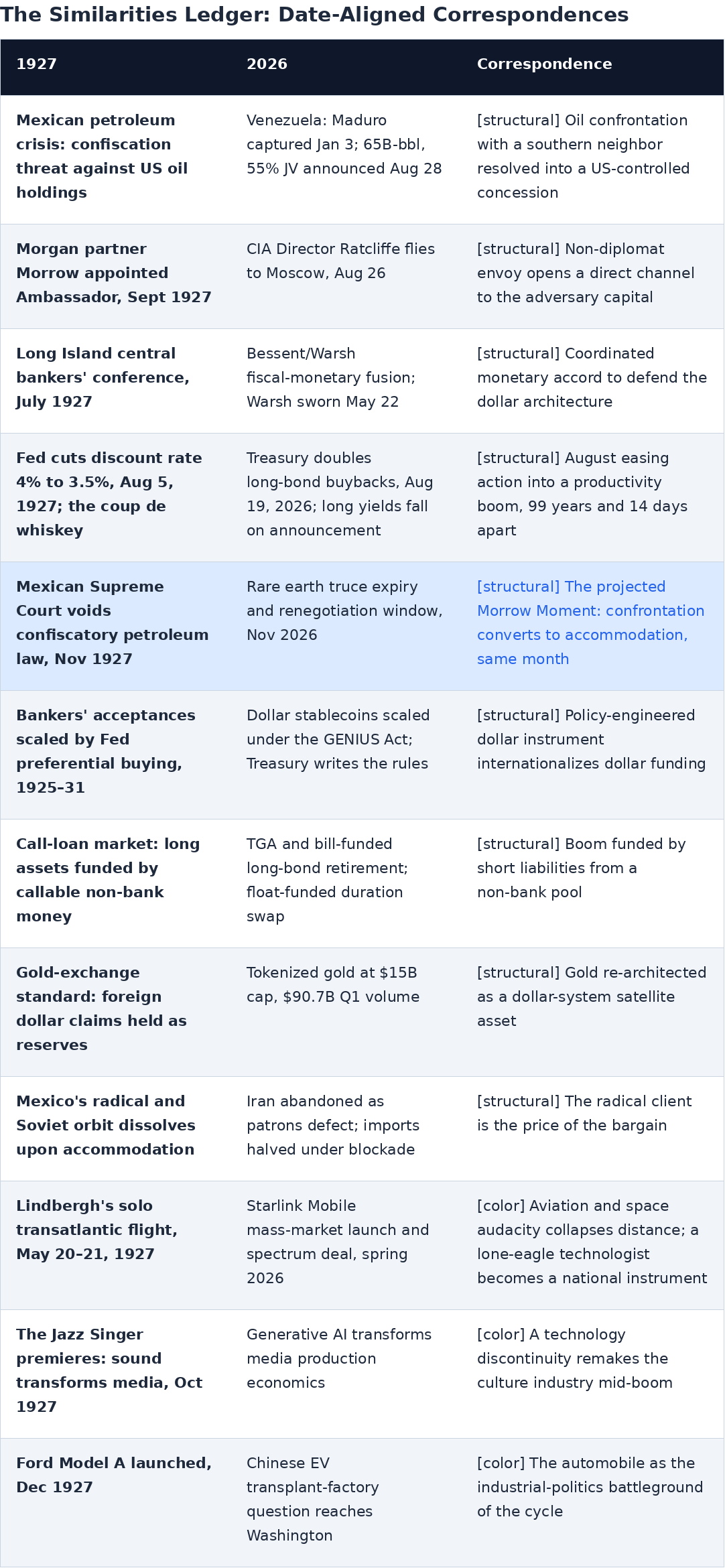
The structural rows are the argument. Nine independent correspondences, political, diplomatic, monetary, and instrumental, landing in the correct sequence and, in four cases, in the matching calendar month, is beyond what a loosely fitted analogy would produce. The 99-year clock did not merely survive 2026. 2026 is the year the clock's political predictions came due and were paid.
Part IV: The Forward Calendar
The mapping generates a specific near-term schedule. All forward figures below are outputs of the JD Unfiltered model, not consensus forecasts.
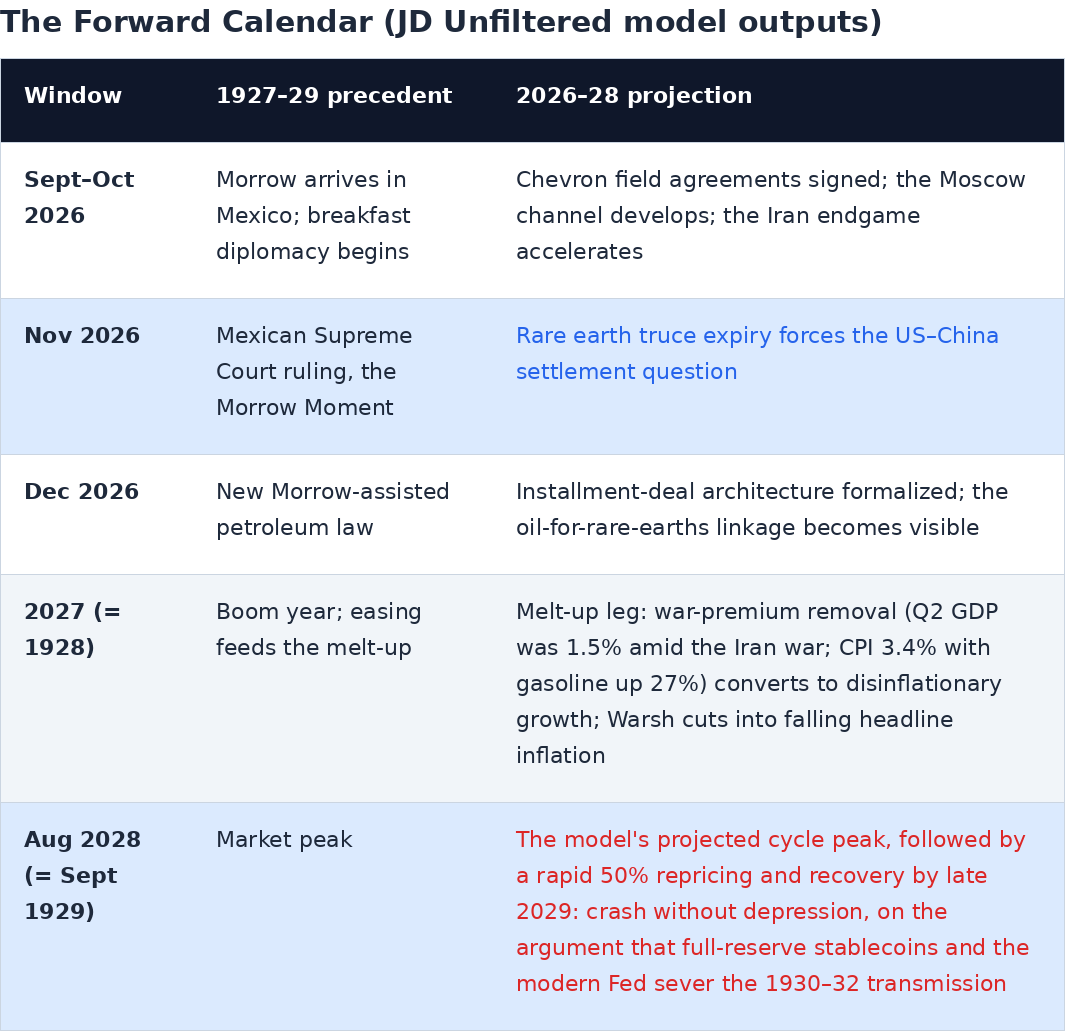
The transmission logic for 2027 deserves emphasis because it is now mechanically visible. The Venezuela barrels and an Iranian resolution attack the exact wedge, energy prices, holding growth at 1.5 percent and headline CPI at 3.4 percent. Oil falls, headline inflation falls, the Fed chair who has argued for room to cut gets cover, the buyback machine anchors the long end, and the AI-productivity engine, the cycle's real-economy engine, runs into loosening financial conditions. That is the 1928 configuration: the coup de whiskey administered into a genuine productivity boom.
Part V: What Would Break the Clock
A model confirmed by events must still name its falsifiers. Five are live.
One. The float gauge. Stablecoin float at $308 billion remains roughly 4.5 percent below its May 2026 peak. The framework's own rule treats sustained float contraction as the principal exit signal, and the duration machine has now made the float load-bearing for Treasury funding itself. A float that fails to reclaim its high by the Morrow window is the single most important warning.
Two. Long-end credibility. The August buyback doubling was forced by a long-end selloff. If the accord cuts rates into sticky 3.4 percent inflation and the long end reprices anyway, the failure mode is not a tight Fed. It is a credibility repricing no buyback schedule can outrun.
Three. The Baltic miscalculation. Warnings of Russian provocation remain active. A cornered Kremlin that concludes it has lost both the Trump deal and the Xi hedge could reach for the board-flipping option. The Ratcliffe channel exists to prevent exactly this, and its failure would suspend the entire accommodation sequence.
Four. The coupon-layer separation. The adoption layer works only while conversion-funded incentives remain legally distinct from issuer yield. A regulatory ruling collapsing that distinction removes the float's demand engine at the moment of maximum dependence.
Five. The Cárdenas horizon. The Calles-Morrow settlement held eleven years before Mexico expropriated everything. Vassalage purchased under duress is rented, not owned. A 100-year lease signed by an interim government, and rare earth licenses renewed in six-month tranches, carry the same reversibility: a risk beyond this cycle's horizon, but a certainty of the pattern.
Conclusion
The 99-year clock was built as a market model: an index overlay, a productivity-cycle comparison, a volatility framework. What 2026 has delivered is a category of confirmation the model never demanded, with political events arriving in the analog's sequence, through the analog's institutions, in the analog's months. An oil crisis with a southern neighbor settled into a concession wrapped in local sovereignty. A private-capital envoy dispatched to an adversary's capital in the late summer. A monetary accord easing into a technology boom in August. A dollar instrument scaled by statute and subsidy. A radical client abandoned as the price of great-power accommodation. And a November window, ninety-nine years to the month after the original, in which the confrontation either converts to accommodation or does not.
The Colossus Doctrine framing holds. The United States is consolidating energy, monetary, and distribution dominance simultaneously, and its adversaries' rational play, visible in Beijing's omitted readouts and Moscow's opened channel, is negotiated vassalage rather than resistance. If the Morrow Moment arrives on schedule in November, the 1928 equals 2027 melt-up becomes the operative scenario, with its documented magnitude projections and its documented terminal date.
The clock's most sobering property is its symmetry: the same mapping that validates the boom schedules its end. Watchfulness on the float, the long end, and the Baltic gray zone is not pessimism. It is the model working as designed.
This report presents a historical-analog framework and macro thesis for research and discussion purposes. It is not investment advice, and the forward projections herein are model outputs of the JD Unfiltered framework, not predictions of certainty. Historical analogies inform judgment; they do not bind the future.
The authors hold positions in securities mentioned and reserve the right to buy or sell shares at any time without notice.