
Thirst as Leverage

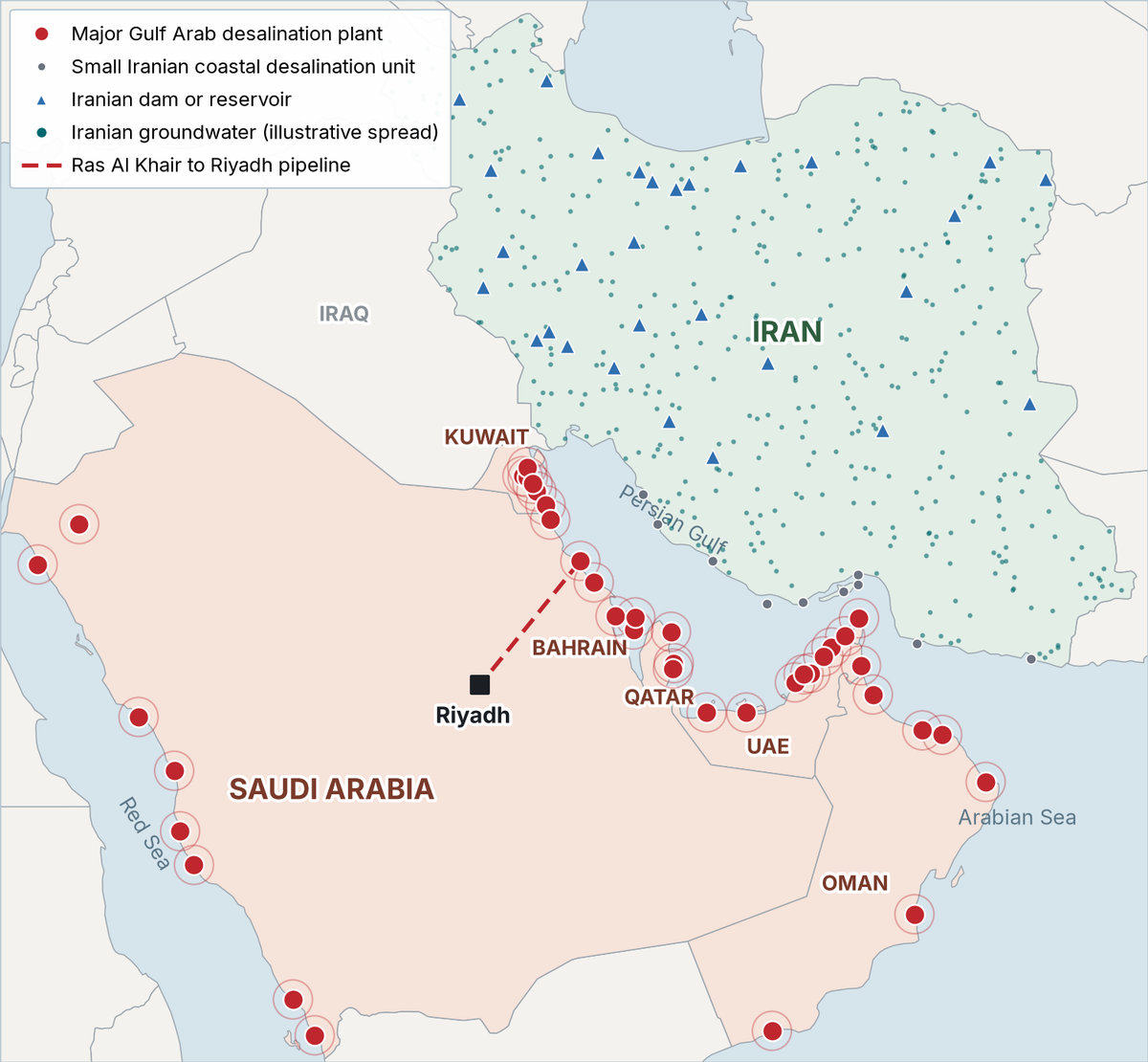
The Gulf's desalination dependence, Iran's asymmetric water advantage, and why drinking water may be the hidden brake on US escalation. Strategic research whitepaper.
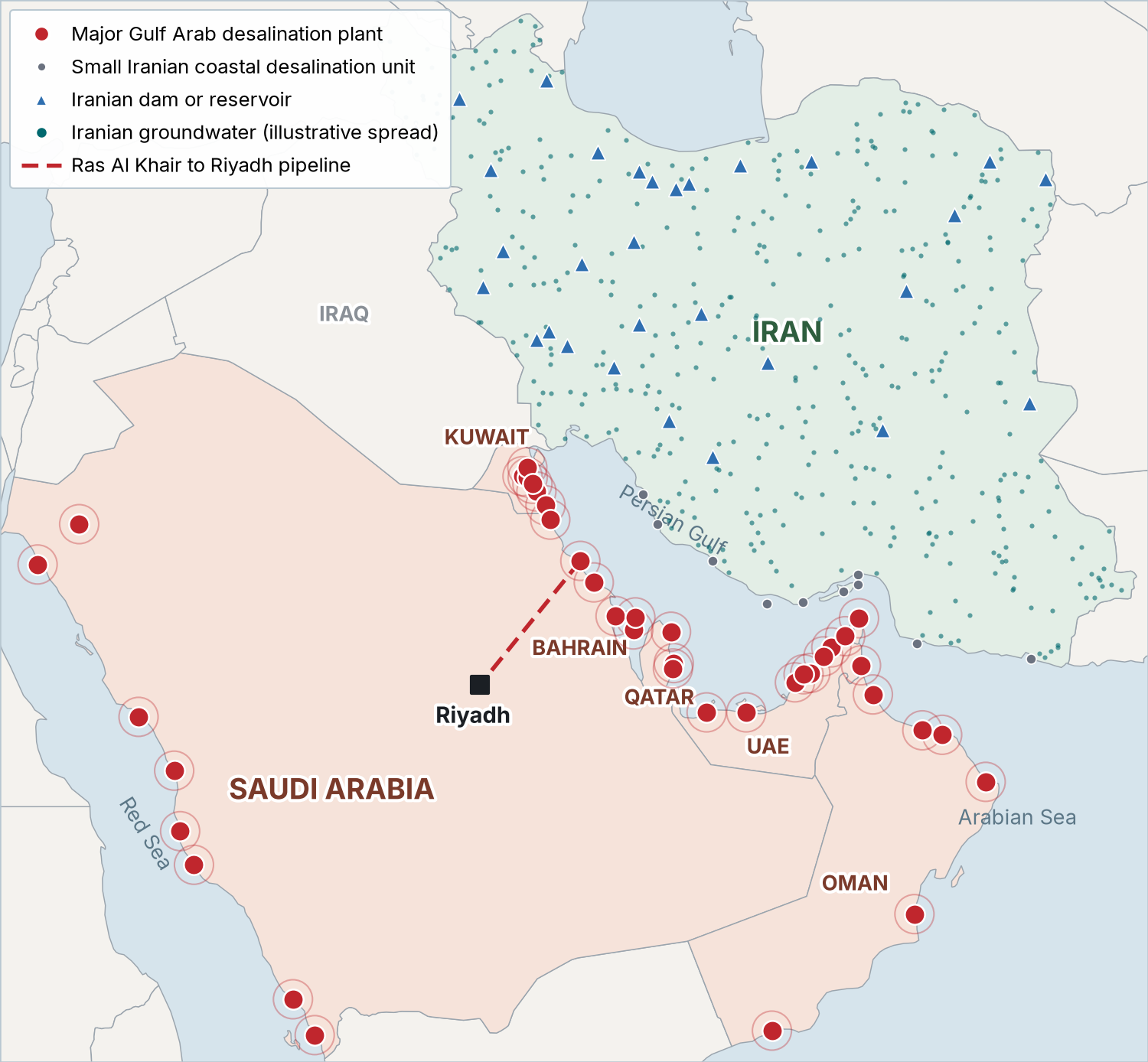
Bottom line. Saudi Arabia, Kuwait, the UAE, Oman, Qatar and Bahrain get most of their drinking water from a small number of coastal desalination plants, most of which also generate electricity. Iran gets about 3 percent of its drinking water this way. That gap gives Tehran a lever no Gulf state or the United States can match: Iran can threaten the daily water of tens of millions of people, while a strike on Iran's own plants barely touches its national supply. The record of this war shows Gulf warnings about water arriving just before several US pauses. That makes the water imbalance a documented constraint on American escalation, though not the only one.
Key findings
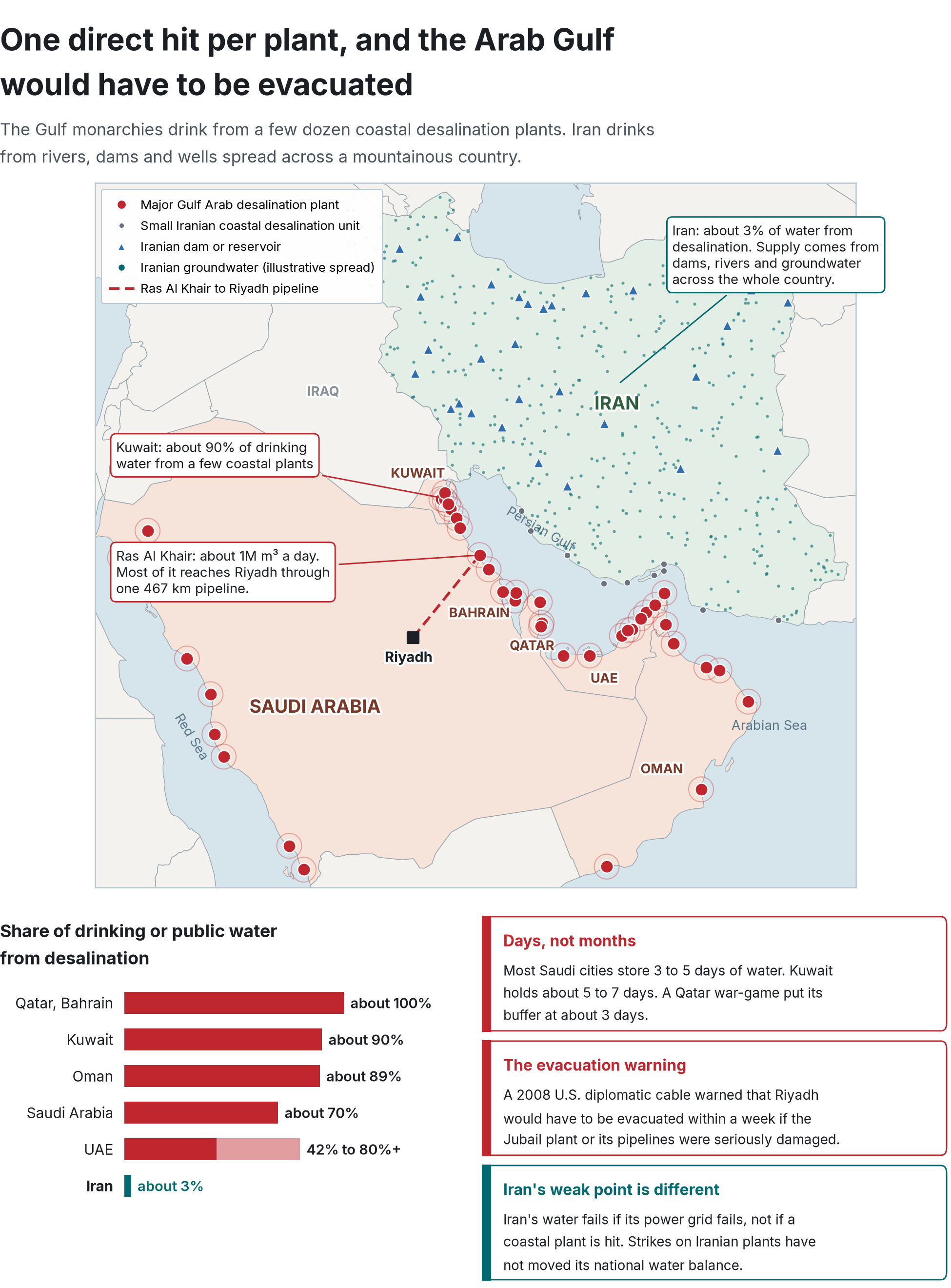
Dependence is lopsided. Desalination supplies about 90 percent of Kuwait's drinking water, about 89 percent of Oman's public supply, effectively all of Qatar's and Bahrain's, and most of Saudi Arabia's. For Iran the figure is about 3 percent.
The targets are few and concentrated. Only 56 large plants produce more than 90 percent of the Gulf's desalinated water. Kuwait has 8 major plants. Riyadh draws most of its water from plants on the Persian Gulf coast, more than 450 km away.
Air defense cannot guarantee protection.Gulf and allied defenses have stopped over 90 percent of incoming Iranian weapons, but Iran has still hit at least 4 of Kuwait's 8 combined power and water plants.
Above 50 percent offline, the clock is days, not weeks. Most Gulf states hold roughly 2 to 7 days of stored water. Emergency rationing would start within 48 to 72 hours, and evacuations become plausible within 1 to 3 weeks if repairs stall.
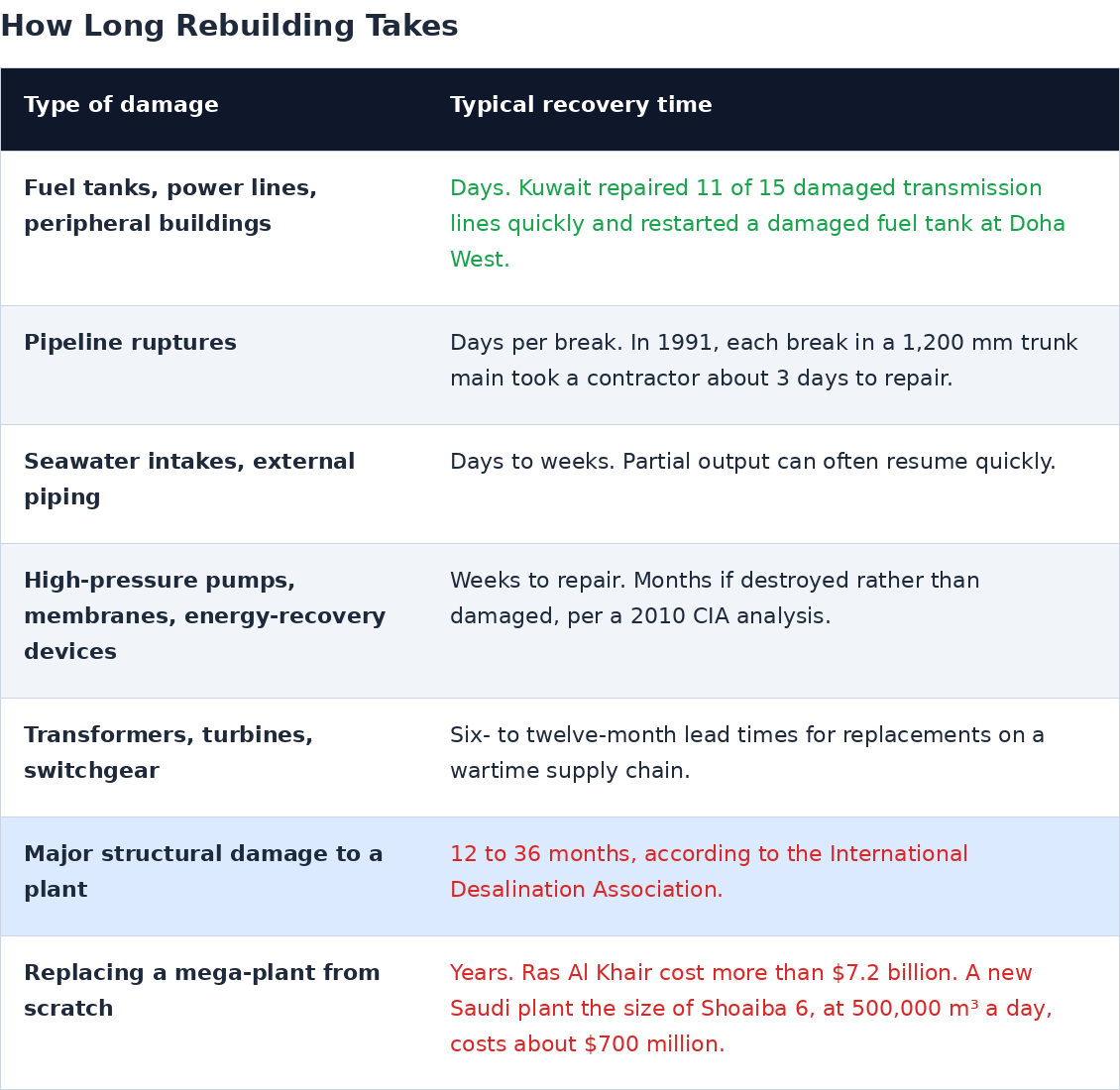
Rebuilding is slow. Damage to pipes and intakes can be fixed in days. Destroyed pumps, membranes or transformers take weeks to many months. Rebuilding a heavily damaged plant can take 1 to 3 years.
Water arrives at the brink of the US decision. Gulf leaders, including Crown Prince Mohammed bin Salman, have repeatedly warned Washington that striking Iran's power grid would invite strikes on their water. Those warnings came just before US pauses in March, May and August.
Defending the plants is falling to the Gulf states. Since the April ceasefire, Washington has approved billions in emergency air-defense sales to the Gulf, but there is no public evidence that it has stationed its own defenses at water plants. Its own interceptors are rationed and depleted.
Iran's restraint is conditional. Iran has used the water threat mainly as leverage, not as an all-out attack. That calculation could change if the blockade comes to threaten the regime's survival.
1. Two different water systems
The Gulf monarchies and Iran face water scarcity in opposite ways. The Gulf states turned seawater into a utility, so a few very large coastal plants sustain modern cities. Iran relies mostly on rivers, dams and groundwater spread across a large, mountainous country, and desalination is a small coastal addition. That structural difference is the basis of everything that follows.
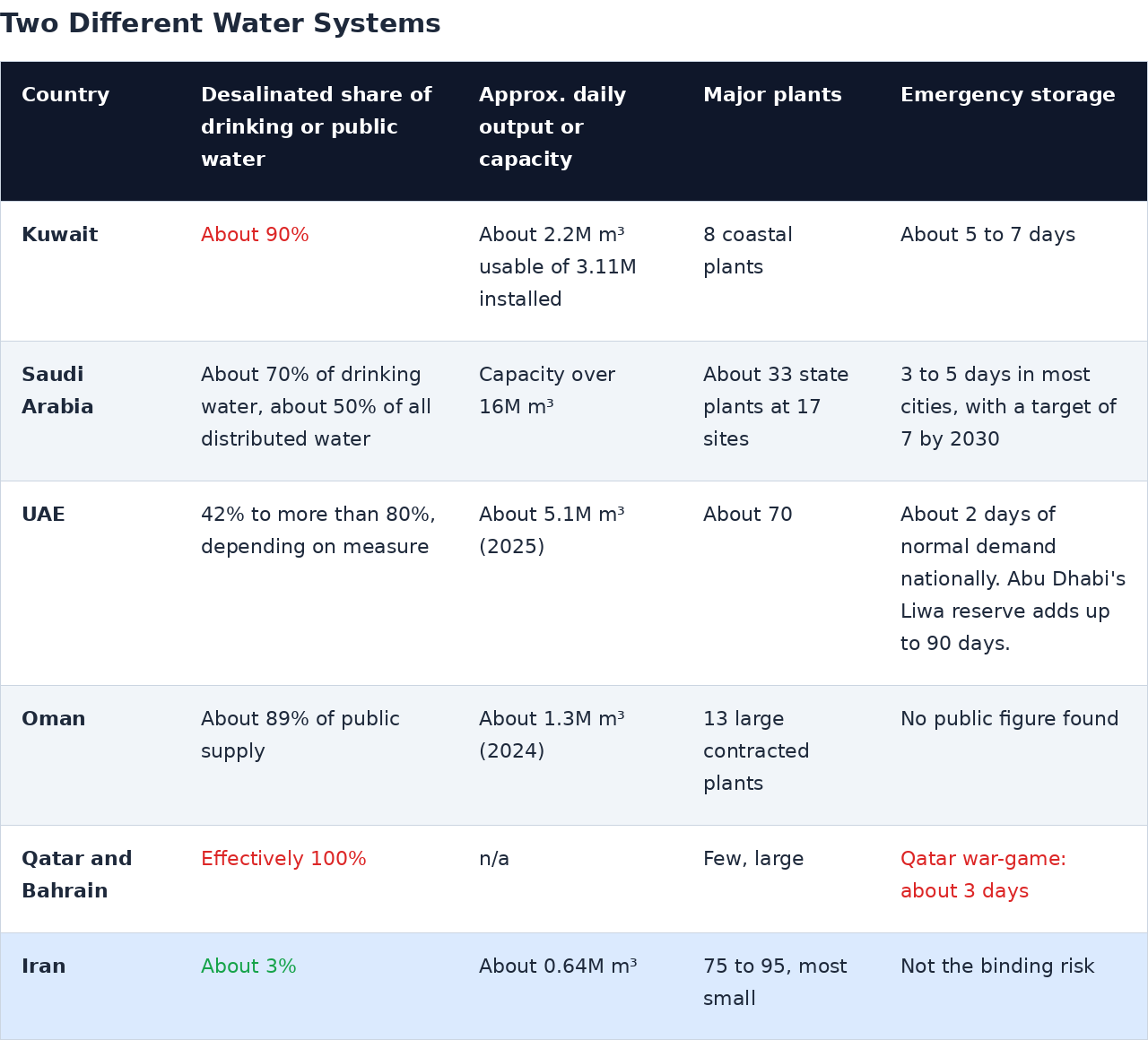
Iran is not water-secure. Its weakness is different.
Iran is in its sixth year of severe drought. In November 2025, four of Tehran's five reservoirs were 88 percent empty, and water shortages helped fuel deadly protests in December 2025 and January 2026. But Iran's water depends on electricity more than on desalination. Pumps, wells, treatment plants and distribution networks stop when the grid fails, and Iran's grid operator says about 4,200 megawatts of generating capacity have been knocked offline. Spring rains refilled Tehran's Amir Kabir dam to about 90 percent by mid-July 2026, which shows that Iran's supply can recover with rainfall in a way a destroyed desalination plant cannot.
This sets up the central asymmetry. To threaten Iranian water at scale, the United States would have to take down Iran's national power grid. That is a broad campaign against a civilian system, and it would strike all 92 million Iranians while doing little to the military, which runs largely on diesel. Iran, by contrast, can threaten Gulf water by hitting a handful of coastal sites. Iranian state media said a US strike put a Qeshm Island plant "completely out of service," and a strike near Bonji disrupted water for about 10,000 people. Neither moved Iran's national water balance.
2. Why one missile can matter
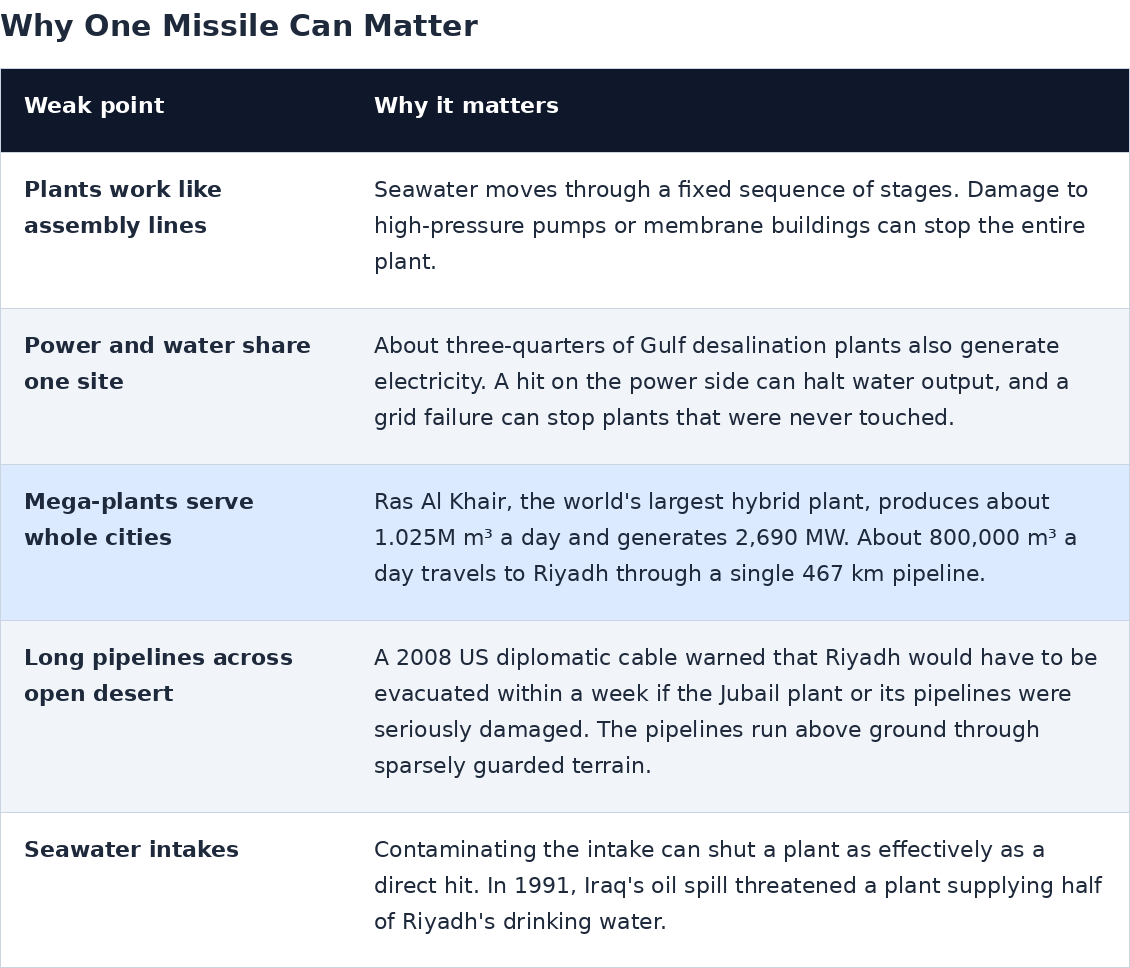
Gulf desalination is vulnerable not only because the plants are large, but because of how they are built and connected. Five features turn single hits into system-level outages.
Air defense: strong, but not sufficient
Gulf and allied defenses have performed well, stopping over 90 percent of Iranian missiles and drones since the war began on JINSA's figures. The UAE, the most heavily targeted state, faced over 2,800 attacks and stopped more than 96 percent. But water infrastructure has to be protected every time, while an attacker only needs a few hits. Even a 92 percent interception rate against the UAE's 433 incoming ballistic missiles let about 35 warheads through.
Kuwait shows the limit. Reuters found Iran struck at least 4 of Kuwait's 8 combined power and desalination plants between March and July, some more than once. Kuwait's usable desalination capacity is about 2.2 million cubic meters a day against 3.11 million installed.
Debris explanations are doubtful. Gulf governments blamed damage on falling interceptor debris at least 34 times. Reuters and 14 experts judged many of those hits too precise to be debris.
Interceptors run out faster than drones do.Gulf states may have used about 800 top-tier Patriot and THAAD interceptors in the first days of the war. Israeli intelligence estimates Iran holds more than 10,000 Shahed drones. One analysis warns that about 50 drones a day plus missiles, aimed at specific plants, could exhaust defenses.
Iran still has firepower. US estimates put Iran at about 60 percent of its prewar launchers and 40 percent of its drones, possibly recovering to about 70 percent of its missiles. Israeli estimates are lower, at 300 to 400 ballistic missiles.
The plants are hard to harden. They are open-air coastal sites with seawater intakes and brine outlets, and Global Water Intelligence notes they "cannot inherently be better reinforced" than other major infrastructure.
3. If more than 50 percent goes offline
The share of plants offline matters less than how long they stay down and which cities they serve. A 50 percent national loss for three days is a severe emergency the Gulf states could ride out. The same loss for three weeks, concentrated on Kuwait, Qatar, Bahrain or Riyadh's supply, is a humanitarian crisis. The timeline below combines published scenario work with this paper's assessment.
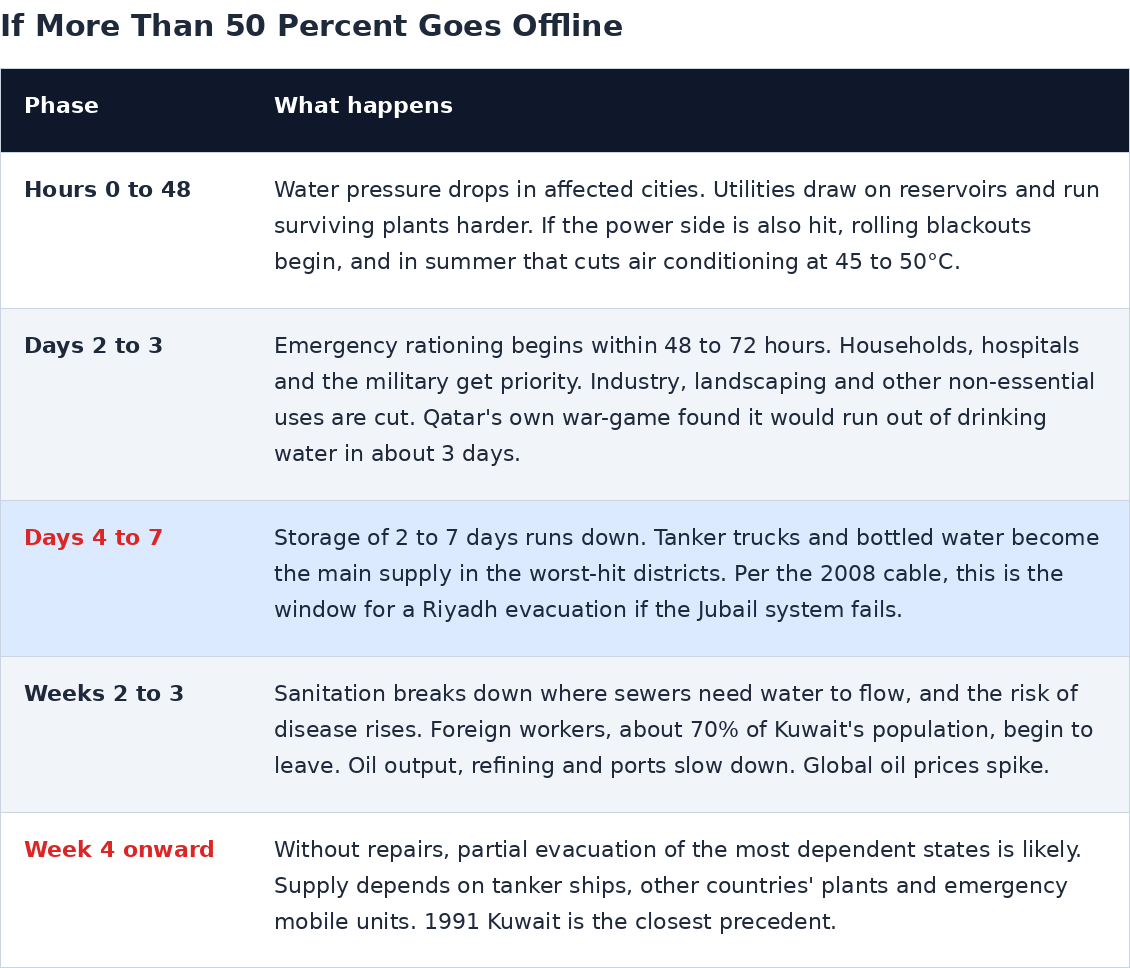
Imported water is not a real substitute. Covering a 50 percent loss in Kuwait alone would take about 1 million cubic meters a day, roughly three supertanker loads every day by this paper's estimate. That is before tank cleaning, port congestion and a contested Strait of Hormuz.
4. How long rebuilding takes
Recovery time depends on what is destroyed. The table reflects published engineering assessments and the 1991 Kuwait record.
The 1991 precedent
Retreating Iraqi forces destroyed most of Kuwait's desalination capacity. With massive support from the US Army Corps of Engineers, primary power came back within 30 days, water supplies were replenished within 45 days, and daily water service resumed in early June 1991. By December 1991, three desalination plants were running and water was continuously available across Kuwait City, about ten months after liberation. Full restoration of the national desalination network took more than five years. A modern rebuild would face an extra problem that 1991 did not: repairs would happen while missiles and drones are still flying.
5. When lives are at risk
Two clocks run at once. The first is the human body. Someone resting in the shade at about 49°C, or 120°F, with no water survives about 2 days. At 38°C, about 5 days. Children, the elderly and people working outdoors can die of dehydration and heat in hours. Gulf summer temperatures routinely pass 45°C, and Kuwait can exceed 50°C.
The second clock is the supply system. The amount needed for survival is small. The international humanitarian minimum set by the Sphere standards is 15 liters per person per day, of which only 2.5 to 3 liters is for drinking. For Kuwait's roughly 4.9 million people, that is about 73,000 cubic meters a day, under 4 percent of normal output by this paper's calculation. Even the higher 50-liter urban minimum is only about 12 percent. So people are rarely endangered because the nation runs out of water entirely. The danger comes when the remaining water cannot reach people.
Pressurized networks fail unevenly. At low volumes, high floors and districts at the ends of the network go dry first, while other areas still have water.
Power is the multiplier. If the same strikes cut electricity, people lose air conditioning, refrigeration and pumping at once. That turns a water shortage into a heat-mortality event.
Sanitation fails before drinking water runs out. Sewers that need water to flow become a disease risk within days.
Assessment. In summer, with both water and power lost in a city, the most vulnerable people face life-threatening conditions within 24 to 72 hours of household taps going dry. With storage of 2 to 7 days in front of that, a sustained outage above 50 percent puts the most dependent populations in danger within about 3 to 10 days. In winter, or with power intact, the window stretches to weeks. That is why evacuation planning, not repair, sets the real deadline.
6. Is this why the US has held back?
The question is whether the water asymmetry explains US reluctance to destroy Iran's remaining infrastructure, including the power grid that keeps Iran's own water flowing. A strike like that could, in theory, produce enough civilian hardship to destabilize the regime. The public record supports a qualified yes.
Evidence that water has restrained Washington
March 2026. President Trump threatened to strike Iran's electricity grid unless Tehran reopened the Strait of Hormuz. Gulf states warned him directly that US strikes on Iranian power plants would trigger Iranian retaliation against their energy and desalination facilities, and Iran sent word of "unlimited retaliation." Trump paused. A former US diplomat told Reuters that once Iran's willingness to hit Gulf energy infrastructure became clear, Trump was forced to back down.
Late March to April. Iran hit a Kuwaiti desalination plant on March 30. That was seen as a major escalation that helped push the United States to declare the war's first ceasefire about a week later.
May. Trump said he postponed planned strikes on the advice of Qatar, Saudi Arabia and the UAE. He publicly named the Emir of Qatar, Crown Prince Mohammed bin Salman and UAE President Mohamed bin Zayed as having asked him to hold off.
August. Iran warned Gulf states it would hit their oil, power and water plants unless they talked Trump out of renewed strikes. Mohammed bin Salman then called Trump and urged him to delay. On August 2, Trump cancelled the attack "subject to being able to rapidly make a deal."
Expert read. AP's analysis concluded that, given the gap in desalination dependence, the bigger danger "may not be what Trump could do to Iran, but how Tehran could retaliate."
Evidence that complicates the thesis
The rhetoric has not been restrained. Trump has repeatedly threatened Iran's power plants and desalination plants, and US strikes have hit at least one Iranian desalination plant.
Other reasons are on the record. Trump has pledged no attack before the November 3 midterms. The FT reported he blocked an Israeli operation planned for around October 10 to avoid pre-election escalation. Oil prices, Hormuz shipping and active negotiations all weigh on the decision.
The pause may be temporary. US strike options are reportedly ready for after the midterms.
Gulf positions have shifted. In late March, the UAE, Saudi Arabia and Bahrain said they were ready to absorb escalation rather than accept a post-war Iran that could still use Hormuz as leverage.
Grid collapse may not topple the regime.The Atlantic Council judged that destroying Iran's grid would cause "only minor disruptions" to Iran's military while endangering its civilians. Saudi officials also fear an Iranian civil war, not only Iranian missiles. Infrastructure campaigns often harden a population against the attacker instead of turning it on its own government. And deliberately depriving civilians of water would be widely treated as a war crime.
Assessment. The water asymmetry is very likely one of the main constraints on US escalation against Iran's civilian infrastructure. The repeated sequence is a Gulf warning about water, followed by Gulf leaders calling the White House, followed by a US pause. That pattern is too consistent to be coincidence, but it is not proof of motive. The immediate public reasons for the current pause are the midterms and the talks. The fairest conclusion is that Iran's ability to make the Gulf's taps run dry has repeatedly set the outer limit on how far Washington will go, without being the only factor.
7. Saudi leaders see the weakness
Riyadh's behavior shows a clear understanding of this vulnerability. Princeton's Bernard Haykel put it plainly: Saudi Arabia worries that if Trump strikes Iran's energy and electricity infrastructure, Iran retains the capability to strike back at desalination and power plants "which cannot be fully defended." The kingdom has acted on that understanding in four ways.
Diplomacy. Mohammed bin Salman has personally urged Trump to delay strikes and return to talks.
Storage. The Saudi Water Authority is working to raise emergency storage from 3 to 5 days toward 7 days by 2030.
Geographic diversification. Large new capacity is going to the Red Sea coast, away from Iran, including the $700 million, 500,000 cubic meter a day Shoaiba 6 plant.
Following the UAE model. Abu Dhabi's Liwa reserve stores 26 million cubic meters of desalinated water in an aquifer 80 meters underground, enough for about 90 days of emergency supply, at a cost of about $435 million. It is the region's clearest example of buying time in advance.
Still, Saudi Arabia's exposure remains structural. Its capital sits hundreds of kilometers inland, at the end of pipelines from plants within easy reach of Iran's cheapest weapons.
8. Who is defending the plants?
Since the first US and Iran ceasefire on April 7, 2026, there is no public evidence that the United States has stationed its own missile defenses at Gulf desalination plants. Washington's main contribution has been to approve emergency arms sales so Gulf governments can defend the plants themselves. At the same time, US protection in the region has become more selective, not broader.
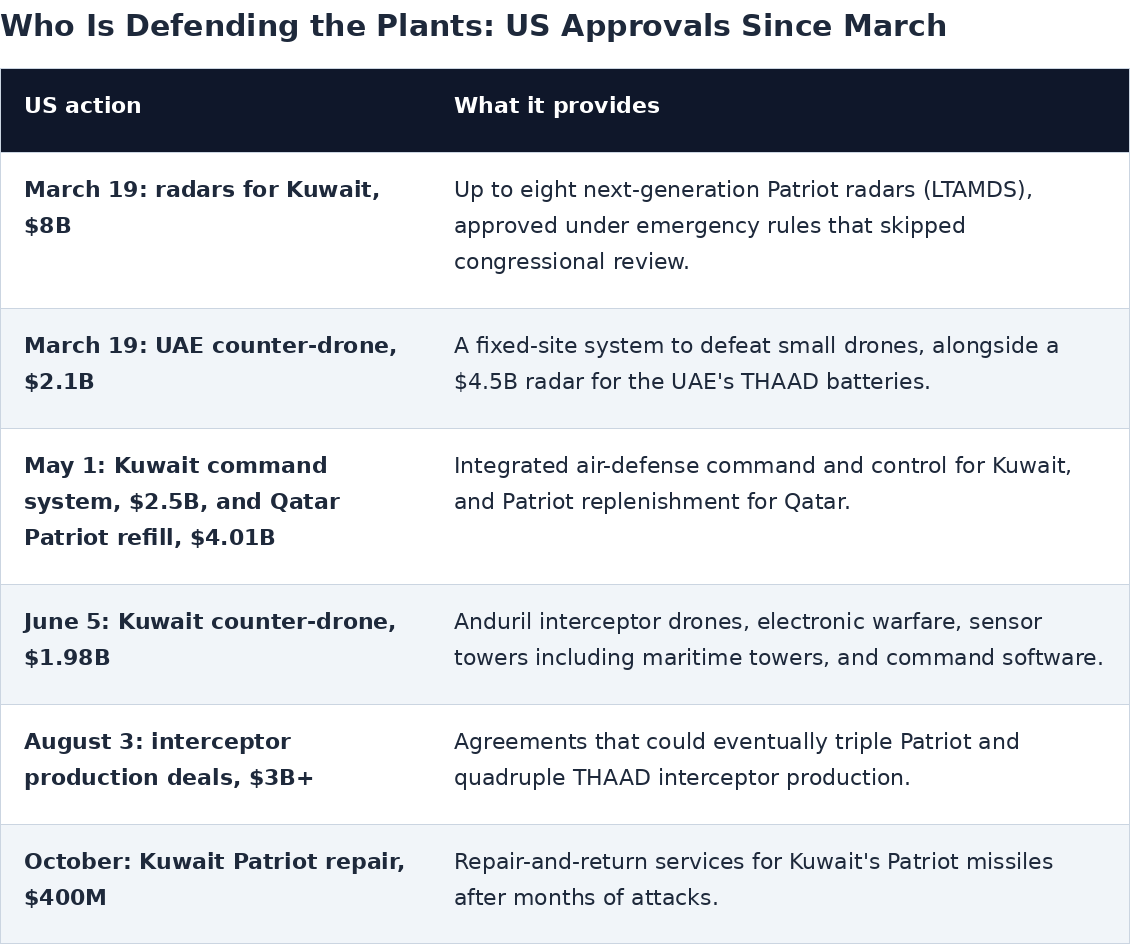
US protection has narrowed
Rationed interceptors. US commanders fire only at weapons predicted to hit US forces, key facilities or allies, and let others through to conserve stocks.
Depleted magazines. CSIS estimates US Patriot interceptors fell from 2,330 to fewer than 850 by the end of July, and THAAD interceptors from 452 to about 250.
Assets moved out. After fighting resumed in July, US assets were moved from exposed Gulf bases to hardened sites in Israel.
Planned drawdown. Senior Pentagon officials want to scale back troops in several Gulf countries and shift more of the defense burden to regional partners.
What happened at the plants
Hours after the April ceasefire was announced, 28 Iranian drones caused serious damage to Kuwaiti oil facilities, power stations and desalination plants. After fighting resumed in July, Kuwait reported strikes on its power and desalination plants for four nights in a row. Air defenses and other measures appear to have prevented worse outcomes, but it is unclear whether they could hold against a sustained campaign aimed at specific plants. Some Gulf governments have placed their own missile batteries around their largest plants. Gulf states are also seeking cheaper drone interceptors from Ukraine and the United Kingdom, partly out of frustration with delays in US deliveries.
Assessment. The burden of defending Gulf water is shifting from Washington to Gulf governments whose own interceptor stocks are depleted. That keeps the plants exposed, and it gives Gulf leaders a strong, continuing reason to press the United States against escalation.
9. Why Iran has not gone all out
Iran has struck Gulf desalination plants, but it has not launched the overwhelming, concentrated campaign that could collapse a Gulf state's water supply. It has held back even as the US naval blockade strangles its economy and its neighbors keep exporting oil. Some of that oil still moves through Hormuz, where crude flows were about 74 percent of prewar levels in early October. The rest leaves from the Gulf of Oman coast and the Red Sea, which kept total Middle East exports near normal. No Iranian official has publicly explained this restraint. The reasons below are this paper's assessment, built from the record.
The threat is doing the work. Iran's warnings have been conditional: it will hit Gulf oil, power and water if the United States launches new strikes. Gulf leaders then pressed Washington, the August strikes were called off, and further strikes are now paused until after the midterms. Destroying the plants would remove the Gulf's reason to restrain Washington and would more likely push Gulf states to back escalation.
Each side holds the other's civilians hostage. Iran's own water depends on a power grid that has already lost about 4,200 megawatts, during a severe drought. A mass-casualty attack on Gulf water would very likely bring a US campaign against that grid, with broad international backing.
It is choosing calibrated hits. As one Leiden University scholar put it, Iran's strategy is to impose economic costs through Gulf energy infrastructure, and if it wanted to bomb the desalination plants, "they could easily do it, but that would be very escalatory." Repeated strikes on Kuwait, which hosts US bases, look like signals rather than an attempt to collapse a country.
It is answering the blockade at sea. At least 10 ships were struck in a single recent week, and Hormuz traffic has fallen far below its 2025 baseline of about 138 vessels a day. That puts pressure on world oil prices and on Washington directly, at much lower political cost than killing civilians.
It is saving and rebuilding its arsenal. Iran has resumed missile production from stockpiled components, but output remains below prewar levels. A truly overwhelming salvo would spend missiles it needs to deter a renewed US and Israeli campaign. The pause gives it time to rebuild.
Diplomacy is still open. Iran is negotiating with Oman over control of shipping through Hormuz. Wrecking Gulf water would destroy the neighbors it needs as mediators and future trading partners.
Why the calculation could flip
The blockade is biting hard. Iran's crude exports fell to zero in September, its oil stored on tankers at sea was used up by mid-October, and there are reports that it is struggling to pay troops and pensions. Restraint makes sense while Tehran has time and money. If the leadership comes to believe the blockade threatens its survival, and that US strikes are coming after the midterms anyway, the water card stops being a threat to preserve. It becomes a tool of last resort.
Assessment. Iran's ability to dry up Gulf taps is worth more to it as a threat than as an attack. That logic holds only while Tehran believes restraint still buys it something. The months after the US midterms, as the blockade deepens, are likely to be the most dangerous period yet for Gulf water.
10. Implications
For Gulf governments. The cheapest gains are storage, meaning aquifer reserves where the geology allows; spare transformers, pumps and membranes held in-country; buried or protected trunk pipelines; and hardened water supply for hospitals and command centers.
For Washington. Any campaign against Iran's grid has to be planned together with Gulf water defense and emergency supply, or it hands Tehran its strongest counter-move.
For markets. A successful strike campaign on Gulf water would be a population-displacement event, not just an oil event. It would affect labor, real estate, sovereign wealth flows and the region's role as an AI and data-center hub.
What to watch. Kuwaiti ministry statements on damaged units, actual deliveries of approved Gulf air-defense sales, Iranian drone production, signs of regime financial distress under the blockade, and post-midterm US decisions on grid targeting.
Method and limits. This paper draws on public reporting, think-tank analysis and engineering sources available as of October 26, 2026, including CSIS, JINSA, the Atlantic Council, the US Army Corps of Engineers, the International Desalination Association, the Sphere standards, Reuters, AP, the Financial Times and US State Department notices. Plant counts, supply shares and storage figures use different years and measures. Where this paper gives its own estimates or assessments, it says so. It does not forecast attack probabilities or establish the intent of any government. Statements attributed to officials and heads of state are drawn from published reporting rather than independently verified. This is strategic analysis, not investment advice.