
The 25-Year Small Public Company Descent to Hell


How market structure shifted small-company capital from growth investors to predatory financiers. Market structure analysis. History, mechanism, the large trading firms, return and dilution evidence, and the way forward. There is hope.
Summary
Over the past 10 to 15 years, the smallest US public companies and OTC-traded companies have trailed the S&P 500 by a wide and widening margin. The public price and share-count record shows a clear pattern. The companies that collapsed are overwhelmingly the ones that issued shares in extreme amounts, while companies that raised capital moderately did well. That pattern is what the predatory-financing explanation predicts, and it is difficult to explain otherwise.
The record points to a market structure that, through nearly three decades of FINRA, Nasdaq and SEC changes, from the 1997 Nasdaq listing standards to the 2025 delisting rules, removed the small brokers who once underwrote and supported growth companies, and left those companies dependent on discounted convertibles, equity lines, at-the-market programs and serial discounted offerings. The same structure gave the providers of that capital the means to short the stock ahead of, and hedged by, the very shares they would receive.
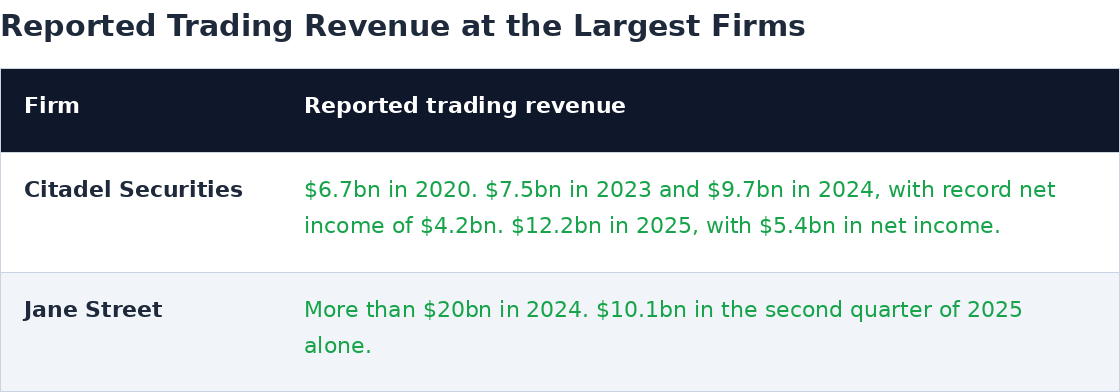
At the same time, market making in small and OTC stocks consolidated into a few very large trading firms, including Citadel Securities, Virtu and Jane Street, whose revenues grew to record levels as small-company returns fell further behind. Citadel Securities is under common control with one of the largest hedge funds, creating a structure in which the same ownership group can be long the largest stocks while its market-making arm holds the exemptions that make shorting small stocks easier.
1. The full history: how the field was tilted, 1997 to 2026
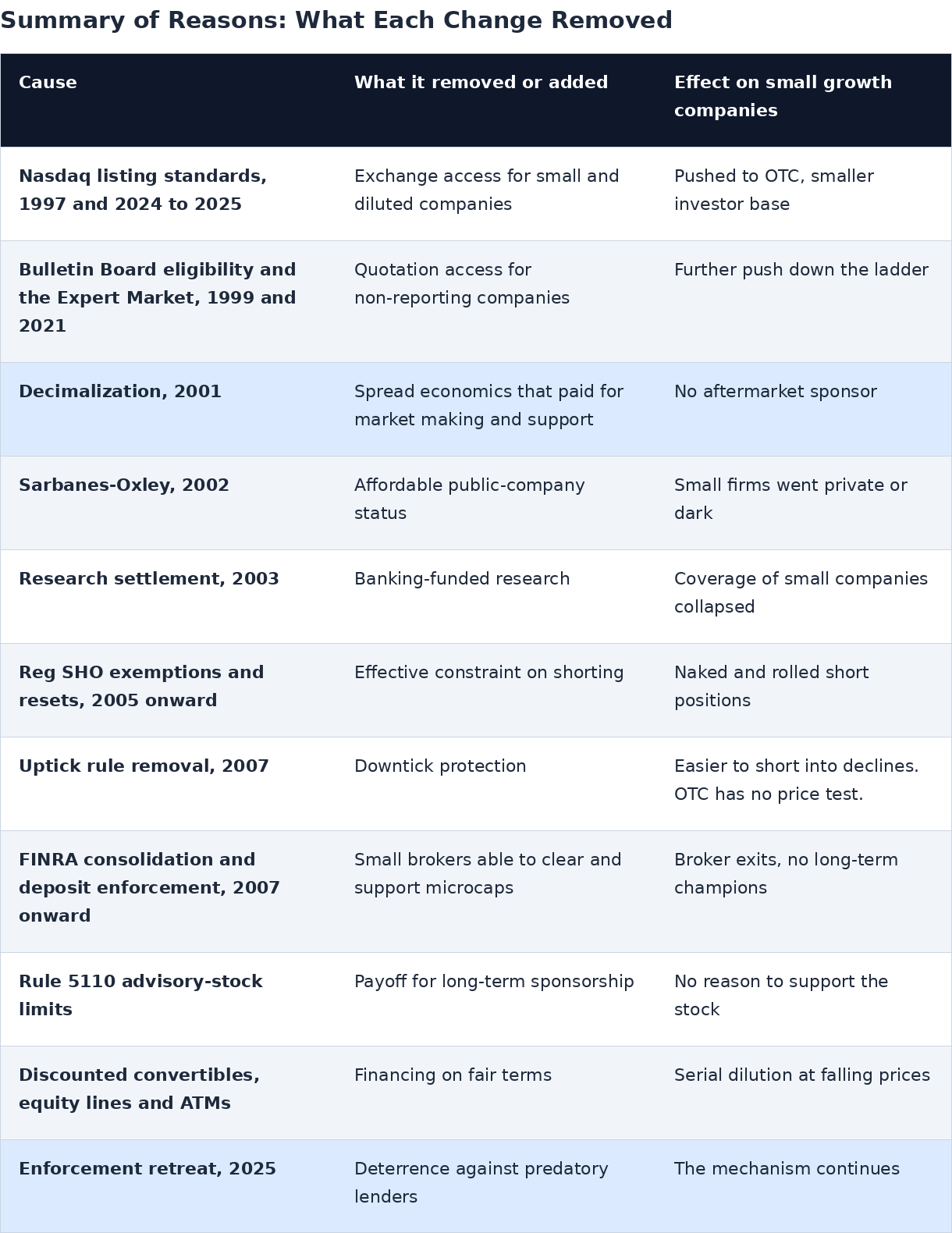
The decline of the small growth company as a public investment did not come from one rule. It came from a sequence of changes, each defensible on its own terms, that together removed the economics, the intermediaries and the protections that once supported small companies, while leaving intact, and in some cases enlarging, the tools available to financiers who profit from their distress.
Era 1, 1997 to 2000: small companies pushed off the exchange
Nasdaq raises the bar. The SEC approved tougher Nasdaq listing standards in August 1997, requiring a $35 million market cap, $2 million in net tangible assets and a $1 minimum bid. Nasdaq delisted 290 companies in 1997 and 593 in 1998, many of which moved to the OTC Bulletin Board.
The Pink Sheets change hands. Cromwell Coulson's investor group bought the National Quotation Bureau, operator of the Pink Sheets, on April 14, 1997.
The Bulletin Board eligibility rule. Bulletin Board companies were required to file current reports with the SEC or their bank or insurance regulators, fully phased in by June 2000. Companies that did not comply were pushed down to the Pink Sheets.
Why this mattered: every step down the ladder reduced the pool of investors and brokers allowed or willing to own the stock, and raised the company's dependence on whoever would still finance it.
Era 2, 2001 to 2003: the economics that supported small companies removed
Decimalization. Quoting moved from fractions to pennies in 2001. Narrower spreads reduced the profit in making a market, especially in smaller companies, which in turn discouraged firms from providing analyst coverage and reduced demand for the stock. For most small-cap stocks, the trading spread fell from $0.25 to $0.01 a share, a loss of 96 percent of the economics that paid for capital commitment and aftermarket support.
Small IPOs collapse. There were 2,990 IPOs raising under $50 million from 1991 to 1997, and only 233 from 2001 to 2007, a 92 percent decrease.
Sarbanes-Oxley. Compliance costs fell disproportionately on small firms. The average cost of being public for companies under $1 billion in revenue rose $1.6 million, or 130 percent. Deregistrations jumped from 67 in 2002 to 198 in 2003, and the tendency of US public firms under $15 million to go private rose 53 percent in the first year.
The Global Research Analyst Settlement.Banning investment-banking compensation of analysts in 2003 left trading revenue as the only funding source, so research shifted to high-volume large caps and coverage of emerging growth companies fell. Two thirds of companies under $1 billion lost at least one sell-side analyst.
Why this mattered: decimalization and the research settlement together made it unprofitable for brokers to sponsor, research and support small companies. Without sponsors, small companies lost natural buyers, which made their prices easier to push down.
Era 3, 2005 to 2010: short-selling rules rewritten, regulation consolidated
Regulation SHO. The 2005 rule set a locate requirement, with an exemption for bona fide market makers, and a 13-settlement-day close-out for heavily failed stocks. Firms used the market-maker exemption while not making genuine markets, and used paired stock-and-options reset trades to restart the 13-day clock and rebuild short positions without borrowing, as described in Overstock v. Goldman and in the Hazan order.
Nasdaq SmallCap renamed. The SmallCap Market became the Nasdaq Capital Market in 2005.
Uptick rule eliminated. The 1938 rule that barred short sales on a downtick was removed in July 2007. Its 2010 replacement applies only after a stock falls 10 percent in a day, and applies to exchange-listed stocks, not OTC stocks.
FINRA created. NASD and NYSE member regulation merged into FINRA in July 2007, the single regulator of all securities firms dealing with the public. Its compliance regime, applied uniformly to firms of every size, fell hardest on small brokers.
OTC Markets reorganized. OTCQX launched in 2007, and the company became OTC Markets Group in January 2011.
Why this mattered: short selling became easier just as small companies lost their sponsors, and the protections against abusive shorting depended on rules that well-resourced firms could work around.
Era 4, 2010 to 2021: small brokers squeezed out, predatory financing fills the gap
Penny-stock deposits and clearing. FINRA directed firms to treat large deposits of thinly traded low-priced stock as a fraud red flag and to consider refusing restricted shares. Fines reached $16.5 million, and clearing firms banned physical penny-stock certificate deposits. Small brokers lost the ability to handle the stock of the companies they had financed.
Advisory stock restricted. Stock a broker receives around an offering counts as underwriting compensation under FINRA Rule 5110, locked up for 180 days, and advisory fees on offerings that do not close are treated as unreasonable. This removed the reason for a small broker to champion a company long term.
Small brokers disappear. FINRA broker-dealers fell from 5,392 in 2002 to 3,517 in 2019, with small firms accounting for over 97 percent of the 2013 to 2019 decline, and to 3,184 by the end of 2025.
The tick-size pilot. The SEC tested wider ticks for small companies beginning in 2016. Research found it improved small firms' investment efficiency, and that the gains reversed when the pilot ended in 2018. The pilot was not made permanent.
Predatory financing becomes the default.With underwriting and sponsorship squeezed out, surviving small brokers increasingly placed discounted convertibles, equity lines and at-the-market programs. The Eleventh Circuit in Keener upheld the SEC's position that discounted-convertible lenders who convert and resell in volume are unregistered dealers, and one group was alleged to have made $61 million this way.
Why this mattered: the brokers who could have supported a company's stock were regulated out of that role, and the remaining capital came from funds whose profit depends on issuing shares at a discount to a falling price.
Era 5, 2021 to 2026: quotation and listing rules accelerate the push down
Bulletin Board closed and the Expert Market opened. FINRA shut the Bulletin Board on November 8, 2021, and the amended SEC quotation rule moved 2,247 companies into the restricted Expert Market.
Reverse-split limits. Since October 7, 2024, a reverse split that causes another listing deficiency no longer cures a bid-price problem. Since January 2025, a company that falls below $1 within a year of any reverse split is delisted without a compliance period, and trading is suspended after 360 days of non-compliance even during an appeal.
Higher IPO thresholds. Companies listing on the Capital Market must now meet the public-float requirement solely with IPO proceeds, effectively requiring at least a $15 million raise under the equity standard. Nasdaq also proposed raising the net-income-standard float to $15 million and accelerating delisting for companies with listing deficiencies and under $5 million in market value.
OTCID. OTC Markets replaced Pink Current with the OTCID tier in 2025.
Enforcement retreat. The SEC dropped several unregistered-dealer cases against discounted-convertible lenders in May 2025 as a policy decision.
Why this mattered: a company diluted below $1 by a resetting convertible must reverse split to stay listed, and the 2024 to 2025 rules now delist it quickly if the price falls again. That moves it to the OTC market, where there is no short-sale price test and fewer natural buyers, and where the financing cycle can continue. The listing rules thereby complete the cycle the financing starts.
The cumulative result
US listed companies fell from 8,090 in 1996 to 4,102 in 2012. Small IPOs, the traditional route for growth companies, fell 92 percent. The small brokers that once took these companies public largely disappeared. And FINRA itself noted in 2025 that research budgets and coverage have diminished, and that coverage is especially valuable to small issuers.
2. The mechanism
One. The financing. A fund provides capital through a convertible that converts at a discount to the market price, an above-market warrant, an equity line or an at-the-market program. Research by Brophy, Ouimet and Sialm found that company stock bought by such funds through private placements fell 19.25 percent in the first year, against 0.35 percent when other investors bought them, and that short interest rose after the deals. Hillion and Vermaelen found that companies using discounted convertibles lost an average of 34 percent within a year, with 85 percent negative during a bull market.
Two. The hedged short. Margin rules treat a long convertible against a short in the same stock as an offset, with little or no maintenance margin under the FINRA 4210 interpretations, so clearing firms see the position as hedged. Under the short-sale rules, however, the holder does not own the stock until the convertible is tendered, and the sale must be marked short. The margin treatment gives cover to positions that require a locate.
Three. The naked component. The market-maker exemption has been used by firms that were not doing genuine market making, as in SEC v. Bell and in FINRA's 2023 findings. Locates have been granted after the available shares were used up, processed by email for prime brokerage clients outside the stock loan system, or skipped across tens of thousands of trades. And sales have been marked long when they were short: BTIG on over $250 million of a hedge fund's sales, Nomura by including foreign affiliates outside US oversight in its positions, UBS on likely tens of millions of orders from 2005 to 2010, and through foreign institutions' omnibus and sub-accounts.
Four. Rolling the position. Clearing firms must close out fails in heavily failed stocks after 13 consecutive settlement days. Firms have used paired stock-and-options reset trades to restart that clock and rebuild the short without borrowing.
Five. Covering with the financing. The short is covered with conversion shares or at a discounted secondary. Shorting before an offering and covering in it drew SEC charges against 23 firms in 2013, 19 in 2014 and 6 in 2015. One fund shorted ahead of 19 private placements using confidential placement-agent information, in SEC v. Deephaven. Another shorted after committing to invest, often without borrowing, through Canada, in SEC v. Langley. Another covered pre-registration shorts with placement shares, in SEC v. Shane.
Six. The repeat. Each lower price produces more shares on the next conversion or draw, which is the 17 to 28 fold share-count growth seen in the data.
Enforcement against discounted-convertible lenders as unregistered dealers was upheld in court by the Eleventh Circuit in Keener, but the SEC dropped several such cases in May 2025 as a policy decision.
3. Who makes the market now: the rise of the large trading firms
As the small brokers that once made markets in, researched and sponsored small companies disappeared, market making was absorbed by a few very large trading firms. Some are tied by ownership to hedge funds. This section sets out what the public record shows about that concentration and why the structure creates the incentive described in this paper: firms that make the markets in small companies may short them using the rules described above, while the same ownership groups hold long positions in the largest stocks.
Concentration
Citadel Securities executes about 35 percent of US-listed retail volume, according to the firm, and roughly a quarter of all US equity volume. Virtu Americas processes approximately 25 percent of retail market orders in the United States, according to the SEC. Virtu became that large by buying KCG Holdings for about $1.4 billion in July 2017. KCG was itself the 2012 combination of Knight Capital, a pioneer of electronic market making, and Getco. The deal made Virtu the second-largest player behind Citadel in a consolidating market, and Virtu's filings describe trading on the OTC marketplaces operated by OTC Markets Group. Jane Street is a proprietary trading firm that began in exchange-traded funds and expanded into high-frequency trading, with net trading revenue of more than $20 billion in 2024 and on pace for about $30 billion in 2025.
Together, Citadel Securities and Virtu alone handle roughly 60 percent of US retail order flow by these measures. In 2002 there were 5,392 FINRA broker-dealers. By the end of 2025 there were 3,184, with small firms accounting for nearly all of the decline.
Common ownership of market maker and hedge fund
Ken Griffin founded both Citadel, the hedge fund, and Citadel Securities, the market maker. Citadel Securities became a separate entity in 2012. Griffin is its non-executive chairman and owns at least 75 percent of it, and a 2026 SEC filing made jointly by the two groups says he owns a controlling interest in the general partner of each. The hedge fund manages about $68 billion. The two firms describe themselves as separate, with separate management, and Citadel Securities' president says the market maker does not have the hedge fund as a client.
Why the structure matters: a hedge fund and a market maker under common control can, in combination, be long the largest stocks, which have benefited from buybacks and index inflows, while the market-making side holds the exemptions and the order-flow visibility that make shorting small, thinly traded stocks easier. Separate legal entities and information barriers are meant to prevent this. Whether they work depends on enforcement, and the record shows they have failed before.
The enforcement record of the largest market makers
Citadel Securities, short-sale marking, 2023. The SEC found Citadel Securities incorrectly marked an estimated millions of orders over five years, labeling certain short sales as long sales and the reverse, and provided the inaccurate data to regulators, including the SEC. It paid a $7 million penalty. The firm attributed this to a coding error. Mismarking short sales as long is the same mechanism described in Section 2.
Citadel Securities, OTC stocks, 2020. FINRA found that from 2012 to 2014 Citadel Securities' OTC desk traded for its own account while delaying client orders in the same OTC stocks. It paid $700,000 plus restitution. In a sample review, it traded ahead of 415 inactive OTC customer orders in 559 instances.
Virtu, information barriers, 2023 to 2025.The SEC charged that from January 2018 to April 2019, Virtu's proprietary traders could access customers' names, securities, sides, prices and volumes through a widely shared generic username and password, while Virtu told customers it maintained information barriers. Virtu paid $2.5 million without admitting or denying the allegations.
Jane Street, India, 2025. India's securities regulator barred Jane Street from its market and impounded about $567 million, alleging that it bought index constituents in the cash and futures markets to support the index while simultaneously building large short positions in index options. Jane Street disputes the findings. The alleged pattern, propping up one market while profiting from a short position in a linked market, is the cross-market strategy this section describes.
What this section establishes
Market making in small and OTC stocks moved from many small brokers to a few very large firms. At least one of those firms is under common control with one of the largest hedge funds. Each of the three firms named has faced regulatory findings or allegations involving short-sale marking, use of customer information, trading ahead of customers in OTC stocks, or cross-market positioning. And the price evidence below shows the outcome such a structure would produce.
No public regulatory finding to date states that these firms used the market-maker exemption to short small companies on behalf of affiliated or large hedge-fund clients. Establishing that would require regulators' consolidated audit trail data, which records the identity of the account behind each order, across both the market-making and fund entities.
4. The return gap
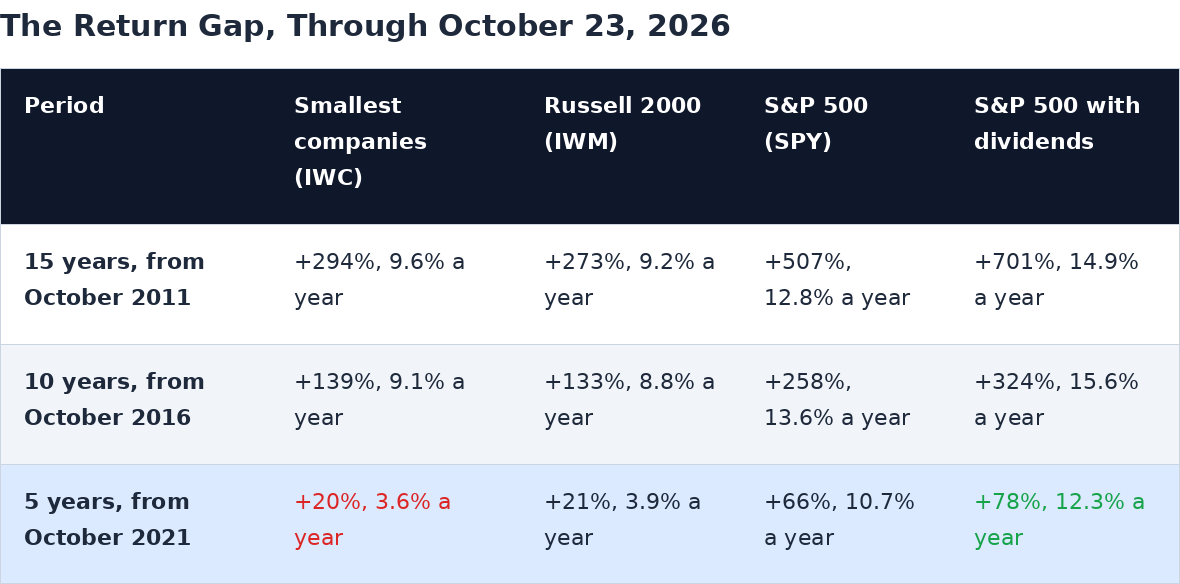
The gap has widened, from about 3 to 4 points a year over 10 and 15 years to about 7 points a year over the last five.
On the OTC side, the OTCQX Composite, OTC Markets' top tier measured on a total-return basis, started at 1,000 on September 1, 2014 and stood at 2,337.69 on October 22, 2026, a gain of 134 percent or 7.2 percent a year. The S&P 500 with dividends returned 372 percent, or 13.6 percent a year, over the same period. The lower OTCQB Venture tier has done worse, down 21.3 percent over one year in recent Edison Group research. Because companies that move up to Nasdaq or the NYSE leave the OTC indexes, OTC benchmarks lose their winners by design.
5. The dilution evidence: the price record verifies the mechanism
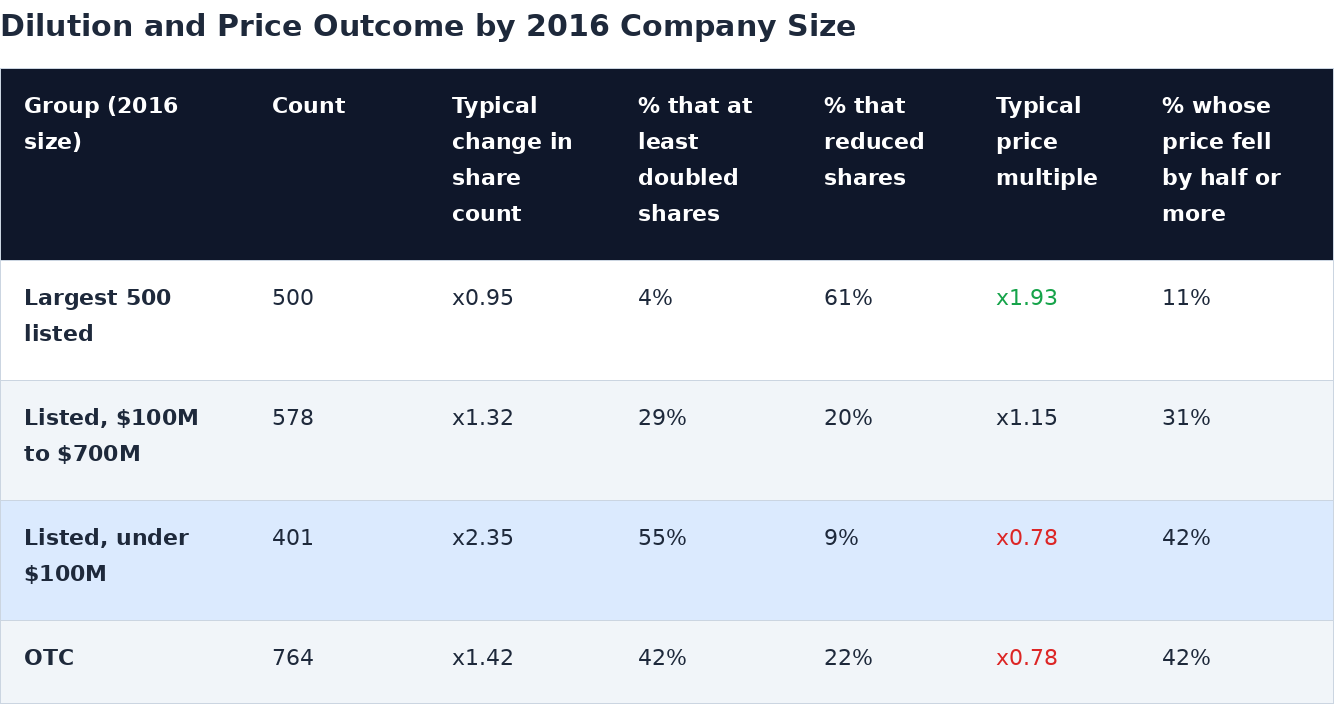
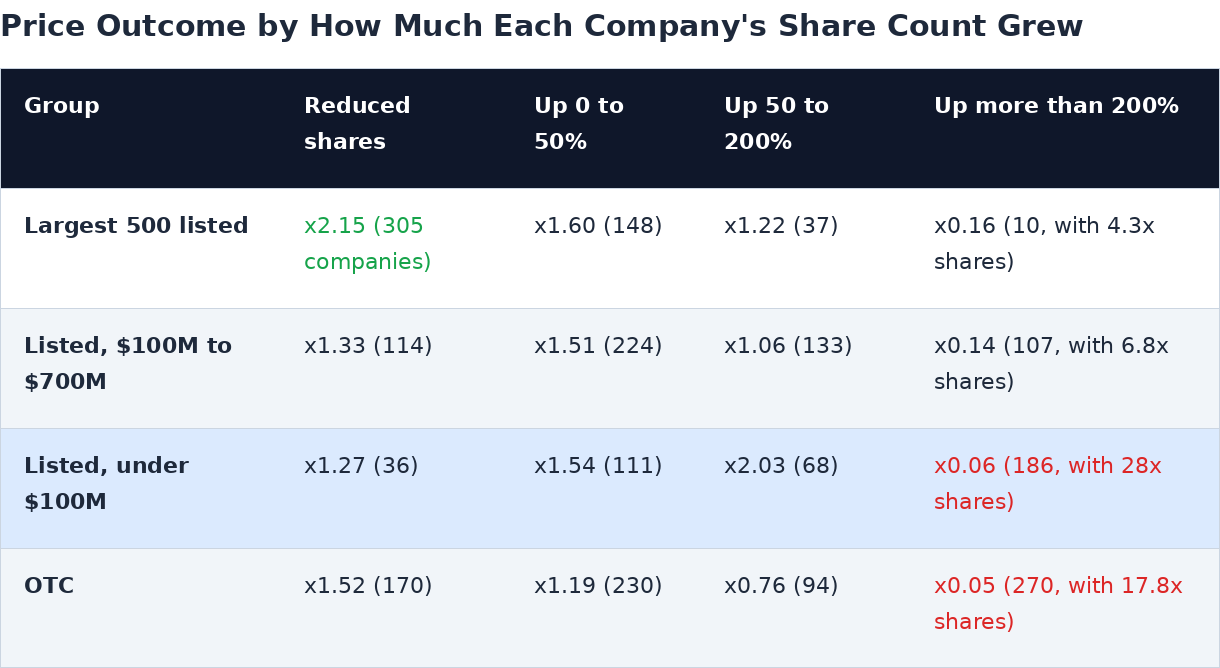
US companies were grouped by market capitalization at the end of 2016. Share counts were compared from fiscal 2016 to fiscal 2025, adjusted for splits and reverse splits. Prices were compared from December 30, 2016 to October 16, 2026. OTC means companies trading OTC today.
What the price evidence shows
The damage is in extreme dilution, not in raising capital. Small listed companies that roughly doubled their shares saw their price double. Small listed companies that multiplied their shares about 28 times lost about 94 percent per share. Ordinary growth financing does not produce that split. Repeated issuance at falling prices does.
The extreme cases are concentrated at the bottom. Nearly half of the listed companies under $100 million, 186 of 401, and over a third of OTC companies, 270 of 764, more than tripled their share counts. Among the largest 500, only 10 did.
The share multiples have the signature of resetting convertibles and equity lines. A 17 to 28 fold increase in shares outstanding combined with a 94 to 95 percent price decline is what happens when conversion and issuance prices reset lower as the stock falls, so each round delivers more shares than the last.
The largest companies are the mirror image. Most of the 500 largest cut their share counts through buybacks, and those that did saw their price rise to 2.15 times.
The numbers understate the effect. Only companies still trading with reports for both years are included. Companies that were diluted into bankruptcy or stopped trading, the most likely victims, are not in the data.
Taken together, the price and share-count record probably verifies the mechanism described in Section 2. It is the outcome that mechanism predicts, at the scale it predicts, in the part of the market where it operates.
6. Conclusion
Across nearly three decades, listing, quotation, trading and broker rules removed the economics and the intermediaries that once supported small growth companies, and left them dependent on financiers who profit from their distress, while market making consolidated into a few very large firms, at least one under common control with a major hedge fund. Every step of the financing mechanism appears in enforcement records, and the public price and share-count data show the outcome that mechanism produces: per-share collapse concentrated among the smallest companies that issued shares in extreme amounts, while moderate issuers and buyback companies prospered. Combined with listing and broker rules that removed the small brokers who once sponsored growth companies, the record supports the conclusion that FINRA and Nasdaq policy tilted the small-company capital market away from long-term growth investors and toward financiers who profit from issuer distress.
Many small companies are also unprofitable, about 40 percent of the Russell 2000 against about 6 percent of the S&P 500. Those companies need outside capital, which places them inside this financing system. Order-level confirmation of specific firms' conduct would require regulators' consolidated audit trail data, order-marking records and locate logs.
7. There is hope
The tilt described in this paper is real, but it is not permanent. The same forces that hollowed out small-company support, technology and the economics of scale, now make it possible to rebuild that support at a fraction of its former cost.
People who understand the plumbing. The mechanisms described above work because few people outside the largest firms understand how clearing, locates, delivery failures, order marking and the 13-day close-out actually operate. Individuals and boutique firms with direct back-office experience can now put that knowledge at the service of small companies: identifying when a stock is being sold short without borrowed shares, when delivery failures are building, when financing terms invite abuse, and when to escalate to regulators.
Research that companies can afford.Decimalization and the 2003 research settlement removed the economics that paid for small-company research, and FINRA itself acknowledged in 2025 that research coverage has diminished and is especially valuable to small issuers. AI changes that. Strong research reports can now be produced affordably, written for different audiences, from retail investors to institutions to industry specialists, and in many languages, reaching investor bases that small companies could never reach before. Paid research must disclose who paid for it, and well-documented, transparent research is the strongest answer to a short campaign.
Structures that fight back. Financing and shareholder structures designed by people who understand the plumbing can offset the naked short. Examples include convertibles and warrants with price floors that remove the incentive to drive the stock down, limits on lending of company shares, shareholders registering shares directly in their own names so they cannot be lent, and continuous monitoring of delivery failures and short-sale data. Each of these shifts the economics back toward long-term holders.
Companies defending themselves. The common thread is that small companies no longer have to wait for a sponsor that is not coming back. With the right advisers and tools, they can defend themselves.
Entrepreneurs fill the vacuum. In a capitalist system, a vacuum created by regulation that did not anticipate its unintended consequences does not stay empty for long. The small brokers, analysts and market makers that once supported growth companies were regulated out. Entrepreneurial individuals and boutique firms, equipped with AI and deep knowledge of market mechanics, are now positioned to take their place.
A companion paper will describe these efforts in detail: the people and firms involved, the research model, the defensive structures, and how they can be deployed within the rules.
Method notes
Returns use monthly ETF closes for October 31, 2011, October 31, 2016 and October 29, 2021 through October 23, 2026, with the S&P 500 Total Return Index for dividend-inclusive figures.
The dilution test covers US companies on the NYSE, Nasdaq, NYSE American and OTC with fiscal 2016 and fiscal 2025 annual reports and prices on both dates. The 2016 market cap is fiscal 2016 weighted average shares multiplied by the December 30, 2016 close. Share counts and prices are split-adjusted, and medians are reported.
Sources
Regulatory and legal: FINRA Notices 97-83, 21-03, 21-38 and 25-06; FINRA Rule 5110; FINRA Rule 4210 interpretations; FINRA 2015 disciplinary actions; FINRA 2017 and 2023 examination findings; FINRA industry snapshot; SEC OTC Bulletin Board eligibility guidance; SEC Regulation SHO staff FAQs; SEC 2010 short-sale final rule; SEC NASD and NYSE consolidation release; SEC tick-size pilot release; SEC press releases of 2013, 2014 and 2015 on shorting ahead of offerings; SEC orders and litigation releases in SEC v. Bell, SEC v. Deephaven, SEC v. Langley, SEC v. Shane, the Hazan order, the BTIG matter, the Citadel Securities short-sale marking order and the Virtu information-barriers matter; Overstock v. Goldman; the Eleventh Circuit decision in Keener; Nasdaq listing releases and proposals; OTC Markets rule and tier notices.
Research and commentary: RAND; Richmond Fed; Wharton; Columbia Law; Harvard Kennedy School; Latham & Watkins; Skadden; Cooley; Morgan Lewis; Harter Secrest & Emery; Carleton Law; Securities Lawyer 101; Practical Law; Financial Poise; IR Impact; SSRN research on the tick-size pilot; Brophy, Ouimet and Sialm on private placements; Hillion and Vermaelen on discounted convertibles; Apollo and Voronoi on unprofitable companies.
Press and market data: Bloomberg; Bloomberg Law; Reuters; CNBC; CNBC TV18; The New Yorker; Fox Business; FX News Group; Securities Finance Times; FinanceFeeds; Economic Times; Forbes; PR Newswire; GlobeNewswire; EDN; Markets Media; Better Markets; Edison Group; OTC Markets Group index rules and data; Citadel Securities and Virtu company disclosures; price data for SPY, IWM, IWC and the S&P 500 Total Return Index.
This paper is market-structure analysis and opinion. It is not investment, legal or tax advice, and it is not a recommendation or solicitation to buy or sell any security. Statements about named firms are drawn from public regulatory findings, court filings, company disclosures and press reporting as cited above, and are characterized here in the authors' words. Where a firm has disputed a finding or settled without admitting or denying allegations, the text says so. No public regulatory finding to date establishes that any firm named here used the market-maker exemption to short small companies on behalf of affiliated or hedge-fund clients, and nothing in this paper should be read as asserting that it did. The dilution and return analysis is the authors' own work on public data, the groupings and medians are the authors' choices, and the conclusions drawn from them are the authors' interpretation rather than demonstrated causation.