AI's Trillion-Dollar Test: Who Pays, and Who Profits?

Anthropic's IPO and Meta's $95 billion financing plan put the same question before public investors: can AI turn extraordinary demand into durable cash returns, or will shareholders keep funding the buildout? AI capital markets.
In 2000, Lucent Technologies described its $2 billion financing package for Winstar Communications as more than a loan. It was a "long-term strategic relationship." Winstar used the money to buy Lucent's equipment, Lucent booked the sales, and the arrangement looked like proof of demand. When Winstar collapsed in April 2001, analysts estimated it owed Lucent more than $800 million.
Lucent was not alone. Vendor financing across the telecom equipment industry peaked at $25 billion to $30 billion in 2000. By the end of 2001, 80 percent of Nortel's customer loans had gone bad, up from 25.5 percent a year earlier. Nortel, valued at $136 billion in December 1999, was worth $14 billion by April 2002.
That history is the right lens for today, not because the AI buildout is a replay of the telecom bust, but because the question it raises is the same: when suppliers finance their customers, how much of the demand is self-funding?
On a single Monday, that question moved from private rounds to public markets. Anthropic made its S-1 public, opening the books on one of the largest IPOs ever attempted. Hours earlier, Meta launched its largest equity raise ever, a plan of up to $95 billion, with Nvidia, AMD and Broadcom lining up to buy $5 billion of the stock. The same two banks, Goldman Sachs and Morgan Stanley, lead both deals.
The investment debate is shifting. The question is no longer whether AI attracts customers, since both companies offered strong evidence that it does. The question is whether that demand will produce enough cash to justify the infrastructure commitments, financing costs and dilution required to serve it. The scarce resource is becoming capital.
Anthropic Opens the Books
Anthropic filed to list Class A shares on the Nasdaq Global Select Market under ANT, with Goldman Sachs and Morgan Stanley leading a syndicate of 22 banks. The filing leaves the price range and share count blank. Marketing could begin as soon as the week of November 9, with trading targeted for the week of November 16, though the timing could shift.
The growth is unlike anything public investors have underwritten at this scale. Revenue reached $16.3 billion in the first half, roughly 13.5 times the prior-year period, after about $4.6 billion for all of 2025. International revenue alone was $4.5 billion, more than 13 times a year earlier. Headcount rose to 5,300 from 940 at the end of 2024, and revenue per employee reached $6.6 million over the trailing twelve months. Anthropic says more than 90 percent of September contributions to its own codebase were written by Claude.
The customer base has broadened well beyond a handful of large buyers. As of September 30, Anthropic counted more than 11,900 enterprise customers generating at least $100,000 in trailing revenue, more than 1,900 above $1 million and roughly 250 above $10 million.
The headline loss is mostly accounting
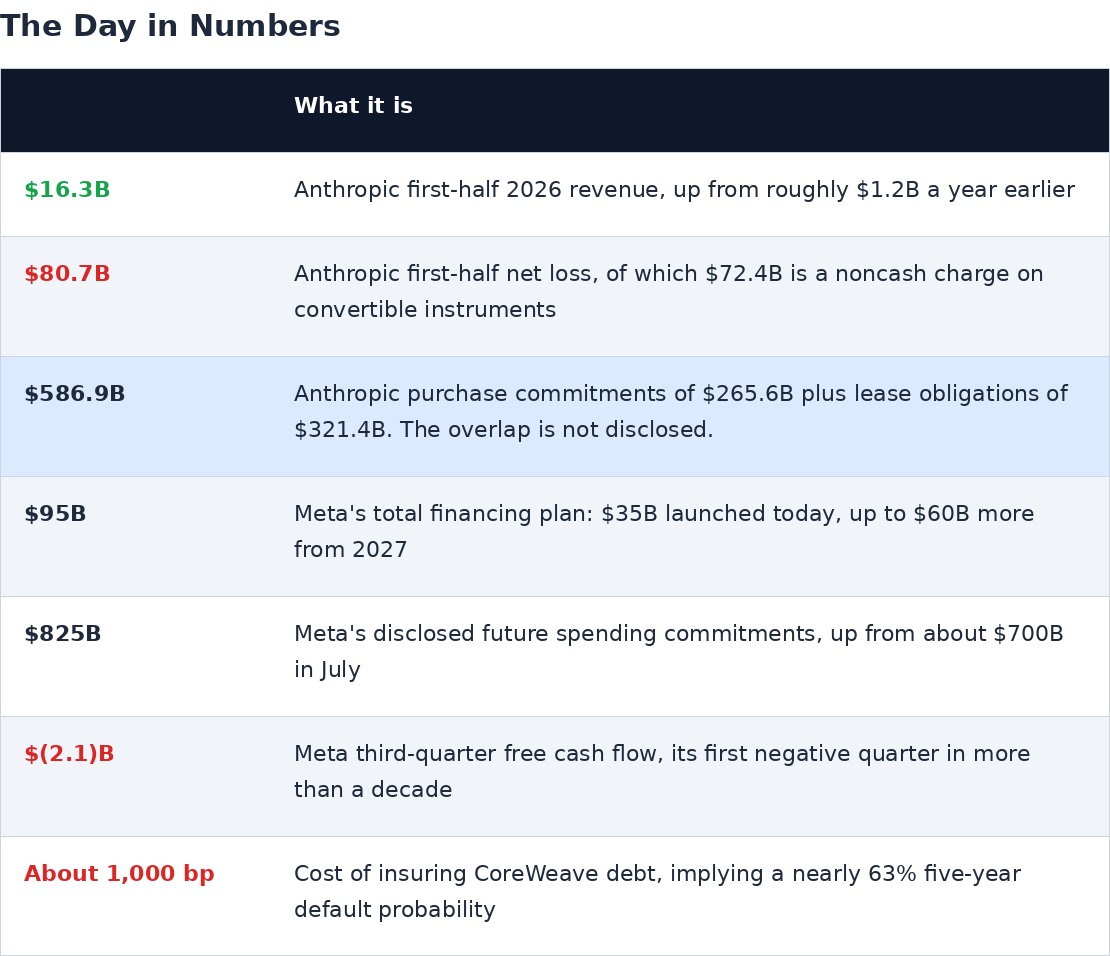
The number that will travel fastest is the $80.7 billion first-half net loss, one of the largest half-year losses any company has recorded. About $72.4 billion of it is a noncash charge reflecting the rising fair value of convertible notes and related instruments as Anthropic's valuation climbed. The operating loss was $693 million, narrowed from $2.1 billion a year earlier.
The charge is not cash spent, but it is not meaningless either. It measures how much value the company transferred to early holders of convertible paper as its private marks soared. That value arrives as dilution when those instruments convert.
The slowdown investors noticed
Two weeks before the filing, Anthropic told prospective investors that third-quarter revenue reached $16.8 billion, up 45 percent from the second quarter and profitable on an adjusted basis. Some attendees were disappointed, because sequential growth had exceeded 140 percent the prior quarter. Several investors began discussing a valuation near $1.5 trillion, down from the roughly $2 trillion previously expected.
The valuation depends on the denominator
Annualizing reported third-quarter revenue of $16.8 billion gives a run rate of about $67.2 billion. Against that base, the valuations in circulation imply the following multiples.
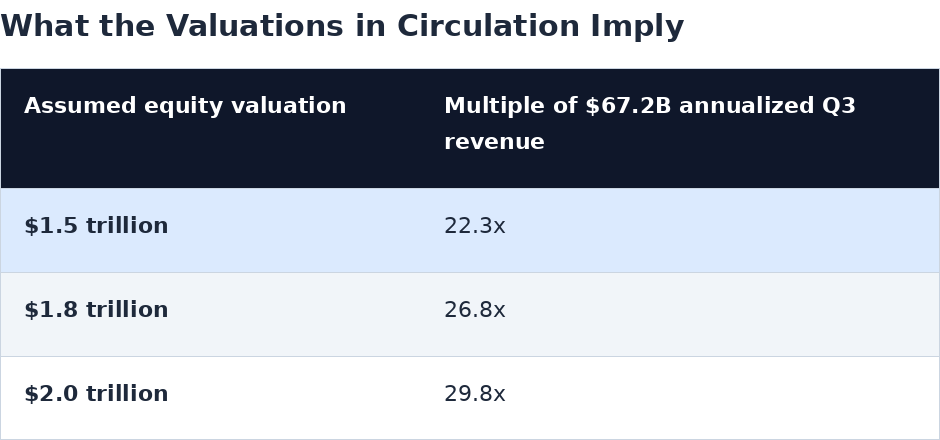
Microsoft trades near 11 times trailing enterprise value to revenue, which offers directional context only, since the bases differ. The more important point is that at any of these prices, investors are paying for years of growth that the third quarter's deceleration has already made less certain.
The Margin Is Real. The Interpretation Needs Work.
Before the filing, the 85 percent gross margin circulated mainly as a claim from private investor briefings. The S-1 confirms it: $16.29 billion of first-half revenue against $2.38 billion of cost of revenue. That is an extraordinary turn from an implied 12 percent gross margin a year earlier.
But the cost of reaching customers sits elsewhere. Sales, marketing and partnership costs rose 2,540 percent to $3.17 billion, the second-largest expense after compute. Of that, $2.7 billion was fees paid to channel partners. Nearly half of revenue, 48 percent, came through Amazon Web Services, Google Cloud and Microsoft Azure, which collect from customers and remit to Anthropic net of their fees.
The hyperscalers are paid twice: once for the compute Anthropic consumes, and again on the revenue they distribute.
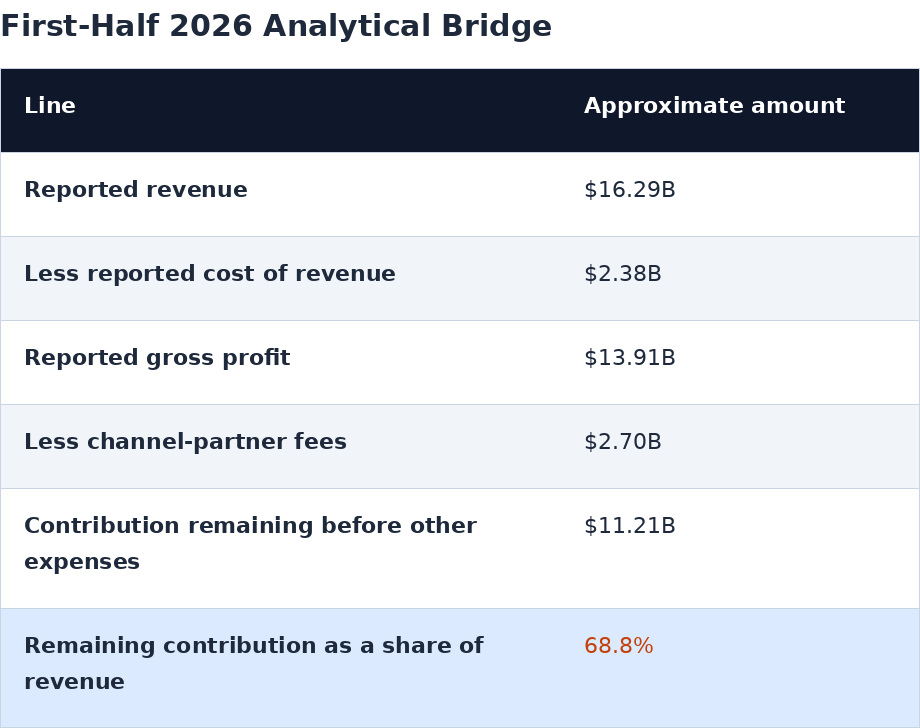
This is not an alternative GAAP measure and does not suggest improper accounting. It shows that distribution absorbs a meaningful share of gross profit before research, model training and personnel costs. An 85 percent gross margin and strong cash generation are related propositions. They are not interchangeable.
The Central Risk: Long Obligations, Variable Revenue
Anthropic's reported debt is modest: $6.2 billion of convertible notes held by Amazon. Its contracted obligations are not. Noncancelable purchase commitments rose to $265.6 billion at June 30 from $54.6 billion six months earlier. Future undiscounted lease obligations rose to $321.4 billion from $50.2 billion, with leases commencing between 2026 and 2028 and running up to 20 years. The filing does not reconcile the two categories, so they should not be added without caution.
The individual contracts show the scale. At least $110 billion is committed to Amazon for cloud services through April 2036, payable "regardless of actual usage," with a true-up if spending falls short. Up to $120.5 billion is committed to SpaceX for Nvidia-powered compute into 2029, about $3.1 billion a month once fully delivered, and Anthropic paid SpaceX just over $5 billion in the third quarter, equal to 34.5 percent of SpaceX's revenue. Broadcom-related lease arrangements total about $161.2 billion, mostly noncancelable.
Against those obligations, about 80 percent of first-half revenue, $13.1 billion, was consumption-based. Capacity is contracted years ahead, and revenue arrives as customers use it. If capacity comes online too early, usage disappoints or pricing compresses, the payments still come due.
The filing adds a risk most investors have not modeled: local opposition to data centers. Anthropic flagged existing and proposed construction moratoriums, which 16 states had formally weighed as of last month, as a threat to the facilities it depends on.
Meta: The Cash Machine Goes to Market
If Anthropic's filing is a test of whether public investors will fund a frontier lab, Meta's raise is the more surprising signal. One of the most profitable companies in history is now selling stock to pay for AI.
Last week's third-quarter report set the stage. Revenue rose 26 percent to $64.6 billion and beat estimates. But capital spending of $34.9 billion exceeded operating cash flow of $32.8 billion, producing negative free cash flow of $2.1 billion, the first in more than a decade. Meta disclosed about $825 billion of future spending commitments, up from roughly $700 billion in July, and created a new nonvoting Class C stock. Shares fell about 7 percent.
Today it used that tool. The structure is more nuanced than the headline.
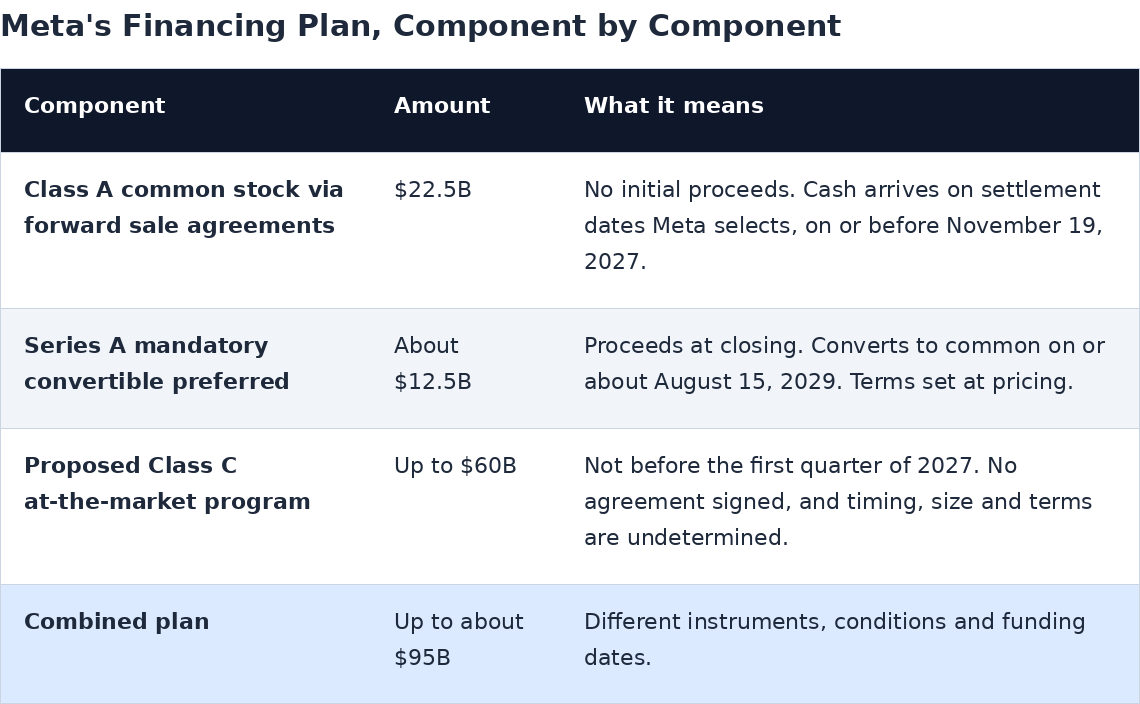
The market's verdict was conflicted. Meta shares fell as much as 4 percent early, then recovered to trade roughly flat, while Nvidia, AMD and Broadcom all rose. Meta still holds about $82 billion of cash and securities and generated $97 billion of operating cash flow in nine months, so this is not a rescue. But a company that spent the last decade buying back stock is now issuing it, and it built a nonvoting share class so it can keep doing so without diluting founder control.
The Real Connection: Suppliers as Investors
Here is where the Lucent comparison earns its place, and where it needs limits.
Nvidia, AMD and Broadcom indicated interest in buying up to $5 billion of Meta's common stock. The indications are nonbinding, and they may buy more, fewer or none. Meta is, in turn, one of the largest buyers of their chips.
Anthropic's version is larger. The Wall Street Journal reports that Google, Amazon and Broadcom have lined up $77 billion of additional financing for the company, each with its own conditions. The S-1 details the pieces. Amazon is offering up to $15 billion of financing in $5 billion tranches, each tied to compute-capacity milestones, from the same company Anthropic has committed $110 billion to. Google holds an option to buy up to $10 billion of stock at the IPO price, which would reduce the $20 billion of notes otherwise available to it.
The differences from 2000 matter. Lucent lent to unprofitable start-ups that could not get bank credit. Meta is a profitable, investment-grade company, and today's supplier positions are mostly equity rather than loans. Anthropic's customers are paying real money at scale.
The similarity also matters. When a supplier's capital funds a customer's purchases from that same supplier, reported demand and independently generated demand diverge. The relevant question is how much of the system's spending is ultimately paid for by end customers, and how much depends on the next financing round.
When suppliers finance customers, revenue can look like demand until the financing stops.
CoreWeave: The Warning Already on the Tape
Investors do not need to look back 25 years for a stress case. CoreWeave reported $2.58 billion of second-quarter revenue, up 112 percent, and a backlog of about $104 billion. It also reported a $626 million net loss and guided to $35 billion to $39 billion of 2026 capital spending.
This month, the debt market rendered its view. With about $50 billion of debt, CoreWeave's bonds fell to roughly 79 cents on the dollar, yields reached about 15 to 16 percent, and the cost of insuring its debt rose to around 1,000 basis points, implying a nearly 63 percent chance of default over five years. That happened despite a deal under which Nvidia will buy any unsold CoreWeave capacity through April 2032.
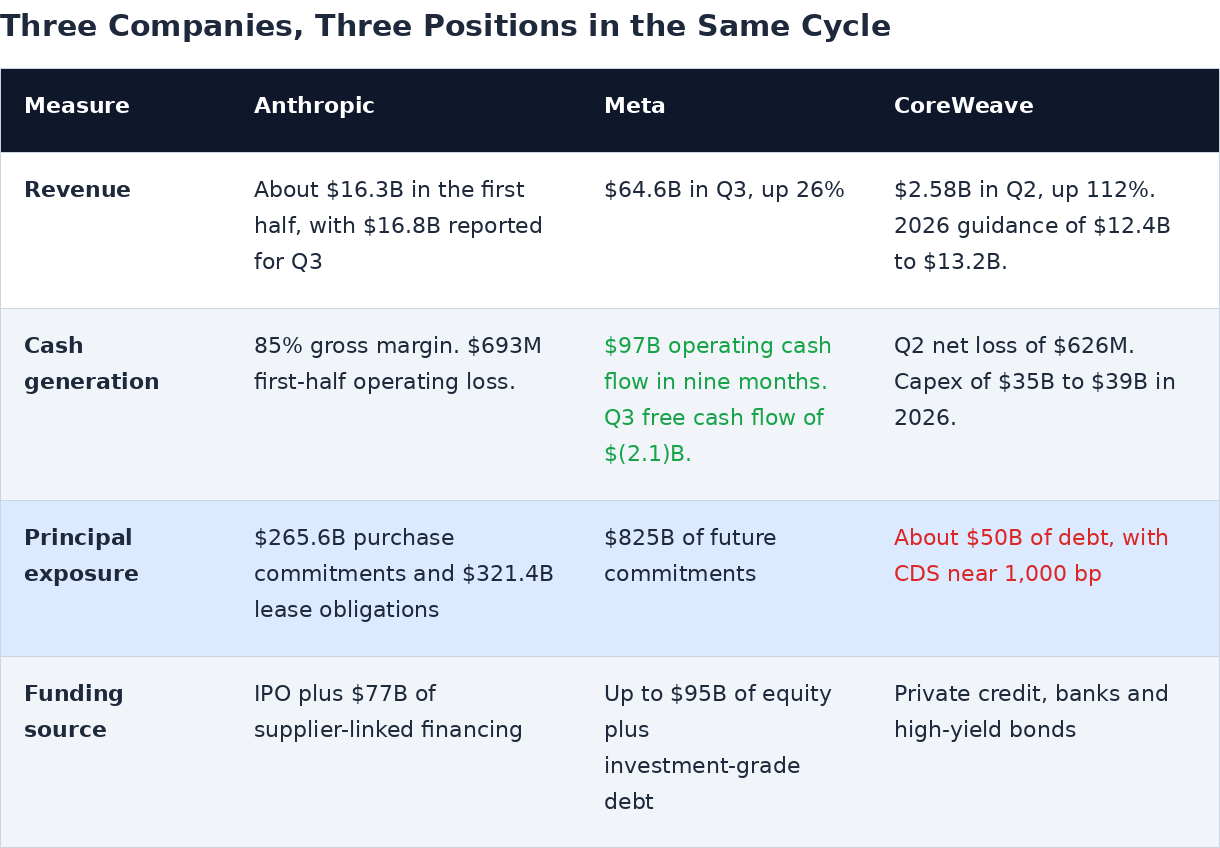
The lesson is not that Anthropic or Meta is another CoreWeave. It is that a large backlog and rapid growth did not protect CoreWeave's securities once investors questioned the financing behind them.
Is the Same-Day Timing a Coincidence?
Probably not in the sense of being random, and probably not in the sense of being coordinated either. Goldman Sachs and Morgan Stanley lead both transactions, as they led SpaceX's IPO. That overlap is notable, but nothing in the public record establishes a coordinated schedule.
The more useful reading is that both companies are drawing on the same pool of capital at the same moment, a week after CoreWeave's credit scare. That creates real competition for allocations. It also makes both deals a referendum: strong demand would reinforce confidence in AI financing, while steep discounts or weak books would challenge assumptions across the sector.
What Investors Should Watch Next
Anthropic
The price range and share count in the amended S-1, and whether the valuation lands nearer $1.5 trillion or $2 trillion.
Primary versus secondary shares, and how much new cash the company actually raises.
The annual payment schedule for compute and leases, not just aggregate totals.
Fourth-quarter revenue growth, after the third quarter's slowdown to 45 percent sequential growth.
Whether Google exercises its $10 billion option at the IPO price.
Meta
The final preferred dividend rate and conversion terms.
Actual purchases by Nvidia, AMD and Broadcom.
Fourth-quarter capital spending, which full-year guidance implies at $49 billion to $59 billion, a record quarter.
Whether the $60 billion at-the-market program is established, and how fast it is used.
The broader market
Whether independently generated customer cash increasingly funds the system, or whether each new round of infrastructure spending requires another round of outside financing.
Conclusion: AI Demand Is Real. The Returns Still Have to Be Earned.
Anthropic's IPO and Meta's financing plan point to the same transition: the AI boom is moving from a contest over technological leadership to a contest over who can finance expansion and earn an adequate return on it.
The same-day timing does not prove coordination. The stronger connection is structural. Companies are raising capital to buy infrastructure from suppliers that increasingly help finance their customers. Those relationships can accelerate adoption, but they also make the cycle more dependent on continued access to outside funding.
For Anthropic, the central risk is the combination of a premium valuation, consumption-driven revenue and long-duration infrastructure obligations. Strong adoption does not eliminate that mismatch. It raises the stakes for converting growth into durable cash generation.
Meta approaches the same cycle with a substantial operating cash engine, but it has crossed a line: its AI spending now exceeds what its business generates. Investors should not value an established cash generator, a frontier-model developer and a leveraged infrastructure provider as interchangeable AI exposures.
The investment thesis is not that AI demand is illusory. It is that demand alone cannot justify every valuation or financing structure. The decisive measure is self-funding: whether cash generated by end customers can increasingly support the system without repeated capital raises on favorable terms.
Lucent's customers were real too. What failed was the assumption that financing would always be there. AI can transform the economy while disappointing shareholders. The winners will be those that retain durable cash returns after paying for the infrastructure, distribution and financing that make their growth possible.
Sources
Company filings and announcements: Anthropic's S-1 announcement of October 26, 2026; Meta's offering announcement of the same date for the Series A mandatory convertible preferred and Class A common stock; Meta's third-quarter 2026 results; CoreWeave's second-quarter 2026 results.
Reporting: CNBC on the Anthropic IPO filing and on third-quarter revenue; Reuters on Anthropic's third-quarter growth, on Meta's equity raise, and on CoreWeave's debt burden and the AI credit scare; The Wall Street Journal on the $77 billion of supplier financing; Fortune and Yahoo Finance on the S-1 revenue and loss figures; Bloomberg via Business Standard and Reuters via The Hindu BusinessLine on the valuation reset; NPR, Quartz, The Next Web and Vector on the filing; Investing.com and Yahoo Finance on Meta's share reaction and spending; Multiples.vc for the Microsoft comparison.
Historical: Newsweek on telecom vendor financing; EDN on bad loans in communications equipment; American Affairs on the decline of Lucent and the US telecom equipment industry.
This analysis is for informational purposes only and is not investment advice or a recommendation to buy or sell any security. Anthropic's offering terms have not been set, and its registration statement is not yet effective. Anthropic's third-quarter figures come from press reports of an investor meeting and are distinguished from first-half S-1 disclosures. Meta's financing plan includes proposed, conditional and future transactions, and the full headline amount has not been raised. Valuation scenarios and analytical margin adjustments are illustrative and are neither company guidance nor GAAP measures. Historical comparisons are illustrative and do not imply similar outcomes. Figures are as reported on or before October 26, 2026.
The authors hold positions in securities mentioned and reserve the right to buy or sell shares at any time without notice.