The Market Maker Has Your Hand


How order flow agreements, not-held discretion, non-deal roadshows and rules nobody enforces let the trading firms see, and play against, every small company and its shareholders, and how to turn your cards face down. The 25-Year Small Public Company Descent to Hell, Part 3.
Summary
Part 1 traced a 25-year descent: rules that removed the small brokers, analysts and market makers that once supported growth companies, and the predatory financing that replaced them. Part 2 set out the answer: agentic AI in the hands of experienced market professionals, and two BCII products built to help small public companies climb out.
This report shows how the game is played at the table today. The firms that buy retail order flow see the cards of every retail investor and every small company before anyone else does, and the rules give them room to play those cards for themselves.
Order flow agreements send retail orders to a handful of wholesalers, who pay the most for orders in small stocks and, in the authors' experience, set private size limits found in no rule that take orders out of automatic protection.
Not-held discretion lets a firm, in the authors' experience, sell, cover, sell and cover again before it ever prints the client's trade, and print blocks at the day's low.
The non-deal roadshow tells every investor in the room that dilution is coming while the CEO is told no money is being raised.
ATMs and equity lines turn the company itself into a large not-held order, worked every day by the firm that sold it the deal.
Stop-loss orders sit in the flow the wholesaler already buys. The market maker does not need to see every card to know the hand.
Every one of these practices runs against a rule that is already written: Manning, front running, Regulation M, trade reporting. The money involved runs to billions of dollars a quarter. Fifteen years of the major public cases add up to about $150 million. The rules are on paper. In the authors' assessment, they are not being enforced.
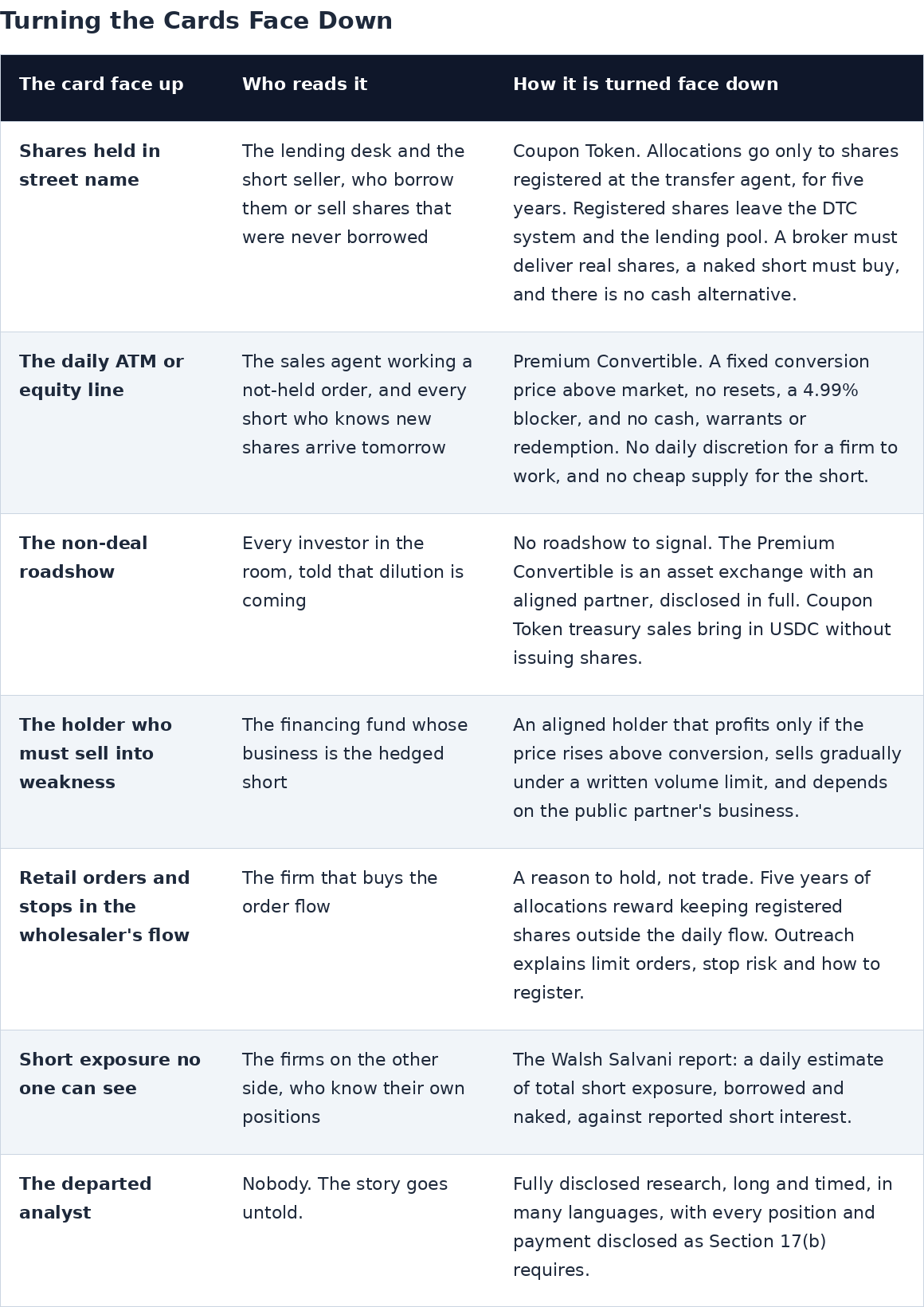
No regulator is coming to turn the cards over. A company can do it itself. The second half of this report shows how BCII's two products and the Walsh Salvani report take each card the trading firms can read and turn it face down, protecting the company's share count, its float and its market value.
1. Where Part 2 left off
Part 2 closed with the Walsh Salvani True Naked and Borrowed Short Report, a daily tool that reconciles public short-sale, delivery-failure, borrow and volume data into an estimate of total short exposure. A tool like that matters because the abuses below are designed not to show up in the numbers regulators publish. Each section that follows names a practice, the rule it runs against, the grey area that lets it continue, and what the public record shows.
2. The table and who sees the cards
Retail brokers that advertise commission-free trading are paid by the wholesalers that execute their customers' orders. Robinhood tells its customers that market centers pay it "a fixed percentage of the spread" between the national best bid and offer for equity orders. Its transaction-based revenue reached $2.63 billion in 2025, and its annual report lists reliance on transaction-based revenue, including payment for order flow, and "new regulation or bans on PFOF" among its risks.
The brokers' own order-routing reports show who buys the flow and what it is worth. Webull's report for the fourth quarter of 2025 is one example.
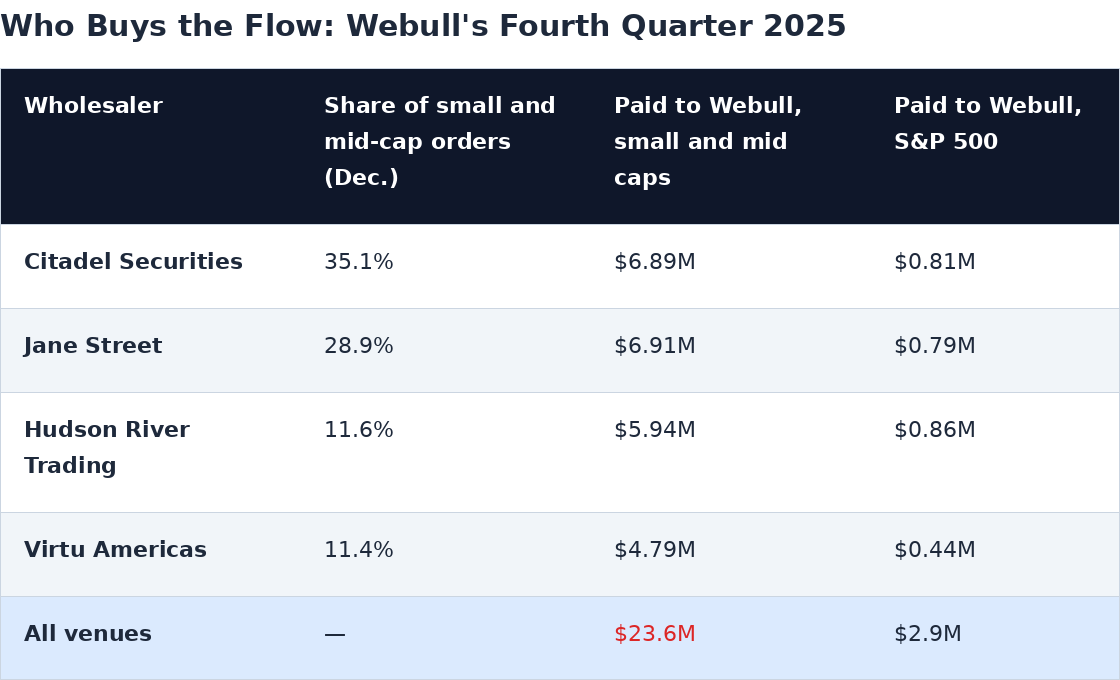
In one quarter, at one broker, the wholesalers paid about eight times as much for orders in smaller companies as for orders in the S&P 500. Four firms took more than 85 percent of those orders. That is the table. Retail orders in small companies are the most valuable flow in the market, because, in the authors' view, they are the easiest to trade against.
The record already shows what can happen. In 2020 Robinhood paid a $65 million penalty after the SEC found it had misled customers about payment for order flow. The SEC found its customers' orders were filled at prices that cost them $34.1 million even after the commission savings. "Brokerage firms cannot mislead customers about order execution quality," the SEC's enforcement director said.
3. The private 50,000-share line
The rules protect customer orders by size. Two thresholds matter.
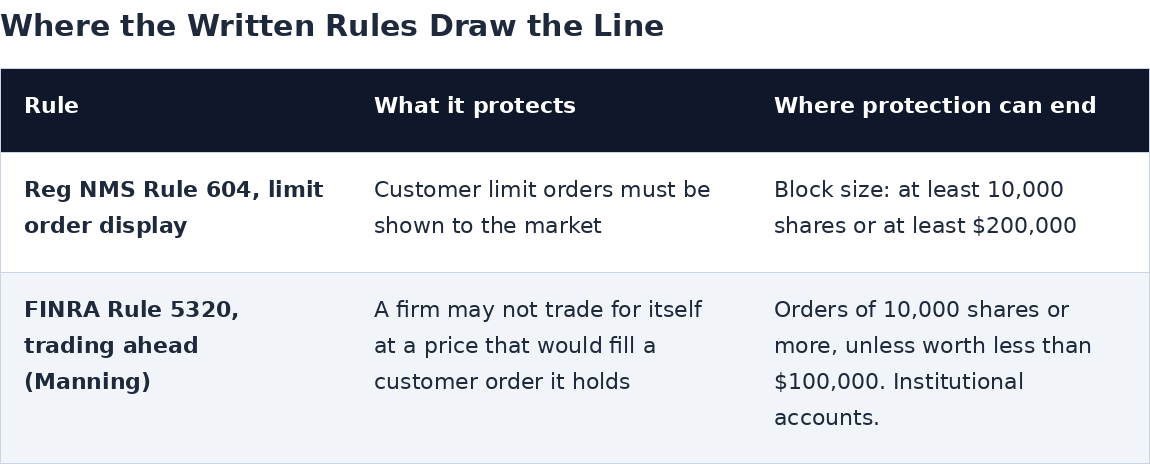
At 13 cents a share, an order must reach about 770,000 shares before it is worth $100,000. Under the rule as written, a 50,000-share retail order in a small company, worth about $6,500, keeps its full protection against trading ahead.
In the authors' experience, the order flow firms that execute for retail brokers draw their own line. Orders above roughly 50,000 shares are treated as if the client never sent the firm an order it had to protect: the firm does not have to offer the balance of the block, and the order moves out of automatic execution into a trader's hands. That line appears in no SEC or FINRA rule. In the authors' experience it is set by the firms themselves, inside agreements the retail client never sees.
The wholesalers' published order-handling documents confirm the mechanism without disclosing a number. Virtu says market orders above its share size parameters may be routed to a trader for manual handling, and that "Orders in OTC Securities are generally handled manually." The parameters themselves are not published. GTS says eligibility for automatic execution is "in the sole discretion of GTS for any client, and for any security."
The case that proves the mechanism. In 2020 FINRA fined Citadel Securities $700,000 and ordered restitution. From September 2012 to September 2014, Citadel's pre-trade controls removed "hundreds of thousands" of over-the-counter customer orders, mostly larger ones, from automated protection and sent them for manual review, where they sat inactive. While they sat, Citadel traded for its own account at prices that would have filled them. In one sample month FINRA found 559 instances of trading ahead of 415 inactive customer orders. Two years of conduct, hundreds of thousands of orders, a $700,000 fine.
4. Sell, cover, sell, cover, then print the client
A retail order handled not held gives the firm discretion over when and at what price it is filled. In the authors' experience, that discretion is used the same way a firm works an at-the-market program: the firm trades for itself first, selling and covering, sometimes three times, before it prints the client's trade. The client sees one fill. The firm has already taken the moves out of the stock.
Three rules stand against this, and each has its grey area.
Trading ahead. FINRA Rule 5320 bars a firm from trading on the same side for its own account unless it "immediately thereafter executes the customer order" up to the size and at the same or better price. The grey area is the no-knowledge exception: a separate trading unit behind an information barrier may trade at prices that would fill the client. Virtu's own disclosure says it may trade in such a unit without filling a resting client order, and UBS describes the same exception.
Opting out by silence. For large orders and institutional accounts, Rule 5320 lets a firm assume consent to trading ahead if it sends a written disclosure and the customer does not opt in to protection, a negative consent.
The print. Trades must be reported "as soon as practicable but no later than 10 seconds after execution," under FINRA Rule 6622. A client print that arrives after three round trips is either a late report or evidence that the firm treated the order as its own to time.
5. Front running blocks and the end-of-day print
FINRA Rule 5270 prohibits a firm from trading while it holds "material, non-public market information concerning an imminent block transaction," generally a trade of 10,000 shares or more. In the authors' experience, firms holding a client block trade ahead of it through the day and print the block at the end of the day at or near the day's low. The client gets the worst price of the session, and the firm keeps the difference. Printing at the close also sets the closing price that margin calls, fund valuations and the next day's trading all key off.
The grey area is the same as in Section 4. The order is not held, the firm has discretion over timing, and the rule's own exceptions allow trading "for the purpose of fulfilling or facilitating" a customer's block, as UBS's disclosure describes. Facilitation and front running look identical on the tape.
6. The non-deal roadshow
In the authors' view, this is the biggest lie in small-company finance. The banker tells the CEO and CFO: we are not raising money, we are only taking you to some meetings and conferences to introduce the company to investors. Every investor in the room, and the banker most of all, knows what the trip is for. The company is being shown to the people who will buy the next deal. The message is that dilution is coming, so sell the stock short and keep selling it. The CEO thinks he is at meet-and-greets. In the authors' experience, others at the table are shorting his stock.
Why it works
One. No one is wall-crossed. An investor formally told of a confidential offering signs a confidentiality agreement and may not trade. On a non-deal roadshow there is officially no deal, so nobody signs anything and everybody remains free to trade. The message is delivered by the meeting itself.
Two. The short-sale rule for offerings is narrow. Rule 105 of Regulation M covers only short sales in the five business days before pricing, and only by those who then buy in the offering. Shorting weeks earlier, from the roadshow, falls outside it.
Three. Small-company deals are mostly exempt. Rule 105 "shall not apply to offerings that are not conducted on a firm commitment basis." ATMs, equity lines and best-efforts registered directs are not firm commitment deals.
What happens when investors are formally told
The cases in which investors were wall-crossed show the motive and the pattern.
Deephaven Capital, 2006. Placement agents for 19 companies told the fund of upcoming offerings. It shorted ahead of each announcement, in one case on 13 separate days, and in two offerings falsely warranted that it had not. The SEC obtained about $5.8 million in sanctions.
Langley Partners, 2006. Three hedge funds shorted 23 issuers, often through naked short sales in Canada, after agreeing to invest in their offerings, then covered with the new shares. The SEC said the covering trades "were not open market transactions because Thorp was on both sides of the trades." Sanctions totaled $15.8 million.
The non-deal roadshow, in the authors' view, produces the same result without anyone being formally told, and so without any rule being triggered.
7. ATMs and equity lines: the company as a not-held order
An at-the-market program or equity line of credit is, in practice, a very large not-held order from the company itself. The sales agent, often the same firm that took the company on its non-deal roadshow, receives discretion to sell the company's shares into the market every day, for months. Everything in Sections 3 to 5 applies, at a far larger scale, with the company's own stock.
The firm has room to trade around the order. It can sell for itself, cover and sell again before it fills the company's order, and report the company's sales at an average price weeks later.
The company sees only totals. It sees the total shares sold and the average price, usually in its next quarterly report. It never sees whether its agent sold ahead, covered, or sold again first.
The short seller knows supply is coming. A steady supply of new shares arrives every day, which is exactly the cheap cover Part 2's Premium Convertible is designed to remove.
Regulation M already forbids the worst of it
Under Rule 101 of Regulation M, a distribution participant, which includes an ATM sales agent and its affiliates, may not "bid for, purchase, or attempt to induce any person to bid for or purchase" the offered stock during the restricted period. The rule's exemption for actively traded stocks requires at least $1 million in average daily trading value and a $150 million public float. Most companies in this series meet neither test, so for them an agent's covering purchases, while it is selling the company's shares, would fall within what the rule prohibits. Stocks below $100,000 a day in trading or $25 million in float get the longest restricted period of all.
The scale
In the third quarter of 2025 alone, PlacementTracker counted $78 billion raised across 1,795 transactions in the markets it tracks. Wells Fargo was sales agent on $21.8 billion of ATM commitments that quarter and Cantor Fitzgerald on $13.2 billion. H.C. Wainwright, a leading small-company agent, was on 40 programs. One equity line investor, YA II PN, signed 20 equity lines totaling $3.2 billion in the same quarter. As DLA Piper notes, equity lines "are generally utilized by smaller companies that are newly public."
8. Stop losses: the market maker has your hand
A stop-loss order is the retail investor's insurance. At Robinhood, a stop "becomes a market order when the stop price is triggered" and executes at the best price available at that moment. In the authors' assessment, three facts put the wholesaler on the other side of that insurance.
One. It buys the flow. The wholesaler receives the orders of millions of retail accounts, including resting limit orders. Webull's report shows separate payments for non-marketable limit orders, $6.5 million in smaller stocks in a single quarter.
Two. Patterns reveal the stops. Flow at that scale shows where retail investors buy, where they cluster, and therefore where their stops are likely to sit. A firm does not have to see each stop to know where they are.
Three. The stops come back to it. When the price is pushed through those levels, the stops trigger and arrive as market orders, the most profitable orders to fill, at the same wholesaler.
It is a poker game in which one player has watched every hand the other has played. Retail brokers' public documents do not say who sees a stop before it triggers. The data the wholesaler buys makes the question almost irrelevant.
9. Rules on paper, no enforcement
Every practice in this report runs against a rule already written. The question is whether anyone enforces them. The public record of major cases follows.
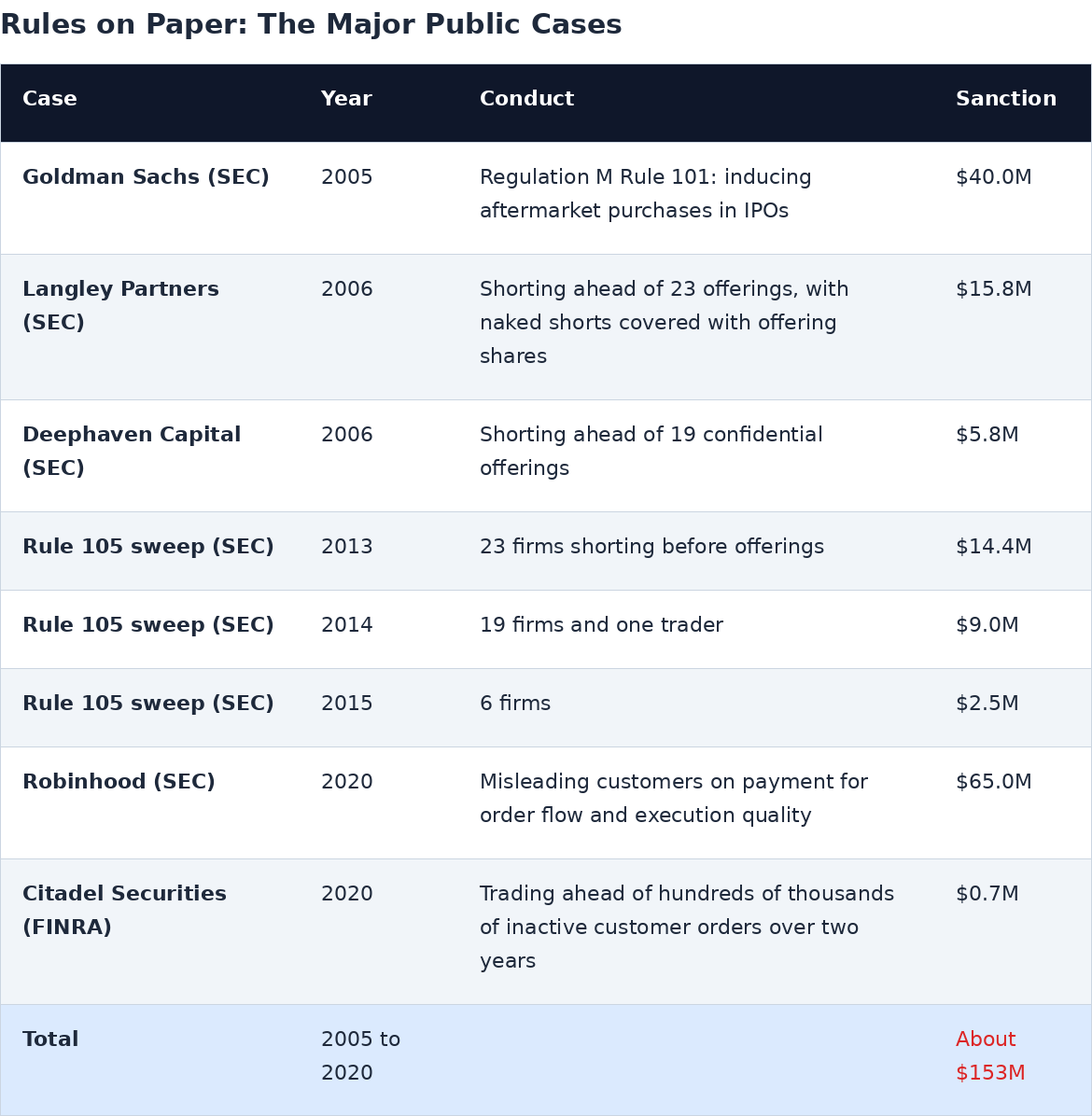
Set that against the money on the table. Fifteen years of the largest cases add up to about $153 million, roughly 6 percent of Robinhood's transaction revenue in 2025 alone. One sales agent took on $21.8 billion of ATM commitments in a single quarter, and one equity line investor signed $3.2 billion. One retail broker collected $23.6 million in a single quarter for orders in smaller stocks.
The truth about Regulation M. The rule that bars an ATM sales agent from buying the stock it is selling for the company has been on the books for decades. We have not found a single SEC action charging an ATM sales agent under Rule 101. The last Rule 105 sweep against shorting before offerings that we found, in 2015, charged six firms a combined $2.5 million. The practices described here move billions of dollars; the cases that reach the public move millions. On the record, Regulation M is not being enforced against these practices.
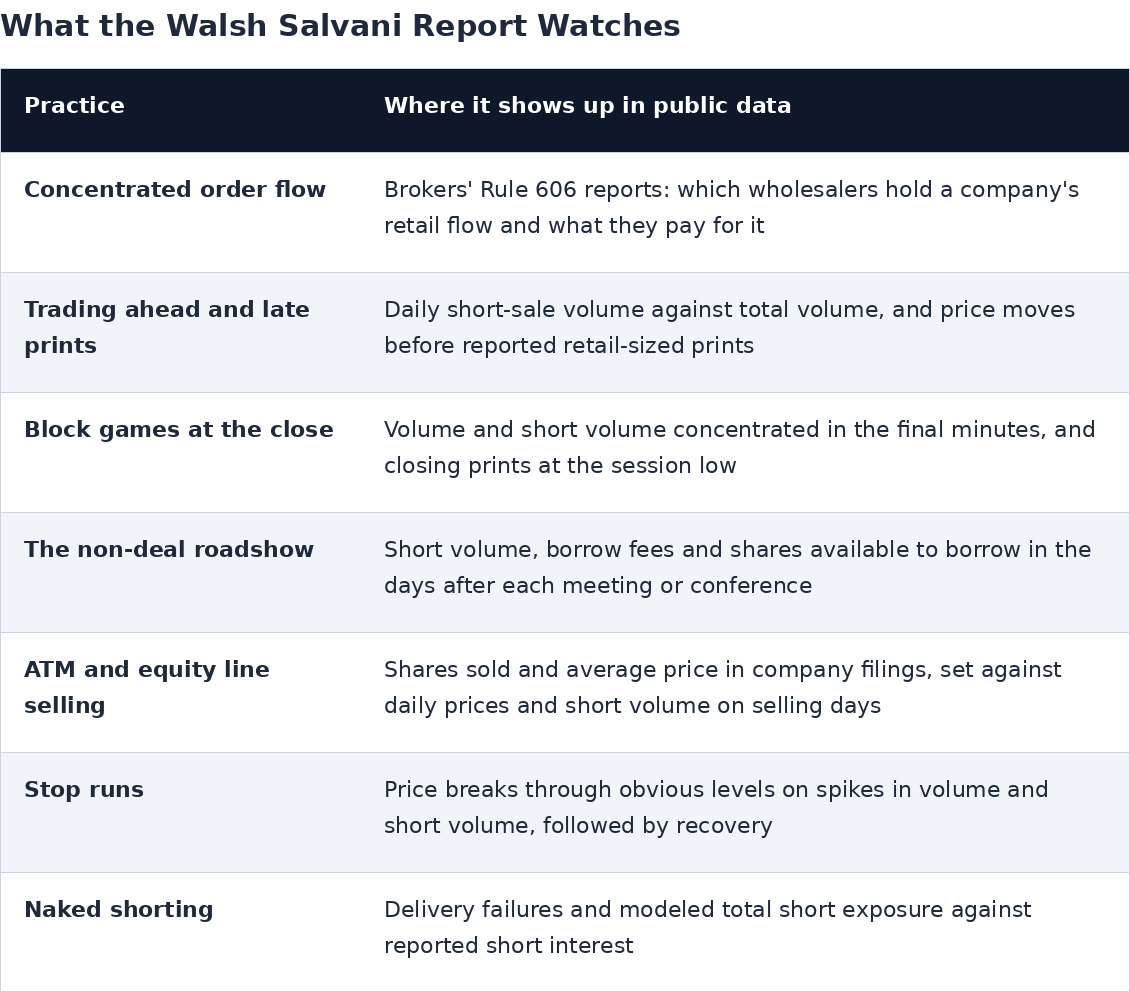
10. What the Walsh Salvani report watches
The practices above are built to stay out of the published numbers. They do not stay out of all of them. The Walsh Salvani True Naked and Borrowed Short Report reconciles public data every day, and each practice leaves a trace.
11. Turning the cards face down
Every card in this report is face up for the same reason: the company's shares, its financing and its shareholders' orders all pass through the hands of the firms that profit from reading them. Shares held in street name sit in the lending system. Financing is sold through a banker's roadshow and worked every day by a sales agent. Orders flow to the wholesaler that buys them. The answer is to take each of those out of their hands.
12. Protecting market capitalization and market value
Market capitalization is share price times shares outstanding. Part 1 showed how the descent destroys it from both sides: shares outstanding multiply through dilution while the price falls under the weight of the short, so among companies that more than tripled their share counts, the typical share price fell about 94 percent. Turning the cards face down is designed to protect both sides of that equation.
The share count
Coupon Token treasury sales bring in cash without issuing shares. Tokens return to treasury every cycle, so the source renews.
The Premium Convertible issues shares only above a fixed price set above market, capped by the 4.99 percent blocker, with no resets that multiply the count as the price falls.
Neither product needs an ATM, an equity line or a discounted convertible, the three engines of dilution in Part 1.
The float the short can reach
Every share registered at the transfer agent is a share that cannot be lent, cannot be used to settle a naked short, and does not sit in a broker's account ready to be sold on a stop.
Allocations keep that pressure on for five years, not one record date, so the float the short can borrow keeps shrinking instead of returning after an event.
Stockholders' equity and listing
Under the CFO Squad accounting opinion, Coupon Tokens held on the balance sheet are carried at market value as current, near-cash assets.
The Premium Convertible adds permanent equity from an acquired asset. In the first case, Vivos Therapeutics expected about $10.38 million added to stockholders' equity, and Nasdaq confirmed it had regained compliance with the equity requirement.
Equity built this way keeps a company listed without the emergency financing that feeds the short.
The price
A short seller's profit depends on three things this report has described: cheap new shares to cover with, borrowable shares, and the ability to see the other side's orders. The BCII products are designed to remove the first two and the Walsh Salvani report is designed to expose the third. These are designs, not guarantees. Part 2 noted that the Coupon Token is not yet tested in the market, and no structure can promise a price. What changes is who holds the cards. A short facing a fixed-price convertible, a shrinking borrowable float and five years of registration pressure is no longer playing against a company that shows its hand.
13. What a CEO can do now
One. Get it in writing. Before any roadshow or conference tour, ask the banker in writing whether an offering is contemplated, and get the attendee list.
Two. Watch the days after every meeting. Track short volume, borrow fees and delivery failures after each investor meeting. If shorting rises after a non-deal trip, you have your answer.
Three. If you run an ATM, demand the detail. Require daily sale reports with times and prices, and written confirmation that the agent and its affiliates did not buy the stock while selling it for you.
Four. Replace discretion with a fixed price. A fixed, above-market structure such as the Premium Convertible removes the daily not-held order that feeds the short.
Five. Educate your shareholders. Explain limit orders and stop risk, encourage them to ask their brokers how orders are handled, and give them a reason to register shares with the transfer agent.
Six. Document and report. Build the file from public data and send it to the SEC and FINRA. Enforcement begins with evidence, and the evidence is in the data.
14. Face down
The retail investor and the small company sit at a table where the other player buys their order flow, sets private limits on which orders it must protect, decides when their trades print, hears about their financing before they do, and works their stock every day through programs they signed. Every one of those advantages runs against a rule that already exists. In the authors' view, none of them is being stopped.
That is the hell. The way out does not wait for enforcement. Register the shares and they leave the lending desk's hands. Replace the daily not-held offering with a fixed price and the sales agent has nothing to work. Raise cash from treasury tokens instead of new shares and the roadshow has nothing to signal. Read the short every day and the company finally sees the other player's hand. Experienced professionals and agentic AI built these tools for exactly this table. A company that uses them stops showing its cards, and starts protecting the market value its shareholders own.
Method notes
Order-flow payments are from Webull's SEC Rule 606 report for the fourth quarter of 2025. Small and mid caps are the report's non-S&P 500 category, and shares are December 2025 non-directed orders.
The 50,000-share threshold, the sell-and-cover sequence before client prints, and end-of-day block printing are described from the authors' experience inside the clearing, trading and financing system. They are not drawn from published rules or filings, which do not disclose wholesalers' size parameters.
The enforcement table lists major public cases found for these rule areas. It is not a complete census of all FINRA and SEC actions, and sweep totals are the SEC's announced minimums.
PlacementTracker agent and investor figures are commitment amounts for programs signed in the quarter, not shares sold.
Product descriptions in Sections 11 and 12 are drawn from Part 2 of this series, including the CFO Squad accounting opinion and the Vivos Therapeutics and SOD Sciences transaction. They describe how the products are designed to work, not forecasts of price.
Regulation M's application to a given ATM depends on the facts and on the stock's trading value and float, and companies should review it with securities counsel.
Sources
Rules and regulations: Regulation NMS Rules 600 and 604; Regulation M Rules 100, 101 and 105; FINRA Rules 5270, 5320 and 6622.
Enforcement: SEC v. Goldman Sachs & Co., Litigation Release 19051; SEC v. Langley Partners, Litigation Release 19607; SEC v. Deephaven Capital Management, Litigation Release 19683; SEC press releases 2013-182, 2014-195 and 2015-239 on the Rule 105 sweeps; CNBC on the SEC's 2020 Robinhood action; FinanceFeeds on FINRA's 2020 Citadel Securities action.
Company disclosures: Robinhood's annual customer disclosure notice, fourth-quarter and full-year 2025 results, fiscal 2025 Form 10-K and stop order support article; Webull's SEC Rule 606 report for the fourth quarter of 2025; Virtu Americas' order handling and execution protocols; GTS order handling protocols; UBS order handling for retail market making.
Market data and commentary: PlacementTracker third-quarter 2025 league tables; DLA Piper on equity lines of credit and at-the-market offerings.
Disclosure. Joseph M. Salvani and Daniel J. Walsh are co-founders of BCII Enterprises, which developed and offers the Coupon Token, the SuperCoupon Token, the Premium Convertible and the Walsh Salvani True Naked and Borrowed Short Report described in this report, and they therefore have a direct commercial interest in their adoption. SOD Sciences' management is the same as BCII's, so the Vivos Therapeutics transaction referenced here is a related-party transaction. The authors may hold positions in companies referenced and may buy or sell at any time without notice.
This report is market-structure analysis and opinion. It is not investment, legal or tax advice, and it is not an offer or solicitation regarding any security, token or service. Several practices described here, including the 50,000-share threshold, trading and covering before printing client orders, end-of-day block printing, shorting from non-deal roadshows and the running of stops, are described from the authors' experience and assessment and are not drawn from any regulatory finding, court decision or published rule. No regulator or court has found that any firm named in this report engaged in those practices. Firms appear in the order-flow table because they appear in a public Rule 606 report, not because of any allegation against them. Enforcement matters are summarized from public releases, and settled matters are typically resolved without admitting or denying the allegations. Product descriptions reflect how the products are designed to work, and the products have not yet been tested in the market.