There Is Now More Than Hope


A Schumpeterian answer: agentic AI in the hands of experienced market professionals as the life preserver for small public companies. The 25-Year Small Public Company Descent to Hell, Part 2. Creative destruction of the market structure. The vacuum, agentic AI, the Coupon Token, the Premium Convertible, carrying it out, and a Part 3 preview.
Summary
The first report in this series traced a 25-year descent. Listing, quotation, research and broker rules removed the small brokers, analysts and market makers that once supported growth companies. Market making consolidated into a few very large trading firms. The capital that remained came largely from financiers who profit when a small company's stock falls, through discounted convertibles, equity lines, at-the-market programs and short selling around those financings.
This report presents the answer. Joseph Schumpeter called the process by which entrepreneurs overturn an established economic order creative destruction. Today the new technology is agentic artificial intelligence, the entrepreneurs are experienced market professionals who know the back-office plumbing from the inside, and the new type of organization is the small fintech firm that combines the two. BCII Enterprises has built two products on that model, designed specifically to help small public companies climb out of the descent.
The BCII Coupon Token and SuperCoupon Token pay coupon tokens only to shares registered at the transfer agent for five years, forcing real shares out of the lending system, while recycling Forever Tokens build a renewing, marked-to-market asset base without issuing a single share.
The BCII Premium Convertible replaces at-the-market programs, equity lines and resetting convertibles with above-market equity from an aligned private-company partner, giving the public company stockholders' equity and a new story, and giving private companies outside the concentrated venture establishment a path to capital. Vivos Therapeutics and SOD Sciences are the first case.
The report closes with a preview of Part 3: the Walsh Salvani True Naked and Borrowed Short Report, a daily tool built by two market professionals with nearly 80 years of combined experience and agentic AI, which BCII uses to structure both products.
1. Where Part 1 left off
The return gap. Over the 10 years to October 2026, the smallest public companies gained about 139 percent, or 9.1 percent a year, against 324 percent, or 15.6 percent a year, for the S&P 500 with dividends. Over the last five years the gap widened to about 7 points a year.
Dilution drove the losses. Among listed companies worth under $100 million in 2016, 186 of 401 more than tripled their share counts by fiscal 2025. The typical one went from 1 share to about 28, and its price fell about 94 percent. Small companies that roughly doubled their shares saw their price double.
The rules tilted the field. The 1997 Nasdaq listing standards delisted hundreds of companies. Decimalization and the 2003 research settlement removed the economics of small-company support. Small IPOs fell 92 percent, and small firms accounted for over 97 percent of the 2013 to 2019 decline in broker-dealers.
The financing became predatory. Companies using discounted convertibles lost an average of 34 percent within a year, on the Hillion and Vermaelen research, and hedge-fund private placements were followed by rising short interest and first-year losses of 19.25 percent, in work by Brophy, Ouimet and Sialm.
2. Creative destruction comes to market structure
Joseph Schumpeter described capitalism as a process of industrial mutation that continually revolutionizes the economic structure from within, destroying the old one and creating a new one, and he called that process of creative destruction "the essential fact about capitalism." For Schumpeter, the competition that matters is not price competition among existing firms. It is competition from the new commodity, the new technology, the new source of supply and the "new type of organization," competition that strikes at the foundations and the very lives of existing firms rather than at the margins of their profits.
The first report in this series described a market structure that has hardened around a few large firms. Listing, quotation, research and broker rules removed the small sponsors of growth companies. Market making consolidated into a handful of very large trading firms. And the financing that remained was supplied on terms that profit from the issuer's distress. That structure is exactly the kind of established order Schumpeter expected to be overturned, not by regulation, but by entrepreneurs with a new technology and a new type of organization.
The new technology is agentic artificial intelligence. The entrepreneurs are experienced market professionals who know the back-office plumbing from the inside. The new type of organization is the small fintech firm that combines the two to do, at a fraction of the cost, what the departed small brokers and analysts once did, and to build financial products the old structure never offered.
3. The vacuum is larger than the public market
The problem described in Part 1 does not stop at the small public company. Private growth companies outside a few regions face the same absence of sponsors.
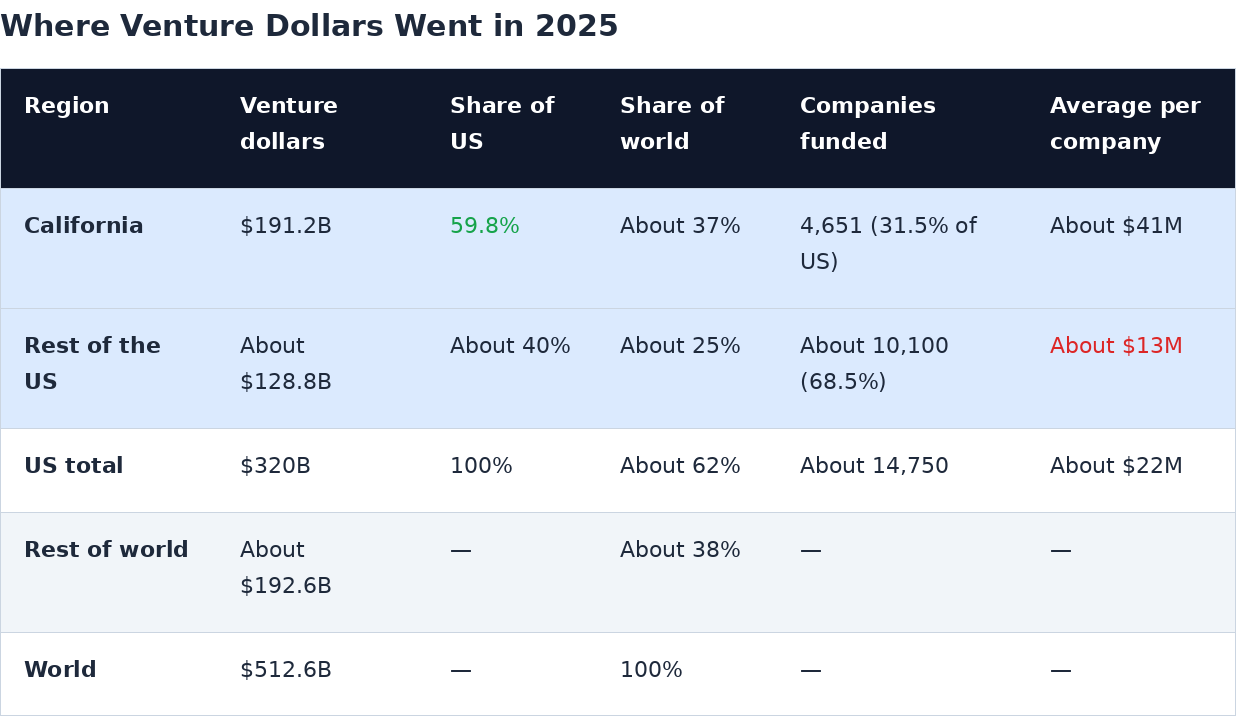
The concentration is more extreme in AI. California accounted for $218 billion of private AI investment in 2025, more than 75 percent of the US total, out of $344.7 billion worldwide on Stanford HAI's figures. California companies took 80 percent of US seed-through-growth funding in AI categories, on Crunchbase data. And the Bay Area had only 22 percent of global AI deals but about 60 percent of the dollars, with $113 billion of its total going to just 92 companies raising $100 million or more.
The pool of companies left out is very large. Tracxn counts about 13,200 US AI companies, but only 1,953 US AI companies received new funding in 2025. The Census Bureau counts 678,459 healthcare and social-assistance firms with fewer than 500 employees, and the number of digital health companies that raised money fell from 975 in the first half of 2025 to 608 in the first half of 2026.
A growth company in Florida, Texas or most of the country is competing for about 40 percent of US venture dollars, and about a fifth of US AI dollars, with checks averaging about a third the size of California's. It also lacks the small brokers that once took companies like it public. These companies, and the small public companies already under siege, are the market for the Schumpeterian answer.
4. Agentic AI in the hands of market professionals
Agentic AI systems do not just answer questions. They carry out multi-step work: gathering data, running analyses, drafting documents and monitoring for change. In the hands of professionals who understand clearing, settlement, short-sale rules and corporate finance, they replace functions that once required a full brokerage firm.
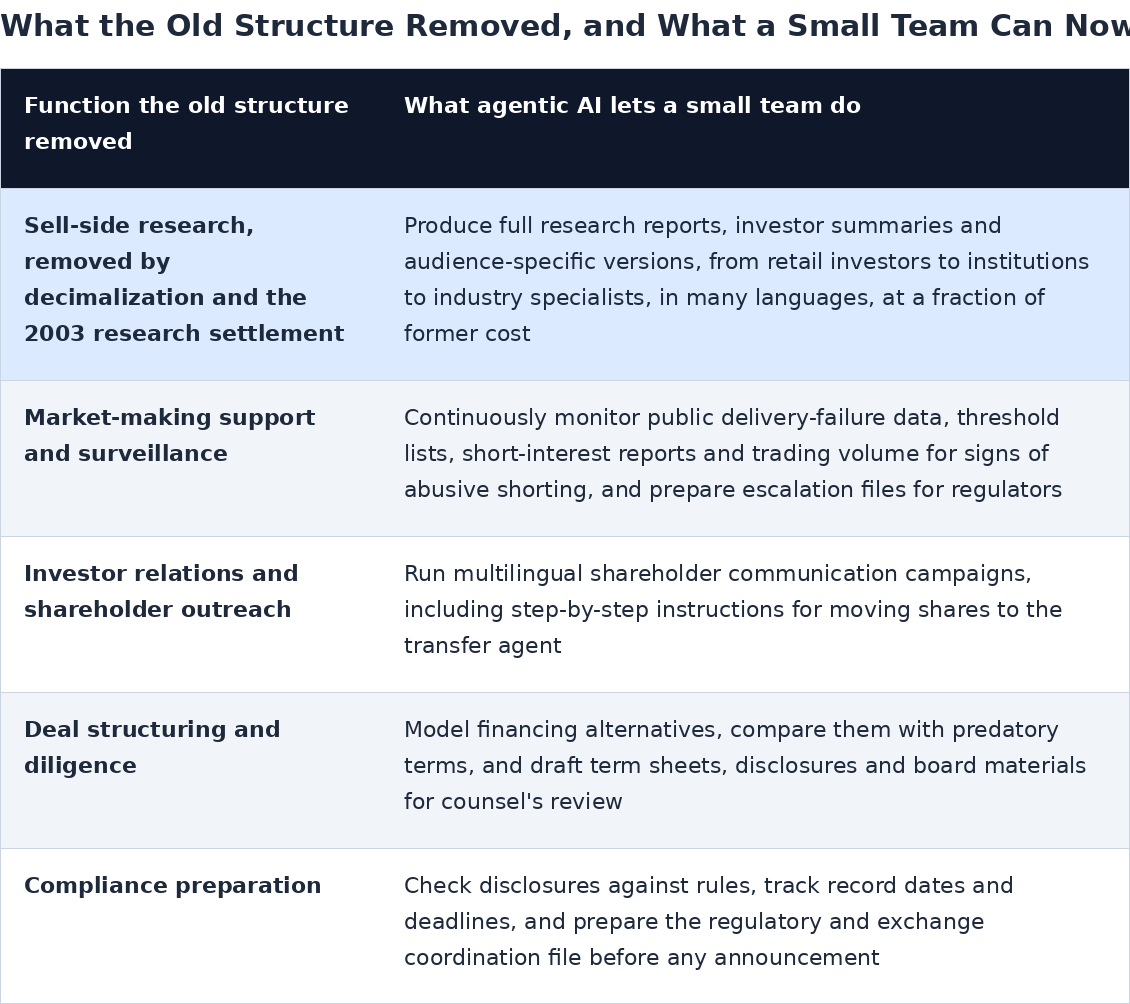
Together they form Schumpeter's new type of organization: a small firm that can serve hundreds of small companies with the depth that once required a large one. BCII Enterprises is built on this model, and its two fintech products are designed specifically to help small public companies climb out of the descent described in Part 1.
5. Product one: the BCII Coupon Token and SuperCoupon Token
Architecture
The token carries the coupon. Each Coupon Token carries discounts from participating advertisers, including discounts on the issuing company's own products. The SuperCoupon Token carries coupons from many advertisers on one token. Advertisers that sign a coupon contract with BCII cannot refuse a valid coupon.
Forever Tokens that recycle. The supply is fixed. In the company's treasury a token is a Forever Token with no clock running. Once sold, it begins an 11-month cycle. When the coupon is redeemed, or if it is not redeemed within 11 months, the token returns to treasury and becomes a Forever Token again, ready to be sold in a new cycle. The treasury is never depleted.
Paid only to registered shareholders. Shareholders receive Coupon Token allocations only if they move their shares out of the DTC system to the company's transfer agent and become shareholders of record. All shareholders are alerted to the deadline for moving their shares.
Automatic crediting. The transfer agent notifies BCII through an API that the shares are registered, and BCII credits tokens to a BCII wallet in the shareholder's name.
Five years of fixed allocations. For the first five years, each shareholder receives the same allocation based on shares owned relative to shares outstanding before each annual declaration date, awarded monthly or quarterly as the company chooses.
The BCII Coupon market. Tokens trade on the BCII Coupon market. BCII's position is that they are digital tools rather than securities or commodities. A coupon's value is set only by the buyer's perceived value of the discounts offered by the participating advertisers, including the issuing company. The number of tokens the company sells from treasury, or collects through the transaction tax, has nothing to do with that perception.
The program was announced as a shareholder engagement model in January 2026, with technology licensed from Horizon Globex GmbH.
How it breaks the naked short
A shareholder asks the broker to move shares to the transfer agent to receive Coupon Tokens. The broker must then deliver real shares out of its DTC position. If those shares were lent out or never existed, the broker must recall the loan, the borrower must return shares or buy them, and a naked short must buy.
Every allocation is a new reason to keep shares registered, so the pressure continues for five years rather than for a single record date. Because there is no cash alternative, a short seller cannot settle the obligation in cash.
How it builds shareholder equity
BCII received an accounting opinion from CFO Squad Inc. concluding that Coupon Tokens fall under the FASB crypto asset standard, ASU 2023-08. Under that treatment, tokens held on the balance sheet are carried at market value at each reporting date, presented separately and classified as current, near-cash assets.
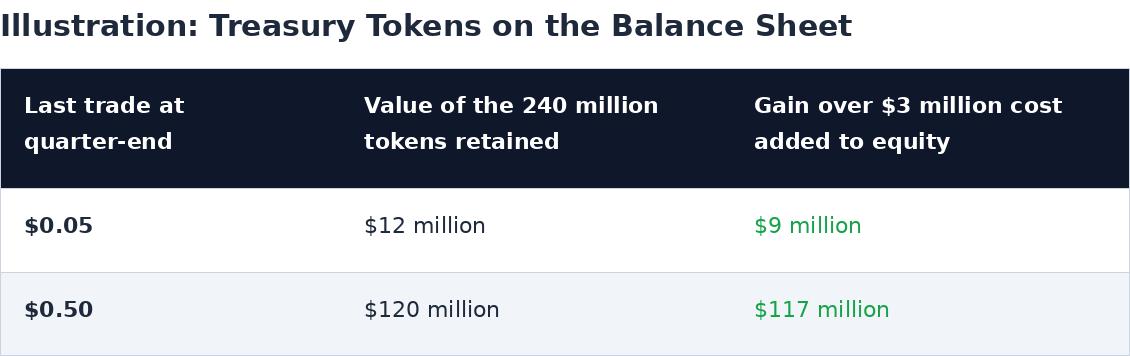
Because tokens always return to treasury, the asset base renews each cycle, and treasury sales bring in new USDC without issuing a single share. This equity is exactly what Nasdaq's $2.5 million stockholders' equity requirement demands, and exactly what predatory financing destroys.
6. Product two: the BCII Premium Convertible
The model
One. Find the private company. It has a real product, needs cash to grow and is deciding whether to go public. Typically it sits outside the concentrated venture, private equity and large-brokerage establishment described above.
Two. Test the story first. The private company sells its product into a BCII-managed company, showing demand before anything goes public.
Three. Manage it jointly. BCII management manages the private company alongside its own team, keeping incentives aligned with the public partner.
Four. Swap equity. The small public company that is under siege acquires a stake in the private company, paying with a convertible preferred that has a fixed conversion price above market with no resets, a 4.99 percent beneficial ownership blocker, and no cash, warrants or redemption.
Five. Both companies gain. The public company gains stockholders' equity and a new story to tell the market. The private company gains a public partner's sales channel and, over time, a gradual way to raise cash by selling conversion shares above the conversion price, judiciously, not to cover a short and not in a desperate move to avoid delisting. The cash goes toward selling both companies' products.
Why it is the anti-ATM and anti-equity line
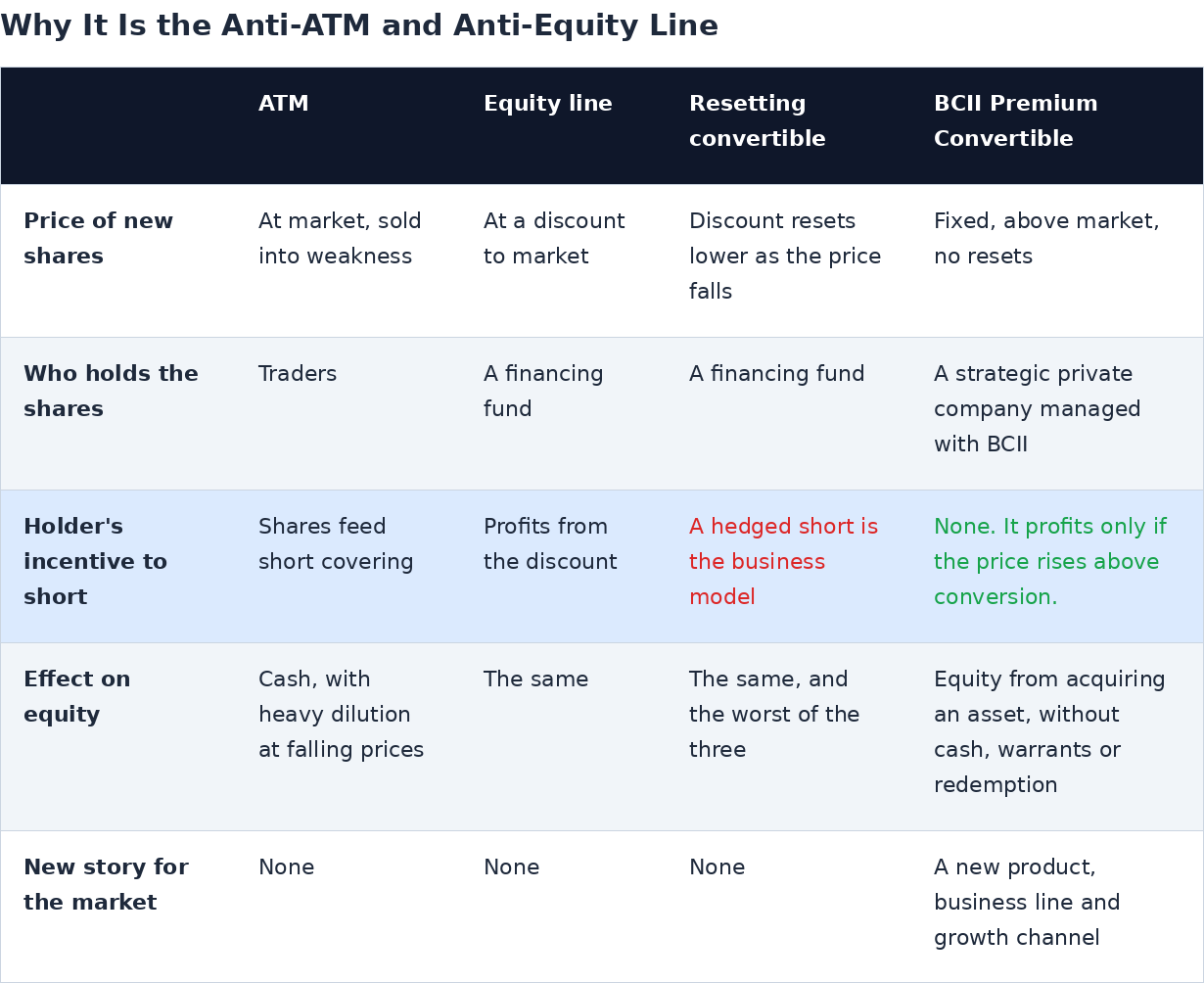
Short sellers in small companies count on a steady supply of cheap new shares to cover with. The Premium Convertible removes that supply. No shares are issued below the fixed price, and the holder, whose own business depends on the public partner, has no reason to sell into weakness or lend shares to short sellers. The short loses its cheap exit and must cover in the open market.
The first case: Vivos Therapeutics and SOD Sciences
Because SOD Sciences' management is the same as BCII's, the team used the structure on its own product first, then positioned it as a BCII product to be offered to others.
Terms. Vivos issued 12,000 shares of Series C Convertible Preferred with a $12 million stated value in exchange for an 11 percent fully diluted stake in SOD Sciences and 50 percent of SOD's pseudohypoxia early-warning test and related IP. The preferred converts at a fixed $0.15 into up to 80 million shares, subject to a 19.99 percent exchange cap and a 4.99 percent beneficial ownership blocker.
Above market. Vivos closed at $0.134 on the October 14, 2026 signing date, so the conversion price was about 12 percent above the market.
Permanent equity. There is no redemption right, mandatory conversion or cash settlement. Vivos expects the transaction to add $10.38 million to stockholders' equity.
Nasdaq compliance. Nasdaq confirmed on October 20, 2026 that Vivos had regained compliance with the stockholders' equity requirement, subject to showing compliance in its next periodic report.
New story. The companies will jointly market the ReBalU Protocol to Vivos customers and US sleep-testing centers on a 50/50 basis, and SOD will market Vivos's testing and devices through American Health Associates and Cleveland Clinic Weston, with Vivos keeping 80 percent of the contribution margin.
7. Why these products succeed where earlier attempts did not
Companies have tried before to fight naked shorting through distributions. Each attempt solved one piece of the problem.
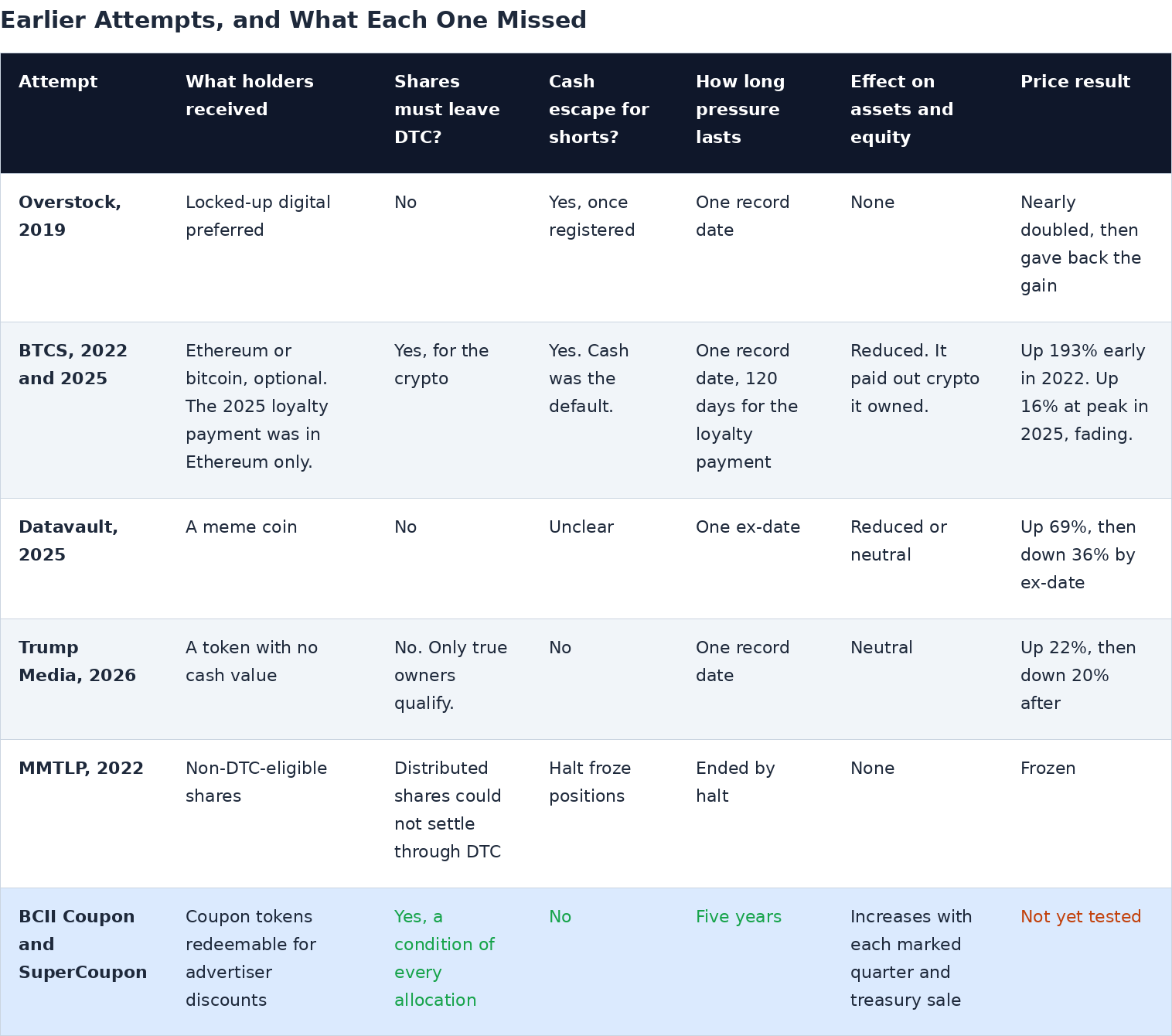
The lessons are consistent. A cash alternative lets the short off the hook, and BTCS and Overstock both allowed cash in the end. Paying only registered holders is workable, and Nasdaq processed BTCS's transfer-agent-only payouts twice. Full disclosure protects the company, and the Tenth Circuit upheld dismissal of the manipulation suit against Overstock because the dividend's terms were fully disclosed. One-time events fade, and every earlier stock peaked shortly after announcement and gave back most of the gain. And none rebuilt the company: every earlier attempt left assets unchanged or reduced them, and none replaced predatory financing.
The BCII products combine what worked, meaning transfer-agent-only allocations, no cash escape and full disclosure, and add what was missing: five years of continuing pressure, a growing asset and equity base, and a replacement for predatory financing.
8. Carrying it out
Creative destruction succeeds when the new organization executes better than the old one. For each company that adopts the BCII products, the implementation checklist is as follows.
One. Shareholder participation. Buy-ins begin only when transfer requests exceed what brokers actually hold. Multilingual, AI-assisted outreach with clear step-by-step instructions, announced well ahead of each deadline, is what turns the design into pressure. Margin shares must be fully paid before they can move.
Two. Advertisers. Sign anchor advertiser agreements before launch so the coupons carry real discounts from day one.
Three. Exchange and FINRA coordination. Agree the handling of record dates and allocations with the exchange and FINRA before announcement, so trading is never halted the way MMTLP's was.
Four. Corporate counsel. Confirm under each company's state law that allocations conditioned on registration, without a cash alternative, are valid.
Five. Auditor concurrence. Each company's auditor must accept the CFO Squad treatment in its own filings, and the Premium Convertible's purchase accounting must be completed in the next periodic report.
Six. Disclosure and conduct. Disclose every term in full, bar insider selling around each event, document related-party relationships, and price all intercompany sales at arm's length.
Seven. Written resale discipline. Put the Premium Convertible holder's commitment to sell gradually into a contractual volume limit, so investors can rely on it.
Eight. Tax. Confirm with tax counsel how allocations are treated and reported to shareholders.
9. The life preserver
Part 1 traced a 25-year descent. Rules written to protect investors removed the small brokers, analysts and market makers that once supported growth companies. Market making consolidated into a few large firms. The capital that remained came from financiers who profit when a small company's stock falls. The record shows the result: the smallest companies trailing the S&P 500 by a widening margin, and the deepest losses concentrated among companies forced into extreme dilution.
Schumpeter would not have expected that structure to last. The same forces that hollowed it out, technology and scale, now make it possible to rebuild what it destroyed. Experienced market professionals, armed with agentic AI, can now provide research, surveillance, outreach and deal structuring that once required a full brokerage firm. And they can build new financial products the old structure never offered. The Coupon Token and SuperCoupon Token force real shares out of the lending system for five years and build a renewing, marked-to-market asset base without issuing a single share. The Premium Convertible replaces at-the-market programs, equity lines and resetting convertibles with above-market equity from an aligned partner, a new story for the market, and a path to capital for private companies outside the concentrated venture establishment.
That is the life preserver. It is not a plea for new regulation or a wait for a sponsor that is not coming back. It is the entrepreneur's answer, creative destruction applied to market structure itself, and it is now available to every small public company that chooses to use it.
10. Coming in Part 3: the Walsh Salvani True Naked and Borrowed Short Report
Part 3 of this series will show the Schumpeterian answer at work through one concrete example: what two experienced market professionals can build when agentic AI multiplies what they already know.
The team
Joseph M. Salvani and Daniel J. Walsh, the co-founders of BCII, bring nearly 80 years of combined experience across every aspect of corporate finance and product marketing, and have worked together for more than 23 years. Salvani graduated as valedictorian of Columbia Business School's May 1981 class, served as Senior Chemical Analyst at Goldman Sachs from 1981 to 1986 and was an Institutional Investor All-Star analyst from 1983 to 1986, then became a general partner at Steinhardt Partners. Walsh was a founder of Montauk Financial and a senior partner of Garden State Securities, among other firms, and has managed more than 1,000 retail brokers and committed capital in trading every type of equity instrument. Together they have consulted for nearly 700 public companies, been responsible for more than $1 billion in capital raised, and worked inside the clearing, trading and financing system described in Part 1. That experience is what tells the AI which data matters, how the plumbing actually behaves and where the abuses hide.
The report
The Walsh Salvani True Naked and Borrowed Short Report is updated daily. For each company it covers, it separates a stock's short position into two parts. The borrowed short is the set of positions supported by located and borrowed shares, the part regulators and the public can see through reported short interest. The naked short is the modeled portion of total short exposure that is not supported by borrowed shares, the part Part 1 showed is hidden by market-maker exemptions, mismarked long sales, offshore accounts and reset trades.
Reported short interest is published only twice a month and reflects what firms report. Daily short-sale volume, delivery failures, borrow fees, shares available to borrow and trading volume each show part of the picture. The report reconciles those public sources every day into a central estimate of total short exposure, with a range, and compares it with reported short interest. BCII regards it as the most accurate and current view of short exposure available for the companies it covers. Part 3 will set out the full methodology, data sources and validation against reported figures, so readers can judge that accuracy for themselves.
How BCII uses it to structure its two fintech products
Choosing where the products work best. Companies whose modeled total short exposure far exceeds reported short interest are the companies where a transfer-agent registration campaign creates the most buy-in pressure.
Timing the Coupon Token. Allocation dates and registration deadlines can be set when the short position is largest and borrow is tightest, so each move of shares out of the DTC system has the greatest effect.
Sizing the Premium Convertible. The report shows how many cheap shares the short is waiting for. A fixed, above-market conversion price, combined with a holder that will not sell into weakness, is designed to close that exit, and the report shows how large the exit is.
Measuring results. Daily updates show whether modeled exposure falls as shares move to the transfer agent and as predatory financing is replaced, turning the products from theory into measured outcomes.
Research the largest firms cannot match
The second half of the example is research. Walsh Salvani research reports are long, detailed and timed to the events that matter for each company: financings, record dates, earnings and corporate actions. Each report discloses every position held by the authors and whether the report was paid for, and by whom.
That disclosure is not optional. Section 17(b) of the Securities Act makes it unlawful to publish a communication describing a security for consideration from an issuer, underwriter or dealer "without fully disclosing the receipt, whether past or prospective, of such consideration and the amount thereof." The provision was written to stop publications that "purport to give an unbiased opinion but which opinions in reality are bought and paid for," and the SEC has charged 27 firms and individuals in a single sweep for paid articles that hid their compensation. Full disclosure of positions and payment is what separates legitimate issuer-sponsored research from the paid promotion regulators pursue, and it is what lets investors trust the work.
The largest firms cannot do this at BCII's cost and scale. Their research economics were broken by decimalization and the 2003 research settlement, and FINRA itself acknowledged in 2025 that research coverage has diminished and is especially valuable to small issuers. Their trading businesses, as Part 1 showed, often sit on the other side of the small companies they would be covering. A daily short-exposure model across many small companies, plus lengthy, fully disclosed, well-timed research in many languages and for many audiences, would require a large staff at a traditional firm. At BCII it requires two experienced professionals and agentic AI.
Credit where it is due
The credit belongs to agentic AI and to creative destruction. The AI supplies the scale: daily collection and reconciliation of public data, drafting and translation, and continuous monitoring. The professionals supply the judgment that no model has on its own: knowing how the plumbing behaves, which numbers can be trusted and what a small company needs to survive. Together they are the new type of organization Schumpeter described, competition that strikes not at the margins of the established firms but at their foundations. Part 3 will show it in detail.
Method notes
Venture figures come from the NVCA 2026 Yearbook, using PitchBook data, for the US and California, and from PitchBook via KPMG Venture Pulse for the world total. Rest-of-US and rest-of-world figures are differences between those totals. AI figures come from the Stanford AI Index 2026 and Crunchbase, and providers' global totals differ by definition.
Price results for earlier distribution attempts use daily prices from announcement to record or ex-date, with peaks as intraday highs. Coupon Token balance-sheet figures are illustrations of the accounting mechanism under the CFO Squad opinion, not forecasts.
Sources
Regulatory, legal and accounting: FINRA Notice 25-06; FINRA guidance on the MMTLP corporate action and trading halt; Nasdaq continued listing guidance; Nasdaq Trader equity corporate action notices for BTCS in 2022 and 2025; the Tenth Circuit opinion in the Overstock securities litigation and Cooley's note on it; the SEC advisory committee dissent on decimalization; the SEC Investor Advisory Committee finfluencer recommendation; an SEC litigation release on paid-article enforcement; White & Case on Section 17(b); the Trump Media SEC filing.
Company and transaction: BCII announcements via Nasdaq and ACCESSWIRE on the Coupon Token program, the Horizon Globex licensing agreement and the CFO Squad accounting opinion; Vivos Therapeutics releases via GlobeNewswire, Business Insider and Investing.com, and Panabee's summary; Overstock's 2019 release; Stock Titan on Datavault.
Research and data: Hillion and Vermaelen on discounted convertibles; Brophy, Ouimet and Sialm on private placements; Carleton Law on broker-dealer counts; EDN on the 1997 Nasdaq standards; Econlib and Princeton on Schumpeter; the NVCA 2026 Yearbook; PitchBook via KPMG Venture Pulse; the Stanford AI Index 2026 and Stanford HAI; Crunchbase; Tracxn via Tool Directory; Bot Memo; The AI Economy; Census SUSB 2021; Value Add VC; and price data for the ETFs and companies discussed.
Disclosure. Joseph M. Salvani and Daniel J. Walsh are co-founders of BCII Enterprises, which developed and offers the Coupon Token, the SuperCoupon Token and the Premium Convertible described in this report, and they therefore have a direct commercial interest in the adoption of those products. As the report states, SOD Sciences' management is the same as BCII's, so the Vivos Therapeutics transaction described here is a related-party transaction in which the authors' own interests sit on one side. The authors may hold positions in companies referenced, including Vivos Therapeutics, and may buy or sell at any time without notice.
This report is market-structure analysis, product description and opinion. It is not investment, legal, tax or accounting advice, and it is not an offer to sell or a solicitation of an offer to buy any security, token or other instrument. The characterization of Coupon Tokens as digital tools rather than securities or commodities is BCII's own position, not a determination by any court or regulator, and no regulator has passed on it. The accounting treatment described rests on an opinion from one firm, and as the report notes, each adopting company's own auditor must accept that treatment in its own filings. Balance-sheet figures are illustrations of a mechanism at assumed token prices, not forecasts, and the products have not yet been tested in the market. Transaction terms, compliance confirmations and figures for Vivos Therapeutics are drawn from company releases and should be read against the company's own filings.