
Spectrum, Towers and the Missing Radio: SpaceX's Moves Sharply Raise AmpliTech's Value

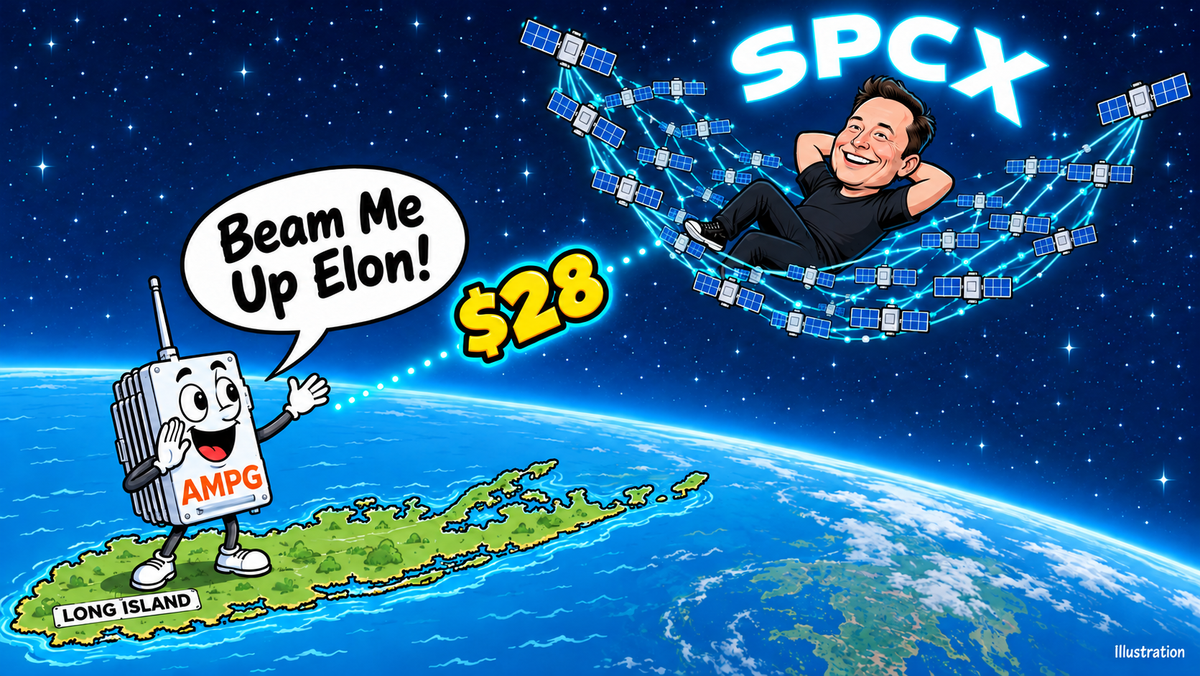
SpaceX has bought the airwaves for a fourth national carrier and is now negotiating for at least 80,000 cell sites to put them on. The one layer it does not control is the radio that sits on every one of those sites. We believe SpaceX will pay $24 to $28 a share to own it. AmpliTech Group, NASDAQ: AMPG and AMPGZ. Strategic Buy. Walsh and Salvani, Strategic Equity Research, JD Unfiltered. Prices as of the October 22, 2026 close.
Market cap is price times roughly 30.1 million shares outstanding. The price target is a 24 to 36 month view.
The Setup
On October 8, 2026, SpaceX agreed to buy Grain Management's entire nationwide 800 MHz spectrum portfolio, up to 14 MHz of paired low-band spectrum, subject to FCC approval. The Wall Street Journal reported the price at about $8 billion in cash. SpaceX's own words describe the deal as closing one of the key remaining technical gaps that will let Starlink Mobile become a major mobile carrier.
The market understood immediately. In after-hours trading, Verizon fell nearly 7 percent, AT&T nearly 8 percent and T-Mobile 7 percent. Verizon's response was the most revealing line of the day: a company can have all the spectrum it likes, but without a network to use it, Verizon said, "it's just empty airwaves."
Two weeks later, SpaceX answered that critique. On October 22, Bloomberg reported that SpaceX aims to secure at least 80,000 US cell sites and is in talks with at least one major tower company, including Crown Castle, to get there. The reported deals are leases that could be worth billions of dollars, not an acquisition of a tower company, and no agreement has been announced.
Spectrum is bought. Towers are being negotiated. The radio on every one of those towers is the last layer SpaceX does not control, and that makes the US-designed radio supplier the most strategic small asset in the network.
Spectrum Bought. Towers Next. Radios Missing.
SpaceX has assembled nearly every layer of a national carrier in roughly fourteen months.
Status as of October 23, 2026.
Earlier this year, SpaceX President Gwynne Shotwell described small cellular base stations mounted alongside Starlink hardware, built out site by site. The tower talks show the plan is now larger: a macro network on existing towers, with small cells filling the gaps. Either way, every site needs radio units operating in SpaceX's own spectrum, and nobody has named the supplier.
80,000 Towers Need 80,000 Radio Sets
A tower is a steel structure with power and a lease. Until a radio is bolted to it, it carries no traffic. If SpaceX secures 80,000 sites, it needs at least 80,000 sets of radios to light them, and usually several radios per site to cover multiple sectors and both its 800 MHz and 2 GHz bands.
The number matches our target. Our $24 to $28 price target, derived below, requires about 72,000 to 84,000 sites carrying AMPG radio content. Bloomberg's figure of at least 80,000 sites falls inside that range. We built the target on small-cell assumptions before the tower report. A tower network at that scale makes the requirement concrete rather than hypothetical.
The cost of the network dwarfs the cost of the supplier. TD Cowen estimates a nationwide terrestrial network would cost more than $80 billion and take many years. At our $28 target, all of AmpliTech would cost about $844 million, roughly 1 percent of that build.
Towers change the radio mix. A macro tower site carries more radio content than a small cell, which should raise AMPG's potential dollars per site. Towers are also where the incumbent radio vendors compete hardest. The 800 MHz coverage layer would draw on AMPG's low-band line, which today includes a Band 28 macro cell at 700 MHz, while the 64T64R Massive MIMO radio belongs on the 2 GHz capacity layer.
The foreign-supplier problem. The tower radio market is dominated by Ericsson of Sweden, Nokia of Finland and Samsung of South Korea. As JD noted in September, the United States has no domestic radio access network manufacturer at scale. A SpaceX network of 80,000 towers, carrying national traffic and built to compete with incumbents that once relied on Huawei and ZTE gear, would otherwise run on foreign-made radios. AmpliTech is the US-designed alternative.
The Architecture: Satellites for the Country, Radios for the City
A satellite signal aimed at a phone arrives weak, and it collapses at a roof, a wall or a basement. JD made this point in May with the satellite-radio analogy: SIRIUS deployed 1,150 ground repeaters and XM 778 because their satellite signals could not reliably penetrate buildings. The consumer market is already confirming it. A $149.99 in-car booster for Starlink's direct-to-phone service launched this month, promising five times the phone's uplink power.
The efficient city design is not a repeater of the satellite signal. It is a small cell that broadcasts to phones on SpaceX's 800 MHz and 2 GHz spectrum and uses a Starlink dish as its link back to the network, so no fiber trench is needed. Because SpaceX would own the spectrum, it needs no permission from Verizon, AT&T or T-Mobile. Federal rules require a carrier's consent even to boost that carrier's signal, so the only clean path is a network on SpaceX's own frequencies.
Figure 1. Satellites cover the country. Ground radios cover the places satellites cannot see. Source: JD Unfiltered analysis.
Why AmpliTech Is the Radio to Own
JD's May 21 report laid out the core claim: AmpliTech is the only US supplier of a commercial-grade 64T64R O-RAN Massive MIMO radio validated in independent multi-lab interoperability testing, and the company is vertically integrated from chip to MMIC to radio unit to managed network service. The distinction matters. Several large US companies, including Qorvo, MACOM, Analog Devices and Skyworks, make RF amplifier chips. AmpliTech's position is different: it designs the amplifier chips and also builds the finished, certified radio that goes on the site. The product line already maps onto the network SpaceX now has to build.
Low band. A Band 28 macro cell, a 700 MHz low-band radio, is a featured product today. An 800 MHz variant is an adaptation of an existing design, not a new invention.
Mid band. A Band 1 radio near 2 GHz and the 64T64R Massive MIMO unit address the capacity layer that SpaceX's 2 GHz spectrum will carry in dense cities.
Private 5G and Network-in-a-Box. Portable, deployable 5G for military, disaster recovery and temporary sites, and carrier-grade private networks for enterprises.
In-house chips. The MMIC low-noise amplifier chips inside each radio are designed in-house by AmpliTech's AGMDC division. The receive chain's noise figure is the binding constraint on direct-to-phone link budgets, and that is where AMPG sits.
Live deployments. About $7.3 million in follow-on orders from an Asian mobile operator in September, and an approximately $11 million multi-year letter of intent from TELUS.
The radios are US-designed, which matters for a network that will carry national traffic and is being built expressly to compete with networks that once relied on Huawei and ZTE gear.
The Second Prize: Robotaxis and Robots
The wireless carrier play is the obvious use. The less obvious one is Tesla.
Robotaxis already run on Starlink
Tesla announced in July that the Cybercab is the first vehicle with Starlink V5 built directly into it. On the second-quarter call, Elon Musk said that "Starlink will be integrated into all our car vehicles," at least in markets where Starlink is active. Tesla's VP of AI Software said the link is not required for safe operation, and that it is for navigation, customer service and fleet management. In practice that means remote assistance, telemetry, dispatch and over-the-air updates, especially where cellular coverage is poor, including urban canyons.
The fleet is small but scaling. Tesla had 169 Cybercabs authorized for commercial use in Texas as of early October, plus 420 Model Y robotaxis. Driverless service runs in Austin, Dallas, Houston, Miami, Orlando and Tampa, with supervised service in the San Francisco Bay Area.
Where the satellite link runs out. A roof-mounted satellite terminal needs sky. A robotaxi spends its working day in downtown canyons, parking structures, tunnels and charging depots, the exact places a satellite cannot see. A SpaceX ground layer on 800 MHz fills those gaps, and the Cybercab already carries a 5G LTE antenna alongside its Starlink terminal. The radios that build the city network for phones are the same radios that keep the robotaxi fleet connected.
Robots work indoors
Tesla is now building several hundred Optimus robots a week at Fremont, targeting more than 1,000 a week by the end of 2026, and plans to lease them to companies with factories and warehouses like its own. Satellites do not reach the inside of a factory. Fleet-scale robot connectivity indoors is a private-network problem, which is the private 5G and Network-in-a-Box category AMPG already sells. Tesla has not announced a connectivity plan for Optimus, and this is a JD inference from the deployment model.
How the companies connect
Tesla and SpaceX are separate public companies. Tesla invested $2 billion in xAI in January 2026, and after SpaceX absorbed xAI that stake converted into SpaceX shares representing less than 1 percent of SpaceX. Any SpaceX network serving Tesla vehicles or robots would be a commercial supply relationship between the two companies, not a single balance sheet. The strategic point holds either way: one radio supplier would serve phones, robotaxis and robots across the Musk ecosystem.
Why AMPG Is Worth More to Musk and to His Rivals
Each SpaceX move raises AmpliTech's strategic value from two directions at once.
The same asset, valued by a buyer who needs it and by a rival who wants to deny it.
To Musk, AmpliTech is the fastest route to a US-designed radio on every site he is leasing, and the cheapest way to avoid building a radio business from scratch.
To anyone trying to slow him down, AmpliTech is a defensive asset. The natural candidates are Amazon, which is building its own satellite network, and the three incumbent carriers, whose shares fell 7 to 8 percent on the spectrum news. A rival that controls the only US-designed certified O-RAN radio cannot stop SpaceX, which can still buy from Ericsson, Nokia or Samsung. But it can force SpaceX onto foreign vendors, lengthen its timeline and remove the made-in-America story from its network. At a market cap of about $80 million, that is cheap leverage over a nearly $2 trillion competitor.
That two-sided demand is what turns AMPG from a supplier into a contested asset. When two sides have reasons to want the same small company, the price is set by the buyer with the most to lose. We believe that buyer is SpaceX.
What It Costs to Lock It Up
JD's May report argued that for SpaceX, NVIDIA or Amazon, an AMPG acquisition is a rounding error, and recommended a confidential all-cash approach at $13 to $15 per share. At today's price the math is even more lopsided.
Share count is about 30.1 million, implied by AMPG's market cap and price at the October 22 close. The stake price is illustrative. The 19.9 percent ceiling reflects the Nasdaq shareholder-approval threshold for private placements, and counsel must confirm structure.
Put those numbers next to what SpaceX has already spent. An early takeout at $13 to $15 equals about 0.02 percent of SpaceX's roughly $1.9 trillion market cap, and even at the $24 to $28 target it is about 0.04 percent. The early takeout equals about 5 percent of the reported $8 billion paid for the 800 MHz spectrum alone, and about 9 to 11 percent at the target. It equals about 2 to 3 percent of the $17 billion EchoStar spectrum purchase. At the target, it equals about 1 percent of TD Cowen's estimated cost of a nationwide ground network.
SpaceX has spent roughly $25 billion on airwaves. Spending under half a billion to control the radios that light them up is the cheapest insurance in the stack, and the price only rises once a supply contract becomes public.
What It Is Worth to AMPG Holders
The more valuable outcome for AMPG shareholders may be a supply contract rather than a buyout. The table below sizes a SpaceX city-network order. The assumptions are JD's, not company guidance: $10,000 of AMPG radio content per small-cell site, meaning an 800 MHz unit plus a 2 GHz unit, built over four years, valued at 3x to 5x annual revenue, which sits inside the 3x to 6x range for Open RAN hardware peers.
Value per share is annual SpaceX-related revenue times the multiple, plus about $5.0 million of cash, divided by about 30.1 million shares. It excludes AMPG's existing business, robotaxi and robot connectivity, and any dilution needed to fund manufacturing scale-up.
For SpaceX, the all-in network cost at an assumed $20,000 to $50,000 per installed site would run about $3 billion to $7.5 billion for Phase 2, spread over several years. That is less than the reported cost of the 800 MHz spectrum, and it replaces a revenue-sharing arrangement with an incumbent that the carriers have so far refused to offer.
Even Phase 1 at the low multiple implies roughly 4.7 times today's $2.66 share price. The stock has fallen about 51 percent since the $5.41 reference price in our July report, while the strategic case has strengthened with every SpaceX spectrum purchase and now the tower talks.
Justifying a $24 to $28 Price Target
Our 24 to 36 month price target is $24 to $28 per share. From $2.66, that is a large move, and the honest way to underwrite it is to work backward from the price to the business it requires.
Assumptions are JD's, not company guidance. The 4x multiple is the midpoint of the 3x to 5x range used above and sits inside the 3x to 6x band for Open RAN hardware peers.
What the target requires. Roughly 72,000 to 84,000 SpaceX sites carrying AMPG radio content over four years, a range that brackets the at-least-80,000 sites SpaceX is reportedly seeking. That sits between our Phase 1 case of 50,000 sites in the top 25 metros and our Phase 2 case of 150,000 sites in the top 100. In plain terms, the target needs SpaceX to commit AMPG radios to roughly its first 25 to 35 metro markets, not the whole country.
Cross-check one, the scenario table. Phase 1 at 5x values AMPG at $20.91 per share, and Phase 2 at 3x values it at $37.51. The $24 to $28 target sits inside that band, closer to the conservative end.
Cross-check two, our July framework. Our July 27 report set out a route to $28 on FY2028 revenue of about $100 million at 8x EV/Sales. That math gives an enterprise value of about $800 million, or roughly $27 per share on the current share count. Two independent methods, one built on a SpaceX order and one built on total company revenue, land in the same range.
What the target does not count. AMPG's existing carrier, satellite and defense business, robotaxi and robot connectivity, and international markets. Each is upside to the target, not a requirement for it.
Floor versus target. The $13 to $15 takeout floor is the minimum a strategic buyer should expect to pay today, before any supply contract is public. The $24 to $28 target is what the equity is worth once a SpaceX-scale order is visible. It is also the price we believe SpaceX will pay.
Why We Believe SpaceX Will Pay $24 to $28
It is our view that SpaceX will pay a price in the $24 to $28 range to control AmpliTech, and that it should. Five reasons support that view.
One. The price is immaterial to SpaceX. At $24 to $28, the equity costs about $723 million to $844 million, or roughly 0.04 percent of SpaceX's market value. A buyer that has just committed a reported $8 billion to 800 MHz spectrum and $17 billion to EchoStar does not walk away from the radio layer over the difference between $15 and $28 a share.
Two. Time is worth more than the premium. SpaceX's spectrum and any tower leases earn nothing on the ground until radios are installed, and lease payments start whether or not the radios are ready. JD's May analysis put an organic radio build at three to five years. Buying a certified, US-designed radio line now pulls the city network forward by years. On a carrier-scale subscriber base, each year of earlier service is worth far more than the entire purchase price.
Three. Denial value. Amazon is building its own satellite network, and the incumbents now face a direct SpaceX challenge on spectrum and, with the tower talks, on sites. JD's May report argued that the logic shifts from could acquire to must acquire to deny competitors, with premiums rising accordingly. A rival that controls the only US supplier of a commercial-grade O-RAN-certified 64T64R radio, by JD's research, slows SpaceX's ground buildout. Paying the target removes that risk permanently.
Four. SpaceX can pay in stock. SpaceX used its own shares in the xAI combination. An all-stock offer at $28 would issue stock worth well under one-tenth of one percent of SpaceX, which makes the headline premium nearly costless to existing SpaceX holders.
Five. The asset serves three Musk-ecosystem demands at once. Phones on Starlink Mobile, robotaxis already built around Starlink, and robots in factories and warehouses. A buyer paying for one use gets the other two included. That is how a strategic buyer justifies a price above what a financial buyer would offer.
The $13 to $15 floor is where negotiations would start. We believe competitive pressure, the time value of the network and the strategic fit carry the final price into the $24 to $28 range.
First in the Fold
SpaceX's 2026 deal sequence has a clear pattern: own every layer.
The radio access network is the one layer still unowned.
In May, JD named SpaceX among the three logical acquirers of AmpliTech and wrote that the strategic logic would shift from could acquire to must acquire to deny competitors, with the window closing as the SpaceX IPO and 6G procurement cycles converged in the second half of 2026. The IPO has happened. The spectrum is bought. The radio layer is the last piece SpaceX does not control, and AMPG is the natural first acquisition in that layer.
Other Markets
The model travels, with one condition. Ground spectrum is licensed country by country. SpaceX's 2 GHz satellite rights are global, but terrestrial service abroad requires a national license in each market, by purchase, lease or partnership. The playbook repeats: acquire local spectrum, then deploy small cells on Starlink backhaul. Every new country is another radio order, which is why a supply position compounds.
Risks to Underwrite
No announced relationship. There is no disclosed SpaceX and AMPG agreement, and SpaceX has not named any radio supplier.
Build versus buy. SpaceX designs most critical hardware in-house. JD's May view was that a three-to-five-year organic timeline argues against building, but the risk is real.
Manufacturing scale. A national order means hundreds of thousands of radios. AMPG would need contract manufacturing and working capital, which could be funded through the investment itself.
Tower talks are unconfirmed. The 80,000-site figure comes from Bloomberg's sources. No lease has been signed, and Crown Castle declined to discuss specific customers.
Incumbent radio vendors. Ericsson, Nokia and Samsung supply most US tower radios today and will compete hard for a SpaceX order.
Regulatory timing. The 800 MHz deal needs FCC approval, and the 2 GHz transfer is expected around late 2027.
Customer conflict. A full acquisition could push carrier customers such as TELUS toward other vendors.
Tesla is a separate company. Robotaxi and robot connectivity would require a commercial agreement between Tesla and SpaceX.
Small-cap volatility. AMPG is thinly traded and has roughly halved since July.
Price expectation. Our belief that SpaceX will pay $24 to $28 is the authors' opinion. SpaceX has made no offer, and a buyer could pay less, pay more or not bid at all.
Target dependency. The $24 to $28 target requires a SpaceX-scale supply relationship. Without one, AMPG trades on its standalone business, and the target does not apply.
Validation Triggers
The tower leases are the nearest and most direct test.
Bottom Line
SpaceX has spent roughly $25 billion to own the airwaves of a fourth American carrier and is now negotiating for at least 80,000 towers to carry them. Verizon's rebuttal, that spectrum without a network is empty airwaves, points straight at the remaining gap: the radio on every site. AmpliTech, by JD's research the only US supplier of a commercial-grade, O-RAN-certified 64T64R radio, with in-house amplifier chips and an existing low-band and 2 GHz product line, can be locked up for about $30 million as a strategic stake, about $450 million at the $13 to $15 floor, or $723 million to $844 million at our $24 to $28 target. Even the top of that range is about 0.04 percent of SpaceX's value and about 1 percent of the estimated cost of the network it would serve.
The spectrum purchases and the tower talks raise AMPG's value to Musk, who needs the radios, and to any rival that wants to slow him, who would want to deny them. That two-sided demand is what makes AMPG a contested asset.
The same radios that light up Starlink Mobile in cities would keep robotaxis connected in the urban canyons where satellites cannot see, and would carry robot traffic inside the factories where Optimus will work.
We rate AMPG Strategic Buy and Acquisition Candidate with a 24 to 36 month price target of $24 to $28, and we believe SpaceX will pay a price in that range to control the company. The target requires AMPG radios in roughly SpaceX's first 25 to 35 metro markets. It matches our July revenue-multiple framework and leaves the existing business, Tesla connectivity and international markets as upside. At $24 to $28, AMPG costs SpaceX about 0.04 percent of its value to secure the radio layer of a fourth national carrier. We believe that is a price SpaceX will pay.
Disclosures
Publication date: October 23, 2026. All prices, valuations and market data reference the trading session ending October 22, 2026. Information may be stale by the time this report is read.
Ownership. The authors own shares of AmpliTech Group, Inc. (NASDAQ: AMPG) and of Space Exploration Technologies Corp. (SPCX) as of the publication date, October 23, 2026, and may buy or sell shares of AMPG, SPCX, or any other security referenced in this report, at any time and without further notice. Position size, cost basis and holding period are not disclosed. Because the authors hold both the subject company and the company they identify as its most likely acquirer, they have a financial interest in both sides of the transaction described in this report. Readers should treat this report as the opinion of an interested party.
Not investment advice. This report is for informational and educational purposes only. It is not investment, legal, tax or accounting advice, and it is not a recommendation, offer or solicitation to buy or sell any security. Readers should consult their own registered investment adviser, broker-dealer or other qualified professional before acting on any information contained here.
No relationship disclosed. No agreement, negotiation or relationship between SpaceX, Tesla and AmpliTech Group is known to the authors. Acquisition, investment and supply scenarios in this report are the authors' analysis, not company disclosures. SpaceX has made no offer for AmpliTech Group, and the $24 to $28 figure is the authors' estimate of what a buyer might pay, not a reported or proposed price.
No fiduciary relationship. The authors are not acting as fiduciaries, investment advisers, broker-dealers or research analysts on behalf of the reader.
Forward-looking statements. This report contains forward-looking statements, projections, price targets, revenue scenarios and estimates based on assumptions that may prove incorrect, including site counts, radio content per site and valuation multiples that are the authors' assumptions. Actual results may differ materially. Past performance is not indicative of future results.
Small-cap and micro-cap risk. AMPG is a small-capitalization company. Small-cap and micro-cap securities can be highly volatile, thinly traded and subject to abrupt price swings, wide bid-ask spreads, limited analyst coverage and heightened liquidity risk. Investors can lose some or all of their invested capital.
Sources and accuracy. Information is drawn from public filings, company disclosures, news sources and third-party research believed to be reliable, but accuracy and completeness are not guaranteed.
This report is not a research report as defined by FINRA Rule 2241 or SEC Regulation Analyst Certification, and the authors are not FINRA-registered research analysts. Distribution of this report does not create any obligation to update, correct or supplement its contents.