Enemies Bound by a Thread

What the Civil War cotton trade, told in David Montejano's "A Red Badge of Cotton," reveals about the United States and China: how trade between adversaries breeds scandal, how economic divergence gets dressed up as moral conflict, and why American energy may be Xi Jinping's off-ramp. An essay in history and political economy.
How to read this article. Facts are drawn from reporting, data and scholarship listed at the end. Passages marked Analysis are the author's interpretation, not established fact. Events are current as of November 16, 2026.
The uniform made of enemy cotton
The bloodstained shirt of the Union soldier has long been celebrated as a red badge of courage. Montejano asks a simpler question: where did the cotton in that shirt come from? His answer is that much of it came from the Confederacy.
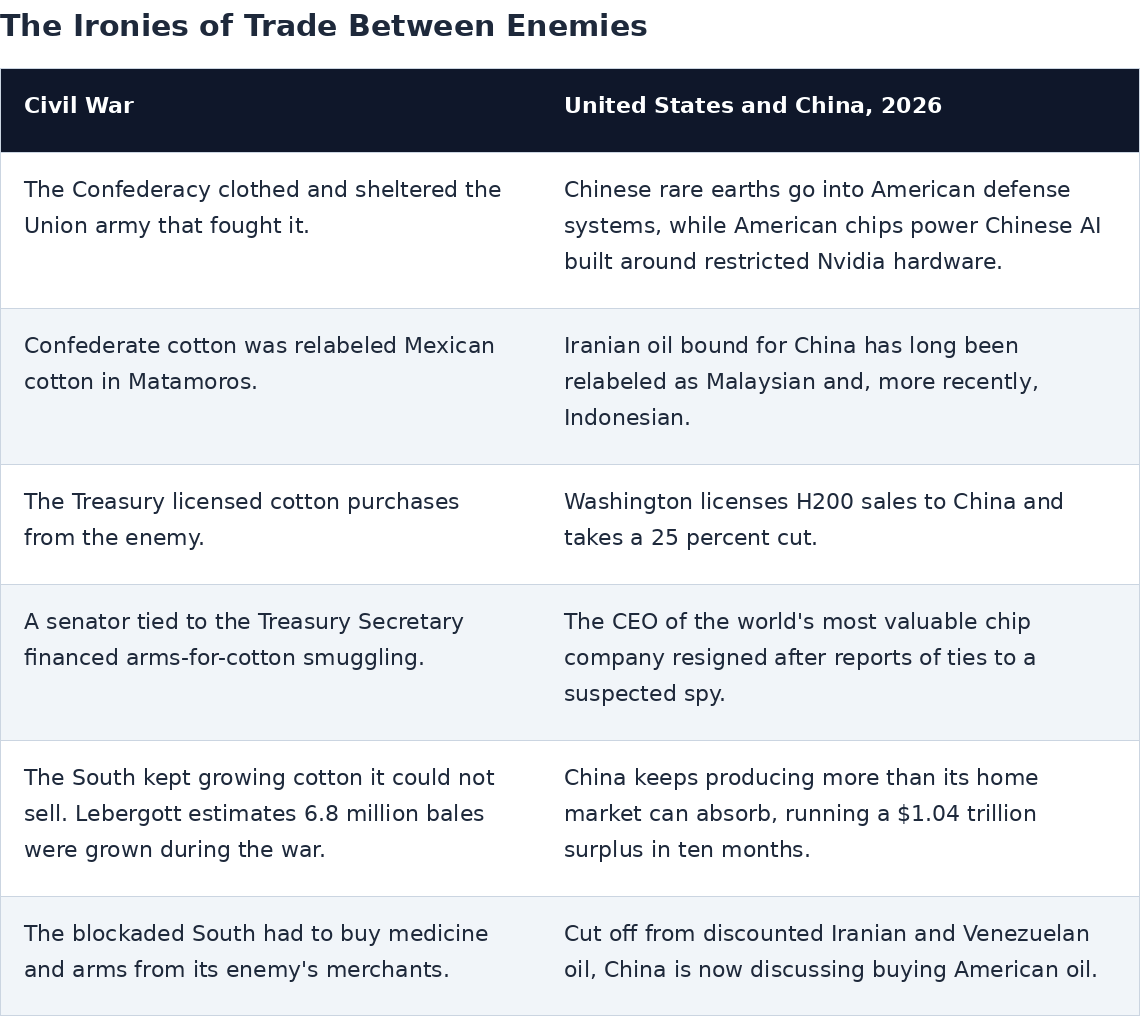
After the North and the South declared trade with each other to be treason, a new supply chain grew up to replace the old one. Cotton from plantations in Louisiana and Texas moved overland to the neutral Mexican port of Matamoros. There, Northern and European agents bought it from Confederate merchants as "Mexican cotton" and shipped it to New York and the mills of New England. The finished goods went back south to the front. Shirts, underwear, sleeping bags, tents, knapsacks and even regimental flags were made in part from Southern cotton. In a literal sense, Montejano writes, the Confederacy was fighting a Union army it was also clothing and sheltering.
Both sides needed the trade. The Confederacy needed money for arms, ammunition, machinery and medicine, and the Union needed cotton for uniforms, bandages and hospital linens. Each side ignored, or pretended to ignore, how much it was trading with the other. Montejano's thesis, in the Wall Street Journal's summary, is that the war shows market forces overriding wartime loyalties.
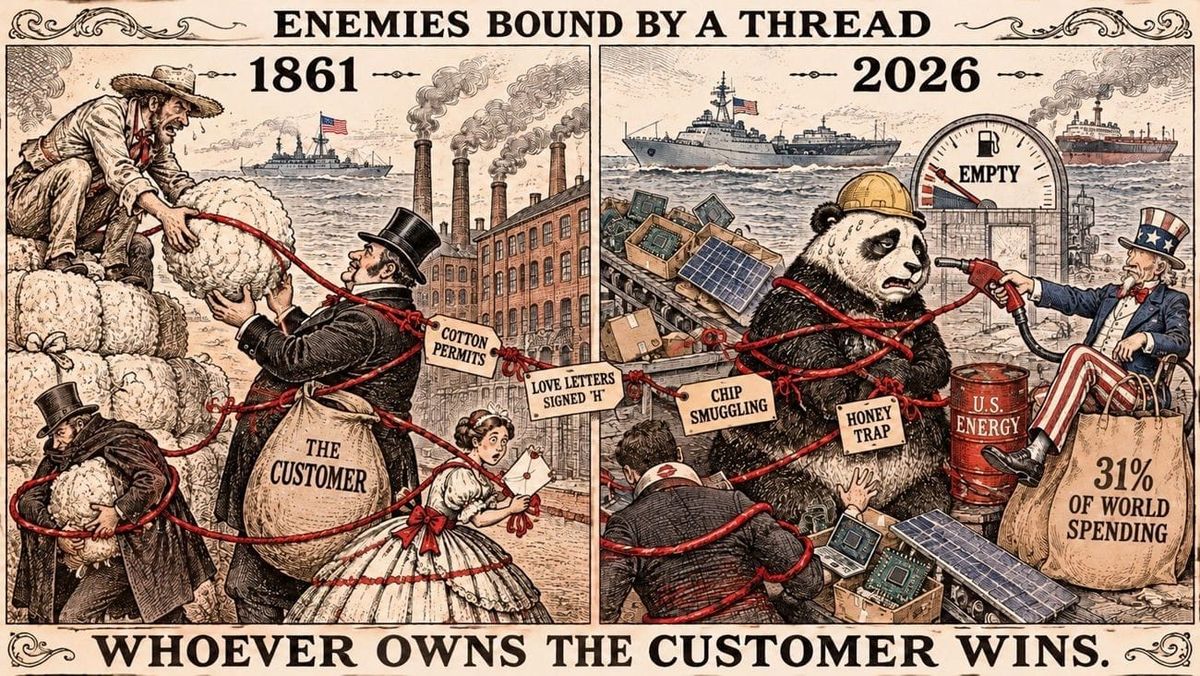
That thesis is the starting point for this essay. The United States and China are not at war, but they are adversaries bound together by trade neither can easily give up. Their relationship shows the same pattern the cotton trade did. There is licensed trade with the enemy, smuggling through neutral ports, scandal at the top, and suspected seduction aimed at those in power. Underneath is an economic divergence that each side increasingly describes in moral terms. It also faces the same question the South faced: what happens to a producer economy when the bigger customer, and the sea lanes, belong to the other side?
Two economies, one bargain
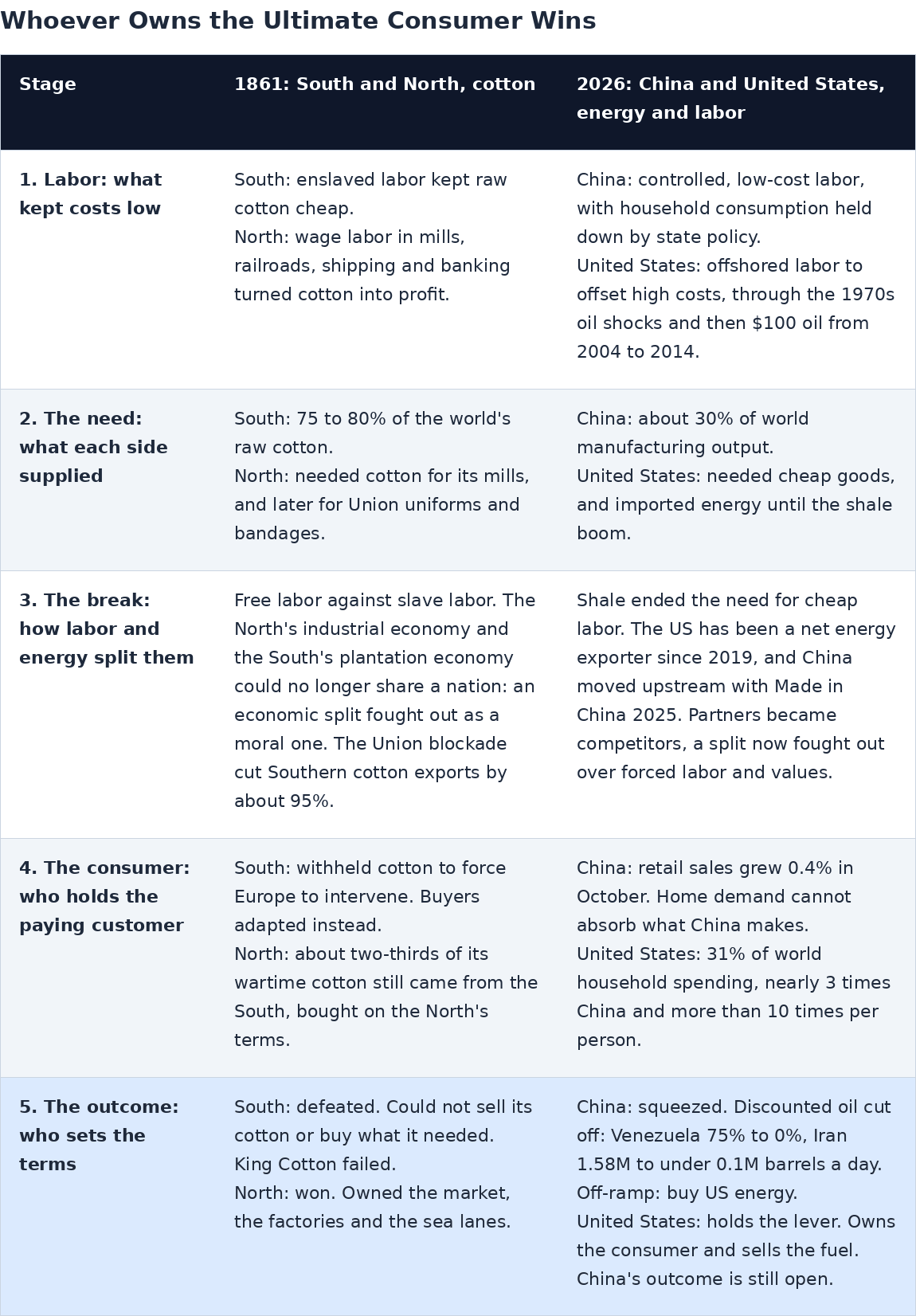
Before 1861, the South grew the raw material and others turned it into wealth. Southern plantations supplied 75 to 80 percent of the world's raw cotton, and the United States supplied roughly 80 percent of all cotton imported into Europe. Enslaved labor kept that input cheap. Northern merchants, shippers, bankers and mill owners profited from it, as did the mills of Lancashire, while looking away from how it was produced.
China played the same role on a larger scale after it joined the World Trade Organization in 2001. It became the world's production floor, run by a state-directed system that kept costs low through subsidies, controlled labor and suppressed household consumption. For two decades the arrangement benefited both sides, as the cotton economy had benefited both North and South.
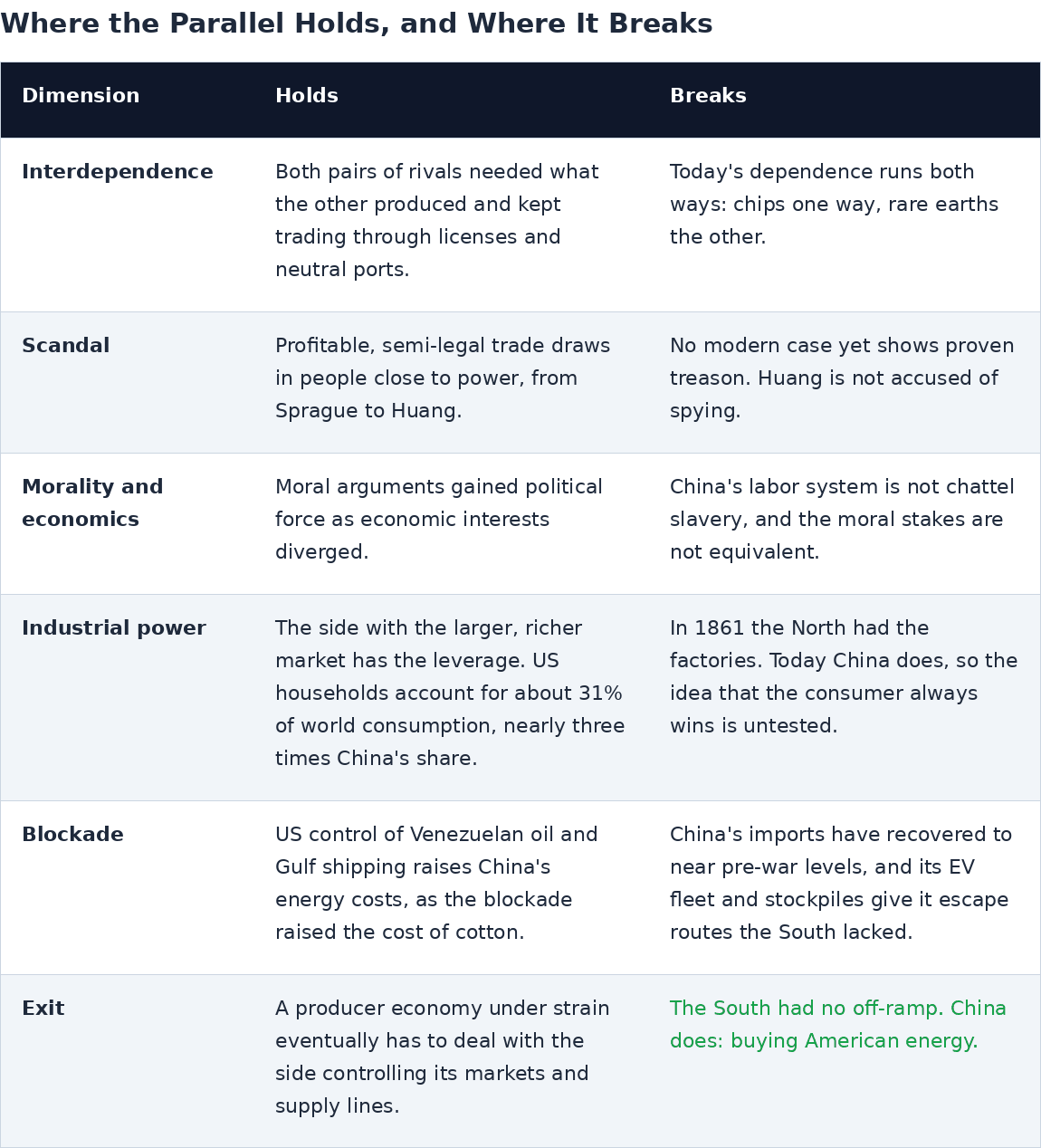
China's labor system is not chattel slavery, and an honest comparison should not claim it is. But one overlap is literal. The United States now bars imports from 190 entities it presumes use forced labor, under the Uyghur Forced Labor Prevention Act. The list includes the Xinjiang Production and Construction Corps, a state-run paramilitary farming conglomerate, and Xinjiang Junggar Cotton and Linen. In both centuries, the moral problem in the cotton supply chain eventually became a legal and political one.
Why the West needed a factory floor
Analysis. The case that America needed China is at bottom about costs. The oil shocks of the 1970s ended the era of cheap energy on which postwar American manufacturing had been built, and stagflation squeezed industrial margins for a decade. Oil prices then eased through the late 1980s and 1990s, so energy alone did not send factories abroad. The bigger drivers were the wage gap, container shipping, information technology and the trade deals that culminated in China's WTO entry. Energy mattered most later. From roughly 2004 to 2014, high oil prices raised American costs just as Chinese labor was cheapest, and that deepened the dependence. Low-cost Chinese labor became the main way to hold down the cost of goods for American consumers.
The shale revolution broke that logic. The United States has been a net total energy exporter since 2019, set a record for energy exports in 2025, and is the world's largest exporter of liquefied natural gas, on Energy Information Administration data. China is the reverse. It is the world's largest crude importer, about 90 percent of that crude arrives by sea, and imports cover roughly 70 percent of its oil needs.
Beijing saw the bargain changing. In 2015, the new Xi administration launched Made in China 2025, a plan to move the economy out of low-cost assembly and into advanced technology across ten sectors. By most measures it worked. A US congressional commission found that China met or exceeded many of its targets, and that China-based firms produced nearly a quarter of global export growth in the targeted sectors from 2015 to 2023. China now accounts for about 30 percent of global manufacturing output. It fell short mainly in advanced semiconductors and commercial aircraft.
Analysis. The success of that move upstream is what makes today's conflict different from a simple trade dispute. China stopped being a supplier of cheap inputs to American industry and became a competitor in every industry that matters. That turned complementary economies into rival ones.
When economics wears the mask of morality
The Civil War is usually remembered as a moral war, and for the four million people held in bondage it was a moral question above all. But a long line of historians has argued that the conflict was also, at bottom, a collision between two economic systems. Charles and Mary Beard called it the "Second American Revolution." In their account, the war was a "social war" that ended with "the unquestioned establishment of a new power in the government." To Beard, North and South were two economies, two civilizations, whose interests became impossible to reconcile.
The Beard thesis has well-known weaknesses. It downplayed slavery and the moral and constitutional questions around it, and later economic historians showed that the war slowed industrial growth rather than speeding it up. But recent scholarship has revived its core insight. The economic changes in the Northern states, built on wage labor, railroads and manufacturing, were a major cause of the political collapse of the 1850s.
Analysis. The most defensible version of the argument is not that morality was a cover story. It is that slavery was itself the economic system, so the moral and economic conflicts were the same conflict. What changed over time was the political force behind the moral argument. Northern opposition to slavery grew strong once the spread of slavery threatened the free-labor economy of the North and West. The abolitionist case had been made for decades. It became decisive only when it lined up with economic interest.
Analysis. The US-China story follows the same arc. Washington knew a great deal about China's labor practices, surveillance and industrial subsidies in 2005, when the partnership was at its most profitable. The moral case against Beijing hardened into law and policy only after the two economies stopped complementing each other. That happened once China had moved upstream into American industries and the United States no longer needed imported energy or cheap labor as badly. The human-rights concerns are real. But as in the 1850s, their political weight rose and fell with economic interest.
Trading with the enemy
The Matamoros pipeline
International law prevented the Union from blockading Mexican waters, including the Rio Grande. The result was a boom along the border that Texans called the Cotton Times. As many as 70 European freighters at a time, along with a few from New England and New York, waited off the tiny Mexican village of Bagdad to exchange arms, medicine, coffee and dry goods for cotton. Bagdad grew from a seashore outpost into a town of 25,000. More than 20,000 speculators from the Union, the Confederacy, Britain, France and Germany crowded into Bagdad and Matamoros. Cotton that cost about three cents a pound in the Confederacy could fetch fifty cents a pound in gold there.
A Union general described Matamoros in 1865 as being "to the rebellion west of the Mississippi what New York is to the United States." It was, he said, the rebellion's "great commercial and financial center, feeding and clothing the rebellion, arming and equipping" it.
Much of the trade did not need smuggling at all. Lincoln's Treasury appointed agents to buy cotton from occupied territory, a policy the president backed even when it seemed to work against military goals. The generals complained, but the trade went on. One congressman said that "each bale of cotton costs twenty coffins." In Texas, the Confederacy's own Cotton Bureau authorized agents to sell cotton to Union buyers near Shreveport, from where it moved to New Orleans. The economic historian Stanley Lebergott estimated that about two-thirds of the 1.8 million bales consumed in the North during the war were smuggled in from the South.
The modern pipeline
The modern version runs in both directions. Washington sells China the critical capability, advanced AI chips, and China sells the United States the critical input, rare earths. Each side licenses, taxes and polices the trade, and each side leaks.
Since January 2026, the United States has licensed Nvidia H200 sales to China case by case and takes a 25 percent cut. Restricted chips still reach Chinese users through third countries. Chinese firms rent computing power in data centers in places like Malaysia's Johor region; as one investor told AFP, controls "restrict where a chip is shipped, not who uses it." Southeast Asia is today's Matamoros. Last month a university with deep ties to China's army bought H200 chips despite being on the US blacklist, and Reuters found about $3.2 billion in Chinese AI projects built around restricted Nvidia chips.
China works its lever the other way. Its licensing of seven heavy rare earths has stayed in force since April 2025. Its broader October 2025 controls are suspended only until January 10, 2027, which keeps the threat alive in short steps. It has also barred exports to specific American firms, including MP Materials. Washington's response mirrors Lincoln's Treasury agents. The Pentagon took a roughly 15 percent stake in MP Materials and guaranteed a price floor of $110 per kilogram for a key magnet input, when the price inside China was under $60.
There is also a twist the Union never faced: China is refusing to buy. About 600,000 licensed H200s sit in Hong Kong because Beijing will not approve large-scale imports, preferring to push its companies onto domestic chips.
Scandal at the top
When trade with the enemy is profitable and only partly legal, the people closest to power are the ones best placed to profit. That happened in the 1860s and it is happening now.
Senator Sprague's Texas adventure
William Sprague was governor of Rhode Island, then a senator, and the son-in-law of Treasury Secretary Salmon P. Chase. His family firm ran the world's largest calico-printing works, and the blockade threatened to starve it of cotton. He pressed Chase for a trade permit, arguing that "the cotton is of more value to us than money to the enemy." Starting in December 1862, Sprague financed a Texas operator named Harris Hoyt, who shipped arms and other contraband through Matamoros to Confederates in exchange for cotton bound for New England. When the blockade caught one shipment in late 1864, Sprague's partners confessed. Secretary of War Stanton received the file weeks before Lincoln's assassination and never acted. A later Senate inquiry cleared Sprague, but key papers, including Hoyt's confession, were missing. He was never convicted, though the exposure eventually ruined him socially and politically.
The general's father
Even Ulysses S. Grant's family was drawn in. His father, Jesse, agreed to help Cincinnati clothiers get cotton permits from his son in exchange for 25 percent of the profits. Days after Grant sent them home, on December 17, 1862, he issued General Orders No. 11, expelling all Jews from his military district. Lincoln revoked it. The lesson carries forward. Scandal around the trade tends to produce a sweeping, overbroad crackdown aimed at the wrong target.
Nvidia
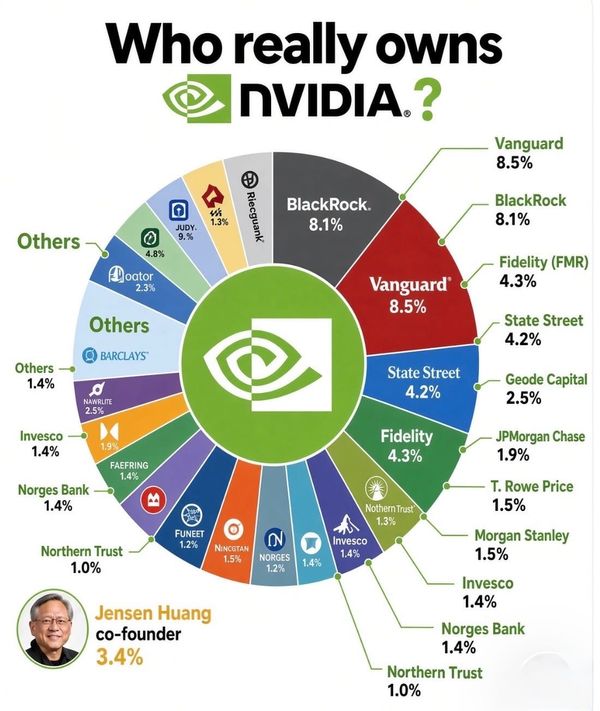
Jensen Huang lobbied Washington for years to allow chip sales to China, arguing that restrictions only help Chinese rivals grow. That was essentially Sprague's argument, that the trade is worth more to us than to the enemy. On November 12, Huang stepped down as Nvidia's chief executive. He did so days after reports of an affair with an executive at a Singapore-based technology company, a woman US authorities suspect of spying for Beijing, Reuters reported. AFP reports that US authorities also suspect her company of smuggling AI chips into China. Lawmakers of both parties are now pushing to attach new chip-export restrictions to the annual defense bill.
The honey trap
Every adversarial trade relationship produces a second, quieter market: access to the people who make the rules. The oldest way to buy that access is romance.
Rose Greenhow and the senator
Rose O'Neal Greenhow was a Washington socialite who ran a Confederate spy ring in 1861. Her admirers included Senator Henry Wilson, chairman of the Senate Military Affairs Committee and later Grant's vice president. When the detective Allan Pinkerton arrested her, he seized love letters signed "H." One read: "spies are put upon me but I will try to elude them tonight." After the Union defeat at Bull Run, rumors spread that Wilson had leaked the invasion plans to her. General McClellan complained that she "knew my plans, and has four times compelled me to change them." Wilson was never shown to have passed secrets, and biographers note the handwriting does not match his; it may have belonged to his committee clerk.
The modern pattern
Recent cases follow the same template.
Christine Fang. From 2011 to 2015, Fang, whom US officials believe worked for China's Ministry of State Security, built ties with rising politicians through fundraising, networking and romantic or sexual relationships with at least two Midwestern mayors. She helped raise money for the campaign of Eric Swalwell, then a rising California politician who went on to serve in Congress, and placed an intern in his office. She left the country abruptly in 2015 amid an FBI investigation. FBI records declassified in August 2026 show Swalwell acknowledged a physical relationship with her. He was never charged, the FBI found no evidence that he committed federal corruption violations, and his attorney has called the release of the records politically motivated.
Katrina Leung. A 2006 Justice Department report found that FBI agent James J. Smith had an 18-year secret affair with Leung, an informant suspected of passing information to China. It found that she gave classified information to China without authorization.
Benjamin Pierce Bishop. In 2014 the defense contractor and former Army lieutenant colonel pleaded guilty to giving classified information to a Chinese woman he was romantically involved with. He was sentenced to more than seven years.
The Huang case fits this template on its face. According to the New York Times, as summarized by Axios, US authorities suspected China's Ministry of State Security of recruiting the woman, Alice Huang. They suspected her task was to gather information about Jensen Huang and influence his feelings about selling AI chips to Chinese firms. Nvidia's board said it had no reason to believe company secrets or national security were compromised, and China denied the allegations. Huang himself has not been accused of spying.
Analysis. On the evidence so far, Huang's case looks more like Wilson's than Sprague's: proximity and suspicion, not proof. But the political effect may matter more than the legal outcome. In 1862, scandal around the cotton trade led to General Orders No. 11. In 2026, it is speeding up a congressional crackdown on chip exports that had been stalled.
The ironies of trade between enemies
Trade between adversaries produces ironies that neither side can admit while the conflict lasts.
The blockade, then and now
The Union did not defeat the South by out-trading it. It strangled it. Lincoln proclaimed a naval blockade a week after Fort Sumter, and over four years it tightened from a paper line into a noose. Cotton exports fell about 95 percent, from 10 million bales in the three years before the war to roughly 500,000 during the blockade. The blockade never stopped everything. Its real power was cost. By the middle of the war, shipping cotton to Europe cost nearly 50 cents a pound, about ten times the price of the cotton itself. By the last two years of the war, fewer than one in four attempts to run the blockade succeeded.
The Confederacy made the strategic error of believing its product made it indispensable. Its leaders held cotton back in 1861, expecting Britain and France to intervene to restore supply. Prices rose, but the Union blockade cut off delivery at the higher price, and by 1863 both European governments had decided to ride out the shortage rather than intervene.
Analysis. Something similar is now happening to China's energy supply, though not in the way the word blockade suggests. The United States has not cut China off from oil. It has cut China off from cheap oil and made itself the gatekeeper on two of the supply lines Beijing relied on for discounted barrels.
Venezuela
After a US naval blockade of sanctioned Venezuelan tankers in December 2025, a US military operation captured Nicolás Maduro in Caracas on January 3, 2026. Energy Secretary Chris Wright said the United States would control Venezuelan oil sales "indefinitely," with the revenue held in accounts controlled by the US government. The State Department reports that it handled $12.26 billion in Venezuelan resource revenues from January through September. In August and September, Washington and Caracas agreed a deal that gave a new company, North American Blue Energy Partners, control of fields holding about 65 billion barrels of proven reserves. Some of those fields were previously run by or partly owned by Chinese firms. A US government stake of 35 percent has been reported.
The effect on China is stark. In 2025, China took about 75 percent of Venezuela's crude exports. In 2026, according to the US Energy Information Administration, Venezuela has exported no crude to China, and the United States has become its largest customer. Washington says China may still buy Venezuelan oil, but at international prices rather than the deep discounts it once enjoyed.
The Strait of Hormuz
The US-Israeli war on Iran, which began in late February, effectively closed the Strait of Hormuz and choked off Middle Eastern exports of crude and fuel. Since mid-July the United States has blockaded Iran's ports. American officials, including Defense Secretary Hegseth, say they control the strait, and Iran continues to attack vessels in and near the waterway almost daily. As of mid-November the strait is contested rather than sealed. Ships cross mainly through a US-coordinated southern corridor in Omani waters, while Iran runs a permit system on a northern route. Visible commercial traffic is a small fraction of normal, though many ships now cross with their transponders off. US Central Command said on November 11 that its forces were keeping the strait open and enforcing the blockade. Freight from the Gulf to Asia has reportedly reached as much as $40 a barrel, against a historical average of about $4. That tenfold markup echoes the cost of running the cotton blockade.
Iran had been China's most important source of discounted oil. China's imports of Iranian crude ran at 1.24 million and 1.58 million barrels a day in January and February, Reuters reported. By October, deliveries had fallen below 100,000 barrels a day. China's independent "teapot" refiners, the main buyers of sanctioned Iranian oil, are scrambling for replacements. Iran had supplied up to about 13 percent of China's seaborne imports. Some teapots paid premiums of up to $18 a barrel over Brent for Iraqi crude for November delivery, and at least 50 tankers carrying mainly Iranian crude sit stranded along China's coast.
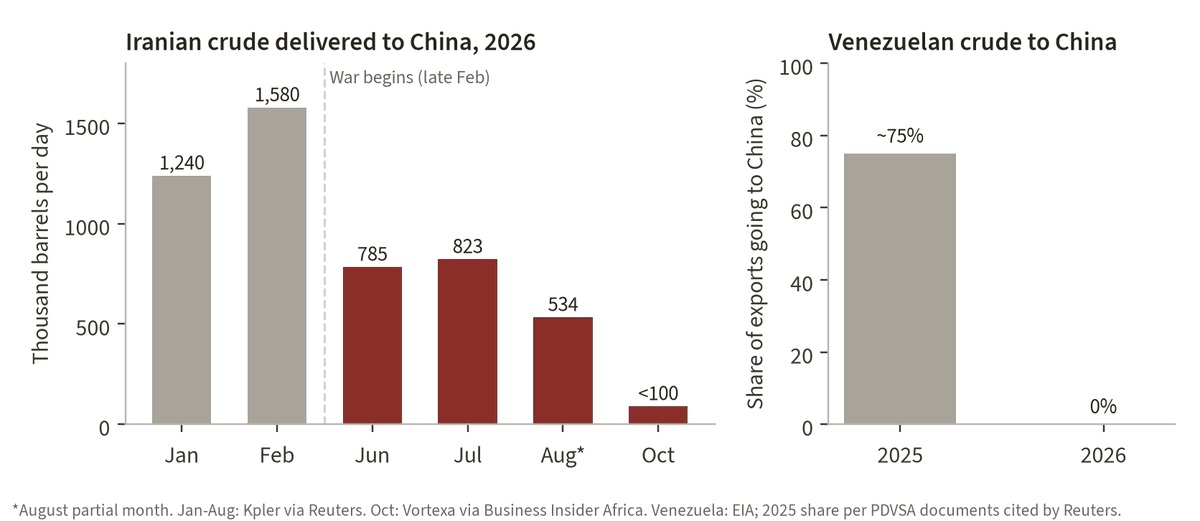
China has coped, which is the main caution against calling this a stranglehold. It drew down its stockpiles and cut fuel exports. By October its crude imports had recovered to 9.88 million barrels a day, with arrivals from the Middle East back to pre-war levels at 4.65 million barrels a day. Its electric-vehicle fleet already displaces about 1.35 million barrels of oil a day. The South had no comparable escape routes.
Analysis. Even so, the direction is clear. The oil China is still getting costs more, travels farther, and passes through sea lanes where the US Navy decides what moves. That is what the blockade did to the South's cotton: it did not stop every bale, but it moved the profit from the seller to whoever controlled the route.
The limits of a command economy
The Confederacy's deeper weakness was its economic model. A system built to produce one export in huge volume, at the lowest possible cost, had no fallback when that export could not reach its buyers. Planters kept growing cotton they could not sell, and most of the wartime crop was hoarded or destroyed.
China's model shows a similar inflexibility. Its exports rose 35.2 percent in October from a year earlier. The surplus for the first ten months reached $1.04 trillion, the fastest the country has ever reached that mark. Much of that is AI hardware: semiconductor exports rose 111 percent in the first ten months. At home, the picture is the opposite. October retail sales rose only 0.4 percent, and fixed-asset investment fell 8.1 percent for the year to date. Consumption's contribution to growth is at a 13-year low.
The price data show the squeeze. Factory-gate prices rose 5.7 percent in October, the fastest in more than four years, driven by energy and raw materials, while core consumer inflation eased to 0.8 percent. Within the producer index, mining prices rose 27.9 percent while consumer-goods prices fell 0.1 percent, on National Bureau of Statistics data.
Analysis. In plain terms, the cost of what Chinese factories buy, especially energy, is rising fast, while the prices they can charge Chinese households are flat or falling. Before the war, producer prices had fallen for more than three years while exports kept rising. A country that sells more and more for less and less, while paying more for fuel, is being squeezed from both sides.
The most valuable customer
The United States is by far the largest, richest and easiest-to-reach consumer market in the world, and nothing else comes close. In 2024, American households spent $19.90 trillion, about 31 percent of the world's $63.19 trillion in household consumption, on World Bank data. That is nearly three times China's $7.49 trillion and about nine times Japan's $2.22 trillion. Stephen Roach, working from Commerce Department and World Bank data, puts the 2023 US share at 31.3 percent. Put another way, a country with about 4 percent of the world's people buys nearly a third of everything the world's households buy.
The prize: 31 percent. US households spent $19.90 trillion of the world's $63.19 trillion in household spending in 2024. That is nearly 3 times China's market and about 9 times Japan's. Per person, Americans spend more than ten times what Chinese households do.
Analysis. Size is only half of it. The US market is also the most profitable and the easiest to reach. Spending per person is more than ten times China's, about $58,000 against about $5,300, a ratio derived from the household totals above and the two countries' populations. So each American customer is worth far more, and American buyers pay premium prices for brands, quality and speed. A seller reaches 340 million affluent buyers through one language, one currency, one set of national rules, the world's deepest retail and e-commerce networks, and dollar payments that settle instantly. No other market offers that combination of scale, wealth and access. Europe is rich but split across 27 sets of national politics and many languages. China is large but poorer per person, protected, and run by a state that decides who wins. That is why access to the American consumer has been the most valuable thing Washington can grant or withhold.
Analysis. Think of the American consumer as a superstar athlete or celebrity. Nobody is surprised when a superstar commands a premium, because the audience cannot be found anywhere else at the same scale or the same cost. Tariffs work the same way: they are an access fee for reaching that audience. The replacement arithmetic shows why exporters keep paying it. To replace the spending of one American consumer, a seller would need the spending of about eleven Chinese consumers, spread across a poorer, more protected and more state-managed market. The rest of the world combined is larger, but it is split into dozens of currencies, languages and regulatory systems, each with its own cost of entry. So foreign producers and governments tend to absorb the fee through lower prices, export subsidies or weaker currencies rather than give up the market. This is the leverage the North held over the South. The cotton economy could sell elsewhere, but nowhere else paid as well. The United States now combines that market with energy independence, and no other buyer can offer both.
But Washington's direct leverage is narrower than that share suggests. The US share of China's exports fell from 19.2 percent in 2018 to about 10 percent in January to September 2026. China's surplus with the European Union over the first ten months, more than $310 billion, now exceeds its surplus with the United States, about $266.5 billion. What matters is that the rest of the world is starting to follow Washington's lead. Mexico raised tariffs on 1,463 product categories and on Chinese cars to 50 percent. India leads the world in trade-defense cases against China, and the EU cut its steel quota by 47 percent with a 50 percent tariff above it. A new EU arrangement could halve Chinese electric-vehicle imports, and Brazil's EV tariff has reached 35 percent.
Analysis. This is the modern equivalent of the blockade, and it works the same way: not by sealing every port, but by raising the cost of every sale. In the Civil War, the decisive moment was when Britain and France chose not to break the blockade. Today's decisive question is whether Europe, India, Mexico and Brazil keep raising their own barriers. If they do, China's export machine has nowhere left to send its surplus at a profit.
The off-ramp: American energy
The South never had an off-ramp. The Union had nothing it wanted to sell the Confederacy except surrender. This is where the US-China case departs from history in a way that could matter a great deal.
China's vulnerability is energy that passes through chokepoints it does not control. The United States has become the world's largest energy exporter. After their May summit in Beijing, the White House said Xi "expressed interest in buying more U.S. oil to reduce China's dependence on the Strait of Hormuz." Chinese state media's summaries of the meeting did not mention energy purchases.
The terms of a deal are taking shape slowly.
Where trade stands. China has imported no US oil since May 2025 because of its own 20 percent tariff. Even at its 2020 peak, US crude was just under 4 percent of China's imports. China's imports of US LNG fell from 4.15 million tons in 2024 to 26,000 tons in 2025 after Beijing's tariffs.
The contracts already exist. Chinese buyers hold about 14 million tons a year of US LNG contracts, worth about $6 billion. They are still taking delivery under those contracts and reselling the cargoes elsewhere.
New deals despite the tariff. China Gas signed a 20-year agreement with Venture Global in September, starting in 2030, despite a 15 percent Chinese tariff on US gas. PetroChina is reported to be negotiating more than one million tons a year.
The summit framework. At their latest summit, the two sides agreed on a Board of Trade and reciprocal tariff cuts on about $30 billion of imports each. China committed to import at least 10 million tons of US coal a year in 2027 and 2028, and the trade truce was extended to January 10, 2027.
What is not yet agreed. On October 30, US trade officials left LNG off the tariff-relief schedule. The pact explicitly excluded crude oil and liquefied gas.
The next test comes soon. Trump, Xi and Vladimir Putin plan an unprecedented joint meeting on the sidelines of the APEC summit in Shenzhen, with the Iran war on the agenda, the Associated Press reported.
Analysis. The logic of the off-ramp is straightforward. For Xi, American oil and gas are insurance against chokepoints the US Navy now controls, and a way to show trading partners that China is narrowing its surplus. For Washington, energy sales turn military control of the sea lanes into commercial leverage, and they reverse the Civil War's arithmetic. The Union bought the South's cotton because it needed it. The United States would be selling China the fuel it needs, on American terms.
Analysis. There are good reasons Xi may hesitate. Beijing has spent two decades trying to avoid dependence on the United States for anything strategic. Buying American energy to escape American naval power swaps one vulnerability for another. China is also diversifying in other directions, toward Iraq, Saudi Arabia, Russian pipelines and electric vehicles. American politics adds uncertainty: Democrats won both chambers of Congress in the November midterms, and Congress is in a hawkish mood after the Nvidia scandal. An energy deal is a rational exit for an economy under strain. Whether it is a politically acceptable one, in either capital, is still open.
Where the parallel holds, and where it breaks
Conclusion: King Cotton and King Factory
The Confederacy went to war believing in King Cotton: the world needed its product so badly that no one would let it fail. That belief was wrong in a specific way. Buyers adapted, the blockade moved the profit to whoever controlled the route, and the South found it could neither sell what it made nor buy what it needed. Meanwhile its cotton kept leaking north to clothe the army that would defeat it, and the trade corrupted senators and embarrassed a general along the way.
China's version might be called King Factory: the belief that the world cannot do without its production. It is a stronger position than the South's. China has the factories, the technology and escape routes the Confederacy never had. But the pressures are recognizable. Its home market cannot absorb what it makes, and its other customers are raising barriers. Its discounted oil from Venezuela and Iran has been cut off by American power, and the sea lanes it depends on are patrolled by the US Navy. As in the 1860s, trade between the rivals continues through licenses, relabeling and middlemen. It produces scandals that drag in the powerful and harden politics on both sides.
Montejano's lesson is that market forces outlast wartime loyalties. The open question is which market force prevails this time. The South's story suggests that the side with the bigger customer base and control of the sea lanes sets the terms in the end. In 2026 that side is the United States. It holds the most profitable and easiest-to-reach consumer market on earth, nearly a third of all household spending and many times larger than any rival per person. The difference in 2026 is that Washington has something to sell its rival that the Union never offered the South: the energy to keep its factories running. If Xi takes that off-ramp, the US-China rivalry may end not with a defeat but with a dependence, the very outcome both sides have spent a decade trying to avoid.
Sources
The book and its review: Yale University Press on David Montejano's "A Red Badge of Cotton"; Roger Lowenstein's review in the Wall Street Journal, November 13, 2026.
Civil War history: Historical Statistics of the United States (Cambridge), including Stanley Lebergott's estimates; Encyclopedia.com on the Civil War blockade and on Rose O'Neal Greenhow; the Encyclopedia of Alabama on blockade running; Oxford Academic on business in the Civil War; the Texas State Library, the Texas State Historical Association and the UTRGV Civil War Trail on the Matamoros trade; HistoryNet and American Heritage on William Sprague; the National Park Service on General Orders No. 11; the CIA's history of Civil War intelligence; Mr. Lincoln's White House on Henry Wilson; Roger Ransom's essay on the economics of the Civil War at EH.net; David Blight's Yale lectures; and reference entries on the Union blockade, Matamoros, Charles Beard and Henry Wilson.
US-China trade, technology and labor: the Department of Homeland Security's UFLPA Entity List and its Federal Register notice; the Congressional Research Service and the US-China Economic and Security Review Commission on Made in China 2025; New Zealand's Ministry of Foreign Affairs and Trade; AFP and Reuters on Nvidia chip flows and Jensen Huang's resignation; 24/7 Wall St. on Reuters' $3.2 billion finding; the Straits Times, Strategic Raw Material and Columbia's Center on Global Energy Policy on rare earths and MP Materials; The Next Web on H200s in Hong Kong; Axios on Christine Fang and on suspected honey traps; reporting on the August 2026 declassified FBI records; CNBC, Reuters, ICIS, the USCC China Bulletin and China's National Bureau of Statistics on trade, prices and consumption; Statbase (World Bank data) and Stephen Roach on household consumption; Peacock Tariff Consulting, the Associated Press and KrASIA on trade barriers against China.
Energy: the US Energy Information Administration; the Council on Foreign Relations and CrudeOilPrice.org on China's oil imports; Marketplace, Business Insider Africa, CNN en Español, Swissinfo and The China Expert on Venezuela; Reuters, Hormuz.now, CBS News, INSS, Tilt, Business Standard and Investing.com on the Strait of Hormuz and Iranian crude; Reuters, Business Times, East Asia Brief, IndexBox and Basilinna on US energy sales to China; the Associated Press on the planned Trump, Xi and Putin meeting; Rystad Energy on the midterms.
This essay is historical and political-economy analysis. Passages marked Analysis are the author's interpretation. Statements about named individuals are attributed to published reporting and official records; Jensen Huang has not been accused of spying, Alice Huang has not been charged and China has denied the allegations, and Eric Swalwell was never charged. This is not investment advice.
The authors hold positions in securities mentioned and reserve the right to buy or sell shares at any time without notice.