Should You Buy, Sell or Hold NVIDIA Into Tonight's Earnings?

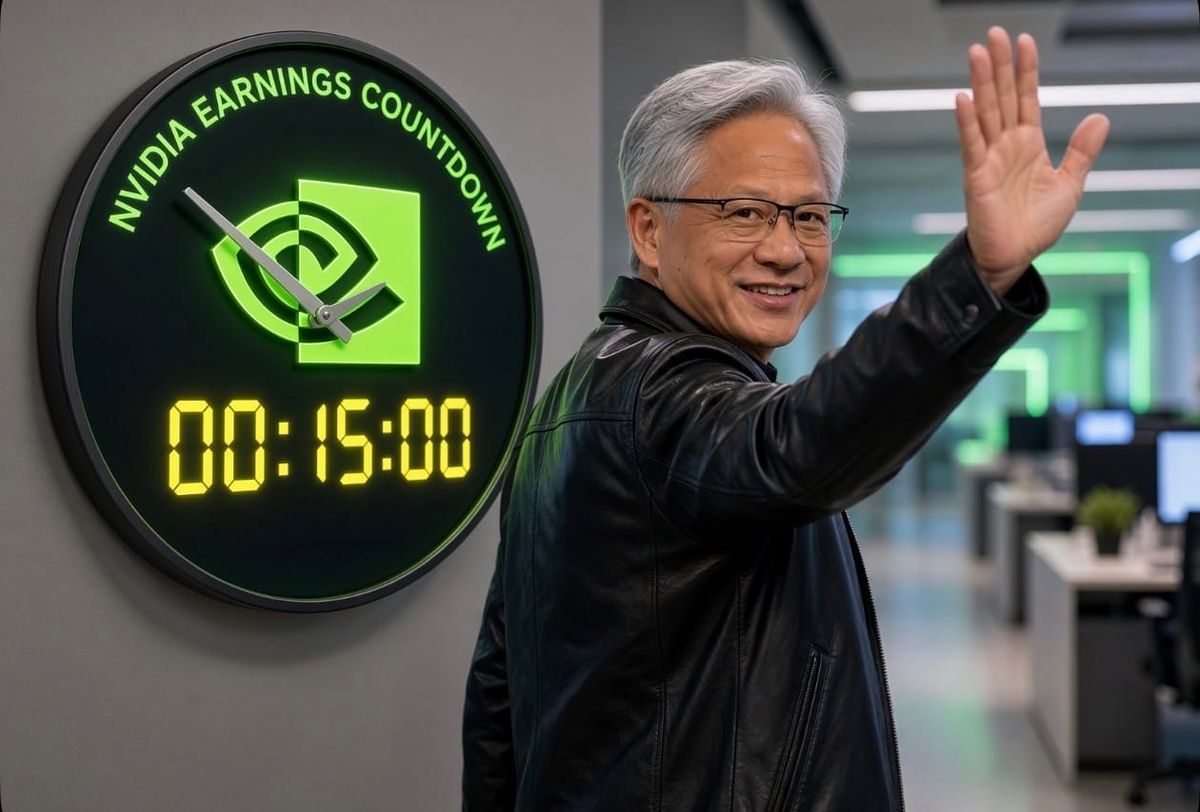
NVIDIA reports after the bell with a CFO in the CEO chair, a founder lobbying to come back, and options pricing a swing of more than $300 billion. The quarter is already in the books. The call is not.
The short answer
The numbers should be fine. The quarter closed on October 25, before the scandal broke, and NVIDIA has beaten revenue consensus in each of its last six reports. A miss on the headline would be a genuine shock.
The stock will trade on the Q&A, not the press release. For the first time, Colette Kress will answer the questions Jensen Huang used to take: China, customer commitments, the roadmap and who runs the company next.
Three things decide the reaction. Fourth-quarter guidance near or above the $125 billion consensus, a clear restatement of the roughly 70 percent growth outlook for next year, and no new disclosure on China or the investigation.
What to do. Index fund and 401(k) holders: do nothing tonight. Long-term holders: size the position for leadership risk, not for one print. New buyers: the stock is cheap on earnings for a reason, so buy in stages after the call rather than before it.
What does Wall Street expect tonight?
NVIDIA reports fiscal third-quarter 2027 results at about 4:20 p.m. Eastern, with the call at 5:00 p.m. In August, the company guided to $108 billion in revenue, plus or minus 2 percent, and a non-GAAP gross margin of 74 percent, plus or minus half a point, with no data center compute revenue from China in the outlook, Fortune reported. Here is where the Street sits going in.
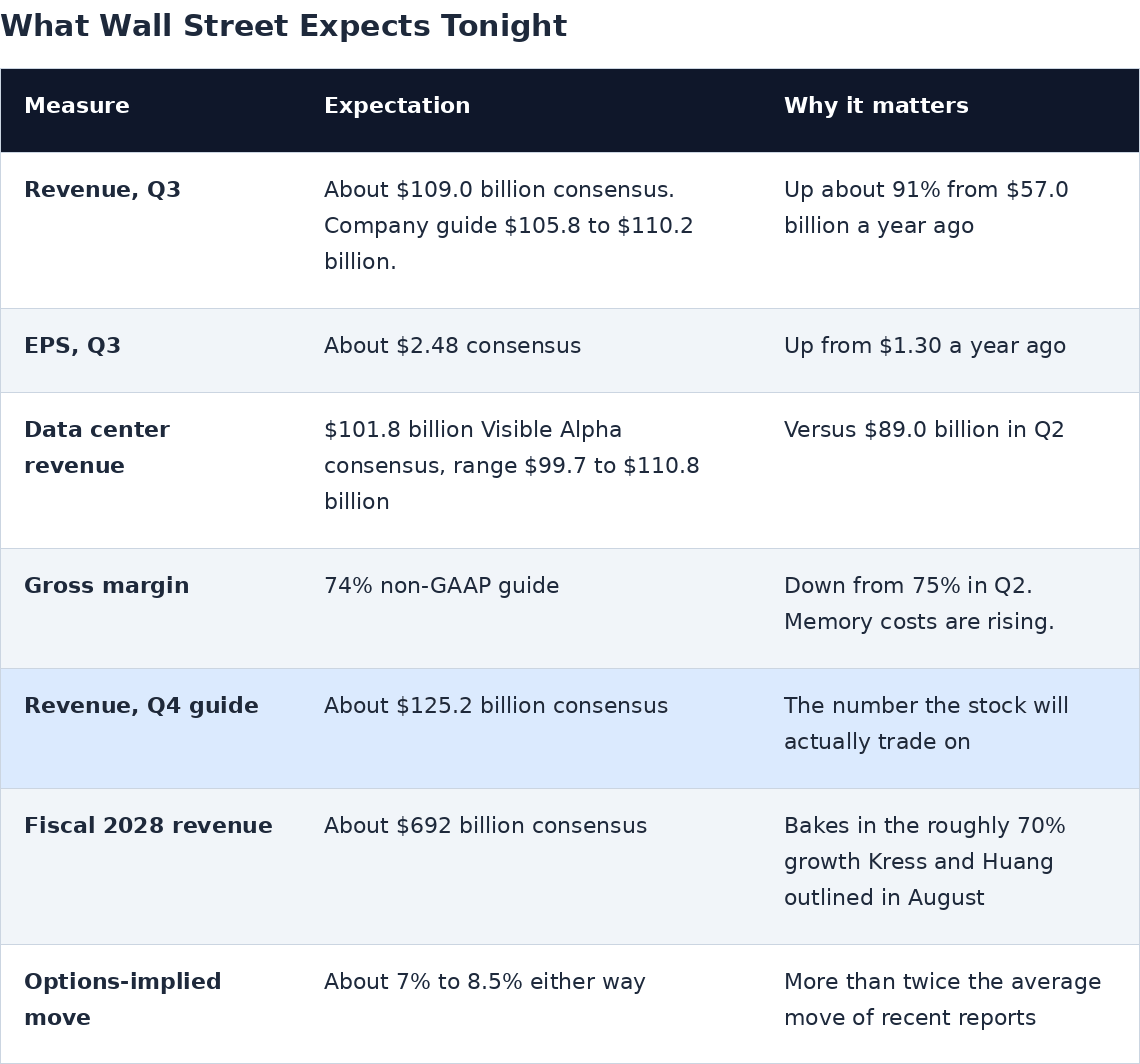
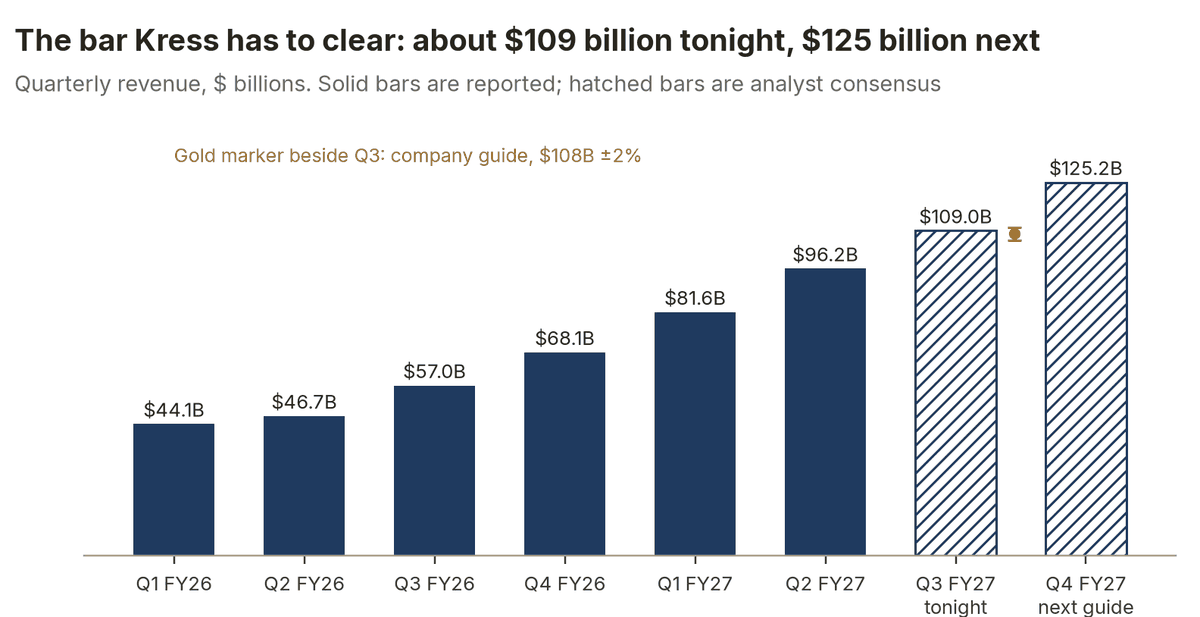
NVIDIA's record makes the headline the least interesting part of tonight. Revenue beat consensus in each of the last six quarters, and in August it beat by about $4.0 billion. If Kress repeats that, revenue lands near $113 billion. The more important line is next year. In August, Kress said she expected fiscal 2028 revenue to grow about 70 percent and called the outlook "supply constrained." Bloomberg Intelligence's Kunjan Sobhani told CNBC the best thing the company could do is "reiterate that and confirm that is still intact," if it is able to.
Has a stand-in ever saved a quarter before?
Once, famously. On Monday, January 17, 2011, a market holiday, Steve Jobs told Apple employees he was taking medical leave and handing day-to-day operations to Tim Cook. Apple reported earnings the next afternoon. The stock fell nearly 4 percent at the open and closed down 2.25 percent, CNNMoney reported. Then Apple posted a record $26.7 billion quarter and $6 billion of profit, and guided above the Street. On the call, Cook gave investors one line they kept: "Apple is doing its best work ever… Excellence has become a habit." The shares rose after hours.
The comparison is tempting and only half right. Cook was the operator who had already run Apple during an earlier leave, and Jobs stayed on as CEO. Huang is gone, the exit is tied to a national security investigation, and the founder is reportedly trying to return. Kress has more to prove than Cook did and less room to say it. The lesson that holds: a stand-in does not need to replace the founder on the call. She needs to show the machine still runs without him.
Why is this the most important call NVIDIA has ever held?
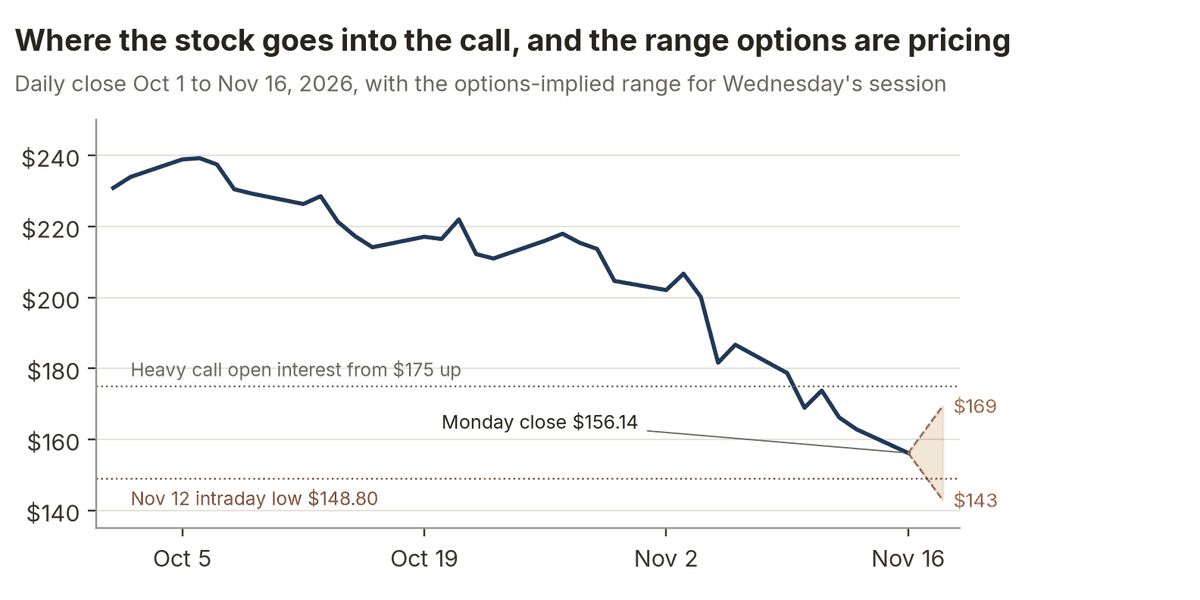
Because the stock now prices the person, not the product. NVIDIA closed Monday at $156.14, down 4.1 percent on the day and about 35 percent below its October 6 record of $239.24, its lowest close since July 1, 2025, CNBC reported. Market value fell from about $5.8 trillion in early October to about $3.9 trillion by Friday. The weekend made the picture murkier, not clearer.
A comeback campaign. The Financial Times reported that Huang discussed returning with confidants and that supporters were assembling a "war room" to lobby the board. Elon Musk signed a reinstatement petition and wrote that many supply deals "were a handshake with Jensen, not a written contract." President Trump said a return would not be a bad idea.
A board saying no. CNBC reported Monday that the board is not considering bringing Huang back. The stock hit its session low on that report. The petition has passed 190,000 signatures.
Washington tightened the screws. On Monday the Commerce Department issued an interim final rule to block Chinese companies' remote access to AI chips. This morning NVIDIA's board created a National Security and Export Control Oversight Committee, chaired by director Suzanne Nora Johnson.
The AI trade has a rival for attention. Anthropic is expected to begin trading Thursday, and Vanda Research expects record first-day retail buying.
How will the market react to Kress running the call?
The format change is the story. On past calls, Kress read the financials and handed the Q&A to Huang, who fielded everything from chip design to the shape of the AI economy. Tonight her written CFO commentary posts with the results, and the call includes prepared remarks and Q&A for analysts and institutional investors. NVIDIA has not said whether a permanent CEO candidate, or chair Harvey Jones, will join her.
Her credibility on numbers is not in question. She joined as CFO in 2013, when NVIDIA had $4.13 billion of annual revenue; it did $215.9 billion in fiscal 2026. S&P Global's Melissa Otto called the transition "essentially a regime change" and told Fortune that Kress has to be the steadying voice. Our read: Wall Street will accept a CFO who answers precisely and admits what she cannot say. It will punish one who reads from a script or sounds as though counsel is listening to every word. Tone will move the stock as much as any number.
Will the call cause panic?
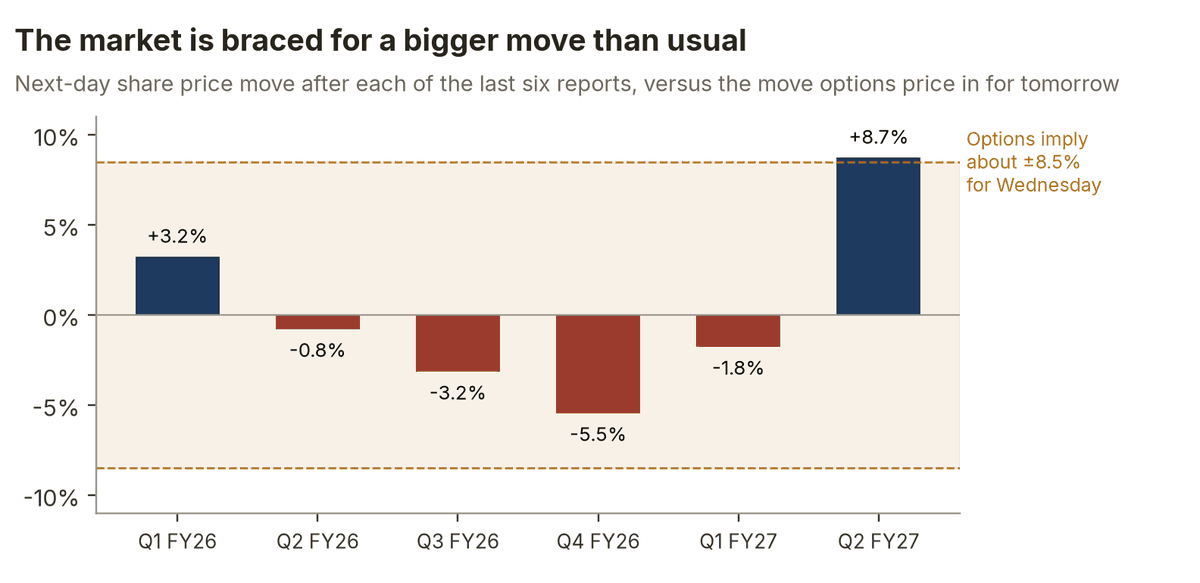
Not by itself, but positioning makes a bad surprise more dangerous than usual. Implied volatility hit 68 on Monday, against under 40 in early October. CNBC, citing SpotGamma, reported very few open puts at or below Monday's close, so a negative surprise would find many holders unhedged, while heavy call open interest from $175 up could cap a bounce. Susquehanna's Chris Murphy told Reuters investors have been trimming stock while buying calls and call spreads to play a rebound. That is a market leaning on hope, with a thin floor under it. The November 12 intraday low of $148.80 is the level to watch on the downside.
Can Kress win tonight?
Probably not on stage, and that is the point. No one can be Jensen Huang on an NVIDIA call. For years he answered analysts from the transistor up, connecting a question about memory supply to the economics of a data center and the future of computing in a single answer. Investors paid a premium for that voice. It left the building on November 12, and no finance chief, however capable, can bring it back in one evening.
That makes the setup lopsided. If the call goes well, the market will credit the business. If it stumbles, the market will blame the leadership gap. A standing ovation is not on the table; a let-down is. Investors should expect her to sound careful, scripted in places and unwilling to speculate on the roadmap or the search, and should not read that caution as bad news by itself.
What Kress can do is let the numbers and the disclosures carry the call. Tim Cook was nobody's idea of Steve Jobs, and his calm, specific call the day after Jobs' 2011 leave steadied Apple precisely because he did not try to imitate him. The same playbook applies here: precise guidance, direct answers on China and customers, and a plain admission of what she cannot yet say. The deeper problem is not her performance. It is that NVIDIA has lost its technical voice, and a CFO cannot fill that role. The sooner the board puts an engineering leader beside her, on the call or in the job, the sooner the stock can trade on the business again.
Will there be new disclosures in the Q&A?
Expect analysts to ask what Huang would never have been asked. These are the questions most likely to produce a new fact, and the answers that would help or hurt.
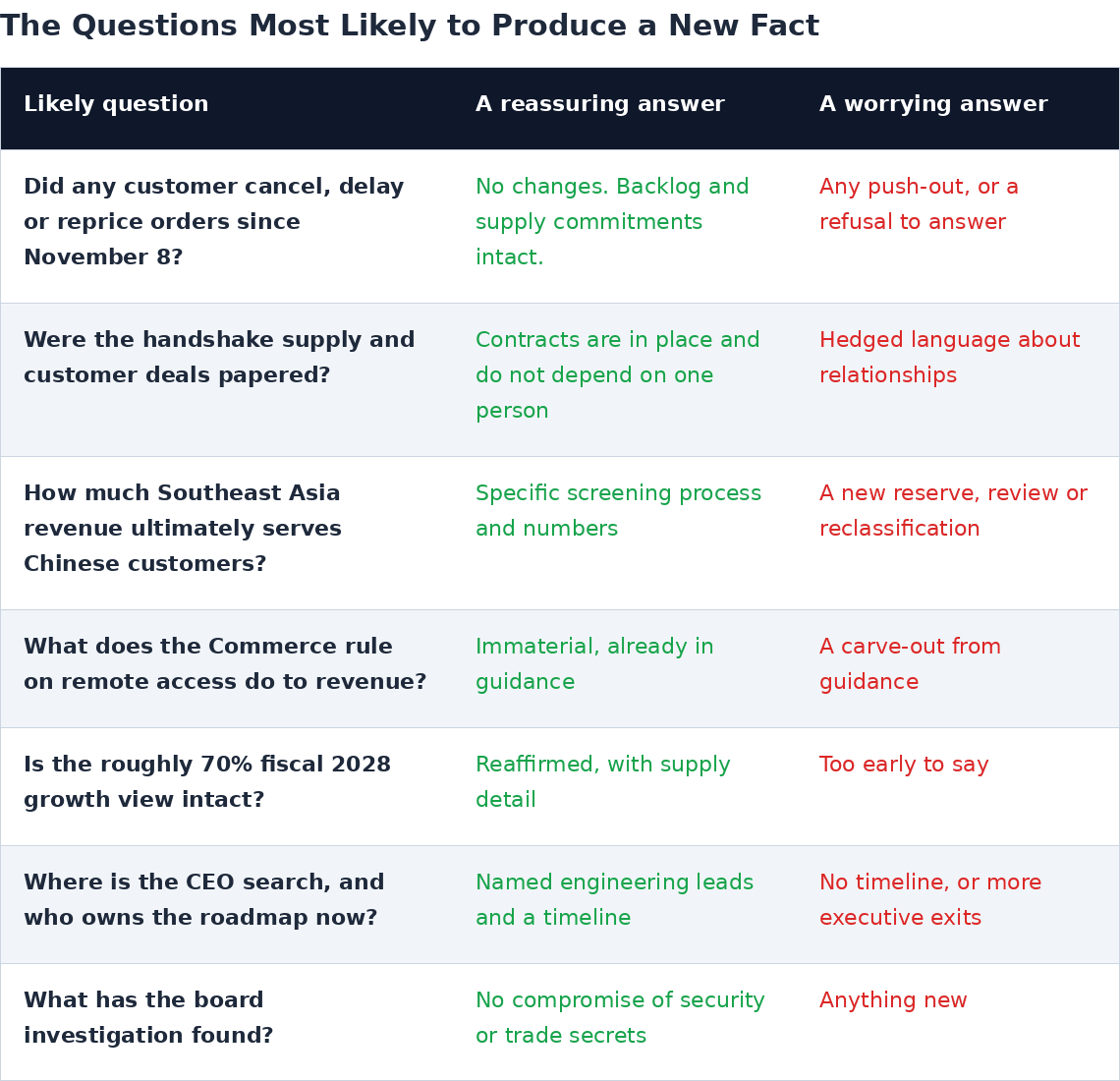
Two of these carry the most risk. China first: NVIDIA says it has essentially no data center sales from China, while short seller Culper Research has alleged that 20 percent of fiscal 2026 compute revenue was China-driven, and Treasury Secretary Scott Bessent asked on CNBC, "did Nvidia know their client?" Then the supply chain: NVIDIA has committed $145 billion to supply, including inventory purchase commitments and prepayments, and investors want to know how much capital it is also committing to customers. Any new number on either topic will move the stock more than a revenue beat.
Is the stock cheap enough to buy?
On earnings, yes. At Monday's close, NVIDIA trades at about 13 times consensus earnings for the next four quarters, against 18.3 times for the S&P 500 on FactSet's measure. Put another way, the market values the world's dominant AI chip company at a steep discount to the average stock. That discount is the price of key-person risk, regulatory risk and the chance that the earnings estimates themselves come down.
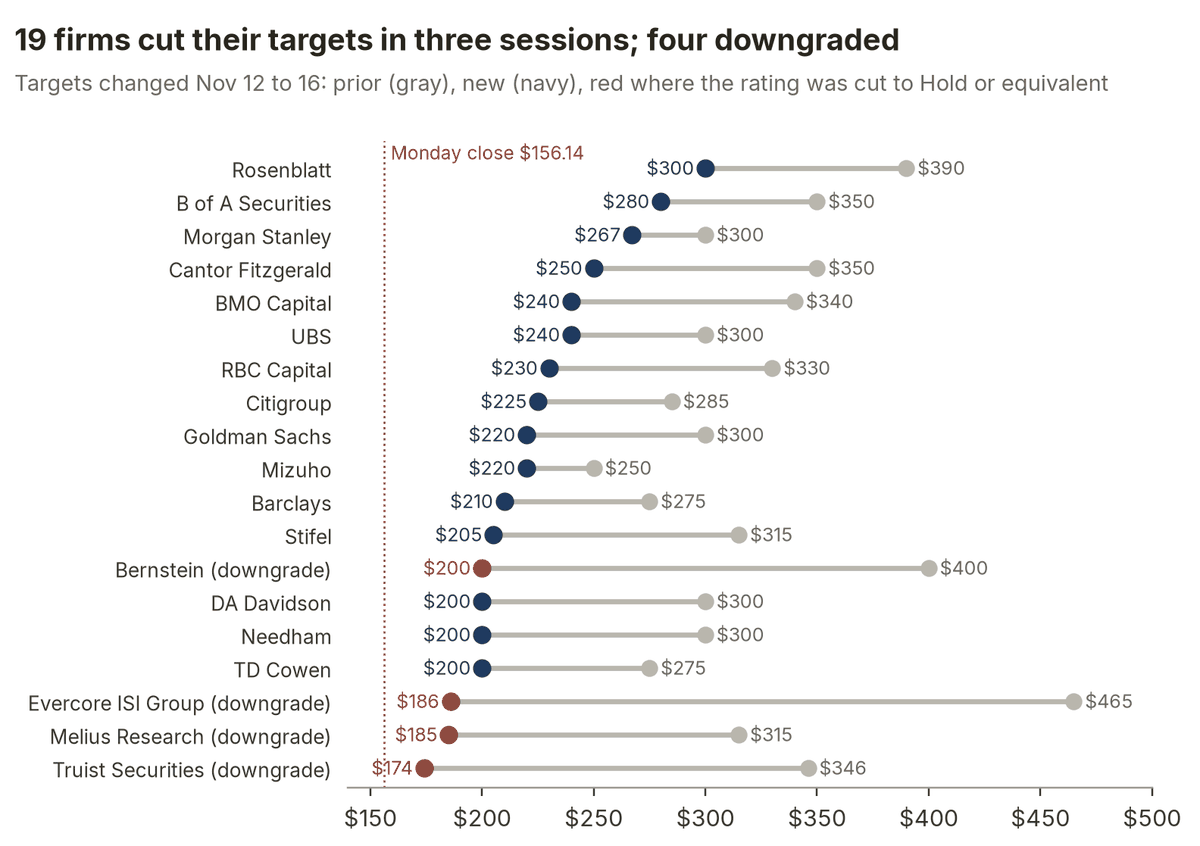
The Street has not walked away, but it has repriced. Since November 12, 19 firms have cut their targets. Four of them, Truist, Melius, Evercore ISI and Bernstein, downgraded to Hold or the equivalent. The median new target is $220, down from $315. Yahoo Finance counts at least 10 recent downgrades from Buy to Hold, many citing Washington scrutiny and succession uncertainty. Dan Ives of Yorkville called talk of Huang's return "ridiculous" given the legal and regulatory backdrop.
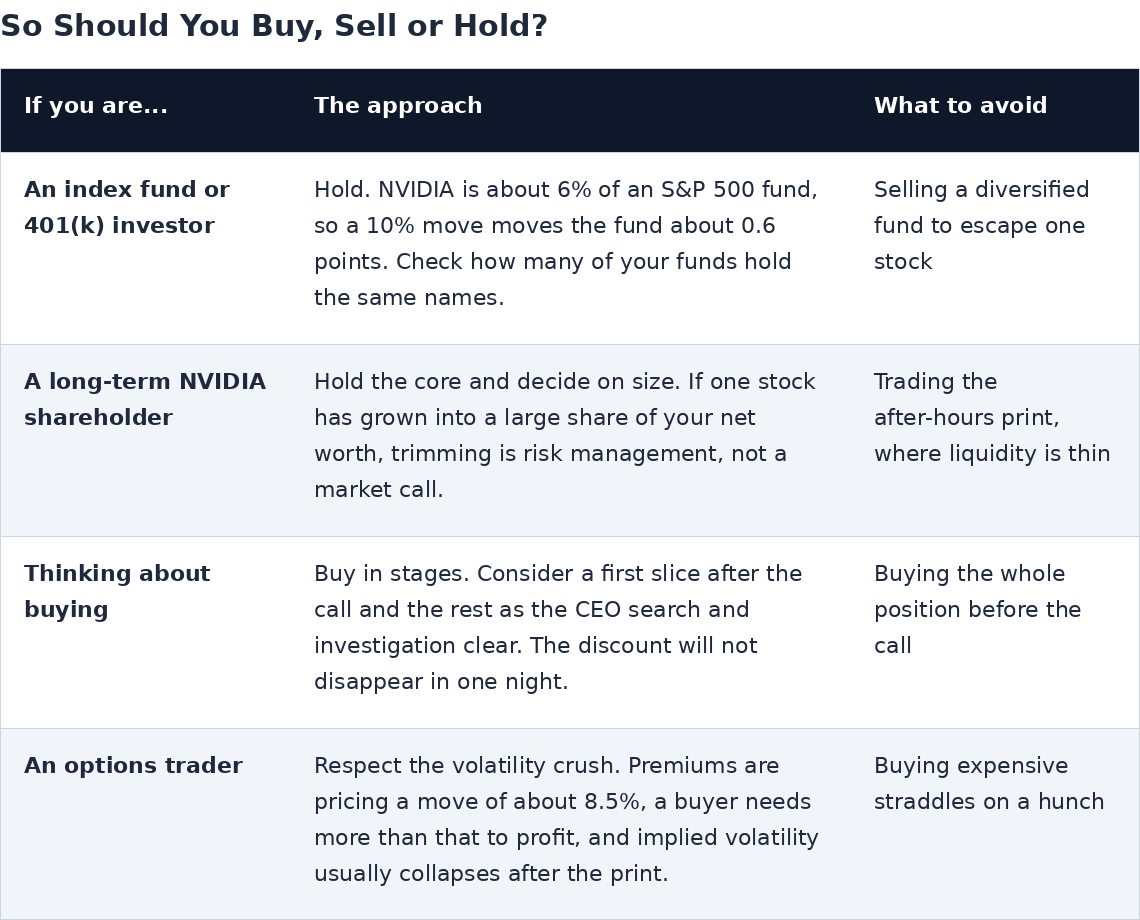
So should you buy, sell or hold?
That depends on what you own and why. The right approach tonight is different for an index investor, a long-term shareholder, a new buyer and a trader.
How we see tonight playing out
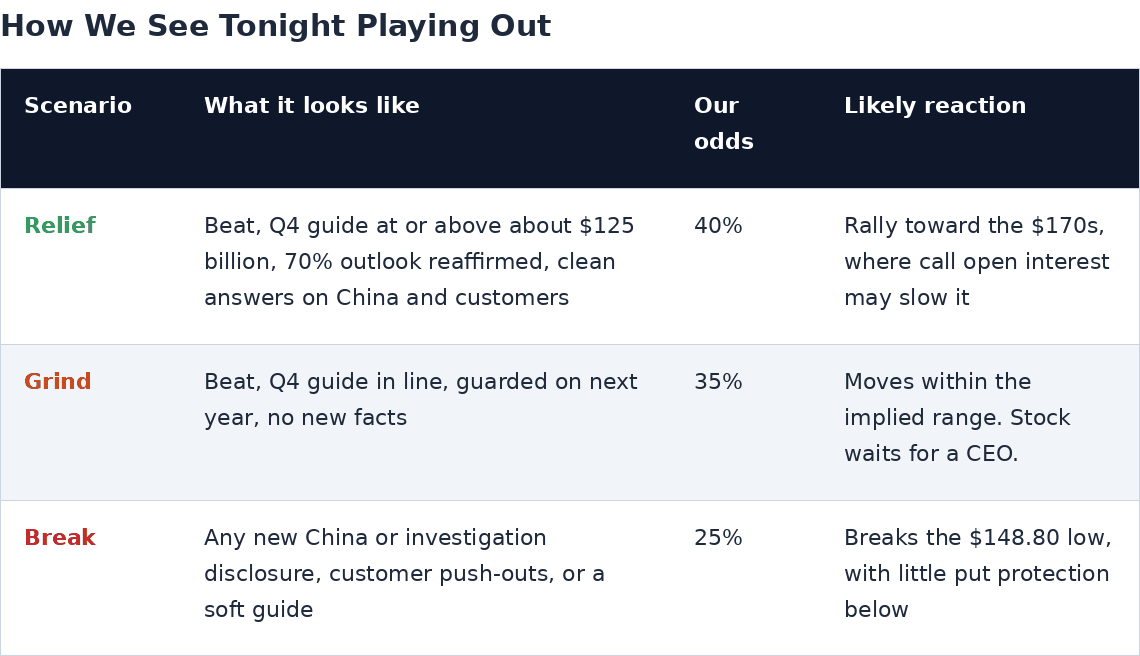
Our base case is that the numbers hold and the stock is decided in the first 20 minutes of the Q&A. NVIDIA's business has not changed in a week. Its governance has. Tonight is the first chance for the company to show those are separate problems.
Your checklist for tonight
Watch for these, in order.
4:20 p.m. Revenue versus about $109 billion, and data center versus about $102 billion.
Gross margin. At or above 74 percent. Anything below 73.5 percent points to memory costs or pricing pressure.
Q4 guidance. Versus the roughly $125 billion consensus. This is the number that sets Wednesday.
Fiscal 2028. Is the roughly 70 percent growth view repeated, softened or dropped?
Who is on the call. An engineering leader or chair Harvey Jones beside Kress would say a lot about the succession.
The China answer. Specifics on Southeast Asia customers and the new Commerce rule, or a dodge.
Customers. Any mention of cancellations, delays or contract reviews since November 8.
Levels. $148.80 below, $175 above. A close outside either on Wednesday tells you which side won.
Before you act. Wait for the regular session. After-hours prices are thin and often reverse.
This article is for information only and is not investment advice or a recommendation to buy or sell any security. Consensus estimates, options-implied moves and analyst targets change continuously; figures are as of the November 16 close and the morning of November 17, 2026. Scenario odds are the author's opinion. Investors should consider their own objectives and risk tolerance and consult a qualified adviser. The author may hold positions in securities mentioned through diversified funds.
Position disclosure. The author holds a position in NVIDIA Corporation (NVDA) as of the date of publication. The author may buy, sell, add to, reduce or hedge that position at any time, including before or after tonight's results, without notice. The size and structure of the position are not disclosed. Because the author has a direct financial interest in NVIDIA's share price, readers should treat this article as the opinion of an interested party.