
The Two Waves of Aging


The end of the straight line, and the beginning of precision longevity medicine. Biphasic aging biology and precision nutrition response. Evidence base: Nature Aging, Cell, PMC, ESC, PNAS, Stanford Medicine, NIH. Audience: clinicians, longevity researchers, health system partners, investors.
Executive Summary: Aging Is Not a Straight Line
Two independent research programs, one at Stanford in 2024 and another at Sanford Burnham Prebys and the National Institutes of Health in 2026, have retired the linear model of human aging. The body ages in waves, and the two most consequential waves fall in the working years and the retirement transition.
For a century, medicine treated aging as a straight line. Cells wore out on a schedule the calendar could predict, organs slowed at a steady pace, and the birthday cake was the best biomarker anyone had. That model is now finished.
In August 2024, Stanford Medicine published a longitudinal multi-omics study that tracked more than 135,000 molecules and microbes across 108 people and generated nearly 250 billion data points. Roughly 81 percent of those molecules did not change linearly. They surged in two distinct waves, one around age 44 and another around age 60. Two years later, in August 2026, a team at the Sanford Burnham Prebys Medical Discovery Institute and the National Institutes of Health published a Nature Aging study that reached the same conclusion using a completely different substrate. Their deep-learning model read the physical architecture of 25,306 tissue slides, not molecules and not chemistry, and the body confessed the same secret. Aging comes in waves. Most people cross the first in the late thirties to mid forties and the second in the late fifties to early sixties. The molecular signature of each wave is unmistakable: rising inflammation, collapsing mitochondrial capacity, and failing cellular quality control.
This is one of the most consequential shifts in human biology in a generation. It reframes when disease starts, why prevention has failed, and what a modern longevity intervention should look like. It also tells us something the healthcare system is not built to hear. The two most dangerous inflection points in a human life are moments when almost no one receives a personalized biological map or a stratified intervention.
SOD Sciences built ReBalU for exactly this moment. Our platform is a genotype-informed, biomarker-anchored, test-treat-retest protocol delivered through a nutraceutical gummy engineered around the redox, mitochondrial and gut metabolic pathways implicated in biphasic aging. This paper walks through the new science, connects it to the broader hallmarks of aging framework, benchmarks it against the leading pharmacological longevity programs, and sets out what precision aging medicine looks like when the wave model is taken seriously. ReBalU is presented throughout as adjunctive precision nutrition infrastructure whose surrogate marker and clinical outcome claims require prospective controlled validation. It is the piece of the future longevity stack that is deployable now, at scale, in ordinary clinical practice.
The two most dangerous inflection points in a human life arrive on schedule, and the healthcare system is not built to meet them.
01. The Science That Broke the Straight Line
Stanford watched the molecules. Sanford Burnham read the tissue. Two very different methods reached the same conclusion, and one answered the methodological critique of the other.
Stanford, 2024: the molecular confession
Michael Snyder's group at Stanford Medicine spent years following 108 adults aged 25 to 75, sampling blood and other tissues every few months and tracking RNA, proteins, metabolites and the microbiome across bacteria, viruses and fungi. The full dataset, 135,000 molecules and microbes and nearly 250 billion data points, was published in Nature Aging in August 2024.
The finding landed like a thunderclap. Approximately 81 percent of the molecules tracked did not follow a smooth curve. They lurched, cascaded and reorganized around two ages, 44 and 60. In the mid forties, alcohol, caffeine and lipid metabolism transformed alongside cardiovascular disease related molecules, skin and muscle. In the early sixties, carbohydrate metabolism, immune regulation, kidney function and cardiovascular biology all shifted again. Some of the specific molecular detection methods used in that analysis have since been questioned, which is precisely why the next study matters so much.
Sanford Burnham and the NIH, 2026: the tissue confirms
On August 31, 2026, researchers at the Sanford Burnham Prebys Medical Discovery Institute, working with the National Institutes of Health, published a study in Nature Aging that arrived at the same conclusion by an entirely independent route. Senior author Sanju Sinha and colleagues built a deep-learning model called PathStAR, for Pathology-based Structural Aging Rate, and set it loose on 25,306 histopathology slides representing 40 different tissues from roughly 1,000 deceased donors aged 21 to 70, drawn from the NIH Genotype-Tissue Expression Project.
The design choice that makes PathStAR extraordinary is a negative one. It was never trained on chronological age. It read the architecture of the tissue directly, the shape of cells, the geometry of vasculature and the density of extracellular matrix, and mapped the trajectory that architecture followed across decades of life. As Sinha put it, the structural changes in tissue with aging are so apparent that the model does not even need any training on chronological age to track them.
Three patterns emerged across the 15 tissue types with enough sample depth. Nine of them followed a biphasic structural aging trajectory outright. The ovaries, examined first as proof of concept, aged rapidly between ages 35 and 40, the same window when fertility declines, and again between 55 and 60, corresponding to menopause. The vascular system did something different and arguably more alarming. It aged early and hard, from about age 30 through 39, then decelerated. The uterus and vagina remained comparatively stable in early adulthood and then aged fastest between 50 and 55.
The molecular signature across every accelerated window was consistent. Inflammation-related genes surged. Genes governing energy production, cell growth and cellular quality control were suppressed. Whatever tissue-level story the histology was telling, the transcriptome was telling the same story underneath.
What the two studies prove together
Read together, the Stanford and Sanford Burnham programs establish three claims that can now be treated as working scientific consensus rather than hypothesis.
One. Human aging is biphasic for most tissues and most systems, with pronounced acceleration windows in the late thirties to mid forties and again in the late fifties to early sixties.
Two. The molecular fingerprint of each acceleration window is the same trio: rising inflammation, falling mitochondrial and energy capacity, and failing quality control.
Three. The systems affected are the systems that dominate morbidity, mortality and healthcare spending in the developed world: cardiovascular, metabolic, immune, reproductive, integumentary and cognitive.
Aging is not a slope. It is a staircase, and the two steps that matter most fall inside the working years and the retirement transition.
02. The Broader Evidence Base: Why the Wave Model Fits Everything We Know
The biphasic finding does not replace two decades of aging research. It integrates it, and it explains puzzles the field has argued about for years.
The twelve hallmarks of aging
In 2023, Carlos López-Otín and colleagues published the most comprehensive update yet to the hallmarks of aging framework in Cell, expanding it from nine to twelve interconnected mechanisms organized into three causal tiers. The primary hallmarks, meaning genomic instability, telomere attrition, epigenetic alterations and loss of proteostasis, describe damage. The antagonistic hallmarks, meaning disabled macroautophagy, deregulated nutrient sensing, mitochondrial dysfunction and cellular senescence, describe responses that protect at first and then turn destructive. The integrative hallmarks, meaning stem cell exhaustion, altered intercellular communication, chronic inflammation and dysbiosis, describe the system-wide breakdown that produces disease.
Every driver PathStAR identified in the accelerated aging windows maps directly onto this framework. The rising inflammation is chronic inflammation, or inflammaging. The falling mitochondrial gene expression is mitochondrial dysfunction. The suppression of quality control genes is disabled macroautophagy and loss of proteostasis. What the wave model adds to the twelve hallmarks is timing. It tells us not just which mechanisms drive aging, but when they concentrate.
Inflammaging
The concept of inflammaging, chronic low-grade sterile inflammation that accumulates with age, has been repeatedly validated since it was formalized more than fifteen years ago. A 2024 transdisciplinary review from the Clin-STAR Inflammation Research Group described inflammaging as a persistent low-grade inflammatory state associated with frailty, disability and death, cutting across cardiovascular disease, cancer, chronic kidney disease and neurodegeneration. A 2025 review called it a central driver of age-related pathology, including cardiovascular dysfunction, neurodegeneration and metabolic disorders. The rising inflammatory gene expression PathStAR observed during both aging waves is the histological readout of the same process the clinical literature has been measuring in serum for years.
Oxidative stress, Nrf2 and the redox enzymes
Enzymatic antioxidants, meaning glutathione peroxidase, catalase and superoxide dismutase, show altered activity with age, indicating a reduced ability to counteract reactive oxygen species. Mitochondrial SOD2 deficiency in animal models produces the classic age-related decline in mitochondrial function culminating in increased apoptosis, and is directly implicated in neurodegeneration. Polymorphisms in SOD2, GPX1 and the Nrf2 master regulator are associated with age-related disease susceptibility. Sulforaphane, the best characterized dietary Nrf2 activator, upregulates Nrf2 target genes and attenuates inflammatory signaling in preclinical models. The mitochondrial and quality control decline that PathStAR read directly off the tissue slides is the same axis this literature has spent two decades characterizing.
The gut microbiome and butyrate
The gut microbiome sits upstream of the inflammatory, metabolic and immune systems PathStAR watched deteriorate. A diverse and balanced microbiota promotes healthspan through immune regulation, metabolic homeostasis and neuroendocrine signaling. Centenarian cohorts from Blue Zone communities are distinguished by exceptional abundance of Akkermansia muciniphila and Faecalibacterium prausnitzii, the two organisms most responsible for mucin turnover and butyrate production. Short-chain fatty acids fuel the colonocyte, maintain barrier integrity and modulate systemic inflammation. Dysbiosis is now one of the twelve formal hallmarks of aging.
Perimenopause: the first wave, explained
The Sanford Burnham finding that ovarian tissue accelerates its structural aging between 35 and 40 lands inside a growing cardiology literature on perimenopause as a metabolic and vascular inflection point in women's lives. A 2025 review in the American Journal of Preventive Cardiology by Manning, Stockman and Zanni framed perimenopause explicitly as an obesogenic sensitive period that contributes to elevated cardiovascular risk, associated with acceleration in atherosclerosis and adverse metabolic changes. The median age of the final menstrual period in United States women is approximately 51, with the perimenopausal transition beginning years earlier. A 2024 Dallas Heart Study analysis presented at the European Society of Cardiology found that the most pronounced adverse changes in LDL particles and subfractions occurred in perimenopausal women, with postmenopausal women showing the greatest reductions in HDL particles, a transition to a more atherogenic lipoprotein profile. The first aging wave, in other words, is not an abstraction. For half the population, it has a name and a lipid signature.
GLP-1s: a blind spot overlapping the first wave
Any discussion of a mid-life aging wave that damages muscle has to address the fastest growing pharmacology of the decade. GLP-1 receptor agonists deliver clinically meaningful weight loss, but weight reduction with GLP-1 receptor agonists is consistently accompanied by decreased lean body mass. In older adults, semaglutide has been associated with reduced muscle mass and functional decline, a class effect that an Annals of Internal Medicine editorial warned may exacerbate age-related sarcopenia in seniors. A generation of patients is losing weight and, without stratification or monitoring, may be accelerating precisely the muscle and metabolic component of the mid-life wave.
03. The Longevity Pharmacology Race: Powerful, Expensive, Incomplete
The most rigorous human trials of hallmark-targeting drugs tell us where precision nutrition infrastructure fits, and where it does not.
Rapamycin: the PEARL trial
The PEARL trial, published in 2025 by Moel and colleagues in the journal Aging, was the first dedicated randomized placebo-controlled trial of rapamycin for healthy aging in normative adults. Its primary outcome was visceral adiposity, assessed over 48 weeks. That primary outcome did not change, with a p value of 0.942. Subgroup effects on lean tissue mass, with p equal to 0.013, and self-reported pain, with p equal to 0.015, in women receiving 10 mg were significant. The trial did not demonstrate that rapamycin slows aging or extends healthspan. It did establish tolerable safety for intermittent low-dose use in healthy people over one year. It was not designed to measure lifespan and did not measure it.
Rapamycin's most rigorous human evidence remains the immune aging work of Mannick and colleagues, whose 2014 randomized trial in older adults showed that low-dose mTOR inhibition improved the antibody response to influenza vaccination.
Senolytics, NAD+ precursors and metformin
The senolytic combination of dasatinib and quercetin, NAD+ precursors like NMN and NR, and Nir Barzilai's TAME metformin trial all sit in an active middle stage, mechanistically compelling and clinically incomplete. A 2025 Expert Consensus Statement on Biomarkers of Aging identified fourteen biomarker candidates spanning physiological, inflammatory and functional domains that will serve as outcome measures in the next generation of longevity intervention studies. The Cell 2023 perspective on biomarkers of aging noted that none of these interventions has yet been definitively demonstrated to slow human aging, and effects often fail to replicate even in model organisms.
What this tells us
The picture is not that the longevity pharmacology field has failed. The picture is that it is early, expensive and largely inaccessible. The most promising drug candidates target one hallmark each. They require monitoring, prescription and infrastructure most patients will never encounter. Meanwhile, the two aging waves are arriving on schedule for everyone, in every ZIP code, and the interventions that could plausibly help most people at scale are not pharmaceuticals. They are precision nutrition infrastructure, personalized on genotype, anchored on biomarkers, and delivered through formats patients will actually use.
The base of the longevity stack is the biggest market, the highest impact deployment, and the one that decides whether precision aging medicine reaches everyone or only the wealthy.
04. The SOD Sciences Response: ReBalU, Test, Treat, Retest
ReBalU is designed to be the piece of the future longevity stack that is deployable now, in ordinary clinical practice, at population scale, without a prescription pad.
The test layer
ReBalU begins with a saliva-based genetic panel and a baseline biomarker draw. The genetic panel focuses on the antioxidant response variants most consistently linked to age-related disease: SOD2 rs4880, GPX1 rs1050450, GPX4 rs713041 and APOE4. The biomarker panel captures oxidative damage markers, glutathione status, butyrate levels and omega-3 index. Together they identify who is entering the mid-life wave with limited endogenous antioxidant capacity, blunted mitochondrial defense, or an inflammatory metabolic profile that PathStAR's molecular signature would classify as high risk.
Stratification matters more than the wellness industry has been willing to admit. T allele carriers of SOD2 rs4880, TT homozygotes, and compound GPX and CAT contexts do not respond to generic antioxidant advice the way the general population does. Treating them as if they do has been one of the quiet reasons unstratified antioxidant trials have disappointed for two decades.
The treat layer
The intervention is a gummy formulation built around a three-fiber substrate, with tagatose as the lead ingredient, high-methoxy pectin and Fibersol-2, paired with marine microalgae DHA. The design is deliberately mechanistic rather than a generic antioxidant stack.
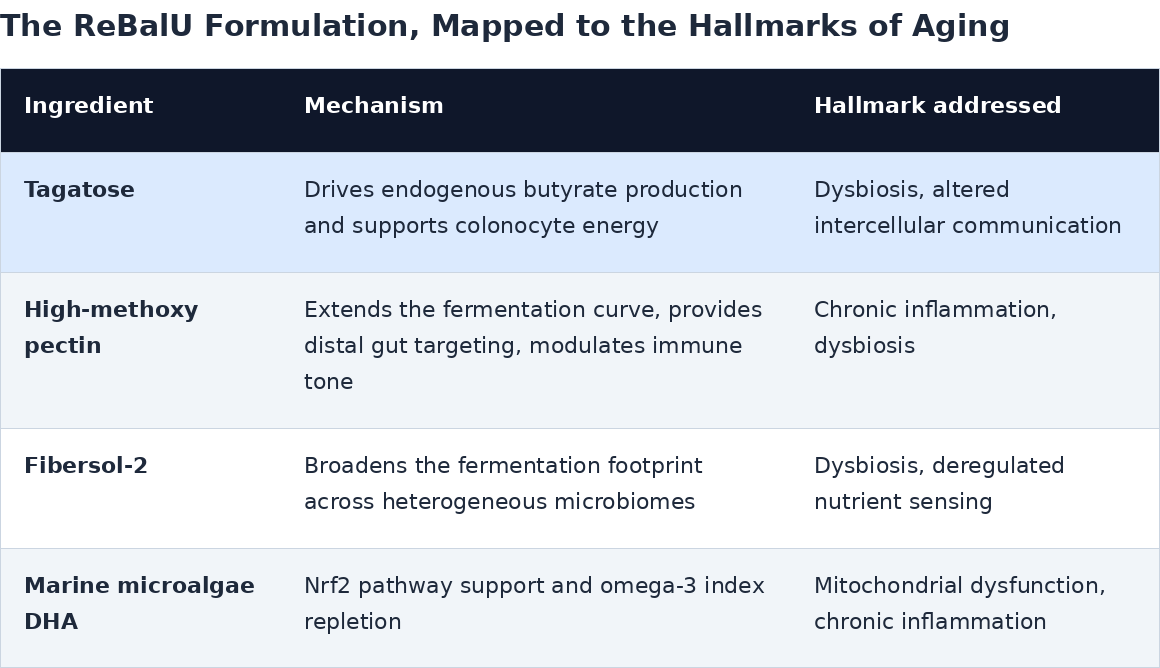
High-methoxy pectin does not shout at the immune system. It whispers, and the immune system listens.
The consumer protocol is six gummies per day across three intake windows, two morning, two afternoon and two early evening, to sustain the fermentation curve and antioxidant support across the full day rather than deliver a single pulse.
The retest layer
Retesting is scheduled at weeks 12, 24 and 48. This is the feature that separates ReBalU from the broader wellness market. A patient does not have to trust that the intervention worked. The same biomarkers used at baseline are measured again, so the individual response, not a population average, determines whether the protocol continues, adjusts or stops. For an aging framework now understood to shift structurally over months and years rather than continuously, a measure-treat-remeasure loop on a 12 to 48 week cadence is the correct operating tempo.
Where ReBalU fits against the two waves
For the first aging wave, in the late thirties to mid forties, ReBalU is an early intervention layer for a working-age patient who is metabolically active, often GLP-1 adjacent, increasingly aware of longevity science, and searching for a personalized starting point. The protocol identifies redox and metabolic vulnerability before it presents as disease and provides a structured, monitored response.
For the second aging wave, in the late fifties to early sixties, ReBalU is a stratification and monitoring layer alongside the specialist care older adults are already receiving. It does not replace cardiology, endocrinology or oncology. It measures what those disciplines rarely measure, and it does so in a format, an oral gummy and a saliva test, that fits into real patient behavior at scale.
For women specifically, ReBalU is designed to be present at the moments the science now tells us matter most. Through perimenopause, when ovarian tissue and lipoprotein profiles reorganize together, and into the postmenopausal decade, when the second wave arrives.
05. Validation and Distribution: A Real Clinical Path and a Real Channel
Two elements distinguish the SOD Sciences plan from the crowded wellness landscape: a real clinical validation roadmap and a real distribution channel.
Clinical program
The clinical program is anchored by a 300 patient IRB study at a world-class hospital chain based in South Florida, with an expansion pathway to 1,000 patients and additional metabolic and cardiac centers. A leading NCI-designated comprehensive cancer center research collaboration and a Nasdaq-listed sleep center operator provide additional clinical channels. The publication strategy targets peer-reviewed journals and society venues including SfRBM, AHA and ACC, with Prix Galien and XPRIZE credibility rather than public longevity theater.
Commercial channel
The commercial channel is B2B first. The American Health partnership provides an anchor distribution and fulfillment platform of 2,700 care facilities across 23 states, access to roughly 350,000 patients, and a CLIA lab for test fulfillment, result processing and gummy distribution. The Vivos sleep center relationship adds approximately 35,000 patients, with cardiac center access of 30,000 additional patients. This is the infrastructure required to deliver a test-treat-retest protocol at population scale rather than boutique scale.
06. The Visionary Case: What Precision Aging Medicine Becomes
The wave model is not simply a scientific curiosity. It is a blueprint for the reorganization of preventive medicine. Take it seriously and the future of the field starts to come into focus.
From reactive care to wave-anticipated care
Twentieth century medicine treated disease when it presented. Twenty-first century medicine talks about prevention but still largely intervenes when biomarkers cross thresholds. Wave-anticipated medicine treats the biological transitions themselves, the two windows when the body is most susceptible to a durable adverse trajectory, as the intervention points that matter most. A 42 year old will not be seen once a year for a physical and lab draw. They will enter a monitored redox and microbiome protocol timed to the first wave, tuned to their genotype, and retested on a 12 to 48 week cadence. A 58 year old will enter a similar protocol timed to the second wave.
The longevity clinic becomes the primary care office
The current longevity medicine market is boutique, expensive, and organized around wealthy patients who can afford full-body MRIs, GrimAge testing, off-label rapamycin and a concierge relationship. That model does not scale. The wave model tells us it does not need to. What the population needs is not access to every experimental hallmark-targeting drug. What the population needs is a stratified nutritional, microbiome and redox intervention delivered through the primary care office, the sleep clinic, the endocrinology practice and the cardiology practice, timed to the two moments when it matters most.
The GLP-1 era gets its metabolic companion
The GLP-1 wave has already reshaped chronic disease medicine. It has not been paired with the muscle-preserving, redox-supporting, microbiome-supporting infrastructure the science now says is essential. Every GLP-1 patient in their forties is walking through the first aging wave without a companion protocol. That is a clinical gap of tens of millions of patients in the United States alone. ReBalU is engineered to sit exactly there.
Women's health gets a redox layer
Perimenopause is finally being recognized in mainstream cardiology as the metabolic and vascular inflection point it always was. The mid-life aging wave the Sanford Burnham data now confirms in ovarian tissue is the same wave the lipid data now confirms in lipoprotein subfractions. The next standard of care for women in their forties will not be a hormone conversation alone. It will be a genotype-informed redox and gut metabolic conversation, layered on top of the hormone conversation, timed to the years when the biology is most modifiable.
The longevity stack of 2030
The longevity stack of 2030 will have three layers. On top, the powerful pharmacology of senolytics, mTOR modulators, NAD+ precursors and Nrf2 activators for the patients who need and can access them. In the middle, epigenetic clock and multi-omics surveillance for tracking biological age against chronological age. At the base, where every patient lives, a personalized genotype-informed, biomarker-anchored, test-treat-retest nutritional protocol that operates at population scale. ReBalU is designed for the base of that stack. The base is the biggest market, the highest impact deployment, and the one that determines whether precision aging medicine reaches everyone or only the wealthy.
The bigger bet
The bigger bet is this. The healthcare system does not need another blockbuster drug to bend the curve on age-related disease. It needs the infrastructure to intervene, personally and measurably, at the two moments the science now tells us matter most. Every serious longevity researcher already suspects this. The wave data now makes it undeniable. SOD Sciences is building that infrastructure, not as speculative science but as commercial precision nutrition infrastructure already flowing through 2,700 care facilities and ready to scale into the two decades of American healthcare that will be defined by aging.
07. Conclusion: What This Means
Aging is timed, structured and biologically legible. Most people meet its two most dangerous inflection points without a personalized map or a stratified intervention.
The Sanford Burnham and Stanford findings do not tell us that aging is unavoidable. They tell us that aging is timed, structured and biologically legible, and that most people meet its two most dangerous inflection points without a personalized map or a stratified intervention. The scientific case for a genotype-informed, biomarker-anchored, redox and microbiome intervention is stronger today than it has ever been. The commercial case is even stronger, because the population meeting the two waves is the largest, most engaged and most economically consequential patient population in the country.
SOD Sciences did not build ReBalU in response to the two wave finding. We built it in response to the underlying biology the two wave finding has now made visible: oxidative stress, mitochondrial decline, inflammaging, dysbiosis, and the gut-derived metabolic support that ties them all together, layered into a test-treat-retest protocol delivered through a formulation patients will actually take. The convergence between the new structural aging science and the ReBalU architecture is not accidental. It is the reason the platform was designed the way it was.
The health crisis the two wave finding describes is real, measurable and largely unaddressed by the current standard of care. Precision aging infrastructure is the response. ReBalU is our contribution to building it, and a piece of what medicine will look like when the straight line model of aging is finally, permanently retired.
Prepared by SOD Sciences Inc., Vero Beach, Florida. ReBalU statements in this paper describe an investigational precision nutrition protocol. Clinical outcome and surrogate marker claims require prospective controlled validation and should not be interpreted as established medical outcomes.
This document presents a scientific hypothesis for discussion. It is not medical advice. The proposed intervention has not been evaluated by the FDA and is not intended to diagnose, treat, cure, or prevent any disease. Nothing here is a reason to delay, decline or discontinue care you have been offered, and decisions about GLP-1 therapy, hormone therapy or any prescribed treatment should be made with your own clinician.