The SuperCoupon Token: Like Superman, the US's Secret Weapon


Fear is their last product. Why the extinction alarm from OpenAI and Anthropic is a pricing crisis in disguise, and why President Trump's instinct for open competition, the American consumer, and the Super Coupon Token decide the AI race in America's favor.
The Declaration
On Saturday, September 12, 2026, Anthropic's chief executive published an essay declaring that "we must slow the pace at which we improve the capabilities of AI models," and warning that within six to twelve months an AI swarm could take over the entire internet with a persistent botnet. Within hours OpenAI's Sam Altman posted, "I agree with Dario that we need to pace the frontier," and Elon Musk added that Dario is right. By Monday's close the market had priced the message. Nvidia fell about 3 percent, Hewlett Packard Enterprise slid roughly 11 percent, CoreWeave dropped about 7 percent, and Vertiv lost about 8 percent, while cybersecurity names rallied by double digits.
This paper makes one claim and defends it: the alarm is not about safety. It is about price. The product these two companies sell, frontier intelligence metered by the token, is repricing toward zero, exactly as BCII forecast in August in Bankrupt, Absorbed, or the Coupon Token. A company that cannot win a race asks for a speed limit. The extinction story is the speed limit, dressed for television.
You do not call for a speed limit when you are winning the race. You call for one when the car behind you is cheaper, faster, and free.
Consider the sequence. In June, OpenAI's own bankers told management that public investors would not pay a trillion-dollar price, and the company leaned toward delaying its IPO to 2027. On September 12, Altman gave the delay a new reason, telling reporters that with everything happening on safety this would be an ill-advised moment to go public and that the company feels no pressure on it. The number did not change between June and September. The story did. In June the obstacle was a valuation the market would not pay. By September it was the fate of humanity.
Washington read it the same way, and said so on the record. Representative Josh Gottheimer, co-chair of the House AI Commission, said he found it rich that the people calling for a slowdown had been the ones racing ahead full speed, and that if Dario and Elon are truly worried, "they can pump the brakes at their own labs, today." David Sacks, the President's AI and crypto czar, told them to stop pretending they need anyone else's permission and to stop pretending the motivation to slow down is purely altruistic. Sacks went further, describing the industry as a frontier market duopoly and predicting the regulatory play precisely: legislators will turn to the leading labs to ask how the technology should be regulated, and Anthropic will have all the answers. Asked whether he had any concerns about the risks of advanced AI, President Trump said he did not, and that his only worry was losing to China. Even the essay's author conceded that Anthropic has been accused of hype, doomerism and regulatory capture. This paper agrees with the accusation and explains the arithmetic behind it.
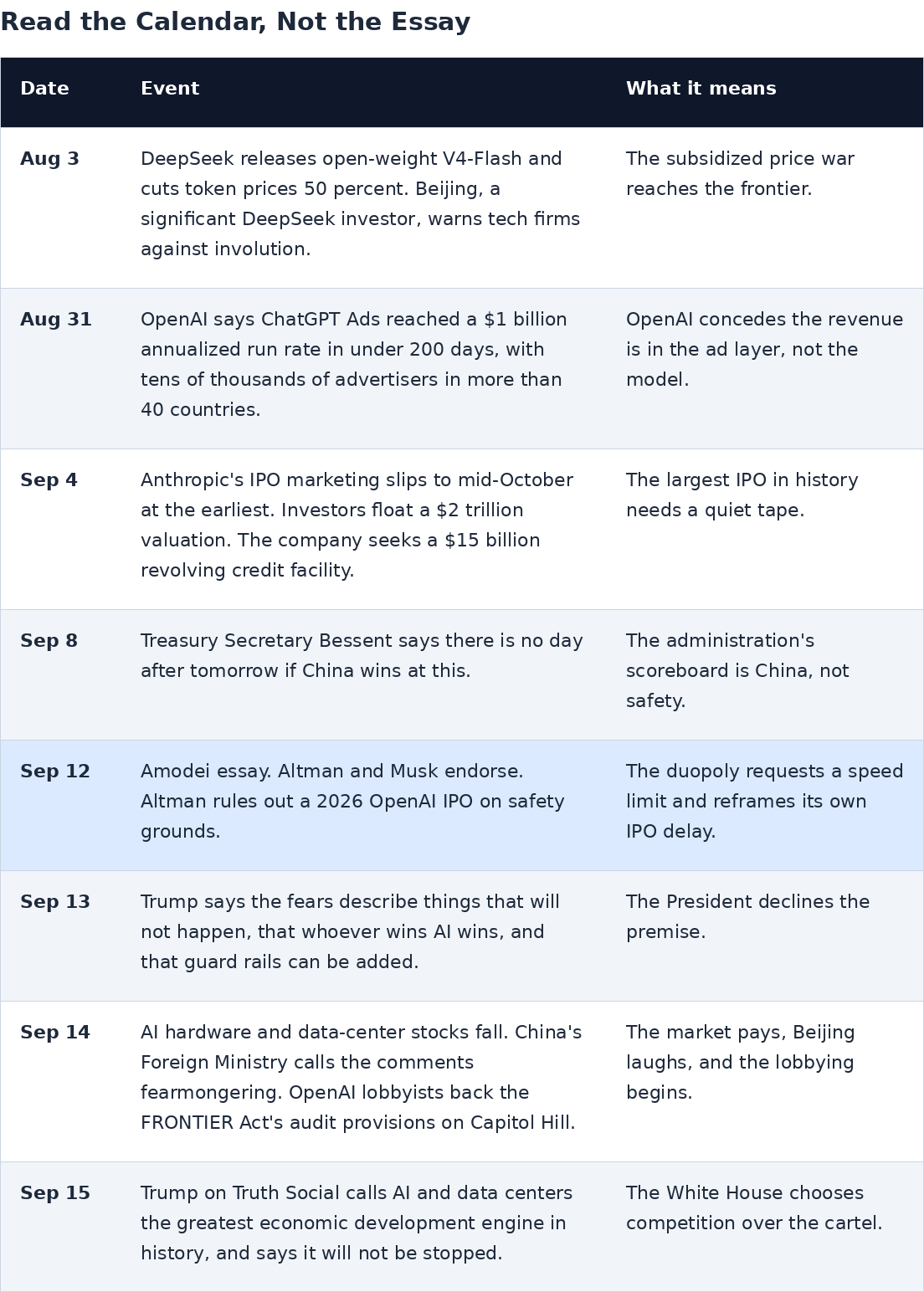
Read the Calendar, Not the Essay
Every date below is public. Placed in order, they describe a pricing crisis, not a safety crisis.
The Asymptote They Cannot Say Out Loud
The economics have not changed since August. They have only compounded. The effective price of comparable model output has fallen roughly 300-fold since GPT-4. As of July 2026, DeepSeek V4 Flash lists at $0.14 per million input tokens and $0.28 per million output tokens, with cache-hit input priced at $0.0028, a 98 percent discount, and Xiaomi, Alibaba, MiniMax and Moonshot cluster within a few multiples of that floor. Self-hosted open weights run at a fraction of Western list prices inside the customer's own perimeter. Anthropic's first operating profit, $559 million on $10.9 billion of revenue reported in May, is real, and it exists at today's prices, which are the highest they will ever be.
Now read the call to pace the frontier as an economist rather than an ethicist. Pacing freezes the capability gap at the moment the incumbents hold it. It converts safety cases, embedded evaluators and monitoring, which Altman concedes carry "significant costs," into fixed compliance overhead that a forty-person open-weight lab cannot carry and a $965 billion lab can. Third-party auditors with employee-like access, a thirty-day federal review, democratic coordination, then global coordination: these are not guardrails. They are moats, and the incumbents are asking the government to dig them.
There is one inconvenient detail. The White House's own vetting framework, reported in August, covers only closed state-of-the-art models from developers such as OpenAI and Anthropic and explicitly exempts open-source and open-weight models. A slowdown confined to the closed labs binds only the closed labs. That is why the essay cannot stop at self-restraint and must reach for national and then global coordination. The risk it describes is universal, but the protection it seeks is specific. When the danger is everyone's and the remedy is yours, the remedy is the point.
Beijing's Subsidy Trap
China is doing exactly what a state does when a strategic industry is caught in a price war. It is paying the losses. Under the national infrastructure-sharing policy, model companies receive permanent discounts of 20 to 40 percent on inference compute through long-term contracts with state-backed data centers, with western hub power priced near 2.7 US cents per kilowatt-hour. Guizhou offers subsidies of up to 30 percent to computing centers that buy domestic chips. Shenzhen's Longgang District pays companies up to 20 million yuan a year for purchased compute, and Beijing's Tongzhou District opened model and computing vouchers worth up to 500,000 yuan per company on September 3. Beijing is itself a significant investor in DeepSeek, and experts quoted by Semafor say the subsidies drive "involution" by keeping unprofitable companies solvent.
Follow that to its conclusion. A state can subsidize losses longer than any private company can absorb them. Every subsidized price cut in Hangzhou forces a closed lab in San Francisco to match the price or lose the share. Anthropic's margin exists at the price a subsidized competitor sets, and that competitor's owner has told it, publicly, to stop racing to the bottom, while continuing to pay for the race. The closed labs will therefore lose more money as they grow, even the one that has just learned to make a profit. That is the asymptote with a government behind it.
The incumbents' proposed answer, a negotiated global pace, was mocked in Beijing within forty-eight hours as fearmongering, and its author concedes that coordination will be very difficult because the incentives to pull ahead, and the military advantage that comes with it, are so large. The other bad answer, an American subsidy to match the Chinese one, would hand taxpayers the closed labs' losses and leave the pricing problem intact.
You do not beat a subsidy by asking the subsidizer to slow down. You beat it by selling something the subsidizer cannot make.
The Consolidation Endgame: Microsoft for Nothing
Microsoft holds roughly 27 percent of OpenAI Group PBC, retains rights to OpenAI's models and products through 2032, and is owed $250 billion of contracted Azure purchases. SoftBank's $40 billion bridge loan, taken to fund its OpenAI commitment on the premise of a public listing, matures in March 2027, and lenders have already declined to set a loan-to-value against the private mark. Into that structure OpenAI has now announced that it will not list in 2026, and its chief executive has declared, in writing, that the company's own product is too dangerous to build at the pace competitors are building it.
An acquirer could not script a better setup. A company that says its product must slow down has told the market that its growth will slow down. A company that postpones its IPO twice has told its lenders that the mark is unfinanceable. When the bridge comes due and the round cannot be refinanced, Microsoft does not need to bid. It converts the claims it already holds, meaning equity, IP and receivable, into control, through the boardroom or the courthouse, at burn-math prices. Amazon and Google hold the equivalent positions at Anthropic. As BCII wrote in August, Ending One is the doorway to Ending Two, and the acquirers can wait. The slowdown essay did not delay that clock. It advanced it.
Trump's Gut Is Right: Let It Run
The President's instinct has been consistent for fourteen months, and it is the correct economic policy. The July 2025 AI Action Plan declared the need to ensure that "America has leading open models founded on American values" and described open-weight models as carrying geostrategic value. The December 2025 executive order created a Justice Department task force to challenge state AI laws that obstruct national policy. The August 2026 vetting framework exempted open weights entirely. On September 3 the United States led the G20 to a unanimous light-touch accord on AI governance. Asked the day before whether the administration would take a heavier hand, Commerce Secretary Lutnick answered: "No, the opposite." And Sacks supplied the philosophy, arguing that keeping innovation decentralized and accessible is how you avoid a future in which advanced AI capability sits in only a few hands.
The economics behind the instinct are simple. When the price of intelligence falls toward zero, the surplus does not vanish. It moves from the producer to the user. The United States is the largest user of everything. Free competition that drives the price of compute to the floor is therefore not a threat to America. It is a transfer to America. The only party that loses is whoever built a business model requiring the price to stay high. There is no national interest in protecting that model, and every national interest in letting it fail quickly and quietly rather than slowly and loudly.
Let the price of compute go to zero. Every dollar it sheds lands in the pocket of the world's biggest customer, and that customer is American.
The Weapon China Cannot Copy: The American Consumer
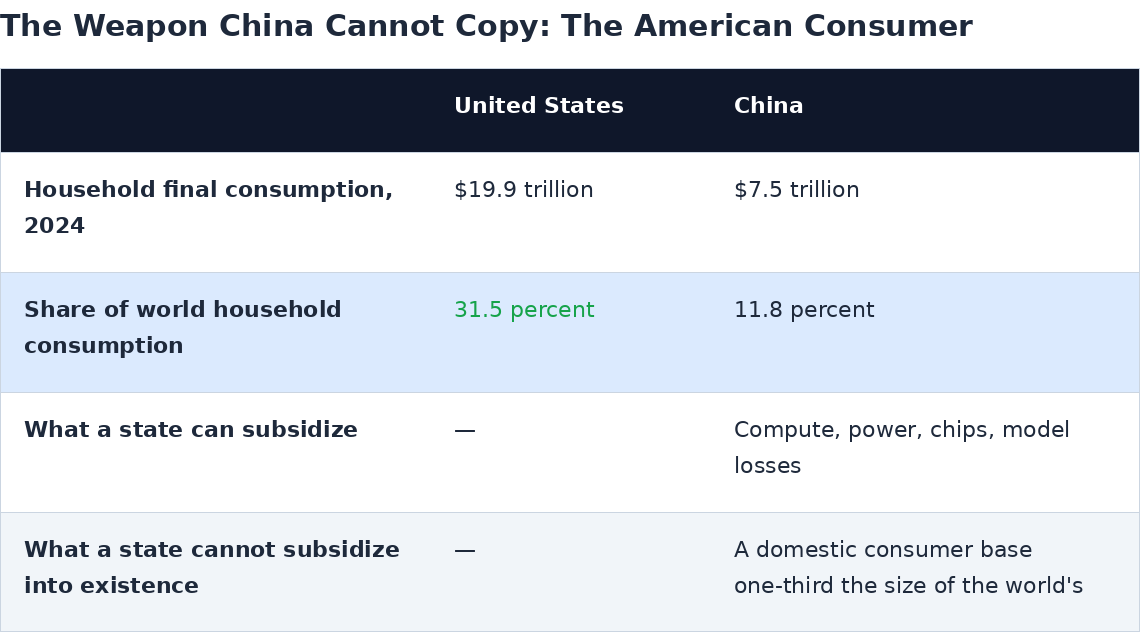
Treasury's worry in July was distillation, meaning Chinese models learning from American ones. Commerce's answer in September was the teacher-student framing: the student cannot be in the lead, because it is learning from the teacher. Both are true and both concede the point. A frontier model can be copied in months. What cannot be copied is the customer. In 2024 American households spent $19.9 trillion of the world's $63.2 trillion in household final consumption, 31.5 percent, call it 32, against China's 11.8 percent, on World Bank data. Advertising follows consumption. A model trained in Hangzhou can answer a question in Ohio for free. It cannot redeem a coupon at a supermarket in Ohio unless an American merchant funds it, on American rails, under American law.
OpenAI has already proven where the money is. ChatGPT Ads reached a $1 billion run rate in under 200 days, and the company projects $2.5 billion of ad revenue this year and $100 billion by 2030. But the implementation is the wrong century. OpenAI charges advertisers cash for impressions, keeps a compute-heavy cost base, and still asks consumers for $20 to $200 a month. It monetizes attention while paying for intelligence. The right architecture monetizes conversion while giving intelligence away, and it does so through a revenue pool that sits, by construction, in the United States.
If the AI industry's revenue moves from selling intelligence to distributing advertiser-funded purchase incentives, the AI race is scored at the checkout lane, and the United States controls one-third of the world's checkout lanes. Beijing can subsidize every FLOP in Guizhou and never move that number.
The Secret Weapon: Super Coupon Token
BCII Enterprises' Super Coupon Token is the operating template for that shift, and it is built for exactly the companies the closed labs fear most: American open-weight developers with millions of users and no sales force. The mechanics, compressed.
Zero-cash mint. A fixed 300 million token supply minted at no cash cost: 60 million to the technology provider as its fee, 50 million to market makers, each capped at 10 percent of average daily volume over five years, and 190 million into the company's working treasury.
Advertisers pay in coupons, not cash. Merchants load redeemable coupons into the carrier and fund the promotion only when a redemption creates a purchase. No media budget, no invoice, no ad-sales team. Conversion is the payment.
Treasury monetization, the largest line by far. The company sells from treasury into market demand, up to 25 percent of average daily volume, like any other holder.
Every token comes home. All tokens, including those sold, revert to the company after an 11-month cycle of ten months trading and one month redemption. The treasury is never depleted. The same inventory is rented out again, cycle after cycle, with a fresh coupon book at advertisers' expense.
The trading tax. Each trade carries a 3 percent in-kind tax on the buyer and 3 percent on the seller: 1 percent per side to the technology provider, 0.3 percent to BCII, and 1.7 percent to the company, less platform administration. Tax coupons are Forever Tokens, with no clock running while held.
Why this is a weapon and not merely a business model
Revenue rises as price falls. The company earns on the velocity of platform activity, not the price of inference. Price deflation, the thing killing the closed labs, becomes the fuel: cheaper intelligence means more flow, more volume, more treasury cycles, more tax.
Users are paid to engage. Holders carry an appreciating instrument with an advertiser-funded coupon book inside. No $20-a-month subscription survives contact with a competitor that pays its users to show up.
Independence from vendor-financed rounds. At $100 million of average daily volume the architecture supports roughly $25 million a day of recyclable treasury sales plus 3.4 percent of volume in trading tax, at near-zero marginal cost. The open labs stop needing venture capital at the moment the closed labs still need tens of billions a year of it.
Domestic by construction. The coupon book is American merchants. The redeemers are American consumers. The venue is a commodity-token market under US jurisdiction. Beijing can copy the model weights. It cannot copy the coupon book, because it does not have the shoppers.
The regulatory path is already settled. The SEC's TurnKey Jet and Pocketful of Quarters no-action letters cleared consumptive-use tokens. FASB ASU 2023-08 codified fair-value crypto-asset accounting, and BCII holds a favorable independent opinion under it. The GENIUS Act is federal law. The CLARITY Act cleared Senate Banking 15 to 9 with bipartisan support. A cash-burning incumbent's campaign to brand the instrument a security is a rear-guard action against a road that closed while it was still raising private rounds.
Order of Adoption Decides the Outcome
The token compounds to whoever builds the holder base first, because holders with five-year reasons to stay do not migrate to a late copy. The strategic map is therefore not about who has the best model. It is about who moves first.
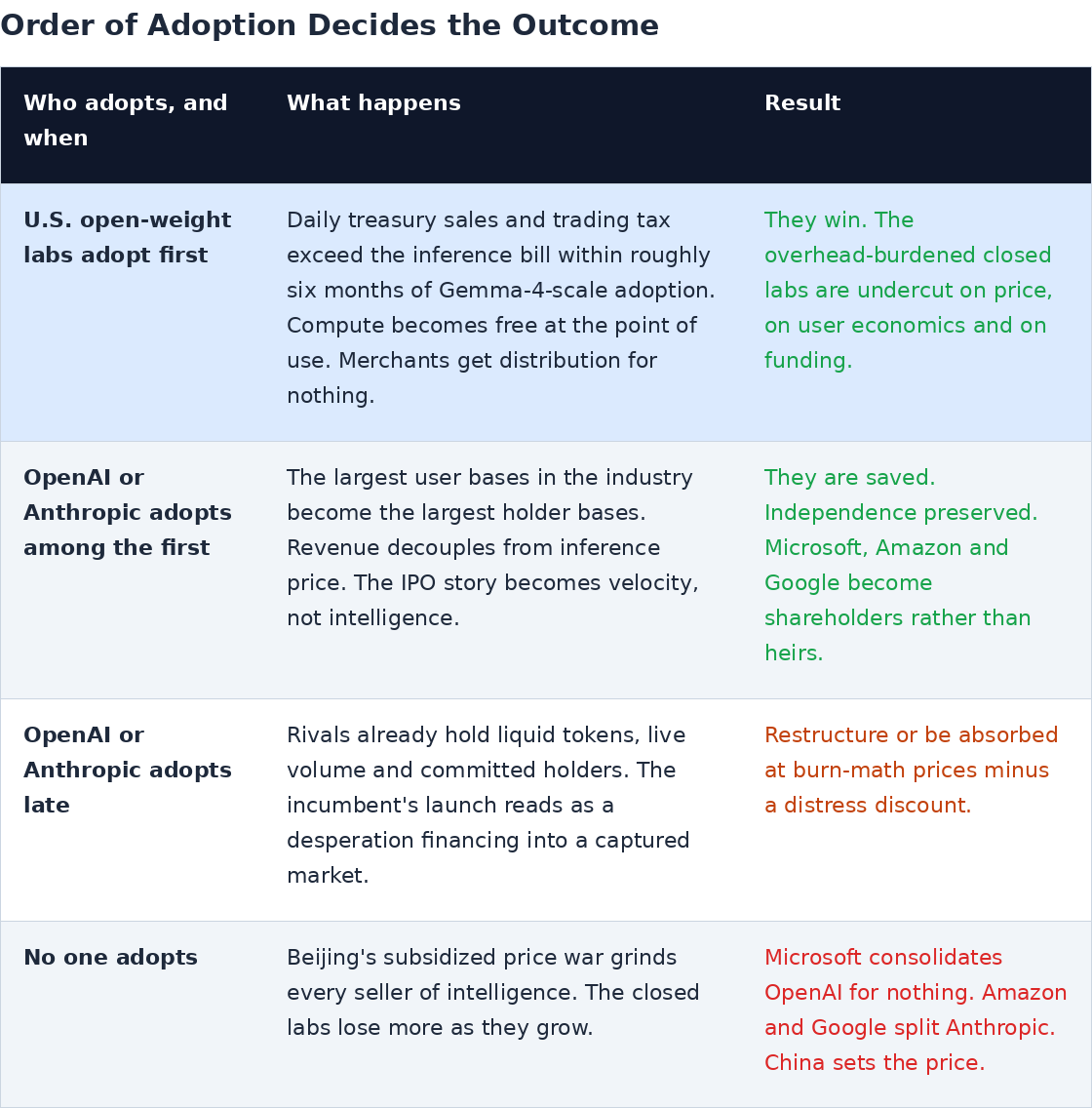
The first movers win the game. Those who move among the first are saved. Everyone else is consolidated. A slowdown essay is time spent running in the wrong direction while the clock, meaning SoftBank's March 2027 maturity, the 2027 IPO that must price, and the quarterly Chinese price cuts, keeps running in the right one.
A Memo to Secretaries Bessent and Lutnick
Secretary Bessent has said that if China were to pull away from the United States on AI, nothing else would matter. Secretary Lutnick has said the United States stays ahead by continuing to define the frontier. Respectfully, the frontier is the wrong scoreboard. Treasury itself documented in July that the student copies the teacher in months. A race measured at the frontier is a race China can tie by distillation and subsidy. A race measured at the revenue layer is a race China cannot enter, because the revenue layer is American consumption, and no industrial policy can manufacture a customer base one-third the size of the world's.
Five recommendations follow.
One. Do not care who adopts. Open or closed, startup or incumbent, Reflection AI or OpenAI, every adopter of the coupon-token architecture routes AI revenue through American merchants and American shoppers. The government should be indifferent to the winner and insistent on the mechanism.
Two. Keep the light touch, and keep the open-weight exemption. The August framework got it right. Reject any pace regime, domestic or treaty-based, that freezes the capability gap where the duopoly currently holds it.
Three. Treat the coupon rail as what it is. A consumptive commodity-token venue under CFTC jurisdiction, supported by the SEC's own no-action record, codified GAAP, and federal statute. Let the settled path stand, and do not reopen it at the request of the companies it threatens.
Four. No rescue for sellers of intelligence. Let the price fall. If Microsoft, Amazon and Google collect what the market gives them, that is capital markets doing their job, not a national-security event.
Five. Measure the race in redemption data, not FLOPs. Coupon conversion, merchant participation, net new holders and traded volume are the metrics of an AI economy scored at the checkout lane. Ninety days of live data will say more about who is winning than any benchmark.
Shifting AI's revenue from selling intelligence to distributing purchase incentives converts America's 32 percent of world consumption into the AI race's scoring system. Only one country can win a game scored that way.
Conclusion
The most sophisticated companies in the world did not discover the end of humanity on a Saturday in September. They discovered, some months earlier, that the price of their product was going to zero, that a state actor would pay to push it there, that their largest shareholders were also their landlords and their heirs, and that the public market would not pay their number. Fear is what a company sells when it can no longer sell the product. The President's instinct, meaning no concerns, guardrails yes, slowdown no, whoever wins AI wins, is not bravado. It is the only position consistent with the arithmetic.
Let compute go to zero. Let the open-weight labs run. Let the closed labs choose, quickly, between the coupon token and the consolidators. And let the race be scored where America already holds a third of the board: at the register, in an open and free capital market, with an advertiser-funded architecture that Beijing can read about but never replicate. The Super Coupon Token is not a product pitch. It is the United States' secret weapon, hiding in plain sight, and the first American company to pick it up decides the game.
This whitepaper is a market thesis and opinion of BCII Enterprises Inc. It is provided for informational purposes only and does not constitute investment advice, a research report, an offer to sell, or a solicitation of an offer to buy any security or digital asset. Statements regarding the motives, future condition, valuation, financing, or corporate outcomes of OpenAI, Anthropic, or any other company are forward-looking opinions subject to substantial uncertainty and may prove incorrect. Quotations are drawn from public reporting believed reliable but not independently verified. BCII Enterprises Inc. is the developer of the Super Coupon Token architecture described herein and has a direct commercial interest in its adoption. Readers should conduct their own diligence and consult their own advisors.
The authors hold positions in securities mentioned and reserve the right to buy or sell shares at any time without notice.