
The Super Acceleration of US Stablecoin Adoption


What an advertiser-funded coupon layer means for stablecoin adoption, dollar hegemony, and the post-GENIUS monetary architecture.
Executive Summary
The Super Coupon Token is an advertiser-funded coupon carrier designed to attach purchase incentives to non-security digital assets, payment stablecoins and commodity tokens, without merging the incentive with the underlying asset. Its mechanics are simple to state. Advertisers contribute coupon value rather than cash. Tokens circulate through a defined trading and redemption cycle and return to issuer inventory for repeated monetization. And a per-side in-kind transaction tax funds the operating layers.
Its implications are not simple at all. If the architecture performs as designed, it addresses the single largest unsolved problem in the post-GENIUS stablecoin system, the absence of any lawful consumer incentive to adopt, and in doing so touches advertising economics, foreign dollarization, Treasury demand, and state fiscal policy. This whitepaper works through those implications in order, then states plainly what remains unproven.
The Architecture in Brief
Five design choices drive everything that follows.
Two-state token model. Every token is either a Forever Token held on a balance sheet with no expiration clock, or a time-limited circulating token created when a holder sells, which returns to permanent status after redemption or expiration. Sold inventory comes back, and the same token base is monetized repeatedly.
In-kind transaction tax. Buyer and seller each pay a small percentage in tokens rather than cash, allocated across the technology provider, the program operator, and the issuer. The tax is self-denominated. It grows with activity and requires no external funding.
Advertiser-funded value. Advertisers add opt-in coupons with no upfront media charge and fund the promotion only when redemption creates a purchase. Conversion, redemption, and repeat-purchase data, not impressions, are the commercial proof.
Treasury sales as primary revenue. The issuer monetizes treasury inventory into market volume under a daily-volume cap, making recurring treasury sales the principal revenue stream rather than a side effect.
Two-instrument separation. The coupon carrier is a distinct instrument from any underlying stablecoin or commodity token it distributes. Incentives, expiry clocks and taxes live on the coupon layer. The underlying asset stays clean.
Implication One: The Missing Adoption Engine for US Stablecoins
The GENIUS Act built a rail and then banned the toll rebate. The statute prohibits permitted payment stablecoin issuers from paying holders any form of interest, yield or rewards solely in connection with holding, a provision designed to protect bank deposits, with the White House's own analysis finding the prohibition increases bank lending at a measurable net welfare cost. The practical consequence is that an American consumer has no economic reason to hold or spend a stablecoin. The market's growth to roughly $317 to $322 billion has been driven by trading, settlement and foreign demand, not domestic retail adoption.
The Super Coupon architecture is built for exactly this gap. Because the coupon is funded by an advertiser, carried on a separate instrument, and paid only when redemption creates a purchase, it is not issuer yield within the statutory prohibition. It is marketing spend routed through the rail. The distinction is structural, not cosmetic: the incentive attaches to usage, not holding; its funding source is a merchant, not the issuer's reserve income; and the coupon layer never merges with the payment stablecoin. The result is the first lawful consumer-side reason to adopt a US-regulated stablecoin, arriving in a market where the yield ban has eliminated every competing incentive. The ban stops being adoption friction and becomes a moat around the only incentive design it permits.
Implication Two: Foreign Markets, Converting Fear into Velocity
Abroad, stablecoin adoption already has a driver, but it is defensive. The IMF describes cryptoization, meaning residents of inflation-prone economies shifting savings into dollar stablecoins that bypass domestic authorities, and BIS research finds these flows largely unaffected by capital controls, unlike bank deposits, across a sample of more than 130 economies. That is holding behavior: a store-of-value migration.
A coupon layer changes the behavior class. Every coupon redemption is a purchase denominated in digital dollars, which converts saved float into transactional velocity and deepens the medium-of-exchange function, the dimension that reinforces the existing dollar hierarchy, given that 98 percent of stablecoin value is already dollar-denominated. The economics of the customer acquisition are notable. Because advertisers fund coupons only on conversion, the marginal cost of pulling a foreign consumer into dollar-denominated commerce is borne by merchants seeking sales, not by any government or issuer. Dollarization of wholesale trade finance took a central bank acting as market maker in the 1920s. Dollarization of retail commerce may take nothing more than a coupon.
Implication Three: Advertising Economics, Conversion as the Unit of Account
For advertisers, the model inverts the industry's standing complaint: media is bought on impressions and hoped into sales. Here there is no upfront media charge, and the promotion is funded at the moment redemption creates a purchase.
Three consequences follow. First, advertiser risk approaches zero, which lowers the barrier to participation and favors rapid catalog growth. Second, the platform's dataset is composed entirely of high-signal events, meaning conversions, redemptions and repeat purchases rather than exposure metrics, making the data asset more valuable per record than impression-based inventory. Third, coupon value gives the carrier token a floor of intrinsic, advertiser-committed utility that is independent of speculative trading, which distinguishes it from incentive tokens whose value is purely reflexive.
Implication Four: Issuer, Treasury, and Macro Effects
The architecture aligns every party the yield ban created.
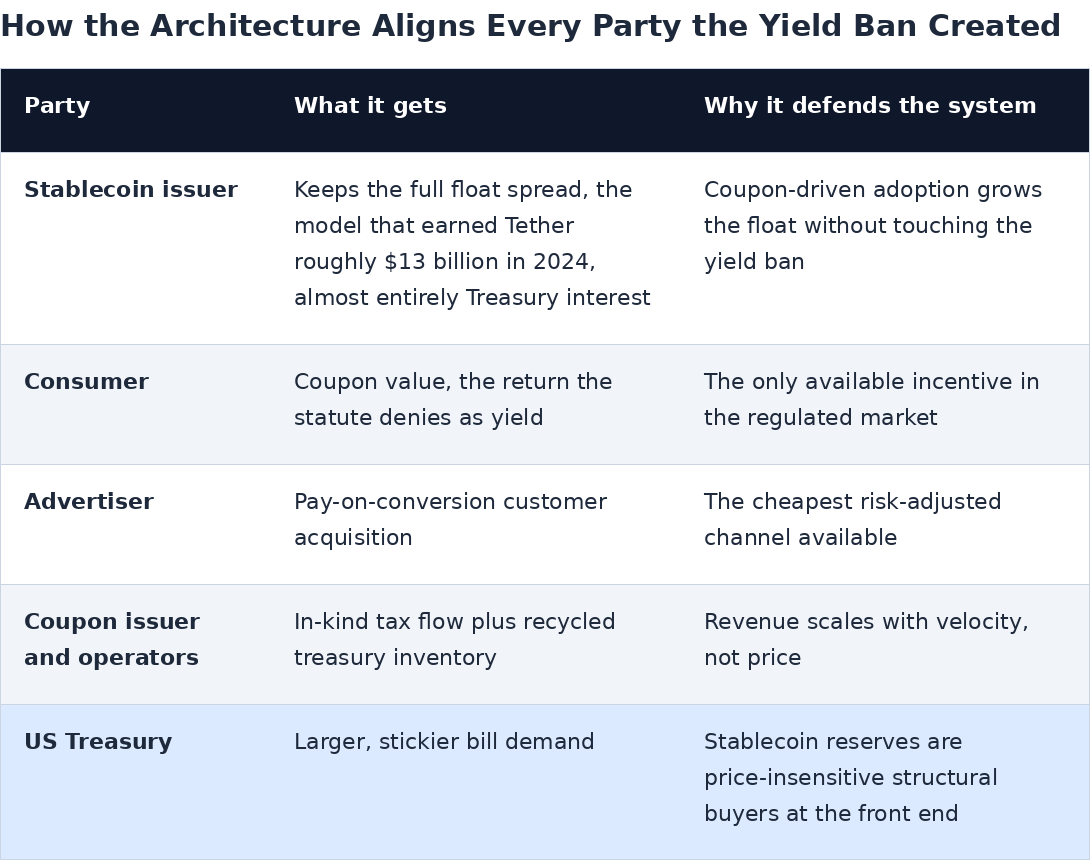
The macro chain matters most. Stablecoin reserve demand already measurably compresses short-term Treasury yields, with asymmetric effects that strengthen as the market grows, and Treasury projects the market reaching roughly $3 trillion by 2030. Any layer that accelerates adoption, particularly transactional adoption, which is stickier than speculative parking, accelerates that entire chain: float growth, bill demand, front-end yield compression, and the fiscal room those create. A coupon layer is, in macro terms, a demand-side amplifier bolted onto the dollar's newest funding channel.
Implication Five: The State-Policy Variant
The same architecture generalizes from commerce to public finance. A state-issued variant, meaning the two-state token model, the in-kind transaction tax and treasury recycling operated at the state level, with allocations flowing to program operations and the state's general treasury, turns the coupon system into a fiscal instrument. A state can distribute tax relief or consumer stimulus through coupons whose cost is advertiser-funded and whose treasury allocation grows with transaction volume rather than tax rates.
The policy implication is a new category between tax cut and spending program: a self-funding incentive rail whose long-run treasury unlock aligns the state with the platform's success. The design questions of custody, constitutional debt limits and procurement are real, but the category itself is novel and, after GENIUS normalized regulated dollar tokens, no longer exotic.
Regulatory Positioning and Guardrails
Four framing disciplines protect the architecture.
Commodity-venue positioning. The trading surface should be described as a commodity-token venue under CFTC jurisdiction. Securities-market terminology invites a classification fight the design is built to avoid.
No issuer yield. The coupon layer must remain advertiser-funded and usage-triggered. Any drift toward issuer-funded or holding-triggered rewards would collide with the statutory yield prohibition and with the debate already underway about yield-bearing workarounds.
Layer separation for hard-backed assets. Where the underlying is a physically backed commodity receipt, the tax, expiry clock and recycling mechanics must remain entirely on the coupon layer. Applying them to the receipt would destroy exact physical backing.
Banking-system awareness. Regulators are actively studying stablecoin disintermediation of bank deposits and its transmission of liquidity stress. A coupon layer that accelerates adoption should expect scrutiny proportional to its success, and Kansas City Fed work notes that each stablecoin dollar adds Treasury demand only by reallocating it from other assets.
Risks and Open Questions
Candor requires a short list of what is not yet proven.
Execution evidence. Platform readiness, app-store acceptance, issuer launch, traded volume and coupon redemption remain to be demonstrated. The first ninety days of verified volume and redemption data are the valuation inflection point. Before that, all economics are projections.
Term verification. Allocation splits, market-maker terms, volume caps and issuer-agreement economics require confirmation against definitive documents before investor use.
Regulatory drift. The line between advertiser-funded coupons and prohibited rewards is defensible but untested. Adverse interpretation is a live risk until precedent exists.
Adoption behavior. The thesis that coupons convert holders into spenders, especially in foreign markets, is supported by advertising economics but not yet by platform data.
Conclusion
The GENIUS Act built the rail and the yield ban emptied it of consumer incentive. Foreign fear fills it from one side, and nothing fills it from the other. The Super Coupon Token is a candidate answer whose significance is easy to understate. It is not a coupon business that happens to use tokens, but an adoption engine for the dollar's newest funding channel, one that pays consumers what the statute forbids issuers to pay, at advertisers' expense, while growing the float that anchors Treasury demand.
If the launch data validates the mechanics, the implications run from retail commerce to the front end of the yield curve. If they do not, the architecture still defines the category every successor will have to occupy: the lawful incentive layer of the regulated dollar token system.
This whitepaper describes an architecture and its implications for research and discussion purposes. It is not investment advice, an offer to sell or a solicitation to buy any security or token. Descriptions of mechanics, allocations and economics are as designed and have not been confirmed against definitive documents, and the forward-looking statements throughout are projections rather than results. The regulatory positions taken here are the authors' analysis, not legal advice or any assurance of how a regulator will treat the structure.
The authors hold positions in securities mentioned and reserve the right to buy or sell shares at any time without notice.