
The AI and Quantum Frenemy Trade

Machine learning and quantum computing spent a decade being sold as rivals. In 2026 the tape is telling a different story, and the last time two technologies converged this way, it minted an entire industry.
On the morning of December 23, 1947, in a small laboratory on Mountain Avenue in Murray Hill, New Jersey, John Bardeen and Walter Brattain wired up a fingertip-sized sliver of germanium with two gold contacts and a paper clip, applied a small voltage, and watched a signal amplify. They had built the first working transistor. There was no press release. Bell Labs did not announce the device publicly for another six months, and when the announcement came, The New York Times buried it on page 46, between a story about a new radio program and a commercial for a hearing aid. The prevailing wisdom in 1948 was that computing belonged to vacuum tubes, and vacuum tubes were doing just fine. ENIAC, unveiled two years earlier, had 18,000 of them, weighed thirty tons, and filled a room the size of a small warehouse. In 1949 Popular Mechanics famously predicted that computers of the future might one day weigh as little as one and a half tons.
For nearly a decade the transistor was treated as a laboratory curiosity, useful for hearing aids and portable radios, but not a serious threat to the tube-based mainframes that IBM, Remington Rand and Ferranti were building. The two technologies were framed as rivals: one proven, one experimental. Then, in 1957, eight engineers walked out of Shockley Semiconductor in Palo Alto, the group William Shockley would forever after call his "traitorous eight," and founded Fairchild Semiconductor. Within eighteen months, Jack Kilby at Texas Instruments and Robert Noyce at Fairchild had independently invented the integrated circuit, placing multiple transistors on a single sliver of silicon. The pairing of the transistor with the digital computer, two technologies that had spent a decade being sold as competitors, produced the semiconductor industry, Silicon Valley, and every dollar of technology-equity wealth that followed.
The prevailing wisdom in 1948 was that computing belonged to vacuum tubes. The prevailing wisdom in 2020 was that computing belonged to GPUs.
I open with this story because artificial intelligence and quantum computing are, in the autumn of 2026, in almost precisely the position the transistor and the digital computer occupied in the late 1950s. Two technologies, developed in parallel through separate communities, initially framed as competing bets on the future of computation, are now visibly converging into a single hybrid stack. When The Economist declared in July that AI and quantum computers would be frenemies, it was describing that convergence in the language of Silicon Valley personality drama. The capital-markets translation is more consequential. The convergence has already reached the tape. The hyperscalers underwriting both sides are the same names. The pure-play quantum equities are trading not on current revenue but on a milestone calendar that, for the first time in the field's history, is publishing dates rather than aspirations. This is the moment before Fairchild, not the moment after.
A brief prehistory of the rivalry
The rivalry framing has a specific origin. On May 16, 2013, Hartmut Neven, then a director of engineering at Google, published a blog post announcing the Quantum Artificial Intelligence Lab, a joint effort with NASA's Ames Research Center and a consortium of universities. The lab was built around a D-Wave Two annealer, 512 qubits, cooled to a fraction of a degree above absolute zero, and its stated purpose was to accelerate machine learning. The announcement made the front page of the technology press. For a brief moment quantum computing appeared to have found its killer application: training the neural networks that Google, then in the middle of its deep-learning renaissance, was betting the company on.
The moment did not last. In February 2014, Nature Physics published a benchmark study concluding that D-Wave's machine, on the specific optimization problems tested, showed no clear quantum speed-up over well-tuned classical algorithms running on ordinary GPUs and CPUs. Alan Baratz, D-Wave's current chief executive, now concedes that both technologies were immature. Neither was ready. And so began the decade of divergence. AI scaled violently on classical silicon: Nvidia's H100 and Blackwell generations, trillion-parameter language models, a market capitalization for a single graphics-chip company that briefly exceeded the entire market capitalization of Germany. Quantum spent the same decade in a quieter, more grinding process, coaxing coherence times from microseconds toward milliseconds, and error rates from one in a hundred toward one in a million. The two communities stopped talking to each other. The rivalry hardened into an assumption.
The assumption is now wrong, and the evidence that it is wrong is not a slide deck. It is a chip, an algorithm, an interconnect, and a ten-billion-dollar check.
The chip: Willow and the below-threshold moment
In December 2024, Google Quantum AI introduced Willow, a 105-qubit superconducting processor fabricated in a new facility in Santa Barbara. Willow was the first quantum system to demonstrate what the field has spent thirty years chasing: error correction below threshold. The concept, introduced by Peter Shor in 1995 alongside his more famous factoring algorithm, is straightforward in principle and brutal in practice. Group many physical qubits into a single logical qubit, run consistency checks constantly, and if the physical error rate is low enough, adding more qubits will reduce the logical error rate rather than compound it. Below threshold means the machine gets better as it gets bigger. Above threshold, it drowns in its own noise.
Willow crossed the line. Google tested encoded-qubit grids at three by three, five by five, and seven by seven, and at each step the error rate was cut in half. The chip also posted a random-circuit-sampling benchmark that would take the fastest classical supercomputer an estimated 10²⁵ years to reproduce, a figure so large it exceeds the age of the universe by fifteen orders of magnitude. Ten months later, Google Quantum AI extended the result with an algorithm it calls Quantum Echoes, the first demonstration of verifiable quantum advantage on hardware. Verifiable is the key word. It means the answer produced by the quantum computer can be independently checked, either by another quantum computer or by a real-world experiment. An unverifiable advantage is a science project. A verifiable one is a product.
The algorithm: AlphaQubit and the transformer inside the fridge
The AI piece slotted in almost immediately, and it slotted in from a direction that surprised the field. In November 2024, Google DeepMind unveiled AlphaQubit, a neural-network decoder that identifies errors inside a quantum computer in real time. AlphaQubit is not built on some exotic quantum-native architecture. It is a transformer, the same deep-learning architecture, developed at Google in 2017, that underpins ChatGPT, Claude, Gemini and every large language model in production. Trained on data from the Sycamore processor and on hundreds of millions of simulated examples, AlphaQubit cut error-decoding mistakes by 6% against tensor-network methods and 30% against correlated matching on the largest experiments. It maintained accuracy across simulated systems up to 241 qubits and 100,000 rounds of correction. The work was published in Nature.
Stop and consider what this means. The bottleneck to a useful quantum computer, real-time error correction, the problem the field has struggled with since 1995, is being solved with the same architecture that runs your chatbot. The two technologies are no longer rivals for the same workload. One has become an essential component of the other. This is the transistor-and-digital-computer moment. In 1958 no one at Bell Labs, IBM or Fairchild would have described the transistor as a rival to the computer. By then it was obvious that the transistor was how you built the computer. In 2026 it is becoming similarly obvious that AI is how you build a useful quantum computer, and that certain computational problems will only be solved by a hybrid stack in which classical accelerators, AI models and quantum processors run as a single coordinated machine.
The interconnect: NVQLink and Nvidia's side of the bet
The hybrid stack needs plumbing. In October 2025 Nvidia unveiled NVQLink, a low-latency interconnect that ties quantum processors directly to GPU systems, and at GTC 2026 it made the technology publicly available through a new cudaq-realtime API. Seventeen quantum hardware builders, including Quantinuum, IonQ, Rigetti, Infleqtion, IQM, Pasqal and Quandela, and nine U.S. national laboratories including Berkeley Lab, signed on at launch. Every serious quantum roadmap now assumes an Nvidia accelerator sits next to the dilution refrigerator, running the decoder, the pre-processing, the post-processing, and the AI workflow layer that choreographs the whole apparatus.
This is the trade Nvidia was supposed to lose. The narrative for years was that a real quantum breakthrough would eventually erode Nvidia's moat by taking workloads it currently owns, such as molecular simulation, certain optimization problems and cryptanalysis, and moving them onto qubits. Instead Nvidia has positioned itself as the classical half of every hybrid workload, modality-agnostic. Whether superconducting qubits win with IBM, Google and Rigetti, or trapped ions with IonQ and Quantinuum, or neutral atoms with Pasqal, QuEra and Infleqtion, or photonics with PsiQuantum, Xanadu and Quandela, or topological qubits with Microsoft, the classical accelerator sitting next to the QPU is a Blackwell GPU running CUDA-Q. It is the equivalent of selling picks and shovels to every gold rush at once, and it is why Nvidia's exposure to quantum computing is arguably the most investable version of the thesis.
The check: IBM's $10 billion, a foundry, and a dated roadmap
On June 2, 2026, IBM committed more than $10 billion over five years to quantum computing, funding a roadmap that targets a fault-tolerant machine, IBM Quantum Starling, by 2029, followed by Blue Jay, designed to execute one billion quantum operations across 2,000 qubits. IBM has already signed more than $1.1 billion in client quantum contracts since 2017 and operates more than 90 systems across a 340-organization network that includes Cleveland Clinic, the University of Tokyo, RIKEN, Yonsei and BasQ. In August 2026 IBM successfully joined and cooled its first two modular cryogenic modules, the physical plumbing for a shared, ultra-cold environment capable of hosting hundreds of quantum chips, and confirmed that Nighthawk processors will be installed later this year, with an L-coupler-linked 1,000-qubit machine targeted for 2027.
The company is also building the supply chain. Alongside the $10 billion commitment, IBM announced Anderon, a pure-play quantum wafer foundry backed by the U.S. Department of Commerce and described as America's first. This is the part of the story that separates IBM from the pure-plays. A published fault-tolerant date, a wafer foundry, more than $1.1 billion in signed client contracts, and 90 deployed systems is a business, not a science project. The 2026 to 2029 milestone calendar gives investors something they have never had in quantum: dates that will either be hit or missed on schedule. Nighthawk at 7,500 gates in 2026. 10,000 in 2027. 15,000 in 2028. Starling in 2029. Every one of those numbers is a checkpoint the market can price.
Microsoft is running a longer physics bet. In February 2025 it unveiled Majorana 1, the first processor built on a topological-qubit architecture designed to suppress errors at the hardware level rather than through software correction. The underlying physics, Majorana zero modes in a hybrid superconductor-semiconductor system, remains unproven at scale, and the scientific community is divided on whether the effect Microsoft has observed is what the company claims. But the strategic point holds. Three of the four largest cloud platforms in the world are now treating quantum computing as a first-class product line rather than a research curiosity, and the fourth, Amazon through Braket and its Center for Quantum Computing at Caltech, is not far behind.
The dark horse: photonic qubits and the room-temperature bet
There is a fifth modality that deserves its own section because it does not sit inside the cryogenic-and-vacuum framing that dominates the superconducting and trapped-ion stories: photonic quantum computing. Instead of trapping electrons in Josephson junctions at 15 millikelvin or laser-cooling ions in ultra-high vacuum, photonic architectures use single particles of light as qubits, manipulate them through integrated optical circuits, and run the bulk of the machine at room temperature. Only the single-photon detectors sit at cryogenic temperature. Everything else, the chip, the interconnects, the switching fabric, operates on the same silicon-photonics and lithium-niobate manufacturing base that already produces the world's optical-networking gear.
That has three consequences the market has only recently begun to price.
First, photonic systems inherit an existing semiconductor supply chain rather than requiring dilution refrigerators and helium logistics, which is why the modality is seen as the most credible path to a genuine million-qubit machine.
Second, photons are the natural carrier for quantum networking. You can pipe them through fiber the same way telecom traffic moves, so a photonic architecture is modular by construction, not by aspiration.
Third, the physics is loss-limited rather than decoherence-limited, which makes the engineering problem more like scaling an optical datacenter than like building an entirely new class of cryogenic hardware.
The pure-play menu here is short but consequential. PsiQuantum, still private, raised approximately $1 billion in a September 2025 Series E at a $7 billion valuation led by BlackRock, and in September 2025 broke ground on the Illinois Quantum and Microelectronics Park in Chicago on the site of the old U.S. Steel South Works, the first US-based utility-scale, million-qubit fault-tolerant machine under construction, with a parallel $940 million Australian government-backed site in Brisbane. The company has also signed an expanded $125 million agreement with DARPA under the Quantum Benchmarking Initiative and remains one of two finalists in the program's Stage C.
Xanadu, listed on the Nasdaq and TSX as XNDU, went public in March 2026 in the first pure-play photonic quantum-computing IPO, raising approximately $302 million and now trading at roughly $3 billion of market capitalization. Its Aurora system, published in Nature in early 2025, is the world's first scalable, networked and modular photonic quantum computer: four server racks, 35 modules, interconnected by 13 kilometers of fiber, roughly 90% of which operates at room temperature. The August 2026 roadmap targets fault tolerance in 2028 to 2029 and more than 1,000 logical qubits by 2031.
And then there is Quantum Computing Inc., QUBT on the Nasdaq, the noisier, more volatile and more heavily traded photonic name. QCi is a vertically integrated quantum-optics and integrated-photonics company that operates its own thin-film lithium-niobate chip foundry in Tempe, Arizona, and has now built a second production facility. First-quarter 2026 revenue was $3.7 million against $39 thousand a year earlier. Second-quarter revenue rose to $5.6 million, with revenue running for the first time out of the TFLN foundry. The company's NeuraWave photonic reservoir-computing platform, pitched at real-time AI inference at the edge for telecom, autonomous vehicles, robotics and healthcare, reached commercial readiness in the second quarter and booked an initial five-system order under a larger framework agreement, alongside the acquisitions of Luminar Semiconductor and other photonic assets to build out the vertically integrated stack. QUBT closed at $8.22 on September 8, 2026, for roughly $1.86 billion of market capitalization, a fraction of the trapped-ion and superconducting comps despite owning the only listed pure-play with a working TFLN foundry. France's Quandela, still private, is the other name worth watching. Its Belenos 12-qubit photonic machine went live on OVHcloud in April 2026 and is the anchor of the French PROQCIMA strategic quantum program.
Photonics is the modality most likely to produce the surprise. It is also the modality that maps most cleanly onto the transistor-era analogy, because it is being built on top of an already-industrial manufacturing base, the same silicon-photonics and lithium-niobate foundries that today produce the optical transceivers inside every hyperscaler datacenter. If quantum computing scales to a million qubits before 2035, the smart money increasingly believes it will get there on photons rather than on Josephson junctions or trapped ions. That belief is why PsiQuantum has raised more private capital than any other quantum company, why Xanadu's IPO cleared at a premium to its private mark, and why QUBT trades at a revenue multiple no software company would justify.
The public-market menu
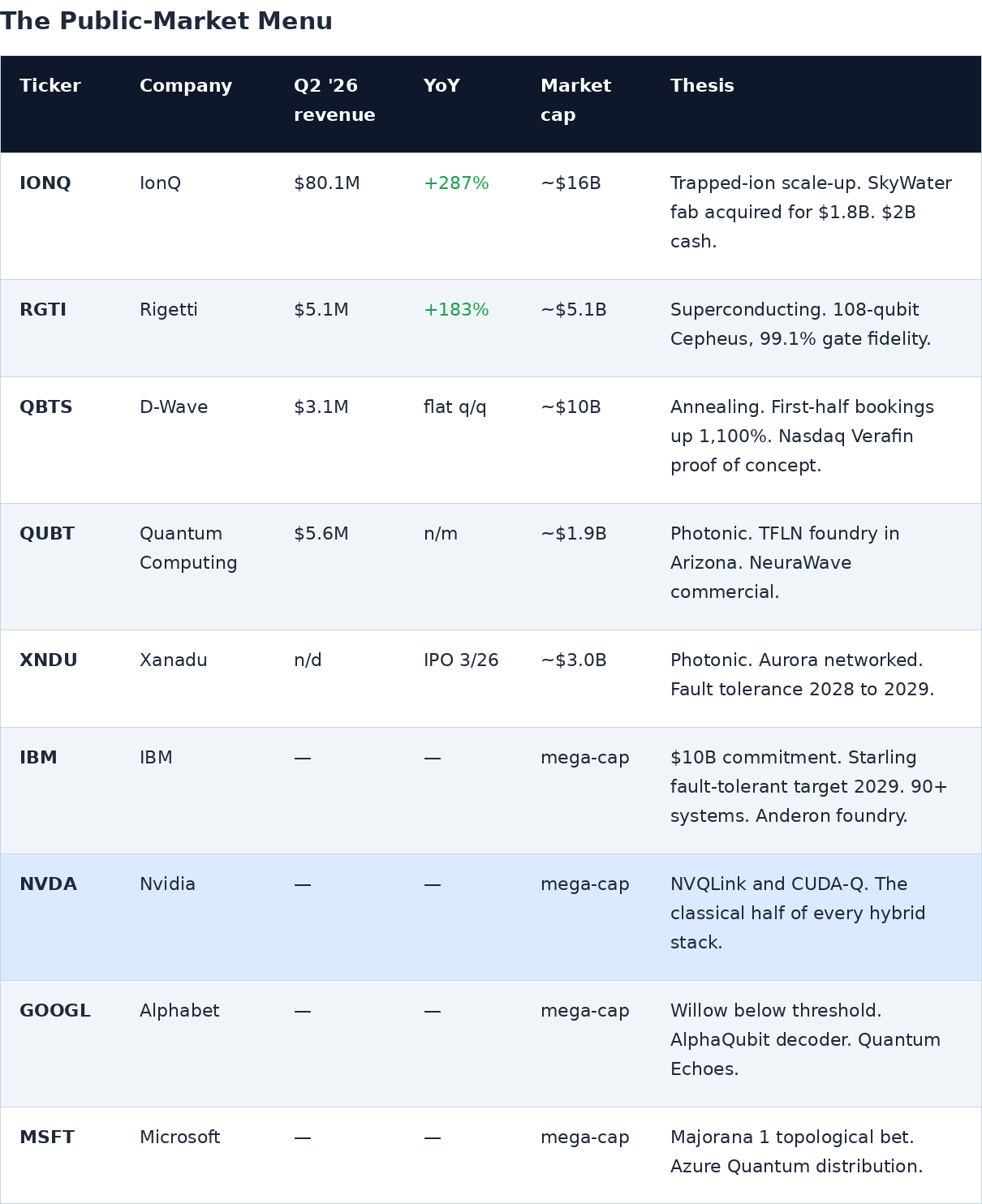
The pure-plays diverged sharply on the second-quarter tape. IonQ printed a record $80.1 million, up 287% year over year, raised full-year guidance to $280 million to $290 million, and on July 31 closed the acquisition of SkyWater Technology for approximately $1.8 billion, making it the only vertically integrated, full-stack quantum computing platform in the public markets: trapped-ion hardware, software, and now its own semiconductor foundry. The company ended the quarter with roughly $2 billion of cash on the balance sheet. Rigetti did $5.1 million, up 183%, with gross margin expanding to 43% and management publicly targeting a 1,000-qubit superconducting system within three years, extending from its 108-qubit Cepheus platform at 99.1% median two-qubit fidelity. D-Wave printed only $3.1 million but bookings ran up more than 1,100% in the first half, and its early-stage proof-of-concept with Nasdaq Verafin on fraud and money-laundering detection put an actual commercial financial-services customer next to the science.
The sector re-rated hard into late July, with IonQ down 39% and Rigetti and D-Wave off roughly 30% each in a single month, and then snapped back on earnings and deal news. Valuations remain option-like. Combined pure-play sector market cap sits in the tens of billions against revenue that would not fill a mid-cap software quarter. This is exactly the pattern the semiconductor equities traded on in the early 1960s, when Fairchild, Texas Instruments and Motorola were valued not on current transistor sales but on the option value of an industry that had not yet been built. The comparison is not perfect, since no historical analogy is, but the pattern of a small basket of pre-profit pure-plays trading as long-dated call options on a technology curve underwritten by much larger, profitable incumbents is one Wall Street has seen before, and one it has occasionally rewarded extraordinarily.
How to trade the frenemy thesis
Three portfolio observations follow from the tape rather than the marketing.
First, the cleanest exposure is the classical side of the hybrid stack. Nvidia gets paid whether superconducting, trapped-ion, photonic, neutral-atom or topological wins the modality race, because every credible roadmap now assumes accelerated computing sits next to the QPU running the decoder, the pre-processing, and the AI workflow layer. That is a rare position for a public-markets investor: leverage to the outcome without having to pick which physics wins. It is also the position Bell Labs' parent, AT&T, briefly occupied in the 1950s and then squandered by licensing the transistor patent to essentially everyone for a nominal fee, a decision that eventually created Silicon Valley but denied AT&T the equity upside. Nvidia is not making that mistake. CUDA-Q, NVQLink and the developer ecosystem around them are the moat.
Second, IBM is the most investable direct exposure inside the mega-caps. A $10 billion committed spend, a published fault-tolerant date, a wafer foundry with Commerce Department support, and more than $1.1 billion in signed client quantum contracts is a business. The 2026 to 2029 roadmap gives investors dated milestones, with Nighthawk at 7,500 gates in 2026, 10,000 in 2027, 15,000 in 2028 and Starling in 2029, that will either be hit or missed on schedule. This is what the transistor era looked like from an investor's seat in 1959: IBM the incumbent that had just committed serious capital, a roadmap with specific product dates, and a market that had begun to price the acceleration.
Third, the pure-plays are best sized as a basket of long-dated call options across modalities rather than a conviction single name. IonQ is the revenue leader and now vertically integrated through the SkyWater acquisition. Rigetti has the cleanest superconducting fidelity story and a credible 1,000-qubit roadmap. D-Wave has the only real commercial book, however early. On the photonic side, Xanadu is the cleanest listed pure-play with a peer-reviewed networked architecture, and QUBT owns the only publicly traded thin-film lithium-niobate foundry, the same manufacturing base PsiQuantum is scaling privately into a million-qubit machine in Chicago. None of them will be valued on 2026 revenue. They will be valued on whether the AI-decoded, GPU-coupled architecture that IBM, Google, Nvidia and Microsoft are now jointly building actually reaches quantum advantage on problems that matter, meaning protein folding, materials discovery, portfolio optimization and cryptography, inside this decade, and on which physics wins the modality race. IBM's own enterprise study earlier this year found that quantum is coming faster than most enterprises are ready for. That gap between capability and adoption is where the trade lives.
There is a fourth observation worth flagging for completeness: the risk that the entire hybrid-stack thesis is being over-priced by the market on hype alone. That risk is real. Quantum computing has produced more spectacular hype cycles than almost any technology of the past forty years, and this one has all the hallmarks, with soaring pre-profit valuations, breathless press coverage, and a fundraising environment that rewards narrative over revenue. The correct response to that risk is not to avoid the sector but to size positions honestly as options, with option-like conviction and option-like maximum loss.
The pattern that has happened before
The Economist framed the two technologies as frenemies. The capital-markets translation is simpler and, I think, more actionable. AI needs quantum to break through the physical limits of classical scaling on certain problem classes, including factoring, molecular simulation and high-dimensional optimization, that no amount of GPU capacity will crack economically. Quantum needs AI to survive its own error rates long enough to reach those problems. The two technologies are becoming complementary in the same specific, technical, architectural sense that the transistor and the digital computer became complementary in the late 1950s. Neither replaces the other. Together they produce something neither could produce alone.
The equities that own both sides of that convergence, meaning the hyperscalers building the hybrid stack in IBM, Google and Microsoft, the accelerator vendor that connects it in Nvidia, and a small basket of pure-plays priced on optionality across the modality race, with IonQ and Rigetti on the cryogenic side, QUBT and Xanadu on the photonic side, and D-Wave on annealing, are how a public-markets investor gets paid for the convergence rather than the rivalry. The last time this pattern played out, in the decade after the traitorous eight walked out of Shockley Semiconductor and founded Fairchild, it produced Intel, Advanced Micro Devices, Texas Instruments, Motorola, and eventually the entire modern semiconductor industry. Nothing about the AI-quantum trade is guaranteed to follow the same trajectory. But the shape of it, two initially rival technologies converging into a single hybrid stack, underwritten by the largest capital commitments the incumbents have ever made, with a small basket of pure-plays priced on option value, is a shape Wall Street has seen before. Investors who recognized it in 1959 did well. It is worth taking seriously in 2026.
This commentary is for informational and educational purposes only. It is not investment advice or a solicitation to buy or sell any security. The author may hold positions in companies referenced.
The authors hold positions in securities mentioned and reserve the right to buy or sell shares at any time without notice.