
The Barter at 1600 Pennsylvania

Why Xi needs September 24: a five-file exchange, a diesel clock, and the evidence that Beijing is already spending its authority to slow a dollar migration it cannot stop.
Macro strategy series: US and China, energy, capital flows.
In one paragraph
On September 24, Xi Jinping walks into the White House with a large business delegation and a clock running against him: China's export-control truce lapses on November 10 and its US-specific mineral suspensions on November 27, while Washington's tariff relief expires the same day. Most commentary treats the meeting as a tariff truce with agricultural garnish. We read it as a barter across five files, with refined fuel as the operative currency, because the world has lost roughly 9 percent of its refining capacity to two wars and only Beijing can add diesel barrels within weeks. Xi will concede substance while keeping the nomenclature. Trump will take the substance. Iran is the file Xi gives away: Tehran's barrels have already stopped reaching China under the US blockade, and its partners have just closed the Red Sea exit and Saudi Arabia's bypass pipeline on Beijing's other suppliers. The reason Xi will do so is not tariffs. It is that the Chinese consumer has stopped, the subsidy pull-forward is exhausted, and Beijing has spent the summer erecting a control stack aimed squarely at its own savers, at the same time as it works through the state banks to keep the yuan from rising. A government that is simultaneously suppressing its currency, taxing offshore insurance policies, threatening exit bans and paying its citizens more to hold dollars inside its own banks than yuan is telling you what it fears. It fears exit. Central-bank research on 130 economies finds dollarization, once established, is very hard to reverse. Beijing is trying to slow the unslowable, and that is why it needs this deal more than Washington does.
Executive summary
The summit is a barter, not a trade meeting. Five files are on the table: rare-earth and critical-mineral licensing; refined-product relief; Ukrainian targeting restraint on Russian refineries; energy supply under the Venezuela and NABEP template; and Iran. The tariff and agriculture items being briefed to the press are the wrapping paper.
Diesel is the currency. Two wars have taken almost 9 percent of world refining offline. Russia's throughput is about 4 million b/d, 30 percent below pre-invasion. US refineries run at 98 percent utilization with distillate stocks near 23-year lows. On September 13, the President told Kyiv to stop hitting Russian diesel. The only supplier that can add product in weeks is China, by quota release.
Iran is Xi's cheapest concession, and the summer made it cheaper. China took almost all of Iran's exported oil in 2025. Since the US blockade was reimposed on July 13, no supertanker of Iranian crude has been seen crossing Hormuz, China's Iranian imports fell to 534,000 b/d in August, and Tehran is asking premiums to Brent for barrels it once sold at a discount. Beijing already restricted its own fuel exports rather than defend Tehran. Venezuela is off the table for him: the NABEP concession gives Washington a 35 percent equity stake, 20 percent of output at cost and first refusal on the rest, and those barrels are not going east.
Both doors out of the Gulf now shut on Beijing's suppliers, not on Washington's. On September 10 and 11 the Houthis took Mocha, the Hanish islands and Perim at the mouth of Bab el-Mandeb, and Saudi Arabia shut its 4 to 5 million b/d East-West bypass pipeline after drone strikes from Iraq. Brent went back above $100. Half of China's crude imports come from the six Gulf states behind Hormuz, and Qatar has declared force majeure on Chinese LNG contracts. Iran's war is destroying Chinese supply security, which is why Xi's interest is a reopened Gulf, not a protected Tehran.
The chokepoint ledger runs against Xi. Of the valves being turned in 2026, meaning Hormuz, Bab el-Mandeb, the Black Sea, Panama, Congo's copper and cobalt, Indonesia's nickel and Myanmar's tin, China is the buyer at most of them. What it holds are processing valves, in rare earths, gallium, graphite and drug starting materials, whose value depreciates with every month of withholding and which resource states are now copying. The valuable file is minerals. The costless file is Iran. Sections 9 and 10 lay out both ledgers.
Xi needs the deal because the home front has stopped. Trade-in sales fell from 1.6 trillion to 1.1 trillion yuan in the first half while the subsidy fund shrank from 300 billion to 250 billion yuan. Gasoline-car sales fell 40 percent in August. Growth slowed to 4.3 percent in the second quarter.
Beijing is already fighting the dollar migration, and doing it quietly. State banks lifted dollar deposit rates above 3 percent and bought Treasuries, which Reuters' sources describe as moves that would blunt the yuan's rise, and foreign-currency deposits reached $1.18 trillion. Between July 1 and September 15, Beijing brought resident individuals under outbound-investment law for the first time, imposed a 20 percent tax on offshore trusts and Hong Kong insurance, proposed removing the $300 million reporting threshold on outbound deals, and codified exit bans of six months to three years.
The arithmetic is unforgiving. Household deposits stand at 173.48 trillion yuan. A one percent shift is about $243 billion, more than the entire $176 billion QDII quota. A five percent shift exceeds China's annual current-account surplus. The Bank for International Settlements finds that stablecoin flows are largely unaffected by capital-flow restrictions, broad or specific, and that dollarization resists being undone once it takes hold.
What this does not mean. China is not a vassal. It holds more than $4 trillion in net external assets and borrows at 1.68 percent against 4.85 percent for the United States. It faces a decade of balance-sheet repair that forecloses consumption-led rebalancing and caps its bid to be the world's settlement layer. Xi does not kneel. He stays stuck.
Base case, 55 percent: a multi-file barter announced as a trade truce. Narrow truce extension, 25 percent. Grand bargain including energy reallocation, 12 percent. Breakdown, 8 percent. Seven indicators and a falsification test are set out in Section 16.
1. The thesis: a five-file barter dressed as a trade truce
The public calendar is simple. President Trump invited Xi Jinping and Peng Liyuan to the White House for September 24 during the Beijing state banquet in May. It is the third face-to-face meeting between the two leaders in twelve months. Xi is preparing a large delegation of Chinese executives for the trip, and Reuters' sources describe expectations as modest. The briefed agenda runs to Taiwan, trade, tariffs, critical minerals and energy. Beijing's commerce ministry has floated reciprocal tariff reductions on about $30 billion of goods at an early date, and Barclays expects targeted cuts rather than a broad deal. We would call this consensus managed continuity.
The calendar underneath is engineered. The US Trade Representative extended tariff exclusions on 178 Chinese products to November 10, 2026. That is the same day the US suspension of heightened reciprocal tariffs on China and China's suspension of its October 2025 rare-earth export-control package both lapse under the November 2025 truce. China's separate suspension of its ban on gallium, germanium and antimony exports to the United States runs to November 27, 2026. The summit therefore sits 47 days before the first cliff and 64 days before the second. Nobody arranges a state visit that close to two expiries unless both sides intend to reset them, and nobody resets them without trading something.
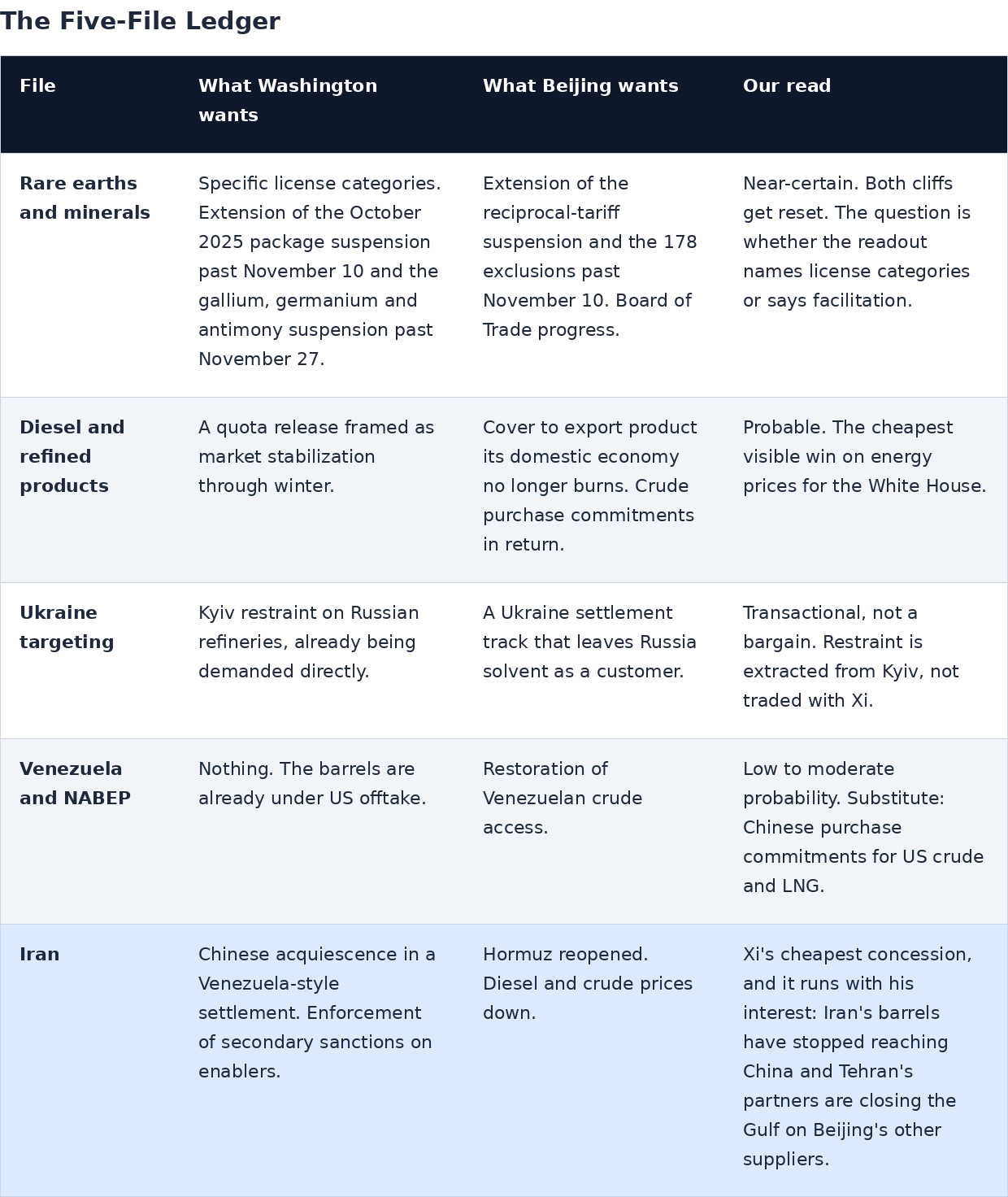
Our thesis is that the trade is wider than tariffs and is best understood as a ledger with five files. The rare-earth file is the one both sides talk about. The diesel file is the one that has become urgent. The Ukraine file is the price Washington is already extracting from Kyiv. The Venezuela file is the one Beijing would like and will not get. The Iran file is the one Beijing can give away cheapest. Section 6 lays out the ledger. Sections 8 through 10 explain why the Iran file is the one Xi gives away, and place it on the wider map of maritime and product chokepoints being squeezed in 2026. Sections 11 through 14 explain why Xi will pay: not because of tariff pressure, but because his domestic position is weaker than the headline data suggest and his own government is behaving as though it knows it.
How to read this paper. The barter is a scenario, not an announced agreement. We separate confirmed structures, meaning NABEP terms, export-control dates, market data and Chinese regulations, from inferences, meaning China's diesel role, Ukrainian restraint as consideration, and an Iran extension. Where our reading of Beijing's behavior differs from what Beijing says, we show both.
2. How commodity leverage actually works
Commodity leverage is old, and its rules are stable. Athens fought Thasos in 465 BC for a silver mine and blockaded the Hellespont to control Black Sea grain. Venice built a state salt monopoly by 1220, fought Padua for it in 1304 and Ferrara for it in 1482, and financed total war against Genoa on salt revenue. The East India Company locked up Bengal saltpetre, the 70 to 75 percent ingredient in gunpowder, on fixed-price London contracts. In 1942 Salazar split Portugal's wolfram between both sides of the war and embargoed it only in June 1944 under Allied threat. Turkey did the same with chromite until April 1944. Sweden supplied 43 percent of Germany's iron ore and stayed unoccupied partly because Germany needed the ore. Chile went to war in 1879 for the nitrate fields and lived on nitrate taxes for a generation. OAPEC cut production 5 percent a month in 1973 and quadrupled the price by 1974.
Three lessons follow. First, leverage works when substitutes are unavailable in the relevant window and the holder's share is large enough that preclusive buying is unaffordable. Second, leverage is monetized by selling access, not by withholding it: Portugal and Sweden collected for years, while the Confederacy's King Cotton self-embargo produced neither recognition nor intervention and accelerated Europe's search for Indian and Egyptian cotton. Third, leverage is perishable. Every month of withholding buys the buyer a month to build the substitute. China's rare-earth position in 2026 is a Portuguese wolfram position: valuable, real, and best sold before it depreciates. The reason Beijing suspended its October 2025 package within a month of announcing it is that it understands the third rule.
3. The diesel clock
On Sunday, September 13, speaking at his Doonbeg course on the sidelines of the Irish Open, the President said Zelensky has to "stop knocking out diesel fuel in Russia," that he should go after other targets, and that the strikes are causing a shortage. He added, in remarks reported by Al Jazeera, "Don't hit diesel fuel." The same night Ukraine's General Staff reported strikes on the Slavyansky refinery in Krasnodar Krai and the Taneco refinery at Nizhnekamsk in Tatarstan.
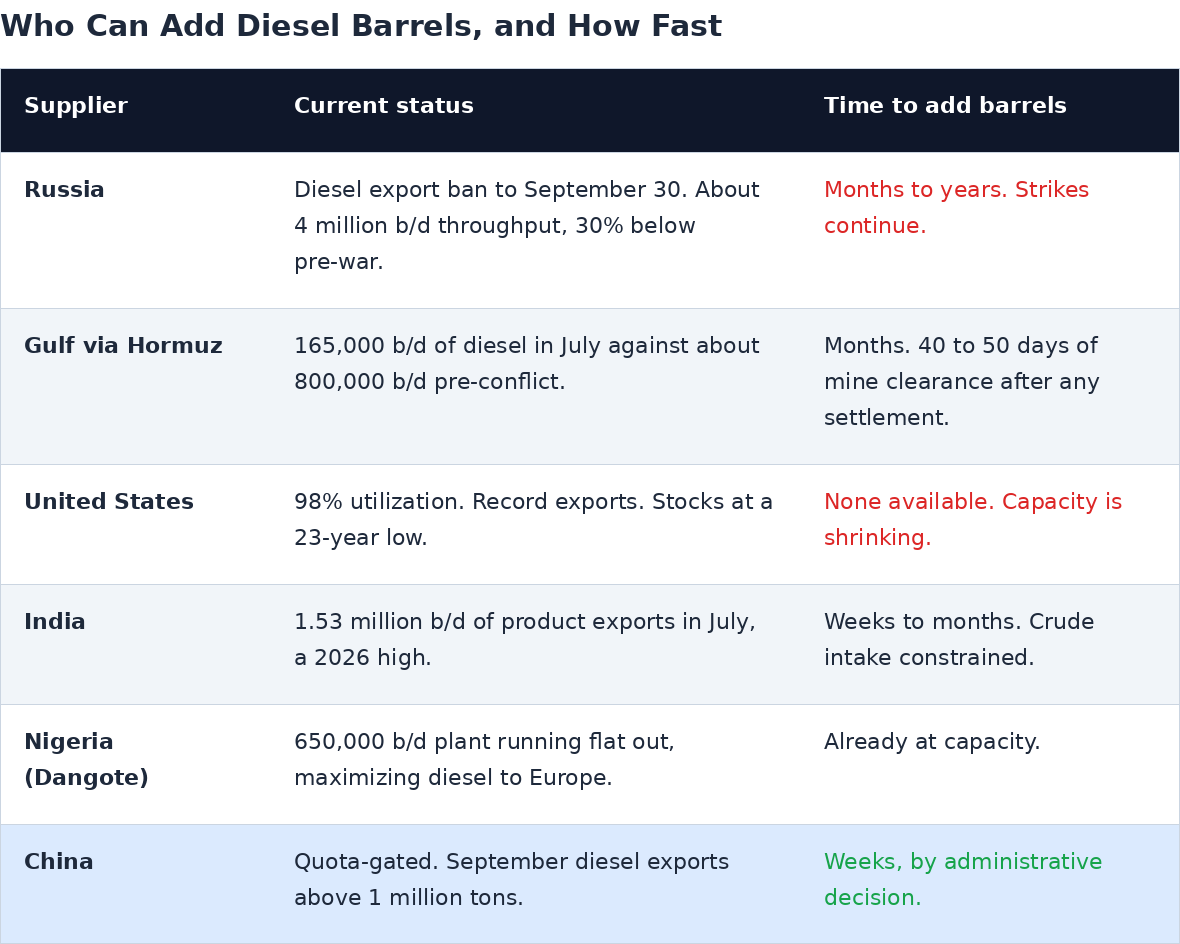
The President is describing a real shortage. The IEA has cut its baseline for Russian oil processing over the next eighteen months to about 4 million barrels a day, 30 percent below pre-invasion levels. Kpler estimated in July that 1.5 to 2 million b/d of Russian processing capacity was effectively offline and that refineries in downtime or damaged represented about 4.3 million b/d, roughly 58 percent of national capacity. The Oxford Institute for Energy Studies counts 24 of Russia's 34 refineries attacked in 2026, covering 5.1 million b/d or 81 percent of capacity. Moscow extended its ban on diesel exports to September 30 and banned gasoline and non-producer diesel exports to January 31, 2027. Kpler put 2025 average Russian diesel and gasoil loadings at about 817,000 b/d, so the ban removes roughly 800,000 b/d from Turkey, Brazil and Africa.
Russia is only half the hole. Vitol's chief executive Russell Hardy told the APPEC conference in Singapore on September 8 that there is "really a shortage of products," with close to 2 million barrels a day missing from Russia and nearly as much again from the Middle East. Diesel flows through Hormuz were 165,000 b/d in July against about 800,000 b/d before the conflict, and maritime-security sources told Reuters that mine clearance could take 40 to 50 days before insurers and shippers are confident enough to transit. Industrial Info Resources estimated in May that outages linked to the two wars equalled almost 9 percent of the world's 100.5 million b/d of refining capacity.
The United States cannot fill it. Operable atmospheric distillation capacity was 18.16 million b/cd on January 1, 2026, down from 18.42 million a year earlier, and Valero's 145,000 b/d Benicia refinery has since ceased fuel production and been removed from EIA's capacity estimates. Refinery utilization reached 98 percent in the week to August 28, the highest since August 2018, with East Coast distillate stocks at a record low. National distillate inventories fell to 100.8 million barrels in May, the lowest since 2003, and the EIA now forecasts they fall below 100 million barrels in September and stay below the five-year low through most of 2027. The US diesel crack spread hit a record $108.02 a barrel on September 2 as retail diesel set a record $5.82 a gallon. Distillate exports set a record 1.884 million b/d in the week ended July 31. The American refining system is a fixed, highly utilized machine running flat out, and no new crude unit of consequence arrives before 2028.
4. Ukraine's negative control and Washington's bottleneck
Ukraine holds a new kind of commodity lever. It does not own diesel. It holds a veto over whether Russian diesel reaches the market. Historically that is closer to the Athenian blockade of the Hellespont than to Portuguese wolfram: chokepoint denial rather than ownership. Denial generates no revenue and no customers, and it makes the patron bear the cost, which is exactly what the Doonbeg remarks reveal. The lever is real and perishable. Destroyed refineries stay destroyed for months, so a conditional and reversible pause costs Kyiv nothing permanent and can be traded for consideration on air defense, long-range munitions or ceasefire terms. The historical prescription is to convert the lever into terms before surrendering it.
Kyiv's bargaining position is nevertheless weak because its patron controls the release valve. Prime Minister Koretskyi has told parliament Ukraine faces a $27 billion shortfall in its 2026 defense budget. Europe has structured a Ukraine Support Loan of up to 90 billion euros for 2026 and 2027, but about 95 percent of Patriot interceptors reach Ukraine through the PURL mechanism, which releases only when the US Department of War releases the articles. Europe can replace dollars. It cannot replace interceptors. That is why the President can tell Kyiv which targets to leave alone.
Russia, for its part, is being hurt despite higher prices. Oil and gas revenues fell 16.7 percent year on year to 5.02 trillion rubles in January to August. The federal deficit reached 6.45 trillion rubles, 2.8 percent of GDP, in the first seven months, already above the whole of 2025. Military spending consumed 57.3 percent of federal revenue in the first half. Moscow's response has been to announce preparations for massive strikes on Ukraine's energy sector, which means it will worsen Ukraine's winter before it eases its own export pain. That keeps diesel politically salient in Washington through the summit and beyond. Xi arrives knowing that the American president wants the diesel problem to go away and that Beijing is the only party in the room who can make part of it go away quickly.
5. China as the refined-product swing factor, and its limits
China banned refined-fuel exports on March 11, 2026, to protect domestic supply during the Iran war. It then reopened the tap. Diesel exports rose 88 percent month on month to 810,000 tons in July as total product exports reached 4.65 million tons. Refiners are expected to export slightly more than 4 million tons of gasoline, diesel and jet fuel in September, with diesel above 1 million tons. The first two 2026 quota batches total about 32 million tons, dominated by Sinopec at 12.81 million tons and CNPC at 10.54 million tons.
This is what makes Beijing the swing supplier: a large, underutilized refining base whose export volume is set by an administrative quota that can change in a week. No other supplier has that. India is near its ceiling and losing crude intake. Dangote is full. The Gulf is waiting on repairs and mine clearance. American refiners have no spare capacity to give. If Washington wants relief before the northern winter, a Chinese quota release framed as market stabilization is the only instrument that works on the timeline.
The limits matter too. Chinese product exports were running about 13 percent below 2025 levels through July, so Beijing can be a partial offset rather than a full replacement. Its domestic product demand is contracting, which frees barrels, but Washington will not want China to become the marginal price-setter for European diesel. The realistic barter item is therefore a quota commitment that stabilizes the Atlantic Basin through the winter, not a structural role. That is also why it is cheap for Xi. He is being asked to sell product his own economy no longer burns.
6. The five-file ledger
7. Venezuela: why the barrels do not flow east
A recurring hope in Beijing, and a recurring rumor in markets, is that Washington would allow Venezuelan crude to flow to China as part of a wider bargain. The contract structure rules it out. Under the August 31 agreement, North American Blue Energy Partners holds 100-year concessions over 17 Venezuelan oil fields with about 65 billion barrels of proven reserves. The Department of War's Office of Strategic Capital holds a 35 percent equity stake in NABEP's corporate parent. The State Department has the right to buy 20 percent of output at production cost to refill the Strategic Petroleum Reserve and a right of first refusal on the remaining 80 percent. A majority of the board must be US citizens and the agreement is governed by US law.
The flows already reflect it. Venezuelan exports were 1.16 million b/d in July, of which some 786,000 b/d went to the United States, the most since early 2019 and up from 284,000 b/d in January. Reuters' destination breakdown names the United States, India and Europe. Chevron committed more than $7 billion over five years to double its Venezuelan output to about 600,000 b/d, and Energy Secretary Wright expects national production above 1.5 million b/d in the first half of 2027. A decade of Venezuelan barrels for China would require unwinding 100-year offtake rights and would defeat the purpose of the deal, which is to replace China as Venezuela's patron. The realistic substitute is a Chinese commitment to buy US crude and LNG, which fits the White House's imbalance narrative and costs Xi only foreign exchange he has in abundance.
Venezuela is also a feedstock story, not a capacity story. Extra-heavy sour Venezuelan crude is the preferred diet of complex Gulf Coast refineries. It lowers feedstock cost and improves distillate yields. But it is a substitution cycle within a fixed, highly utilized and shrinking US refining system. It does not create the diesel that is missing this winter.
8. Iran: the cheapest file on Xi's side, and the second exit
The administration has repeatedly held up Venezuela under Delcy Rodríguez as its model for dealing with Tehran, and in a prime-time address in April the President said the approach could serve as a template for Iran. US strikes on Iran resumed at the end of August, with the military announcing completion of its latest wave on September 1. Treasury Secretary Bessent's plan for secondary sanctions on Iran's enablers hangs over the summit.
Iran is where Beijing has the least to lose and the most to gain from cooperating. During the Hormuz crisis China chose to restrict its own fuel exports to protect domestic supply rather than defend Tehran's position. Moscow, with most of its refining struck, has no surplus product to offer Iran or anyone else. A reopened Hormuz lowers Chinese crude import costs and diesel prices simultaneously. So the Iran file is the one Xi can concede at near-zero domestic cost while collecting credit in Washington: quiet acquiescence in a Venezuela-style settlement, tolerance of enabler sanctions, and no obstruction at the Security Council. We expect this to be the least discussed and most consequential item in the room.
The discount is gone, and with it Iran's value to Beijing
Iran's value to China was never strategic affection. It was a discounted barrel. In 2025 Iran was China's second-largest crude source after Saudi Arabia: 520 million barrels, almost all of Iran's exports, with Iran and Venezuela together supplying about 17 percent of Chinese purchases. That trade has collapsed. Washington reimposed its blockade of Iranian ports on July 13 after the interim deal broke down, and Kpler has seen no supertanker carrying Iranian crude cross Hormuz since mid-July. China's imports of Iranian oil fell to 534,000 b/d in August against a 2025 average of 1.4 million, and Iranian sellers were offering September and October cargoes at premiums to Brent rather than the usual discount. Shandong's independent refiners, the only Chinese buyers who ever took Iranian barrels, answered by buying 16 to 20.5 million barrels of Qatari, Iraqi and Emirati crude at $5 to $8 below Brent. A senior trader observed that "ironically Iranian oil becomes the most expensive." Kpler had already noted Beijing ramping down Iranian purchases in favor of Russian crude before the war began. A partner whose only product you have stopped buying is a partner you can afford to trade away.
The second exit closes
On September 10 and 11 the Houthis, with what Reuters' sources describe as Revolutionary Guard guidance, took the port of Mocha, the Hanish islands and then Perim island at the mouth of Bab el-Mandeb, the 17-mile strait that is the Red Sea's only southern door. The same week Saudi Arabia shut its 1,200-kilometer East-West pipeline to Yanbu after drone attacks launched from Iraq. The line had been carrying 4 to 5 million b/d, roughly 4 to 5 percent of world supply, and was the kingdom's only route around Hormuz. Yanbu exports had climbed above 5 million b/d by June for exactly that reason. Saudi crude supply is at its lowest in three decades, Brent went back above $100 for the first time since mid-May, and the crown prince has asked President Trump for help twice and received intelligence and targeting support only. Hormuz transits fell to seven vessels on September 10 against a ten-day average of 15. Bab el-Mandeb traffic was already down about 60 percent from late 2023. The Houthis' stated exception is telling: navigation is safe for everyone except Saudi vessels.
Why this pushes Xi toward the trade, not away from it
Both doors out of the Gulf are now held by Tehran and its proxies, and China is the customer standing outside. Roughly half of China's 2025 crude imports came from the six Gulf states behind Hormuz, and Saudi Arabia and Iraq are its second- and third-largest suppliers. The barrels Iran's war is stranding are Chinese barrels. China's crude imports fell to 8.1 million b/d in the second quarter, 32 percent below the first, with the largest declines from Iraq and the UAE, and in May and June they dropped below 8 million b/d for the first time since 2016. Qatar declared force majeure on long-term LNG contracts, including Chinese ones, after Iranian missiles took out two of its fourteen trains and 12.8 million tonnes a year of capacity for three to five years. Tehran's assurance that Chinese ships would be allowed through a blockade did not survive the insurers' repricing. Now Iran's partners are attacking Beijing's largest supplier directly. A Tsinghua scholar quoted by the Guardian placed Iran "outside of the top 10" of countries that matter to Beijing, and said what matters is managing the conflict so that oil prices come down.
Beijing has behaved accordingly all year. It banned its own fuel exports on March 11 rather than defend Tehran's blockade. Its state refiners have avoided Iranian barrels since 2018, and when Washington sanctioned Rosneft and Lukoil in October 2025, Sinopec, CNOOC and PetroChina dropped seaborne Russian crude within weeks. Tehran and Islamabad credited China with pushing Iran into the April ceasefire, after which Beijing and Islamabad published a five-point plan to reopen Hormuz. It drew down its own stockpile of 1.3 to 1.5 billion barrels by 500,000 to 1 million b/d between April and June rather than buy at war prices, and cut June imports 41 percent year on year to 7.12 million b/d. When Treasury launched Operation Economic Outcast on August 24 and listed Hong Kong and mainland entities, Beijing threatened all necessary measures, but Treasury stopped short of the large Chinese banks and Beijing stopped short of doing anything. Both sides left the door open. The price of walking through it is a settlement Beijing has already said it wants: the war over and Hormuz open.
There is a longer reason, which Sections 9 and 10 develop. China is the most chokepoint-dependent large economy on earth. About 80 percent of its oil imports arrive by tanker through the Strait of Malacca, roughly 7.9 million b/d, against about 1.5 million b/d of overland pipeline capacity from Russia, Kazakhstan and Myanmar. Iran's toll on Hormuz has already been cited by Indonesia's finance minister as the precedent for a Malacca levy, floated and withdrawn within a day. Every month a coastal state is allowed to monetize a strait, the norm China depends on erodes a little more. Xi's interest is in restoring free transit at Hormuz, not in preserving Tehran's right to tax it. So the concession is not merely cheap. It runs with the grain of Chinese interest, and the only thing Beijing loses is the appearance of standing by a partner whose barrels it has already stopped buying.
The Iran file in one sentence. Xi will not defend Tehran because Tehran is now costing him more than it ever gave him: the discounted barrels are gone, the Gulf that supplies half his crude is shut at both ends by Iran's own partners, and the precedent Iran is setting at Hormuz is the one Beijing fears most at Malacca.
9. The chokepoint map: where else the world can be squeezed
Hormuz is the acute case, but 2026 is a year in which several valves are turning at once. We set them out here for two reasons. First, the summit is being held against this backdrop, and any deal on diesel or Iran will be judged by whether it relieves it. Second, the map shows an asymmetry that matters for the barter: at almost every valve, China is on the buying side and the United States is on the far side.
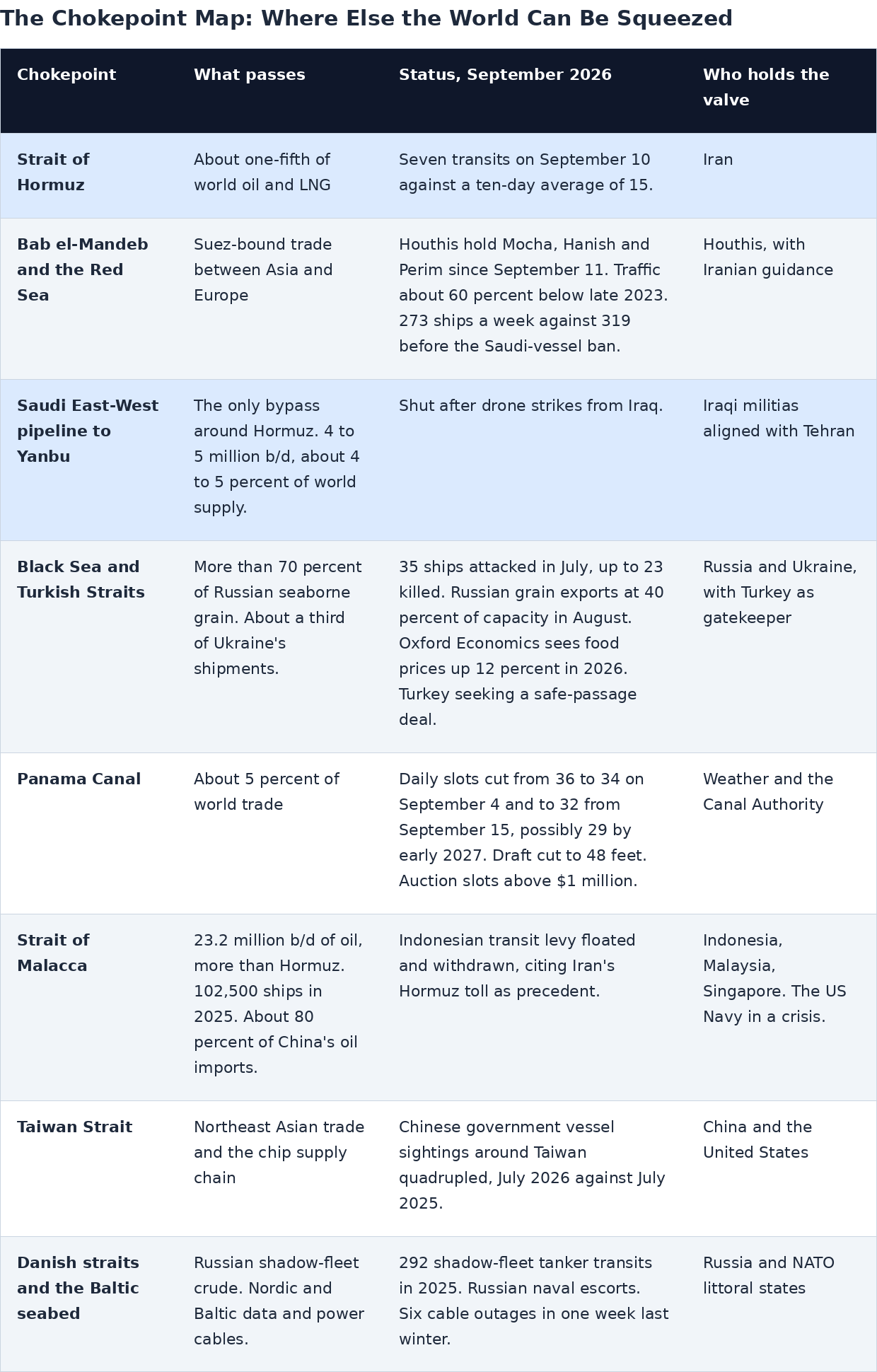
Three groups appear. The first is held by Iran and its partners: Hormuz, Bab el-Mandeb and the Saudi bypass. The second is held by the Russia and Ukraine war: the Black Sea and the Baltic. The third is held by geography and by US allies: Panama, Malacca and Taiwan. China buys through the first group, stands by at the second and is the exposed party at the third. The United States is a net energy exporter with a two-ocean coastline, and its navy is the reason the third group stays open. When Xi walks into the White House, his suppliers' exits have been closed by his own partner and his imports' entrance is watched by his counterparty. That is the quiet backdrop to September 24, and it is why the Iran file is the natural place for him to give.
10. Beyond barrels: the product chokepoint ledger, and why Iran is the file Xi trades away
The same logic applies to materials and finished goods, and it is worth setting out in full because it is where the two sides' real leverage lives. We keep three ledgers. The first lists what is already squeezed in 2026. The second lists the valves Beijing holds and the clocks attached to them. The third lists valves held by others, which bound how hard either side can push.
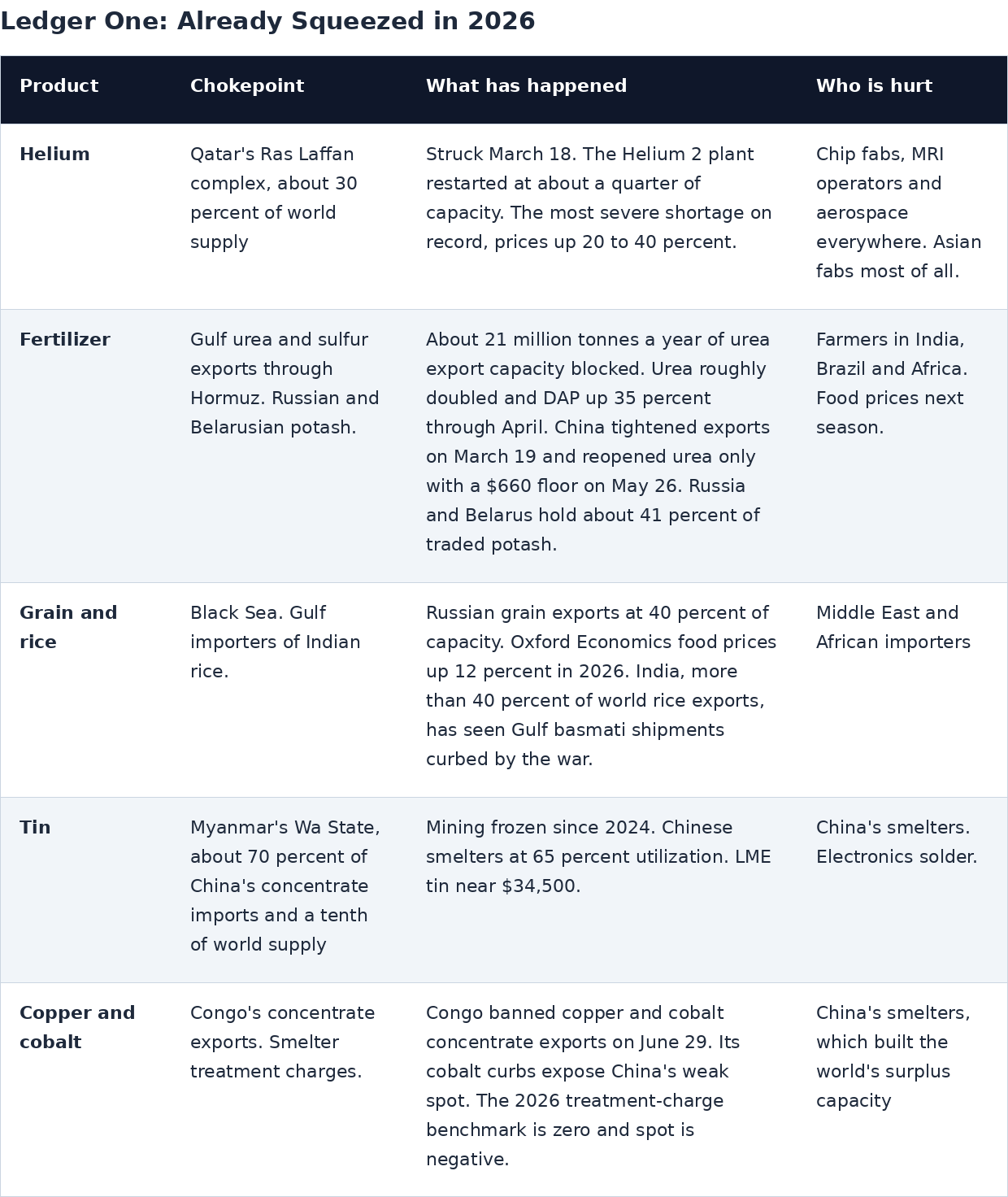
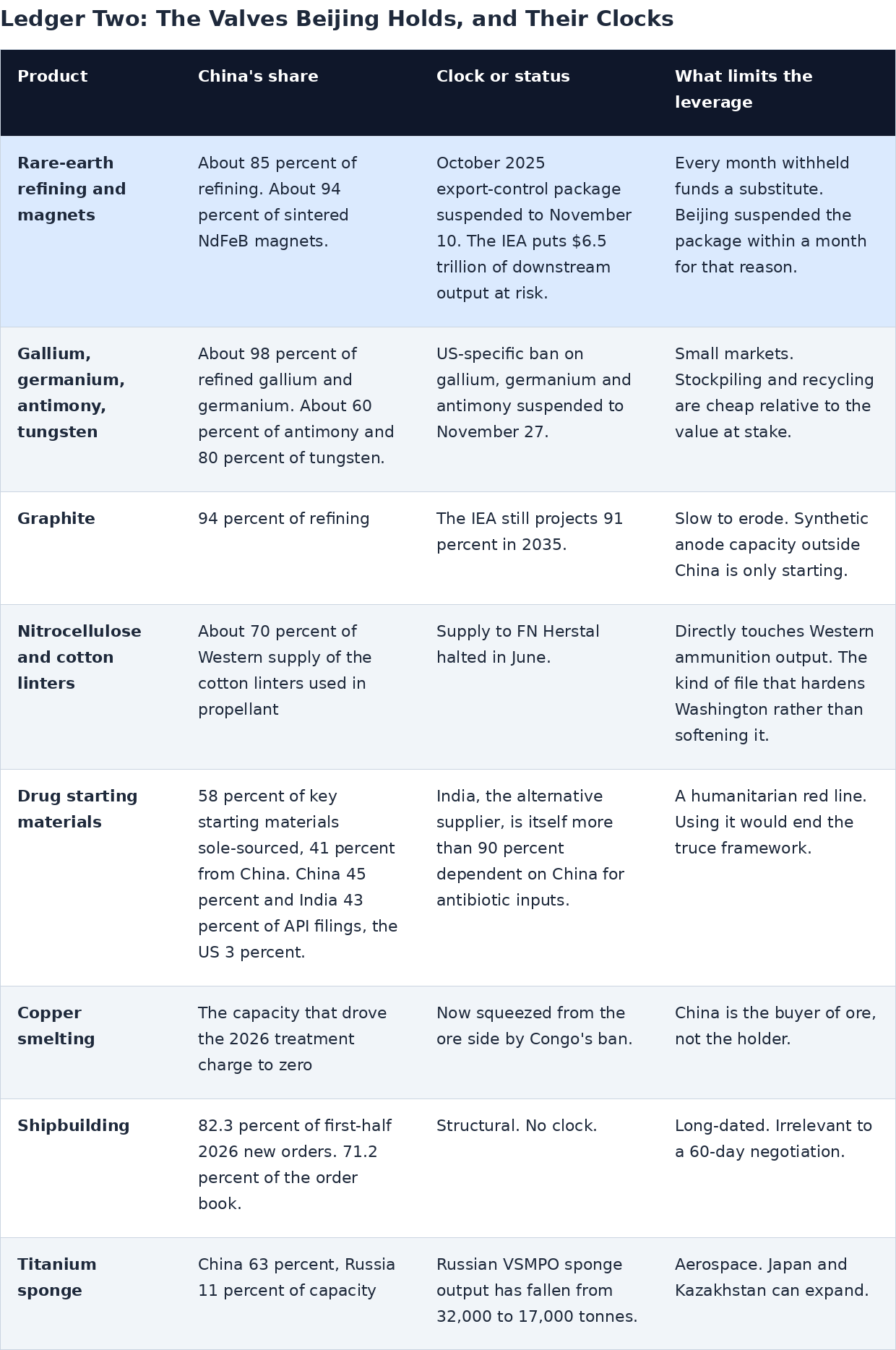
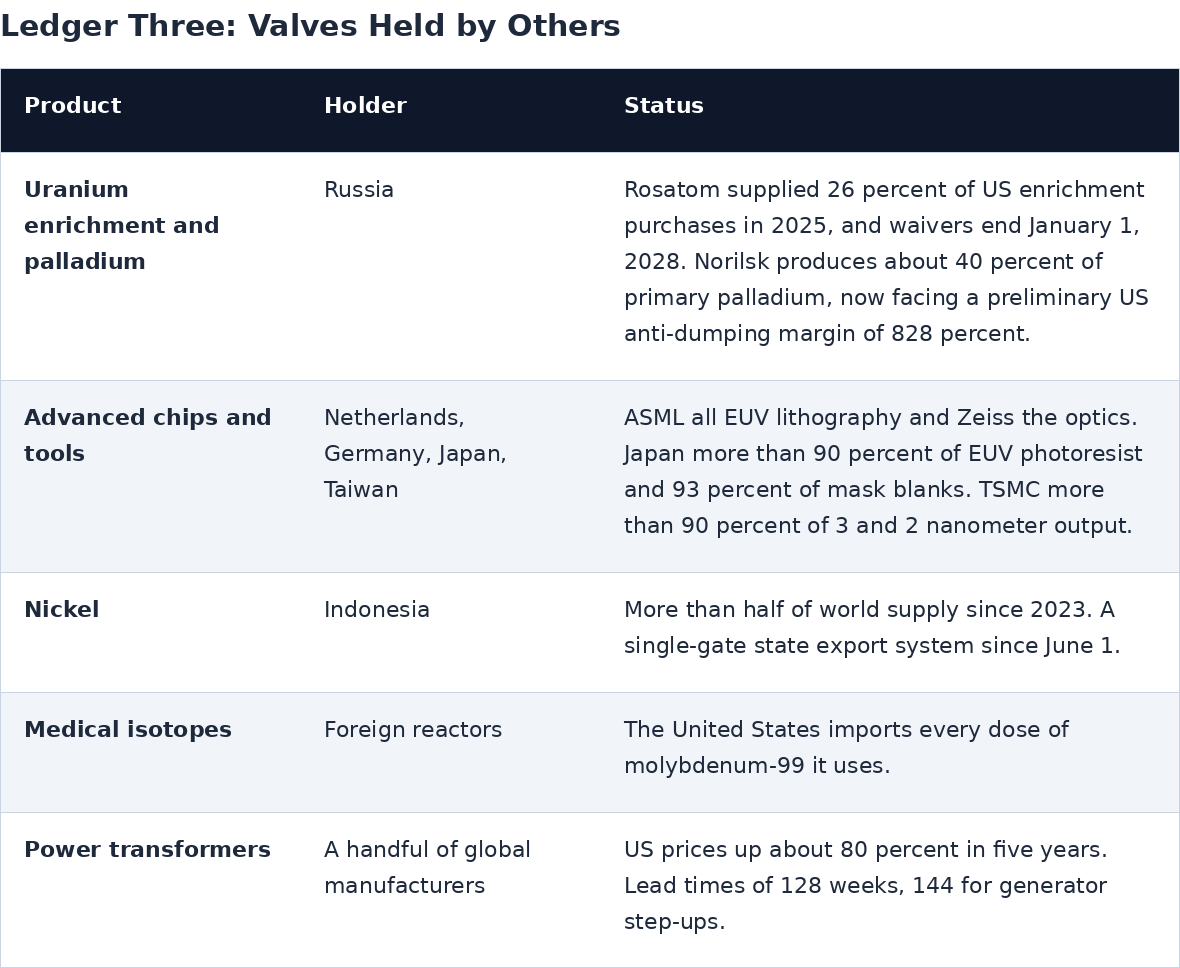
What the ledgers say about the Iran file
Read together, the three ledgers make the case for the barter more strongly than any single item.
One. The acute shortages of 2026 all have a Gulf origin, and China imports what is stuck. Diesel, LNG, helium and fertilizer are the four products the world is short of this year, and all four trace to Tehran's war. China buys half its crude from behind Hormuz, holds long-term Qatari LNG contracts now under force majeure, runs the fabs that need Qatari helium and was itself forced to ration fertilizer exports. Every week the Gulf stays shut is a week of Chinese cost and American advantage.
Two. Beijing's leverage is processing, not ore, and processing leverage is perishable. Rule three of Section 2 applies to every row of the second ledger. Meanwhile the resource states are copying the export-tap playbook against China: Congo on concentrate, Indonesia on nickel, Myanmar's frozen tin. A monopoly on refining is worth less every year the ore owners learn to price it. The rare-earth file is therefore the valuable file, and it is a depreciating one. The Iran file costs Xi nothing. A rational seller spends the costless file to protect the valuable one before November 10.
Three. Iran's partners are now destroying Chinese supply security. The Houthis' exemption for all shipping except Saudi vessels, the drones from Iraq that shut the East-West line, and the missiles that took a fifth of Qatar's LNG offline for years are attacks on China's second-largest supplier, its bypass route and its gas contracts. Tehran is not protecting Beijing's energy position. It is spending it.
Four. Iran's barrels no longer reach China, so there is nothing left to defend. With the blockade back since July 13, Iranian crude arrivals have fallen to a third of their 2025 level and the discount has turned into a premium. Beijing's refiners have already made the substitution to Iraqi, Emirati and Qatari grades. The commercial relationship the political relationship rested on is gone.
Five. The precedent Iran is setting is the one China fears most. Hormuz tolls have already been cited in Jakarta as a model for Malacca, through which 80 percent of China's oil arrives. Beijing's long-run interest is a world in which straits are not taxed, and that interest is served by Iran losing, not winning.
Six. The third ledger disciplines Washington too. The United States depends on Russian enrichment, Indonesian nickel, foreign isotopes and allied chip tools, and its grid waits two and a half years for a transformer. It cannot afford a breakdown that pushes Beijing toward Moscow on any of them. Both sides therefore need a currency that is cheap for the giver and visible for the receiver. Iran is that currency.
Seven. Xi collects credit rather than paying a price. Beijing brokered the Saudi and Iranian rapprochement in 2023 and was credited with the April ceasefire. Acquiescence in a settlement can be presented at home as mediation, and Beijing keeps its nomenclature, meaning opposition to unilateral sanctions and calls for restraint, while conceding the substance, meaning no obstruction, enabler sanctions tolerated and Hormuz reopened. That is exactly the shape of concession we expect across the whole ledger.
The barter restated: what Xi gives on Iran costs him barrels he is no longer buying and a partner he has not defended. What he protects is a mineral position worth more sold than held. What he gains is a reopened Gulf that lowers his import bill, relieves his diesel problem and removes the precedent that threatens Malacca. On the Iran file, at least, Washington and Beijing want the same outcome, and the negotiation is about who is seen to have paid for it.
11. Slowing the unslowable, part one: the consumer has stopped
The headline numbers describe a slowing economy. Growth eased from 5.0 percent in the first quarter to 4.3 percent in the second, missing forecasts. Manufacturing PMI stood at 49.8 in August, in contraction. Real-estate development investment fell 19.2 percent year on year in January to July. Local-government land-sale revenue fell 30.8 percent to 1.2 trillion yuan over the same period. Morgan Stanley estimates about 41 trillion yuan of housing value destroyed since December 2024. Retail sales fell outright in May, the first decline since 2022, with autos down 16.1 percent and appliances down 15.6 percent, and they grew 0.6 percent in July against a 1.5 percent forecast.
The numbers underneath describe something sharper: a consumer who has been paid to buy ahead of time and has now run out of future to borrow from. Beijing's 2025 trade-in scheme was backed by 300 billion yuan of ultra-long special bonds. The 2026 allocation is 250 billion yuan. By August 21 the Ministry of Finance had disbursed 187.5 billion yuan, generating 178 million purchases and about 1.32 trillion yuan of sales. First-half trade-in sales were 1.1 trillion yuan, down from 1.6 trillion a year earlier. Within that, 3.707 million vehicles and 63.266 million appliances were traded in, while trade-in-linked auto volumes fell 21.1 percent and appliance retail fell 9.9 percent to 425 billion yuan.
Trivium China's macro team put it plainly in August. The short-term boost is real, they said, but the stimulus impact fades over the medium term, and that is what has been seen. Asked what replaces it, the answer was: "At the moment, it looks like probably nothing." The auto market confirms the diagnosis. Gasoline-car retail sales fell 40 percent year on year in August and total passenger-car sales fell 23.6 percent. Even new-energy vehicle retail fell 10.1 percent. The dealer inventory alert index stood at 62.3 percent, deep in contraction. Reported sales themselves were inflated for years by zero-mileage used cars, new vehicles registered off the line and exported as used.
Beijing's answer to exhaustion is more of the same, further out. The September 1 guideline targets 60 trillion yuan of retail sales by 2030 and creates a 100 billion yuan fiscal-financial coordination fund. A five-year consumption plan is a confession that the one-year plans did not hold. Every yuan of pull-forward subsidy is a yuan of household income spent early, and when the subsidy stops, the income is already gone. That is why Chinese households are saving everything but necessities, and why the consumer pillar of rebalancing is not available to Xi on any timeline that matters for this summit.
12. Slowing the unslowable, part two: managing the yuan through the banks
The yuan tells the second half of the story, and it tells it backwards from what most observers expect. The currency strengthened to 6.7050 per dollar on September 7, its strongest since February 2023. The People's Bank set the daily midpoint at 6.7795, 709 pips weaker than the Reuters estimate, the largest weak-side deviation since a record in February. Reuters reported on August 31 that China is slowing a long rally in the yuan and is likely to keep further gains to a minimum this year, with HSBC analysts observing that the flatlining fix shows authorities are content with a balanced yuan. Onshore spot turnover fell to $31.2 billion a day in August from $42.2 billion in July as large state banks repeatedly bought dollars.
The instrument is not the central bank's balance sheet. Official reserves rose $19.5 billion to $3.4383 trillion in August and SAFE attributes the rise to currency translation and asset-price changes, and the Treasury's own FX report records that Chinese banks, not the PBOC, were buying record volumes of spot dollars late last year. The instrument is the commercial banking system. Reuters reported on September 4 that Chinese banks have been buying US Treasuries after lifting dollar deposit rates, moves that "could help slow gains in the yuan." Foreign-currency deposits reached $1.18 trillion at the end of July, up 17.9 percent year on year and up $121.2 billion in seven months. The Big Five had capped most dollar deposits at 2.8 percent since 2023. Since June, balances above $50,000 have been able to negotiate above 3 percent, and close to 4 percent at some smaller and foreign banks since August. Three-year yuan time deposits at the big banks pay 1.55 percent. Beijing is paying its own citizens a premium of roughly two percentage points to hold dollars, provided they hold them inside a state bank.
Read those two facts together. A country with a $195.1 billion quarterly current-account surplus and a $278.9 billion goods surplus should have a rising currency. Beijing is leaning against it, because weak domestic demand means the export sector is the only engine still running, and because the yen has collapsed the cross-rate. With the Bank of Japan at 1.00 percent and the Fed at 3.75 percent, the 275 basis-point gap keeps the yen sliding despite Tokyo's July 31 intervention, which hands Japanese exporters a price advantage against Chinese goods that a strengthening yuan would compound. Governor Pan Gongsheng told the G20 that China has "neither the need nor the intention" to use currency depreciation for competitive advantage. That is literally true. Beijing is not devaluing. It is resisting appreciation, and doing it through channels that do not appear on the central bank's balance sheet.
The containment valve. The dollar-deposit program is the most revealing policy of the summer. Beijing has a preference ordering: it would rather its citizens held yuan than dollars, but it would far rather they held dollars in a Chinese state bank than dollars anywhere else. Raising onshore dollar deposit rates above 3 percent while holding yuan rates near 1.5 percent is a government paying to keep the exit inside the building. It concedes the currency preference in order to defend against the thing it fears more, which is exit.
That is the sense in which Beijing needs a weak yuan but cannot let the people know. If the currency were allowed to rise to where the trade surplus would take it, exporters would fail. If it were pushed down openly, households would read it as the start of a run and move first. The commercial-bank channel is the only route that manages both audiences at once, and it works only for as long as households believe the dollars in the state bank are as good as dollars outside it.
The official flow data confirm the direction of travel without confirming a crisis. SAFE reported net inflows by enterprises and individuals of $247.2 billion in the first half, but noted that inflows moderated from June and that bank settlement and sales have been "broadly balanced since July." The PBOC has added gold for 22 consecutive months, to 76.73 million ounces. The August trade surplus was $119.09 billion with exports up 25 percent. A balanced FX position on top of a record surplus means the private sector is exporting capital at the rate the current account brings it in. That is the definition of the exit Beijing is trying to slow.
13. Slowing the unslowable, part three: the control stack aimed at savers
Between July 1 and September 15, 2026, Beijing enacted or proposed the most concentrated set of individual-level capital and mobility controls in a decade. None was announced as capital control. Read together, they are.
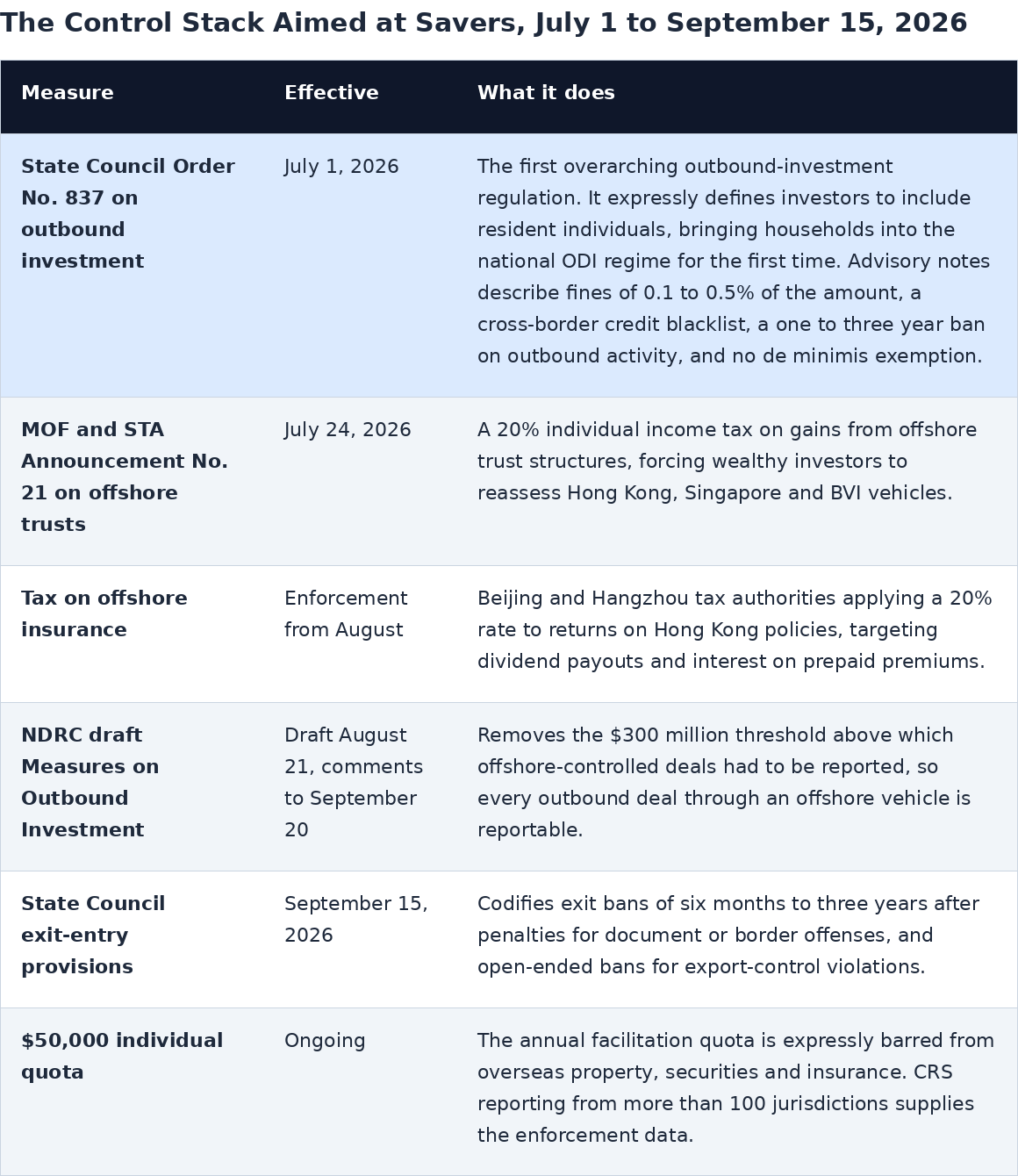
Every item on that list is aimed at a household, not a corporation. A government confident in its savers does not need to define individuals as regulated investors, tax their Hong Kong insurance policies, or write exit bans into the immigration code. The stack is evidence of the thing it is meant to prevent. And the demand it is meant to suppress is visible in the plain sight of the channels that remain open. AIA's new business value rose 10 percent to $3.21 billion in the first half, with its chief financial officer reporting continued demand from mainland visitors and no change in purchasing behavior from May through August despite the tax pivot. Yuan payments through Hong Kong's Faster Payment System hit a six-month high of 350.3 billion yuan in July, up 34 percent from February. Southbound Stock Connect flows have slowed to about HK$370 billion this year from HK$1.4 trillion in 2025, which is the pattern of savers who want out of yuan assets, not into Hong Kong ones.
The digital perimeter is being closed too. Circular No. 42 of February 6, 2026, issued by the PBOC, the CSRC and six other agencies, prohibits issuance of any yuan-pegged stablecoin inside or outside China and bars tokenization of real-world assets without approval. On August 27 the Shanghai Public Security Bureau announced an underground-banking case using virtual currency for cross-border exchange, with more than 70 arrests and more than 20 billion yuan involved. The state is policing the fiat on-ramp, the over-the-counter broker and the person, because those are the only points where it still has purchase.
14. The arithmetic of a small leak, and the dollar's new rails
Household deposits stood at 173.48 trillion yuan at the end of June, after growing 7.58 trillion in the first half, while state banks have cut three- and five-year deposit rates to as low as 1.55 percent. In April, household deposits fell 1.9 trillion yuan, the largest monthly drop on record. The World Bank puts the stock at about 122 percent of GDP. The scale is the point. When the savings stock is this large, even a marginal loosening in how much may be diversified abroad moves enormous sums.
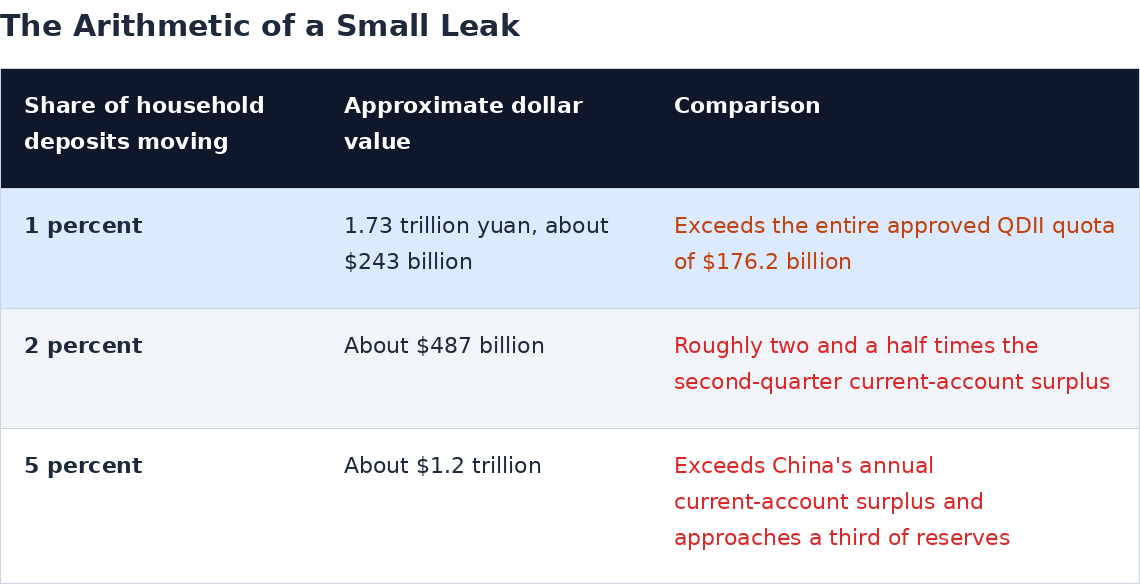
This is why the control stack is being built now, before the rails that would carry such flows are finished. The Bank for International Settlements' July working paper by Hofmann, Mehrotra and Paulick, covering more than 130 economies, finds that stablecoin flows, unlike deposit dollarization, appear largely unaffected by capital-flow restrictions of either the broad or the targeted kind, and documents significant persistence in both forms, which suggests dollarization is "hard to reverse once established." That is the academic form of our title. Once a population has learned to hold dollars, the central bank does not get them back by decree.
The rails are being built on a schedule Beijing can read. Total stablecoin capitalization is about $303 billion, of which Tether's USDT is $183.5 billion and Circle's USDC $74.3 billion. Treasury's GENIUS Act rules make licensed issuance mandatory in the United States from January 18, 2027, and prohibit US service providers from offering unlicensed stablecoins from July 18, 2028. Twenty-one banks and asset managers, including Goldman Sachs, Bank of America, Citi and UBS, announced on September 1 that they will form a company to issue a dollar stablecoin in the first half of 2027. None of this explains China's present weakness, which began with the 2020 property crackdown. All of it explains the urgency of China's present controls. Beijing is racing to close the doors before the bank-grade dollar token arrives, and the BIS evidence says the doors do not hold.
We do not claim the leak is large today. Against a 173 trillion yuan deposit base, the underground channel is a rounding error and the official flow data show balance, not flight. Our claim is narrower and, we think, stronger: the Chinese state is behaving as though it expects the leak, and is spending regulatory capital, tax authority, and its own citizens' freedom of movement to slow it. Governments do not do that about risks they consider remote.
15. What Xi's weakness does and does not mean
It would be a mistake to read the foregoing as a vassalage thesis. China is not a debtor kneeling to a creditor. At the end of 2025 its external financial assets were $11.79 trillion against $7.71 trillion of liabilities, for net external assets of $4.07 trillion. Its ten-year government bond yields about 1.68 percent, while the United States sold ten-year notes at 4.834 percent on September 9, the highest since 2023. China funds itself at home, in yuan, from a household saving rate above a third of income, and it exports the surplus.
The constraint is different and slower. The IMF's augmented measure of government debt, which includes local-government financing vehicles, was 117.0 percent of GDP in 2024, an estimated 126.6 percent in 2025 and a projected 135.3 percent in 2026. Beijing has cut officially recognized hidden local debt from 14.3 trillion to 6.5 trillion yuan through a 10 trillion yuan swap program, while total government debt rose to 102.5 trillion yuan as the liabilities moved onto explicit balance sheets. On September 6 the Ministry of Finance led a 360 billion yuan capital injection into three state banks and five insurers. This is domestic yuan debt held by state banks. It is not a solvency event. It is a decade of national income transferred from savers to debt service through deposit rates held below growth, which is to say a hidden tax on exactly the household deposits Section 14 describes.
That is the real meaning of Xi's weakness for September 24. China faces a decade of balance-sheet repair that forecloses consumption-led rebalancing, and a savings base that is beginning to look for the exit. Both facts cap its bid to be the world's settlement layer: a currency whose own holders must be fenced in cannot be the currency other people choose. Xi does not kneel. He stays stuck, and a leader who is stuck at home needs calm abroad. He needs the export engine running, which means tariff relief and a managed yuan. He needs commodity prices down, which means Hormuz open. And he needs the November cliffs reset without a fight he would have to explain to a public that has stopped spending. Trump can give all three. The price is substance on the five files, and Xi will pay it, provided the nomenclature lets him call it a truce.
16. Scenarios, indicators and what would prove us wrong
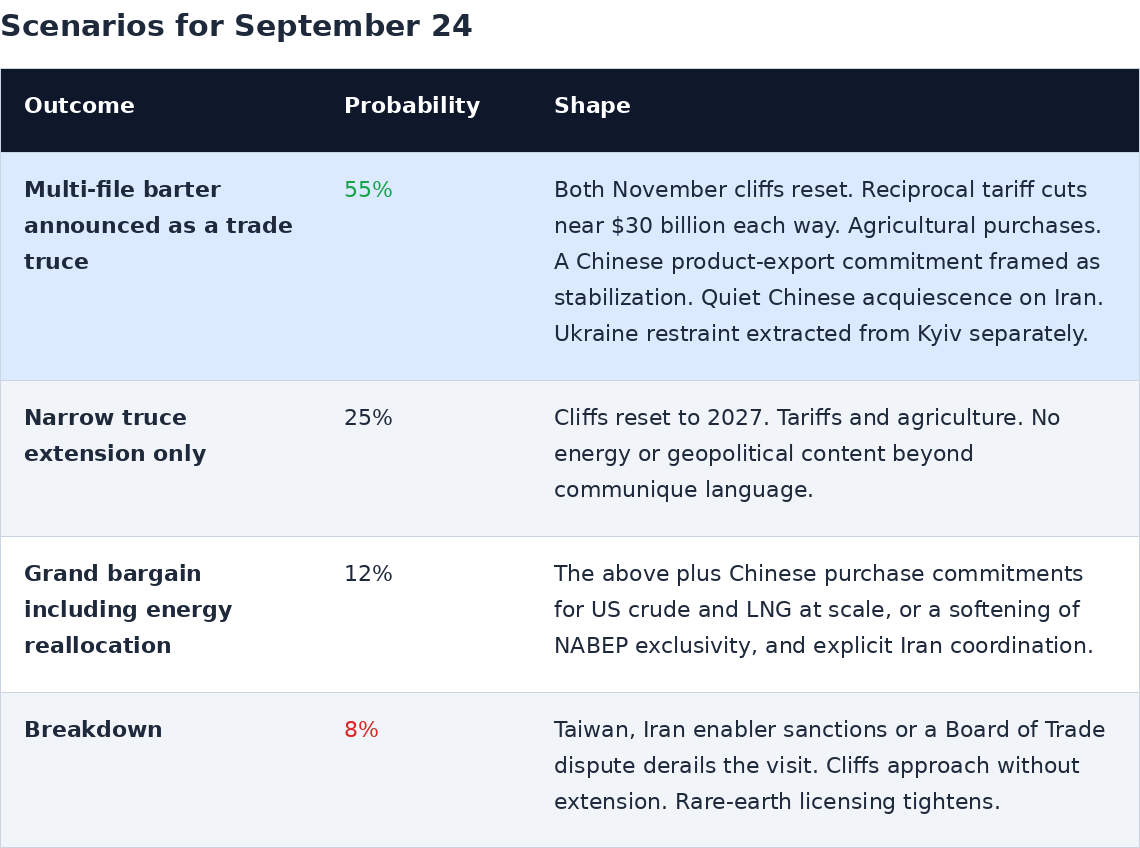
Seven observable indicators
One. Ukrainian strike tempo. Whether Kyiv's refinery strikes fall in the ten days before September 24. A drop confirms Washington is already collecting the Ukraine file.
Two. License categories versus facilitation. Whether the readout names specific rare-earth and mineral license categories or uses generic language. Categories mean substance. Facilitation means nomenclature.
Three. A Chinese quota commitment. Whether Beijing announces a refined-product export quota or volume explicitly framed as market stabilization, and whether a third 2026 batch lands before quarter-end.
Four. Energy purchase language. Whether the communique includes Chinese commitments to buy US crude or LNG, the substitute for the Venezuelan barrels Xi will not get, or any softening of NABEP offtake terms.
Five. The yuan fix after the summit. Whether the PBOC continues to set the midpoint hundreds of pips weaker than estimates and whether dollar deposit rates at state banks stay above 3 percent. Continued suppression means the exit problem outranks the trade problem.
Six. Household deposits and errors and omissions. Whether the second-half deposit series turns negative after the 7.58 trillion yuan first-half gain, and whether the balance-of-payments errors-and-omissions line widens. Together they would mark the point where controls stop working.
Seven. The second exit. Whether the East-West pipeline to Yanbu reopens and Perim island changes hands before September 24, and whether Chinese statements on Yemen shift from restraint on all sides to naming the Houthis. Either would show Beijing collecting Iran-file credit in advance.
What would falsify this reading
The summit yields only tariff cuts and agricultural purchases with no product-export, energy-purchase or Iran language, and Kyiv's strike tempo does not change. The barter thesis would then be wrong and managed continuity right.
Hormuz repairs and Indian, Nigerian and Chinese substitution relieve diesel prices before winter without any diplomatic terms. Ukraine's lever would have depreciated on its own, and Beijing's diesel file would have lost its value.
The PBOC allows the yuan to appreciate toward the level its surplus implies, state banks unwind the dollar-deposit premium, and Order 837's implementing rules for individuals turn out to be light. That would mean Beijing does not fear exit as much as we argue.
Household deposits keep growing through the second half, southbound and insurance demand fade with the new taxes, and enforcement continues to disrupt underground channels at scale. The leak would then be as small as the official data say, and the control stack precautionary rather than defensive.
Venezuelan cargoes to Chinese buyers reappear under new PDVSA licenses. That would contradict our reading of the NABEP structure and raise the grand-bargain probability sharply.
Beijing publicly defends Tehran's control of Hormuz, resumes Iranian crude purchases at scale, or blocks a Security Council resolution to reopen the strait after the summit. That would mean Iran is worth more to Xi than the ledgers in Sections 8 to 10 suggest.
Bottom line. The most revealing thing about September 24 is not what Washington wants. It is what Beijing has spent the summer doing to its own citizens. A government that suppresses its currency through the banks, pays savers a premium to hold dollars inside the system, taxes their offshore policies, writes exit bans into law and criminalizes the channels they use to leave is a government that believes the migration to the dollar has already begun. The Bank for International Settlements says that once it begins it is hard to reverse. Beijing is trying to slow the unslowable. That is why Xi will trade substance for nomenclature at the White House, and why the correct question after the summit is not what China conceded, but how much longer the doors hold.
Method and limitations
This report was prepared on September 14, 2026, using public data through that date. Chinese August activity, investment and 70-city housing data are scheduled for release on September 15 and are not reflected. Penalty details under Order No. 837 rest on advisory commentary, and implementing rules for individuals had not been issued at the time of writing. Reuters, Politico and CNBC reporting is cited from published headlines and summaries where full text was not retrievable. All scenario probabilities and the five-file ledger are the authors' judgments. Figures are stated as the cited source states them, and where sources differ, as Kpler and the Oxford Institute for Energy Studies do on Russian refinery damage, both are given.
JD Unfiltered publishes independent macro research. This report is for informational purposes only and is not investment advice, an offer or a solicitation. It may be circulated freely with attribution to JD Unfiltered.
The authors hold positions in securities mentioned and reserve the right to buy or sell shares at any time without notice.