The Trillion-Dollar Discount

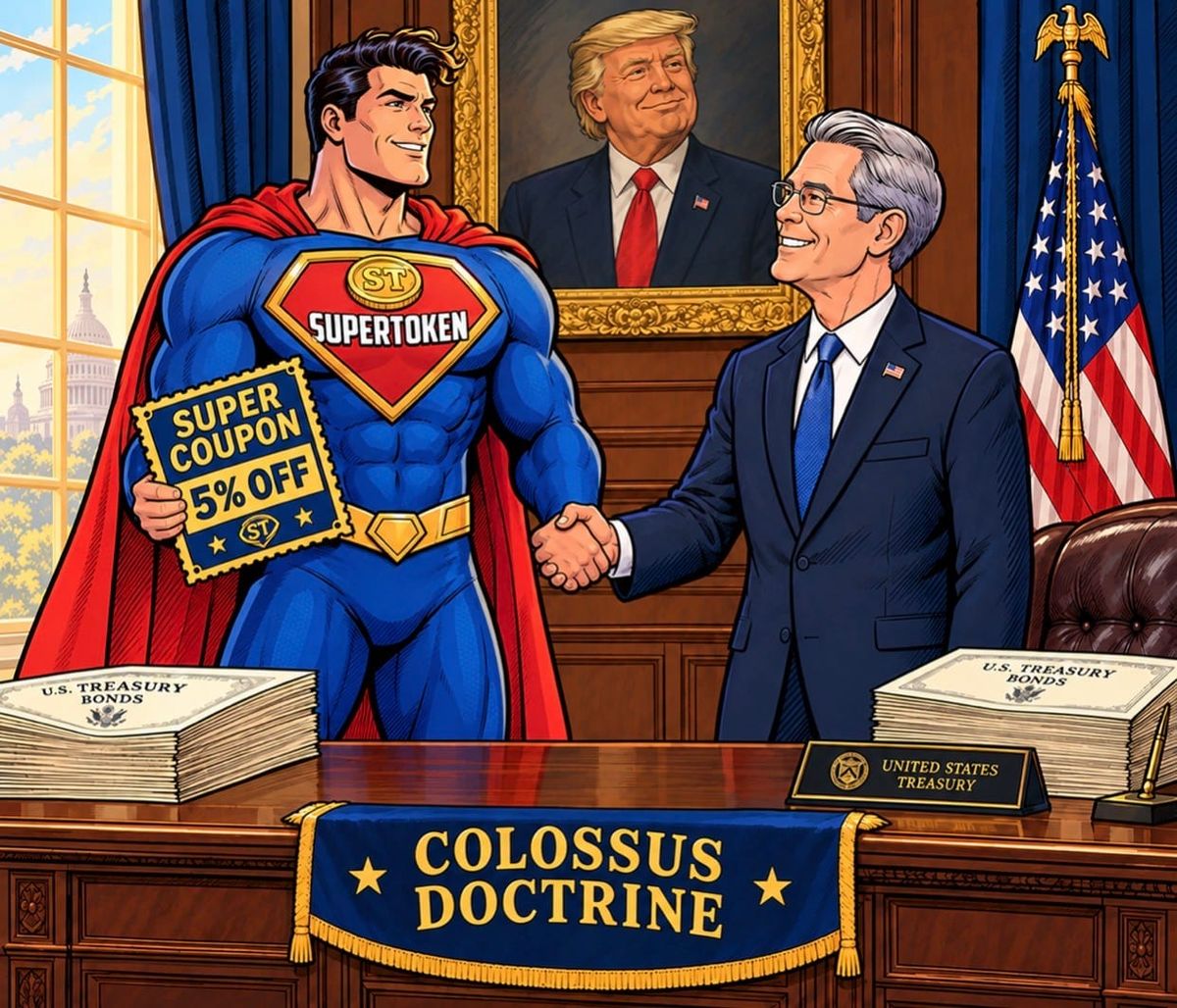
How Bessent can retire $1 trillion of pandemic-era bonds for about 55 cents on the dollar, and why the Super Coupon makes it easier. A JD Unfiltered Special Report by Joseph M. Salvani and Daniel J. Walsh.
The Opportunity
The United States borrowed for thirty years at 1.25 percent in 2020. Today the market will sell that debt back to the Treasury for about 43 cents on the dollar.
That is not a one-off. We priced all 112 Treasury bonds outstanding, the 86 originally sold as 30-year bonds and the 26 sold as 20-year bonds, against the October 9 Treasury yield curve, when the 20-year yielded 5.65 percent and the 30-year 5.60 percent. Outstanding amounts come from the Treasury's own September 30 Monthly Statement of the Public Debt.
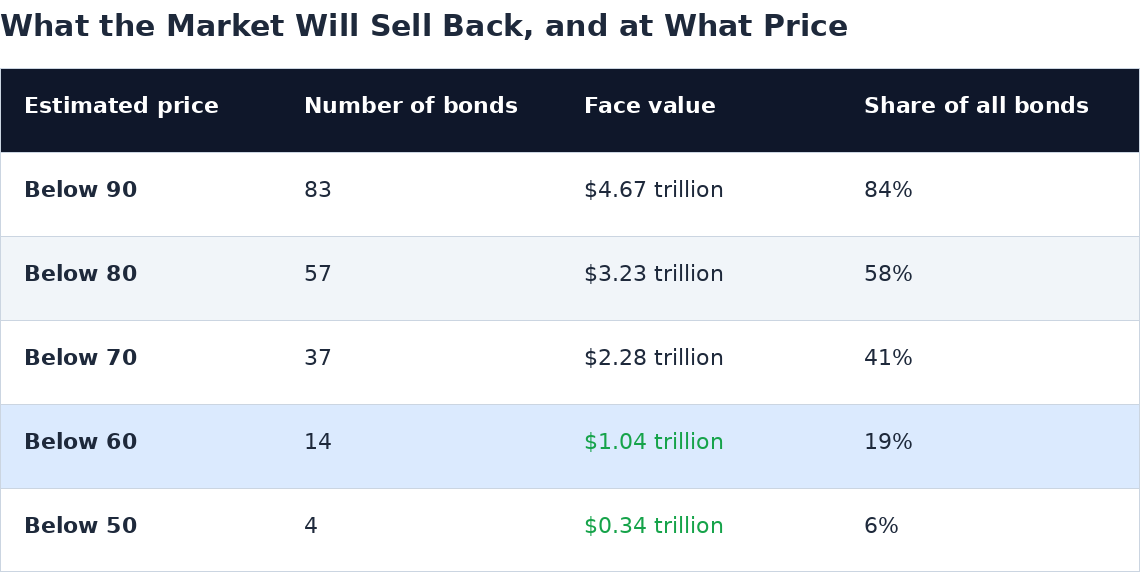
The $5.55 trillion of face value the government owes at maturity is worth about $4.13 trillion at today's prices. The gap is roughly $1.4 trillion, and it sits mostly in the low-coupon bonds sold when rates were near zero. To a money manager, that is not a problem. It is inventory on sale.
The Trade
Under the Colossus Doctrine, the Treasury buys back the cheapest $1 trillion of face value and pays for it by selling 3-month bills. The cheapest trillion is 13 issues, all sold between 2020 and 2022 with coupons of 1.125 to 2.375 percent, maturing between 2040 and 2052.
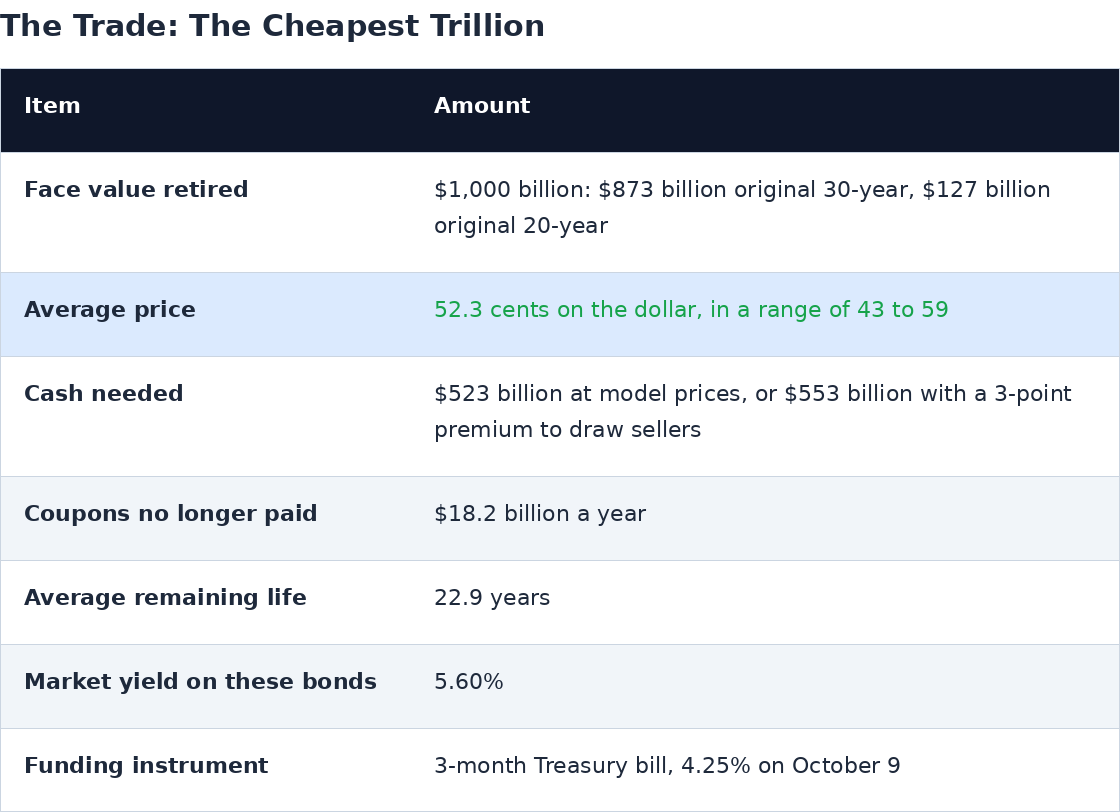
The cheapest single issue is the 1.25 percent bond due May 2050 at about 43, with $74 billion outstanding. The 1.375 percent of August 2050 is about 45 and the 1.625 percent of November 2050 about 48. Every dollar of cash spent on bonds priced in the mid-40s retires more than two dollars of debt.
The Schedule
The program runs six months, starting at a measured pace and picking up sharply once the GENIUS Act takes effect on January 18, 2027. Roughly 30 percent of the buying happens before that date and 70 percent after.
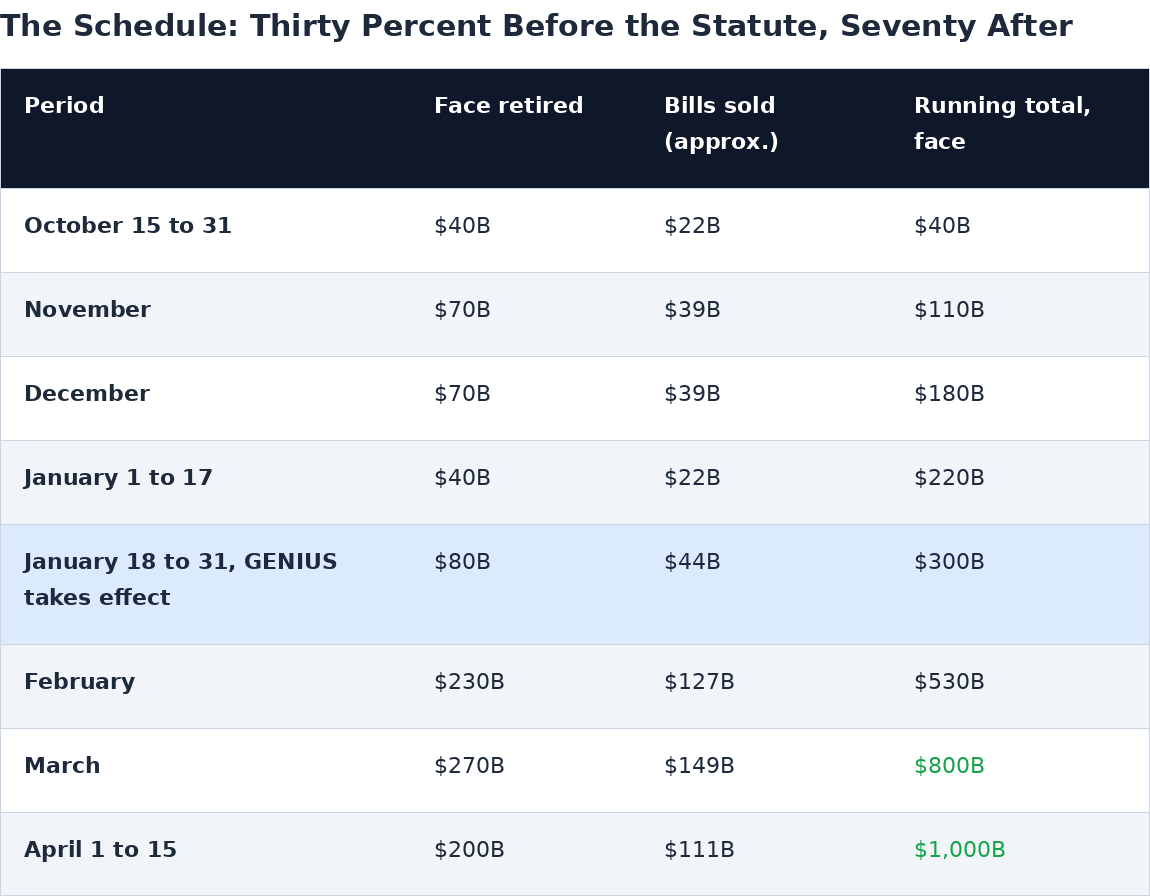
This is a large step. The current long-end program schedules about $32 billion a quarter. The Colossus pace is roughly fifteen times that, peaking near $60 billion a week in March. Buying on that scale pushes these bonds up and long yields down, which is the point. It is the go-for-the-jugular sizing Soros taught Druckenmiller, and that Bessent watched from the London desk in 1992.
What the Taxpayer Gets
An immediate cut in the debt. The $1 trillion owed at maturity is replaced by about $553 billion of bills. Federal debt falls by roughly $447 billion the moment the program is complete, about 1.4 percent of marketable Treasury debt, without a dollar of spending cut or tax increase.
A real saving every year. The retired bonds cost the government 5.60 percent a year on their market value. Bills cost 4.25 percent today.
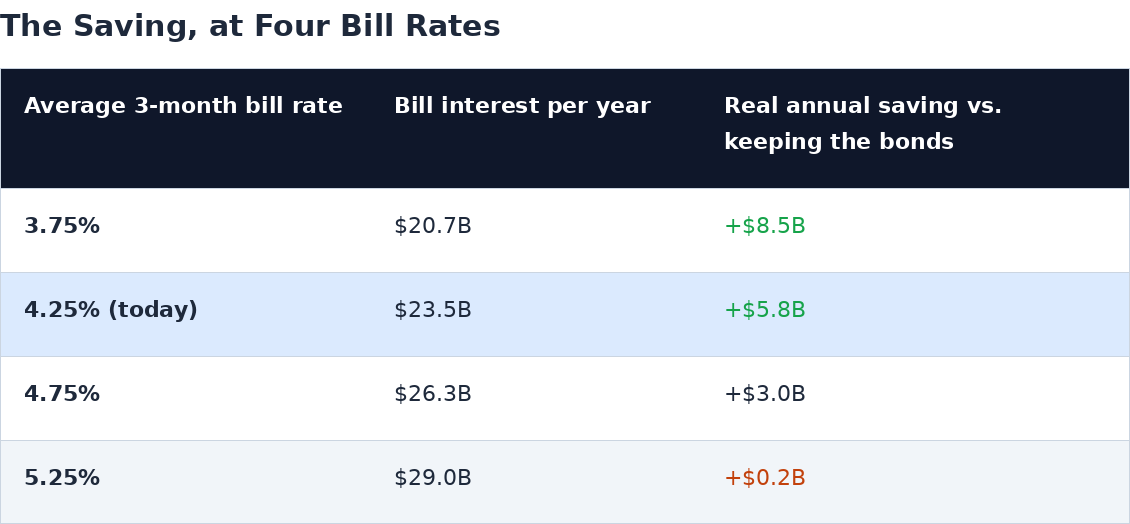
A large saving over the life of the bonds. Measured in plain dollars to the 2040s and 2050s, the bond path costs about $1.43 trillion in coupons and principal. The bill path at today's 4.25 percent costs about $1.13 trillion, roughly $300 billion less. The trade wins as long as the 3-month bill averages less than about 5.6 percent over the next 23 years.
One honest point on the accounting. Cash interest rises slightly at first, by about $5 billion a year, because the bonds being retired carry tiny coupons while bills pay a market rate. The saving shows up in the far smaller amount the government has to repay at maturity. A trader looks at the yield, not the coupon, and the yield says buy.
The Constraint: Who Buys the Bills
The trade adds about $550 billion of bills. Bills were $7.0 trillion, 22.2 percent of marketable debt, on July 31 on the Treasury Borrowing Advisory Committee's figures. After the swap, the bill share rises to roughly 24 percent. Because each bill matures in 13 weeks, the program also adds about $2.2 trillion a year of extra bill auctions. Every one of those auctions needs a buyer.
That is where the GENIUS Act comes in. The statute requires every payment stablecoin to be backed one-for-one by cash, insured deposits, repo, and Treasury bills of 93 days or less. Bessent said at signing that the law would "lead to a surge in demand for US Treasuries, which back stablecoins," and he projects a market of roughly $3 trillion by 2030. A buyer whose demand is set by law and who rolls every bill automatically is exactly what a bill-funded buyback needs.
The problem is timing. Stablecoin supply was $303.9 billion on October 9, up just 0.9 percent over 90 days. Bessent's 2030 target implies $600 to $700 billion of growth a year on average, but adoption so far has been driven by trading, settlement, and foreign savers, not by domestic consumers. On the current trajectory, stablecoins might absorb $100 to $200 billion of the program's bills over the six months. The rest falls to money market funds and other short-term buyers, at whatever rate it takes to clear the auctions.
Why the Super Coupon Makes This Significantly Easier
The stablecoin float is flat for one reason. The GENIUS Act prohibits issuers from paying holders any interest, yield or rewards for holding a payment stablecoin. The law built the pipe to Treasury bills and then removed every lawful reason for an ordinary consumer to use it.
The Super Coupon Token, BCII Enterprises' patent-pending architecture, supplies that reason without breaking the rule. It is an advertiser-funded coupon carrier that attaches a purchase discount to a stablecoin or commodity token while keeping the incentive separate from the asset. The issuer pays no yield. The advertiser funds a discount at the point of purchase, a sales promotion rather than a return for holding. BCII has received a favorable accounting opinion treating the program as a sales promotion under ASC 606.
Here is what that does to the trillion-dollar trade.
It turns the bill constraint into a bill bid. Every dollar a coupon pulls into a licensed stablecoin becomes a dollar of mandated reserve demand, most of it in exactly the 3-month bills this program sells.
It costs the Treasury nothing. The incentive is paid by advertisers, not taxpayers and not issuers. The government gets a growing, price-insensitive buyer for its bills without subsidizing it.
It arrives on the right date. The program is built to accelerate after January 18, when licensed issuance begins. A consumer incentive launched into that window lands precisely when the buying peaks.
It lowers the rate on the bills. The Bank for International Settlements finds that a $3.5 billion stablecoin inflow compresses 3-month bill yields by 2 to 4 basis points. Every basis point off the bill rate widens the saving on the trade and pushes the 5.6 percent breakeven further out of reach.
It makes the duration permanent. A float growing on everyday spending, rather than parked foreign savings, is a stickier base. The more stable the float, the more safely the Treasury can fund 23-year debt with 13-week paper, because the bills are re-bought at every roll.
The arithmetic is direct. On the current trajectory, stablecoins cover perhaps a fifth to a third of the $553 billion of new bills. As an illustration, if a working consumer incentive doubled the pace of float growth after January 18, stablecoins could plausibly cover roughly half, and the balance left to rate-sensitive buyers would shrink by $100 to $200 billion. That is the difference between a trade that has to be sold to the market and a trade the market is required by law to finance.
What Could Go Wrong
Bill rates rise. Swaps price a full Fed rate hike by year-end. Each hike narrows the annual saving, and a sustained bill rate above 5.6 percent erases it.
Rollover risk. Half a trillion dollars would be refinanced every quarter rather than once in 23 years. A failed bill auction or a stablecoin outflow would hit immediately.
Sellers hold out. Some of these bonds sit with the Federal Reserve or in stripped form, and the Treasury can buy only what holders offer. A program this size would likely need a premium above our 3-point assumption.
The coupon must prove itself. The Super Coupon is not yet proven at scale. Launch data, counsel's confirmation of the separation between coupon and stablecoin, and issuer adoption will decide how much of the float it can move.
Conclusion
The Treasury is sitting on the best trade in the bond market: a trillion dollars of its own debt for sale at about 55 cents, yielding 5.6 percent, refinanceable at 4.25 percent. A Treasury Secretary trained at Soros Fund Management recognizes it on sight. The only question is whether the bill market can carry it.
The GENIUS Act built a statutory buyer for those bills. The yield ban left that buyer without a reason to grow. The Super Coupon Token gives consumers that reason, at advertisers' expense, in the same window the program accelerates. Adding it does not just help the trade. It makes the trade significantly easier: a deeper bid, lower bill rates, a stickier float, and a larger share of the trillion financed by demand the law requires rather than demand the Treasury has to pay for.
Methodology: bond prices are model estimates from the October 9, 2026 Treasury par yield curve, interpolated by remaining maturity, with settlement on October 13. Actual prices for older issues are typically a point or two lower. Outstanding amounts are as of September 30, 2026 and include bonds held by the Federal Reserve and in stripped form. The buyback schedule, the premium assumption and the float-growth illustration are the authors' constructions, not Treasury announcements or guidance.
Disclosure: Joseph M. Salvani and Daniel J. Walsh are co-founders of BCII Enterprises, which developed the Super Coupon Token architecture discussed in this report, and therefore have a direct commercial interest in its adoption. This report is an analytical essay, not investment advice, a recommendation, or a solicitation to buy or sell any security. The trade described here has not been proposed or adopted by the Treasury, and the projections may prove wrong. Market data as of October 9, 2026.
The authors hold positions in securities mentioned and reserve the right to buy or sell shares at any time without notice.