Orders Of Magnitude

Elon Musk says he sees a path to SpaceX being worth orders of magnitude more than the entire Earth economy. It sounds absurd. So did every claim made about the companies that later defined their eras. This piece lays out the record, the evidence that SpaceX fits the pattern, and the risks that could break it.
Disclosure: the author holds shares and options in both SpaceX (SPCX) and Tesla (TSLA). See the full disclosures at the end of this report.
The Sentence
On Thursday, Elon Musk posted a thought that even he introduced as crazy: he said it would sound super crazy, but that he sees a path to SpaceX being worth "orders of magnitude more than the current Earth economy."
Orders of magnitude means at least ten times, and his sentence says more. World GDP was $118.35 trillion in 2025. One hundred times that is more than $12 quadrillion, which would imply a share price thousands of times higher than today's. SpaceX is worth about $2.14 trillion.
On Friday he walked it back somewhat, saying that seeing a path was not a statement of extreme confidence, only that the probability was not zero. Critics rushed to note that GDP is a yearly flow while market capitalization is a stock of expected future profits, and on that narrow point they are right. We think they are missing the larger point. The claim is not a forecast. It is a statement about how much of the future economy could run through one company, and that is a question history has answered before, usually against the skeptics.
We Have Heard This Before
On May 31, 1999, Barron's put Jeff Bezos on its cover under a headline that became a punchline: "Amazon.bomb." The magazine dismissed the idea that Bezos had pioneered a new business paradigm as silly, called him "just another middleman," and said the stock market was beginning to catch on. Amazon was valued at roughly $19 billion and was losing about $720 million a year.
The critics were not stupid. They were reading the income statement, and it was ugly. The shares fell more than 90 percent over the following two years. A short seller who stopped the analysis there would have been right about the stock and wrong about the company. Amazon is worth $2.82 trillion today, about 150 times its valuation on the day of the cover. In 2025 its AWS unit alone produced $128.7 billion of revenue and $45.6 billion of operating income.
Nobody in 1999 was entitled to predict AWS, which did not exist until 2006. The skeptics did not lose because they ignored the numbers. They lost because they valued the business that was visible and not the platform it could become. That is the test to apply to Musk's sentence. The question is not whether the number is tidy. The question is whether the business being valued is the business that will exist.
The Pattern
Set the doubts beside the outcomes and the pattern is hard to ignore.
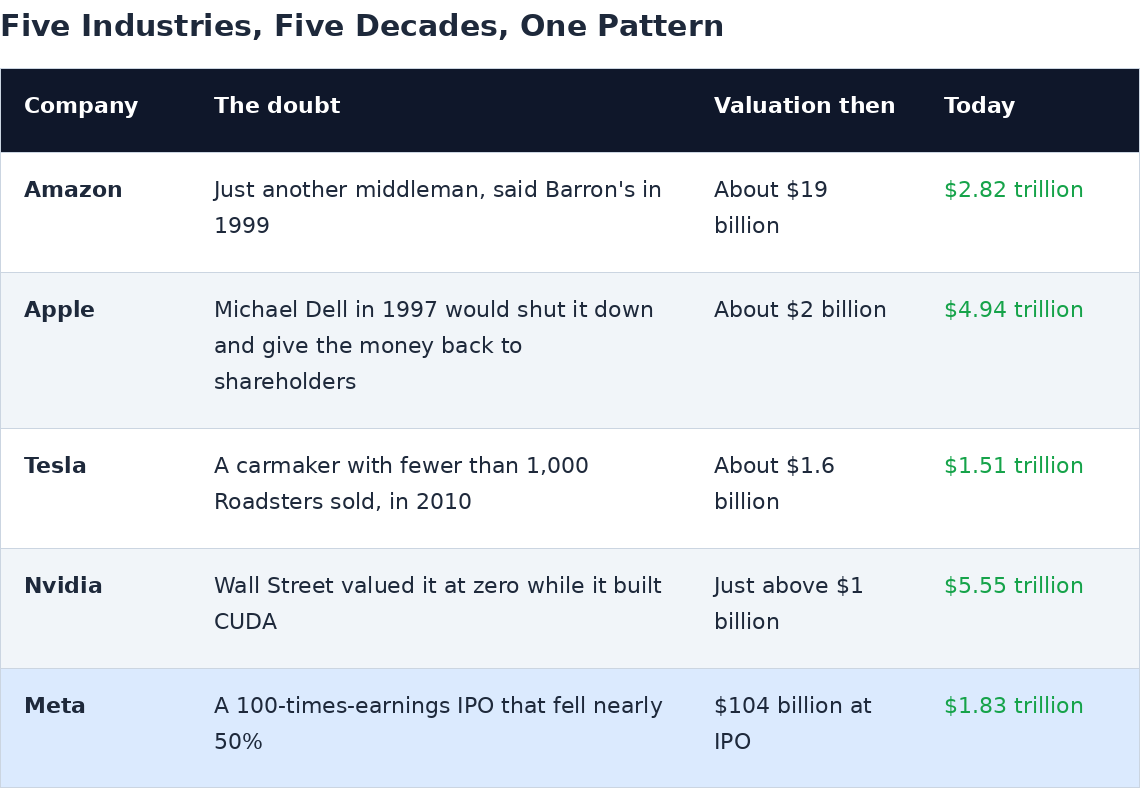
Five industries and five decades. In each case the skeptic was analyzing the business as it existed. The winner was building the business that would exist once a cost curve bent or a platform opened to outside customers.
Nvidia's CUDA is the cleanest example. It launched in 2006 and Wall Street doubted the spending for roughly a decade, until the same software layer turned out to be the foundation of modern AI. Nvidia reported about $216 billion of revenue in fiscal 2026.
The honest objection is scale. Apple started at $2 billion and SpaceX started at $1.77 trillion, so nobody should expect an Apple multiple. Nobody should demand one either. The better comparison is Meta. It came public in May 2012 at $38 a share and a $104 billion valuation, more than 100 times earnings. The stock fell almost 50 percent and needed until August 2013 to get back to its IPO price. It is worth about 17.6 times that IPO valuation today. A record IPO at a punishing multiple can still be the start of a very large compounding story.
The Dreamer's Ledger
Musk's critics treat the big number as the signature of a promoter. The record points the other way. His dream-big mentality has usually been correct, and his largest visions have repeatedly proved right on direction, even when the schedule slipped. That record is the reason the orders-of-magnitude sentence deserves a hearing.
Rockets that land
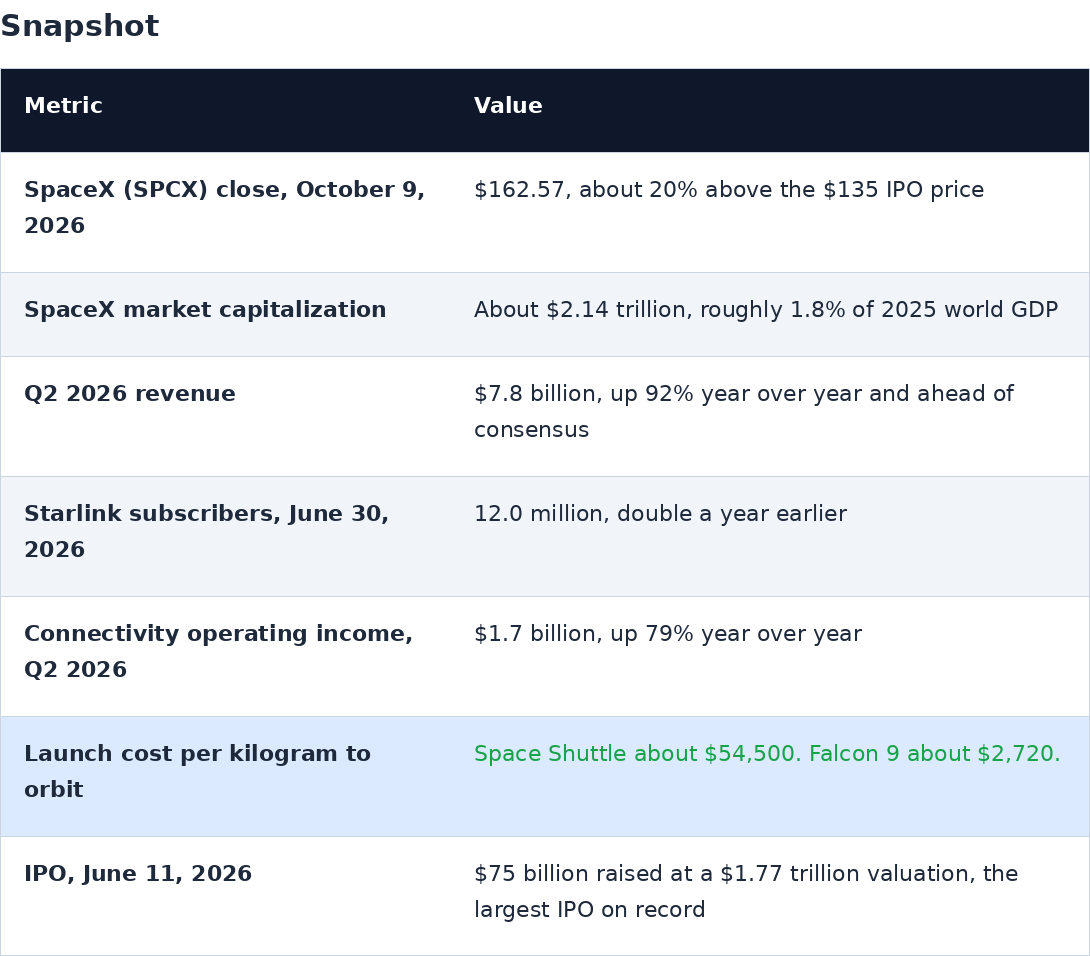
SpaceX's first three Falcon 1 launches failed. The fourth reached orbit on September 28, 2008, and Musk has said it was the last money the company had for the program. The first successful Falcon 9 first-stage landing came on December 22, 2015, and the first reflown booster flew on March 30, 2017. The result is a launch cost of roughly $2,720 per kilogram on Falcon 9, against about $54,500 on the Space Shuttle, a reduction of about twentyfold. On the latest call Musk said Falcon now delivers 80 to 90 percent of the mass sent to orbit each year, which is his claim and not an audited figure.
Cars
Tesla priced its IPO at $17 a share in June 2010, or $1.13 adjusted for splits. It had about $150 million of lifetime revenue and the Model S was still two years away. By January 2020 Wedbush analyst Daniel Ives conceded, "They proved us, along with many skeptics, wrong." Tesla is worth $1.51 trillion today.
Satellite internet
Starlink had 2.3 million subscribers in 2023, 4.4 million in 2024 and 8.9 million in 2025. It reached 12.0 million on June 30, 2026, after adding more than 1.7 million in the second quarter alone, its best quarter on record. The constellation is roughly 10,200 satellites delivering about 800 terabits per second of downlink capacity across 167 markets.
The calendar caveat
Honest accounting matters here, because Musk's schedules slip, sometimes badly. In 2017 Tesla targeted 1,500 Model 3 vehicles in the third quarter and built 260. The goal of 5,000 a week arrived roughly a year late, in mid-2018. Then the Model 3 became the best-selling plug-in car in the world from 2018 through 2020.
The calendar was wrong. The destination was right.
Investors who sold on the calendar missed the outcome. That is what dream big has meant in practice: not a forecast to be marked to market on a given date, but a direction of travel backed by repeated execution. Starship's stated goals, including a ship catch this year and a flight a day within twelve months, should be read the same way. They will probably run late. The direction is the story.
The Cost Curve Is the Whole Game
To see why this matters economically, go back to 1956. On April 26 the converted tanker Ideal-X sailed from Newark to Houston with 58 containers. Conventional loading cost $5.83 a ton. Container loading cost less than 16 cents. The saving was not simply a cheaper version of the old activity. Standardized boxes moved between ships, trucks and railways without being opened, and that made integrated transport possible.
When an activity is prohibitively expensive, observed demand only tells you what people will buy at the prohibitive price. It says nothing about what they will buy after the barrier falls. Amazon learned the same lesson inside its own walls. AWS launched in 2006 because Amazon had experienced how hard and expensive infrastructure was to provision, and it rebuilt the problem so that anyone could rent it.
Launch is the same kind of bottleneck. Falcon 9 already delivered the first twentyfold reduction. Management says Starship aims to quadruple payload capacity and cut launch costs by 10 times against Falcon 9. That is a target and not a result. The Cambridge Judge Business School notes that as of mid-2026 Starship had not yet flown a real payload to orbit or shown rapid full reuse. Management reports two successful flights of the V3 vehicle, says the heat shield problem appears solved, and says it sees no technical obstacle to full and rapid reusability. We treat those as claims to be verified flight by flight, and we note which way the evidence has moved.
Containers also carry a caution. They created enormous value for trade without handing all of it to one shipping company. A cheaper launch can enrich customers and competitors as well as the launch provider. That is why the Starlink business matters so much: it is the part of the value chain SpaceX owns outright.
Starlink Is the Bridge
The bull case does not need asteroid mining. It needs the commercial engine that already connects cheap launch to paying customers, and the second-quarter report showed that engine accelerating.
Revenue was $7.8 billion, up 92 percent from $4.1 billion a year earlier, against consensus of about $6.9 billion. The net loss narrowed to $541 million from $1.0 billion. Connectivity revenue rose 66 percent to $4.3 billion and operating income rose 79 percent to $1.7 billion, a margin of 38.6 percent against the 35.9 percent analysts expected. Enterprise and government revenue grew 108 percent to $1.8 billion, with more than $6 billion of multi-year US government contracts for Starshield.
A subscriber is a service line, not a person, and the subscriber count is the kind of number that compounds. It doubled in a year. The distance between 12 million lines and the roughly eight billion people on Earth is the runway.
At about $2.14 trillion the market is paying for a launch franchise and a satellite internet provider. It is not paying for the third and fourth things a lower cost curve could create. Orbital manufacturing, space-based energy and Mars are unproven and we assign them no value in our base case. We do not need them. If they work, they are upside.
The Version That Does Not Need a Quadrillion
The cleanest way to test the sentence is to shrink it. World GDP has grown from $1.37 trillion in 1960 to $118.35 trillion in 2025, an increase of about 87 times in nominal terms. The denominator is not a fixed ruler. Market capitalization also belongs next to wealth, not annual output, and UBS put global personal wealth at about $471 trillion at the end of 2024.
Apple at $4.94 trillion and Nvidia at $5.55 trillion are each about 4 to 5 percent of one year of world GDP. SpaceX at $2.14 trillion is about 1.8 percent. A $10 trillion SpaceX would be roughly 8 percent of 2025 world GDP, about 2 percent of global personal wealth, and a gain of about 4.7 times from here. That is a very large number. It is not a quadrillion.
The quadrillion version is a different matter. We do not underwrite it, and by his own words Musk does not claim confidence in it either. We underwrite a multi-trillion-dollar outcome and let the rest be a free option.
The Risks, Stated Plainly
A bullish argument earns trust by facing the cases that did not work.
Valuation. The IPO priced at about 94 times 2025 revenue. Morningstar's fair value estimate was $780 billion, about $63 a share, against a $135 offering price. This is the central reason the stock can disappoint even if the company executes. Amazon fell more than 90 percent from its peak before it compounded. A great company and a good entry price are separate questions.
The AI segment. In 2025 the xAI business lost about $6.4 billion at the operating line on $3.2 billion of revenue. Starlink profits are partly funding a very different and far more competitive business.
Pricing per subscriber. Average revenue per user is $66 a month, down from $85 a year earlier, as lower-priced plans and international markets widen the base. The subscriber count doubled and more than offset it, but the trend deserves attention.
Execution and key-person risk. Starship must prove commercial reliability and rapid reuse. The company's direction is tied unusually closely to one person.
The failure modes of history. Iridium built a technological marvel and went bankrupt in August 1999 with about 10,000 subscribers against a break-even of roughly 500,000 to 600,000. RCA backed a real technological revolution, yet a 1929 buyer waited until the 1960s to recover the dividend-adjusted price. The lesson from Iridium is that technology without demand fails. The lesson from RCA is that the right technology bought at the wrong price still hurts.
Starlink answers the Iridium test: 12 million subscribers and $1.7 billion of quarterly operating income, with a launch cost curve that bends in its favor. The RCA test is the live one, and it is why we pay attention to entry price. This list is also built from survivors, and we say so plainly.
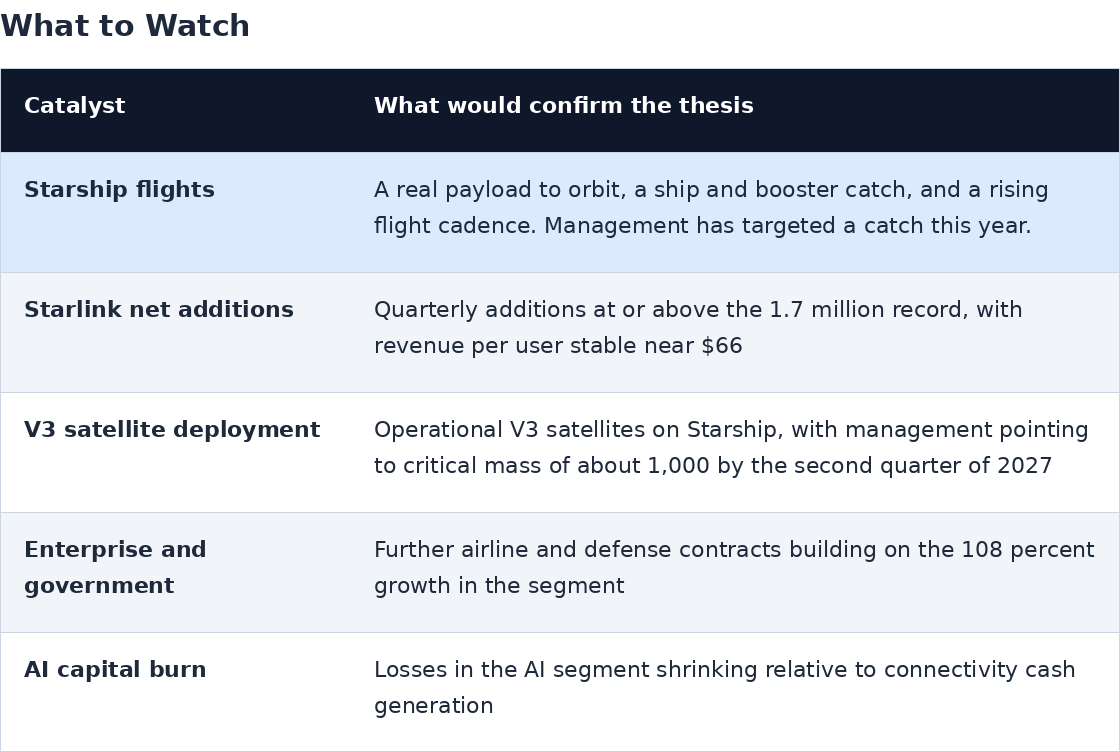
What to Watch
The winners in this story shared three observable traits before the market recognized them: demonstrated demand, a falling unit cost and the financial staying power to reach the next stage. The evidence trail for SpaceX is specific.
Conclusion
Barron's looked at Amazon in 1999 and saw a middleman. Michael Dell looked at Apple in 1997 and saw a liquidation. Wall Street looked at CUDA for a decade and saw a cost center. Each judged the business by what it was on the day. Each was reading true numbers, and each was wrong about the thing that mattered.
SpaceX is the same kind of case. The business has a proven demand engine in Starlink, a cost curve that has already fallen about twentyfold and a founder whose dream-big mentality has usually been correct. The market is paying for what it can see. The history says the platform is what compounds.
Musk says he sees a path to orders of magnitude. By his own account the probability is small but not zero, and we do not need it to be large for the investment case to work. A $10 trillion SpaceX would be roughly the combined size of Apple and Nvidia today, and it would sit well inside the history of what platforms have done. The bears will keep pointing out that a quadrillion is a very large number. They are right, and it does not matter. The burden of proof now sits with those who say the cost curve stops here. Our view is that it does not.
Important Disclosures
Position disclosure. The author holds shares and options in Space Exploration Technologies Corp. (SPCX) and Tesla, Inc. (TSLA) as of the date of publication. The author may buy, sell, add to, reduce, hedge or close these positions, including options positions, at any time before or after publication and without notice. The author has a financial interest in the securities discussed and may benefit from price movements that follow publication. Readers should treat this article as the opinion of an interested party.
No investment advice. This article is for informational and educational purposes only. It is not investment, legal, tax or accounting advice, and it is not a recommendation or solicitation to buy, sell or hold any security or derivative. It does not take into account the investment objectives, financial situation or needs of any reader. Consult a qualified, licensed financial adviser before making any investment decision.
Opinion. The views expressed, including the view that SpaceX fits the pattern of historically underestimated platforms, are the author's opinion. Statements by company management, including Starship goals and cost targets, are management expectations and not achieved results. Comparisons to other companies are illustrative and do not imply similar future outcomes. Speculative markets such as orbital manufacturing, space-based energy and Mars are unproven.
No affiliation or compensation. JD Unfiltered and the author are not affiliated with SpaceX, Tesla, Elon Musk or any other company cited. The author received no compensation from any issuer, underwriter or third party for preparing or distributing this article.
Forward-looking statements. This article contains forward-looking statements about valuations, technology development, markets and share prices. Such statements involve significant risks and uncertainties, and actual results may differ materially. The author undertakes no obligation to update this article as circumstances change.
Information and accuracy. Information is drawn from public sources believed to be reliable, including company reports, transcripts and news coverage, but its accuracy and completeness are not guaranteed. Market data is as of the October 9, 2026 close unless otherwise noted. Past performance is not indicative of future results. All investments involve risk, including loss of principal.