
The October Call

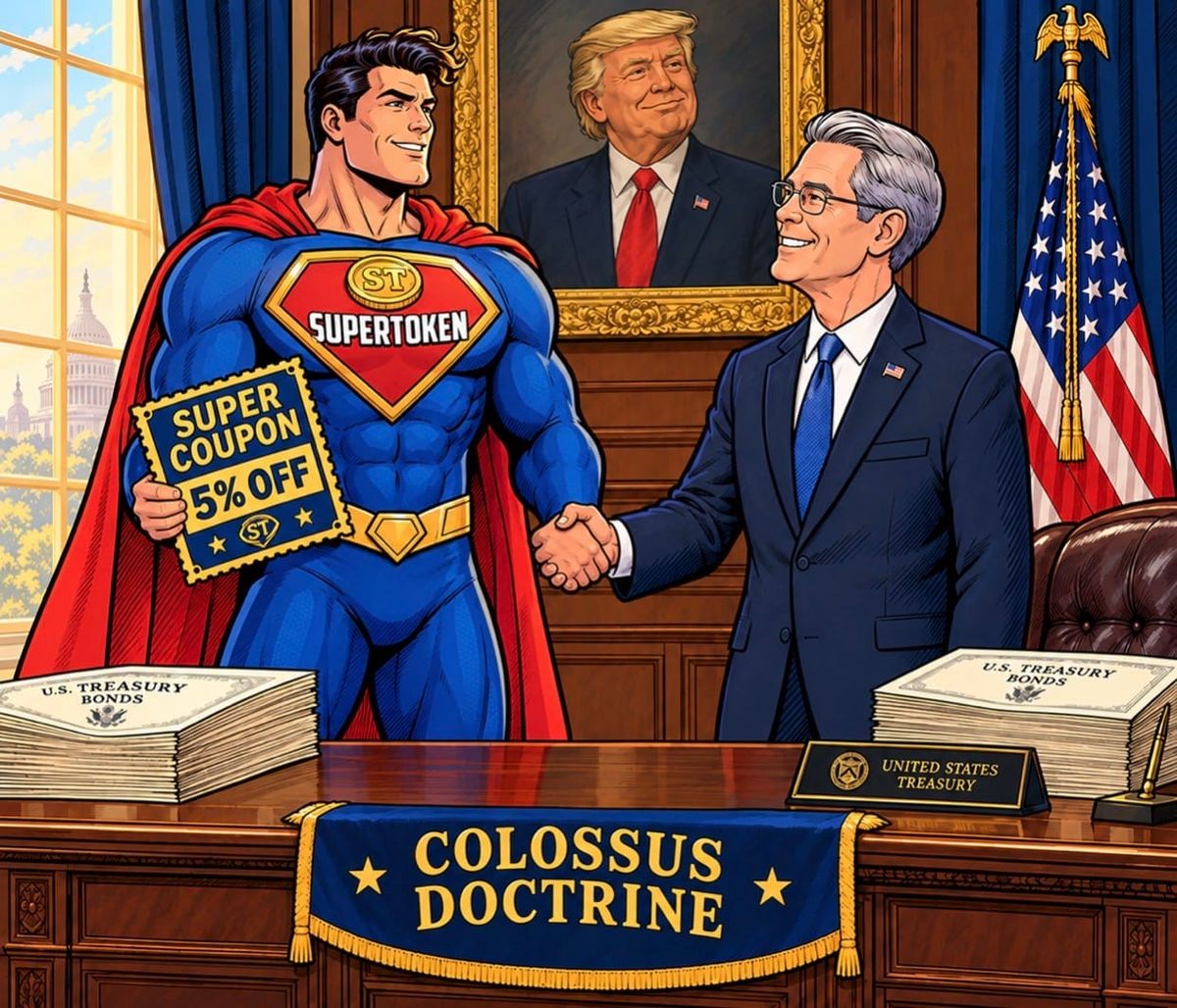
Why Bessent goes bigger on the long-bond buyback this month, and why the GENIUS Act makes it possible. A JD Unfiltered prediction note by Joseph M. Salvani and Daniel J. Walsh.
The Call
Before October 31, 2026, Bessent will go bigger on the long-end buyback, and not by a token amount. The August move doubled the program and the September operations tripled it. We expect the October move to be the largest step yet.
One. A per-operation ceiling of at least $10 billion in the 10-to-20-year and 20-to-30-year sectors, up from the $6 billion maximum Treasury has used since September. That is five times the $2 billion size that applied before August 19.
Two. An extension of the enlarged program beyond November 4, the date the current schedule expires, so the expansion becomes the standing size for the next refunding quarter rather than a temporary measure.
Three. More long-end operations added to the calendar, taking long-end buybacks for the next quarter to at least double the roughly $32 billion scheduled in the current one, financed, as every buyback so far has been, with Treasury bills.
The November 4 quarterly refunding will then lock it in. We expect the refunding to pair the bigger buyback with smaller long-bond auctions, completing what Bessent himself has called the Treasury twist.
The engine behind the move is the GENIUS Act. The statute created a buyer for short-term government paper that did not exist before it was signed. That is what lets the Treasury Secretary keep retiring 30-year debt and refinancing it at the front of the curve without running out of buyers for the bills.
Where Things Stand Today
The bond market has handed Bessent the reason to act.
The long end is at generational highs. The 30-year Treasury yield closed at 5.60 percent on October 8 on the Federal Reserve's H.15 release, after touching 5.72 percent on October 7, its highest level since 2002, as Brent crude moved above $102 a barrel. The 30-year term premium is at its highest since 2011 on Bloomberg Economics data.
Auction yields are the highest in a quarter-century. The October 7 ten-year reopening stopped at 5.300 percent and the October 8 thirty-year reopening at 5.618 percent, both the highest since 2000.
The current program is fully used. On October 8, the Treasury accepted the full $6 billion on offer in the 20-to-30-year bucket against $14.9 billion of offers. The October 1 operation in the 10-to-20-year bucket also bought the full $6 billion.
That last point is the trigger, and it is why we expect a big step rather than a small one. In late September the story was the opposite. Treasury was accepting roughly half of what was offered and falling short of its cap, and investors were asking why it had announced a bigger program at all. ING's Padhraic Garvey answered at the time that the Treasury "has always got the option to buy more." Two consecutive operations hitting the ceiling mean the ceiling is now the binding constraint. When a trader is filled in full at the limit he set, and the other side is still offering more than twice his size, he raises the limit. A trader who has been filled in full twice running, with offers at 2.5 times his size, does not raise it by a billion. He resets it.
The Bessent Playbook
Bessent has already told the market how he behaves in this situation. When the Treasury announced on August 19 that it would at least double long-end buybacks to at least $4 billion per operation from September 9 through November 4, the operative phrase was at least. The next day he said the increase "could be more than the $4 bn per issue." Within three weeks the operations were running at $6 billion, triple the original size.
He has also shown that he will move outside the calendar. The August announcement came two weeks after a scheduled refunding, timing Jefferies' Thomas Simons called "not within their norms at all." Bessent explained he increased sizes because the market was "illiquid and moving quickly," moving away from equilibrium rather than toward it. Yields at 24-year highs, with oil above $100, describe exactly that condition.
This is the hedge fund manager's instinct applied to the sovereign balance sheet. When the thesis is intact and the price is moving your way, you do not trim. Soros told Druckenmiller to "go for the jugular" in 1992. Bessent was on that trade.
Why the GENIUS Act Is the Engine
A buyback is a maturity swap. The Treasury buys back a long bond and pays for it by selling bills. Analysts have spent two months pointing out that this simply moves debt from the long end to the short end, where it is exposed to Fed rate decisions. That objection is correct for every Treasury Secretary before this one. It misses what changed in July 2025.
The statute manufactures the bill buyer. The GENIUS Act requires every payment stablecoin to be backed one-for-one by cash, insured deposits, and Treasury bills of 93 days or less. Bessent said at signing that the law would "lead to a surge in demand for US Treasuries, which back stablecoins," and he has projected the market growing to roughly $3 trillion by 2030. Every one of those dollars has to sit at the front of the curve, exactly where buybacks put the new supply.
The licensing clock is now fixed. No federal regulator issued a final rule by October 2, so the Act takes effect on January 18, 2027. From that date, issuing a payment stablecoin in the United States generally requires a federal or state license. The Federal Reserve released its implementing proposals on September 24. The onshore, licensed, bill-backed channel goes live in roughly 100 days. A Treasury Secretary who expects that bid to arrive in the first quarter of 2027 has every reason to issue the bills now and retire long bonds while they are cheap.
The bonds being retired are cheap. Much of the long-end supply in these operations is low-coupon paper issued during the COVID-era period of near-zero rates, trading at a deep discount to face value. Aptus Capital's John Luke Tyner put it plainly, noting that bonds issued in that period are "pricing at 50 to 60 cents on the dollar" and that buying them back looks like a good way to do it. Retiring a dollar of face value for 50 to 60 cents is a profit for the taxpayer on the principal, whatever the yield optics.
The duration lives in the float. This is the thesis we set out in The Bessent/Warsh Accord. A stack of bills that is rolled continuously and backed by a statutory reserve requirement behaves like long-term funding, in the same way bank deposits fund 30-year mortgages. The more the float grows, the more of the long end the Treasury can retire without a buyers' strike at the bill auctions.
The November 4 Follow-Through
The October announcement is the tactical move. The November 4 refunding is the strategic one. Citi's head of US rates strategy, Jason Williams, expects the Treasury to cut each 20-year and 30-year auction by $3 billion, fund the gap with additional bills, and possibly cancel 20-year issuance altogether. At the last refunding the Treasury said it was evaluating changes rather than increases to coupon sales, which left the door open to cuts.
Put the pieces together and the twist is complete: buy more long bonds in the secondary market, sell fewer of them in the primary market, and fund both with the bills the GENIUS Act guarantees a buyer for.
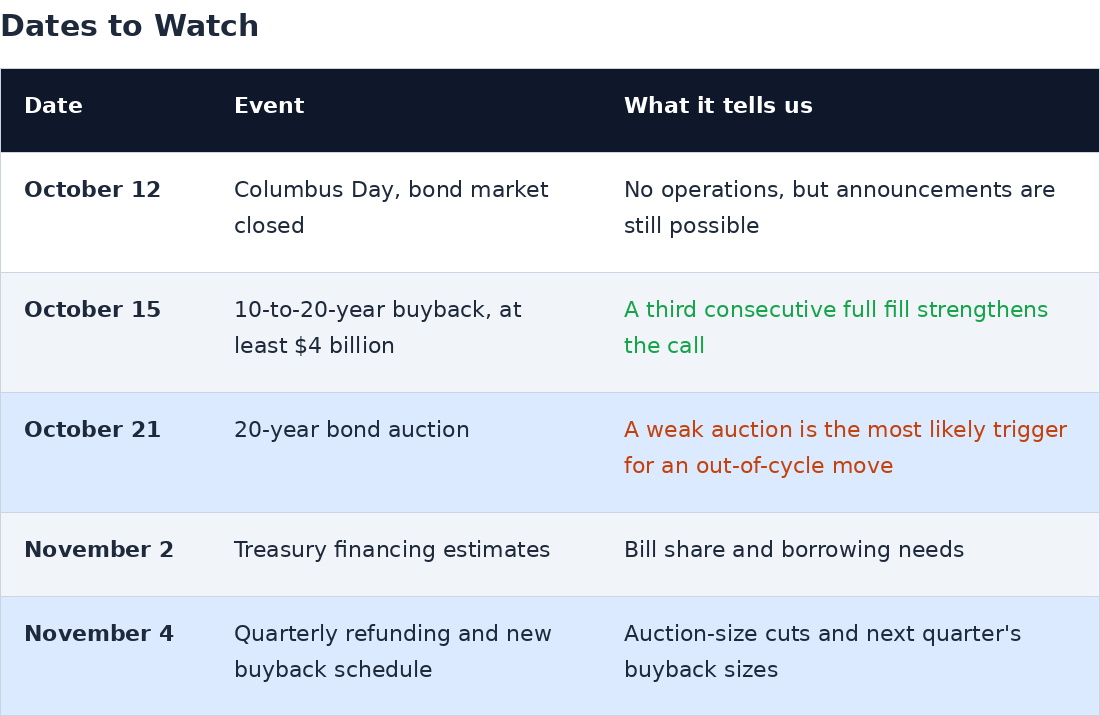
Dates to Watch
How We Will Score It
Full hit. Before October 31, the Treasury announces a per-operation long-end ceiling of $10 billion or more, or an expansion of equivalent size through added operations, carried past November 4.
Hit. Before October 31, the Treasury raises the long-end ceiling above $6 billion, extends the enlarged program past November 4, or adds long-end operations.
Partial. No October announcement, but the November 4 schedule sets long-end buyback sizes above the current program.
Miss. The November 4 schedule returns long-end operations to $4 billion or less, or the Treasury signals the expansion is over.
What Could Make Us Wrong
We hold ourselves to the same falsifiers we have published before.
The float has stalled. Total stablecoin supply was $303.9 billion on October 9, up only 0.9 percent over 90 days, with CoinDesk putting September-end supply at $313 billion. The GENIUS bid is a 2027 story, not yet a 2026 one. The Treasury would be pre-funding against expected demand, not demand already in hand.
Bessent has acknowledged the limit. He has said on CNBC that he cannot set the equilibrium price, and Treasury's own framework says buybacks are not meant to fight acute market stress.
Bills are getting more expensive. Swaps price a full Fed hike by year-end. BNP Paribas warns that leaning harder on bills while the Fed is hiking could raise funding costs, and that cutting long-bond supply could read as panic and embolden the bond vigilantes.
Bureaucratic preference for the calendar. The Treasury may simply prefer to hold changes for the scheduled November 4 refunding, two business days after the last business day of October. That outcome scores as a partial, not a hit.
The Accelerant the Doctrine Needs
The first falsifier above is the one that matters most, and it points to the missing piece. The Colossus Doctrine rests on a growing stablecoin float, and the float has gone flat. The reason is built into the statute. The GENIUS Act prohibits issuers from paying holders any interest, yield or rewards for holding a payment stablecoin. The law built the pipe and then removed every lawful reason for an ordinary American to use it. Growth has come from trading, settlement, and foreign savers protecting themselves against weak currencies, not from domestic consumers.
The Super Coupon Token, BCII Enterprises' patent-pending architecture, is designed to fill that gap. It is an advertiser-funded coupon carrier that attaches a purchase incentive to a stablecoin or commodity token without merging the incentive into the asset itself. The issuer pays no yield. The advertiser funds a discount at the point of purchase, which is a sales promotion, the oldest instrument in retail, rather than a return for holding. BCII has received a favorable accounting opinion treating the program as a sales promotion under ASC 606.
The connection to this month's call is direct. Every dollar of float that a coupon pulls into a licensed stablecoin becomes a dollar of mandated bill demand. Every dollar of bill demand is a dollar of long bonds the Treasury can retire without a buyers' strike at the front of the curve. A bigger buyback is the sovereign's move. A faster-growing float is what makes it sustainable, and a lawful consumer incentive is what the float has been missing. If Bessent wants the Doctrine to run at the size this market now demands, he needs adoption to accelerate before January 18, 2027, not after it.
The architecture is not yet proven at scale. Launch data, counsel's sign-off on the separation between coupon and stablecoin, and issuer adoption will decide whether it performs as designed. The gap it targets is not in dispute.
What We Learned From the Best
The authors' views on how to run money were formed inside the firms that defined modern macro and risk-taking: at Goldman Sachs in the Leon Cooperman era, at Steinhardt Partners, and in close contact with the Soros and Tiger organizations. The lesson from all of them was the same. When the evidence lines up and the risk-reward is favorable, you press. You size up when the market fills you, you move before the calendar tells you to, and you hold your people to a standard that brings out their best work. Bessent learned at the same table. This note is written in the hope that he reads it.
Bottom Line
Treasury is filling its long-end buybacks to the limit at 24-year-high yields, buying discounted COVID-era bonds for well under face value, and doing it about 100 days before the GENIUS Act's licensed, bill-backed stablecoin channel goes live. Bessent has already shown he raises size when the trade is working and moves outside the calendar when the market is moving away from equilibrium. He doubled the program in August and tripled the operations in September. We expect him to go bigger again this month, to at least $10 billion per long-end operation, and to make that the new standing size. The buyback is the sovereign's move. A lawful consumer incentive that grows the float is what keeps it going.
Disclosure: Joseph M. Salvani and Daniel J. Walsh are co-founders of BCII Enterprises, which developed the Super Coupon Token architecture discussed in this note, and therefore have a direct commercial interest in its adoption. This note is an analytical essay and a published market prediction, not investment advice, a recommendation, or a solicitation to buy or sell any security. The call, the scoring criteria and the policy path set out here are the authors' expectations and may prove wrong. Figures are drawn from Treasury releases, Federal Reserve data and third-party reporting believed reliable but not independently verified. Market data as of October 9, 2026.
The authors hold positions in securities mentioned and reserve the right to buy or sell shares at any time without notice.