
The Interest Wall


US stablecoins have barely dented Europe's 6 trillion euro household deposit base. January 2027 changes the starting gun, and Circle is in position. But Europe has walled off the one weapon that wins deposits, paying people to hold. The Super Coupon goes through the wall, not over it. A JD Unfiltered Special Report by Joseph M. Salvani and Daniel J. Walsh.
The thesis in one paragraph
Europe's banks are not losing deposits to US stablecoins. Not yet. France just posted its first negative 12-month household deposit flow since 2003, but the money went to life insurance, not to USDC. Italy's savers went to government bonds, and Germany's are still adding to deposits. Euro stablecoins total about half a billion euros against a household deposit base of more than 6 trillion euros in the three countries. That is the calm before the GENIUS Act, which takes full effect by January 18, 2027. Circle has already built the European beachhead: a French license, a stadium-sized marketing budget and a Brussels lobbying campaign. What Circle cannot do in Europe is the thing that actually pulls money out of banks, which is pay a return for holding. MiCA bans interest not just by issuers but by exchanges and anyone else, if the benefit grows with the time a token is held. That wall stops yield. It does not stop a purchase discount that is the same whether you held the token for a minute or a year. That is BCII's Super Coupon architecture, and in Europe it may be the only legal way to compete for a saver's euro on price.
Part one: so far, a rounding error
Look at where Europe's savings actually went this year, on ECB balance sheet data through August 2026.
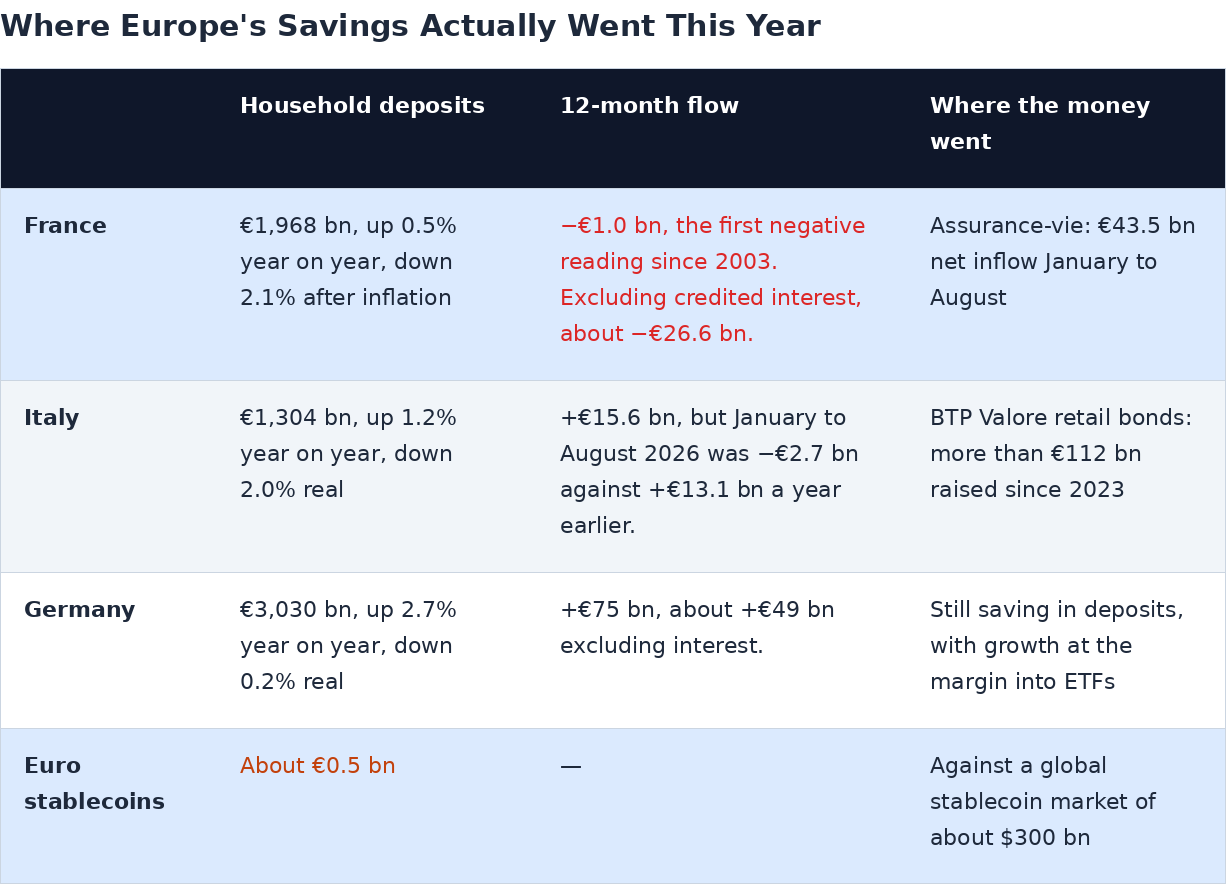
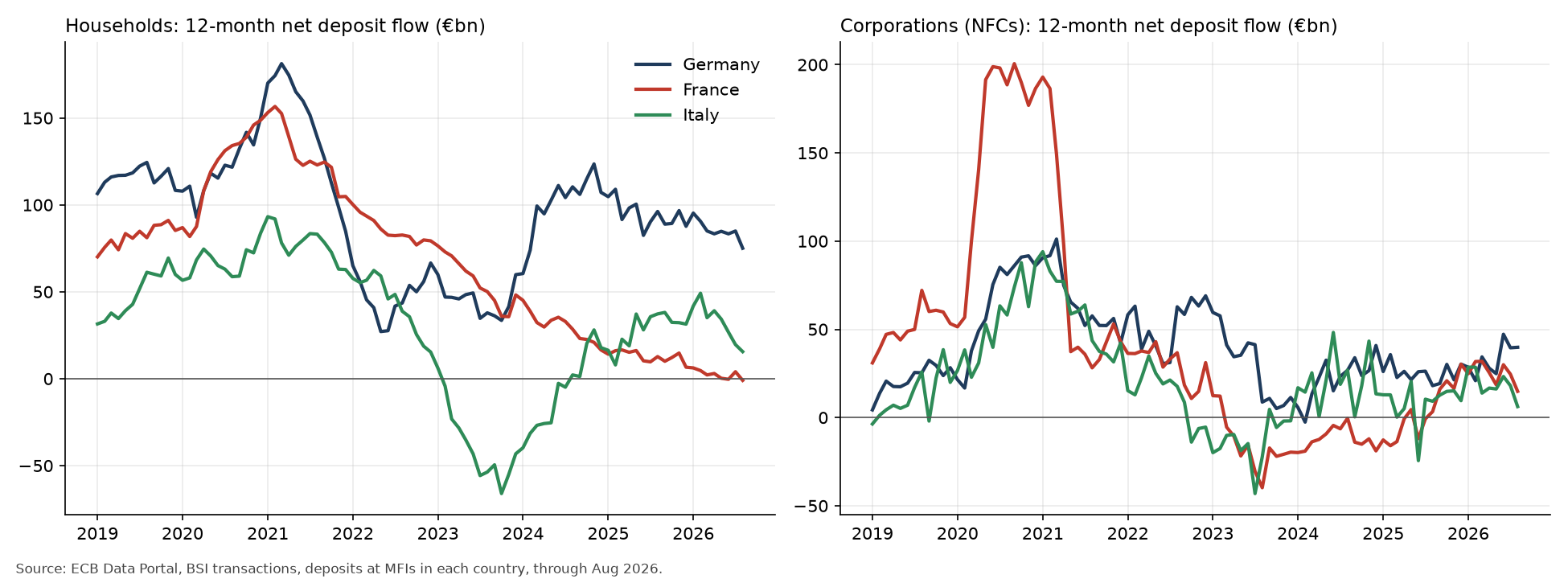
The ECB's own research says banks are not yet experiencing any significant loss of deposits to stablecoins. The pressure on deposits is real. The leak is not stablecoins. It is the rate gap. In August, a French household current account paid 0.05 percent, an Italian one 0.20 percent and a German one 0.51 percent, on the ECB's MFI interest rate series. Meanwhile the ECB deposit facility sits at 2.50 percent, and September flash inflation ran 3.3 percent in Germany, 3.4 percent in France and 4.1 percent in Italy on Eurostat's figures. Savers are losing about 3 to 4 points a year in real terms on their checking balances. They are moving, just not into tokens.
The European saver is already shopping for return. Stablecoins have not shown up at the store yet because, in Europe, they are not allowed to offer one.
Part two: January 2027, and Circle is set to pounce
The GENIUS Act takes effect on the earlier of January 18, 2027 or 120 days after final regulations. From that date USDC carries a US federal regulatory status that most dollar tokens circulating in Europe lack. Circle has spent 2026 getting ready.
The license. Circle France won expanded AMF authorization in April 2026 to provide crypto services across the EU under MiCA. It issues both USDC and EURC as an e-money institution.
The distribution. A five-year commercial renewal with Binance, plus a $100 million Binance investment in Circle.
The brand. USDC on the shirt of Chelsea FC, the most visible sponsorship any stablecoin has bought in Europe.
The lobbying. An October 1 comment letter asking Brussels to overhaul MiCA, noting that only 3 of the top 30 stablecoins meet EU rules.
Circle has the license, the legal status, the exchange partners and the shirt sponsorship. It has everything except a reason for a French saver to move 10,000 euros out of a bank account paying 0.05 percent. In the United States that reason exists. In Europe it has been legislated away.
Part three: the interest wall is higher in Europe
Both regimes ban the issuer from paying interest. The GENIUS Act stops there. Exchanges and other third parties remain free to pay rewards on stablecoin balances, as the Congressional Research Service has set out, and the CLARITY Act that would have closed that door failed on September 15, 2026. MiCA goes further.
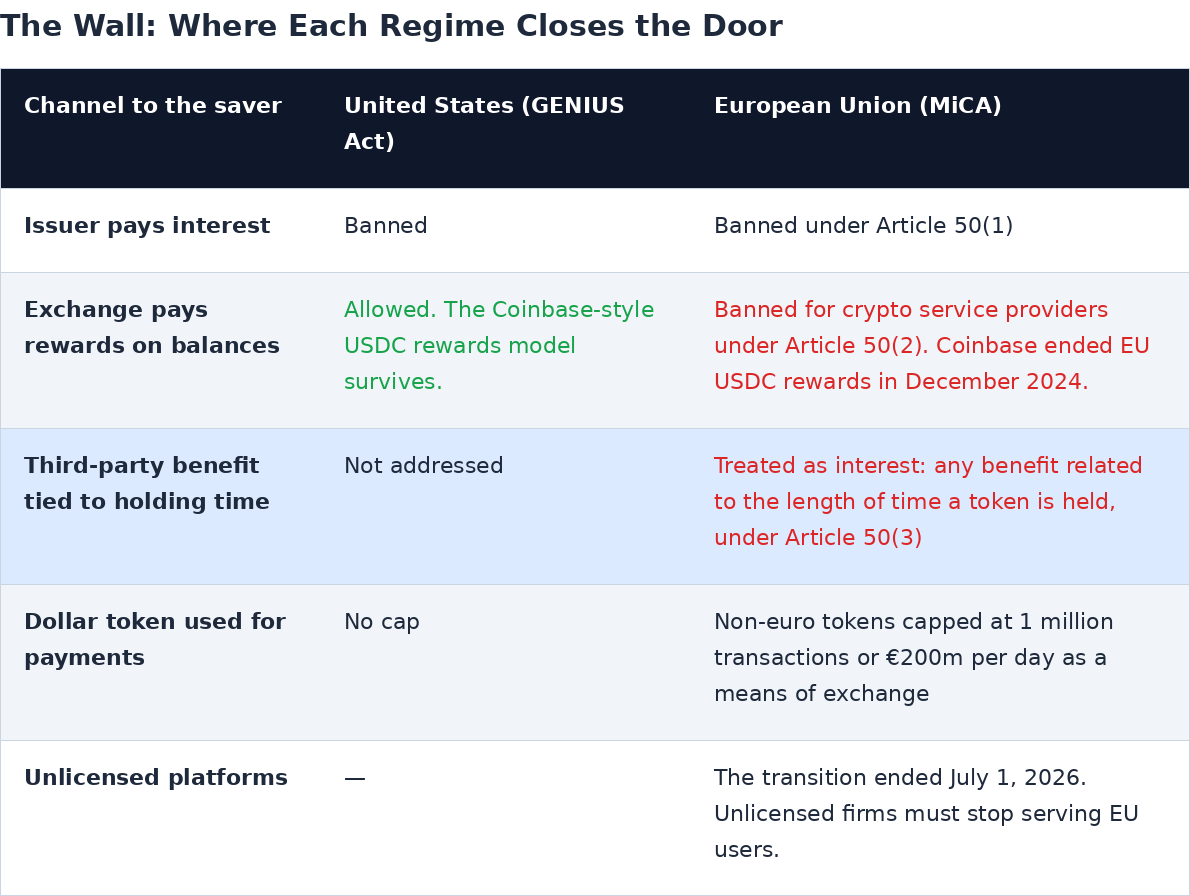
Put simply: in America, a stablecoin can win deposits through the back door of exchange rewards. In Europe, the front door, the back door and the side door are all bricked up. A USDC holder in Paris earns nothing, and no one in the chain is allowed to pay them for waiting.
That is why the deposit drain has not come to Europe. It is also why, when it comes, it will not come through yield.
Part four: the Super Coupon is not a yield, so the wall does not apply
MiCA defines the forbidden benefit by one test: does it grow with the time you hold the token? BCII's Super Coupon architecture was built to fail that test on purpose. The coupon is a separate token, independent of the stablecoin. It delivers the same purchase discount no matter how long the holder kept the USDC or the coupon token. The discount is triggered by a purchase, funded by the advertiser and fixed per transaction. None of this is a payment for holding, so it falls outside Article 50(3). Discount-only instruments are also outside the EU VAT voucher rules set by Directive 2016/1065.
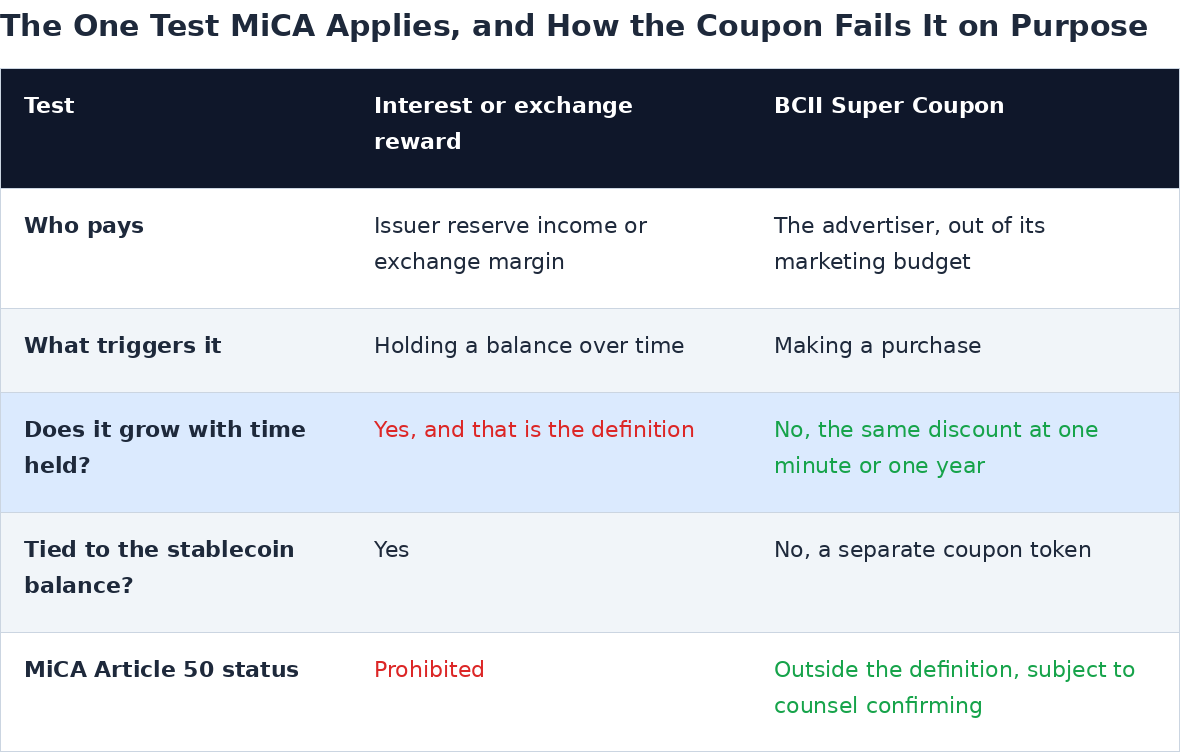
The economics speak plainly. A French saver with 10,000 euros in a current account earns about 5 euros a year at 0.05 percent. A 5 percent advertiser discount on a single 200 euro grocery run is worth 10 euros. That is twice the bank's annual interest, delivered at the checkout counter, with no yield paid by anyone. These are illustrative figures, and actual coupon values are set by each advertiser.
Part five: Japan opened the door Europe bricked up
Japan is running the opposite experiment. Its law does not directly ban interest on a stablecoin. FSA guidance discourages funds-transfer providers from paying interest on balances, because that looks like illegal deposit-taking. But holders can earn through a separate lending transaction, and bank tokenized deposits can pay ordinary deposit interest. Japanese institutions are using that opening.
USDC lending. SBI VC Trade launched USDC lending on March 19, 2026: 10 percent annualized for an introductory 12-week term, with about 5 percent expected thereafter, capped at 5,000 USDC per account per round.
Yen stablecoin lending. SBI followed with 3 percent on its trust-type yen coin JPYSC, against the 0.325 to 1 percent it cites for ordinary yen deposits. It is not a deposit, not insured and not segregated.
Foreign coins welcomed. From June 1, 2026, qualifying foreign trust-type stablecoins became regulated payment instruments in Japan, subject to an equivalence test.
US dollar coins at the checkout. USDC was used at a Shibuya cafe with JCB and Resona, with merchants receiving yen. SBI ran USDC payments at BicCamera and Unatoto. Netstars ran USDC, USDT and JPYC through an existing Lawson register on August 17.
The banks join in. MUFG, Mizuho and SMBC plan live transactions in a jointly issued trust-type stablecoin during fiscal 2026.
Now set that against the saver's alternative. The Bank of Japan has raised its policy rate to 1.25 percent, and megabank ordinary deposits move only from 0.4 to 0.5 percent on November 2. A licensed Japanese exchange offering about 5 percent on USDC is a ten-to-one rate gap, paid in dollars. That is exactly the channel the JD Unfiltered Japan warning flagged: yen savings leaking into dollar tokens. Japan-only stablecoin flows are still not published, so the size of the leak cannot yet be measured.
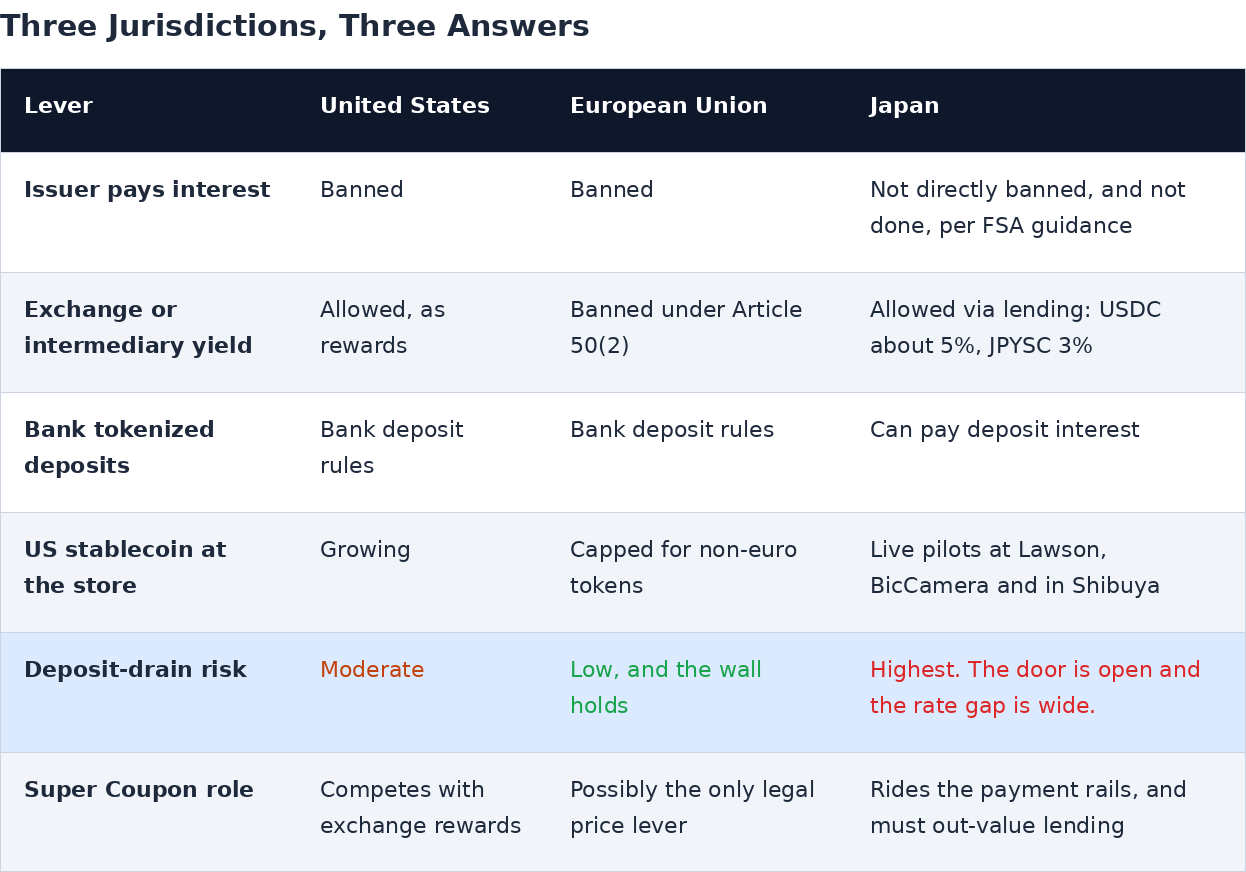
The lesson cuts both ways. Japan proves the demand: when someone is allowed to pay a saver to hold dollar tokens, and stores accept them, the plumbing gets built fast. Europe proves the wall: without yield, Circle's beachhead has no lever to pull. In Japan the Super Coupon is one offer among several. In Europe, where yield is shut out, it may be the only one.
Japan shows what happens when the door opens. Europe shows what happens when it stays shut. The Super Coupon is built to work either way, and to matter most where the door is closed.
What it means for the deposit question
Through January 2027. Expect deposit pressure to stay a rate-gap story, meaning assurance-vie, BTP Valore and ETFs, rather than a stablecoin story.
After January 2027. Circle's US legal status and European license make USDC and EURC the default regulated tokens. But in Europe, without yield, adoption depends on utility and promotion.
The swing factor. A legal, time-independent consumer benefit is the only price lever left in Europe. Whoever controls it controls the pace of conversion from deposits to tokens.
The Japan contrast. Where intermediaries may pay yield and stores take USDC, the drain risk is real. Europe's wall delays it, but it also concentrates the competition onto non-yield levers.
The euro twist. Because the coupon is independent of the token, it can ride on EURC as easily as USDC, which keeps it clear of the non-euro payment cap.
The licensing path. BCII runs as IP owner and royalty holder, with Horizon Globex as the technology provider. A MiCA-licensed trading-platform operator, one of 22 on ESMA's register, runs the EU market. Each issuer files its white paper under Article 8.
The JD Unfiltered call. Europe's banks keep their deposits through January 2027, not because savers are loyal, but because the law has taken away the bribe. The first platform to offer a legal reason to switch, priced at the checkout rather than in the balance, sets the terms of Europe's stablecoin decade. The Super Coupon is built to be that platform.
Data: ECB BSI and MIR series for France, Germany and Italy through August 2026; Eurostat HICP flash for September 2026; Japan items from issuer and press sources as cited. Real changes deflate by HICP. The coupon example is illustrative. This report reflects the authors' analysis and opinions. It is not legal, tax or investment advice. MiCA treatment of the Super Coupon must be confirmed by EU counsel, and no EU launch, partner agreement or regulatory approval is implied.
BCII Enterprises Inc. is the owner of the Super Coupon architecture described here and has a direct commercial interest in its adoption. The authors hold positions in securities mentioned and reserve the right to buy or sell shares at any time without notice.