
The Last Mile Is on the Ground: Why SpaceX Should Lock Up AmpliTech Before Anyone Else Does

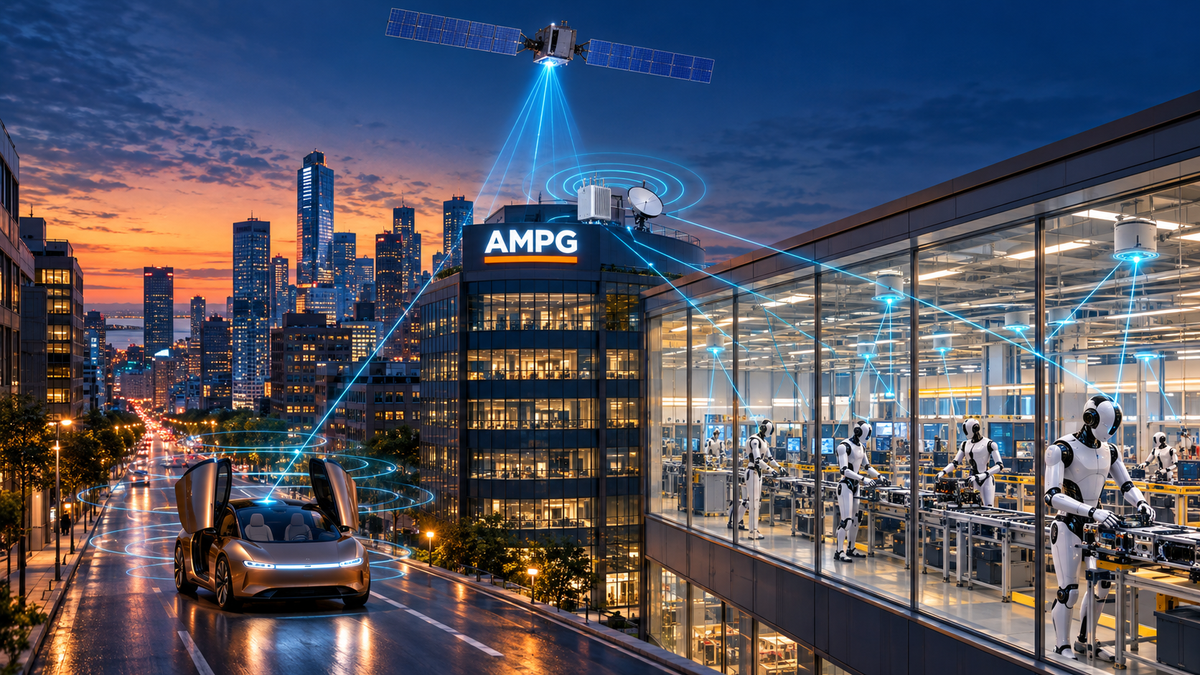
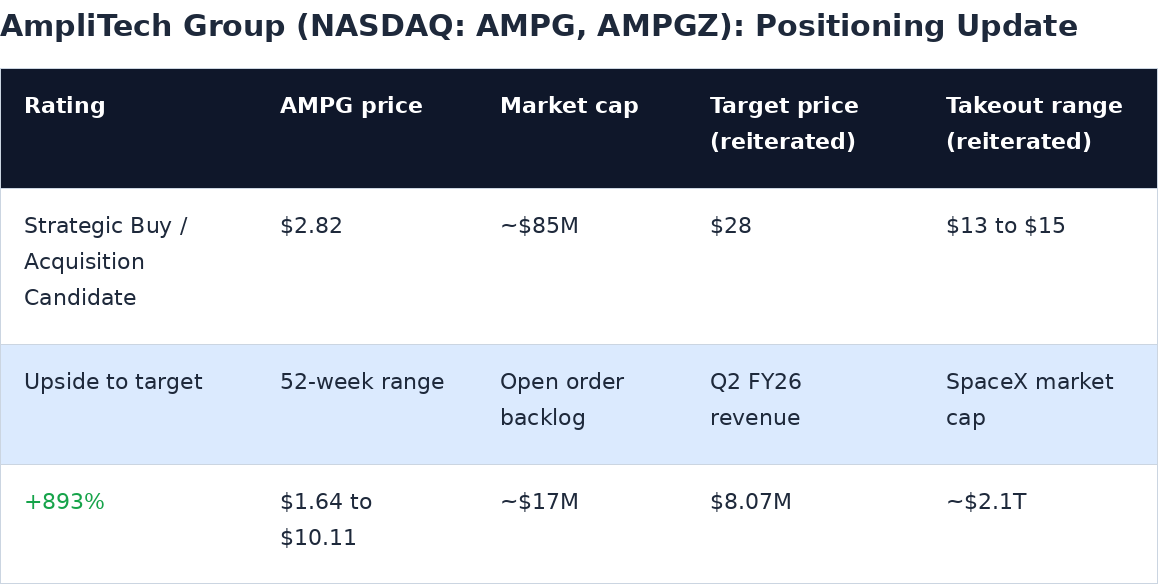
SpaceX now owns the airwaves to become America's fourth carrier. What it does not own is the radio that turns those airwaves into a city network. The same radio layer would connect Tesla's robotaxis and robots where satellites cannot reach. We reiterate our $28 target price and our $13 to $15 takeout range. AmpliTech Group, NASDAQ: AMPG and AMPGZ. Positioning update. Walsh and Salvani, Strategic Equity Research, JD Unfiltered. Prices as of the October 8, 2026 close.
The Setup
On October 8, 2026, SpaceX agreed to buy Grain Management's entire nationwide 800 MHz spectrum portfolio, up to 14 MHz of paired low-band spectrum, subject to FCC approval. The Wall Street Journal reported the price at about $8 billion in cash. SpaceX said the spectrum addresses one of the key remaining technical gaps that will pave the way for Starlink Mobile to become a major mobile carrier in the US. In extended trading, T-Mobile, Verizon and AT&T fell roughly 6 to 8 percent.
Verizon's response was the most revealing line of the day. A company can have tons of spectrum available, Verizon said, but if it does not have the network to use it, it does not matter, and it is just empty airwaves. Analyst Tim Farrar made the same point from the other side: to get reliable building penetration in urban areas, SpaceX would have to deploy towers on the ground.
Verizon is right about one thing. Spectrum without radios is empty airwaves. That is exactly why the radio supplier is now the most strategic small asset in the SpaceX supply chain.
The policy backdrop is moving the same way. The FCC authorized SpaceX's Gen2 Starlink Mobile constellation of 15,000 satellites this week, and it has scheduled an October 29 vote on seeking comment on an additional 482 MHz for supplemental coverage from space.
Spectrum Is Bought. The Network Is Not.
SpaceX has assembled a complete US spectrum stack in roughly thirteen months.
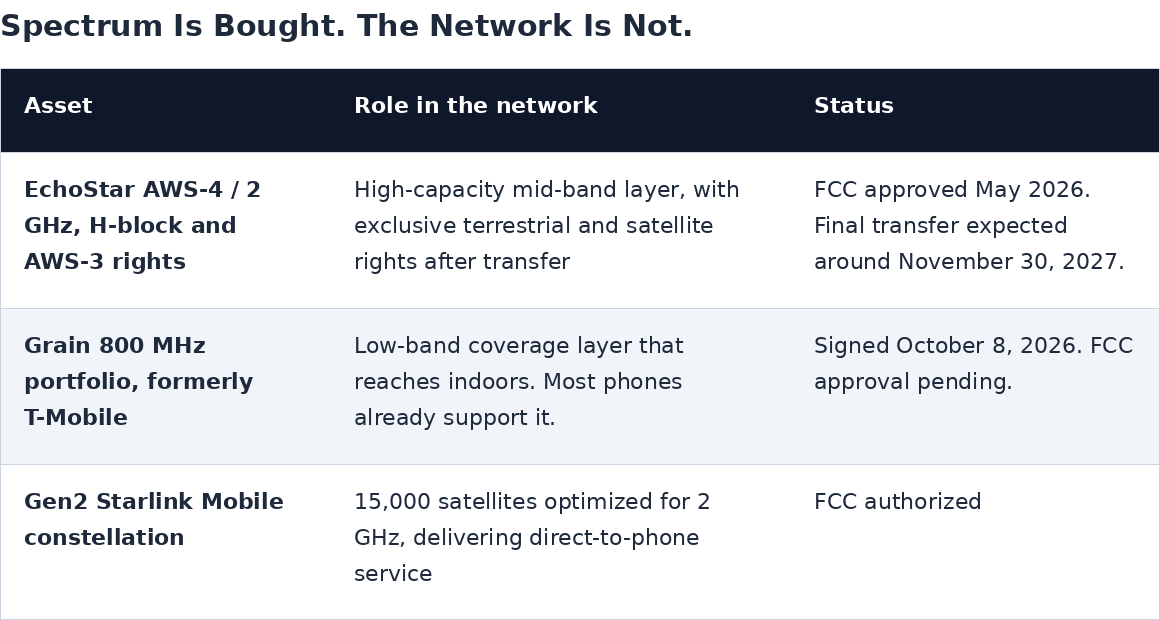
What is missing is the ground layer. SpaceX President Gwynne Shotwell has described small cellular base stations mounted alongside Starlink hardware, built out site by site where demand warrants it, rather than a tower-heavy buildout like the incumbents'. Every one of those sites needs a radio unit operating in SpaceX's own spectrum. Nobody has named the supplier.
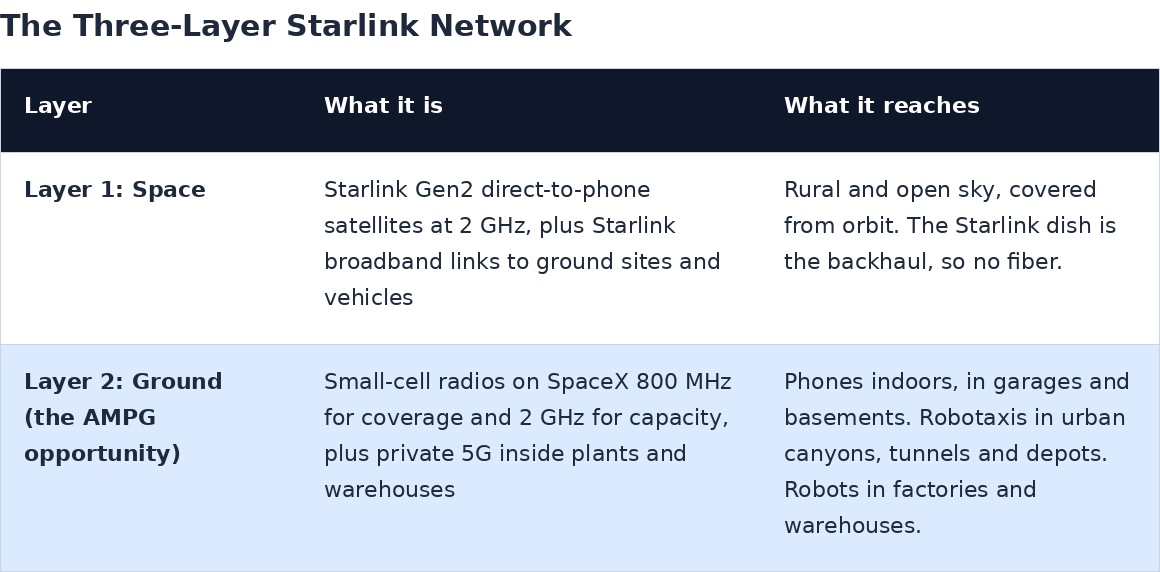
The Architecture: Satellites for the Country, Radios for the City
A satellite signal aimed at a phone arrives weak, and it collapses at a roof, a wall or a basement. Sirius deployed 1,150 ground repeaters and XM 778 for exactly that reason, because their satellite signals could not reliably penetrate buildings. The consumer market is already confirming it. A $149.99 in-car booster for Starlink's direct-to-phone service launched this month, promising five times the phone's uplink power.
The efficient city design is not a repeater of the satellite signal. It is a small cell that broadcasts to phones on SpaceX's 800 MHz and 2 GHz spectrum and uses a Starlink dish as its link back to the network, so no fiber trench is needed. Because SpaceX would own the spectrum, it needs no permission from Verizon, AT&T or T-Mobile. Federal rules require a carrier's consent even to boost that carrier's signal, so the only clean path is a network on SpaceX's own frequencies.
Why AmpliTech Is the Radio to Own
AmpliTech is the only US supplier of a commercial-grade 64T64R O-RAN Massive MIMO radio validated in independent multi-lab interoperability testing, and the company is vertically integrated from chip to MMIC to radio unit to managed network service. The product line already maps onto the network SpaceX now has to build.
Low band. A Band 28 macro cell, a 700 MHz low-band radio, is a featured product today. An 800 MHz variant is an adaptation of an existing design, not a new invention.
Mid band. A Band 1 radio near 2 GHz and the 64T64R Massive MIMO unit address the capacity layer that SpaceX's 2 GHz spectrum will carry in dense cities.
Private 5G and Network-in-a-Box. Portable, deployable 5G for military, disaster recovery and temporary sites, and carrier-grade private networks for enterprises.
In-house chips. The MMIC low-noise amplifier chips inside each radio are designed in-house by AmpliTech's AGMDC division. The receive chain's noise figure is the binding constraint on direct-to-phone link budgets, and that is where AMPG sits.
Live deployments. More than 2,000 radios are shipped and in service with a Tier-1 North American carrier, and cumulative 5G O-RAN shipments exceed $17 million. A further $7.3 million of follow-on orders from an Asian mobile operator was announced August 27, and AmpliTech holds purchase orders of about $11 million under a multi-year TELUS letter of intent announced in 2025.
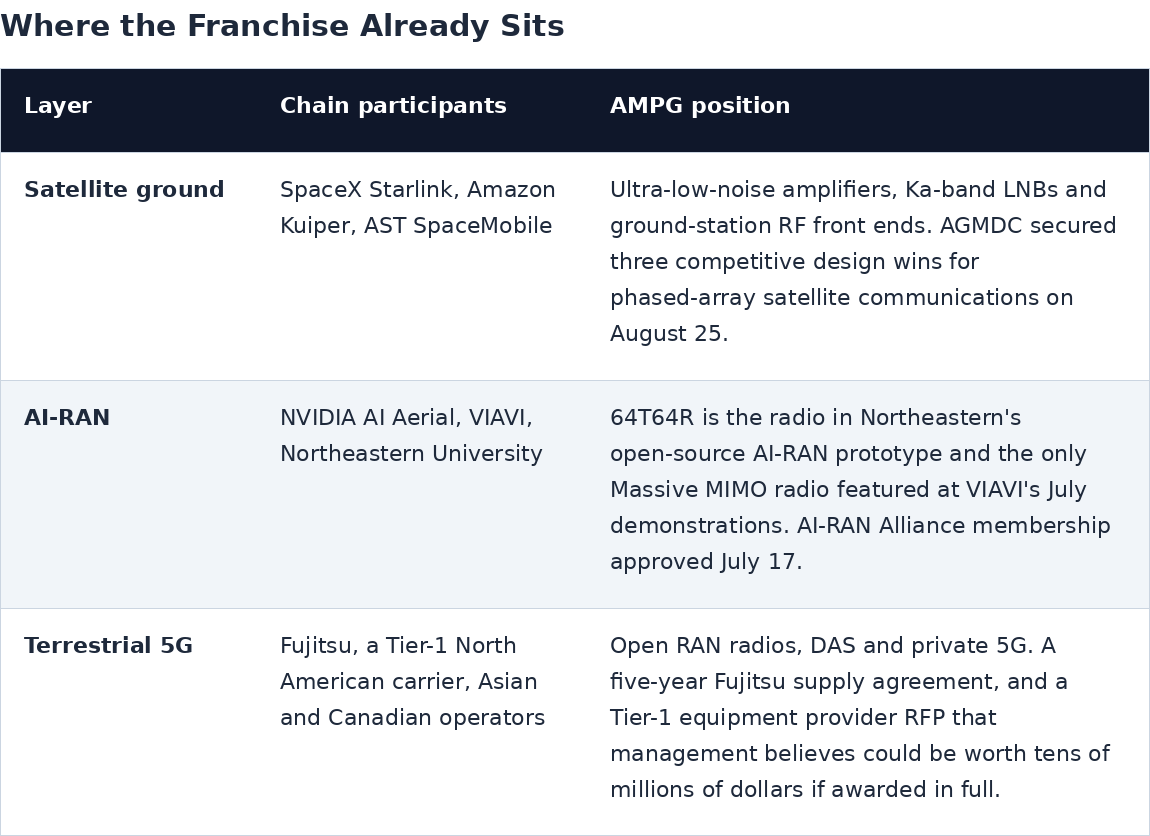
The radios are US-designed, which matters for a network that will carry national traffic and is being built expressly to compete with networks that once relied on Huawei and ZTE gear. The same franchise reaches two other layers of the chain.
What the Stock Has Priced In
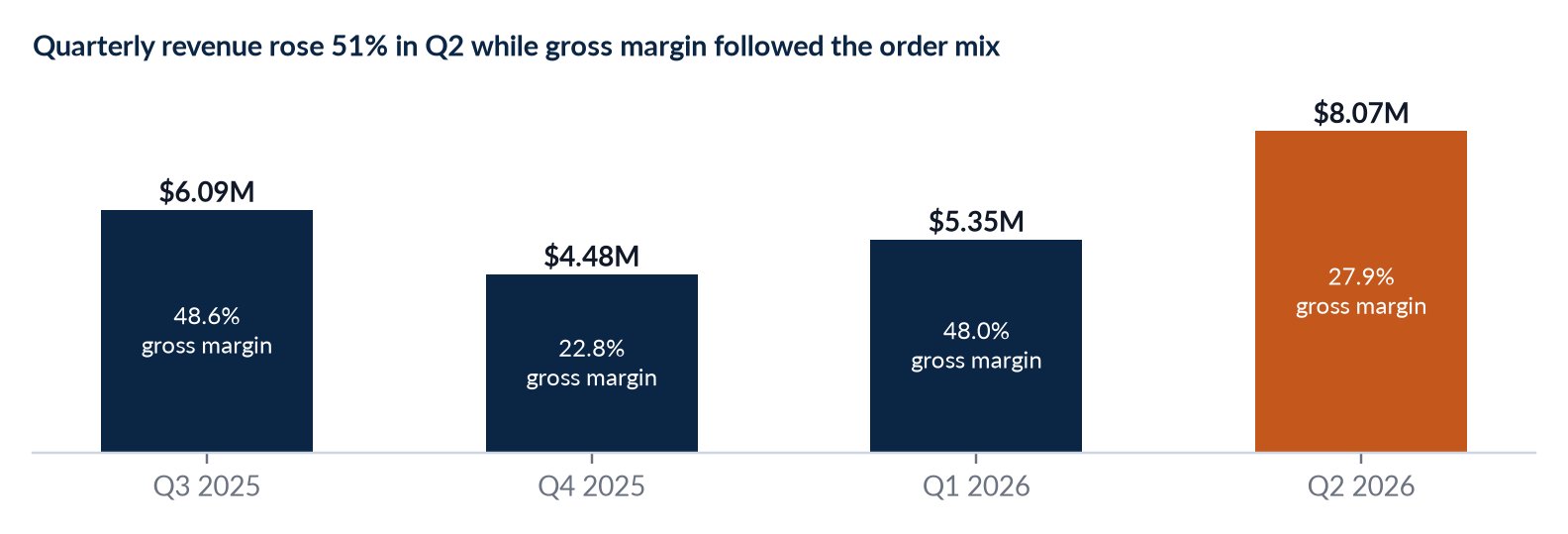
AMPG has fallen 71 percent from its June 17 close of $9.70 and 47.9 percent from the $5.41 reference price in our July 27 report, to $2.82. The decisive move came on August 14, when the shares dropped about 33 percent after second quarter results. Revenue of $8.07 million rose 50.9 percent sequentially but came in 37.9 percent below the $13 million Wall Street forecast. Gross margin was 27.9 percent, down from 48.0 percent in the first quarter, which management attributed to customer and product mix, and the net loss was $3.09 million on heavier research and SG&A spending.
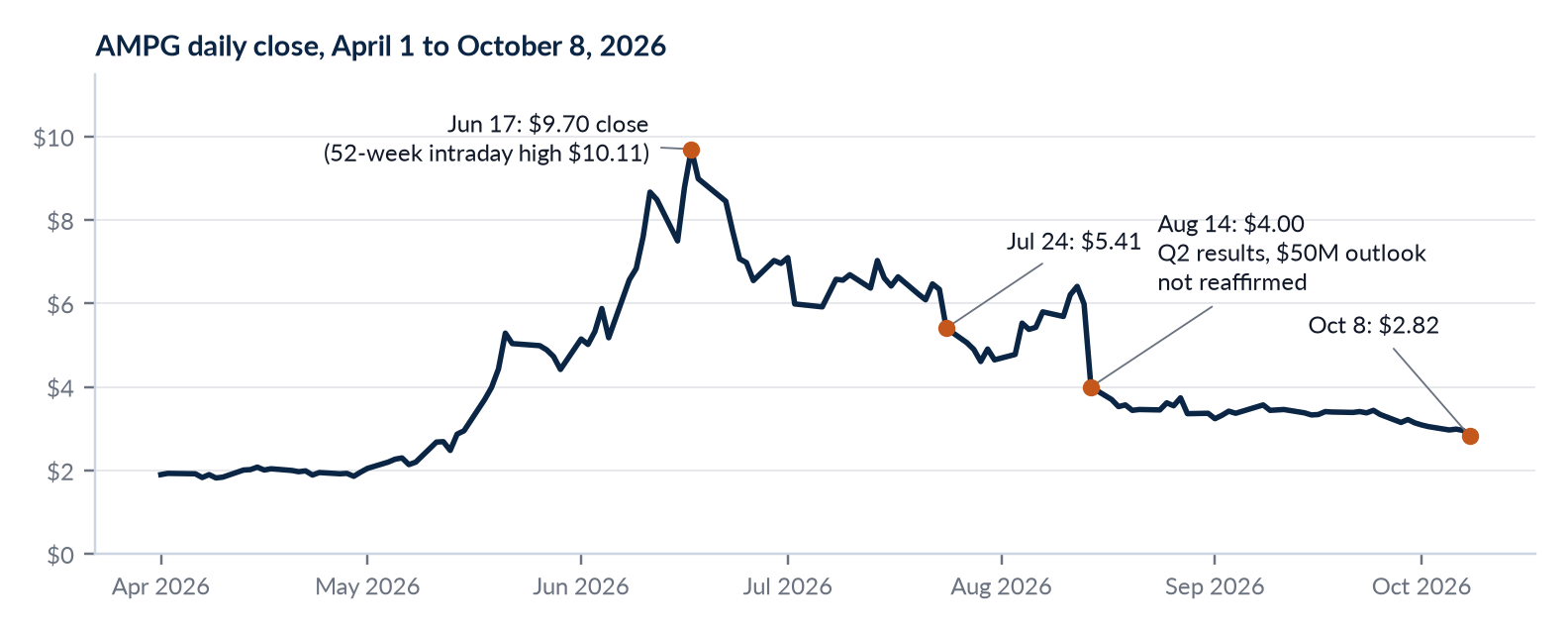
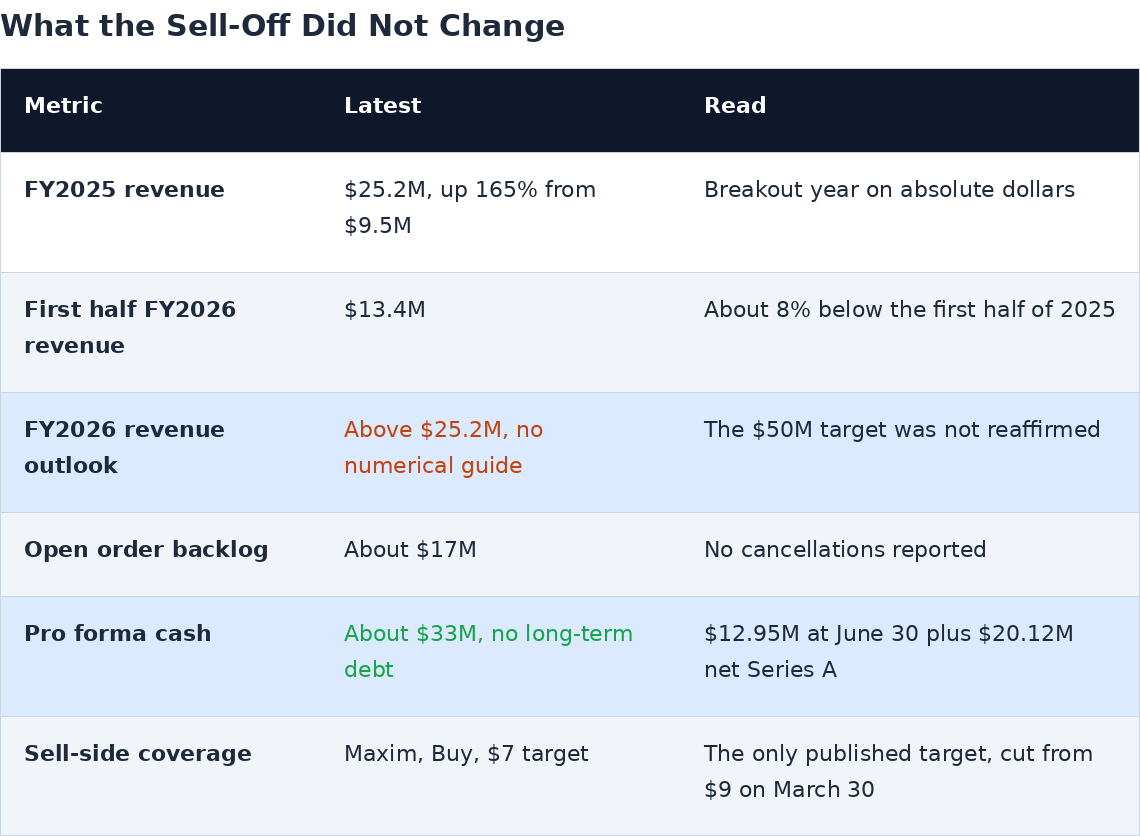
The more important change is the outlook. Management did not reaffirm its $50 million revenue target for 2026. COO Jorge Flores said the decision reflected shifting shipment timing, particularly in an international 5G program, rather than a change in the underlying customer opportunity, and when asked whether $50 million was still possible this year he answered, "It could." In its August 17 update the company said it expects full-year 2026 revenue to exceed 2025's $25.2 million, with additional shipments in the second half and a portion possibly extending into 2027. We treat the $50 million figure as an upside case, not a base case.
What the sell-off did not change is the balance sheet or the order book. Cash, equivalents and marketable securities were $12.95 million at June 30, and the Series A rights exercise added $20.12 million of net proceeds in July, for roughly $33 million pro forma with no long-term debt. The board also terminated the at-the-market equity facility and authorized a $10 million buyback on July 7. Management reports no cancelled backlog orders, about $17 million of open orders and more than $6 million of follow-on orders in July alone.
The Second Prize: Robotaxis and Robots
The wireless carrier play is the obvious use. The less obvious one is Tesla. Tesla announced in July that the Cybercab is the first vehicle with Starlink V5 built directly into it, and on the second-quarter call Elon Musk said that "Starlink will be integrated into all our car vehicles," at least in markets where Starlink is active. Tesla's VP of AI Software said the link is not required for safe operation, and that it is for navigation, customer service and fleet management. In practice that means remote assistance, telemetry, dispatch and over-the-air updates, especially where cellular coverage is poor, including urban canyons.
The fleet is small but scaling. Tesla had 169 Cybercabs authorized for commercial use in Texas as of early October, plus 420 Model Y robotaxis, with driverless service in Austin, Dallas, Houston, Miami, Orlando and Tampa.
Where the satellite link runs out. A roof-mounted satellite terminal needs sky. A robotaxi spends its working day in downtown canyons, parking structures, tunnels and charging depots, the exact places a satellite cannot see. A SpaceX ground layer on 800 MHz fills those gaps, and the Cybercab already carries a 5G LTE antenna alongside its Starlink terminal. The radios that build the city network for phones are the same radios that keep the robotaxi fleet connected.
Robots work indoors. Tesla is building several hundred Optimus robots a week at Fremont, targeting more than 1,000 a week by the end of 2026, and plans to lease them to companies with factories and warehouses like its own. Satellites do not reach the inside of a factory. Fleet-scale robot connectivity indoors is a private-network problem, which is the private 5G and Network-in-a-Box category AMPG already sells. Tesla has not announced a connectivity plan for Optimus. This is our inference from the deployment model.
Tesla and SpaceX are separate public companies. Tesla invested $2 billion in xAI in January 2026, and after SpaceX absorbed xAI that stake converted into SpaceX shares representing less than 1 percent of SpaceX. Any SpaceX network serving Tesla vehicles or robots would be a commercial supply relationship between two companies, not a single balance sheet. The strategic point holds either way: one radio supplier would serve phones, robotaxis and robots across the Musk ecosystem.
What It Costs to Lock It Up
Our May report argued that for SpaceX, NVIDIA or Amazon, an AMPG acquisition is a rounding error, and recommended a confidential all-cash approach at $13 to $15 per share. We reiterate that range. At today's price the math is even more lopsided: the range is 4.6 to 5.3 times the current share price, yet the total check is small against what SpaceX has already spent.
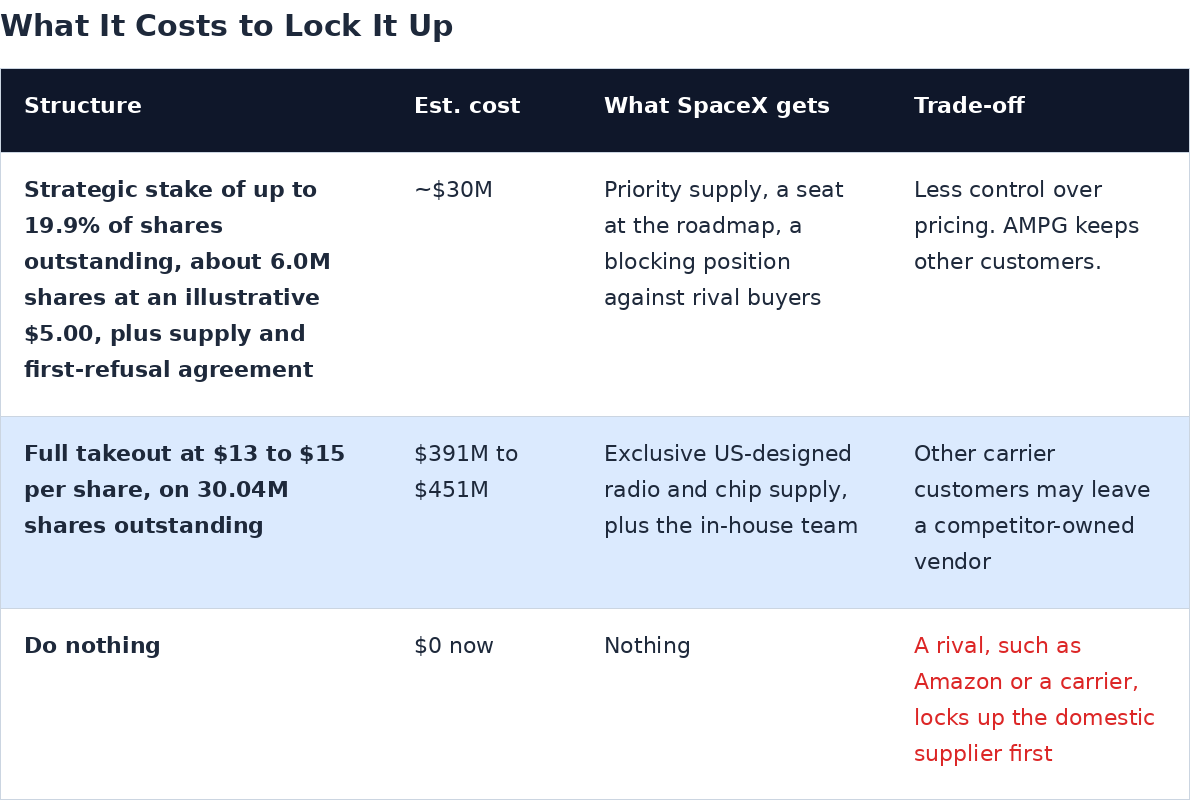
A full takeout at $13 to $15 equals about 0.02 percent of SpaceX's roughly $2.1 trillion market cap. It equals about 5 percent of the reported $8 billion paid for the 800 MHz spectrum alone, and about 2 to 3 percent of the $17 billion EchoStar spectrum purchase.
SpaceX has spent roughly $25 billion on airwaves. Spending under half a billion to control the radios that light them up is the cheapest insurance in the stack.
What It Is Worth to AMPG Holders
The more valuable outcome for AMPG shareholders may be a supply contract rather than a buyout. The table sizes a SpaceX city-network order. The assumptions are ours, not company guidance: $10,000 of AMPG radio content per small-cell site, meaning an 800 MHz unit plus a 2 GHz unit, built over four years, valued at 3x to 5x annual revenue, which sits inside the 3x to 6x range for Open RAN hardware peers.
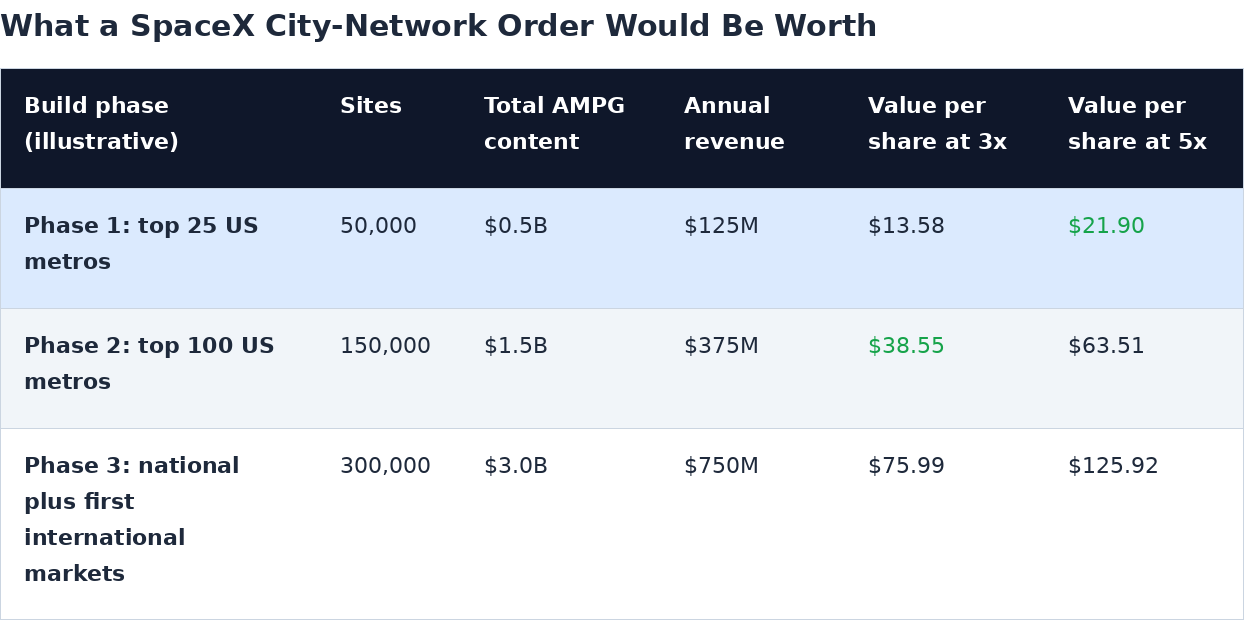
For SpaceX, the all-in network cost at an assumed $20,000 to $50,000 per installed site would run about $3 billion to $7.5 billion for Phase 2, spread over several years. That is less than the reported cost of the 800 MHz spectrum, and it replaces a revenue-sharing arrangement with an incumbent that the carriers have so far refused to offer. Even Phase 1 at the low multiple implies about 4.8 times today's $2.82 share price. The stock has fallen 47.9 percent since July while the strategic case has strengthened with every SpaceX spectrum purchase.
Price Target Reiterated at $28
We reiterate our $28 target price on a 24 to 36 month view. From $2.82 that is 893 percent upside. It is a stretch target, not a base case, and the second-quarter outlook change makes the conditions for it more specific. The target stands on three routes that can work separately or together.
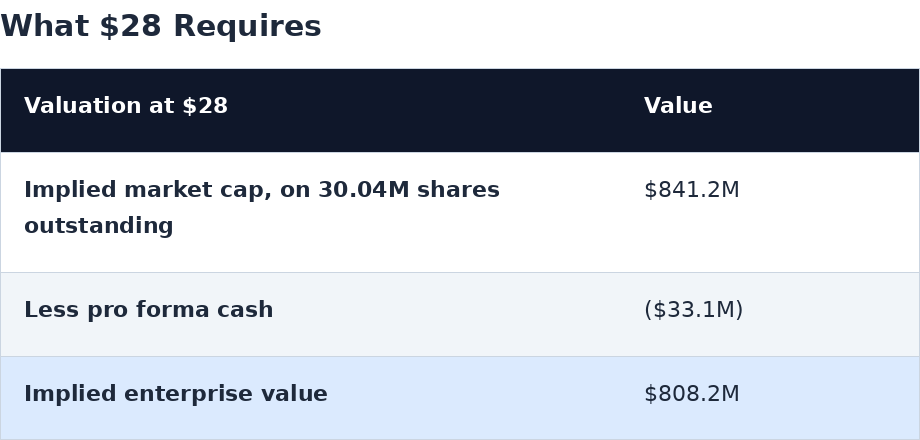
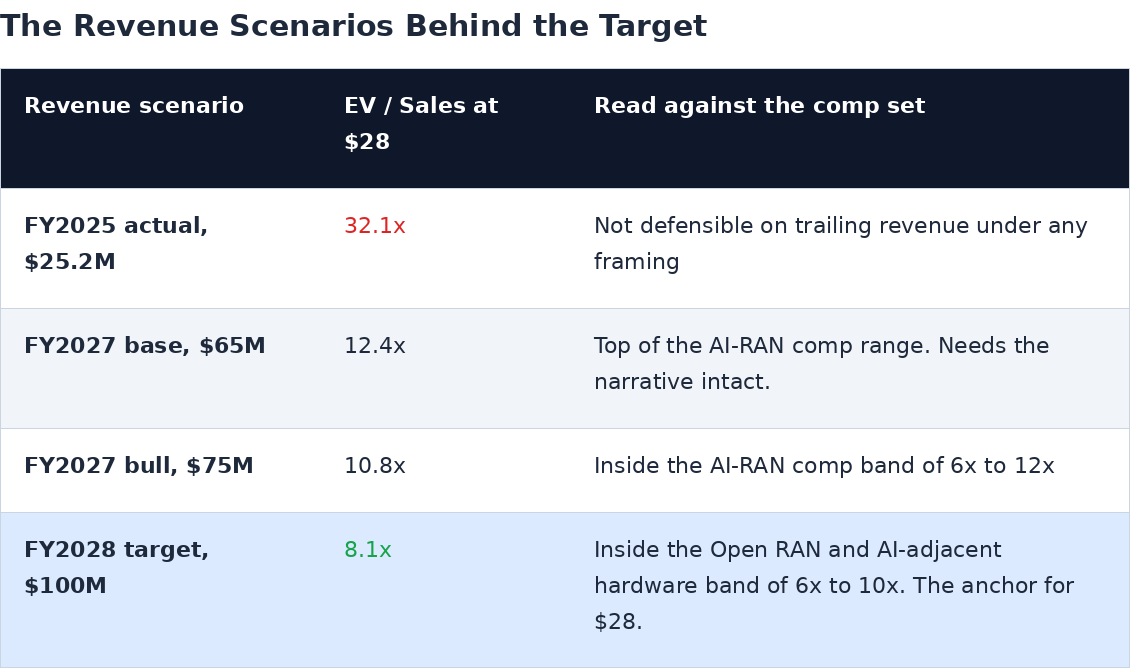
Route 1: execution. FY2028 revenue of $100 million at about 8x EV/Sales. That is roughly four times FY2025's $25.2 million, a 58 percent compound annual rate, and it is steeper than the 30 to 40 percent path we described when the $50 million outlook stood. The backlog of about $17 million, the active letters of intent, the Tier-1 RFP and a second half that management expects to be stronger are the evidence to watch. On our estimate of a $25 to $30 billion blended market by 2030 across satellite terminals, Open RAN radios and AI-RAN infrastructure, $100 million is 0.33 to 0.40 percent of the total.
Route 2: a SpaceX supply contract. The contract table above brackets $28. Phase 1 at 5x is worth $21.90 per share and Phase 2 at 3x is worth $38.55. A contract of that scale does not require AMPG to win a share of the whole market, only a defined role in the network SpaceX has to build.
Route 3: strategic takeout. A buyer paying a 40 to 60 percent control premium would need an unaffected price of $17.50 to $20.00 for $28 to be the takeout number. Our $13 to $15 range is the level at which SpaceX can act without strain from today's price. A contested process, with Amazon, a carrier or an infrastructure vendor bidding, is the scenario in which the range is not the ceiling.
First in the Fold
SpaceX's 2026 deal sequence has a clear pattern: own every layer.
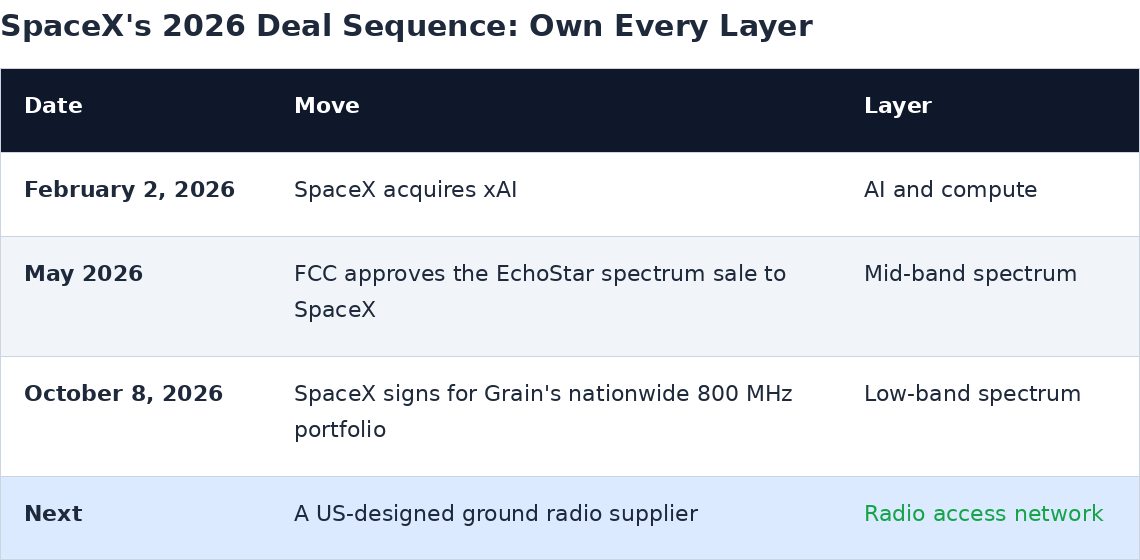
In May we named SpaceX among the three logical acquirers of AmpliTech and wrote that the strategic logic would shift from could acquire to must acquire to deny competitors, with the window closing as the SpaceX IPO and 6G procurement cycles converged in the second half of 2026. The IPO has happened, and SPCX closed at $160.57 on October 8, above its $135 IPO price. The spectrum is bought. The radio layer is the last piece SpaceX does not control, and AMPG is the natural first acquisition in that layer.
The model travels, with one condition. Ground spectrum is licensed country by country, and SpaceX's 2 GHz satellite rights are global, but terrestrial service abroad requires a national license in each market by purchase, lease or partnership. The playbook repeats: acquire local spectrum, then deploy small cells on Starlink backhaul. Every new country is another radio order, which is why a supply position compounds.
Risks to Underwrite
Outlook and order timing. Management has withdrawn its $50 million 2026 revenue target, and customer-controlled deployment schedules, particularly in Asia, drive when shipments land. Some second-half shipments may slip into 2027.
LOI to purchase order conversion. The disclosed letters of intent, which the company has put at more than $118 million, are not firm backlog. Open orders are about $17 million.
Gross margin. Margin swung from 48.0 percent to 27.9 percent in one quarter on mix. Volume shipments into a Tier-1 carrier have historically compressed margin further.
No announced SpaceX relationship. There is no disclosed SpaceX and AMPG agreement, and SpaceX has not named any radio supplier.
Build versus buy. SpaceX designs most critical hardware in-house. Our May view was that a three-to-five-year organic timeline argues against building, but the risk is real.
Manufacturing scale. A national order means hundreds of thousands of radios. AMPG would need contract manufacturing and working capital, which could be funded through the investment itself.
Regulatory timing. The 800 MHz deal needs FCC approval, and the 2 GHz transfer is expected around late 2027.
Customer conflict. A full acquisition could push carrier customers such as TELUS toward other vendors.
Tesla is a separate company. Robotaxi and robot connectivity would require a commercial agreement between Tesla and SpaceX.
Financing and liquidity. The Series B rights, AMPGZ, carry a $6 exercise price and expire November 20, so they add capital only if the stock recovers. AMPG is thinly traded, down 72 percent from its 52-week high of $10.11, and SPCX itself fell 4.2 percent on October 8 before the deal news.
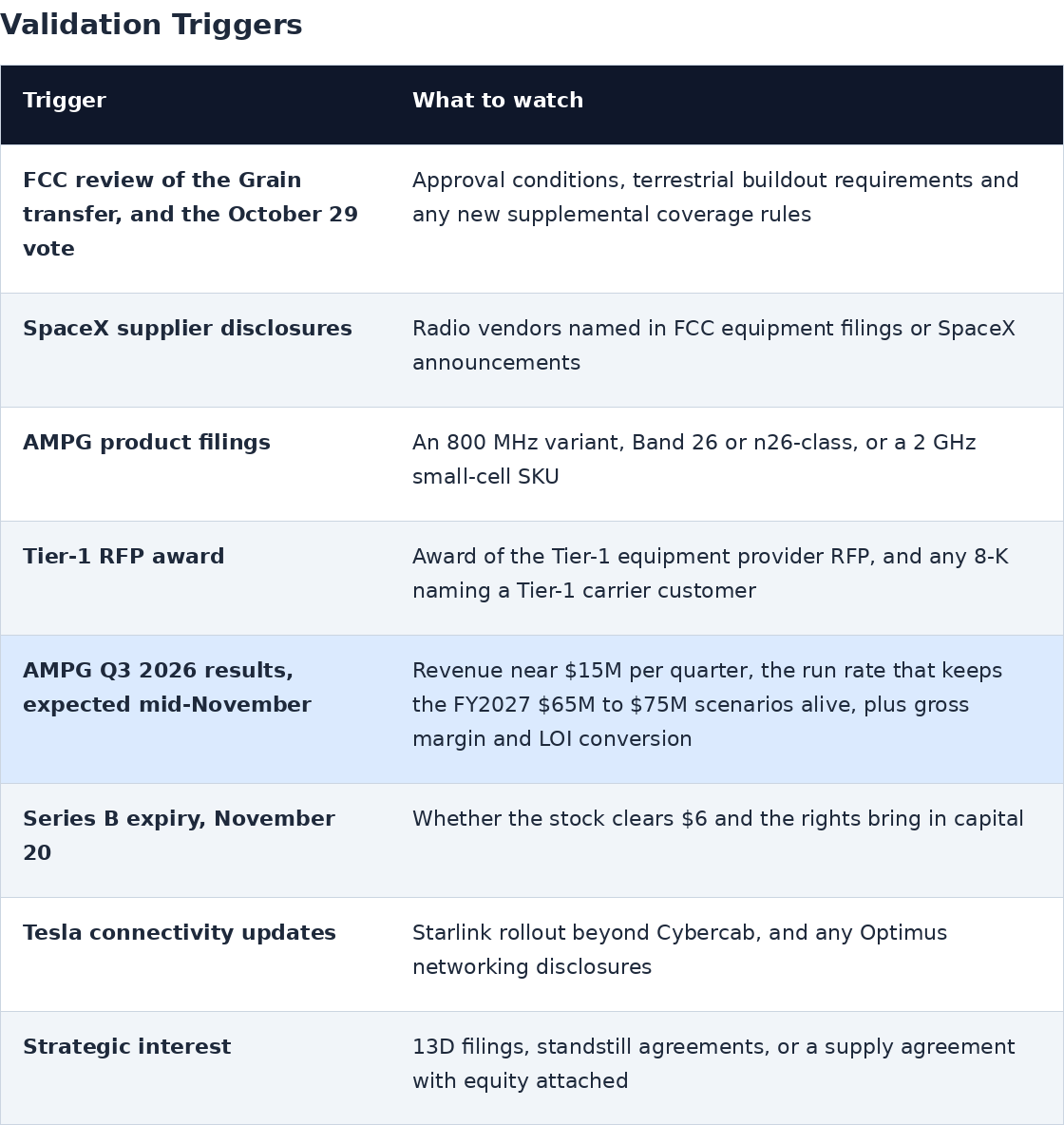
Validation Triggers
Bottom Line
SpaceX has spent roughly $25 billion to own the airwaves of a fourth American carrier. Verizon's rebuttal, that spectrum without a network is empty airwaves, points straight at the gap: the ground radio. AmpliTech, by our research the only US supplier of a commercial-grade, O-RAN-certified 64T64R radio, with in-house amplifier chips and an existing low-band and 2 GHz product line, can be locked up for about $30 million as a strategic stake or under $451 million outright. That is about 0.02 percent of SpaceX's value and about 5 percent of what it just paid for 800 MHz.
The stock has been marked down for a withdrawn revenue target and a margin swing, not for any loss of orders, and the company holds about $33 million of pro forma cash with no long-term debt. The same radios that light up Starlink Mobile in cities would keep robotaxis connected in the urban canyons where satellites cannot see, and would carry robot traffic inside the factories where Optimus will work. We reiterate Strategic Buy and Acquisition Candidate with a $28 target price on a 24 to 36 month view and a $13 to $15 takeout range, and we view a SpaceX supply contract as the path to materially higher values.
Disclosures
Publication date: October 9, 2026. All prices, valuations and market data reference the trading session ending October 8, 2026. Information may be stale by the time this report is read.
Ownership. The authors own shares of AmpliTech Group, Inc. (NASDAQ: AMPG) as of the publication date, October 9, 2026, and may buy or sell shares of AMPG, or any other security referenced in this report, at any time and without further notice. Position size, cost basis and holding period are not disclosed.
Not investment advice. This report is for informational and educational purposes only. It is not investment, legal, tax or accounting advice, and it is not a recommendation, offer or solicitation to buy or sell any security. Nothing in this report should be relied upon as the sole basis for any investment decision. Readers should consult their own registered investment adviser, broker-dealer or other qualified professional before acting on any information contained here.
No relationship disclosed. No agreement, negotiation or relationship between SpaceX, Tesla and AmpliTech Group is known to the authors. Acquisition, investment and supply scenarios in this report are the authors' analysis, not company disclosures.
No fiduciary relationship. The authors are not acting as fiduciaries, investment advisers, broker-dealers or research analysts on behalf of the reader. No adviser-client, broker-customer or fiduciary relationship is created by the distribution of, or access to, this report.
Compensation and independence. The authors have not been compensated by AmpliTech Group, Inc., SpaceX, Tesla or any third party for preparing or distributing this report. The views expressed reflect the authors' opinions as of the date shown and are subject to change without notice.
Forward-looking statements and price targets. This report contains forward-looking statements, projections, price targets, revenue scenarios and estimates based on assumptions that may prove incorrect, including site counts, radio content per site, revenue paths and valuation multiples that are the authors' assumptions. Any price target reflects the authors' opinion of potential value under specific assumptions and is not a guarantee of future price movement. Actual results may differ materially. Past performance is not indicative of future results.
Small-cap and micro-cap risk. AMPG is a small-capitalization company. Small-cap and micro-cap securities can be highly volatile, thinly traded and subject to abrupt price swings, wide bid-ask spreads, limited analyst coverage and heightened liquidity risk. Investors can lose some or all of their invested capital.
Sources and accuracy. Information is drawn from public filings, company disclosures, news sources and third-party research believed to be reliable, but accuracy and completeness are not guaranteed. Numbers, prices and market data are point-in-time. Readers should independently verify any material fact before acting.
Regulatory framing. This report is not a research report as defined by FINRA Rule 2241 or SEC Regulation Analyst Certification, and the authors are not FINRA-registered research analysts. It is not an offering document under the Securities Act of 1933 or a proxy solicitation under the Securities Exchange Act of 1934. Distribution of this report does not create any obligation to update, correct or supplement its contents.