The Strait That Starves: How Iran's Last Lever Is Accelerating Its Own Collapse

A Historical Parallel With a Deadly Twist
In 1926, President Calvin Coolidge faced a confrontation with Mexico's President Calles over oil nationalization that bears remarkable structural similarities to today's US-Iran crisis. Both involve a resource-rich nation attempting to use control over critical commodities as leverage against American interests, both feature internal instability draining state capacity, and both see the US applying multi-vector pressure — economic, military, and through proxy conflicts.
But where Calles had 18 months to negotiate from a position of sovereign territorial integrity, Iran's crisis is compressing into weeks what historically takes years.
The critical difference observers are missing: Iran's closure of the Strait of Hormuz, framed as its ultimate weapon, is functioning as a suicide mechanism that is starving its own population and unifying its regional enemies.
The Food Clock Nobody Is Watching
The global conversation around the Strait of Hormuz focuses almost entirely on oil, Brent crude surging past $106/barrel, US gasoline approaching $4/gallon, European energy costs doubling. What receives far less attention is that the same chokepoint Iran closed to threaten the world's energy supply is the primary artery for Iran's own food imports.
Iran imports approximately 30% of its wheat, and is almost entirely dependent on imports for animal feed, corn and soybean meal arrive overwhelmingly from Brazil via the Gulf. The numbers paint a grim picture:
- Wheat/flour milling stocks: Approximately 7–8 million tons in storage, providing a 5–6 month runway at current consumption of ~1.4 million tons per month, but only if milling infrastructure remains powered and rail distribution functions.
- Poultry and livestock feed: Iranian feed mills operate on 14–21 day just-in-time inventories. These supplies were already exhausted by mid-March.
- Protein collapse: The feed shortage has forced mass premature culling of poultry flocks — a brief glut of cheap meat followed by a prolonged protein vacuum expected within 6–8 weeks of the blockade's start.
- The harvest trap: Iran's spring wheat harvest begins in April–May and normally covers ~70% of domestic consumption. But the regime has been diverting natural gas from fertilizer plants to military facilities, devastating top-dressing applications during the critical winter growth phase. Analysts project a 30%+ yield deficit in the 2026 harvest, locking in food shortages through 2027.
Even Iran's fallback option, importing Russian wheat through Caspian Sea ports at Anzali and Amirabad, depends on the North-South Transport Corridor rail link from Rasht to Astara, which remains under construction and is vulnerable to dual-use targeting as a military logistics route.
The Habtoor Research Institute characterized the 60-day window from mid-March as a "critical test of both logistical resilience and social cohesion". That clock is already ticking.
The Mexico Comparison: Same Pattern, Radically Different Speed
The structural parallels between Coolidge's Mexico and today's Iran are instructive:
Calles' Mexico used the threat of destroying foreign oil infrastructure as its ultimate deterrent — ordering General Lázaro Cárdenas to commit arson at foreign oil sites if the US invaded. Iran closed the Strait of Hormuz and launched 3,000+ missiles and drones at Gulf states. Both were self-destructive escalations designed to deny the adversary its prize.
Calles faced the Cristero rebellion — a Catholic insurgency that drained military resources and destabilized the interior. Iran faces ongoing protests, bazaar closures over the currency collapse, and questions about security force loyalty severe enough that Iraqi militia members were reportedly deployed inside Iran to suppress demonstrations.
Coolidge applied proxy pressure through Nicaragua, backing anti-Mexican forces on Calles' southern flank. The US has degraded Iran's entire proxy network — Hezbollah weakened from the 2024–2025 Lebanon conflict, Houthis under sustained strikes, Iraqi militias calculating that self-preservation matters more than Iranian solidarity.
But the acceleration factors separating the two cases are enormous:
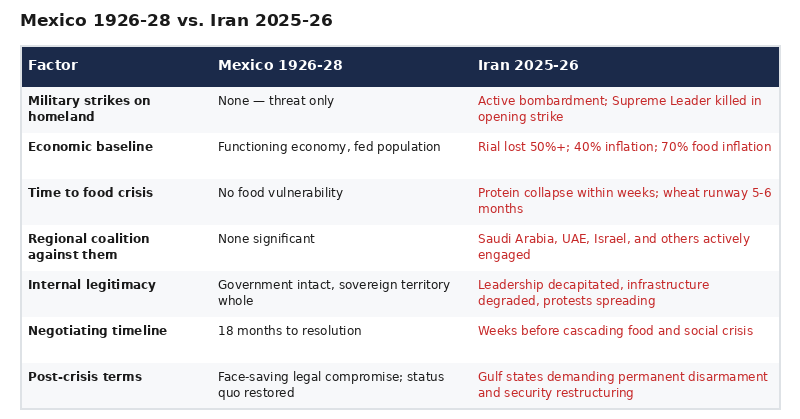
Calles could afford to wait. He had a fed population, an intact military, and a dispute that was ultimately legal, not existential. Iran has none of these buffers. The regime displays what analysts describe as the classic preconditions for revolution, economic collapse, military humiliation, legitimacy erosion, and external pressure, all simultaneously.
The Strait Paradox: Iran's Weapon Is Aimed at Itself
This is the dynamic that most commentary misses. The Strait of Hormuz closure is treated as Iran's trump card, and in pure oil-market terms, disrupting 20% of global supply is genuinely powerful. But the second-order effects of the closure fall disproportionately on Iran itself:
First, it is starving Iran. Every day the Strait remains closed, Iran cannot receive the grain ships, feed shipments, and commodity imports its population depends on. By early March, nine grain vessels sat outside the Strait unable to reach Bandar-e Emam Khomeini, Iran's primary Gulf port for feed-grain. The protein supply chain has already broken. The wheat runway is finite and shrinking. And the fertilizer diversion guarantees that even when the next harvest arrives, it will be significantly below normal yields.
Second, it is unifying Iran's enemies. The Gulf Arab states spent decades managing Iran through a combination of deterrence, accommodation, and US security guarantees. The Strait closure, and Iran's retaliatory missile strikes on Gulf airports, ports, energy facilities, and desalination plants, has ended that era of ambiguity permanently:
- Saudi Arabia granted access to King Fahd Air Base, signaling a long-term basing commitment that fundamentally changes the regional military architecture.
- The UAE signed an $8.4 billion arms deal; Kuwait secured $8 billion in air and missile defense systems.
- Gulf states are demanding permanent destruction of Iran's offensive missile and drone production as a ceasefire precondition, not a freeze, but elimination.
- Multiple Gulf monarchies are diversifying defense partnerships beyond the US to France, Australia, Ukraine, and Italy, building redundant security networks specifically designed to prevent future Iranian coercion.
The Gulf states have now experienced firsthand what Iranian retaliation looks like, civilian casualties, damaged infrastructure, disrupted economies, and they are restructuring their entire security posture to ensure it never happens again. Iran's use of the Strait hasn't deterred them; it has radicalized them.
The Endgame Compression
Iran is caught in a strategic paradox with no historical precedent for escape at this speed. Its strongest lever (the Strait) accelerates its own food crisis. Its retaliatory strikes on Gulf states are converting cautious neighbors into permanent adversaries demanding disarmament. Its currency collapse makes any future imports, even if the Strait reopens, ruinously expensive. And its fertilizer diversion to military uses has already sabotaged the 2026 harvest that was supposed to be its domestic safety net.
The IRGC-linked newspaper Javan floated the idea of monetizing Strait access, charging $50/barrel transit fees and barring US/Israeli vessels, suggesting some factions understand that total closure is unsustainable and are searching for face-saving off-ramps. But the Gulf states have already signaled they will never accept Iranian toll authority over international waters.
Coolidge's crisis resolved through the quiet diplomacy of Dwight Morrow, who gave Calles a face-saving exit: the Mexican Supreme Court struck down the Petroleum Law, American oil rights were restored, and the 1917 Constitution remained symbolically intact. The question for Iran is whether any such off-ramp exists — or whether the combination of food crisis, economic collapse, Gulf state determination, and military degradation will force a resolution far less gentle than what Mexico received a century ago.
The people focusing on $106 oil and global energy disruption are watching the wrong variable. The real clock is in Iran's grain silos, feed mills, and bread shops, and it is running out far faster than the regime's ability to negotiate its way to survival.