The Rise of Specialized AI: Ultrasound AI and the Shift to Owned Compute

A whitepaper on outcome-trained specialist models, their compute economics, and what they mean for data-center demand, local AI, and the companies positioned to benefit, 2026 to 2031.
Executive Summary
The public story of artificial intelligence in 2024 to 2026 has been a story of scale: trillion-parameter language models, gigawatt data centers, and hyperscaler capital spending approaching $1 trillion a year. A second story is unfolding underneath it. Small teams are training narrow, outcome-focused models on proprietary image data, using modest hardware, and taking them through the hardest validation gate available: the US Food and Drug Administration.
Ultrasound AI is the clearest example. Its founder built the first training machine from parts in his basement, as he told PBS NewsHour. The company trained its models on ordinary obstetric ultrasound images linked to real delivery outcomes, and in February 2026 it received an FDA De Novo authorization for Delivery Date AI. Around that product it has built a patent family whose broadest claim covers using non-invasive medical images, a trained neural network and clinical data to determine clinical values, US 12,369,883.
This paper argues five points.
One. Outcome-trained specialist models are a distinct class of AI with very different economics. They learn to predict one measurable outcome from one kind of data. Our estimates put their training compute about a million times below a frontier language model, and their per-use inference roughly 100 to 300 times below a typical chatbot answer.
Two. Medical imaging is the proving ground, and Ultrasound AI holds an early, defensible position in it. Its patent claims are limited to medicine, but within medicine they cover every non-invasive imaging method and any device. It combines regulatory clearance, outcome-linked data and broad issued claims. Patent examiners are already citing Ultrasound AI's patents against applications from GE, Philips and Siemens. GE's closest-overlapping application reached a final rejection, and Philips' was abandoned.
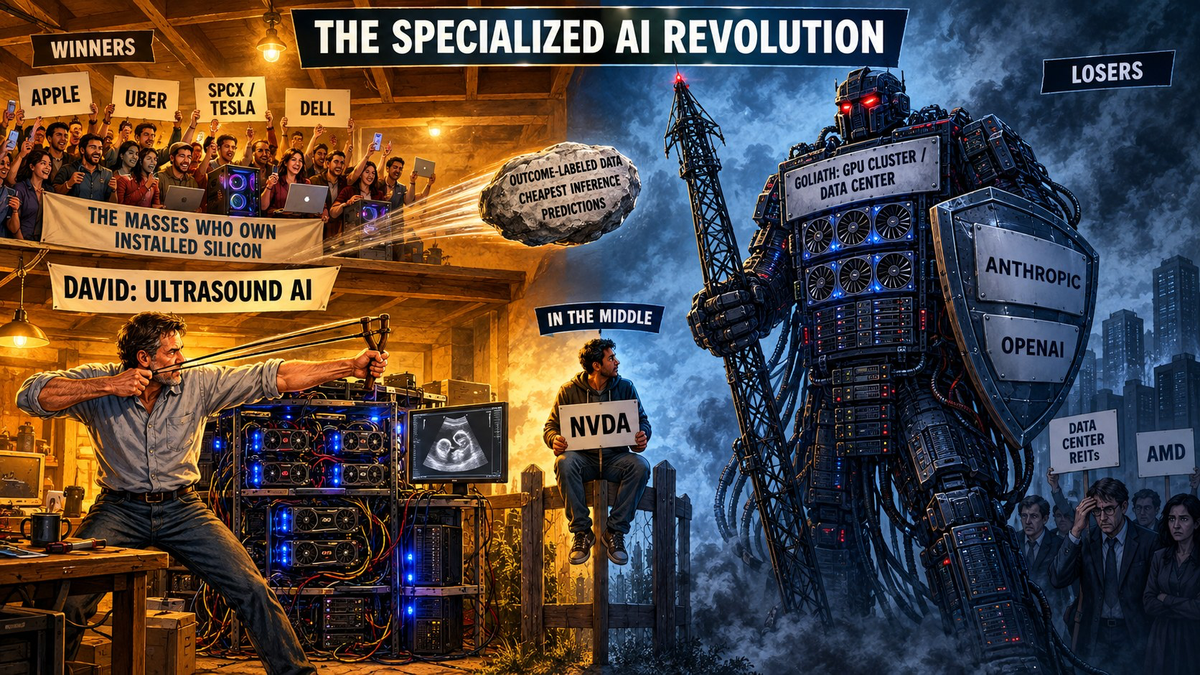
Three. The method generalizes, and outside medicine it is unpatented. Any industry with large image or video archives and recorded outcomes can follow the same pattern. Autonomous vehicles, defense, insurance, manufacturing and agriculture all show early examples. In those fields Ultrasound AI's patents do not apply, so the winners will be whoever owns the outcome data and installed hardware.
Four. This shifts demand at the margin. We expect a fractional shift over three to five years, not a collapse. Specialist models will dominate AI by number of tasks while using a small share of total compute. The bigger effect is on where inference runs: more of it moves to owned devices, on-premises servers and pooled consumer silicon. Through 2027, data-center demand still exceeds supply. From 2028 the shift shows up as slower growth and pricing pressure, not as shrinking demand.
Five. The winners are those who own installed silicon, proprietary outcome data, or the networks that tie them together. Apple, Tesla and SpaceX/xAI, Microsoft, Dell and Uber each hold a different piece. A new category of silicon aggregators, which pool phones, PCs and vehicles into usable training and inference capacity, could become the connective layer.
Agentic AI is the main swing factor. Small models can handle most agent sub-tasks more cheaply and locally. But agents also multiply total token use. The net result is a hybrid architecture, not the end of the GPU cluster.
1. Two Kinds of AI
Most public discussion treats AI as one thing. It is better understood as two.
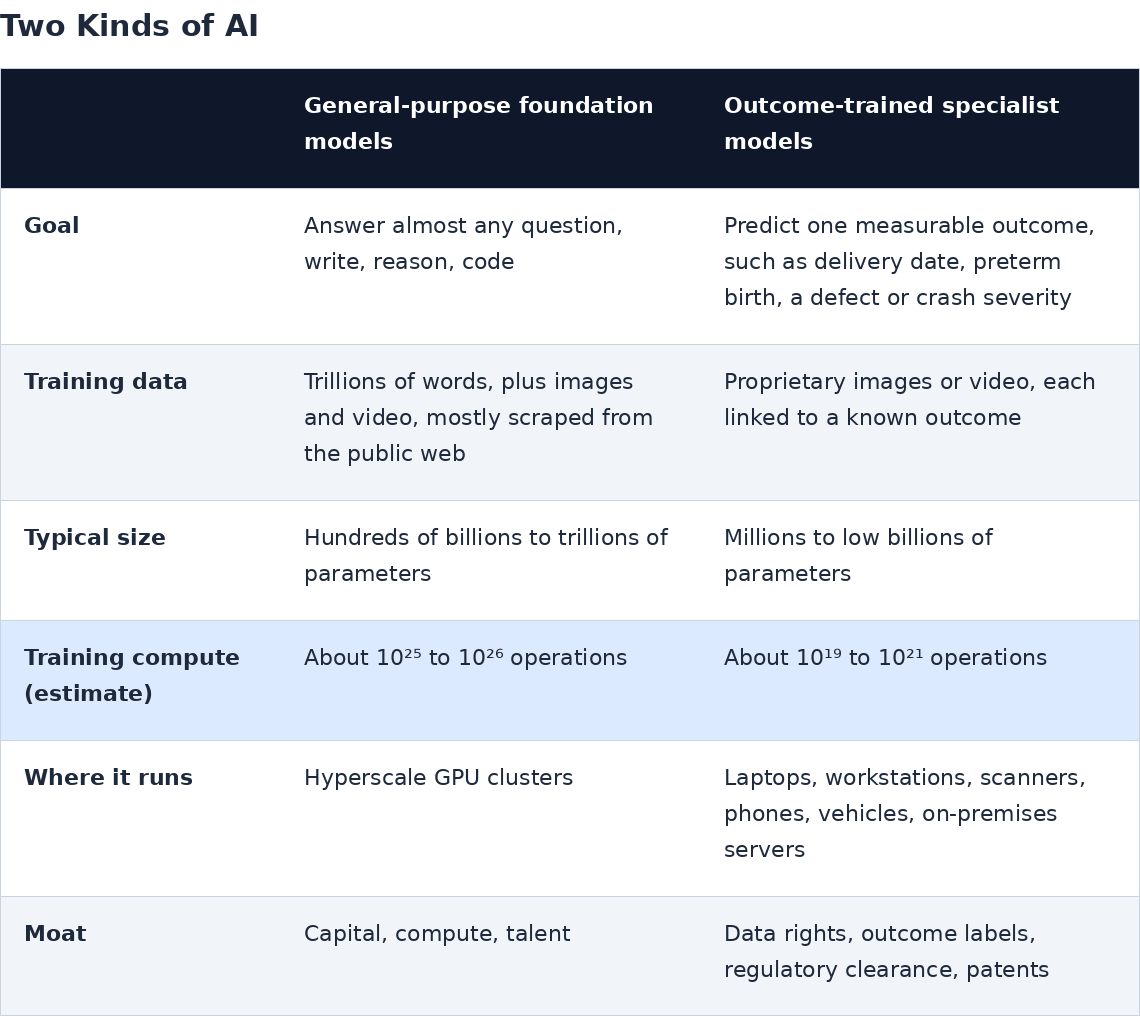
Language still dominates frontier training. Even multimodal frontier models use roughly 10 to 40 percent image data, on Epoch AI's analysis, and published training summaries show text as the dominant input at the 100-trillion-token scale. The specialist class works differently. It does not need to understand the world in general. It needs to find whatever signal in a specific image predicts a specific result. That narrowness makes it cheap to train.
2. Case Study: Ultrasound AI
2.1 Origin and method
Ultrasound AI was founded by Robert Bunn after a personal loss to premature birth. He trained the company's early models on a machine he built himself, describing it to PBS NewsHour as a "supercomputer from parts in my basement," with training runs lasting months. The training data came from University of Kentucky ultrasound archives, and the models found predictive patterns in structures such as the uterus and ovaries that clinicians do not normally use for dating, CBS News Colorado reported.
The technical approach is an ensemble of deep neural networks trained on millions of images. The key design choice is the label. The model is not trained to reproduce what a radiologist sees. It is trained against what actually happened, the real delivery date. That lets it learn from information radiologists ignore or cannot perceive.
The available reporting supports modest hardware rather than no specialized chips. A home-built training machine almost certainly used consumer graphics cards. The point is the scale: a single owned machine, not a rented cluster.
2.2 Regulatory validation
The FDA granted De Novo authorization, DEN250007, in February 2026, creating a new Class II device type for predicting delivery date in pregnant women without a reliable estimated due date. The cleared indication covers singleton pregnancies in patients 18 and older, imaged between 14 weeks 0 days and 36 weeks 6 days.
The pivotal PAIR study covered 5,714 women, 19,940 exams and 877,141 images, Contemporary OB/GYN reported. Reported performance includes an R² of 0.92 for delivery-date prediction, and 0.95 for term births. For preterm detection, sensitivity was 39 percent, specificity 93 percent and AUC 0.757. Observers note the training data came largely from a single Kentucky hospital, so generalization across populations remains a key question. The technology is also in use in Brazil and Chile and was named one of Time's best inventions of 2026.
The De Novo pathway is the significant part. Of the roughly 1,614 AI-enabled devices on the FDA's list as of mid-2026, 96.2 percent came through the 510(k) route, which relies on comparison to an existing device. Only 40 came through De Novo. An even more telling figure: one review found that only 3 of 1,357 AI devices were tested against actual patient outcomes. Most medical AI automates what a clinician already does, such as finding a nodule or measuring a structure. Ultrasound AI predicts a future outcome. It belongs to a very small group.
2.3 The hidden-signal principle
The company's own description is the clearest statement of the thesis: ultrasound images carry a great deal of noise, and the AI can "see things we can't," as it told Yahoo Finance. The physics supports this. Ultrasound speckle, the grainy texture usually treated as noise, is produced by tissue microstructure and carries information about it. Quantitative ultrasound research using raw radio-frequency data shows the same thing.
Ultrasound AI is not alone in finding this.
Retinal photographs. Google trained a model on retinal photographs from 284,335 patients that predicted biological sex with an AUC of 0.97, something ophthalmologists cannot do, along with cardiovascular risk factors.
A small retinal model. A 22-million-parameter retinal model produced results its authors called "surprising and puzzling."
Echocardiograms. Echocardiogram AI predicts age, sex, height and weight from heart ultrasound, in work published in the European Heart Journal.
The general lesson is that routine images hold more outcome-relevant information than human experts use. Whoever holds images linked to outcomes can extract that value with a small model.
2.4 The patent position
Ultrasound AI's portfolio, listed on its patents page, includes the following.
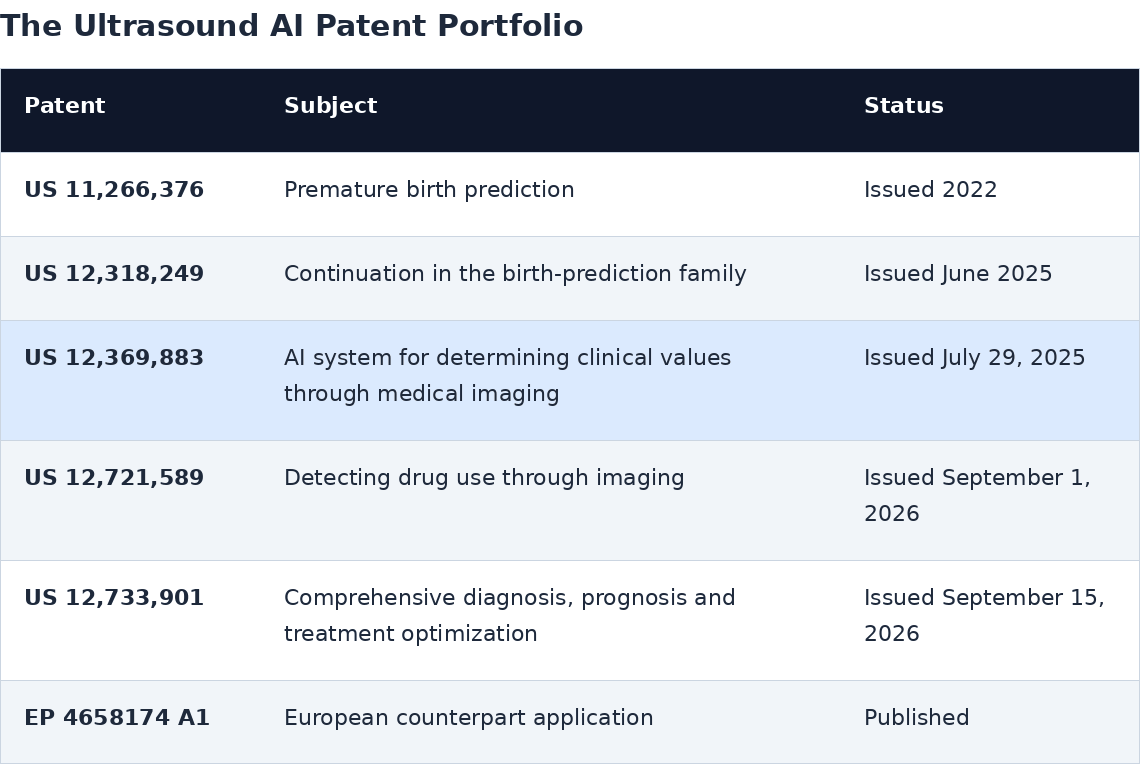
Claim 1 of the '883 patent covers a system that takes non-invasive medical images and a clinical data set, applies a trained neural network, and outputs a clinical or laboratory value. Claim 15 covers the training method, and claim 24 covers predicting the probability of a future event. The company has described the patent as extending its approach across imaging types and clinical uses.
Non-invasive imaging includes ultrasound, MRI, CT and X-ray. A claim of this breadth, if it holds up, could give Ultrasound AI licensing leverage over a large share of outcome-prediction products in medical imaging. That is the basis for viewing it as a likely leader in medical specialized AI. Section 2.5 shows that patent examiners already treat the portfolio as leading art in this field.
Four factors will decide how much that leverage is worth.
Claim structure. The system claims, 1 and 24, require a clinical data set alongside the images, but method claim 20 does not. It covers giving a non-invasive image of a body part to a trained neural network and receiving the patient's current or future clinical or lab value. Image-only products therefore cannot avoid the patent simply by leaving out patient data. The claims are not tied to one imaging modality. The specification lists ultrasound, X-ray, magnetic resonance, tomography, nuclear imaging, elastography, photoacoustic, echocardiography and near-infrared imaging. The priority date is June 19, 2020, and the anticipated expiration is June 19, 2041.
Field of use. Every independent claim is framed as a medical determination about a patient's body part and a clinical or lab value. The patent therefore covers medical outcome prediction from any non-invasive imaging device. It does not reach non-medical uses of the same method, such as vehicles, defense, manufacturing or agriculture. In those fields the method is open to other companies, as Section 2.6 sets out.
Patent eligibility. In Recentive Analytics v. Fox in 2025, the Federal Circuit held that applying generic machine learning to a new data environment, without a specific technical improvement, is not patent-eligible. Broad AI claims will face that argument. Specific training methods and outcome-linkage steps are the best defense.
Prior art. Published work such as the 2018 Google retinal study predates the patent family's priority date and will be cited in any challenge.
These are questions for patent counsel, not settled outcomes.
2.5 How patent examiners are treating the portfolio
The strongest evidence that the portfolio carries weight comes from patent offices themselves. When examiners review applications filed by other companies, they keep pulling Ultrasound AI's patents in as the closest existing art. A review of Google Patents citation records found that eight of ten major filers in this space have applications citing an Ultrasound AI document. In seven of those eight, the patent office supplied the citation itself, and the applicant did not volunteer it.
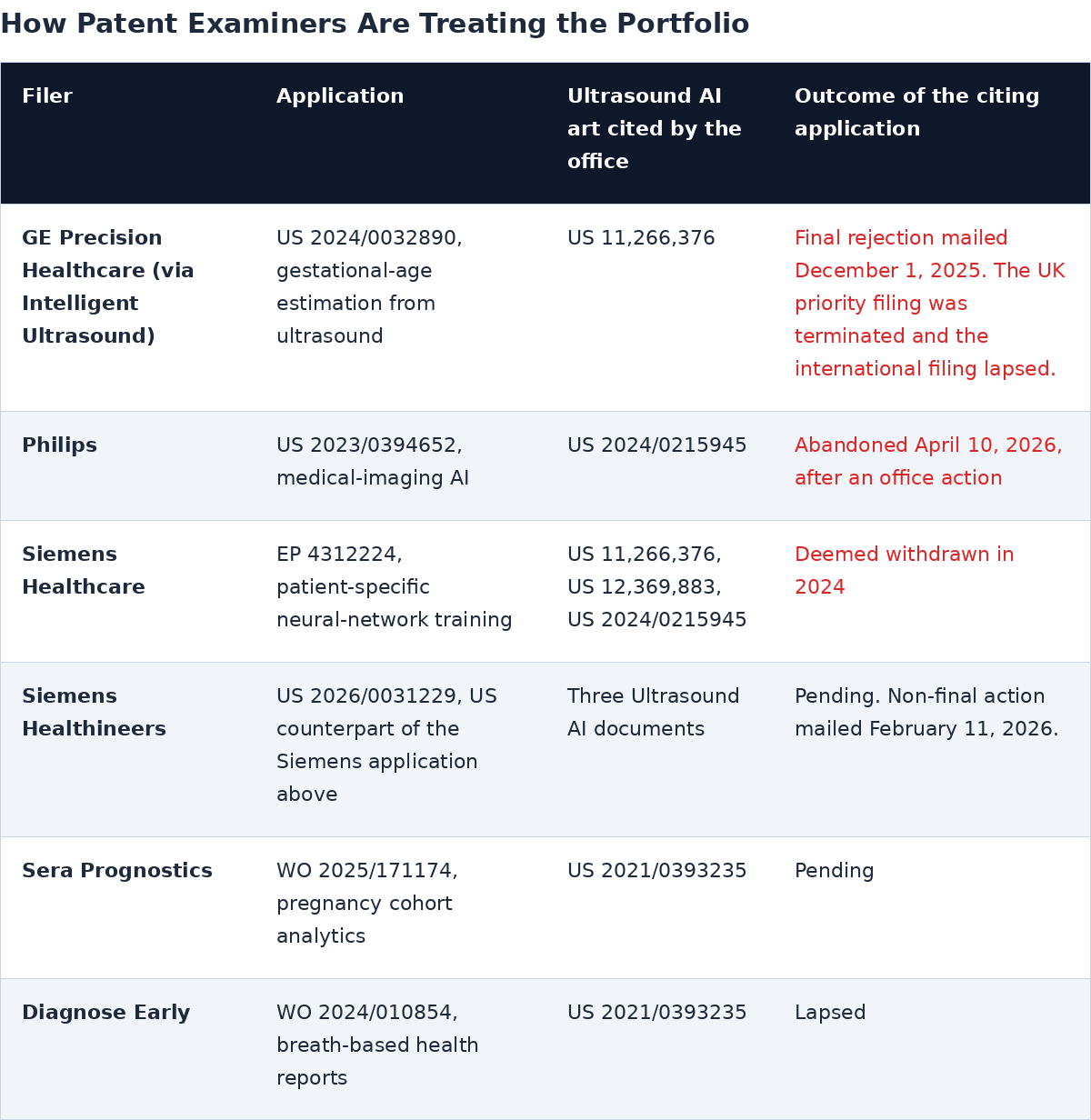
The pattern matters most at the major ultrasound manufacturers. GE's gestational-age application, which overlaps most closely with Ultrasound AI's subject matter, reached a final rejection after the examiner cited Ultrasound AI's premature-birth patent. Philips abandoned its application, and Siemens' European filing was withdrawn. The office is treating Ultrasound AI's filings as foundational art in imaging-based outcome prediction. That is the practical meaning of a strong position: rivals' own applications run into it.
Two points define how far this evidence goes. First, a citation by the office shows the art was judged relevant, but it does not by itself show that a rejection rested on it, and confirming that requires reading the office actions in each file. Second, some applications citing Ultrasound AI art were still granted, including two Chinese patents, CN 115349889 and CN 120339228, so a citation does not automatically block a filing. Even with those limits, the record shows that examiners in the US and Europe consistently place Ultrasound AI's portfolio at the center of this technology field.
The commercial point follows directly. Even a contested broad patent, combined with the only FDA De Novo for outcome-based delivery prediction and an expanding portfolio of continuations, creates a strong licensing and partnership position. Competitors will find it easier to license or partner than to litigate.
2.6 Where the patent applies and where it does not
The method Ultrasound AI patented, training a neural network on images linked to recorded outcomes, works in any industry. The patent itself does not. Every independent claim of the '883 patent is written as a medical determination about a patient, based on non-invasive images of a body part, that produces a clinical or lab value. Its other issued patents and continuations cover premature birth, drug use, and diagnosis, prognosis and treatment, so they are medical as well.
That gives the patent two very different reaches.
Inside medicine, the reach is broad. The claims cover the following.
Every non-invasive imaging method. The specification names ultrasound, X-ray, magnetic resonance, tomography, nuclear imaging, elastography, photoacoustic imaging, echocardiography and near-infrared imaging.
Any device. The claims recite a stored image, a trained network, a processor and a user interface. A cart-based scanner, a handheld probe, a phone app, a PC and a cloud service could all fall within them.
Current values and future predictions. Claims 24 and 25 cover the probability that a future clinical or lab value occurs within a set time frame.
Predictions from images with or without other patient data. Method claim 20 requires only the image and the trained network.
Outside medicine, the patent does not apply. A company that trains the same kind of model on dashcam video, drone footage, factory-camera images, satellite imagery or battlefield sensor data is not making a medical determination about a patient. The patent does not restrict it.
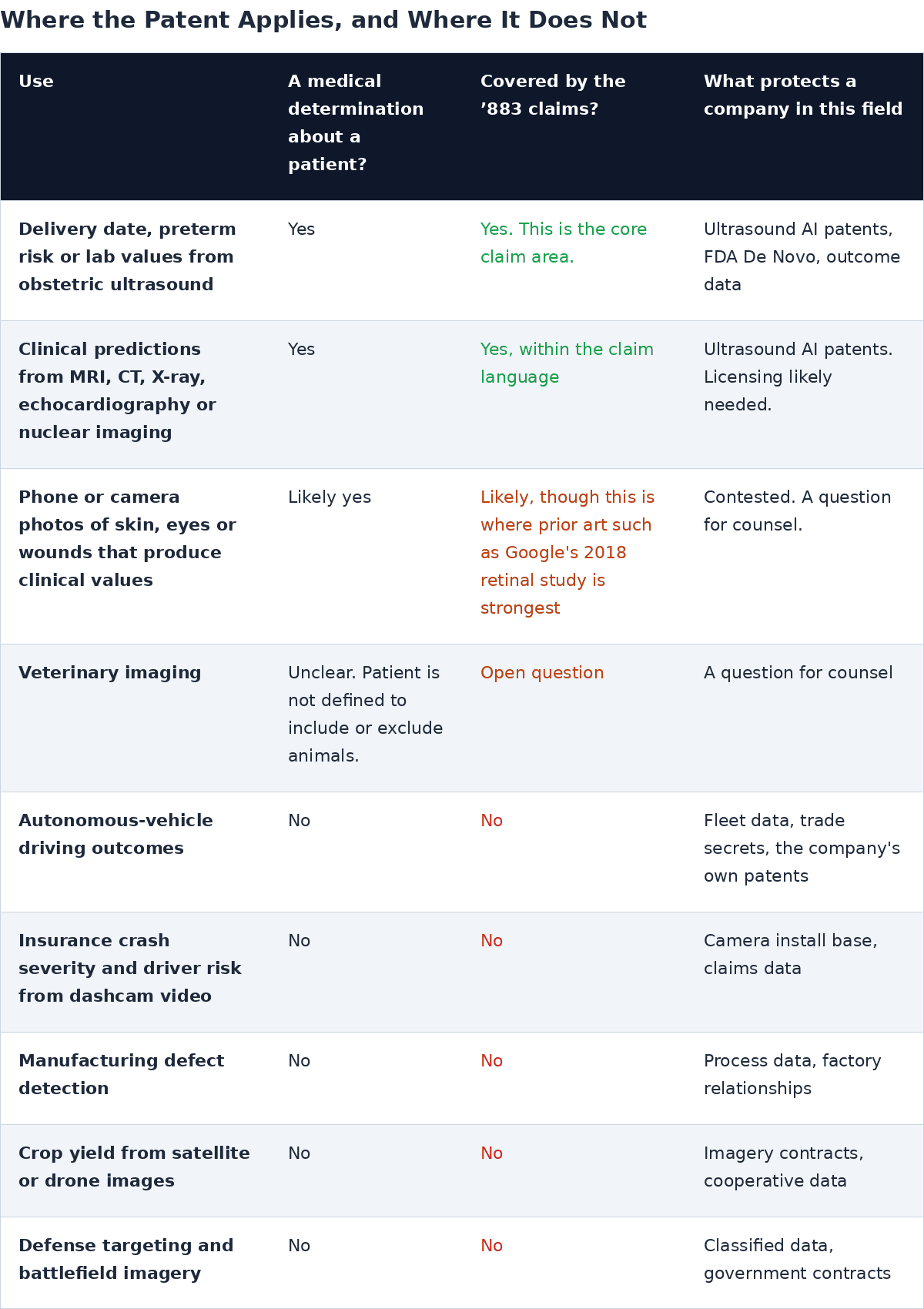
This scope sets the competitive structure of the specialized-AI market.
In medicine, the patent is a gate. New entrants that predict clinical outcomes from images will need to design around the claims, challenge them or take a license. This is why the paper treats Ultrasound AI as the probable leader in medical specialized AI, and why the examiner citations in Section 2.5 matter.
In every other industry, the method is open. No one owns outcome prediction from images for vehicles, factories, farms or defense. In those markets the advantage goes to whoever owns the outcome-linked data and the installed cameras and silicon, not to whoever holds a method patent. That is the basis for treating Tesla, Uber and the silicon aggregators as winners in Section 7. Their position rests on data and networks, not on patents.
Ultrasound AI's lessons transfer even where its patents do not. Low-cost training, outcome labels and signals hidden in image noise apply everywhere. Companies outside medicine can copy the approach without a license. That is why this paper expects many cheap specialist-AI companies to appear across industries, each building its own data moat rather than paying a royalty.
3. Why Specialist Models Are Cheap
3.1 The compute arithmetic
The figures below are order-of-magnitude estimates prepared for this paper. They are not company disclosures.
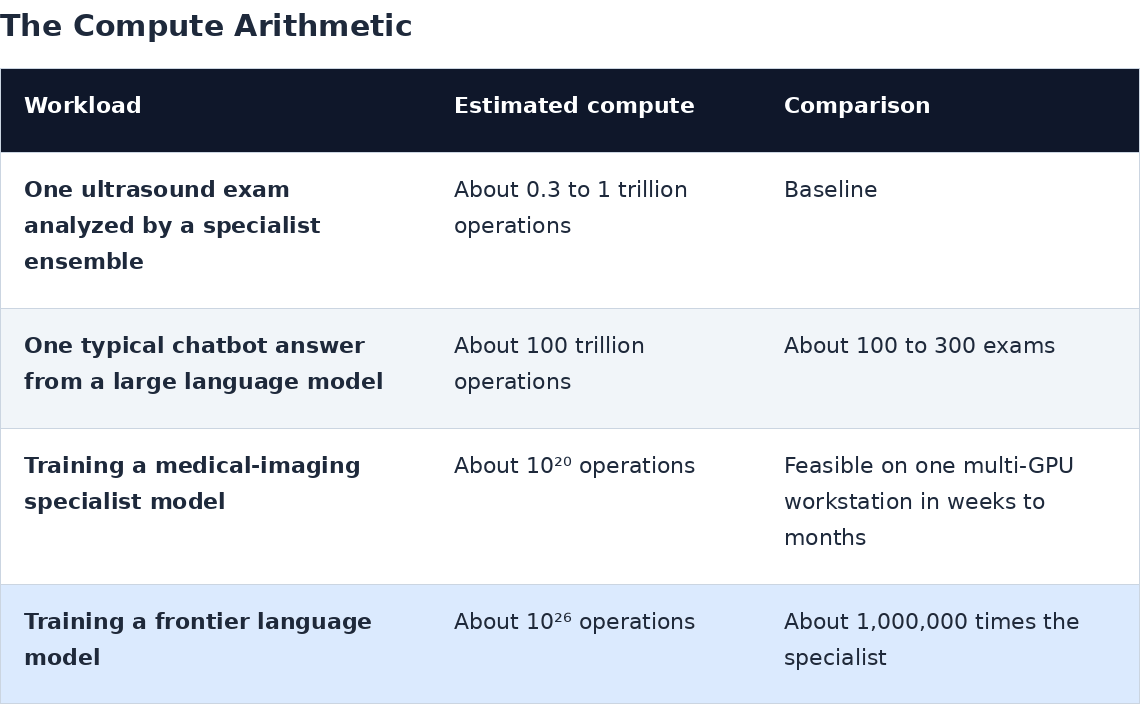
The reasons are structural. A specialist model has fewer parameters, sees one data type, optimizes one objective, and does not need to absorb the internet. Its training set may run to millions of images, but each image is processed by a small network. Once trained, it runs on the device that captures the data, whether that is an ultrasound cart, a camera, a vehicle computer or a laptop.
3.2 Other industries show the same economics
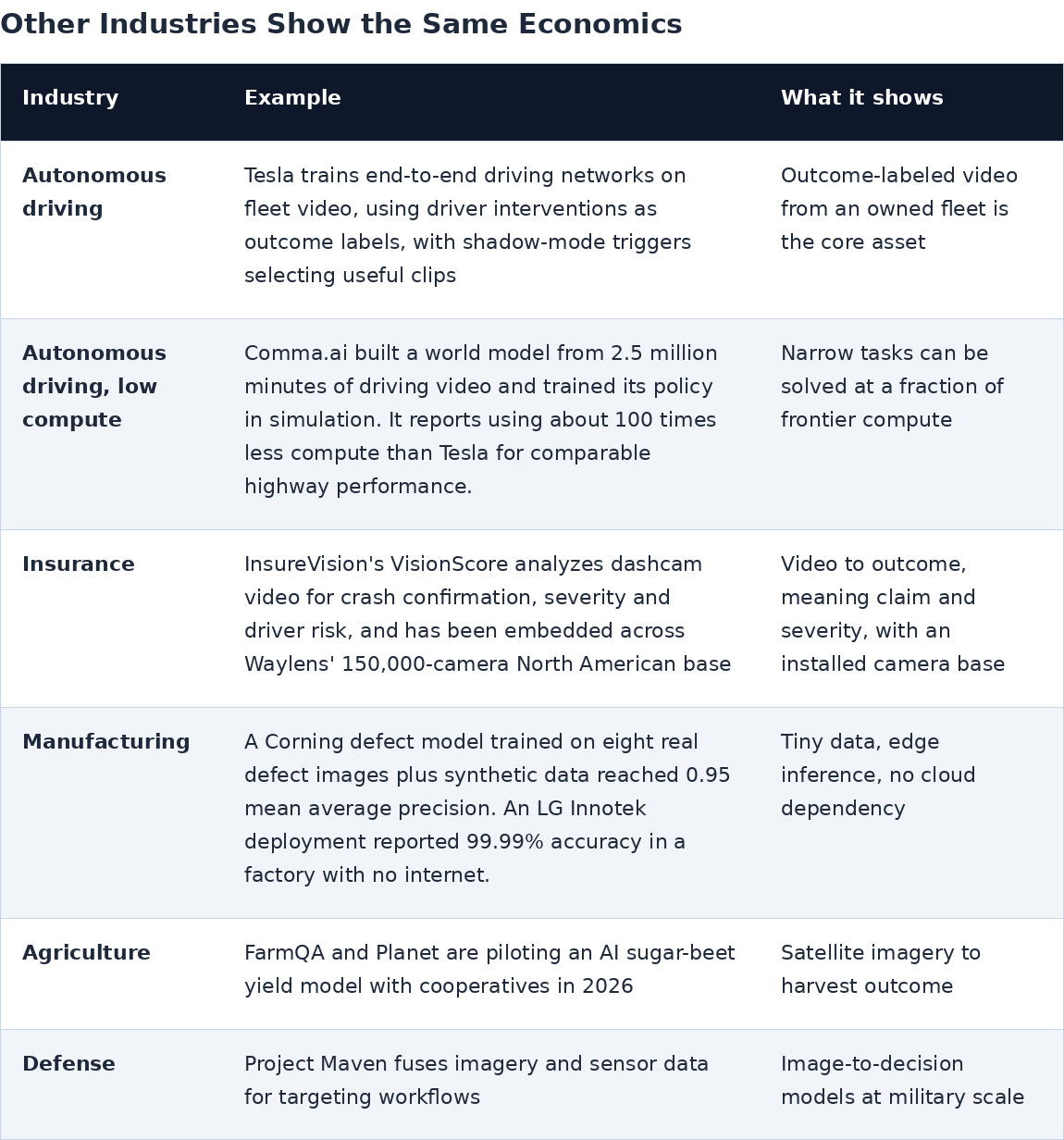
In each case the expensive asset is not compute. It is data linked to outcomes, and the right to use it. Competition in these industries turns on data ownership and installed hardware, not on method licensing.
4. Compute Demand: A Fractional Shift
4.1 The current build-out
Hyperscaler capital spending is expected to reach about $800 billion in 2026 and about $1.1 trillion in 2027, on Goldman Sachs' estimates, with growth slowing to about 12 percent in 2028 at roughly $1.4 trillion, according to Northern Trust. Bain projects AI data-center capacity rising from 79 GW in 2025 to 228 GW in 2030, at a cost of $5 trillion to $6.5 trillion, and estimates that roughly $6 trillion in annual revenue would be needed by 2031 to justify it. JLL forecasts about 200 GW by 2030.
Supply is tight now. IDC expects shortages through 2027 and memory constraints into 2028. One estimate holds that only 30 of the 55 GW planned for 2027 will be delivered. Commentary linked to SemiAnalysis already sees chip oversupply forming and a possible data-center oversupply by 2028. There are early signs of discipline as well: Microsoft trimmed its capex estimate to about $170 billion because of delays, CNBC reported.
4.2 Where the shift happens: inference
Training is no longer the main workload. Inference was expected to be about two-thirds of AI compute in 2026, on Deloitte's estimate. McKinsey projects 93.3 GW of inference capacity against 62.2 GW for training by 2030. Futurum projects that hybrid and edge inference spending, at $127 billion, will nearly equal public-cloud inference, at $135.3 billion, by 2030.
That is the opening for specialized AI. A specialist model trained once can run billions of times on hardware that already exists: in hospitals, factories, vehicles and pockets. Each of those runs is inference that never reaches a hyperscale data center.
4.3 The counterweight: cheaper AI means more AI
Cheaper AI also drives more usage. The cost of GPT-4-class output has fallen from about $20 to under $0.50 per million tokens, while average enterprise AI budgets rose from about $1.2 million to about $7 million, DatacenterDynamics reported. This is the Jevons effect: efficiency expands total consumption. Specialist models will create many new AI uses. Some of them, especially training at scale, synthetic-data generation and coordination by large models, will land back in data centers.
4.4 Scenario estimates, 2026 to 2031
The following are estimates prepared for this paper to frame the range of outcomes. They are not forecasts from the cited sources.
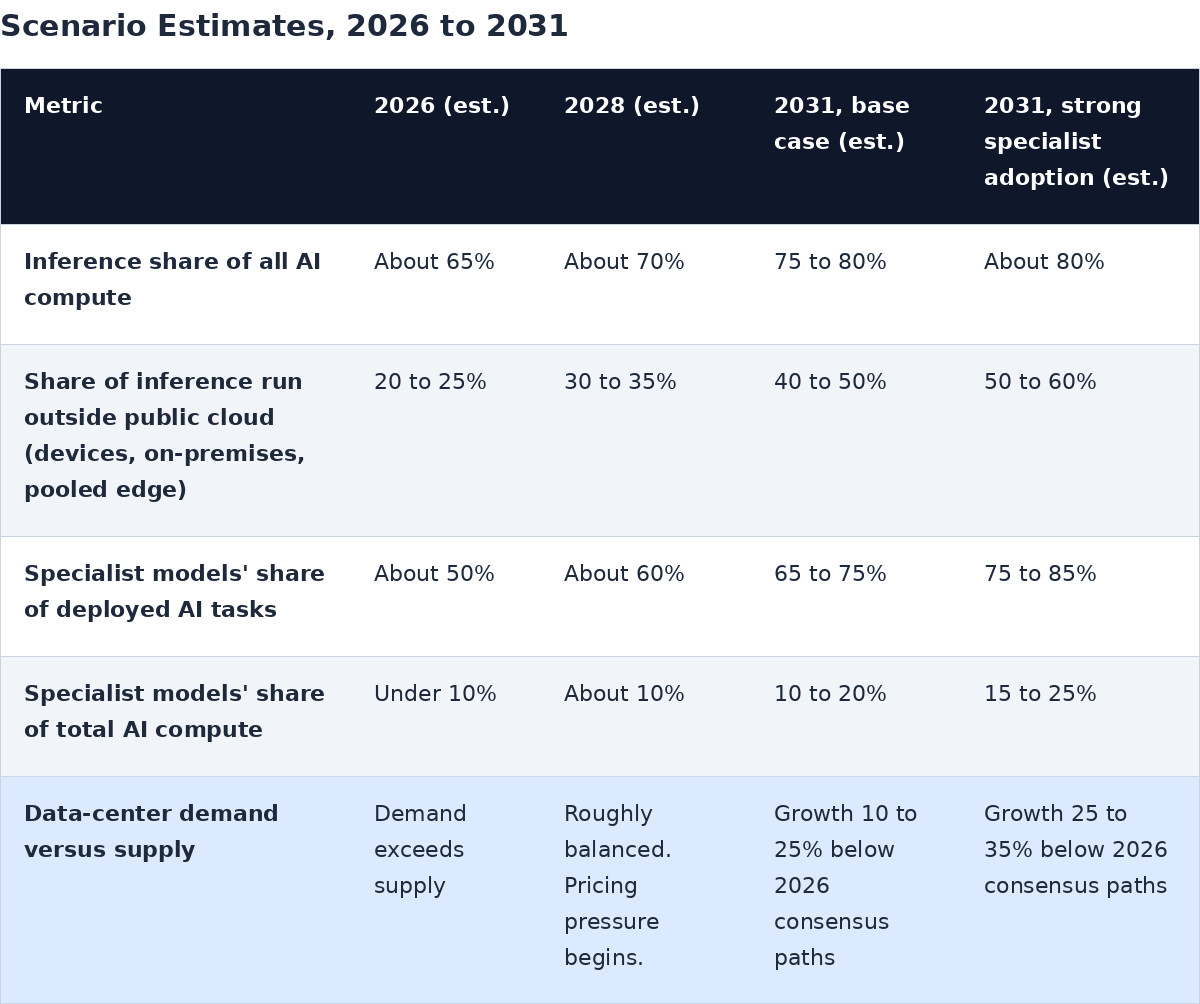
The pattern is consistent. The effect on data centers is fractional. Through 2027 it is invisible, because supply is the constraint. From 2028 it shows up as utilization and pricing pressure, slower capacity additions than current plans assume, and a widening gap between the roughly $6 trillion in revenue Bain says is needed and what customers actually pay for cloud inference.
5. Agentic AI: Fewer Clusters Per Task, More Tasks
Agentic AI, in which software agents plan and carry out multi-step work, is often cited as the reason data-center demand will keep growing. The evidence points two ways.
Smaller per task. NVIDIA researchers argue that small language models are "the future of agentic AI." They estimate that 40 to 70 percent of the calls agents make to large models could be handled by small models at 10 to 30 times lower cost, which points to a mixed fleet of models rather than one giant model. Microsoft's Foundry Local, generally available since April 2026, runs open models directly on Windows, macOS and Linux devices with "no per-token costs." Perplexity has demonstrated a local-first agent running on an NVIDIA DGX Spark desktop system.
Larger in total. Goldman Sachs projects that token consumption will rise 24-fold, to 120 quadrillion tokens a month by 2030, led by agents. Gartner estimates agents use 5 to 30 times more tokens per task than a chatbot. Futurum sees 10 to 100 times more, with inference spending rising from $120 billion in 2025 to $885 billion in 2030.
The likely result is a split architecture. A large cloud model handles hard reasoning and planning. Local small models handle routine sub-tasks, private data and specialist predictions. Agents will therefore need fewer GPU-cluster cycles for each step they take, and much of the growth in their workload will run on owned hardware. Total cluster demand still rises in absolute terms. What falls is the cluster's share of the work.
6. Training Moves Back to Owned Systems
The thesis that training, and not only inference, can move to owned and pooled systems now has technical support.
Low-communication training. DiLoCo-style methods cut the data exchanged between machines by about 500 times. Prime Intellect's INTELLECT-1 trained a 10-billion-parameter model across 30 independent compute providers on three continents at 83 to 96 percent utilization. Google DeepMind trained a 12-billion-parameter model across four US regions using ordinary wide-area links. The current honest assessment is that decentralized methods are competitive for smaller models, reinforcement-learning post-training and fine-tuning, while frontier pre-training still needs a data center. Prime Intellect's own flagship INTELLECT-3 was trained on a centralized H200 cluster. That boundary is precisely where specialist models sit.
Federated learning. Hospitals can train jointly without moving patient data, and results approach centralized training. This matters for medicine, where data cannot leave the institution.
Pooled consumer hardware. Folding@home reached 2.43 exaflops on volunteer machines in April 2020. Today, Salad rents consumer RTX 4090 GPUs for about $0.16 an hour against about $0.42 elsewhere, and it runs Civitai's 10 million images a day on more than 600 consumer GPUs.
Personalization adds a further reason for local training. A model tuned to one patient, one driver, one factory line or one user's documents is most private and cheapest when it is trained where the data already lives.
7. The Winners
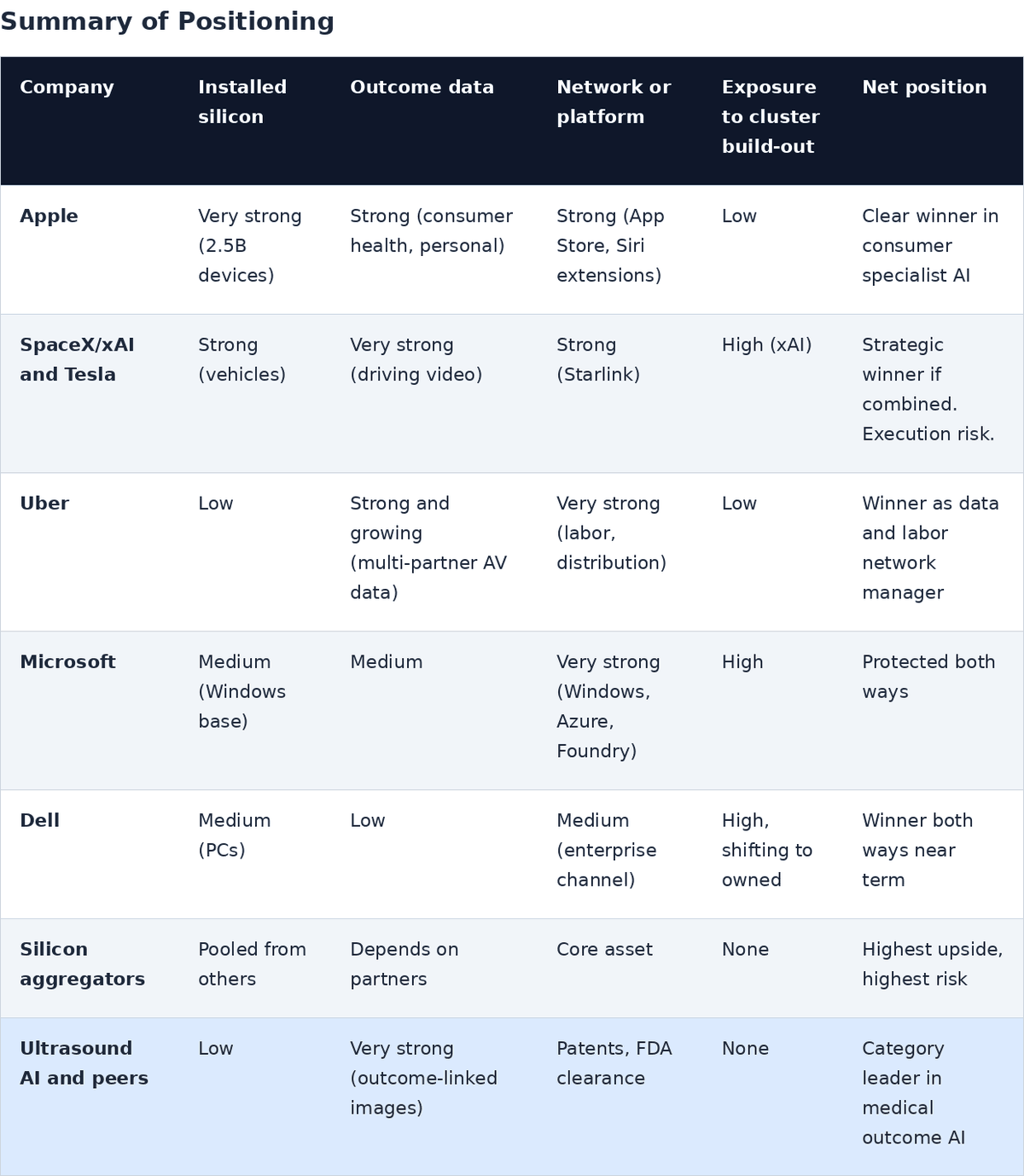
The companies best placed in this shift share at least one of three assets: installed silicon, proprietary outcome data, or a network that coordinates the two. Market values below are as of the November 3, 2026 close.
Apple, about $4.84 trillion market value
Apple has the largest base of high-performance consumer silicon in the world, about 2.5 billion active devices. Its capital spending in fiscal 2026 was about $9 billion on roughly $479 billion in revenue, and its quarterly capex of about $2.2 billion compares with Amazon's $77.3 billion, The Verge reported. Its on-device models run at about 3 billion parameters, with a 20-billion-parameter tier for heavier work. Apple rents frontier capability from Google for about $1 billion a year rather than building it, and customers pay for the inference hardware when they buy devices.
Apple is the clearest winner in consumer and personal specialist AI: health signals from Watch and iPhone sensors, on-device personalization and private agents. Its position in industrial or clinical specialist AI is weaker unless it partners. Any Apple feature that turns camera or sensor images of the body into clinical values would also sit within the medical scope of Ultrasound AI's claims, as Section 2.6 sets out, which makes a license or partnership more likely than independent development.
SpaceX/xAI and Tesla, about $1.85 trillion and $1.58 trillion
Tesla owns the world's largest outcome-labeled driving-video fleet and a computer in every car. Its training uses fleet interventions as labels, and Elon Musk has proposed using idle cars as an inference network that could approach 100 GW. Skeptics point to power, connectivity and owner-consent problems.
SpaceX acquired xAI in February 2026, and its Starlink network is a natural link layer for a distributed fleet. A SpaceX and Tesla combination would unite data, edge silicon, connectivity and frontier models. Special committees are reviewing the idea, Musk has called it a "good idea," and a deal may never be agreed, Reuters reported. Barclays calls it feasible but notes timing and approval obstacles. The combination fits the thesis strategically. Its execution is uncertain. Note also that xAI is itself a heavy cluster builder, and orbital compute is estimated at more than four times terrestrial cost in 2026, so the combined company benefits from both sides of the shift.
Uber, about $136 billion
Uber is building a different asset: a network of outcome data and human labor across many autonomy partners. Uber Autonomous Solutions runs a data-collection fleet of thousands of vehicles feeding an NVIDIA-based data factory. Uber has said it would put 500 data-collection cars on the road in 2026, logging about 2 million miles a month, TechCrunch reported. It has more than 30 AV partners and 120,000 pledged robotaxis, and its AI Solutions unit can draw on 8.8 million earners for labeling and data work. Uber's role is network manager for data, labeling and distribution rather than owner of compute. That role is the one that matters most to specialist models, which are limited by labeled outcomes rather than by GPUs.
Microsoft, about $3.87 trillion
Microsoft benefits from both sides. Azure is one of the largest cluster builders, with capex around $170 billion. Microsoft also owns the dominant enterprise desktop platform. Foundry Local and Windows ML let developers ship models that run on users' own PCs, offline, without cloud token costs. If inference shifts to owned hardware, Microsoft keeps the software layer, developer tools and management plane. Its cloud growth may slow at the margin, but its platform position is protected.
Dell, about $260 billion
Dell is the arms dealer for owned compute. Its AI-server business booked a record $60.9 billion in orders in fiscal Q2 2027, recognized $16.4 billion in revenue, and exited with a $95 billion backlog. Its AI customer base grew from 5,000 to 6,500 in one quarter, with demand broadening across neoclouds, sovereign deployments and enterprises. Dell has raised its full-year AI-server revenue outlook to $74 billion.
The growth in enterprise and sovereign buyers is the key signal for this thesis. Organizations that buy and own their AI hardware, rather than renting it, are Dell's fastest-growing segment, and Dell's PC business adds the client-side silicon. Today much of the backlog is still large-cluster demand, so Dell gains from the build-out and from the shift to owned systems alike.
Silicon aggregators
The largest underused compute pool in the world is the embedded base of phones, PCs, gaming GPUs and vehicles. A company that can pool this base, verify the work and offer it to specialist-model builders addresses the exact workload that decentralized methods now handle well: small-model training, fine-tuning, federated learning and batch inference.
Salad and Folding@home prove the concept, and Prime Intellect, Nous Research and Gensyn have attracted financing at valuations of $1 billion or more. A model in which device owners receive free compute or rewards for defined uses, paid for by advertisers or data customers, could scale this pool faster than paid rental. The category is early, and its winners are not yet clear.
Summary of positioning
8. Risks and Counter-Evidence
A sound thesis must survive its strongest objections.
One. Frontier models may absorb specialist tasks. Large multimodal models could become good enough at medical or industrial prediction to make narrow models unnecessary. Today the evidence runs the other way. No large-language-model or generative-AI device had been authorized by the FDA as of September 2026, The Medical Futurist reported. Regulators and buyers favor narrow, validated, explainable tools.
Two. The Jevons effect. Cheaper AI may increase total compute demand faster than specialization reduces it. This is why the paper projects slower growth rather than decline.
Three. Patent validity. Broad AI claims face eligibility and prior-art challenges, as described in Section 2.4. The way examiners have cited the portfolio against major manufacturers, in Section 2.5, offsets this risk but does not eliminate it.
Four. Generalization. Single-site training data, such as Ultrasound AI's Kentucky origin, must be shown to work across populations and equipment.
Five. Distributed-compute practicalities. Consumer devices bring power, bandwidth, security, verification and consent problems.
Six. Photonic and quantum computing. These are often cited as forces that could reduce compute demand. Photonic reservoir computers are now reaching their first customers, from Q.ANT and from Quantum Computing Inc. There is still no accepted quantum machine-learning advantage on business data, and photonics' near-term role is mainly in data-center interconnects. They are a post-2030 upside, not a pillar of this thesis.
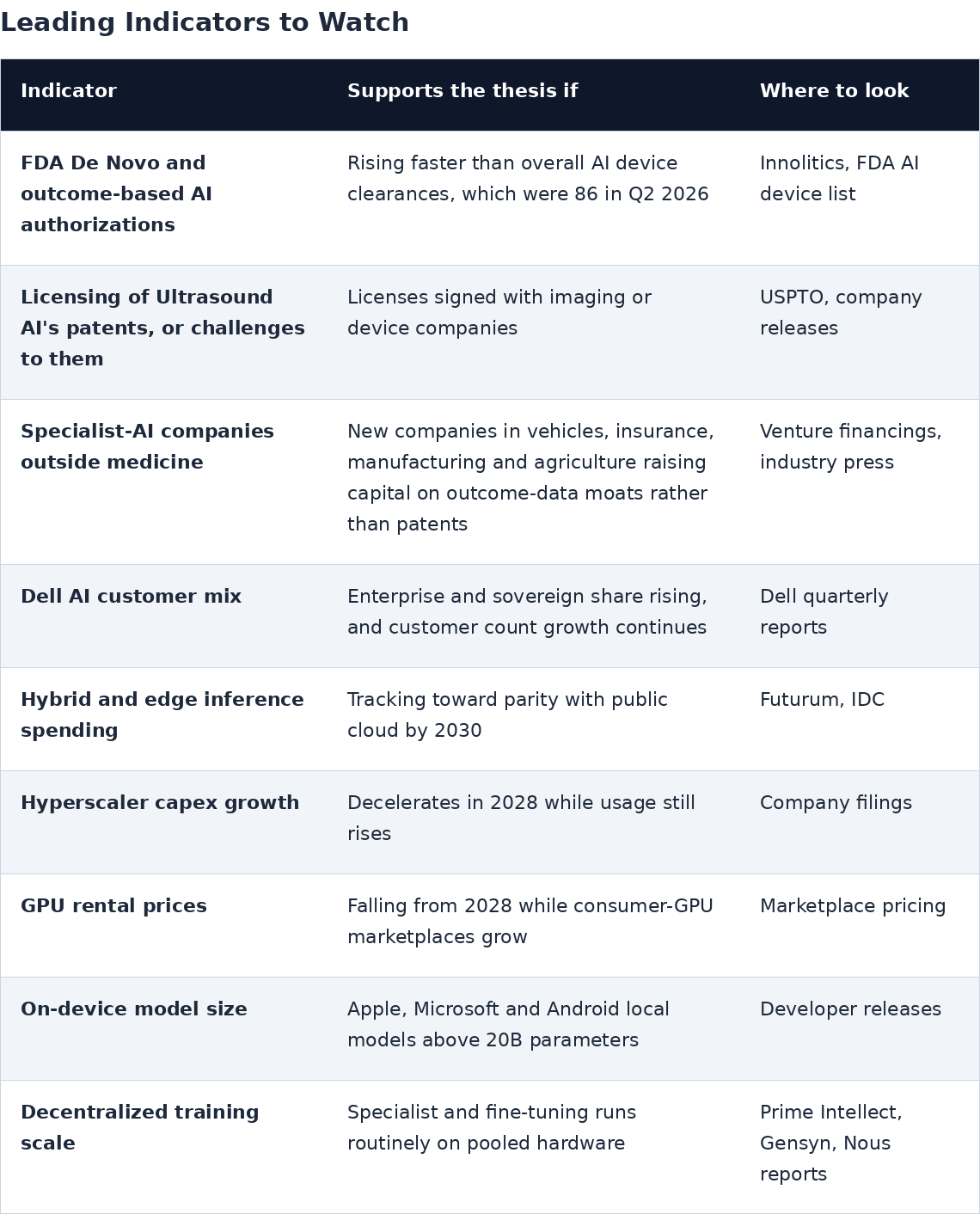
9. Leading Indicators to Watch
10. Conclusion
Ultrasound AI demonstrates that a small team with a home-built machine, outcome-linked images and a clear clinical question can produce an FDA-authorized, patented AI product that predicts what human experts cannot. The approach does not need a frontier model or a gigawatt data center. It needs data rights, outcome labels and validation.
That template will repeat in every industry that holds images or video linked to results. In medicine, Ultrasound AI's patents make it the gatekeeper for imaging-based clinical prediction. Outside medicine, the method is open, and the advantage goes to the owners of outcome data and installed hardware. As it does, the center of gravity of AI usage will move toward owned devices, on-premises systems and pooled consumer silicon, while frontier clusters remain essential but carry a smaller share of the work. The effect on data-center demand is fractional and gradual. Over three to five years it means slower growth and pricing pressure rather than a collapse, and it begins to show after the current supply shortage clears around 2028.
The beneficiaries are the owners of installed silicon, meaning Apple, Tesla, Dell and Microsoft through Windows; the owners and organizers of outcome data, meaning Ultrasound AI in medicine and Tesla and Uber in mobility; and the networks that connect the two, including a new class of silicon aggregators. Agentic AI accelerates the trend by routing most of its routine work to small local models, even as it raises total demand for the reasoning that only large clusters can supply.
Methodology note. Compute figures in Sections 3.1 and 4.4 are order-of-magnitude estimates prepared for this analysis. Market values are as of the November 3, 2026 close. Patent observations, including the claim-scope table and the examiner-citation review, are analytical and are not legal opinions. Figures are drawn from the FDA, USPTO and Google Patents records, company filings and releases, and reporting by PBS NewsHour, CBS News, Contemporary OB/GYN, Reuters, CNBC, TechCrunch, The Verge and others, believed reliable but not independently verified.
This paper is analysis and opinion, not investment, legal or medical advice, and not a recommendation to buy or sell any security. Ultrasound AI is a private company and its products are cleared only for the indications the FDA authorized. The authors hold positions in securities mentioned and reserve the right to buy or sell shares at any time without notice.