The Doctrine Holds

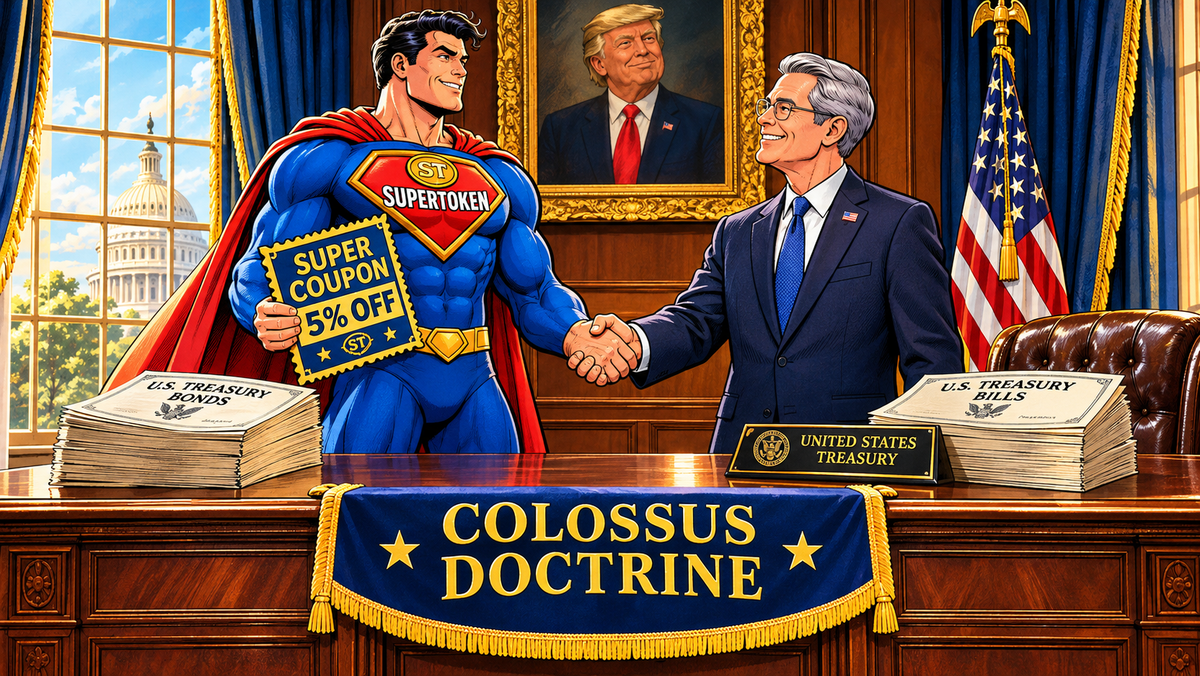
The October Call lands, the refunding moves toward the Colossus Doctrine, and the Trillion-Dollar Discount still works.
The short version
The Colossus Doctrine holds that the Treasury should buy back its cheap long-term bonds, pay for them with short-term bills, and rely on bill demand created by the GENIUS Act to carry the load. In October we showed what that looks like at full scale: retire the cheapest $1 trillion of pandemic-era bonds for about 55 cents on the dollar and fund them with 3-month bills.
Today's quarterly refunding moved the Treasury in that direction. Liquidity-support buybacks nearly doubled to up to $70 billion, funded with bills. The Treasury removed "at least" from its promise to keep long-bond auction sizes unchanged, and it named growing bill demand as part of its outlook. Our October Call landed on target: long-end buyback capacity for the coming quarter is up 50 percent. The trillion-dollar analysis showed about $340 billion of lifetime savings for taxpayers. Repriced on the November 3 curve, after a rally the trade itself predicted, it still eliminates about $420 billion of debt and saves about $290 billion.
The Treasury is not yet buying at the trillion-dollar pace, and the stablecoin float that will buy the bills is waiting on its catalysts. We expect it to accelerate as Japanese stocks keep sliding and the GENIUS Act takes effect in January. A lawful reason for ordinary Americans to hold stablecoins would speed that up, and the Super Coupon is built to supply one.
What the refunding confirmed
Bigger buybacks, paid for with bills. For the November-to-January quarter, the Treasury's refunding statement says it "anticipates that… it will purchase up to $70 billion in off-the-run securities across buckets for liquidity support and up to $25 billion in the 1-month to 2-year maturity bucket for cash management purposes." The August figure was up to $38 billion, so this is an increase of about 84 percent. The Treasury also said it is evaluating "changes to maximum purchase amounts, buyback operation scheduling and frequency."
The long-bond promise is no longer open-ended. In August the Treasury expected to keep coupon auction sizes unchanged "for at least the next several quarters." Today it "anticipates maintaining nominal coupon and FRN auction sizes for the next several quarters." The Treasury Borrowing Advisory Committee asked for the wording change. In Treasury language, removing "at least" tells the market the long-term schedule is no longer fixed.
Bills are named as the funding engine. The Treasury is "monitoring SOMA purchases of Treasury bills and growing demand for Treasury bills from the private sector." Its advisory committee expects current auction sizes "to shift Treasury's debt profile toward an increasing share of bill and shorter-term funding." That shift is the Colossus Doctrine, described in Treasury's own words.
The long end has rallied. The 30-year yield touched 5.72 percent on October 7, its highest since 2002. By November 2 it was 5.28 percent on the Fed's FRED data, and it stood near 5.30 percent this morning, with the 10-year near 4.92 percent. A weaker stock market and a flight to safety helped, but the direction is the one the Doctrine was built to produce.
The October Call: on target
On October 10 we called that Bessent would go bigger on the long-end buyback and that the November 4 refunding would lock it in. It arrived on November 4, two business days after the end of October.
Long-end capacity up 50 percent. Eight long-end operations of up to $6 billion each between November 17 and February 9, up to $48 billion in total on the Treasury's buyback schedule, compared with roughly $32 billion a quarter in the previous program. A 50 percent increase in a single quarter is a major step for the Treasury.
The total program up 84 percent. Liquidity support rises to up to $70 billion, from $38 billion.
The larger size is now standard. The $6 billion long-end operations that began as a temporary step in September now run through February 2027.
The Treasury chose to add operations rather than raise the per-operation cap to the $10 billion we suggested, and it left auction sizes unchanged while loosening its guidance. The substance of the call held: bigger, longer and funded with bills.
The Trillion-Dollar Discount, repriced
We repriced the same 13 bonds, the cheapest $1 trillion of face value, all sold between 2020 and 2022 with coupons of 1.125 to 2.375 percent, on the Treasury par curve for November 3, when the 3-month bill yielded 4.21 percent, the 20-year 5.35 percent and the 30-year 5.32 percent.
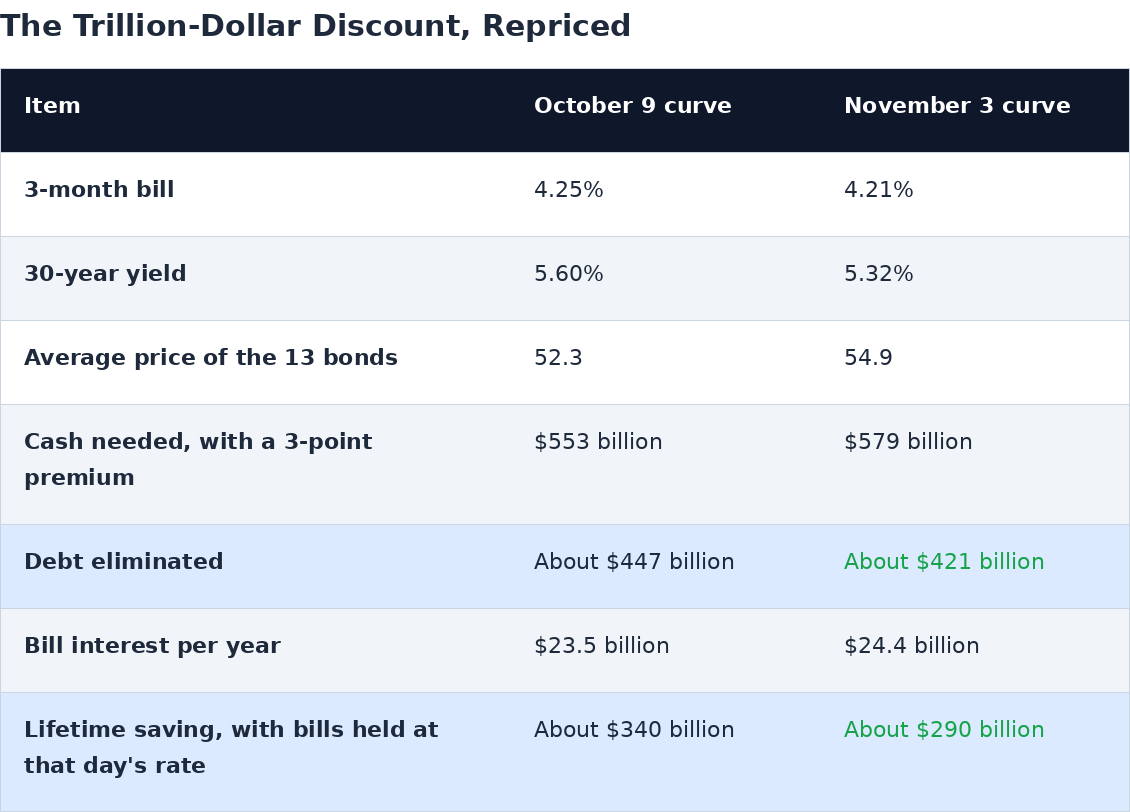
The analysis showed about $340 billion of lifetime savings at October prices, and the case still holds at today's prices. The cheapest issue, the 1.25 percent bond due May 2050, has risen from about 43 to about 46. Every one of the 13 bonds still trades below 62 cents on the dollar. The government still owes $1 trillion at maturity on debt that holders would sell back today for about $550 billion.
The trade still pays. It reduces federal debt by about $420 billion as soon as it is done, without a spending cut or a tax increase. In plain dollars, the bond path costs about $1.42 trillion in coupons and principal through the 2040s and 2050s. Funding the same position with 3-month bills at 4.21 percent costs about $1.13 trillion. The difference is roughly $290 billion.
The rally is itself a confirmation. From October 9 to November 3 the basket gained about 2.6 points, or about $26 billion of market value on $1 trillion of face. That is what heavy, sustained buying of these bonds would do. The trade is somewhat more expensive to put on today, which is the cost of waiting, and the discount is still far too large to ignore.
Where it is tighter. The annual comparison has narrowed with the long-end rally. The bonds now cost the government about 5.3 percent a year on their market value, against 4.21 percent on the bills, a saving of roughly $5 billion a year at today's rates. The annual saving disappears if the 3-month bill averages above about 5 percent. The lifetime saving holds as long as bills average below about 6.4 percent. Every Fed hike moves those lines. Every week of delay also gives up part of the saving as the bonds rally toward par.
The schedule, reset to start now
The Treasury has not adopted a trillion-dollar program, so the six-month schedule now starts after the November 16 refunding settlement. As before, buying starts at a measured pace and accelerates once the GENIUS Act takes effect on January 18, 2027.
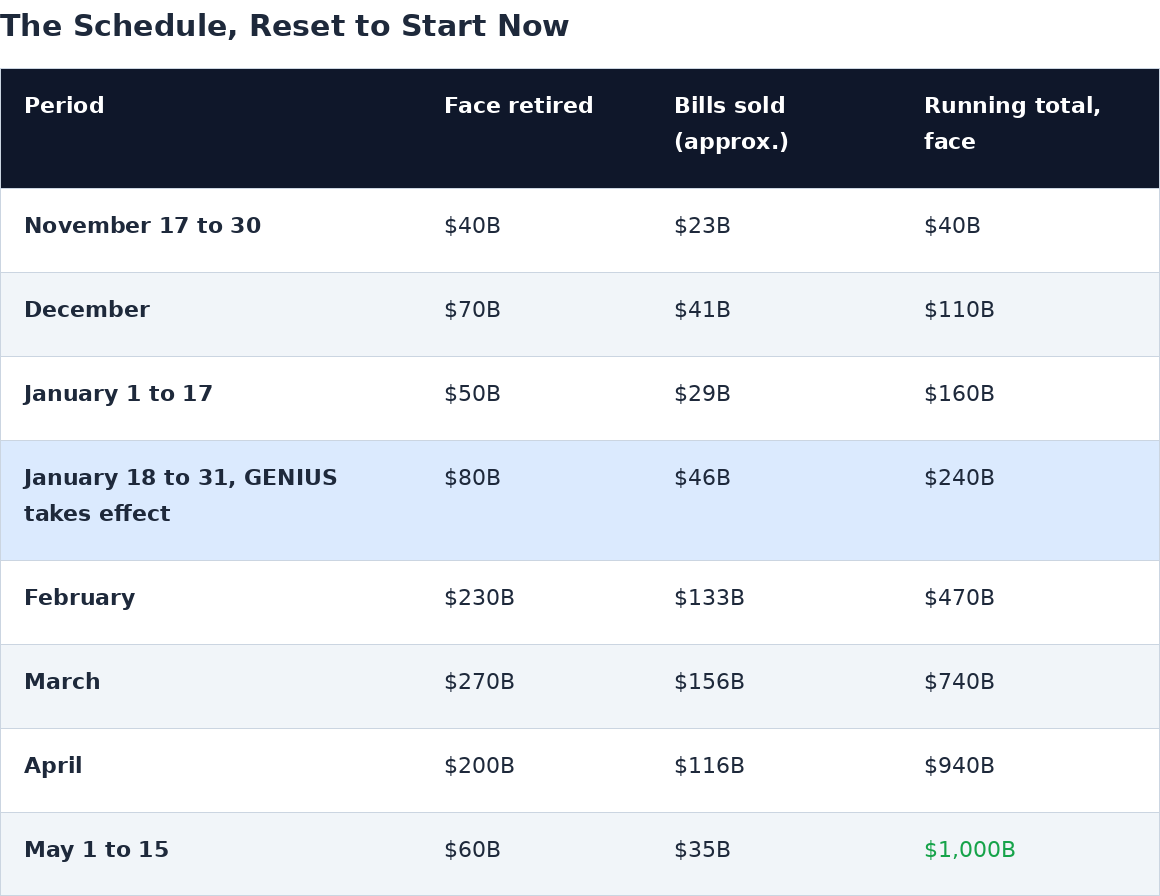
The Treasury's own new schedule is the down payment. It includes eight long-end operations of up to $6 billion each between November 17 and February 9, up to $48 billion in total. That is real progress over the roughly $32 billion a quarter in the previous program. It is about one-tenth of the Colossus pace, so the Treasury is moving in our direction but not yet at our size.
One and done
The Fed raised rates by a quarter point in September, to 3.75 to 4.00 percent, and held in October, CNN reported, with two officials voting for another hike. We believe Warsh stops there, for three reasons.
One. The Treasury is doing the long end's work. Retiring long bonds and funding them with bills pulls long yields down without the Fed having to act. A 40-basis-point rally at the 30-year point is tightening the Fed does not need to repeat.
Two. Conditions are tightening on their own. The advisory committee reports that the Nasdaq 100 fell just over 7 percent from its early-October high, credit spreads widened, and expectations for further hikes have moderated.
Three. The inflation is energy, not demand. Headline CPI was 3.7 percent in September, with gasoline accounting for more than half the monthly increase, while core CPI ran at 2.6 percent, the advisory committee noted.
One and done also protects the trillion-dollar trade. Every hike the Fed doesn't make keeps the bill rate further below the line at which the annual saving disappears. Bessent manages the supply of debt and Warsh manages the price of money. When the two are coordinated, the trade gets cheaper to run.
The constraint: who buys the bills
This is where the evidence runs against us, and we say so plainly. Stablecoin supply was $294.4 billion on November 3, down from $303.9 billion on October 9 and down 1.2 percent over 90 days. Supply peaked for the year at $315.5 billion on May 17 and had given back all of its 2026 gains by late October. Treasury's advisory committee adds that money market fund assets "have leveled off and the bill market has started to show some signs of price sensitivity."
The trillion-dollar trade adds about $580 billion of bills. That raises the bill share of marketable debt from roughly 22 percent to roughly 24 percent. Because the bills roll every 13 weeks, it also adds about $2.3 trillion a year of extra bill auctions. The GENIUS Act requires every payment stablecoin to be backed by cash, insured deposits and short-term Treasury bills. The legal channel for that demand is in place. What it lacks is volume, and two catalysts are lining up to supply it.
Japan. The Nikkei 225 has fallen from its June record of 72,832. Today it dropped as much as 4.8 percent, to 60,030, its lowest since May, before closing at 62,189. The yen is weak, near 158 to the dollar. We expect the slide to continue. When a major market falls and its currency weakens, savers move into dollars, and dollar stablecoins are the fastest way to get there. Foreign savers protecting themselves from weak home currencies have already been a main source of stablecoin growth. A continued Japanese decline adds more of them, and every new stablecoin dollar must be backed by cash, insured deposits or short-term Treasury bills.
January 18, 2027. On that date the GENIUS Act takes effect and licensed, onshore stablecoin issuance begins. Banks, payment companies and retailers that have waited for legal certainty can launch. That is why the trillion-dollar schedule puts most of the buying after January 18.
Today's float is the low point before these catalysts arrive, not a ceiling on demand.
Why the Super Coupon is the missing piece
The stablecoin float isn't growing because the GENIUS Act bars issuers from paying holders any interest, yield or rewards, as the Congressional Research Service has set out. The law built the channel to Treasury bills and took away every lawful reason for an ordinary consumer to use it.
The Super Coupon Token, BCII Enterprises' patent-pending architecture, supplies that reason without breaking the rule. It is an advertiser-funded coupon carrier: the advertiser pays for a discount at the point of purchase, and the coupon rides alongside a stablecoin without becoming part of it. The issuer pays no yield and the holder earns no interest. It is a sales promotion, not a return on savings. BCII has received a favorable accounting opinion treating the program as a sales promotion under ASC 606.
It turns the constraint into a bid. Every dollar a coupon pulls into a licensed stablecoin becomes a dollar of required reserve demand, mostly in the 3-month bills this trade sells.
It costs the Treasury nothing. Advertisers pay for the incentive, not taxpayers or issuers.
It lands on the right date. The trade accelerates after January 18, when licensed issuance begins, which is when a consumer incentive would be launched.
It lowers the bill rate. The Bank for International Settlements finds that a $3.5 billion stablecoin inflow compresses 3-month bill yields by 2 to 4 basis points. Each basis point off the bill rate widens the saving and pushes the breakeven further away.
As an illustration, if a working consumer incentive helped the float grow by $150 billion to $300 billion over the six months, stablecoins could absorb a quarter to half of the trade's new bills. The rest would fall to money funds and other rate-sensitive buyers. That would help offset the slowdown in money fund growth that the advisory committee flagged today. The architecture is not yet proven at scale. Launch data, legal sign-off on keeping the coupon separate from the stablecoin, and issuer adoption will decide whether it works as designed.
What could make us wrong
Larger coupon auctions. The advisory committee says "increases in coupon auction sizes will be warranted later in FY27" and that maturity management "should be done via changes to auction sizes," not buybacks.
More Fed hikes. The Fed's September projections put the median policy rate at 4.1 percent at the end of 2026, which implies one more move. A December hike would end one and done and narrow the annual saving.
A float that doesn't turn. So far the risk-off move has shrunk the float rather than grown it. If Japanese stress drives money into bank deposits and money funds instead of stablecoins, and supply is still falling after January 18, the bills will have to be sold to rate-sensitive buyers at higher rates.
Rollover and seller risk. Roughly $580 billion would roll every quarter instead of once in 23 years. Some of these bonds sit with the Federal Reserve or in stripped form, and a program this large would likely need a premium above our 3-point assumption.
Dates to watch
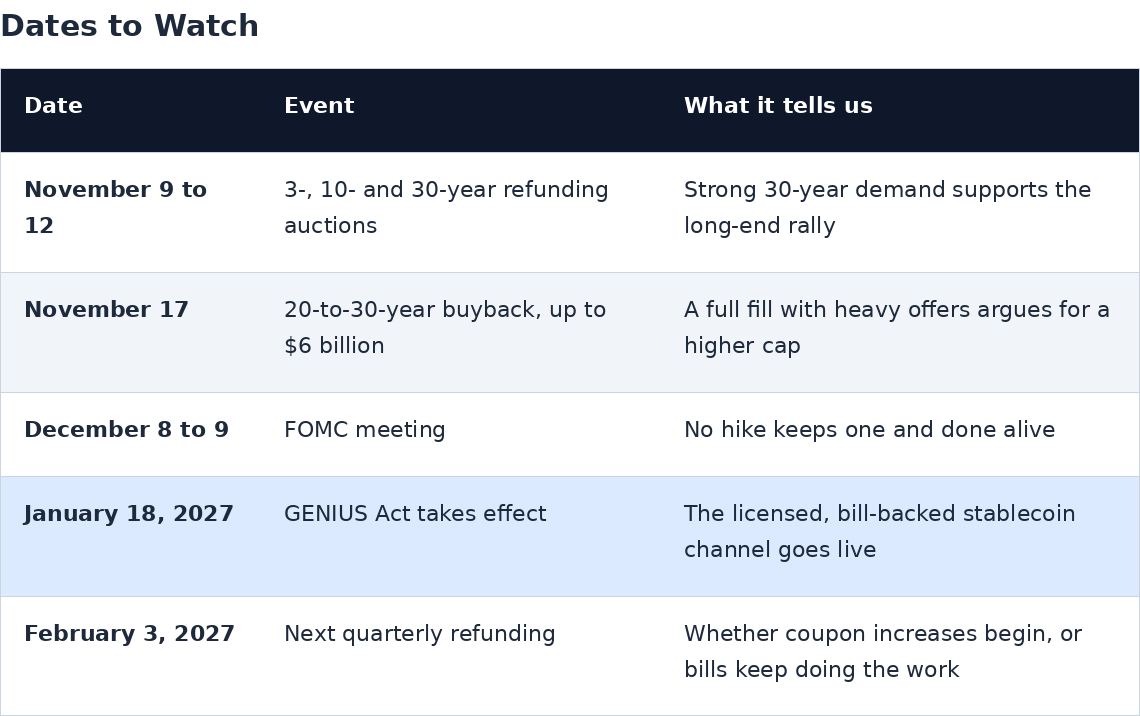
What we learned from the best
We learned how to manage money at Goldman Sachs in the Leon Cooperman era, at Steinhardt Partners, and in close contact with the Soros and Tiger organizations. Each of them taught the same thing: when the evidence lines up, you press. The Treasury pressed today. It nearly doubled the buyback program, said openly that bills are the funding engine, and loosened its long-bond promise. The trillion-dollar discount is still available at about 55 cents. The next step is to size up.
Bottom line
The Doctrine holds. The November refunding nearly doubled bill-funded buybacks to $70 billion, loosened the commitment to fixed long-bond auction sizes, and described in Treasury's own words a debt profile shifting toward bills. Long-term yields are down about 40 basis points from the October peak. The trillion-dollar analysis showed about $340 billion of lifetime savings, and repriced at today's curve the trade still eliminates about $420 billion of debt and saves about $290 billion. Our October Call landed on target, with long-end buyback capacity up 50 percent. With the Treasury managing the long end, Warsh can stop at one. The bill buyer is the next piece. We expect a sliding Japanese market and the January 18 start of licensed issuance to accelerate the stablecoin float, and a lawful, advertiser-funded consumer incentive like the Super Coupon is designed to accelerate it further.
JD Unfiltered, Joseph M. Salvani and Daniel J. Walsh
Methodology. Bond prices are model estimates from the November 3, 2026 Treasury par yield curve, interpolated by remaining maturity, with settlement on November 5. October figures use the October 9 curve with settlement on October 13. Actual prices for older issues are typically a point or two lower than model. Outstanding amounts are as of September 30, 2026 and include bonds held by the Federal Reserve and in stripped form. Cash needed includes a 3-point premium to draw sellers. Lifetime saving compares undiscounted coupons and principal on the bonds with bill interest and repayment, holding the 3-month bill rate constant. The schedule is the authors' illustration, not a Treasury program. Figures are drawn from the Treasury refunding statement, the TBAC report and buyback schedule, the Treasury yield curve, FRED, and reporting believed reliable but not independently verified.
Disclosure. Joseph M. Salvani and Daniel J. Walsh are co-founders of BCII Enterprises, which developed the Super Coupon Token architecture discussed in this report, and therefore have a direct commercial interest in its adoption. This report is an analytical essay and market commentary, not investment advice or a recommendation to buy or sell any security. The trade described has not been proposed or adopted by the Treasury. Market data as of the morning of November 4, 2026. The authors hold positions in securities mentioned and reserve the right to buy or sell shares at any time without notice.