The New World Order: U.S. Markets, the 1920s Parallel, and the Architecture Reshaping Global Finance


The New World Order: U.S. Markets, the 1920s Parallel, and the Architecture Reshaping Global Finance
The greatest bull market of all time isn't over. It's entering its third and largest leg—and the structural forces powering it are simultaneously enriching the United States, empowering India, and dismantling the financial foundations of Japan and China.
I. The U.S. Economy: Why We Favor American Markets
We have consistently argued that we are in the greatest bull market of all time—specifically the third and largest leg of a secular advance. Several structural forces underpin this conviction.
Disinflation driven by productivity. Full AI adoption, robotics, drones, autonomous vehicles, and healthcare breakthroughs (GLP-1s, NLRP3 inhibitors) are producing a productivity boom reminiscent of the mid-1920s.
Federal Reserve cutting cycle. We expect the Fed funds rate to ultimately reach a low of approximately 1.5% over the next two years, fueling credit expansion and asset appreciation. The March 17–18 FOMC meeting is the next critical signpost.
Broadening of market leadership. The peak P/E ratios for the mega-cap hyperscalers (NVDA, AMD, MSFT, AMZN) are behind us. From here, the real outperformance shifts to the users of Agentic AI—Russell 2000 companies, consumer firms cutting costs through automation, transports, Apple, and pure-play Agentic AI companies.
Current valuations support entry. As of late February 2026, the U.S. equity market was trading at a 7% discount to Morningstar's composite fair value estimates, with the technology sector at a 20% discount—offering selective opportunity.
The U.S. remains our preferred market because it is the epicenter of AI innovation, possesses the deepest capital markets, benefits from favorable fiscal policy, and is experiencing a peace dividend from Middle East stabilization.
II. The 1920s / 2020s Parallel: A Quantitative Framework
Beyond the qualitative case, we have developed a rigorous quantitative model that underpins—and in many ways predates—these conclusions. The insight is this: the 1920s and the 2020s are not merely rhyming—they are replicating, 99 years apart, with extraordinary statistical fidelity.
The Only Two Pandemic Recoveries in Modern Market History
The modern stock market has experienced only two pandemic-driven economic shutdowns and recoveries: the Spanish Flu (1918–1920) and COVID-19 (2020). Both produced sharp contractions followed by powerful, multi-year expansionary cycles. The recovery inflection points—May 1921 and May 2020—serve as the twin anchors of our model.
Using variables encompassing monthly stock index prices, U.S. long bond interest rates, inflation, GDP growth, and currency movements across both decades, we ran comparative analyses utilizing a photonic quantum reservoir computer. The model uses month-end closing prices only, eliminating daily noise and isolating the true directional signal.
Since the respective pandemic recovery months of May 1921 and May 2020, every single month has moved in the same direction—and nearly the same magnitude—across both periods. The model has accurately predicted each month's directional move for over five consecutive years. We are now in the equivalent of 1926–1927.
| Period | 1920s Equivalent | Projected Index Move |
|---|---|---|
| 2026 (full year) | 1926–1927 | ~+30% |
| 2027 (full year) | 1927–1928 | ~+30% |
| Jan–Sept 2028 | 1928–Sept 1929 | ~+30% (blowoff phase) |
| Oct–Dec 2028 | Oct 1929 crash | ~−40% retracement |
Why We Believe the Model Will Be Exceeded
While the model projects cumulative gains of roughly 30% per year through September 2028 followed by a 40% retracement, we believe actual performance will significantly outperform—potentially approaching 200% cumulative upside over the next two years. The 2020s possess accelerants that the 1920s did not:
Artificial intelligence and Agentic AI represent a productivity multiplier with no 1920s equivalent. Globalized capital flows and Middle East peace dividends are channeling sovereign wealth into U.S. compute infrastructure at unprecedented scale. The Federal Reserve's anticipated cutting cycle to 1.5% will flood the system with liquidity. Tokenization is creating entirely new asset classes. Healthcare breakthroughs (GLP-1 drugs, NLRP3 inhibitors) are extending productive lifespans.
III. Coolidge and Trump: The Policy Mirror
The quantitative alignment is remarkable on its own. But what makes the parallel truly extraordinary is that it is underpinned by nearly identical policy architectures.
| Policy | Coolidge (1923–1929) | Trump (2025–Present) |
|---|---|---|
| Gov't Spending | Aggressive reduction; balanced budgets every year | DOGE-led spending reduction; systematic elimination of waste |
| Tax Policy | Revenue Act of 1926—slashed top rates from 46% to 25% | Extension and expansion of TCJA; corporate and individual cuts |
| Tariffs | Fordney-McCumber Tariff (1922) raised rates to protect U.S. industry | Broad-based tariff regime on China, EU, and strategic sectors |
| Immigration | Immigration Acts of 1921 and 1924—dramatic restriction | Border enforcement, deportation acceleration, legal reform |
| Regulation | “The business of America is business”—systematic deregulation | Executive orders rolling back environmental, financial, and tech regulation |
Both presidents operated from the conviction that government should shrink, taxes should fall, borders should tighten, domestic industry should be protected, and the private sector—unburdened by regulation—would generate prosperity. In both cases, the policy mix produced surging corporate profits, rising asset prices, and a broadening of economic participation.
Containing China—Then and Now
In the 1920s, the United States was focused on containing China's political instability, deploying gunboats on the Yangtze and maintaining an active military presence to protect American commercial interests. Today, the Trump administration's foreign policy is organized around strategic containment of China through tariffs, semiconductor export controls, supply chain decoupling, AUKUS, the Quad, and military reinforcement of Taiwan. In both decades, China is the central organizing challenge of American foreign policy.
The Oil Shock Parallel: Mexico Then, Iran Now
In 1926–1927, Mexico moved to confiscate foreign oil assets. The resolution—combined with the massive Oklahoma oil fields—produced a glut that crashed prices and became one of the great accelerants of the late-1920s boom.
Today, the parallel is Iran. The Strait of Hormuz crisis has produced a temporary oil price shock. But the resolution is visible: U.S. shale producers have hedged forward massive production increases, offshore Gulf of Mexico projects are positioned for accelerated output, Chevron is cranking up Venezuelan production. When the Strait reopens, the oversupply condition could push crude into the $45–50 range—mirroring the post-Oklahoma glut of 1927.
IV. Japan: The Coming Bond, Currency, and Equity Crisis
The Japanese equity rally on pro-growth policies is fully priced in. What is not priced in is the existential threat now emerging beneath the surface of Japan's financial architecture.
Japan's debt-to-GDP ratio exceeds 260%. For decades, this was manageable because the Japanese people themselves financed it—only 11% of JGBs were held by foreigners. Households deposited savings at near-zero rates, banks recycled those deposits into JGBs. A closed loop. A gentleman's agreement between a frugal population and a profligate government.
That loop is now breaking.
Increased deficit spending triggered a violent JGB rout—Bloomberg characterized it as unleashing a “$7 trillion risk for global markets.” The yen came under severe debasement pressure.
Tokenization and Starlink: The Death of Captive Financing
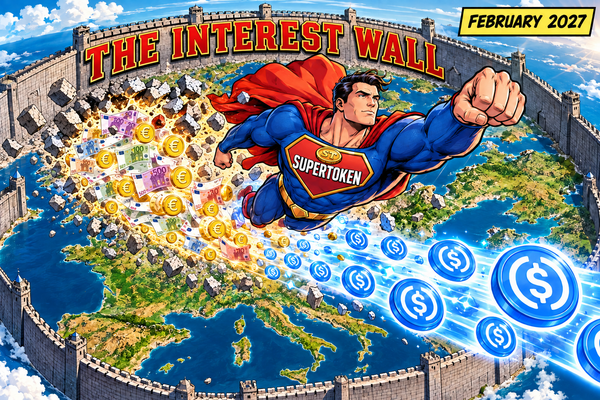
The very technological revolution powering the U.S. bull market is simultaneously dismantling Japan's financial fortress. The GENIUS Act and gold tokenization have created an alternative savings infrastructure accessible to every Japanese depositor with a smartphone:
Stablecoins now offer Japanese depositors U.S. dollar-denominated instruments yielding 4–5%. Gold tokenization provides a familiar store of value with yield enhancement through staking. Starlink has eliminated the last infrastructure barrier—even in rural Japan, satellite internet provides direct access to global DeFi platforms.
Last month, Japanese bank deposits dropped approximately 3%—one of the first meaningful declines in decades. This is not noise. This is the opening phase of structural deposit flight.
We expect the Japanese bond, equity, and currency markets to decline substantially over the next two to three years. This is not a cyclical call—it is a structural one. The technology enriching the United States is simultaneously bankrupting Japan's financing model.
V. China: The World's Most Leveraged Economy
If Japan's situation is dire, China's is catastrophic. China is entering its balance sheet recession without any of the buffers that allowed Japan to muddle through for three decades. Japan had the world's wealthiest household sector, a robust safety net, and a functioning democracy. China has the most leveraged economy on earth, a decimated consumer class, and an authoritarian governance structure that creates the illusion of stability—until the system snaps.
How Xi Destroyed the Chinese Consumer
China's consumer economy was destroyed by deliberate policy during COVID-19. Zero-COVID lockdowns sealed hundreds of millions of citizens in their homes—without income replacement and without a social security safety net. When the lockdowns ended, every pillar of household wealth had been demolished simultaneously: real estate crash (70% of middle-class wealth tied to property), stock market destruction, and no safety net driving precautionary saving at extreme levels.
Domestic consumption is collapsing. This is not a cyclical dip—it is a structural impairment that no amount of stimulus can reverse. You cannot stimulate consumption in a population that has been traumatized into permanent saving mode.
The True Leverage
China's true leverage can only be understood by consolidating central government debt, local government debt (exploded to crisis levels), and state-owned enterprise debt. Combined, China is the most leveraged economy in the world—exceeding even Japan's burden, but owed across a fragmented system of local governments, shadow banks, and SOEs, much of it opaque and already non-performing.
Tokenization Hits China 3x Harder
Everything we described regarding Japan applies to China multiplied by three. Chinese savers are even more desperate for yield and capital preservation. The critical difference: China's authoritarian monetary controls create the illusion of stability. Capital controls work until they are overwhelmed. When digital capital flight reaches critical mass, China's controls will fail suddenly rather than gradually.
China as the Detonator
We believe China's financial crisis in late 2027 to early 2028 will be the spark that ignites the global market selloff we project for late 2028—the equivalent of the 1929 crash in our model. China's controlled system fractures, triggering disorderly yuan devaluation, cascading SOE and local government defaults, and a collapse in Chinese demand for global commodities. Global risk appetite, stretched to euphoric extremes after three years of 30%+ annual gains, evaporates.
China is not just a short. It is the detonator.
VI. India: The Prime Beneficiary of the New World Order
If the United States is the engine of this bull market and the Middle East is its fuel depot, India is the prime beneficiary of the new global economic architecture. Every major structural force—the U.S. boom, the Middle East peace dividend, China's decline, the oil price collapse—flows directly and disproportionately in India's favor.
Demographics. India has surpassed China as the world's most populous nation, with over 65% of its population under 35 and a median age of 28—compared to 39 in China and 49 in Japan. India's working-age population grows until 2047. China and Japan are simultaneously depopulating and aging.
Lower oil. India is the world's third-largest oil importer. Crude at $45–50 reduces the current account deficit, eases inflation, gives the RBI room to cut rates, and puts money into the pockets of 1.4 billion consumers.
India–EU Free Trade Agreement. Concluded January 27, 2026 after two decades of negotiations—eliminating or reducing tariffs on 96.6% of EU exports to India and 99.5% of Indian exports to the EU, with projected annual duty savings of €4 billion and potential to double bilateral trade by 2032. India is positioning itself as the new factory floor.
Modi–Trump rapprochement. The February 2026 India–U.S. trade deal creates a triple trade corridor—combined with the EU FTA and Middle East boom—that positions India at the center of global commerce. As China declines and supply chains restructure, India inherits the manufacturing base, the trade relationships, and the capital flows.
We expect the Indian equity market to track the U.S. market higher through 2028. India is not merely a beneficiary—it is a co-participant.
VII. Two U.S.-Listed Companies Positioned for the India Boom
Zoomcar Holdings (OTCQX: ZCAR)
Peer-to-Peer Car-Sharing Marketplace
India's passenger vehicle sales grew 5% year-on-year in calendar 2025, reaching approximately 4.5 million domestic units, with aggregate vehicle sales across all categories surpassing 26.8 million. ICRA projects continued 4–6% passenger vehicle volume growth in FY2026–27.
Within this backdrop, Zoomcar occupies a unique position. Bookings are up 10% year-on-year with repeat users surging 86%, demonstrating strong platform stickiness. Product expansion includes ZoomPro for fleet hosting, Zoomcar Cabs (rentals with drivers), expanded home delivery across 14 cities, and a strategic partnership with CARS24 for tech-enabled vehicle inspections. New CEO Deepankar Tiwari was appointed in May 2025 to drive the next growth phase, and the company closed a private placement in February 2026 to strengthen its balance sheet.
India's macro tailwinds—rising incomes, premiumization, urbanization, and policy support—create a long runway for platforms that sit at the intersection of technology and transportation.
Limitless X Holdings (OTCQB: LIMX)
“Looking Good and Feeling Great”
Jas Mathur is an Indian-born, self-made entrepreneur who launched his first business at 12, sold his first company at 16, and saved his first million by 21. Born in New Delhi and raised in Montreal, Mathur has built a global following of over 11 million Instagram followers through his extraordinary personal transformation—losing over 114 kilograms through discipline alone—and his expanding presence across entertainment, boxing promotion, film production, and wellness.
Limitless X is building a “recession-resistant ecosystem” integrating direct-to-consumer wellness products, entertainment, fintech, real estate, and film production. Recent moves include entry into the $500 billion global coffee market with a nootropic coffee concentrate, Mathur's conversion of over $6.5 million in personal debt to preferred stock (eliminating legacy liabilities and demonstrating insider conviction), and positioning for a Regulation A+ Tier 2 offering and uplisting to a senior exchange.
The cultural bridge matters. As an Indian-origin entrepreneur, rising film producer, boxing promoter, and wellness influencer with massive social media reach, Mathur is uniquely positioned to resonate with India's aspirational young consumer class—the same demographic driving the country's economic boom.
VIII. The Tokenization Revolution
The passage of the GENIUS Act—and the imminent progression of the CLARITY Act—represent the most consequential financial legislation since the Securities Acts of the 1930s. Together, they are transforming the United States into the undisputed token capital of the world.
The Architecture
The GENIUS Act's critical requirement: stablecoin issuers must hold 90% of reserves in U.S. Treasury securities. Every dollar flowing into regulated stablecoins becomes a dollar of demand for U.S. government debt. As stablecoin adoption scales to trillions in circulation, the Act creates a new, massive, permanent buyer of Treasuries—reinforcing dollar dominance while funding U.S. government operations.
The CLARITY Act, expected to advance toward signing in early April 2026, provides clear regulatory classification for tokenized assets and creates a legal pathway for tokenizing real-world assets on U.S.-regulated platforms.
Commodity Tokenization
Gold tokenization combines ancient store-of-value properties with DeFi staking yields in the 4–5% range—creating what physical gold never offered: income. Silver tokenization follows the same trajectory. The entire stack reinforces dollar supremacy: every transaction, every yield, every settlement flows through Treasury-backed stablecoins.
Starlink + Stablecoins + Tokenization = The Death of Traditional Banking
This is the thesis that ties everything together. Starlink, combined with GENIUS Act-regulated stablecoins and maturing tokenization markets, means that every person on earth with a cell phone no longer needs a bank account.
A farmer in rural India, a shop owner in Lagos, a factory worker in Jakarta can now—via Starlink on a basic smartphone—access a stablecoin wallet denominated in U.S. dollars, backed by Treasuries, earning yield through staking. They can hold tokenized gold. They can send money across borders instantly and nearly for free. They can build wealth without ever setting foot in a bank.
There are approximately $45 trillion in deposits held by underbanked populations globally. There are 1.4 billion completely unbanked adults. The populations that previously turned to Bitcoin as a quasi-banking alternative no longer need it.
What This Means for Traditional Crypto
Bitcoin and virtually every legacy token except Ethereum and Solana face structural demand destruction. Their primary use case among the world's unbanked has been superseded by a superior product stack: regulated stablecoins for transactions, tokenized gold for store of value, DeFi staking for yield.
Ethereum and Solana survive—and potentially thrive—because they are infrastructure layers, not stores of value. They are the platforms on which stablecoins are issued, commodity tokens are traded, and DeFi protocols operate.
The Winners
The U.S. Dollar. Every stablecoin in circulation is a vote for dollar dominance. The dollar is not being displaced by crypto. Crypto is being absorbed by the dollar.
Gold and Silver. Commodity tokenization transforms precious metals from inert stores of value into yield-bearing digital assets, dramatically expanding their addressable market.
SpaceX / Starlink. Starlink is the delivery mechanism for the entire tokenized financial system. SpaceX is becoming the infrastructure backbone of global finance.
IX. Conclusion
The structural picture is clear. The United States sits at the center of a generational convergence: AI-driven productivity, a Federal Reserve cutting cycle, cheap energy from the coming oil glut, Middle East peace dividends, and the tokenization revolution redirecting global capital flows through dollar-denominated infrastructure. India rides this wave as the prime emerging market beneficiary. Japan and China face structural crises that the same technological forces powering the U.S. boom are actively accelerating.
The 1920s model provides the directional roadmap. The policy mirror between Coolidge and Trump provides the confirmation. And the tokenization revolution—powered by the GENIUS Act, the CLARITY Act, and Starlink—provides the accelerant that has no historical precedent.