
The Broken Compact


How Rising Westernization Is Overwhelming East Asia's 2,000-Year-Old Dietary Antioxidant Defense
Important framing note: The underlying mechanisms cited in this paper are drawn from peer-reviewed literature. The proposed intervention — the ReBalU product and its specific natto-powder and bacteria formulation — rests on non-peer-reviewed sources and is presented as a hypothesized, FDA-uncleared intervention, not a proven treatment, and not intended to diagnose, treat, cure, or prevent any disease.
A Paradox That Held for Two Millennia
For roughly two thousand years, East Asian populations have carried a quiet genetic vulnerability in their antioxidant machinery. Weaker SOD2 (Val/Val) and GPX4-TT variants blunt mitochondrial and lipid-membrane redox defense — the cellular systems that neutralize oxidative damage before it accumulates. On its own, this is a genuine liability. Yet the populations carrying it have not merely survived; they have thrived, building some of the longest-lived, healthiest civilizations in human history.
This paper argues that the reason was cultural, and that culture is now failing.
The Ancient Compact: Diet as Genetic Compensation
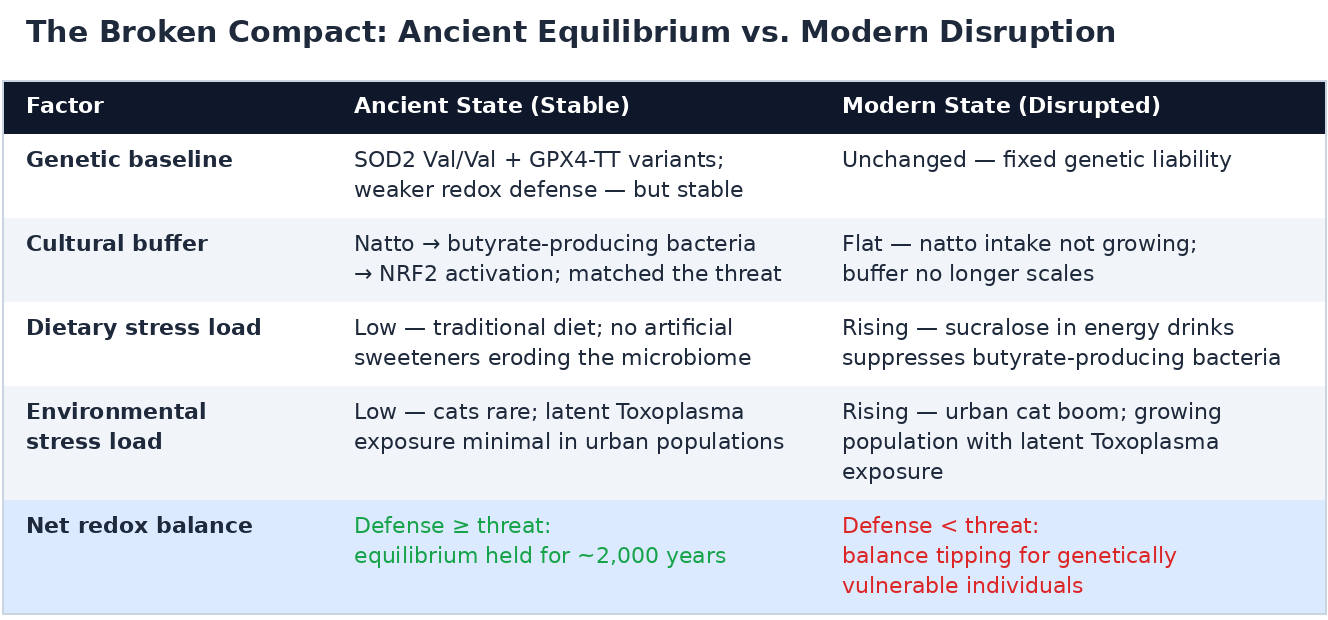
The proposed explanation for the paradox is dietary compensation. Traditional fermented-soy staples — especially natto — support butyrate-producing gut bacteria. Butyrate is a validated upstream activator of NRF2, the master regulator of the cellular antioxidant response, which governs the expression of hundreds of protective genes. In effect, culture supplied a downstream antioxidant surplus that offset an upstream genetic deficit. For two millennia, diet and genetics operated as a self-renewing equilibrium: the same foods, passed from generation to generation, quietly compensating for the same inherited weakness.
The structural vulnerability of this arrangement is easy to miss precisely because it worked so well. The defense is a constant. It was calibrated to an ancient, stable threat level. It cannot, by itself, scale upward to meet a rising load — and today, the load is rising on two simultaneous fronts.
The First Disruption: Sucralose and the Energy Drink Generation
The clearest empirical signal is generational. Among Korean adolescents, the prevalence of consuming energy drinks three or more times per week nearly quadrupled — from 3.2% in 2014 to 12.2% in 2019 — with the increase observed across all subgroups regardless of sex, grade, region, or economic status. The pattern is not isolated to Korea; it reflects a broader Westernization of consumption habits among the 14–40 cohort across urban East Asia.
These beverages are increasingly sweetened with sucralose, the fastest-growing artificial sweetener in the Asia-Pacific region, advancing as aspartame retreats following its WHO "possibly carcinogenic" classification. The mechanistic danger is precise: sucralose is the artificial sweetener most strongly implicated in gut-microbiome disruption, suppressing the very butyrate-producing bacteria on which the natto-based NRF2 defense depends. Westernization here is not merely additive stress. It dismantles the compensation pathway itself — attacking the ancient buffer from within at the exact point where it was always most vulnerable.
The Second Disruption: The Urban Cat Boom and Latent Toxoplasmosis
Cat ownership — historically a predominantly Western practice — has surged among young, affluent, urban East Asians. The regional cat population grew approximately 43% between 2018 and 2023, driven by busy single professionals in small, dense-city apartments. In China, pets now outnumber young children; Chinese pet ownership rose 113% between 2014 and 2019 and correlates with higher socioeconomic position.
The relevance to antioxidant defense is through latent Toxoplasma gondii infection, a confirmed chronic oxidative and nitrosative stressor. Infected individuals show elevated lipid, protein, and DNA oxidative damage, raised malondialdehyde, elevated nitric oxide, and depleted glutathione. The parasite targets the precise enzymes East Asians are genetically weakest at — glutathione, glutathione peroxidases, and SOD — and actively depletes host glutathione to survive within the cell.
One calibration is important here. The risk is concentrated in outdoor and indoor-outdoor cats; indoor-only household cats show low-to-near-zero seroprevalence (zero in Seoul household cats; 2.4–6.2% in urban Chinese pet cats). The defensible argument is therefore one of population-scale exposure: a rapidly growing cat-owning population enlarges the absolute number of genetically vulnerable individuals carrying latent-Toxoplasma risk, even at low per-cat infection rates. The concern is not that every pet cat is infected — it is that the number of people exposed, across a vulnerable genetic population, is rising fast.
The Convergence: A Balance Tipping Out of Equilibrium
The thesis reduces to a simple equation that is losing its balance. The genetic baseline — SOD2-weak, GPX4-weak redox defense — is fixed and ancient. The cultural buffer — natto-driven butyrate and NRF2 compensation — is flat, no longer growing alongside the threat. And the threat is rising on two fronts simultaneously: sucralose and energy drinks suppressing the butyrate buffer from within, and urban-cat-borne latent toxoplasmosis adding oxidative, nitrosative, and glutathione-depleting stress from without.
For two thousand years, the defense matched the threat. Westernization has now pushed the threat above the line that a static traditional diet can hold. The same individual eating the same natto their grandparents did may now slide into chronic oxidative and nitrosative stress — not because their diet changed, but because the cultural shield was calibrated for an ancient threat level, not a modern one.
The Proposed Counter-Force: Rebuilding the Buffer
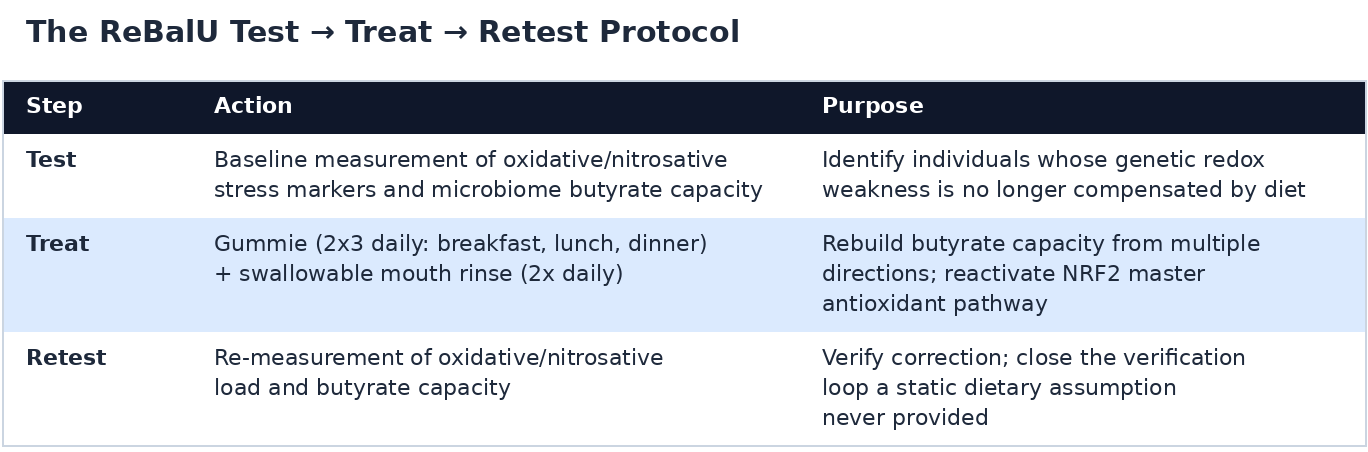
If the problem is a fixed buffer facing a rising load, the answer is not simply to eat more natto. A static buffer cannot be willed to scale. The answer is to reconstruct the butyrate→NRF2 compensation pathway in a dose-adjustable, measurable form — and to verify that it worked. This is the rationale for the ReBalU test → treat → retest protocol.
The defining architectural feature of the ReBalU formula is redundancy in the butyrate pathway. Rather than betting on a single ingredient, every core component independently feeds butyrate production — the upstream activator of NRF2 — so the system does not fail if any one input is disrupted.
Tagatose ("God's sugar") is a monosaccharide sweetener that reaches the lower GI tract intact and is fermented into butyrate; it is the first sweetener to earn NutraStrong Prebiotic Verified certification and is mechanistically the anti-sucralose — a sweet taste that feeds the microbiome rather than disrupting it. Fibersol-2, a resistant maltodextrin backed by more than thirty years of research, is slowly fermented into short-chain fatty acids and is notably better tolerated at high doses than inulin or FOS, supporting real-world compliance. High-methoxyl pectin drives microbiota-dependent butyrate production and modulates the gut microbiome from a third independent direction. Refined marine-algae oil provides a sustainable, fish-free DHA source supporting the lipid membranes that are most vulnerable in GPX4-weak hosts. The full gummie formula additionally includes natto powder — the concentrated ancient buffer — and live butyrate-producing bacteria to directly rebuild what sucralose erodes.
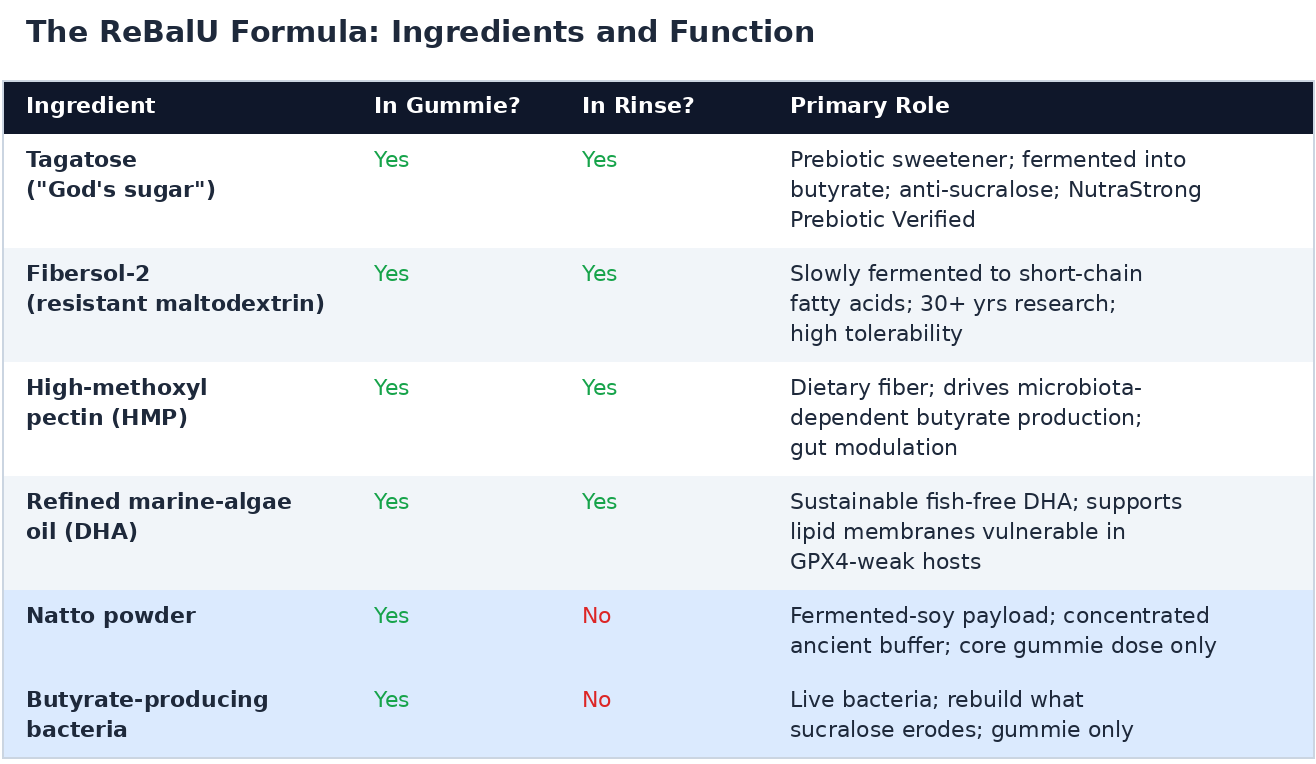
The delivery system uses two complementary formats. The gummie carries the full formula — including natto powder and live bacteria — taken two at a time, three times daily with meals, distributing the butyrate-substrate and live-bacteria signal evenly across the day rather than in a single bolus. The swallowable mouth rinse delivers the same formula minus the natto, twice daily, extending prebiotic and DHA support to the oral microbiome before being swallowed and continuing to the gut. Together, the gummie carries the core fermented-soy and bacteria dose; the rinse maintains the prebiotic-butyrate engine between meals.
The Test → Treat → Retest Loop
What distinguishes this protocol from the traditional dietary assumption is verifiability. The ancient natto defense worked — but it was never measured. No individual could know whether their genetic vulnerability was compensated or not, whether the threat had outpaced the buffer or not.
The ReBalU protocol closes that loop in three steps.
Against the sucralose stressor, tagatose replaces a microbiome-disrupting sweetener with a microbiome-feeding one, attacking the dietary assault at its exact point of damage, while the added bacteria and natto powder rebuild what sucralose erodes. Against the toxoplasmosis oxidative and nitrosative load, the butyrate→NRF2 axis boosts the master antioxidant response, compensating for the SOD2 and GPX4-weak host the parasite exploits, while algal DHA supports the vulnerable lipid membranes. And against the "flat natto" problem — the ancient buffer that cannot scale on its own — the formula makes the defense dose-adjustable and verifiable for the first time.
Limitations and Credibility Guardrails
This is a plausible compounding-risk model, and it should be read as one. Each individual link in the chain is supported by published literature, but no single study yet measures the full pathway — Westernization to overwhelmed natto defense to oxidative disease — in East Asian Val/Val cohorts. The cat risk is a population-scale argument, not a single-incident certainty, and indoor-only cats carry low risk. The sweetener concern is specific to sucralose; aspartame is declining and should not be credited with the same microbiome effects. Most importantly, the ReBalU product and the specific natto-powder and bacteria formulation rest on non-peer-reviewed sources. The mechanisms — butyrate→NRF2, NRF2 as master regulator, butyrate-producing bacteria, fermented-soy benefits — are well-evidenced in the literature. The product is a design hypothesis applying those mechanisms, not a clinically validated treatment.
This document presents a scientific hypothesis for discussion. It is not medical advice. The proposed intervention has not been evaluated by the FDA and is not intended to diagnose, treat, cure, or prevent any disease. Consult a qualified healthcare professional before making dietary or supplement changes.