More Than Coincidence

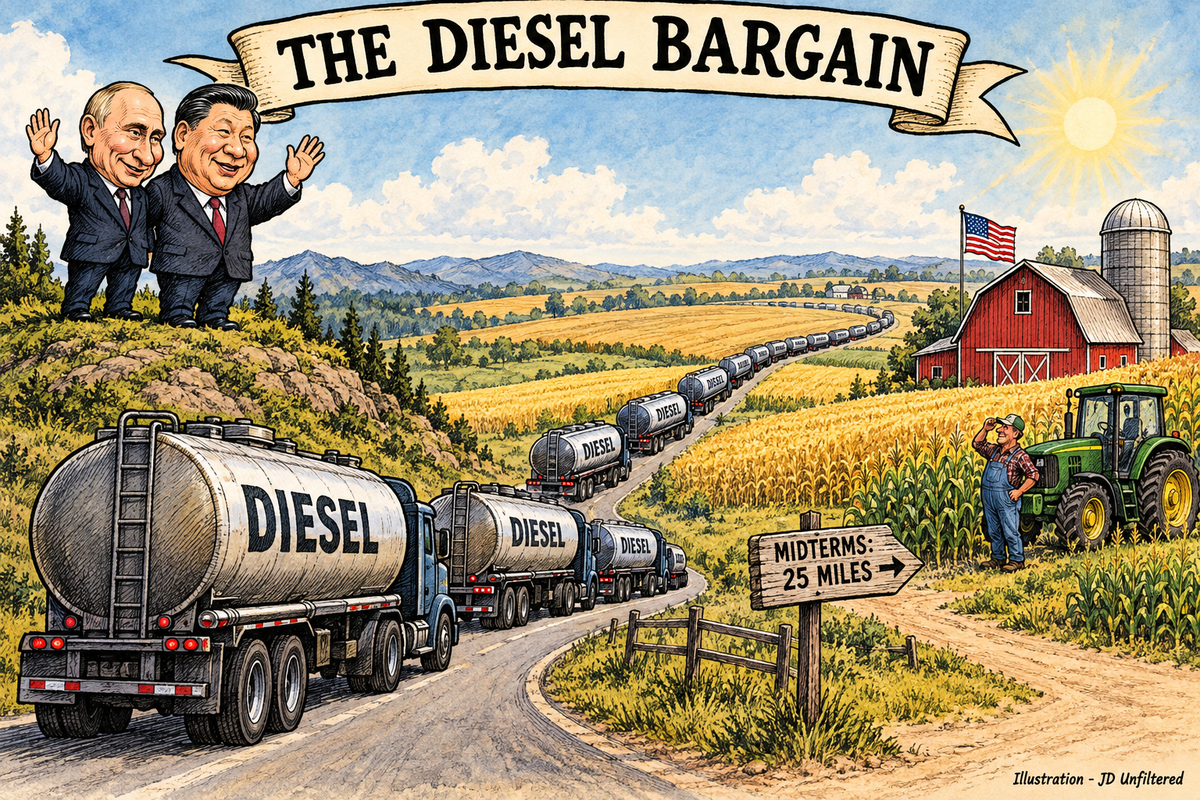
The diesel bargain, de facto vassalage, and the arrival of the Morrow Moment. A JD Unfiltered Special Report.
Executive Summary
In the three weeks after Xi Jinping's September 23 to 25 state visit to Washington, the two powers that the Colossus Doctrine framework identifies as the senior vassals of the American order both did the same thing at the same moment: they put diesel on the market when the United States needed it most. China's diesel exports hit 1.85 million tons in September, up 262 percent from a year earlier and the highest since February 2023, on customs data reported by Reuters. On October 9, Beijing cleared roughly 3.7 million tons of October fuel exports after a holiday freeze. That same evening, President Trump announced that Vladimir Putin had agreed to supply 4.8 million tons of Russian diesel to US and global markets, and Treasury immediately issued a license suspending sanctions on Russian diesel until April 7, 2027.
The consideration for the Russian leg was paid in Ukrainian currency. Within days, the President said Ukraine should get a new leader capable of making a deal. An order from inside the White House slowed Ukraine's military Starshield satellite service, Reuters reported, as Washington pressed Kyiv to stop striking Russian refineries. And on October 16 the President waived the sweeping Graham Act sanctions he had signed only a month earlier. Meanwhile, Putin used the same call to carry Iran's proposal for ending the war to Washington, in coordination with Iran's president.
None of this was announced as submission. Beijing issued no statement and framed its approvals as routine quota management. Moscow's readout cast Russia as a confident supplier confirming its readiness to help the global economy. That is the signature of the 1927 template: the Morrow method secured American terms while letting the weaker party keep its dignity, its domestic narrative, and its own legal wrapper. This report sets out why the convergence of these events is better explained by a de facto bargain than by coincidence, what the public record does and does not establish, and which near-term signals would confirm the thesis.
Core thesis. The diesel bargain is the Morrow Moment in operation. The adversaries supplied the commodity the hegemon needed before its midterm elections. The hegemon paid in sanctions relief and truce time. And the cost was carried by a third party, Ukraine, exactly as Nicaragua carried the cost of the 1927 settlement. The vassalage is real, but it is de facto, not ceremonial.
The 1927 Template: How Vassalage Works Without Ring-Kissing
The 99-year clock maps 1927 onto 2026. The 1927 resolution of the US and Mexico confrontation is the template, and it ran in three moves, each of which has a 2026 counterpart.
Move one: settle the third-party war
In 1926 Mexico under Plutarco Elías Calles armed the Liberal rebels in Nicaragua, and the Calles-Sacasa Pact committed Mexico to provide money, advisors, arms and transport. On January 10, 1927, Coolidge told Congress he had conclusive evidence of large Mexican arms shipments to the rebels. Rather than fight Mexico, Washington settled the proxy war. Coolidge sent Henry Stimson, who met the rebel general Moncada at Tipitapa on May 4, 1927 and obtained his agreement to disarm under US-supervised elections. The war Mexico had been sponsoring was closed out from under it on American terms before the bilateral oil settlement began.
Move two: send a dealmaker, not a diplomat
Coolidge then appointed Dwight Morrow, a J.P. Morgan partner, as ambassador, and Morrow took office on October 29, 1927. By October 31 Calles had invited him to breakfast. The press called him the "ham and eggs diplomat." One of his first acts was to rename the American Embassy the United States Embassy in deference to Latin American sensitivities. He brought Lindbergh and Will Rogers on goodwill tours and commissioned Diego Rivera murals.
Move three: let the weaker party save face
Morrow's solution was for Mexico's own Supreme Court to declare the confiscatory petroleum law ex post facto, which it did in November 1927. Calles then rewrote the law to grant American companies "confirmatory concessions" without time limit, while continuing to criticize the foreign oil companies publicly. Mexico conceded the substance and kept the rhetoric. That is vassalage without ring-kissing: the weaker party is never asked to bow, only to deliver.
China: The Swing Refiner Opens the Valve
China is the only country with large spare refining capacity in a world short of diesel. Its refineries were running at about 75 percent of capacity against roughly 97 percent in the United States, on the Wall Street Journal's figures. Global diesel exports were about 700,000 barrels a day below year-earlier levels in September, and Ukrainian drone strikes on Russian refineries have removed an estimated 800,000 to 1 million barrels a day of diesel from the market, according to S&P Global Energy. Whoever controls China's export licenses controls the marginal barrel of the world's scarcest fuel.
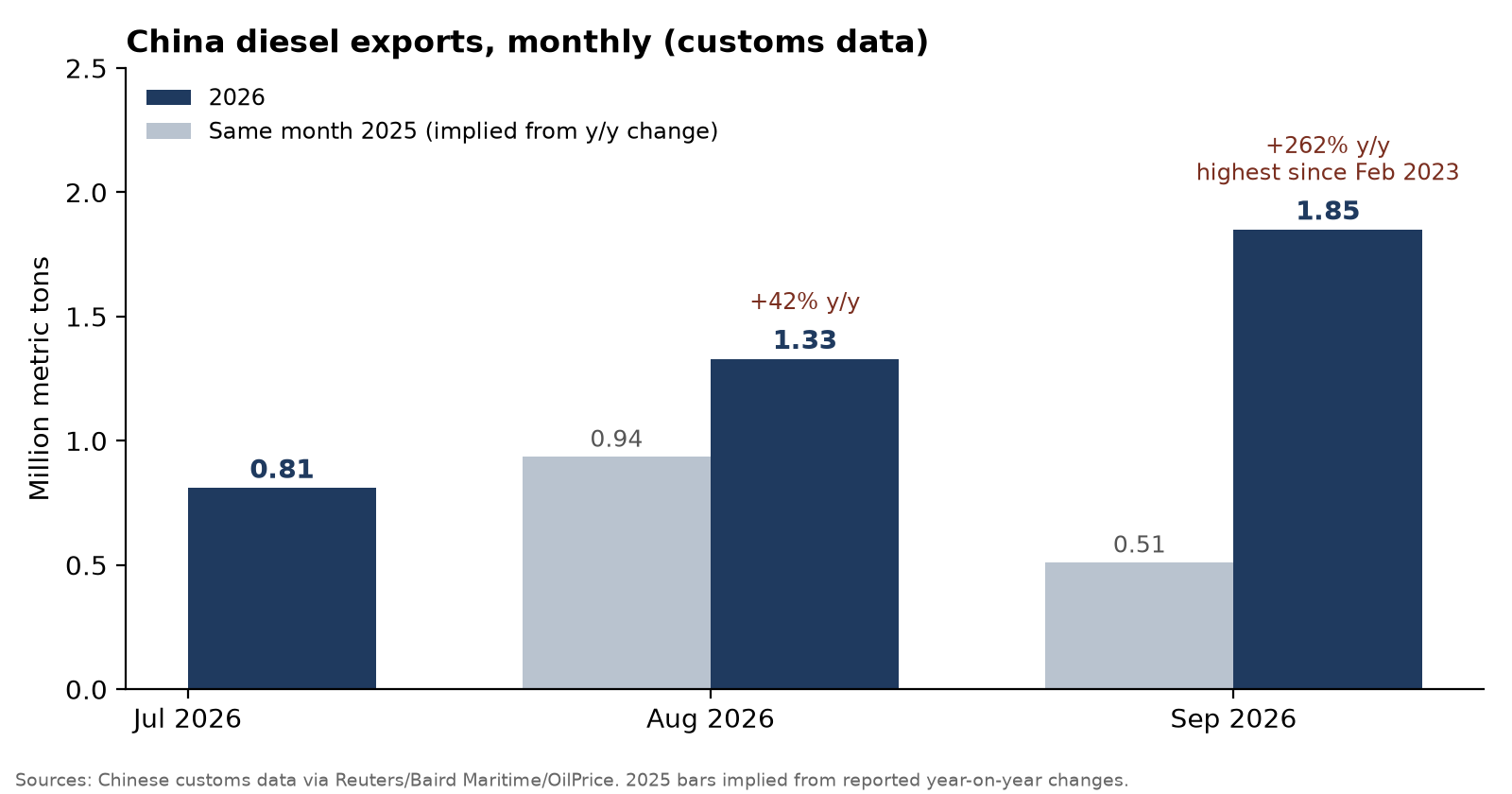
The export record since the summit is unambiguous. September refined-product exports rose 39.4 percent year on year to 7.16 million tons, and diesel exports more than tripled to 1.85 million tons. Vortexa ship-tracking put September diesel exports near 500,000 barrels a day, up from 166,000 a day in April through July. Combined gasoline, diesel and jet exports reached 4.41 million tons, well above the 2025 monthly average of 3 million. The IEA noted that fears of disruption to Chinese product exports, a key source of Asian supply in the third quarter, were alleviated by the resumption of licensing.
The ramp did not come from abundance. China's gasoline and diesel inventories were at their lowest in more than a decade, and refiners had cut throughput about 7 percent this year. August throughput was still 6.9 percent below a year earlier, and Kpler estimated commercial diesel stocks about 20 million barrels short of the level Beijing has used as a threshold for freer exports. Beijing chose to export into a domestic shortfall. A state that ships its scarcest fuel abroad while its own tanks sit at decade lows is making a policy choice, and the beneficiary of that choice is a tight global market whose most politically exposed consumer is the United States.
The timing pattern
The summit itself produced little on paper: a two-month truce extension to January 10, a $30 billion reciprocal tariff framework, an AI dialogue, and an agreement to meet twice more this year. Trump confirmed meetings at APEC in Shenzhen on November 18 and 19 and at the G20 at Doral on December 14 and 15. On October 2, G7 leaders agreed to a 100-million-barrel coordinated release and pledged to avoid energy export restrictions among themselves. Beijing had entered its October 1 holiday without export approvals. It then cleared October exports on October 9, the same day Washington and Moscow announced the diesel bargain. Two adversaries released diesel on the same day, a week after the G7 release, two weeks after the state visit, and twenty-five days before the US midterms.
China's leg follows the Calles pattern exactly. There was no announcement, no concession language, and no linkage acknowledged by either government. The approvals were framed as quota management conditioned on domestic stock levels. Beijing delivered the substance, kept its domestic narrative of supply security, and banked a truce that now runs past the US elections.
Russia: The Diesel Bargain
On October 9, after a call of about an hour and a half, Trump announced that Russia would immediately supply more than 300,000 tons of diesel, another 500,000 tons in November, 1 million tons thereafter, and a further 3 million tons depending on refinery conditions. Treasury's Office of Foreign Assets Control issued General License 135 within minutes, authorizing the sale, delivery and importation of Russian diesel into the United States through April 7, 2027. The Associated Press reported it was the first license easing diesel sanctions for longer than the standard 30-day window since the start of the Ukraine war. Russian Deputy Prime Minister Alexander Novak said Moscow would begin lifting its own diesel export restrictions ahead of schedule.
The relief then widened. On October 16 the President signed an executive order waiving key sanctions and tariffs under the Lindsey O. Graham Sanctioning Russia and Iran Act, which he had signed a month earlier, calling the waiver "in the national interests of the United States." Secretary Rubio said the President would take up to 60 days to assess the economic impact, which places the review's end in mid-December, alongside the Doral G20.
Why the bargain is legally a Ukraine instrument
The statutory ban on Russian energy imports can be lifted only if the President certifies that Russia has reached an agreement, accepted by Ukraine's government, to withdraw its forces and end hostilities; has ceased to pose an immediate military threat to NATO; and recognizes Ukrainians' right to choose their own government. Congress wrote the price of Russian energy relief in Ukrainian terms. By extending relief without those conditions, Washington has effectively advanced Moscow the payment that the law reserved for a Ukraine settlement. The remaining question is what Moscow delivers in return.
The tone of the readouts
Neither side used the language of concession. The Kremlin's statement said Russia confirmed its "readiness to supply oil and oil products to the American and world markets" and predicted a positive impact on the entire global economy. Ushakov called the call friendly and "substantive." Putin is cast as a magnanimous supplier, not a supplicant. That is the Morrow embassy-sign gesture in reverse: the hegemon lets the weaker party narrate the deal as its own generosity.
The Barter: Ukraine
The 1927 template settles the third-party war on the hegemon's terms. In 2026 the third-party war is Ukraine, and the sequence after October 9 reads as the settlement of the account.
October 9. The diesel deal was announced while envoy Steve Witkoff and Jared Kushner were meeting Ukrainian officials in Miami on a proposal to end the war. Zelenskyy said his team was being used as cover.
October 10. Trump said Ukraine should get "a new leader who can make a deal," adding that Zelenskyy never does.
October 13 to 15. Ukraine's Starshield service, the military version of Starlink, was slowed. Two US officials and a Western official told Reuters the order came from inside the White House, while a senior official said the President never made such a request. The restriction came as Trump publicly criticized Kyiv's renewed strikes on Russian energy facilities. Service was later restored.
October 14 to 18. Zelenskyy said US intelligence sharing was blocked for a period. US officials said intelligence sharing had not changed.
October 16. The Graham Act sanctions were waived.
The economics explain why Ukraine is the barter. Ukraine's most effective strategic weapon, the long-range refinery campaign, is also the largest single contributor to the global diesel shortage that is driving US pump prices before the midterms. Restraining Ukrainian refinery strikes is therefore diesel supply policy as much as war policy. The Starshield episode shows that the United States holds the switch. In the Colossus framework, the satellite layer is not only the dollar's distribution rail. It is also the leash on the client state.
The 1927 parallel holds with one inversion. At Tipitapa, Washington forced Mexico's proxy to disarm. In 2026 the pressure falls on Washington's own client. The structure is the same: the great powers' bargain is financed by the smaller party fighting the war. Independent analysts read it the same way. CSIS's Maria Snegovaya called the deal a political and moral blow to Ukraine, and the NEST Centre's Sergey Aleksashenko said Russia's main gain is political, easing sanctions pressure and undermining Western unity.
Iran: From Patron to Broker
The second agenda item on the October 9 call was Iran. Kremlin spokesman Dmitry Peskov said Putin conveyed Iran's view on resolving the war to Trump "in coordination with the president of Iran." Ushakov said Russia's proposal to remove Iran's highly enriched uranium to Russia remained on the table, and that Trump welcomed Moscow's involvement in resolving the situation.
This is the abandonment mechanism in motion. Iran's oil lifeline to China had already been cut roughly in half by the US blockade, from about 1.4 million barrels a day to around 700,000. Now its strategic patron is acting as its messenger to Washington and offering to take custody of its uranium. When a patron becomes a broker, the client's room to resist shrinks to whatever terms the broker can carry. In 1927 Mexico's radical orbit dissolved once Calles chose accommodation. In 2026 Tehran's leverage dissolves as Moscow and Beijing each choose theirs.
The Midterm Variable
The bargain arrived at the point of maximum American political exposure. The national diesel average set an all-time record of $6.5276 on September 22 and stood at $6.32 on October 18, against $3.64 a year earlier. Regular gasoline was $4.30. This is the first October on record with gasoline above $4. High fuel prices have made it harder for the President's party to defend narrow congressional majorities on November 3.
Most analysts say the Russian volume is too small to move pump prices before Election Day. Former IEA oil-markets head Neil Atkinson said it "does not even touch the sides," and GasBuddy's Patrick De Haan said wholesale diesel was "not blinking" over the deal. That point strengthens the vassalage reading rather than weakening it. If the barrels do not change the price, the bargain is not commerce. It is a political settlement: the adversary signals cooperation at the hegemon's moment of need, and the hegemon signals relief. That is the relationship of tribute and protection, in modern form.
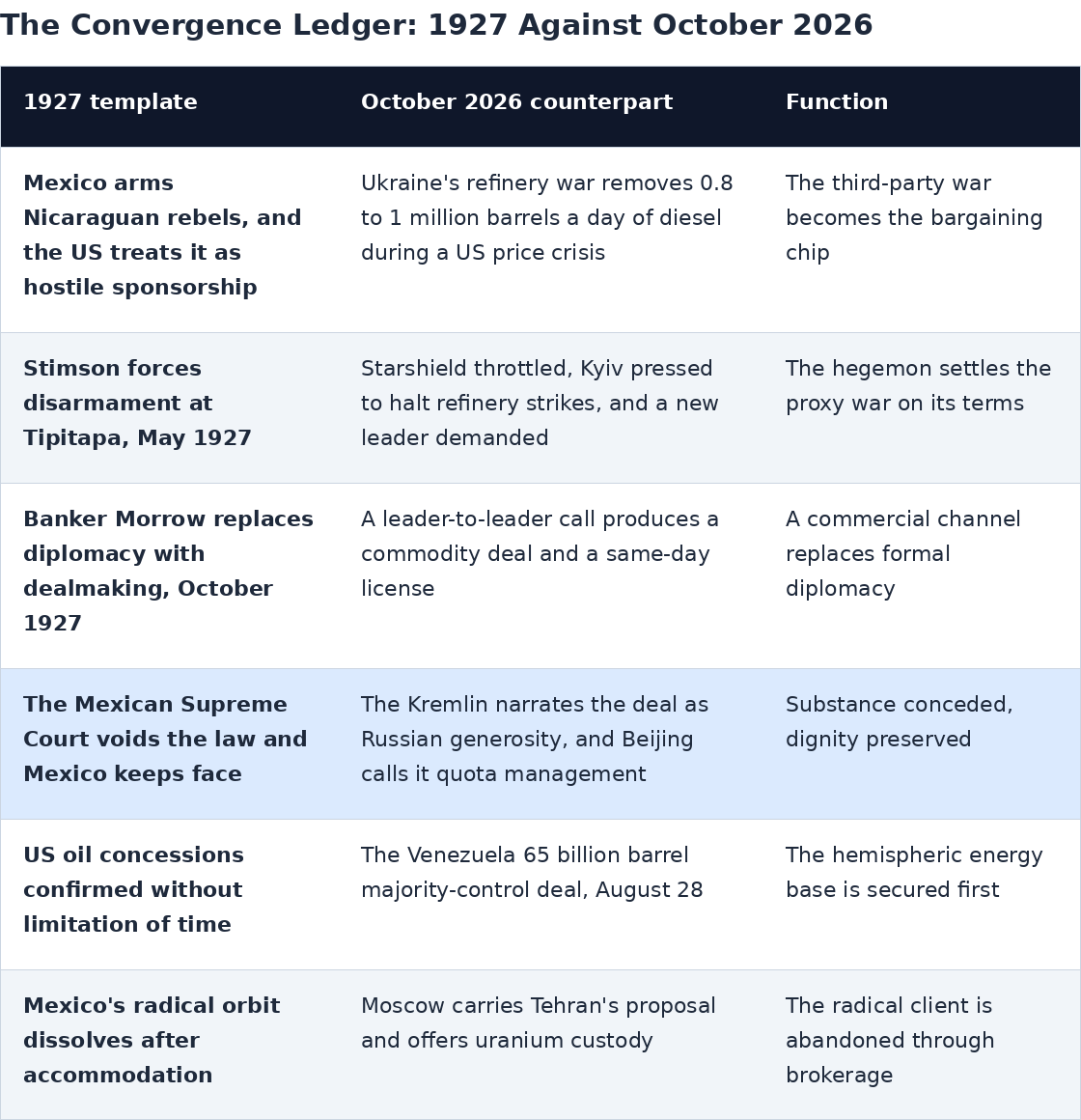
The Convergence Ledger
Reading the Evidence Honestly
The thesis rests on convergence, not on a signed document. Separating what is documented from what is inferred is what makes the argument durable.
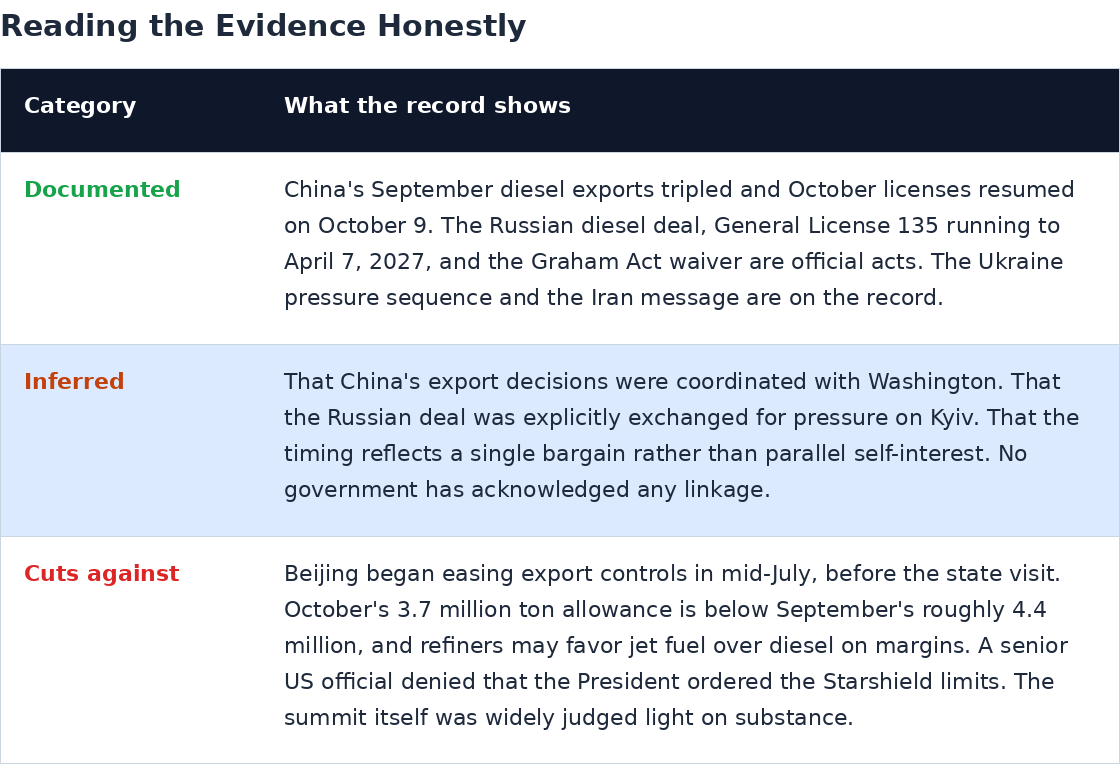
The counter-evidence narrows the claim. It does not dissolve it. Chinese refiners had commercial reasons to export at record margins, but the export valve is a state license, and Beijing chose to open it into decade-low domestic stocks during the weeks of maximum American need. The Russian volume is small, but its smallness is what marks it as political rather than commercial. In the Morrow framework, de facto vassalage is never documented as such. The proof is in behavior that serves the hegemon's priorities while preserving the vassal's narrative, and that pattern is visible on both the Chinese and Russian sides.
The Calendar That Will Confirm or Break the Thesis
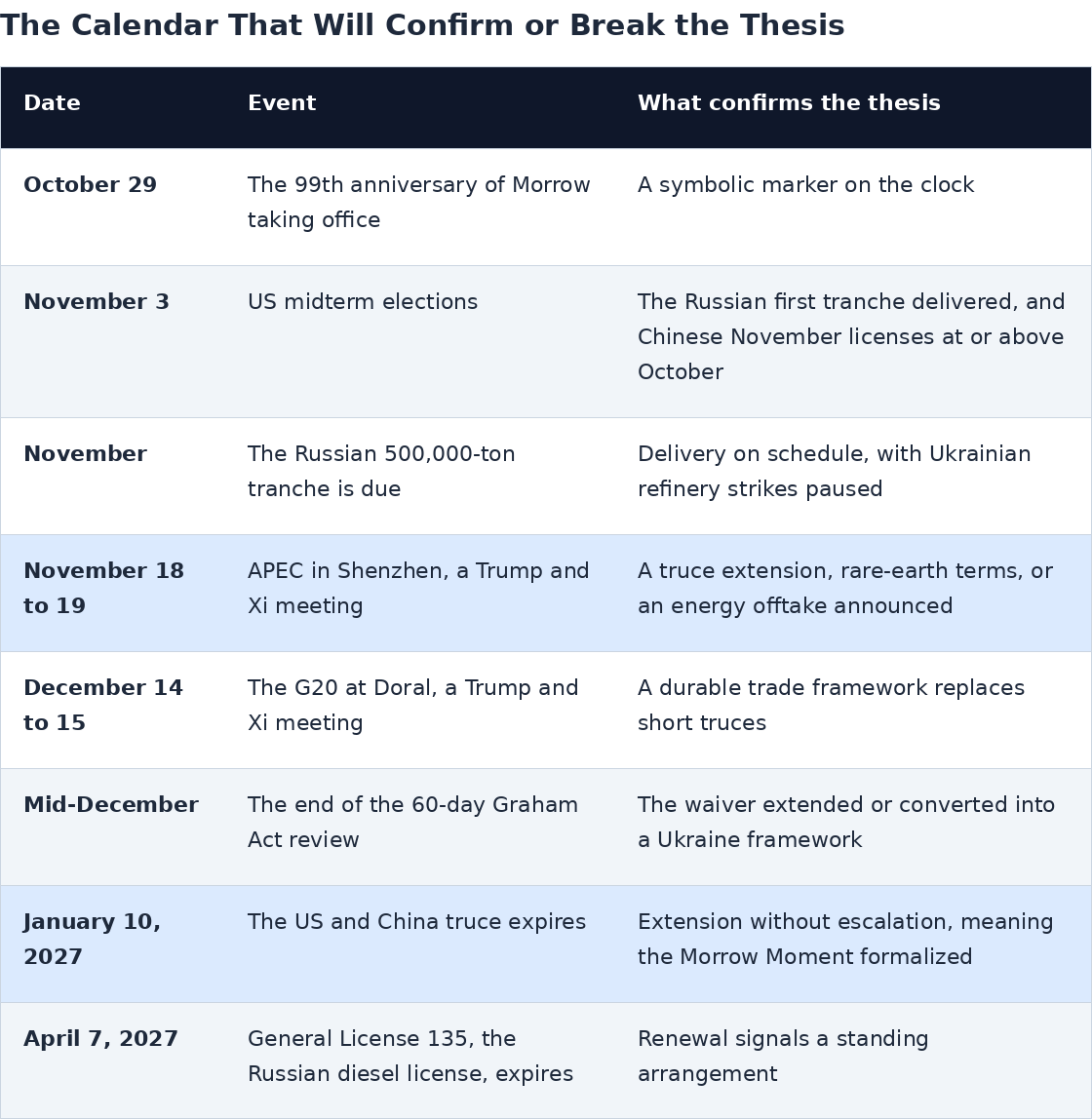
In 1927, the bilateral settlement followed the proxy settlement by months. Tipitapa came in May and the Mexican court ruling in November. If 2026 follows the same order, the Ukraine pressure of October is the Tipitapa stage, and the formal great-power settlement belongs to the November to January window.
Conclusion
The 99-year clock predicted that 2026 would replay the year in which American power resolved its hemispheric oil confrontation not through conquest but through a banker's bargain that let the weaker side keep face. October 2026 delivered that pattern on a global scale. China opened its fuel export valve into its own shortage during the weeks of greatest American need. Russia supplied diesel and received the first diesel sanctions license of the war to run longer than 30 days, followed by a waiver of the sweeping sanctions law signed only a month earlier. Iran's patron became its broker. Ukraine, the third party whose war drives the diesel shortage, absorbed the cost.
No one kissed the ring. Beijing called it quota management, Moscow called it generosity, and Washington called it lower fuel prices. That is the point. The Morrow method never required public submission, only delivery. The decisive confirmation comes at APEC, at Doral, and at the January 10 deadline. If those meetings formalize what October improvised, the Morrow Moment will have arrived on the clock's schedule, and the 1928-equivalent year of 2027 begins on the foundation the framework anticipated.
This report presents a historical-analog framework and geopolitical thesis for research and discussion. Characterizations of motive, coordination and linkage are analytical inferences drawn from the public record, not established facts, and no government has acknowledged the bargain described here. Statements attributed to officials are drawn from published reporting and official readouts believed reliable but not independently verified, and where accounts conflict, as they do on the Starshield order and on intelligence sharing, both versions are given. Market and price data are as of October 18, 2026. This is not investment advice.