Fifteen Pounds and a Share of SpaceX
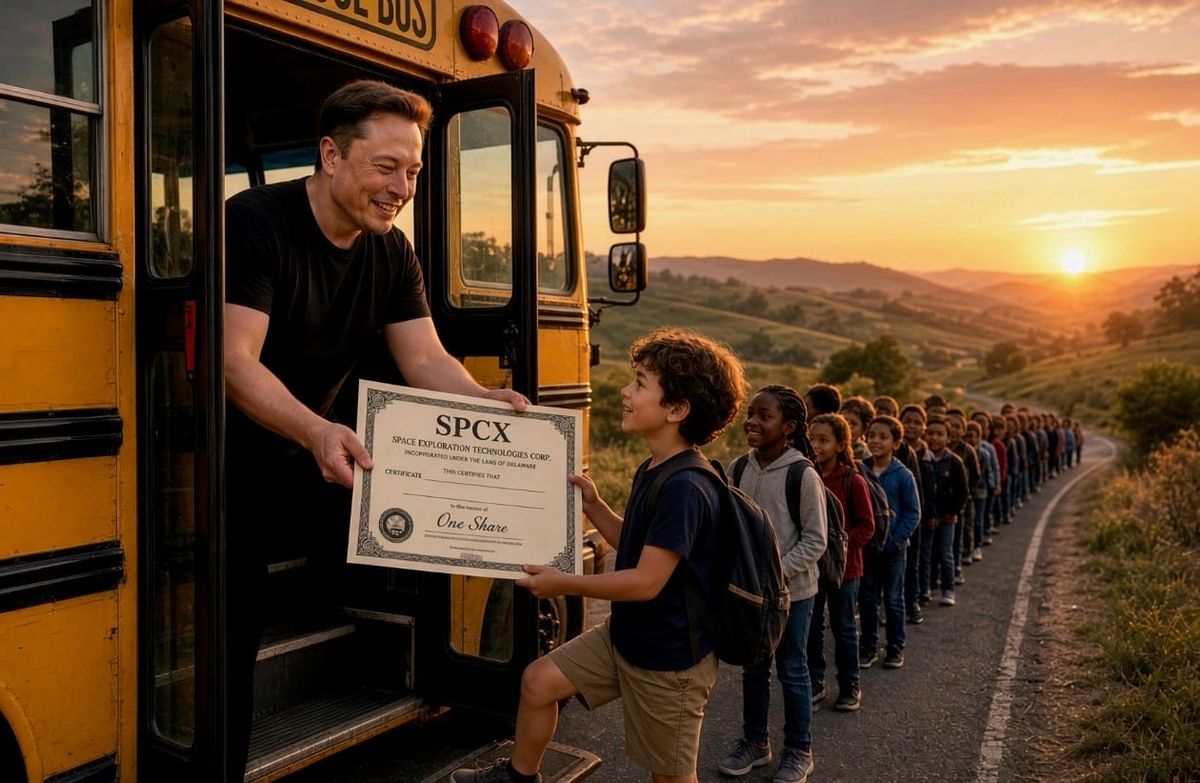
Musk pledged one SpaceX share to every American child and called it the first of many. The real bet is universal high income, and whether the machines can pay for it. SPCX, TSLA. JD Unfiltered Research.
Musk pledged one SpaceX share to every American child and called it the first of many. The gift is small. The idea behind it, that AI and robots will fund a universal high income, is the largest economic claim anyone has made this century. This piece looks at whether the economy can pay for it, what the machines are actually doing in the fields, on the highways, on job sites and in operating rooms, how we might live if he is right, and what it would cost.
Disclosure: the author holds shares and options in both SpaceX (SPCX) and Tesla (TSLA). See the full disclosures at the end of this report.
In the winter of 1795 to 1796, Thomas Paine sat down in revolutionary Paris and wrote a pamphlet that still reads like a policy memo. He called it Agrarian Justice. His premise was that the land had once belonged to everyone, and that private cultivation, however productive, had dispossessed most people of their natural inheritance without compensating them. His remedy was specific. A national fund would pay every person fifteen pounds sterling on reaching the age of twenty-one, "to enable him or her to begin the world," and ten pounds a year for life to everyone over fifty.
Paine did not want to break up the estates. He wanted to tax inheritances and pay the proceeds out in two forms: a lump of capital for the young and an income for the old. Two hundred and thirty years later, the richest man in the world has proposed both halves of that design. He has simply never put them in the same sentence.
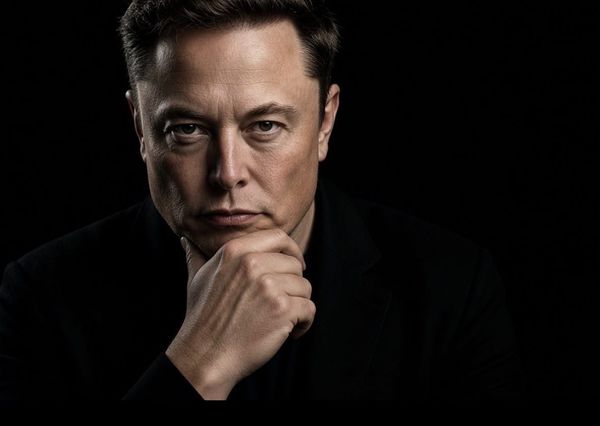
Just before 4 a.m. Eastern on Monday, October 19, Elon Musk posted on X that next year he would "give one of my SpaceX shares to every kid in America," and that this would be the first of many. For more than a year he has argued separately that artificial intelligence and robotics will produce what he calls universal high income, paid by federal checks. The share is Paine's capital stake. The checks are Paine's pension. The share is the smaller half and the easier one to understand, so this article deals with it briefly and then turns to the income, which is a forecast about the entire economy, and to the world that forecast describes and what it would cost us to live in it.
Part One: The Gift
The post contained no mechanics. Musk did not say whether kid means under 18, whether citizenship is required, when in 2027 the shares would move or through what vehicle, and CNBC said SpaceX and his family office did not respond to questions. The scale is simple arithmetic. Roughly 72 to 73 million Americans are under 18, and SPCX closed at $146.03 on Friday, October 16, so one share each is worth about $10.5 to $10.7 billion, the largest charitable gift of Musk's life and about 1.5 percent of the roughly 4.8 billion SpaceX shares he owns outright. The shares come from his own stake, so nobody is diluted. His block is locked until June 12, 2027, so next year probably means the second half of it.
The timing explains the gift. On Sunday, October 18, Anthropic said it would commit at least 5 percent of its shares, about $48 billion, to a Public Benefit Fund that could make grants or "direct distributions to specific populations" affected by AI. Musk replied that he recommended "giving the shares directly to the public," said that was what he would be doing, and seven hours later posted the pledge. Both companies assume AI will create enormous wealth. They disagree about who should hold the deed, a fund with a board or the public directly, and that disagreement is the real subject of this article.
The plumbing to deliver it already exists, which is why the pledge is more than a tweet. Trump Accounts are tax-advantaged investment accounts for children. Temporary IRS rules effective September 30 allow stock to be contributed, with a five-year minimum hold. On October 1 Treasury completed automatic enrollment, announcing that every eligible child under eighteen with a valid Social Security number "now has a Trump Account," and parents cannot refuse a contribution. SpaceX President Gwynne Shotwell pledged a share to about 2 million children in July, and Michael and Susan Dell committed $6.25 billion to seed 25 million accounts. Musk's version is universal, roughly $146 per child, and a tremendous gesture. It will not change any family's circumstances. Its importance is what it points to: a founder of the companies building the machines putting equity, rather than a forecast, behind the idea that the people living through the AI transition should own a piece of it. Everything that follows is about whether that idea, carried to the scale Musk describes, can actually work.
Part Two: The Bigger Picture
The share pledge makes more sense when read alongside eighteen months of Musk's comments on income. The thread is consistent. AI and robots will make goods and services so abundant that the government can pay people well without causing inflation, and work will become optional. He has said it to a British prime minister, a Chinese state broadcaster, The Economist and the President of the United States.
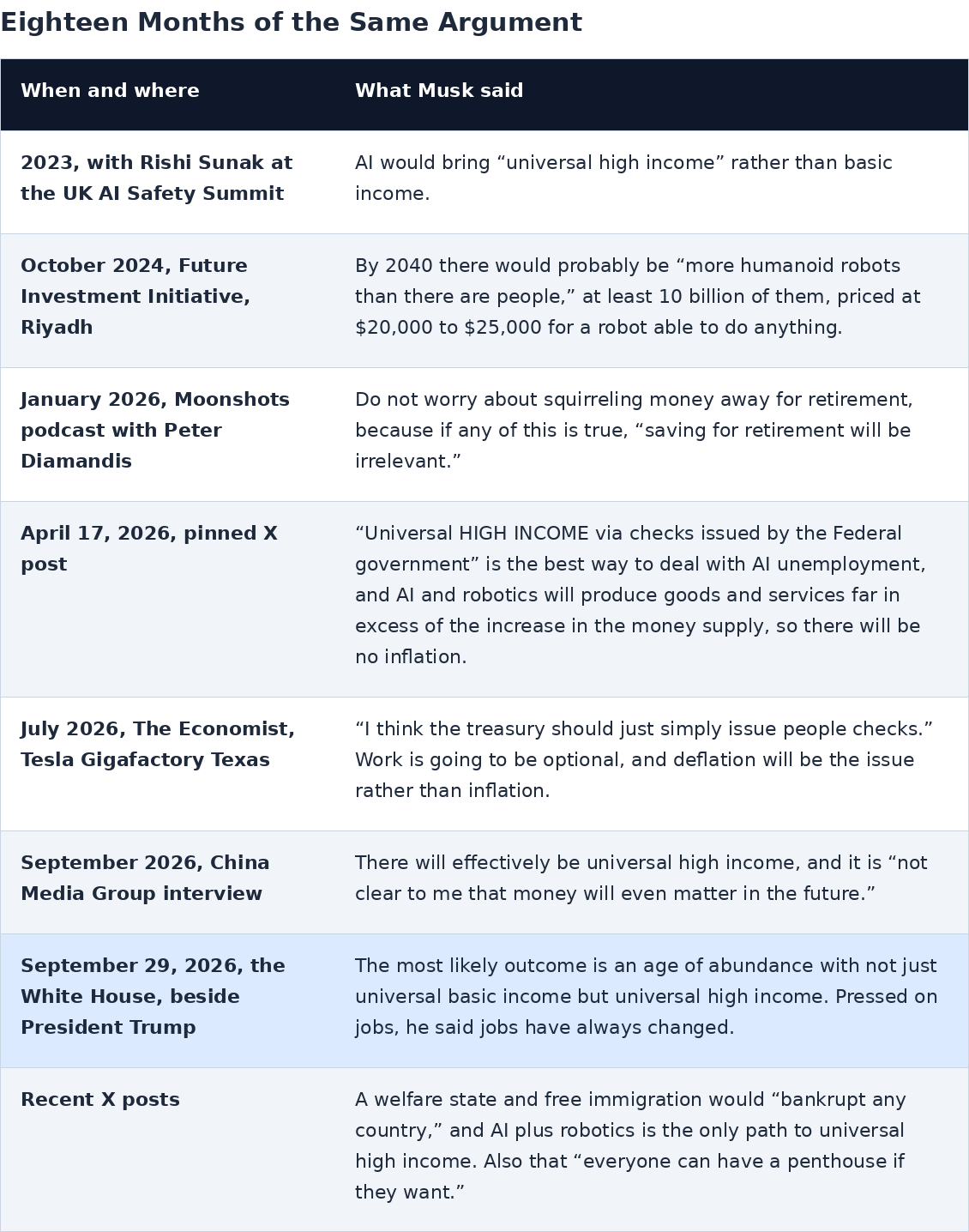
Tesla has written the thesis into its corporate mission. Master Plan Part IV, published in 2025, replaced sustainable energy with "sustainable abundance" and describes Optimus as changing not only the perception of labor but its availability and capability. Musk is not alone in the industry. Sam Altman's June 2025 essay The Gentle Singularity opens with the claim that "we are past the event horizon; the takeoff has started," and argues the transition is proving less strange than it ought to feel. Dario Amodei, whose company's pledge triggered Musk's, told Axios in May 2025 that AI could eliminate half of entry-level white-collar jobs and push unemployment to 10 to 20 percent within one to five years, sketching a scenario in which cancer is cured, the economy grows at 10 percent a year, and "20% of people don't have jobs."
That last sentence is the whole debate in miniature. Musk, Altman and Amodei agree on the destination and disagree on the ride. Musk says the abundance arrives and the checks follow naturally. Amodei says the abundance arrives and a fifth of the workforce is stranded before anyone has agreed how to share it. Everything in the rest of this article is an attempt to decide which of them the evidence supports.
Part Three: Is It Achievable?
The fiscal wall
Start with the money. The United States closed fiscal 2026 with a deficit of $1.992 trillion, 12 percent larger than the year before. A universal payment of $10,000 a year to every resident, which is far below anything that could be called high, costs roughly $3.4 trillion a year, more than the entire deficit and roughly half of current federal spending. At $30,000 a year, closer to what high income might mean, the bill is about $10 trillion, which is approximately a third of US GDP. No tax, no tariff and no billionaire pays for that. Only an economy that is dramatically larger than today's does.
That is why Musk's argument is a monetary one, not a fiscal one. His claim is that if money creation grows more slowly than real output, prices fall, and a large transfer program can be paid for by productivity rather than taxes or debt. He is describing an economy in which the Treasury's checks are not redistribution but a mechanism for distributing purchasing power that would otherwise have no claimant, because the goods are made by machines that do not earn wages. In a strict sense this is coherent. If output doubles and the money supply does not, either prices halve or the money has to get to someone. The problem is not the logic. The problem is the premise. Everything depends on the output arriving first, and arriving at a scale no economist currently forecasts.
What the forecasters say
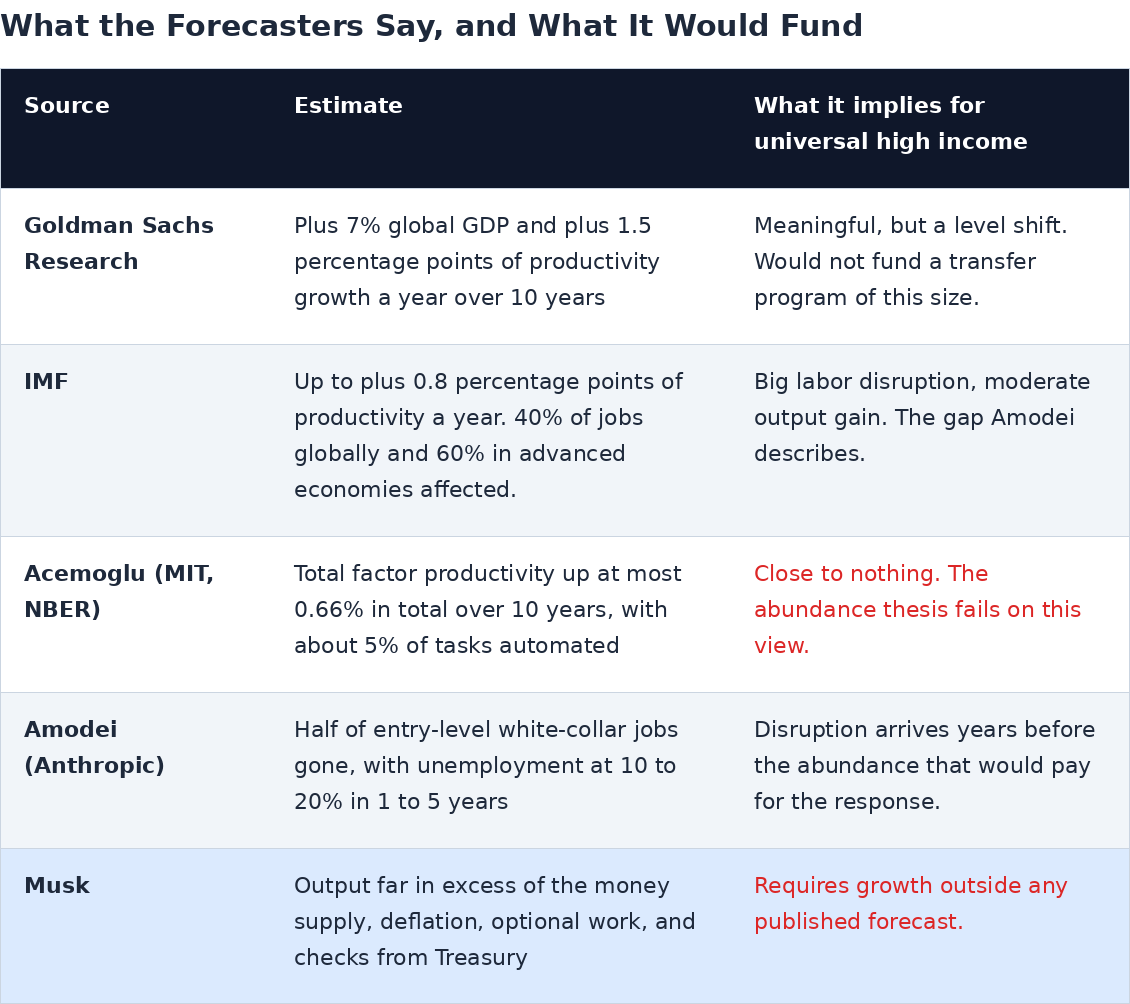
The range of serious estimates for AI's effect on growth is wide, and none of them reaches abundance. Goldman Sachs Research estimates generative AI could lift global GDP by 7 percent and productivity growth by 1.5 percentage points a year over a decade. The IMF's managing director put the productivity boost at up to 0.8 percentage points a year and said about 40 percent of jobs worldwide, and 60 percent in advanced economies, will be "either upgraded or eliminated or transformed." At the other end, Daron Acemoglu's task-based model concludes AI will raise total factor productivity by no more than 0.66 percent in total over ten years, because only about 20 percent of US labor tasks are exposed and only about a quarter of those can be profitably automated with current technology. The disagreement between Acemoglu and Goldman comes down to one assumption: he believes about 5 percent of tasks get automated this decade, they assume 25 percent.
Even Goldman's number is a one-time level shift of 7 percent, spread over ten years. Musk's vision requires something closer to a doubling or tripling of real output per person. There is no mainstream forecast that gets there. That does not make it impossible, since mainstream forecasts have been wrong before and in both directions. But it does mean that universal high income is not a policy proposal. It is a bet on an outcome that lies outside the distribution of expert opinion.
What the labor data say so far
The early evidence is suggestive and contested. Stanford's Digital Economy Lab found that employment of 22 to 25 year olds in the occupations most exposed to AI fell about 11 percent between late 2022 and mid-2026, while employment of the same age group in less exposed jobs rose about 10 percent. The New York Fed put unemployment among recent college graduates at 5.7 percent in June 2026, a full point above two years earlier, with 42 percent of recent graduates working in jobs that do not require a degree. But a UCLA working paper released in September, using Census microdata, found no statistically significant evidence that AI is raising unemployment among new graduates in aggregate. The honest summary is that something is happening at the entry level in exposed occupations, it is not yet visible in the national unemployment rate, and the experts cannot agree whether it is AI, interest rates, or post-pandemic hiring normalization.
The data that is not contested is the labor share. At 52.8 percent it is the lowest ever recorded, and it has been falling through a productivity boom that is producing output gains outpacing wage growth. That is the precise shape of the problem. Output is rising. Wages are not keeping pace. The gains are accruing to capital. Whether or not AI ever delivers abundance, it is already delivering a distribution problem, and that is the problem universal high income is meant to solve.
What the experiments say about checks
Universal income has been tested, and the results are more interesting than either side admits. Finland gave 2,000 unemployed people 560 euros a month for two years with no conditions. Employment effects were small: recipients worked about six more days in the second year than the control group, and reported better perceived economic security and mental wellbeing. The largest American trial, funded by Sam Altman and run by OpenResearch, gave 1,000 low-income adults $1,000 a month for three years against a control group receiving $50. Recipients worked 1.3 fewer hours a week on average, were about 2 percentage points less likely to be employed in years two and three, and earned roughly $1,500 less a year from work. They were also more likely to be actively searching for a job and more likely to insist on work they found meaningful.
Both results point the same direction. Modest unconditional cash does not cause people to stop working, but it does not cause them to work more either, and it shifts their choices toward meaning over money. Reason's critique of Musk, that cash grants reduce work and that paying people not to work during an automation wave is how the jobless outcome becomes real, is grounded in the OpenResearch numbers. But those numbers describe $1,000 a month. Nobody has tested what happens at $5,000, and nobody can, because no economy has the surplus to run the experiment. Alaska is the closest thing to a natural one. The Permanent Fund Dividend, paid from oil and investment revenue since 1982, was $1,702 in 2024, $1,000 in 2025 and $1,200 this year. Its lesson is that resource-funded income is real, popular and politically volatile. The legislature sets the amount each year, and it swings with budgets and commodity prices.
The physical constraints
The abundance thesis also runs through three physical bottlenecks that are easy to forget when the discussion is about software.
The first is electricity. The IEA projects that data center consumption will more than double to about 945 terawatt-hours by 2030, slightly more than Japan uses today, with AI the main driver and the United States accounting for by far the largest share of the increase.
The second is robots. Tesla is building several hundred Optimus units a week at Fremont, roughly ten times its second-quarter rate, with managers targeting more than 1,000 a week by year-end and an eventual 20,000 a week. But as The Information and Electrek report, the robots coming off the line "still can't handle generalized tasks." Meanwhile Chinese manufacturers shipped roughly 19,000 to 25,000 humanoids in the first half of 2026, more than 95 percent of the global total, while American firms shipped a few hundred. Musk's 10 billion robots by 2040 requires the industry to go from tens of thousands a year to hundreds of millions a year within fourteen years.
The third constraint is the one Musk himself identifies: the gap between a robot that can do a task and a robot that can do anything. Every sector below has a version of this gap. Where it has been closed, the economics are already brutal for incumbent labor. Where it has not, the robots remain demonstrations.
Part Four: Sector by Sector
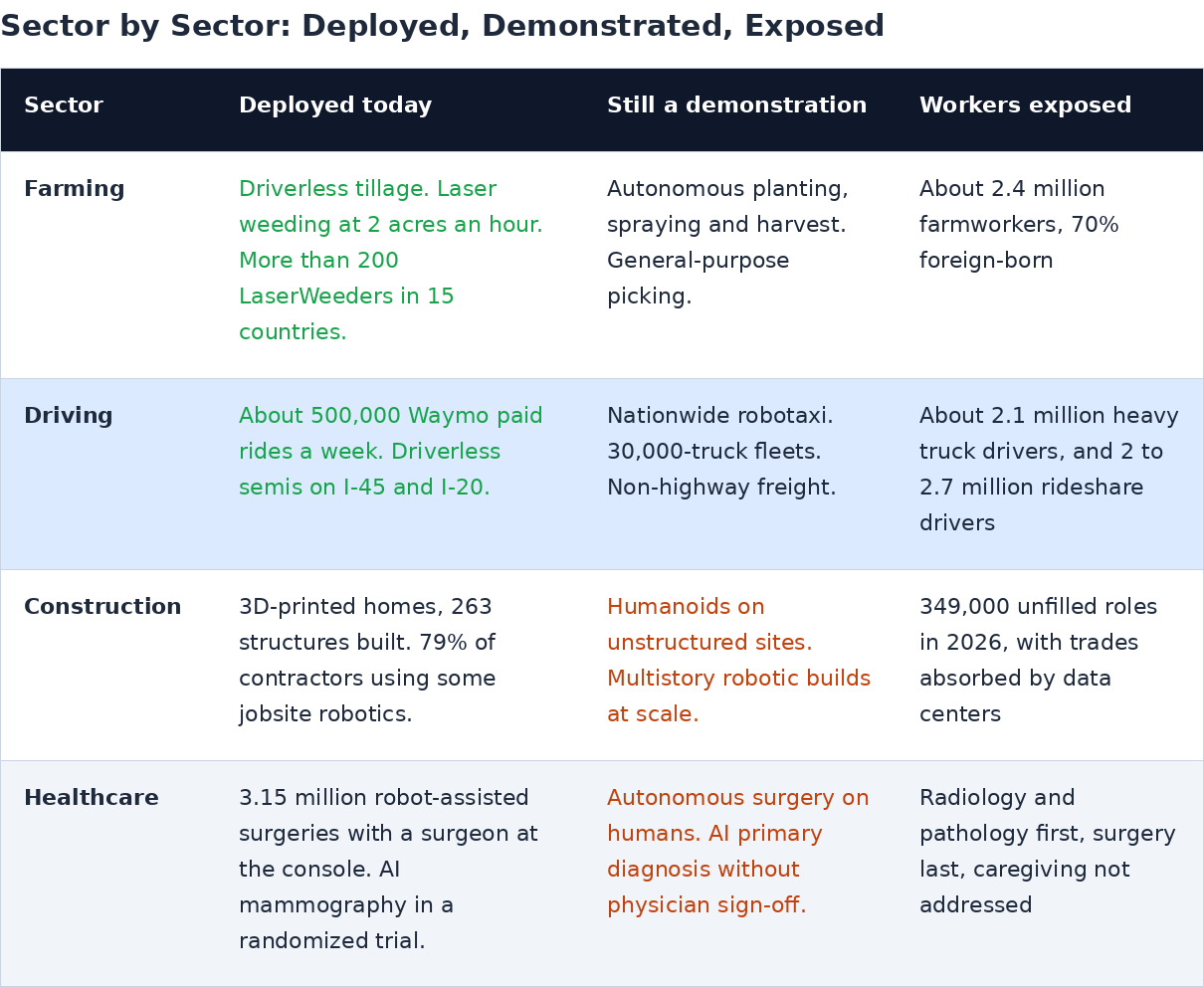
The abundance thesis is not abstract. It is a claim about tractors, trucks, cranes and scalpels. Four sectors employ a large share of the people most exposed to physical automation and account for a large share of what households actually spend money on: food, mobility, shelter and health. Here is where each stands, what is real, what is still a demonstration, and who is in the way.
Farming
Agriculture is where autonomy is furthest along and most invisible. John Deere's autonomous tillage system uses sixteen cameras for 360-degree vision, evaluates every pixel of every frame in about 100 milliseconds, starts the tractor, scans for obstacles and begins work without a driver. The 8R, 8RX, 9R and 9RX tractors now ship autonomy-ready from the factory and retrofit kits fit models back to 2020. But tillage is the only fully driverless job so far. Planting, spraying and harvesting still require an operator in the cab, with automation assisting. Carbon Robotics' LaserWeeder, trained on 150 million labeled plant images, kills more than 100,000 weeds an hour with lasers at about two acres an hour, with more than 200 units in fifteen countries. Robotic strawberry harvesters with two dozen arms are in commercial pilots in Spain and California, with one Israeli startup claiming two to three times human picking speed.
The labor picture is the reason adoption is accelerating. There are roughly 2.4 million farmworkers in the United States. Between 2020 and 2022 about 70 percent were foreign-born and more than 40 percent were not authorized to work. H-2A seasonal visas exceeded 300,000 in fiscal 2022 to 23, up 50 percent in five years, and growers say shortages have been building for more than a decade as immigration enforcement tightens. This is the one sector where the robots are not displacing workers so much as replacing workers who are no longer available. The consequence is not unemployment but a change in who owns the means of production. A laser weeder costs what a decade of a crew's wages costs, and only the largest growers can finance it. Autonomous farming consolidates land.
What abundance looks like here: a row-crop farm run by a handful of technicians and a fleet of machines operating around the clock, with chemical inputs cut sharply because weeding is mechanical and spraying is per-plant. Food gets cheaper and cleaner. The small farm, already an endangered species, becomes a hobby.
Autonomous driving
Driving is the sector where the technology has crossed from demonstration to business. Waymo was running about 500,000 paid driverless rides a week in August 2026 on a fleet of roughly 3,700 vehicles across fourteen US metros, with a target of a million rides a week by year-end. Its safety record is the strongest argument for the entire abundance thesis. Over more than 220 million fully autonomous miles through March 2026, the Waymo Driver was involved in 94 percent fewer crashes causing serious or fatal injuries than human drivers in the same areas. The September update reported 82 percent fewer injury-causing crashes and 95 percent fewer serious-injury crashes, regardless of fault. Roughly 40,000 Americans die on the roads every year. If those ratios hold at scale, autonomy is the largest public health intervention since seat belts.
Freight is following. Aurora runs completely driverless semitrucks on Interstate 45 between Houston and Dallas and on I-20 from Fort Worth to El Paso, has logged more than 500,000 driverless miles since commercial launch, and plans to grow from about 20 trucks to 200 by the end of 2026 and to more than 30,000 by 2030. Bank of America estimates Aurora's service will cost about $0.85 a mile against roughly $1.30 for a human driver's wages and benefits, and Morgan Stanley estimates an autonomous fleet should be "nearly 7.5X as profitable as a human-driven fleet today," because the truck can run up to 20 hours a day instead of being limited by hours-of-service rules. Aurora lost more than $800 million in 2025 and targets positive free cash flow in 2028.
The displacement here is real and specific. There are about 2.1 million heavy-duty truck drivers and 3.5 million Class 8 trucks in the United States. UC Berkeley's Labor Center estimates autonomous trucks could replace as many as 294,000 long-distance drivers, including some of the best-paid jobs in the industry, while creating local and last-mile jobs that, absent policy, will be lower-paid and often misclassified. Add roughly 2 to 2.7 million rideshare drivers whose work is Waymo's addressable market. McKinsey projects autonomous heavy trucks will be 13 percent of the US fleet by 2035, which means the transition is a fifteen-year process, not a cliff. This is the sector where Musk's line that jobs have always changed is both true and insufficient. The long-haul trucking job was one of the last routes to a middle-class income without a degree. The jobs replacing it are not.
What abundance looks like here: transportation as a utility. A family does not own two depreciating cars. It summons mobility at a per-mile price that falls every year. Freight moves overnight at a fraction of today's cost, and the price of everything shipped falls with it. Parking lots become housing. The 40,000 annual deaths become 4,000. The cost is a million or more good jobs and the towns along the interstates that depend on them.
Construction
Construction is the sector where automation has the most to gain and has so far gained the least. McKinsey calculates that global construction productivity improved only 10 percent between 2000 and 2022, about 0.4 percent a year, against 50 percent for the economy as a whole. The industry needs to attract an estimated 349,000 net new workers in 2026 just to meet demand, and job openings sat at 251,000 in August even as residential activity weakened, because data center construction is absorbing the skilled trades. Housing is expensive in large part because building it has not gotten more efficient in a generation.
The robots are arriving late but quickly. ICON, the Austin company whose Vulcan printer built the 100-home Genesis Collection at Wolf Ranch in Georgetown, Texas, raised $200 million in October to deploy a multistory robotic construction system called Titan. It has built 263 structures in the US and Mexico and sold 117 homes. The Wolf Ranch homes list around $600,000, which tells you the technology has not yet made housing cheap. It has made it faster and more resilient. A BuiltWorlds survey found 79 percent of general and specialty contractors used jobsite robotics in 2026, up from 29 percent in 2025, led by layout robots, autonomous site scanners and quadruped inspection platforms. That is a doubling in a year, from a low base, in tasks adjacent to the trades rather than in the trades themselves.
Construction is also where the humanoid robot thesis will be tested, because the work is unstructured, outdoors and different on every site. A tractor runs in a field it has mapped. A truck runs on a highway built to a standard. A building site is new every day. Optimus and its competitors cannot yet handle generalized tasks in a factory, let alone on scaffolding. The sector that most needs the general-purpose robot is the one it is least ready for.
What abundance looks like here: a printed, machine-finished house that costs a fraction of today's price and goes up in weeks, which would do more for the median family's finances than any transfer payment. The consequence is the end of the construction trades as a path to the middle class, and the political fight over whether cheap housing is allowed to be built at all.
Healthcare and surgery
Medicine is where the abundance thesis is most seductive and the gap between demonstration and deployment is widest. Start with what is deployed. Intuitive Surgical's da Vinci systems performed about 3.15 million procedures in 2025, up 18 percent, on an installed base of more than 12,000 systems, with 20.4 million cumulative procedures since 1997, and the company guides to 13 to 15 percent procedure growth in 2026. Every one of those procedures had a surgeon at the console. The robot is a very good instrument, not a surgeon.
Now the demonstration. In July 2025, a Johns Hopkins team published in Science Robotics the results of a system called SRT-H, trained on videos of surgeries, that performed a lengthy phase of a gallbladder removal on eight ex vivo pig specimens with a 100 percent success rate across 17 surgical tasks, responding to voice commands and correcting its own missed grasps. It made independent decisions and adapted to unexpected conditions. It also operated on tissue from a dead animal in a laboratory. The path from there to a human operating room runs through the FDA, malpractice law and the surgeon's own professional guild, and will take years.
Diagnosis is further along than surgery. The MASAI trial in Sweden, the first randomized controlled trial of AI-supported mammography screening, enrolled more than 105,000 women and found AI-supported screening detected 6.4 cancers per 1,000 against 5.0 for standard double reading, while cutting radiologist workload by roughly 44 percent. Microsoft's diagnostic orchestrator, benchmarked against New England Journal of Medicine case records, reached up to 85 percent accuracy on cases where a group of experienced physicians averaged about 20 percent. In drug discovery, Isomorphic Labs has raised $2.7 billion, holds nearly $3 billion in committed milestones from Lilly and Novartis, and has 17 programs under way with a first-in-human cancer trial on the calendar.
Musk's own version of this, delivered at the White House, was that AI will "give you better healthcare than Elon Musk gets." That is the right way to think about medical abundance: not cheaper versions of today's care, but a level of diagnostic attention currently available only to the very rich, delivered to everyone. The consequence is a profession restructured from the top. Radiologists and pathologists feel it first. Surgeons feel it last, because the liability regime protects them. And the fundamental scarcity in healthcare, which is human attention and touch for the sick and the old, is the one thing none of these systems provides. The humanoid robot in the nursing home is the hardest problem in the entire abundance stack, and the one the aging population needs most.
Part Five: How We Might Live
Suppose the optimists are right. Not Musk's 10 billion robots by 2040, but something short of it: the sector trends above continue at their current rates for fifteen years, the humanoid generalization problem is solved sometime in the 2030s, and electricity keeps up. What does a Tuesday look like for a family in 2041?
The children who received a SpaceX share in 2027 are in their late teens and twenties. Their parents did not own two cars. They paid a monthly mobility subscription that cost less than one car payment and never had a fender bender. The house they live in was printed and finished by machines in eleven weeks and cost, in real terms, about what a mid-range sedan cost in 2026. The groceries were grown on a farm with no field workers and no herbicide, and the produce is cheaper than the processed food it replaced. The grandmother's cancer was found at stage one by an AI reader that flagged what two radiologists would have missed, and removed by a surgeon who supervised rather than operated. The family's income is a mixture: one adult works three days a week at something that requires judgment and relationships, the other does not work for pay at all, and a meaningful share of the household budget comes from a federal dividend that is politically contested every year, exactly as Alaska's has been since 1982.
Musk's version goes further. In his September interview with China Media Group he said it is "not clear to me that money will even matter in the future." The penthouse for everyone. In this version work is a hobby, scarcity is a memory, and the question of who owns the robots is moot because the robots make everything for everyone.
The gap between those two pictures is the whole argument. The first is a richer, safer, longer-lived version of the present with a brutal transition for the people whose jobs disappear first. The second is a different civilization. The evidence in Part Four supports the first. Nothing in the evidence yet supports the second, and the robots that would deliver it cannot yet handle a task they were not specifically trained for.
Part Six: The Consequences
The timing problem
The deepest risk is not that abundance fails to arrive. It is that disruption arrives first. Amodei's sequence, in which unemployment hits 10 to 20 percent while the economy grows at 10 percent, is a world in which the output exists but the mechanism for distributing it does not. Universal high income is Musk's answer to that mechanism problem. But a transfer program at the scale he describes requires a fiscal base that only exists after the growth, and a political consensus that only forms after the pain. Alaska built its fund during the boom, before anyone needed it. The United States would be building one during the bust, at a $2 trillion deficit, while the people who need it most are the ones least able to wait.
The ownership problem
The second consequence is already visible in the labor share data. If AI and robots do the work, income flows to whoever owns the AI and the robots. Goldman's note is explicit that continued automation will likely push labor's share lower still, and the equities that capture the other side are held overwhelmingly by the top tenth of households. In an abundance economy this is not a side effect. It is the central fact. A world in which the robots make everything and a few hundred thousand families own the robots is not a world of universal high income. It is a world of universal dependence on the generosity of the owners, administered through either a government they influence or a foundation they control.
The only durable answer to that is broader ownership of the capital itself, which is the half of Paine's design that the income debate usually forgets. Alaska did it with a sovereign fund. Employee ownership does it inside companies. The Trump Account framework, with Shotwell, Dell and now Musk contributing shares, is a first and very small version of doing it for a whole generation. None of these is anywhere near the scale of the problem. But a transfer program without an ownership base is a permanent negotiation between the owners of the machines and everyone else, and the history of such negotiations is not reassuring for the second party.
The meaning problem
The third consequence is the one the experiments keep finding. Finland's recipients reported better wellbeing but did not work more. OpenResearch's recipients worked slightly less and put a higher value on meaningful work, not a lower one. People do not want to be paid not to work. They want work that matters and the security to insist on it. Musk's line that work is going to be optional is a prediction about economics. Whether it is a prediction about human flourishing is a question no economist can answer, and the record of communities that lost their industries, from the coal valleys to the mill towns, is not encouraging about what happens when the work goes and the money comes anyway.
The power problem
The fourth consequence is political. An economy in which the Treasury issues checks funded by the output of privately owned machines is an economy in which the owners of those machines hold a kind of leverage no industrialist has held before. Musk's own argument that a welfare state will "bankrupt any country" while AI-funded income will not depends on the owners of the AI continuing to produce and continuing to share. The same morning he pledged $10 billion to children, October 19, CNBC noted he had given $276 million to one political party since July. None of this is sinister in itself. It is a reminder that in the world he describes, the distribution of abundance is decided by whoever owns the means of abundance, and that the decision will be made through politics the owners are already financing.
The safety and skill problem
Finally, the sectors themselves carry consequences that have nothing to do with income. If Waymo's ratios hold, autonomy saves tens of thousands of lives a year, and resisting it will become indefensible. But a surgeon who supervises rather than operates for twenty years loses the skill to operate when the machine fails, and a radiologist who confirms rather than reads loses the eye. A farm with no workers has no one who knows the land. These are not arguments against the machines. They are the costs of the transition, and they are paid by the people who are told that jobs have always changed.
The Bottom Line
Universal high income is a bet about the whole economy. No mainstream forecaster currently endorses the growth it requires. At even a modest level it would cost several trillion dollars a year against a $2 trillion deficit. And the pilot studies suggest cash at the scale actually tested changes how people choose work more than whether they work. The monetary logic is coherent only after the output arrives. The output is arriving, but in pieces, and the pieces are not arriving in the order the plan needs.
The sectors tell a consistent story. Where the environment is structured, in the field and on the highway, the machines are already better and cheaper than people and the displacement is under way. Where the environment is unstructured, on the job site and in the operating room, the machines are instruments or demonstrations, and the general-purpose robot that would change that cannot yet handle a general-purpose task. The people in the first sectors will not be able to wait for the checks the last sectors are supposed to fund. That is the timing problem, and it is the most likely way the abundance thesis fails even if it is eventually right.
The world Musk describes is worth wanting. Cheaper food, safer roads, housing that costs what a car costs, diagnosis at the level the very rich get today. The question is not whether that world is desirable but who owns it when it arrives, and what happens to the people who get there last. Paine's answer was a capital stake and an income, funded by the people who held the assets. Musk's answer, so far, is an income funded by growth that has not happened and a gift of one share. The gift is the right instinct. The income is the right ambition. What sits between them is an execution plan nobody has written, and the clock on the first sectors is already running.
Important Disclosures
Position disclosure. The author holds shares and options in Space Exploration Technologies Corp. (SPCX) and Tesla, Inc. (TSLA) as of the date of publication. The author may buy, sell, add to, reduce, hedge or close these positions, including options positions, at any time before or after publication and without notice. The author has a financial interest in the securities discussed and may benefit from price movements that follow publication. Readers should treat this article as the opinion of an interested party.
No investment advice. This article is for informational and educational purposes only. It is not investment, legal, tax or accounting advice, and it is not a recommendation or solicitation to buy, sell or hold any security or derivative. It does not take into account the investment objectives, financial situation or needs of any reader. Consult a qualified, licensed financial adviser before making any investment decision.
Opinion. The views expressed, including the assessment of universal high income, the sector outlooks and the scenario described in Part Five, are the author's opinion. Statements by Elon Musk, Tesla, SpaceX, Anthropic, OpenAI and other companies about future products, robot production, pricing, timelines and economic outcomes are management expectations and not achieved results. The one-share-per-child pledge is a stated intention. Its eligibility rules, timing and vehicle had not been disclosed as of publication and it has not been documented in any SEC filing. Transfer-program cost figures and return scenarios are illustrative arithmetic, not forecasts.
No affiliation or compensation. JD Unfiltered and the author are not affiliated with SpaceX, Tesla, Anthropic, Elon Musk or any other company or person cited. The author received no compensation from any issuer, underwriter or third party for preparing or distributing this article.
Forward-looking statements. This article contains forward-looking statements about technology development, labor markets, productivity, public policy and share prices. Such statements involve significant risks and uncertainties, and actual results may differ materially. The author undertakes no obligation to update this article as circumstances change.
Information and accuracy. Information is drawn from public sources believed to be reliable, including government statistics, company reports, academic studies and news coverage, but its accuracy and completeness are not guaranteed. Market data is as of the October 16, 2026 close unless otherwise noted, the price at which the pledge was valued in press reporting. Past performance is not indicative of future results. All investments involve risk, including loss of principal.