Selling the Printing Press

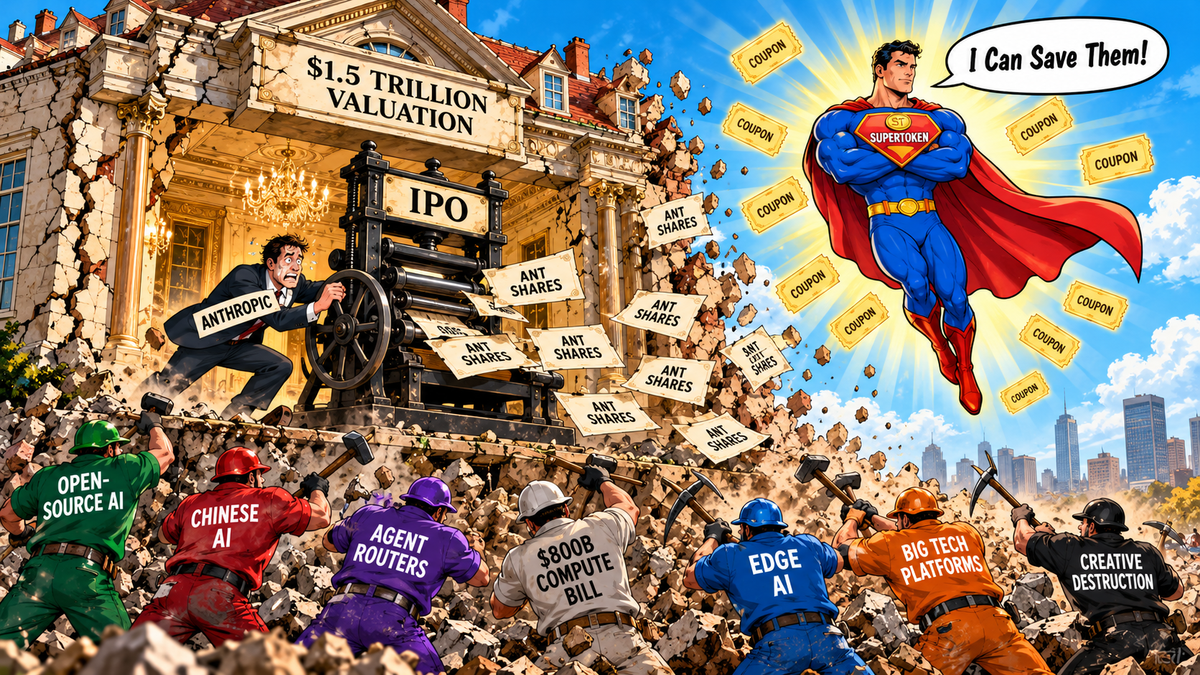
Why valuation does not survive the forces now reshaping AI, and why the company is racing to list before the market sees them.
The argument in brief
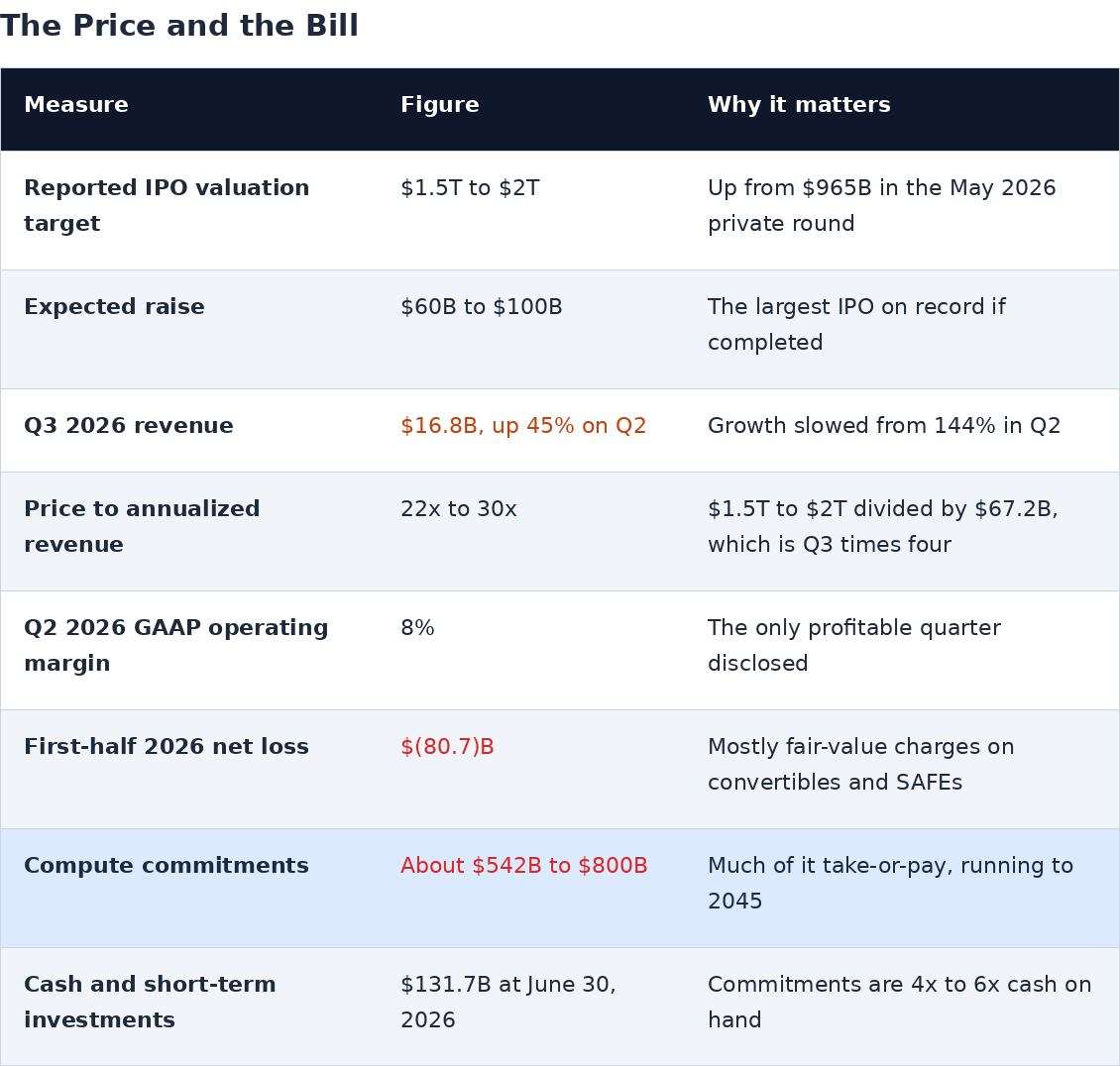
Anthropic is asking public investors to pay roughly $1.5 trillion to $2 trillion for a company whose most recent quarter brought in $16.8 billion of revenue. At that price, buyers are paying 22 to 30 times annualized revenue for a business that has posted one quarter of GAAP operating profit, carries an estimated $540 billion to $800 billion of compute commitments against about $132 billion of cash, and faces six forces that push the price of its core product down while pushing its customers toward someone else's front door.
Our thesis has two parts. First, the valuation assumes Anthropic remains the premium supplier of frontier intelligence to large enterprises for a decade or more. We believe Schumpeterian forces make that assumption untenable: the price of intelligence is collapsing, the incumbent customers are the ones being creatively destroyed, and the new buyers, displaced experts turned sole practitioners, will reach AI through agents, devices and private edge systems Anthropic does not own. Second, in our view the timing and structure of the offering read like a company that understands this and is converting a peak private valuation into a public currency while it can. A listed stock is a printing press. We believe Anthropic needs one to service fixed obligations its revenue may not reach.
1. The price and the bill
The growth is real. Quarterly revenue rose from $376 million in the first quarter of 2025 to $11.6 billion in the second quarter of 2026, and the company turned a $974 million operating profit in the second quarter. But the rate of growth matters more than the level when a stock is priced at 22 to 30 times sales, and that rate is already falling: third-quarter revenue grew 45 percent over the second, after 144 percent the quarter before.
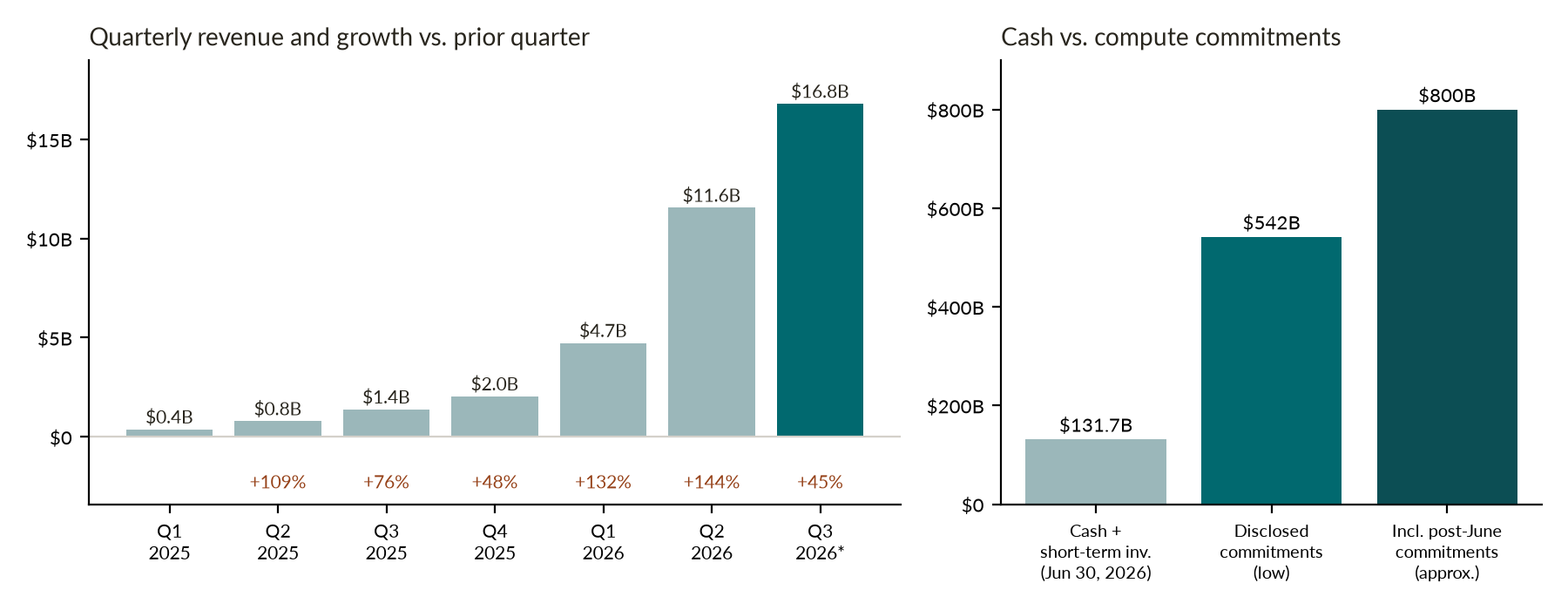
Against that revenue sits a compute bill on a different scale. The S-1 discloses about $417 billion in new minimum payments signed after December 31, 2025, another $125 billion to $150 billion for capacity delivered from 2028 to 2031, and, by The Register's count, roughly $245 billion more signed after June 30, 2026. Several of the largest contracts, with Amazon, Google, Microsoft and Broadcom, are non-cancellable and must be paid whether or not the capacity is used. Over a decade, the disclosed $540 billion alone averages about $54 billion a year, a large share of Anthropic's entire current revenue run rate before a single employee is paid.
The customers, by contrast, are flexible. The S-1 warns that many large customers have no long-term contract or one that expires soon, and can reduce spending at any time. The top five account for about a quarter of revenue. Fixed costs against flexible revenue is the structure that turns an 8 percent margin into a deep loss the moment growth stalls.
A valuation of 22 to 30 times sales assumes the growth curve keeps bending upward. The S-1 shows it is already bending down, while the bill keeps rising.
2. Force one: the price of intelligence is collapsing
Anthropic's own filing concedes the threat. It warns that open-weight models may cause pricing pressure, that competitors may sell at zero or negative margins or subsidize AI, and that rivals may try to distill Claude's capabilities, which could reduce competition to a contest of who owns the most compute. The company is accelerating the decline itself: Opus 5.5 cut customer cost per task by about 40 percent against Opus 5.
The competitors are no longer far behind. Chinese open-weight systems such as Kimi K3, Qwen3.8-Max and DeepSeek V4-Flash are now reported to rival top US systems. In our view, state support and distillation let these developers price below what a company carrying $540 billion or more of take-or-pay commitments can sustain. Meta, meanwhile, gives its Muse Spark Open model away to many developers and calls it the most capable US open-weight model to date, and it runs on two Mac Studios. Its Muse Glimmer agent model runs on a single consumer graphics card.
When quality converges, the premium disappears. The compute bill does not.
3. Force two: the customers are the ones being destroyed
Anthropic's revenue is anchored to incumbents. Customers paying $100,000 or more a year produced 76 percent of 2025 revenue, and more than half the Fortune 500 are customers. Those are exactly the institutions AI is now hollowing out. American Express is cutting about 5 percent of its workforce to prepare for AI. Microsoft has offered voluntary buyouts to roughly 60,000 employees, about 27 percent of its workforce. Layoffs.fyi data attribute 69 percent of 2026 layoffs to AI, up from 29 percent in 2025.
Our scissors argument projects that AI converts roughly 23 million American experts from hourly billing to outcome-based work. As these highly educated people are laid off, many are forced into entrepreneurship. They begin taking risk. They care about quality, but at the lowest possible cost, because they have never paid for their own support systems: IT, legal, accounting, billing, insurance, capital. They will adopt agentic AI to do the work their former employers did, and then come for those employers' clients. Schumpeter called this creative destruction. A company whose revenue depends on the incumbents is selling picks to the side that is losing.
Anthropic's best customers are the incumbents being creatively destroyed. Its future customers are the people those incumbents are laying off.
4. Force three: the sole practitioner, and why Anthropic is turning them away
We believe the largest and most profitable growth in AI will come from firms of five or fewer people doing the work that once required a large company. They care about quality, and they will not tolerate a tool that refuses legitimate work.
Anthropic launched Fable 5 with almost all biology queries blocked, and says professional biology research and drug development are still not usable on it. An early expert-written benchmark found older Claude models refused 34 to 44 percent of legitimate biology research questions, while the other fully tested models refused none. The workaround, a verification program, requires an application, 30-day data retention and separate grants for high-risk projects, and excludes personal Pro and Max plans entirely. The S-1 itself acknowledges that safeguards could make Claude less usable and reduce demand.
For an institution with a compliance department, that is friction. For a five-person biotech or a solo researcher, it is a reason to leave, and every one of them that leaves is a customer the valuation assumed would stay.
5. Force four: agents owned by others choose the model
This is, in our view, Anthropic's largest structural problem. The decision about which model does the work is moving from the user to an agent, and Anthropic does not own most of those agents.
Perplexity Computer routes tasks across 19 models from Anthropic, OpenAI, Google and others, choosing per task. Its Portable Computer runs a local 27-billion-parameter model, Perplexity's own or Alibaba's Qwen, as the orchestrator, and calls paid cloud models only when it decides it needs one.
Apple's iOS 27 Siri Extensions let the user, or Siri, pick Claude, ChatGPT or Gemini for each request.
Microsoft offers more than 11,000 models, including OpenAI, Anthropic, xAI and its own MAI family, and is paid whichever wins. It holds about a 27 percent stake in OpenAI, now diluted to roughly 25 percent, and collects a 20 percent revenue share through 2030.
A router sends routine work to cheap or local models and calls the frontier model only for the hardest steps. Anthropic can keep a high price per token while its total revenue per user shrinks, and it must fill hundreds of billions of dollars of fixed capacity with whatever residual work other companies' agents choose to send it. Over time, routing throttles the independent model makers and hands the economics to whoever owns the device, the operating system or the free model: Apple, Google and Meta.
6. Force five: AI moves to the edge
The developers being laid off add another group to this story. Small firms do not trust that their data is private or that their ideas are safe in someone else's cloud. Data security is now the top AI barrier for small-business owners, rising from 23 to 33 percent in a year on Bluevine's survey. IDC reports small firms asking vendors directly whether their customers' data is being used and how long it is stored. Two-thirds of small and midsize businesses already use self-built AI tools.
What they lack is talent. On Goldman Sachs' survey, 73 percent say they need more help implementing AI, and only 14 percent have it fully integrated into core operations. Displaced developers fill that gap by building private, local systems on free open-weight models. Local models already handle routine, sensitive, high-volume work, with the cloud reserved for complex multi-step reasoning. We expect this to sprout over the next two years. Each private edge deployment is volume that never touches Anthropic's take-or-pay capacity.
7. Force six: the integrated platforms own the front door
Anthropic is an engine sold inside other companies' cars. Cloud marketplaces carried 48 percent of its first-half 2026 revenue and 58 percent of its receivables. The companies that supply its compute, Amazon, Google and Microsoft, are also its investors, its sales channels and, in Google's case, a direct model competitor. The S-1 warns that distribution partners may favor their own competitive offerings. SpaceX, which rents Anthropic up to $120.5 billion of compute, can reclaim capacity for its own Grok models on 90 days' notice from early 2027.
Component suppliers can be very profitable while they are clearly the best. Intel was inside every PC until Apple decided its own chips were good enough. Anthropic's distributors are each building or adopting substitutes. In the world we describe, the platforms that own identity, payments, data and defaults capture the solo practitioner, and the stand-alone model maker gets the hard steps at a declining price.
8. The printing press
If these forces are visible to us, they are visible to the people running Anthropic. The question is what a company does when it holds a peak private valuation, a fixed bill measured in hundreds of billions, and a product whose price is falling. Our answer: it lists, quickly, and turns its valuation into a currency it can print. The record below is factual. The inference about motive is ours.
Speed. Anthropic submitted its confidential draft on June 1, 2026, filed four amended drafts by October 9, made the S-1 public on October 26, and is reportedly targeting a listing the week of November 16.
Size. The reported $60 billion to $100 billion raise would be the largest on record, at a valuation up to roughly double the $965 billion private round of May 2026.
Commitments signed ahead of the listing. About $417 billion of new minimum payments were signed after December 2025, and about $245 billion more after June 30, 2026, the same months the IPO was being prepared.
Equity as payment. Up to $77 billion in convertible notes can be issued to Amazon, Broadcom and Google, and convert into Class N shares. A public price lets suppliers be paid in stock rather than cash.
Automatic share issuance. The company will contribute 5 percent of fully diluted shares to a Public Benefit Fund, plus up to an additional 2 percent for each 50 percent rise in the stock price over four years.
Early exits. Shares held by non-founder directors, officers and certain employees become sellable on the first trading day, with further staggered releases on days 27, 48, 62 and 76, well before a standard 180-day lock-up ends.
Each of these makes sense if management expects the private-market price to be the high point. A public listing lets Anthropic pay suppliers in stock, raise follow-on equity, and give insiders liquidity, all while the growth story is at its most persuasive. That is what we mean by a printing press: a way to meet fixed obligations with newly issued shares when revenue alone may not be enough.
A company that expected its value to keep compounding would have reason to wait. A company that sees the Schumpeterian forces coming has every reason to print while the presses are hot.
9. What the bulls will say, and why it falls short
The margins have already turned. The second quarter of 2026 posted an 8 percent GAAP operating margin. One quarter is not a trend, and it came before the steepest commitments begin.
Net revenue retention is about 900 percent. That measures how fast incumbents are expanding pilots into deployments. It says nothing about how long those incumbents survive in their current form.
The headline loss is mostly accounting. True: about $72.4 billion of the first-half loss is fair-value charges. But those charges exist because investors were promised conversion into the shares now being sold.
The SpaceX deal can be cancelled. So can SpaceX's side, and SpaceX has said it may reclaim capacity for Grok. Flexibility that runs both ways is a supply risk.
Anthropic already serves solo users. About 40 million customers spend under $100,000 a year. They pay subscriptions measured in dollars per month against commitments measured in hundreds of billions, and they are the users most exposed to free and local alternatives.
10. What would have to change
We do not argue Anthropic disappears. We argue it cannot justify a trillion-dollar-plus valuation as an independent premium supplier to incumbents. To survive independently, it would need to move its pricing toward the people who will sell its product for it: developers, consultants and outside IT providers who bring in small-firm customers, paid only when those customers pay, with privacy guaranteed through local or dedicated deployment. That is the logic of the SuperCoupon Token model, where the distributor is rewarded on conversion rather than on access.
Anthropic already pays cloud providers a fee for every sale through their marketplaces. The S-1 shows no comparable program for the small resellers who will reach the next 23 million buyers. Until it builds one, the forces described here work against it, and the valuation investors are being asked to pay assumes they do not exist.
Whoever provides the products the displaced masses use, worldwide, wins. On today's strategy, that is unlikely to be a stand-alone model maker that owes more than it holds.
This paper is an opinion and analysis piece based on public filings and reporting as of October 27, 2026, including Anthropic's S-1 and coverage by NPR, Yahoo Finance, Fortune, The Register, CNBC, Reuters, TechCrunch, MacRumors, Forbes and Gizmodo. Statements about management's intent are the authors' inference. Anthropic's registration statement is not yet effective and its offering terms have not been set. Third-quarter figures come from reporting on an investor meeting rather than from the filing, and commitment totals are press aggregations the filing itself does not state. It is not investment advice or a recommendation to buy, sell or avoid any security.
The SuperCoupon Token referenced in Section 10 is a product of BCII Enterprises, whose co-founders have a direct commercial interest in its adoption. The authors hold positions in securities mentioned and reserve the right to buy or sell shares at any time without notice.