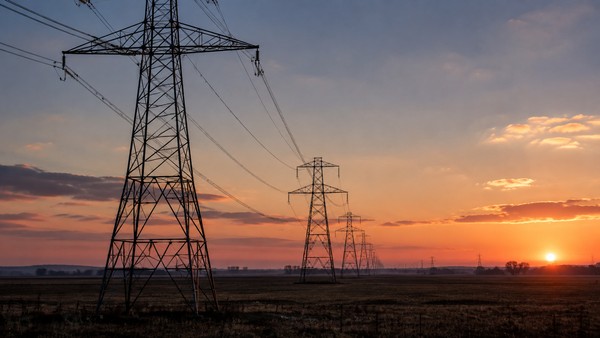
The Colossus Doctrine


A JD Unfiltered Special Report. How Scott Bessent learned from 1929, why the 99-year clock keeps perfect time until the moment it breaks, and why the 2030s belong to America.
"The greatest and boldest operation ever undertaken by the Federal Reserve System, and one of the most costly errors."
Adolph Miller, Federal Reserve Board, on the rate cut of 1927
The One-Paragraph Version
A hundred years ago, America had the greatest economic boom in its history, then the worst crash, then a decade-long depression. Today America is living through an almost identical boom, driven by two new technologies, and it is on track for another huge crash around 2028. Here is the twist. The people running the US economy know this story cold, and they have quietly rebuilt the system so that the boom and even the crash can happen, but the depression cannot. If they are right, the crash will hurt for about a year, and then the 2030s become the most dominant American decade ever, because when the rest of the world panics, all of its money now runs to the United States.
Everything below is the long version of that paragraph.
Five terms that carry most of the argument.
I. The Clock: May 1921 Equals May 2020
Every JD Unfiltered forecast rests on a single calibration. The American market of the 2020s is replaying the American market of the 1920s on a 99-year offset, anchored at May 1921 equals May 2020.
May 1921 was the bottom of the forgotten depression, a brutal deflationary purge that ended the wartime economy and cleared the ground for the greatest peacetime boom in American history. May 2020 was the bottom of the pandemic crash, an equally violent purge that ended one economy and ignited another. Both bottoms were made by policy reversal, and both were followed by the same rare configuration: a general-purpose technology reaching critical mass, a new monetary technology exporting the dollar, and a Treasury working hand in glove with the central bank.
The analog is not numerology. Cycles rhyme when the structure underneath them rhymes, because crowd psychology is the one constant in markets. Markets are made of people, and people in crowds behave the same way in every generation. First they doubt a new technology, then they adopt it, then they get greedy, then they borrow money to get greedier, and then it all comes down. When the same three engines occupy the same positions on the board, a productivity revolution, a monetary plumbing revolution, and Treasury-led policy alignment, the crowd runs the same program: disbelief, adoption, euphoria, leverage, and the vertical top.
The 99-year clock has kept time through six years because the structure has matched for six years. The forecast that follows from it is specific: an easing into strength in 2026, a vertical year in 2027, a peak in the summer of 2028, a crash of roughly half, and then, precisely where the 1930s produced a depression, a recovery.
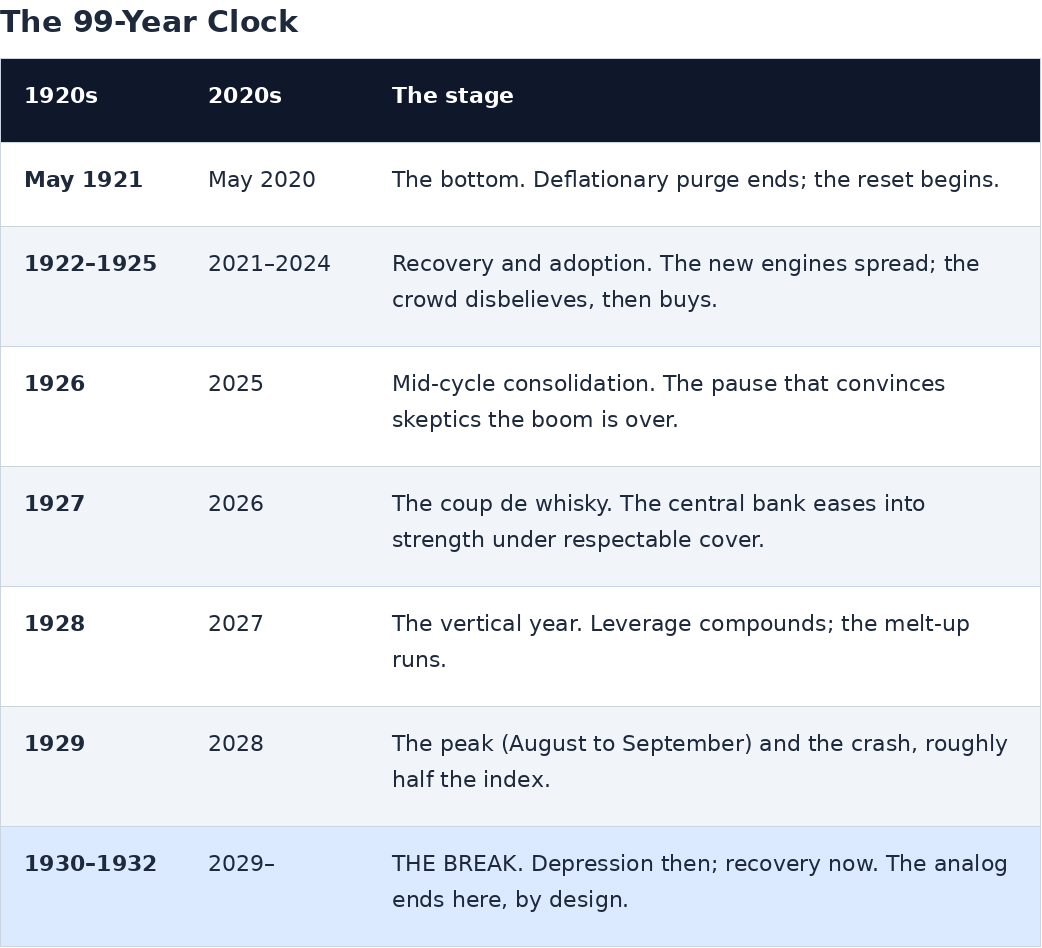
The clock keeps perfect time until the moment it breaks, and it breaks in America's favor.
II. The Engines: Two Technologies, Twice
The 1920s ran on two engines. The first was electrification. American industry had been wiring itself for decades with little to show for it, the famous dynamo delay, until the factory floor was finally rebuilt around the electric motor and manufacturing productivity exploded at better than five percent a year from 1919 to 1929. By 1929, electric motors supplied roughly 78 percent of factory drive capacity. The productivity was real, which is why the boom was real before it became a bubble.
The second engine was monetary: the dollar acceptance market. The Federal Reserve Act of 1913 authorized American banks to finance world trade in dollars for the first time, and Benjamin Strong's New York Fed deliberately made the market, standing as buyer of bankers' acceptances to bootstrap dollar finance. It worked. By 1927 the dollar had overtaken sterling as the leading currency of international trade finance. A machine that multiplied American output, and a wire that exported American money.
The 2020s run on the same pair. The first engine is energy plus intelligence. The fracking revolution, incubated for decades through federal research programs and George Mitchell's stubbornness in the Barnett, has made the United States the largest producer of oil and gas in history, at roughly 24 million barrels a day of petroleum output, with record LNG exports feeding allies. That domestic BTU surplus is what powers the AI buildout, the electrification analog, whose data centers are the new factory floor.
The second engine is monetary: the GENIUS Act, signed July 18, 2025, which created the first federal charter for dollar stablecoins. The float has already grown roughly 50 percent since early 2025 to about $320 billion, and Treasury Secretary Bessent projects roughly $3 trillion by 2030. Dollar stablecoins move value across any border, largely beyond the reach of capital controls. Anyone in Argentina, Nigeria, or Japan can now hold American dollars on a phone. It is the acceptance market rebuilt as software.
Each era pairs a machine that multiplies American output with a wire that exports American money. The machine makes the boom real. The wire makes the dollar unavoidable.
III. The Student of the Tape: What Bessent Learned
Here is the fact that separates this cycle from every previous rerun of an old mistake. The man running the United States Treasury is a professional historian of exactly this tape.
Scott Bessent taught economic history as an adjunct professor at Yale, and one of his three courses was titled, precisely, "Twentieth Century Financial Booms and Busts." More than that, he is the only Treasury Secretary in American history who has personally executed a run on a major central bank. In September 1992 he was a leading member of the Soros team whose $10 billion short broke the Bank of England on Black Wednesday, and in 2013 he orchestrated the billion-dollar short against the yen.
Think about what that means. The man running America's money is the world's leading expert in how money floods out of a weak country and overwhelms its central bank, because he personally caused it to happen. He knows how one-way flows kill a central bank because he has been the flow. Now he has built the United States into the destination of every future run. He was the flood once. Now he owns the drain.
His accord with Fed Chair Kevin Warsh inverts the famous 1951 Treasury-Fed Accord, which freed the Fed from Treasury, into an alignment that manages the yield curve as a joint project. The ledger below is the heart of this report: every structural failure of 1927 through 1933, and the specific 2020s design that patches it.
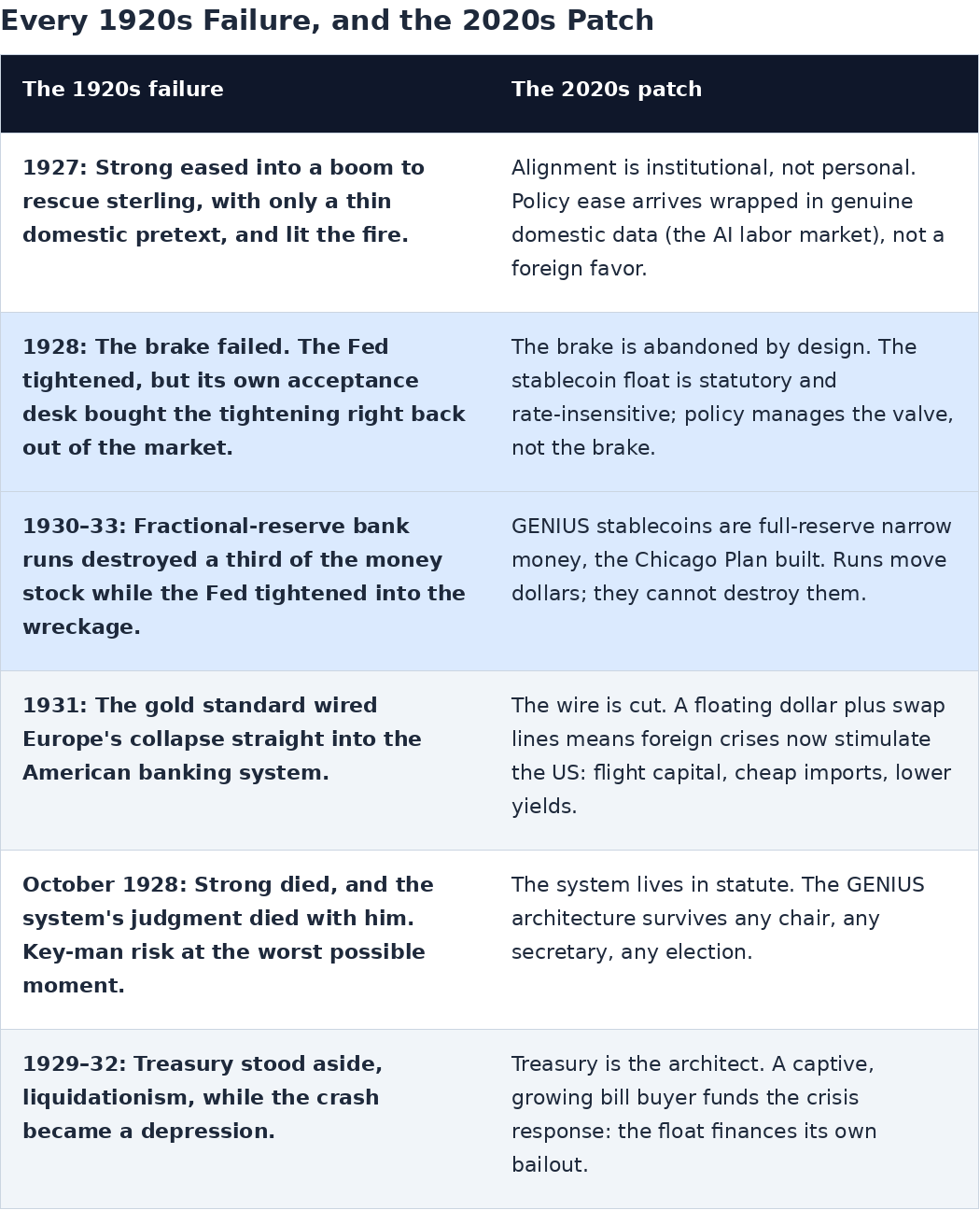
Six failures, six patches. The 1930s were not an accident of policy; they were a sequence, and each link in it has been cut.
The 1928 brake failure deserves the detail, because it is the least known and the most instructive. When the Fed tried to tighten against the bubble, it raised the acceptance buying rate, and its own desk's purchases of acceptances surged, cutting its holdings' restraint in half and nullifying the tightening it was attempting.
Bessent's design does not repeat the error of pretending the brake exists. It accepts that the modern float, statutory, yield-banned, and profitable to issuers at any policy rate, will grow through every tightening, and builds policy around the flow instead of against it. That is what a man who taught the failure does differently from the men who lived it.
IV. The Whisky and the Valve: Why the Analogy Keeps Holding
Picture the economy as a party, and the Fed as the adult holding the punch bowl. Cutting interest rates is like spiking the punch: everyone gets louder, braver, and more willing to do something dumb with borrowed money.
In July 1927, Benjamin Strong forced through a discount-rate cut from 4 to 3.5 percent into a booming, speculative market, telling the Banque de France's Charles Rist it would be "un petit coup de whisky for the stock exchange." Adolph Miller's dissent, the epigraph of this report, named it the costliest error in the System's history, because the late-1927 credit burst ignited the fire that went vertical in 1928. The essential structure: strength misread as weakness, under a respectable, sympathetic cover story.
The 2026 board is set identically. Chair Warsh, confirmed in May, holds rates at 3.50 to 3.75 percent while the cover story writes itself. Goldman Sachs estimates AI is erasing a net 11,000 to 16,000 jobs a month, and Stanford's tracking shows young workers in AI-exposed occupations running 19 percent below trend, even as the same AI drives the aggregate economy at full steam. A cut justified by AI unemployment, into an AI productivity boom, would be the coup de whisky on schedule, to the analog year. The 1998 Greenspan insurance cuts into the internet boom, which powered the 1999 melt-up, are the modern rehearsal. Productivity hides the ease from the CPI. The inflation shows up in asset prices, exactly as it did in 1928.
The trap is not the drink. It is what the bartender has to do afterward: yank the punch bowl away from a room full of people who borrowed money to keep partying.
Meanwhile the valve is already open, and the flow runs one way. Japanese households have pushed cumulative NISA purchases to 71 trillion yen, on pace to pass 100 trillion by the end of 2027, while dumping domestic equities at the fastest pace in a decade, and the yen trades at its weakest real level in roughly 40 years. The ECB's own Financial Stability Review identifies the US AI boom as the dominant driver of euro-area flows into American equities. Beijing confirmed the thesis by banning what it fears: February's crackdown on yuan-pegged stablecoins explicitly cited capital flight, because stablecoins are largely beyond the reach of capital controls. And despite a year of "sell America" headlines, foreign capital has poured into US markets at unprecedented levels.
The defensive response is a trap with a 1929 timestamp. The Bank of England, bleeding gold into the Wall Street call-loan market, finally hiked from 5.5 to 6.5 percent in September 1929. It stopped the outflow only by strangling the British economy, and gold only flowed back to London after the crash itself, in December 1929. If Tokyo, Frankfurt, and Beijing hike to defend their savings pools, they crack their own economies and trigger the dollar's crisis bid anyway. Heads the dollar wins; tails the dollar wins harder.
The float even does the Fed's easing for it. Stablecoin reserve demand already compresses front-end yields, by up to 40 basis points on Governor Miran's arithmetic.
The Fed has lost the brake on three layers. The float is statutory. The politics point down. And the marginal buyer of American assets is now the foreign saver fleeing a system no FOMC vote can regulate.
V. The Firewall: Why 1930 to 1932 Does Not Repeat
The analog holds through the crash. It breaks at the depression, and the break is engineered.
What turned 1929 into 1933 was not the crash. It was the money destruction that followed. Thousands of fractional-reserve banks failed, deposits evaporated, roughly a third of the money stock vanished, and the Fed tightened deliberately into the wreckage. Imagine the economy's blood supply draining out for three straight years. That, not the stock market, is what put a generation out of work.
A GENIUS-compliant stablecoin cannot repeat that mechanism. The Act requires one-to-one reserves in T-bills, repo, and cash equivalents: narrow money, the old Chicago Plan, finally built. When a panicked holder redeems, no money is destroyed. The issuer sells a bill, and the dollar moves from a coin to a bank deposit. A panic can move money around. It can no longer destroy money. The run that manufactured the Depression is structurally impossible inside the regulated float.
The worst a stablecoin run can do is dump T-bills, and absorbing a T-bill firesale is the single thing the Federal Reserve is best equipped to do, with standing facilities and the 2020 playbook on the shelf. And the fiscal side is stranger still: panic itself feeds the rescue. Stress drives money into dollar coins, whose reserves are statutorily forced into Treasury paper, a structural, price-insensitive buyer that grows during crises. No government in history has entered a crash with a captive lender that expands under stress. The fire refills the water tank.
So the 2028 event takes the profile of 2000 to 2002, not 1929 to 1933: a violent asset-price crash, with the framework's forecast remaining roughly half the index from an August 2028 peak, alongside a contained real-economy recession and recovery underway by December 2029. The crash is preserved. The catastrophe is amputated. Fracking removed the external energy-shock channel, the full-reserve float removed the monetary-collapse channel, and the floating dollar removed the golden wire that once imported Europe's failure. What remains is survivable, and what survives, dominates.
VI. The Colossus Decade: The 1930s, Inverted
Here is the deepest irony of the 99-year clock. The 1930s were supposed to be the American decade. The productivity was real, the technology was real, the dollar had already passed sterling. The depression stole it. Bank runs destroyed American money at home, and the gold standard imported everyone else's collapse. American dominance was deferred by fifteen years and finally arrived only through a world war.
The 2030s run the same film in reverse. The bank runs still happen, but they happen abroad, and they run into the dollar. Japan's household savings are migrating out of yen at a structural, accelerating pace. Europe's investors are wired to the American AI boom by the ECB's own admission. China's ban on yuan stablecoins is a signed confession that its savers would leave if they could, and increasingly they can. The IMF is already warning emerging markets about dollar-stablecoin cryptoization of their deposit bases. Every one of those runs is a deposit withdrawal from a foreign banking system and a deposit into the American one, through a rail Washington built on purpose, denominated in dollars, collateralized by Treasuries.
The two technologies make the dominance structural rather than cyclical. The United States is the only major economy that exports both its own energy and its own money. Every foreign crisis therefore arrives twice as a gift: once as flight capital bidding for American assets, and once as demand for the dollar rail itself. In 1931, America imported the world's bank runs and lost a decade. In 2031, America will host the world's bank runs, as the beneficiary. The man who once ran the flow against the Bank of England now operates the machine that receives it. That is not a metaphor. That is the doctrine.
The 1930s were stolen from America by its own banking system. The 2030s will be delivered to America by everyone else's.
VII. The Honest Ledger: What Could Break the Doctrine
A forecast that admits no failure mode is a sermon. Three risks are real.
First, the leverage can hide where the firewall does not reach. Offshore issuance and on-chain leverage, looped collateral and lending against coin balances, sit beyond US jurisdiction, on rails that bypass controls in both directions. If 2028's leverage builds there, the Fed can absorb the T-bill firesale but not the collateral spiral upstream of it.
Second, the long end can veto the bailout. The float anchors bills, but the term premium on tens and thirties is the one price neither Treasury nor its captive buyer controls, and a rescue perceived as fiscal dominance will be invoiced there.
Third, moral hazard compounds. If 2028 proves crashes survivable, the next cycle's leverage will be sized to the guarantee. 1998's successful containment purchased 1999.
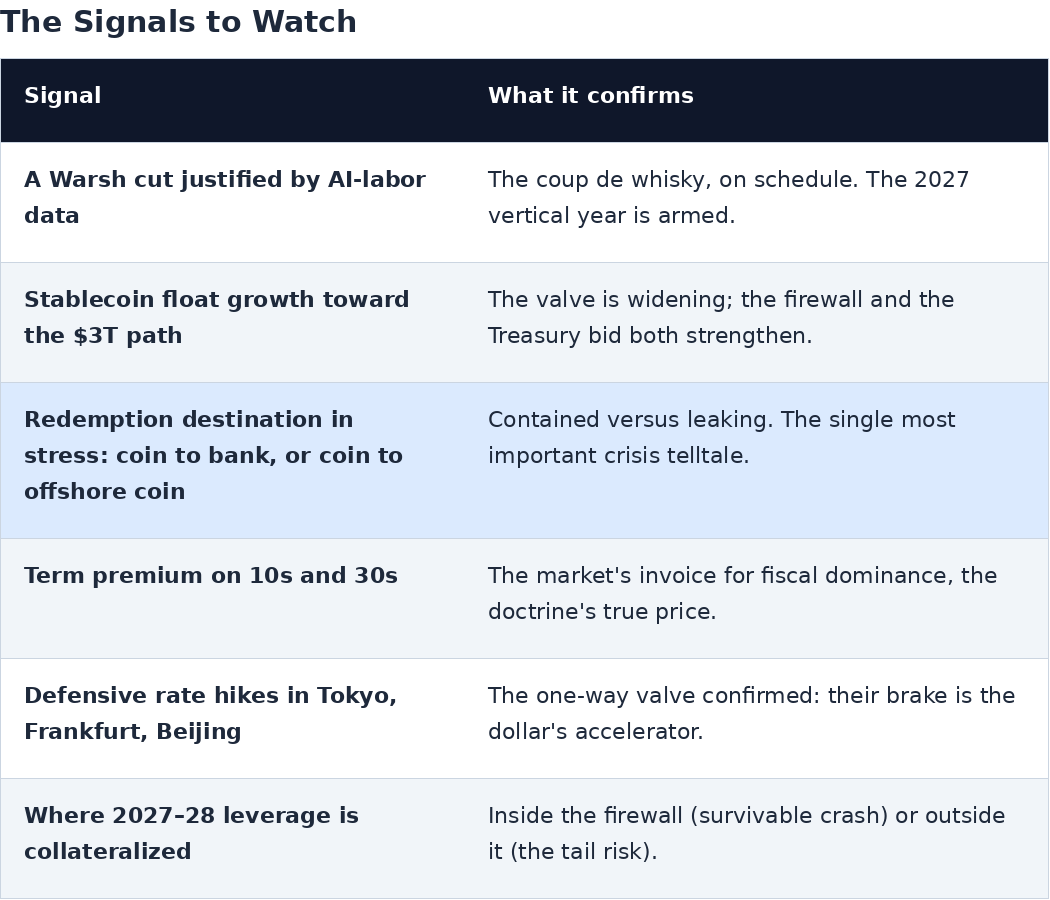
What to watch, and what each signal would confirm.
The 99-year clock is not a prophecy. It is a map of crowd behavior under a matching structure, and it has kept time because the structure matches. It will keep time through the whisky, the vertical year, the peak, and the crash, and then it will break, deliberately, at the exact page of the textbook where the last century's Fed failed.
The man who taught that page now runs the Treasury. The doctrine is simple: let the boom run, let the crash come, keep the money alive, and collect the world's savings as the price of safety. The 1920s built a colossus and then buried it for a generation. This time the colossus stays standing, because the one thing Bessent refused to inherit from the past was its ending.
A JD Unfiltered Special Report. This report is an analytical essay, not investment advice. The 99-year clock is an analytic framework rather than a prophecy, and all projected dates, magnitudes, and index levels are illustrative conventions of that framework, not forecasts.