
ReBalU and the Parasite Vomiting Breakout


A Patient Guide — Who Is at Risk, How the Protocol Works, and What to Expect
For patients, families, and non-clinician readers
IMPORTANT — READ FIRST. This guide explains how the ReBalU protocol is designed to work in plain language. It is not medical advice. It does not replace your doctor. If you have severe symptoms — high fever, blood in stool, dehydration, weight loss over 5%, symptoms lasting more than two weeks, or a weakened immune system — call your doctor. Standard antibiotic treatment (TMP-SMX) is the first-line therapy in those cases.
1. What This Guide Is About
There is a stomach parasite called Cyclospora that is showing up in outbreaks tied to fresh produce. It causes vomiting, watery diarrhea, cramping, low-grade fever, and long-lasting fatigue. In most healthy adults it clears on its own within two to six weeks, but the illness is miserable and it can drag on much longer in some people.
The reason it hits some people harder than others is not random. It comes down, in part, to the antioxidant system your body uses to protect itself — and that system is partly determined by your genetics. Four small variations in your DNA tell us how much reserve you have. That reserve determines how the ReBalU protocol is applied to you.
Here is the essential idea in one paragraph: the parasite steals your antioxidants to survive inside your gut lining cells. Some people's antioxidant system is weaker to begin with. A saliva test checks four genetic markers and assigns you to one of five "Lanes" — A through E — from strongest reserve to smallest. ReBalU is a food-grade gummy containing ingredients that starve the parasite of its niche and help your gut lining rebuild. The same gummy is used across all Lanes. What changes is how aggressively it is pushed, and whether two optional helpers — sulforaphane and NAC — are added and when.
One rule cuts across everything in this guide: if you are immunocompromised, or if you meet any of the STOP criteria below, your doctor and antibiotics come first. ReBalU is support in that situation, not the primary treatment.
2. The Five Lanes — Which One Are You?
Think of your Lane as a tank size. A big tank can absorb a lot of stress before running low. A small tank empties quickly and needs to be refilled and protected more carefully. The saliva test looks at four specific spots in your DNA — each can be strong or weak — and counts how many of the eight total markers are on the weak side. That number assigns your Lane.
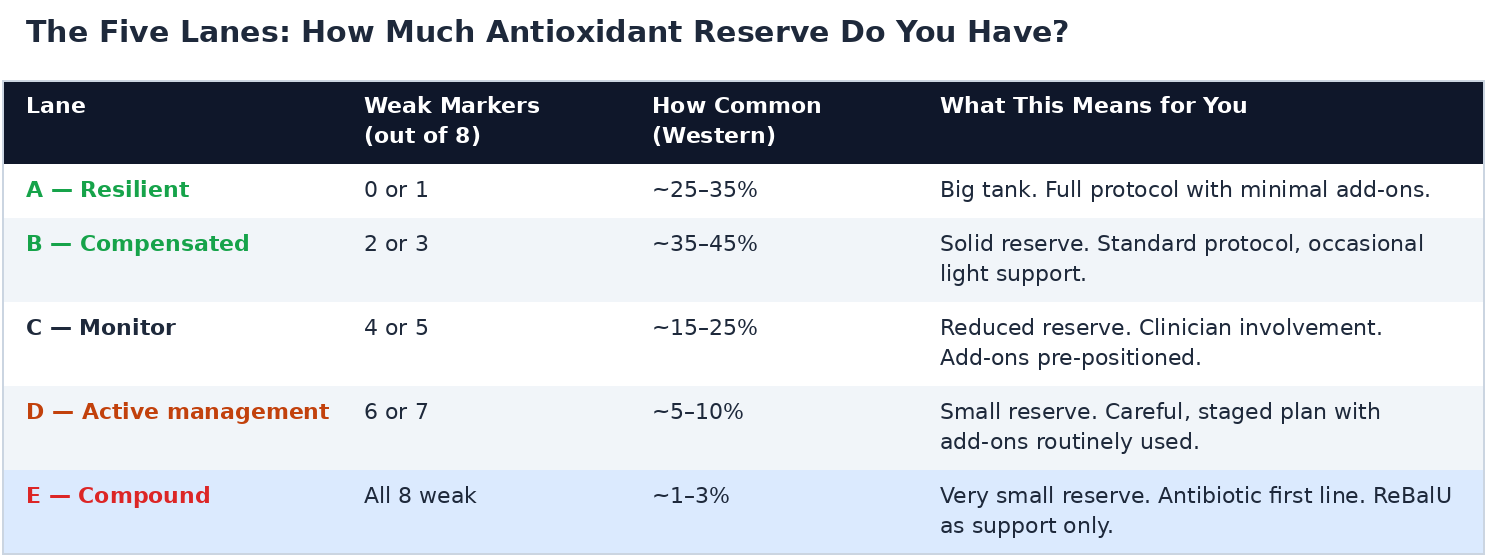
Lane A — the strong-reserve group. Roughly one in three Westerners land here. Your antioxidant system has plenty of headroom. You can use the ReBalU gummy on the standard schedule — two gummies, three times a day. Sulforaphane and NAC are usually not needed. The biggest risk in this Lane is not treating hard enough: the parasite lingers if you stop early because you feel fine.
Lane B — the everyday middle. The most common Lane in most populations. You still have a good working reserve, but not unlimited. The standard gummy schedule is used, with light sulforaphane and NAC added later in the course if recovery feels slow. If you carry the APOE ε4 marker, add-ons are more likely to be recommended.
Lane C — reserve is thinner. Four or five markers on the weak side means your tank is meaningfully smaller. You follow the same protocol, but a clinician typically supervises. Sulforaphane and NAC are pre-positioned so they are ready to add if a blood test shows the antioxidant system is not bouncing back on its own. Cutting out artificial sweeteners is advised during the course, because they further tax the same system.
Lane D — small reserve, careful plan. Six or seven of the eight markers weak. Your antioxidant tank is genuinely small, and this is where the safety flip matters: in Lane A, the risk is not treating hard enough. In Lane D, the risk runs the opposite way — the same treatment intensity that works cleanly in Lane A can strain a small tank. Sulforaphane starts early in the course to provide a protective floor. NAC is added on the first sign of strain. Sweetener withdrawal is required, not optional.
LANE D — THE SAFETY FLIP. In Lane A, the biggest danger is not treating hard enough — the parasite lingers. In Lane D, the biggest danger is treating too hard — the same treatment that works cleanly in Lane A can strain a small antioxidant tank. Same medicine, opposite risk direction. This is why Lane placement matters.
Lane E — very small reserve. All eight markers on the weak side. Your body has been running on a small antioxidant tank your whole life, so your tissues developed under those conditions. If you are otherwise well, a Cyclospora infection is still self-limiting — but the ReBalU protocol is used differently. Sulforaphane starts from day one at full protective dose. NAC is used pre-emptively, not on trigger. If you are immunocompromised or have severe features, the doctor prescribes TMP-SMX first, and ReBalU runs alongside as gut-lining and recovery support only.
LANE E — WHEN TO STEP OUT OF THE PROTOCOL. If you are Lane E AND any of the following is true — a weakened immune system, fever, blood in the stool, symptoms longer than 14 days, weight loss over 5%, or biliary/gallbladder symptoms — your doctor treats you with the standard antibiotic first. ReBalU is not the primary therapy in that situation.
3. Why the Parasite Hijacks Your Antioxidants
Imagine your gut lining cell as a house. Cyclospora is a burglar that breaks in and hides inside a room. Once inside, it locks the door and starts rearranging the wiring so that alarms cannot go off. The alarms it disables are your antioxidants — the same system your body uses to protect the house from fire. The stronger your protection system was to begin with, the more of a shield the parasite inherits when it takes over.
The ReBalU gummy works on this from two directions at once. The butyrate boosters — from tagatose, Fibersol-2, and pectin — feed your good gut bacteria, which produce a short-chain fat called butyrate that weakens the door the parasite is hiding behind, from below. The marine DHA, a specific omega-3 from ocean microalgae, changes how the infected cell's membrane behaves, making it easier for your body to clear out from above. One lowers the parasite's shield. The other raises the pressure. Neither is a drug. Both are food ingredients your body already knows how to use.
This is also why the dose plan differs across Lanes. The same DHA that gently pressures an infected cell in a Lane A person can be too much pressure on a Lane D or E person's tissue. In a large-tank person, DHA helps. In a small-tank person, the same amount can strain healthy gut lining. The add-ons exist to protect the surrounding tissue while the work gets done.
4. How ReBalU Identifies Who Is at Risk
ReBalU uses three layers to place you correctly — what you were born with, what your body looks like right now, and how your immune system is doing.
Layer 1 — Your DNA (saliva test). A simple mouth-swab looks at four spots in your DNA that control how well your antioxidant system runs. SOD2 governs mitochondrial antioxidant function — the weak version means the engines inside your cells produce more oxidative stress and clear less of it. GPX1 handles general cleanup of oxidative byproducts — the weak version means slower recovery. GPX4 guards cell membranes — the weak version means membranes are easier to damage, and carriers of this weak version should deliberately avoid adding selenium during the killing window. APOE ε4 is a lipid-transport marker — carriers move DHA and antioxidants around the body less efficiently.
Layer 2 — Blood markers (during treatment). Your DNA tells us your baseline tank size. It does not tell us how full the tank is right now. That is what the blood tests are for. A small panel is checked before you start and rechecked at set intervals. The key readout is GSH:GSSG — the single most sensitive early signal that treatment is engaging correctly and that recovery has begun. Stool butyrate confirms the fiber in the gummy is actually being turned into butyrate by your gut bacteria. The omega-3 index confirms the DHA is being absorbed. SOD2 activity confirms your mitochondrial machinery is working at expected levels. In Lane A, this panel might be checked once. In Lane D or E, it is checked several times over the course.
Layer 3 — Your immune status. This is the honest, important layer. Your DNA sets your tank size. It does not decide whether the parasite becomes a chronic infection. Chronic Cyclospora — the version that lasts months or moves into the biliary tract — is tied to being immunocompromised, not to your Lane.
STOP AND SEE YOUR DOCTOR. If you have a weakened immune system (HIV, transplant, active chemotherapy, immunosuppressive medication, infancy, advanced age), OR you are Lane D or E with a positive stool test for Cyclospora, you belong on standard antibiotic treatment (TMP-SMX) first. ReBalU is only support in that situation. This is not a judgment call — it is a rule.
5. How ReBalU Treats: The Two Windows
Once you know your Lane, treatment runs in two clear windows with testing at both ends.
What is actually in the gummy. Four ingredients: tagatose (a natural sugar that feeds beneficial gut bacteria early in digestion), Fibersol-2 (a soluble fiber providing sustained fuel deeper in the gut), high-methoxyl pectin (a gel-forming fiber for the final stretch of the colon), and marine microalgae DHA (a specific omega-3 from ocean plants, refined for purity). Dosing is two gummies, three times a day. There is also an optional mouthwash with the same active ingredients for the mouth and throat.
Selenium is intentionally left out of both the gummy and the mouthwash. Selenium normally supports one of your antioxidant enzymes — but during the parasite-killing window, adding it would keep the parasite's hijacked shield too strong. Leaving it out is deliberate.
Window A — the killing window. Short and focused. The gummy is used at its Lane-appropriate dose. Sulforaphane and NAC are dialed down during this window in Lanes A, B, and C so they do not blunt the killing action — in Lanes D and E, sulforaphane instead runs at a protective baseline. You know this window is working when the GSH:GSSG ratio dips as expected. If it does not move, or drops without bouncing back, that is a signal to pause and check.
Window B — the recovery window. Longer and gentler. The gummy continues at maintenance dose to keep rebuilding your gut lining. Sulforaphane and NAC are now dialed up to refill your antioxidant tank. Sulforaphane goes first — it turns the tank's refill machinery on. NAC follows — it supplies the raw material the machinery needs. You will feel steadily better through this window rather than dramatically better all at once. This part cannot be rushed, and stopping early is the most common mistake people make.
What NOT to do during treatment. Do not take selenium supplements during the killing window. In Lane C, D, or E, cut out artificial sweeteners for the duration of the course. Do not start high-dose sulforaphane or NAC on your own — the whole point of the plan is that they are added at the right time. Do not stop early because you feel better.
6. Your Lane, Step by Step
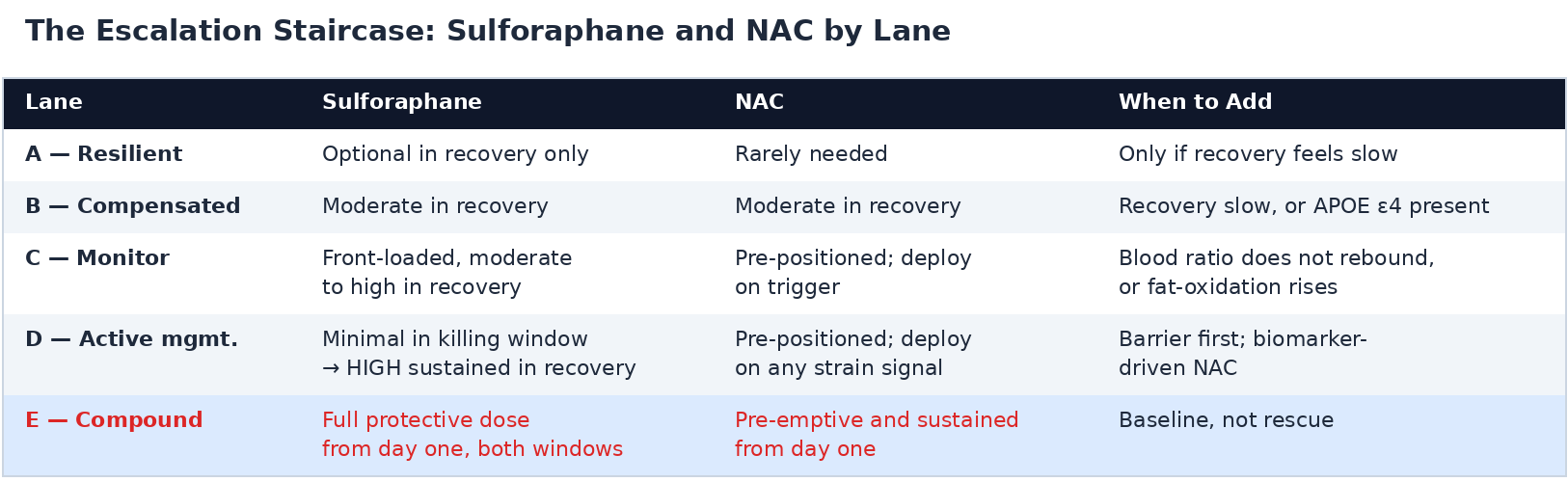
Lane A — Resilient. Gummy at standard dose, full course. Sulforaphane optional in recovery only. NAC rarely needed. One testing panel around the window transition is usually enough. The watch-out: stopping too early because you feel fine before the parasite is fully cleared.
Lane B — Compensated. Standard gummy course. Moderate sulforaphane and NAC during the recovery window, especially if you carry the APOE ε4 marker. Check biomarkers once early and once at the transition between windows.
Lane C — Monitor. Standard gummy course under clinician supervision. Sulforaphane pre-positioned and front-loaded in the recovery window at moderate to high dose. NAC kept on hand and added if the blood ratio does not bounce back or if a fat-oxidation marker starts rising. Cut artificial sweeteners for the duration. Several testing panels through the course to catch any drift.
Lane D — Active management. Same gummy dosing, but paired with early sulforaphane and close biomarker watch. Sulforaphane minimal in the killing window, then high and sustained through recovery — it provides the protective floor. NAC pre-positioned and added on any early sign the antioxidant system is straining. Artificial sweeteners stopped for the whole course. Tight testing cadence, clinician-led. Remember the safety flip: the risk in this Lane is treating too hard, not too softly.
Lane E — Compound. First check: are you immunocompromised or do you have severe symptoms? If yes, standard antibiotic from your doctor first, ReBalU as support only. If otherwise well: gummy at baseline, do not escalate. Sulforaphane at full protective dose from day one, sustained through both windows. NAC used pre-emptively from the start. Tightest possible testing cadence. In this Lane, add-ons are the baseline, not the rescue — the goal is to keep the gut lining protected throughout.
7. The Two Optional Add-Ons — In Plain English
Sulforaphane and NAC are the two levers used to fine-tune the plan across Lanes. Neither is a drug. Both are widely studied and widely available.
Sulforaphane is the active compound in broccoli sprouts. It turns on the master switch that tells your body to make more of its own antioxidant enzymes. This takes hours to days to build up, but the effect is broad and deep. NAC — N-acetylcysteine — is a well-known supplement that supplies the raw material your body uses to build glutathione, the main antioxidant inside your cells. It is faster acting and more direct, but it fills the tank rather than making it bigger.
The order matters: sulforaphane turns the factory on, NAC delivers the raw materials. Turning on the factory first, then supplying materials to it, works better than dumping materials at a factory that is not running. That is why the escalation always adds sulforaphane before, or alongside, NAC — never the other way around.
8. What to Expect Day by Day
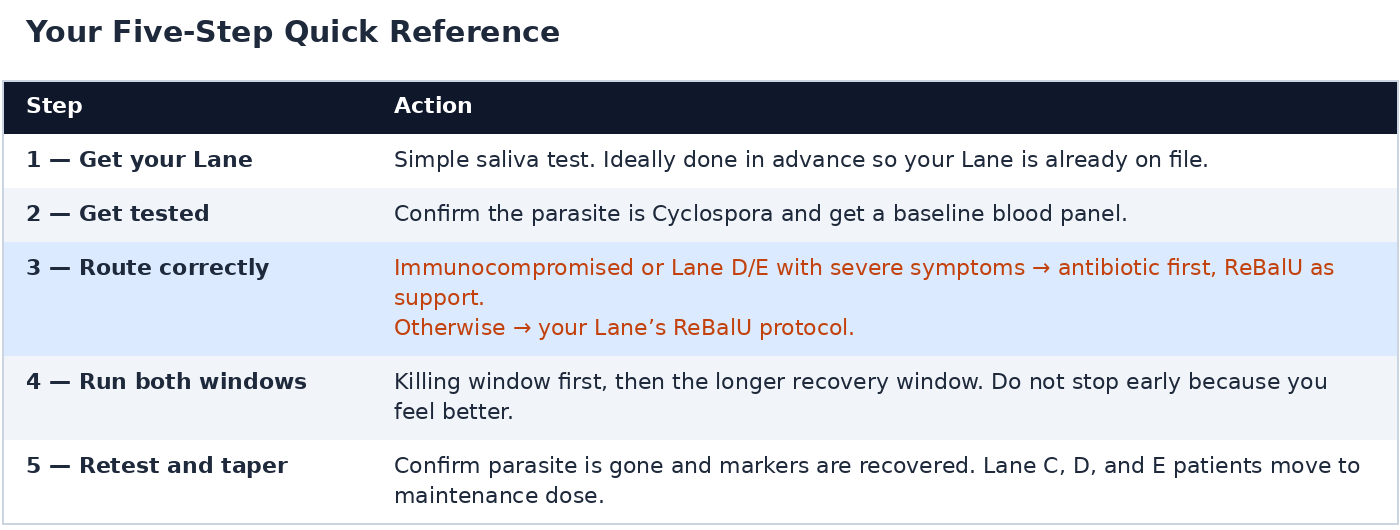
Before you start, three things happen: the saliva test assigns your Lane, the baseline blood panel captures your current antioxidant status, and the stool test confirms the parasite is present and rules out other bugs.
During the killing window — roughly the first week to ten days — you will still feel unwell. This is the phase where the parasite is being dismantled. Vomiting and diarrhea should begin easing, not worsening. If symptoms sharply worsen instead — especially fever, blood in stool, or severe dehydration — call your clinician.
During the recovery window — roughly the following two to four weeks — you will feel steadily, quietly better rather than dramatically better. Energy returns before appetite, in most people. The gut lining is rebuilding, and this part cannot be rushed.
When you are done, two things confirm it: a stool retest to show the parasite is clear, and a final blood panel to confirm your antioxidant markers are back where they should be. For Lane C, D, and E patients, a maintenance plan for the gummy at baseline dose is usually recommended going forward.
9. Safety, Honesty, and What This Is Not
ReBalU is a food-grade gummy and mouthwash system built around fibers and a marine omega-3. It is a protocol that adapts to your genetics and your current biology. It can run alongside standard medical care when needed.
It is not a cure. It is not a substitute for antibiotics when antibiotics are called for — if you meet the STOP criteria, the doctor and the antibiotic come first, every time. It is not race-based. Your Lane is assigned by your actual DNA markers, not by ancestry. And it is not one-size-fits-all: the same molecules can help a Lane A patient and stress a Lane E patient, which is exactly why the plan changes.
The honest science caveat: the specific mechanism this protocol relies on has strong support in laboratory and cancer research, but has not yet been directly tested in a Cyclospora clinical trial. It is a well-reasoned hypothesis under active development. The Lane percentages are estimates for Western populations and will be different in other populations. And your biomarkers always override the prediction from your Lane — if the numbers say something different from what your Lane expected, we follow the numbers.
10. Your Five-Step Quick Reference
Call your clinician immediately if: you have high fever, blood in stool, severe dehydration, or symptoms lasting more than 14 days; weight loss over 5% of your body weight during the illness; symptoms in the gallbladder area (right upper belly, yellowing of the eyes or skin); any severe worsening after starting the protocol; or you are immunocompromised or become immunocompromised during the course.
The reason this protocol is not the same for everyone is not marketing. It is because the antioxidant system your body uses to fight this parasite is genuinely different in different people, and pushing the same treatment at the same intensity across everyone would help some and harm others. Your Lane is how we make sure the plan fits the person, not the average.
This guide explains how the ReBalU protocol is designed to work. It is not medical advice for any individual patient. ReBalU has not been evaluated by the FDA and is not intended to diagnose, treat, cure, or prevent any disease. Consult your clinician before starting any protocol, particularly if you are in Lane C, D, or E or have any underlying health condition. SOD Sciences Inc. · Vero Beach, Florida.