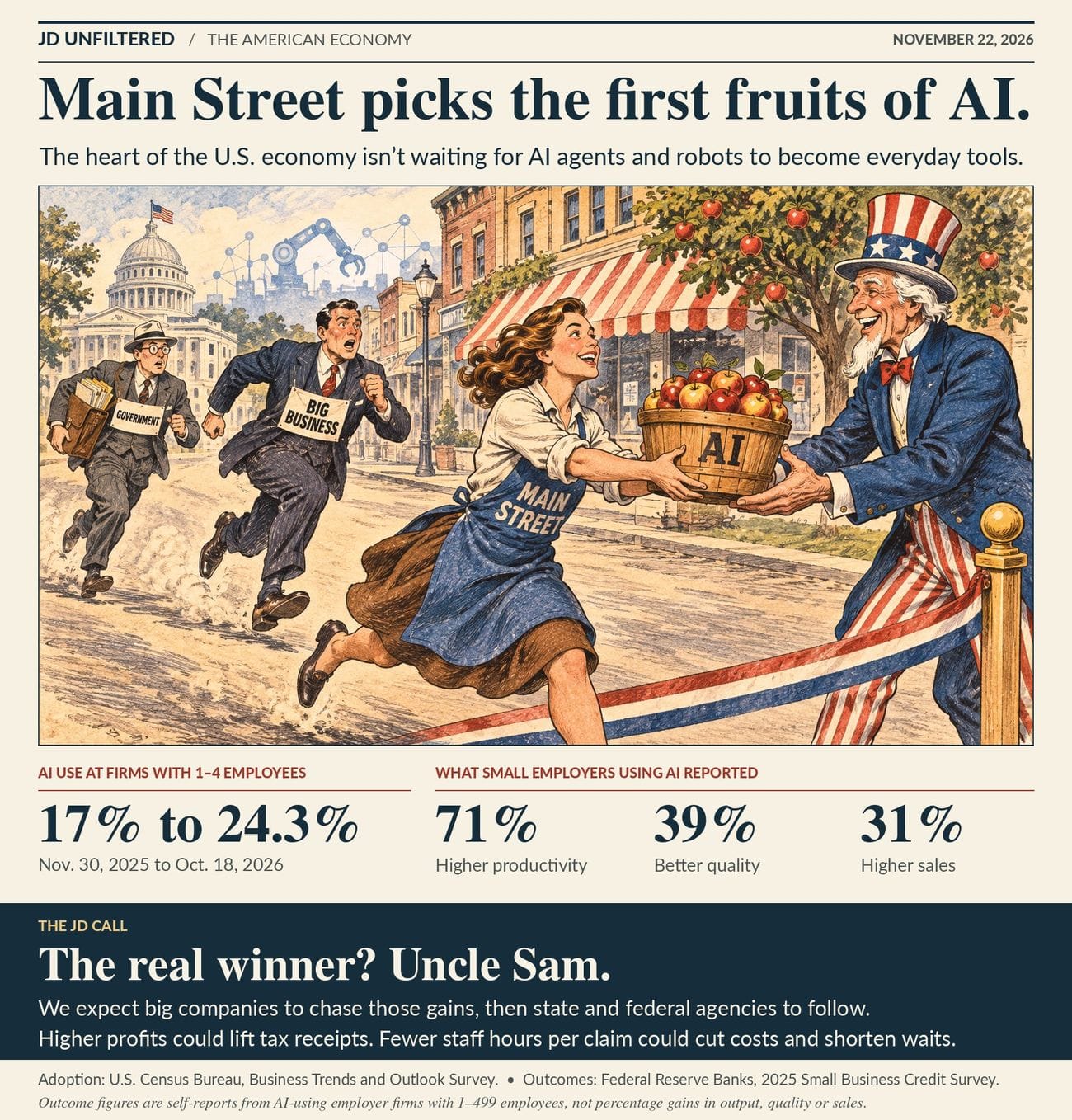
Main Street Picks the First Fruits of AI


Evidence now exists among the most entrepreneurial companies that AI adoption is rapidly spreading and productivity is showing up in gross numbers. This usually means it is moving even faster, since these numbers are backward looking.

Our starting point is the cash register. For two straight months, average real revenue rose at U.S. firms with one to nine employees while the number of payroll jobs in that segment fell. In October, the same pattern appeared in every one of the 12 sectors QuickBooks tracks.
Our bet is that owners are putting saved hours back to work before the full gain appears in the statistics. That is a judgment about timing, not a claim that a delayed report proves acceleration.
Start with what got done
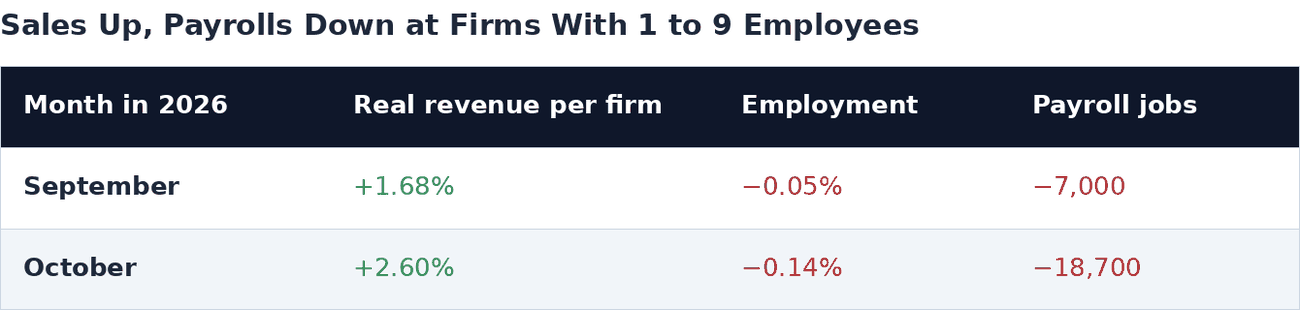
The revenue series is adjusted for inflation and seasonality. These are two indexes, not matched records showing that each employer sold more with fewer hours. Why take the signal seriously? Independent evidence shows how a small firm can get the next job done.
One more client in the week
Choi and Xie surveyed 277 accountants for a study in the Journal of Accounting Research. A one-standard-deviation increase in AI use was associated with 19% more clients supported weekly: about one more at the median of five. A separate field sample covered 79 client businesses, median headcount 10. Among 58 clients in the timing analysis, transactions were recorded 7.52 calendar days sooner relative to month-end. That is faster delivery, not 7.52 days of labor saved.
A cost that disappears outside the payroll
Intuit CEO Sasan Goodarzi said at Intuit Connect that accounting firms using Intuit Accountant Suite saved more than nine hours per client per month. In Citizens' survey of 500 decision-makers, 94% of the subset using AI regularly across multiple functions said they had cut or eliminated spending on at least one outside service; 38% cited bookkeeping or accounting. These are company-reported figures, not estimates for every firm with one to nine employees.
The economic point. A contractor who writes estimates after dinner does not need to lay anyone off to become more productive. If the estimate takes less time and a second paid job gets done, output rises. If the owner simply works a longer day, it does not follow that output per hour rose.
Where the private payroll sits
The 2022 Census benchmark contains 134.36 million covered private payroll jobs after removing government-classified employment. Named for-profit legal forms account for 117.47 million; corporations alone account for 95.61 million. The columns overlap; do not add them.
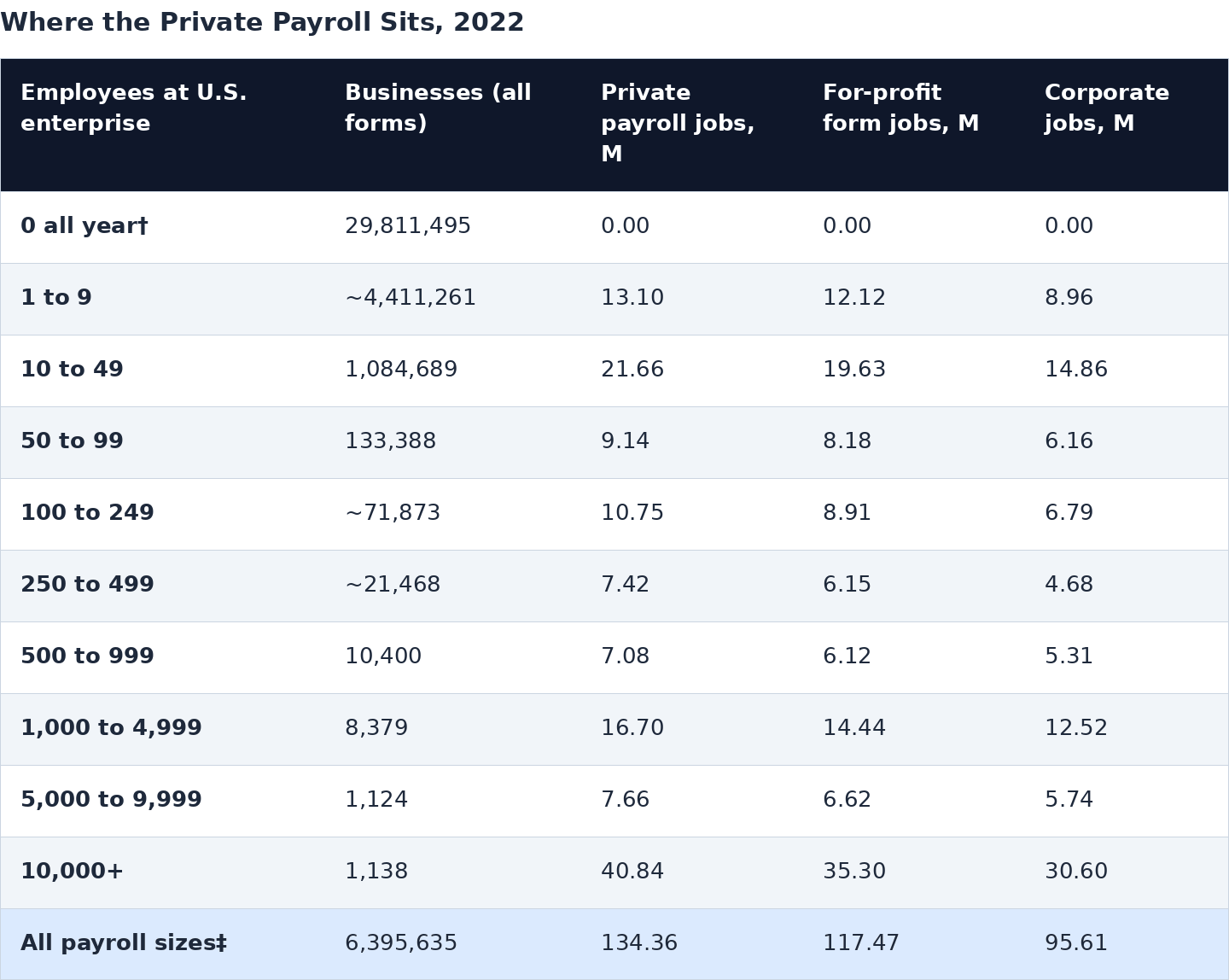
The government subtraction and legal-form splits are published for broad bands, so the narrower rows are estimates. For 20 to 99 and 500+, they use all-form employment weights from the Statistics of U.S. Businesses; for 100 to 249 and 250 to 499, they use Annual Business Survey employment weights. Firm counts marked with a tilde use Annual Business Survey firm weights. Government is excluded from private jobs; nonprofits and "other" are retained. For-profit forms are corporations, S corporations, partnerships and sole proprietors.
The original 11% is corporate only: 8.96 million payroll jobs at one to nine employees plus 1.79 million assumed owners equals 10.75 million of 97.40 million comparable roles. It is not the share of all private workers using AI.
Larger firms are not waiting
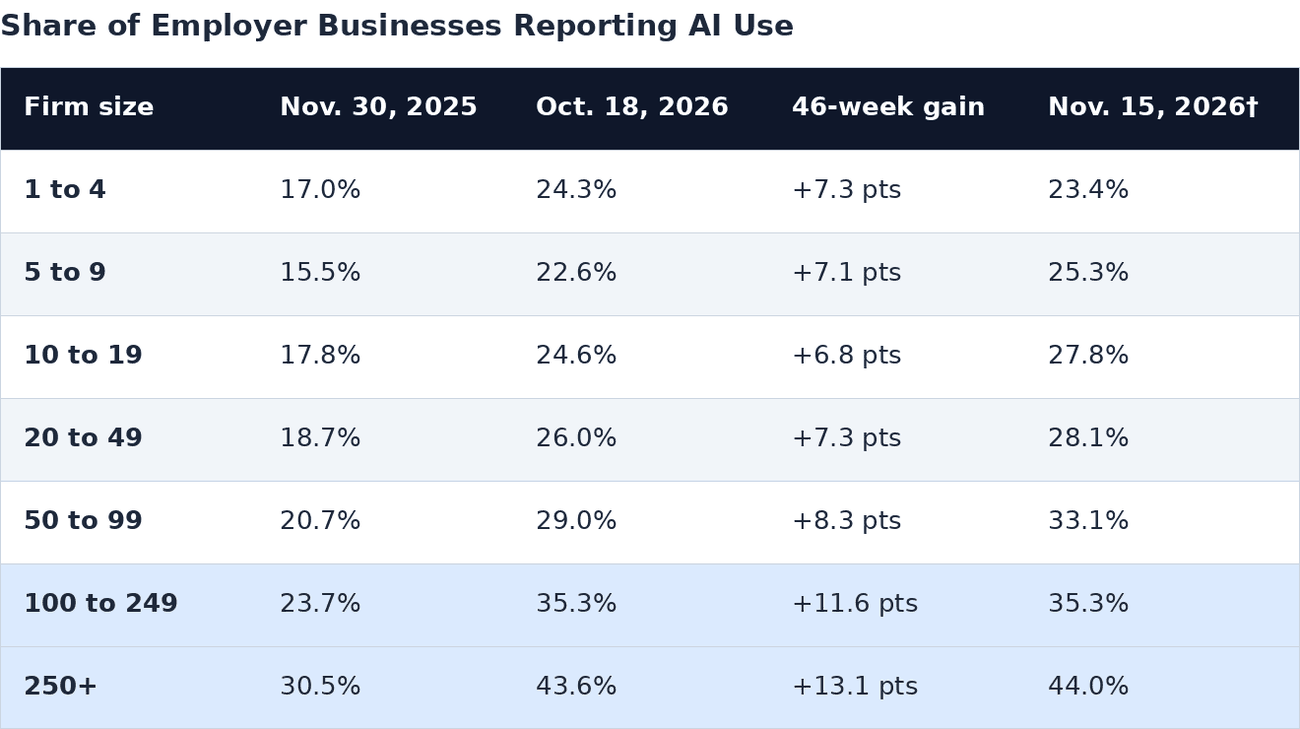
The surprise is higher up the size ladder
On identical wording, firms with one to four employees gained 7.3 percentage points and firms with five to nine gained 7.1. The 10-to-19 and 20-to-49 groups gained 6.8 and 7.3 points. Firms with 250 or more gained 13.1 points. Large firms may take longer to change a whole operation, but they are not slower to report using AI somewhere.
Owner-only firms belong in the story
In the Fed's 2025 survey, 40% of nonemployers reported AI use for work. Across AI-using employer respondents with 1 to 499 employees, 71% said productivity increased and 31% said sales rose. That is the share reporting a benefit, not a 71% increase in productivity. The Fed and Census questions differ; their levels should not be spliced.
If larger firms keep the small-firm pace
This is a scenario for the next 46 weeks, not a forecast. Start November 15, 2026. Add 7.2 percentage points by October 3, 2027: the simple midpoint of the two smallest groups' comparable 46-week gains. Hold the 2022 workforce mix fixed to show scale, not current headcount.
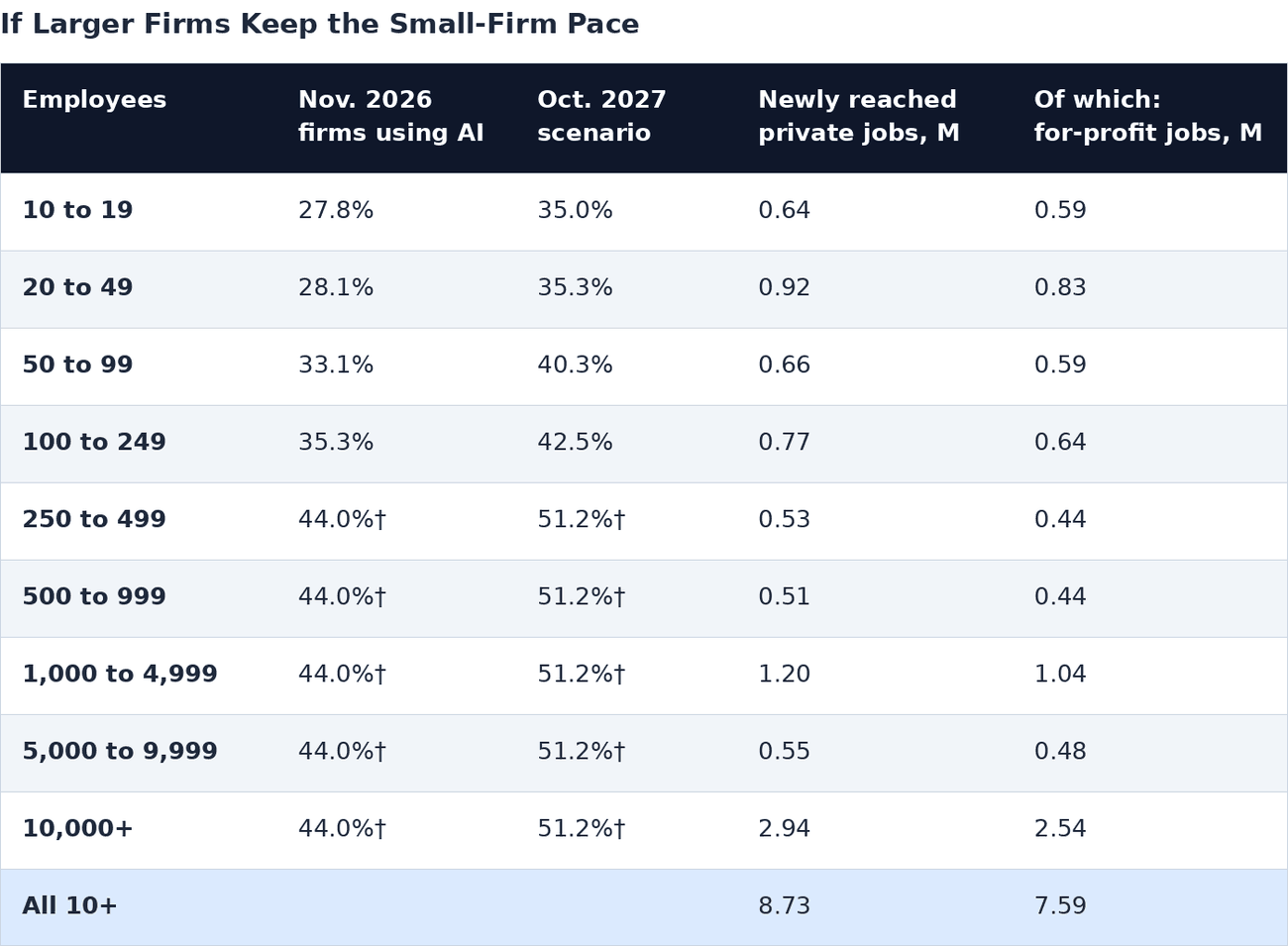
The scale is 8.73 million private payroll jobs. About 1.56 million are at firms with 10 to 49 employees; 5.20 million are at firms with 500+, including 2.94 million at 10,000+. The named for-profit forms alone account for 7.59 million of the 8.73 million. These are jobs at newly adopting employers, not jobs lost or people already using AI.
The translation rule is to multiply each size band's private payroll jobs by 0.072. This assumes newly adopting firms have the same average headcount as their band and that the business survey can be applied to the covered employer mix. If only small units adopt inside a large company, actual worker reach is lower.
A rollout is not a productivity gain
Give a five-person firm and a 5,000-person firm the same software. Don't count logins. Count additional jobs finished at the same quality, after someone has checked the work.
Illustration: 30% of staff save two net hours per week
Use the 121.26 million private payroll jobs at firms with 10+ employees as the fixed base. "Net" means time saved after training, review and rework. The table shows weekly capacity once rollouts are in place, not hours already saved.
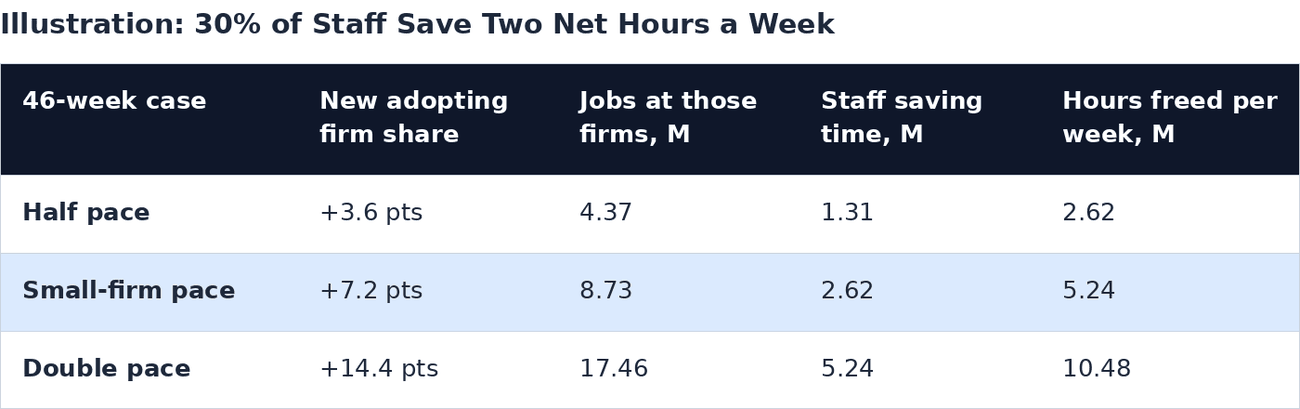
At the midpoint, 30% of 8.73 million workers saving two hours frees 5.24 million hours a week: about 0.11% of a standardized 40-hour week across the entire 10+ workforce. Put those hours into additional paid jobs and output can rise. Without demand, the time saving might never appear in sales.
Why backward-looking numbers matter
Stripe's Patrick Collison told the November 16 Fed panel that new businesses launching weekly on Stripe were up roughly twofold year over year. That is a signal about entry, not output per worker. Warsh called the Fed's scenarios illustrative, not forecasts, in his conference remarks that day. Our interpretation is that the first change can be a job an owner accepts or an outside invoice that never arrives. Neither is identified as "AI productivity" in a payroll report.
What would settle it. Track paid jobs completed per 100 hours at the same firms, before and after adoption, against comparable firms that have not adopted. Count owners, employees, contractors and rework. If completions rise for several quarters without more total hours or more customer callbacks, the gross numbers will have a productivity explanation.
Two hours can beat our 4 to 5% projection
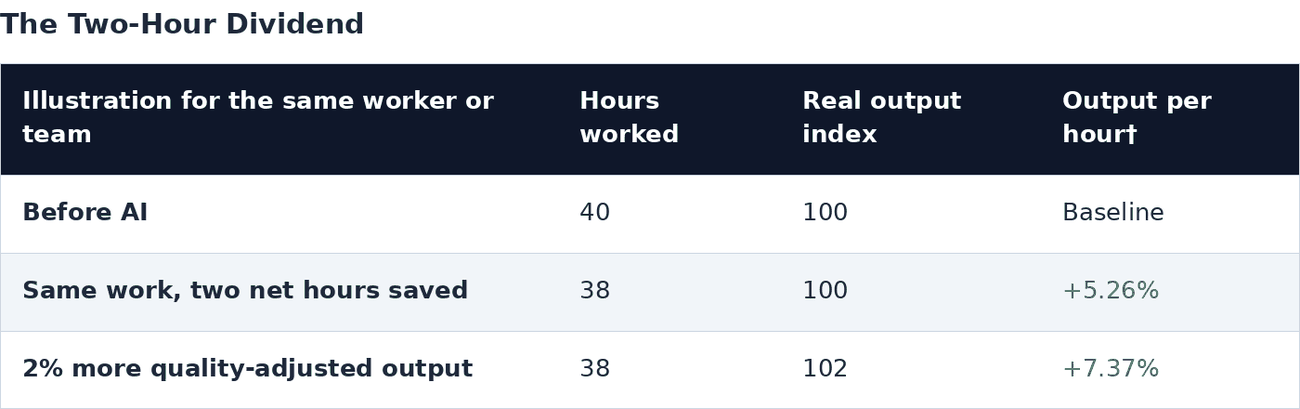
Take the owner who delivers the same work, at the same quality and real revenue, in 38 hours instead of 40. That is 5% fewer hours and 5.26% more output per hour: divide 40 by 38. The owner need not sell one more job for that gain to be real.
The upside is better work that customers will pay for
At firms with one to nine employees, average real revenue rose 2.60% in October while employment fell, QuickBooks reported. In the Fed's separate survey of AI-using small employers, 39% reported better quality and 31% higher sales. The samples differ, but if both gains hold as hours fall, our 4 to 5% projection could prove low. The 7.37% illustration counts better or additional output only once.
Federal and state government: a bigger gain, later
We expect larger gains where agencies track work: checking files, routing claims and recording decisions. Pennsylvania's 175-person pilot across 14 agencies reported 95 minutes saved on days the tool was used. VA is exploring AI for disability claims, according to the GAO; older systems and the need to catch errors help explain why we expect federal and state gains later. The test is correct decisions per staff hour and shorter waits, not revenue.
Our conclusion: productivity gains and service deflation are upon the U.S. economy. A firm that can profitably complete a job in 38 hours can underbid a rival that still needs 40. We expect competition to pass some savings to customers, first in services such as bookkeeping and administrative support. Lower delivery costs come first; falling prices follow where firms compete them away. That is our U.S. outlook, not a claim that every service price is already falling.
Research and analysis only, not personalized financial advice. Consult a qualified financial advisor before making investment decisions.
The authors hold positions in securities mentioned and reserve the right to buy or sell shares at any time without notice.