The 99-Year Engine Room: Shale, Stablecoins, and Coolidge's Two Engines


A JD Unfiltered Report, with a Future Codicil on the Super Coupon Layer.
The analog framework that anchors this publication, 1921 as 2020, 1927 as 2026, 1929 as 2028, makes a testable claim: eras of American swagger are not moods, they are machinery. Each is powered by two engines running in tandem, a real-economy technology that spent decades compounding in obscurity, and a monetary technology that quietly makes the dollar the world's mandatory unit. The 2020s run on shale and the dollar stablecoin. Ninety-nine years earlier, the 1920s ran on factory electrification and the dollar bankers' acceptance. Calvin Coolidge aided both engines and harvested both, exactly as the current administration is doing now.
This report lays out the full parallel, identifies the one place where the analog structurally breaks, which is who holds the brake, and closes with a forward-looking codicil on the layer that could super-accelerate the modern monetary engine: the Super Coupon Token.
Part I: The 2020s Engines
The Real-Economy Engine: Shale
The fracking revolution began as a hybrid of federal seed capital and private obsession. The Department of Energy's Eastern Gas Shales Project, running from 1976 to 1992, proved the resource, demonstrated massive hydraulic fracturing in 1977, and funded directional drilling and microseismic mapping, alongside a roughly $10 billion Section 29 tax credit and DOE and GRI co-funding of Mitchell Energy's first horizontal Barnett well in 1991. George Mitchell spent nearly two decades and $250 million before Nick Steinsberger's 1997 and 1998 slickwater breakthrough cut completion costs by $75,000 to $100,000 per well and cracked the code.
The defining pattern: as the politics got tougher, the technology got cheaper.
Through the Obama years, new-well production per rig rose eightfold for gas and nineteenfold for oil between 2007 and 2019, while breakevens fell 45 and 38 percent between 2014 and 2019. Trump 1 removed the friction and the US became a net energy exporter for the first time in nearly 70 years.
The payoff now: a record 13.6 million barrels per day of crude in 2025, the first-ever 100-million-ton LNG export year at 111 MMT in 2025, record net energy exports of 11 quadrillion Btu, and 24 million barrels per day of total liquids, more than Russia and Saudi Arabia combined. Energy independence converted foreign-policy risk from a constraint into a weapon.
The Monetary Engine: The Dollar Stablecoin
The underlying technology is American in origin, but regulation-by-enforcement and debanking pushed issuance offshore under the Obama and Biden administrations. Exile did not stop the march. Dollar-token liquidity compounded overseas, all denominated in dollars, until banishment had made the dollar the native unit of crypto.
The GENIUS Act, signed July 18, 2025, repatriated the machine: one-for-one reserves in Treasury bills, repos, and cash, monthly attestations, and a licensing perimeter. The market stands around $317 billion to $322 billion, up more than 50 percent since early 2025, with Treasury Secretary Bessent projecting roughly $3 trillion by 2030 and framing the statute explicitly as a machine for cementing dollar reserve status and creating over $2 trillion of Treasury demand.
Unlike shale, this engine is top-down, a deliberately constructed policy architecture operated by two friends: Bessent at Treasury and Warsh at the Fed, confirmed 54 to 45 in May 2026, coordinating through regular breakfast meetings and a proposed accord that inverts 1951 by having Treasury and Fed jointly communicate balance-sheet and issuance objectives rather than keeping them separate. This is the Bessent/Warsh Accord, and its live independence tension is a feature of top-down engines. Rock does not negotiate, but central bankers do.
Part II: The 1920s Engines
The Real-Economy Engine: Electrification
The dynamo dates to the 1880s, yet for thirty years factories bolted motors onto steam-era line shafts and captured almost nothing. Paul David's work on the dynamo delay shows manufacturing endured a three-decade productivity pause before exploding to over 5 percent annual TFP growth between 1919 and 1929, once plants were rebuilt around unit-drive motors. By 1929, electric motors were 78 percent of all machine-drive capacity, and electrification accounted for roughly half of the decade's manufacturing productivity acceleration.
The gestation arithmetic matches shale. Dynamo 1882, payoff 1919 to 1929: forty years. Eastern Gas Shales Project 1976, net exporter 2019: forty years.
Coolidge's aid was frictional removal, not invention. The Mellon Revenue Acts of 1924 and 1926 completed the march of the top rate from 73 percent to 25 percent, and the cuts pulled capital out of tax-exempt shelters and into the electrified industries: radio, appliances, autos, aviation, with light-touch enabling statutes such as the Air Commerce Act of 1926 and the Radio Act of 1927 instead of industrial policy. The harvest was real GNP growth of 4.7 percent annually from 1922 to 1929 and unemployment falling from 6.7 to 3.2 percent. Coolidge Prosperity was the dynamo's deferred dividend.
The Monetary Engine: The Dollar Acceptance
Before 1914 world trade finance was a sterling monopoly, in part because American banks were legally barred from accepting bills. The Federal Reserve Act of 1913 was the era's GENIUS Act. It authorized acceptances and foreign branches and empowered the Reserve Banks to buy acceptances to guarantee a liquid market. War knocked out the incumbent, and Benjamin Strong deliberately promoted dollar acceptance financing to break London's monopoly, the Fed acting as market maker of last resort. Policy, not market forces alone, drove the dollar's rise.
The overtaking landed inside Coolidge's term. The dollar passed sterling as the leading reserve currency in the mid-1920s, with one Banque de France study dating it to 1927 precisely, the analog year for 2026. By the late 1920s more than half of US trade was financed in dollar acceptances. The 1920s had its Bessent/Warsh in Mellon and Strong: Treasury architect plus market-building central banker, coordinating personally, outside any statute.
The Structural Break: Who Holds the Brake
Here the analog stops rhyming, and the difference decides how the two decades end.
In the 1920s, the dollar float ran through the Fed's own desk. The New York Fed posted an acceptance buying rate, and the float expanded or contracted at its discretion. The brake was used. In 1928 the Fed raised the discount rate from 3.5 to 5 percent, sold $393 million of securities, and cut its acceptance holdings in half by raising its buying rate, and when the desk later reversed and bought heavily, the purchases nullified the tightening entirely. The 1920s monetary engine was a creature of the central bank's balance sheet. The Fed could throttle it, and after Strong died in October 1928, its successors throttled it to death, with deliberate tightening from spring 1928 running straight into the crash.
The stablecoin inverts every term of that sentence.
The float is created outside the Fed. Demand is foreign, private, and policy-proof. The BIS finds stablecoin flows largely unaffected by capital controls, unlike bank deposits, with growth governed by adoption rather than interest-rate cycles.
Tightening feeds the machine. The GENIUS Act bans paying yield to holders, so issuers keep the entire float spread. Tether earned roughly $13 billion in 2024 from Treasury interest, which means higher rates make minting more profitable. The brake pedal is wired to the accelerator.
The float pushes back on the Fed's target. Stablecoin inflows measurably compress front-end Treasury yields, with effects strengthening as the market grows. Fed Governor Miran cites estimates of up to 40 basis points of downward pressure at full adoption.
Survivability inverts the same way. Strong's machine was discretionary and died with him, and the key-man clock, October 1928 on the analog year 2027, is the analog's darkest warning. The modern machine rests on statute effective by January 2027, a foreign demand base the IMF calls cryptoization that persists because it bypasses domestic authorities, and an issuer industry whose yield-ban-guaranteed profits make it a permanent lobby. The Strong-Mellon engine could not outlive Strong. The Bessent-Warsh engine is built to outlive Bessent.
The consequence for the analog's back half: in 1929 the authorities could contract the float, and the 1925 to 1931 acceptance boom and its contraction fed the bust, but in 2028 only the holders can. The exit signal is not Washington. It is redemption flow.
The Ledger
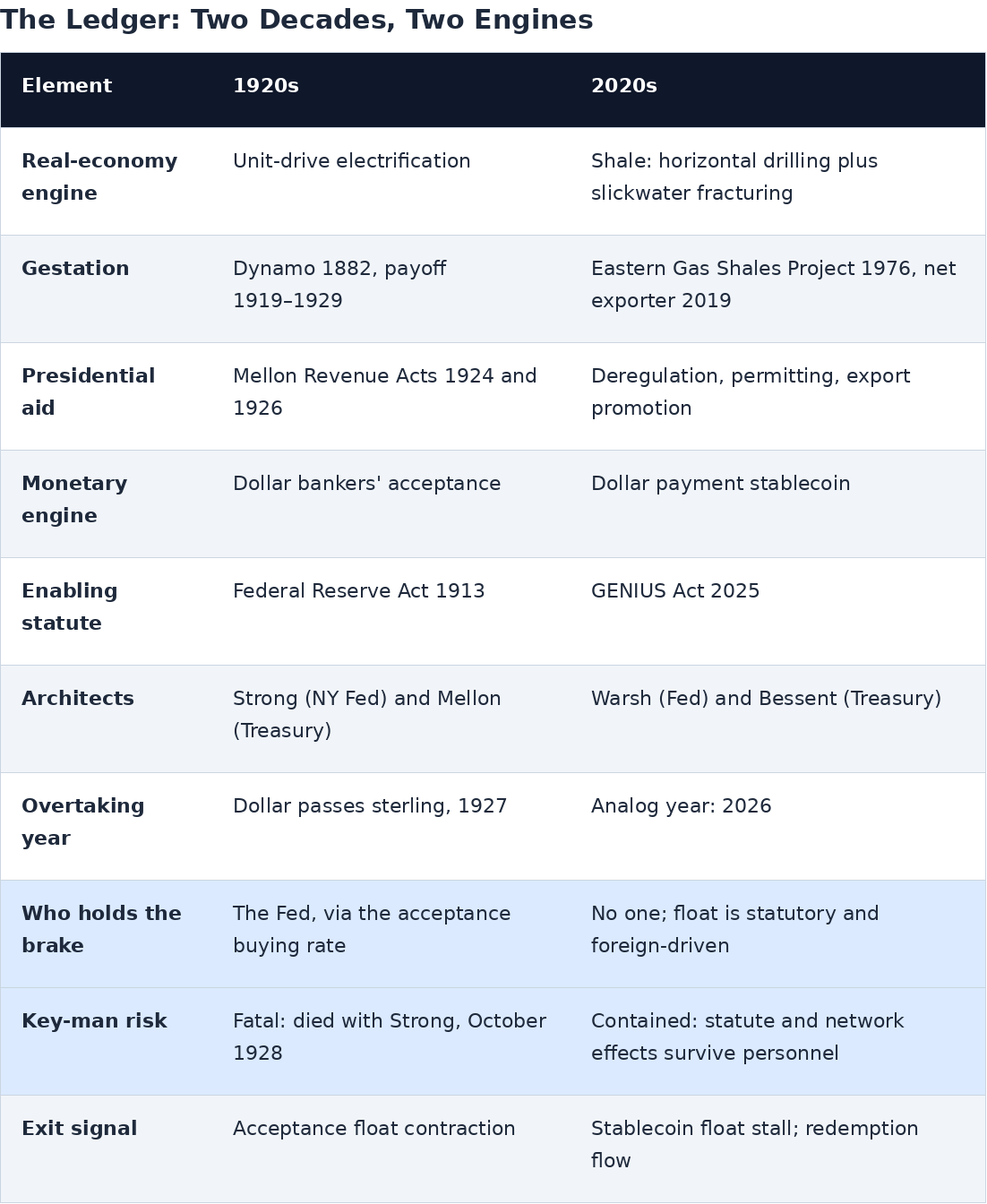
The two decades side by side, element by element.
A Future Codicil: The Super Coupon Layer
The modern monetary engine has one unsolved problem, and it is the subject of this codicil: adoption asymmetry. Abroad, stablecoins grow on fear, the IMF's cryptoization dynamic in inflation-prone economies, but that is defensive holding, a savings behavior. At home there is no driver at all. The yield ban means an American gets nothing from a stablecoin that a bank account does not already give. The float grows on foreign fear and domestic indifference, which caps both its growth rate and its quality.
The Super Coupon Token is a candidate answer: an advertiser-funded coupon carrier that attaches purchase incentives to a payment stablecoin without merging with it. The two-instrument design is the legal wedge. The statute prohibits issuers paying holders solely in connection with holding, but a coupon funded by an advertiser, on a separate carrier, paid only when redemption creates a purchase, is not issuer yield. It is marketing spend routed through the rail. The consumer finally earns a return on stablecoin usage that the law forecloses on stablecoin holding.
The implications for the engine are threefold.
Foreign markets: from holding to spending. The BIS finds stablecoin flows already bypass capital controls across more than 130 economies, and a coupon layer converts that saved float into transactional velocity. Every redemption is a purchase in digital dollars, deepening the medium-of-exchange function that reinforces the dollar hierarchy, and 98 percent of stablecoin value is already dollar-denominated. Conversion-funded advertising means the marketing cost of dollarizing a foreign consumer is borne by advertisers who pay only on conversion.
The US market: the first domestic adoption reason. The yield ban stops being friction and becomes a moat. The coupon layer is the only consumer incentive the statute permits, and it aligns every party: issuers keep the float spread, consumers capture coupon value, advertisers pay on conversion, and the token base recycles for repeated monetization.
The macro thesis: a faster fuel gauge. Coupon-driven adoption is a structural bid under float growth, transactional demand layered on fear demand, which strengthens the synthetic-duration bid under the Bessent/Warsh maturity architecture and accelerates the path toward the Treasury's $3 trillion projection.
The 1920s rhyme completes itself here. Coolidge's decade did not sell electrified goods on engineering merit. It invented modern advertising and installment selling to pull consumers into the new technology. The Super Coupon layer is that same demand-side machinery bolted onto the monetary engine: advertising as the distribution system for a new dollar instrument, ninety-nine years later.
This codicil is forward-looking. Platform readiness, traded volume, and redemption data remain to be proven, and the first ninety days of verified volume will be the inflection point. But the structural logic is already visible. Statute built the rail, foreign fear filled it, and the coupon layer is what gives Americans a reason to ride it.
Closing
Coolidge's swagger was purchased by two engines he did not invent: a dynamo that finally paid and a dollar that quietly conquered. The current administration's swagger is purchased the same way, by shale and the stablecoin. The analog holds with uncanny precision through the overtaking year, 1927 and 2026, and then breaks at exactly one joint: the brake.
Strong's dollar float could be, and was, throttled by its own operator. The modern float answers to no desk, survives its architects, and can be contracted only by its holders.
That single difference is why the machinery of 1929 is not destiny, and why the fuel gauge to watch is not the Fed's balance sheet but the float itself, soon perhaps super-charged by a coupon.
A JD Unfiltered Report. This report is an analytical essay, not investment advice.
The authors hold positions in securities mentioned and reserve the right to buy or sell shares at any time without notice.