It Starts Off Looking Small

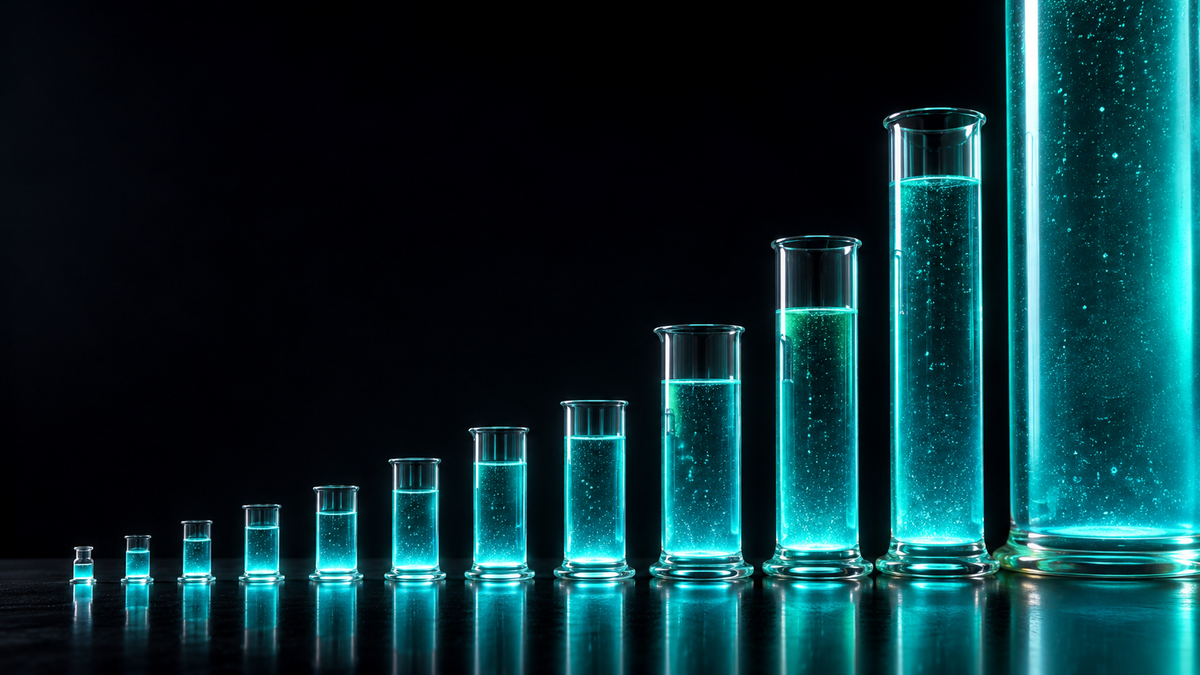
Biotech has reached the steep part of the curve, and AI is making it steeper. LLY, MRK, MRNA, RVMD, NTLA, GSK. JD Unfiltered Research.
In six months, a pill doubled survival in metastatic pancreatic cancer, a single gene-editing infusion all but switched off a hereditary disease, and a vaccine built from each patient's own tumor made the world's best-selling cancer drug work better. None of this is an accident of timing. Five technologies that took decades to mature have arrived together, and artificial intelligence is now compressing nearly every step between an idea and a medicine. This piece explains why the breakthroughs are clustering, where AI is actually speeding the work and where it is not yet, and what follows.
Disclosure: the author may hold positions in companies discussed in this article. See the full disclosures at the end of this report.
On June 26, 2000, Bill Clinton stood in the White House, with Tony Blair joining by satellite from London, and announced that the first survey of the human genome was complete. "Today, we are learning the language in which God created life," he said. Genome science, he promised, "will revolutionize the diagnosis, prevention and treatment of most, if not all, human diseases."
Ten years later, the New York Times marked the anniversary on its front page under the headline "A Decade Later, Genetic Map Yields Few New Cures." Nicholas Wade wrote that the central goal of the $3 billion project, finding the genetic roots of common diseases and turning them into treatments, "remains largely elusive." Both men were right. Clinton had the direction. Wade had the calendar.
What neither could see in 2010 was the cost curve running underneath. In September 2001, sequencing one human genome at federally funded centers cost about $95 million, on the National Human Genome Research Institute's figures. In February 2026, Element Biosciences introduced a benchtop machine built to do it for $100, shipping in the second half of this year. That is a decline of nearly a million times in twenty-five years. For most of that stretch, the drop showed up in laboratories, not pharmacies. That is what an exponential looks like at the start.
At 11:03 p.m. Eastern last night, Elon Musk quoted a thread of recent biotech results and added that if you look closely enough, breakthroughs in everything are accelerating exponentially. "An exponential always starts off looking small," he wrote. In biotech, you no longer have to look closely. The results are in the New England Journal of Medicine, in FDA approval letters and in Phase 3 toplines. The argument here is that they are arriving together for a structural reason, that AI is now pushing on almost every stage of drug development at once, and that the next wave should therefore come faster than this one.
Part One: Six Months of Results
Here is what crossed the wire since spring. Every item comes from a company release, a regulator or a peer-reviewed paper.
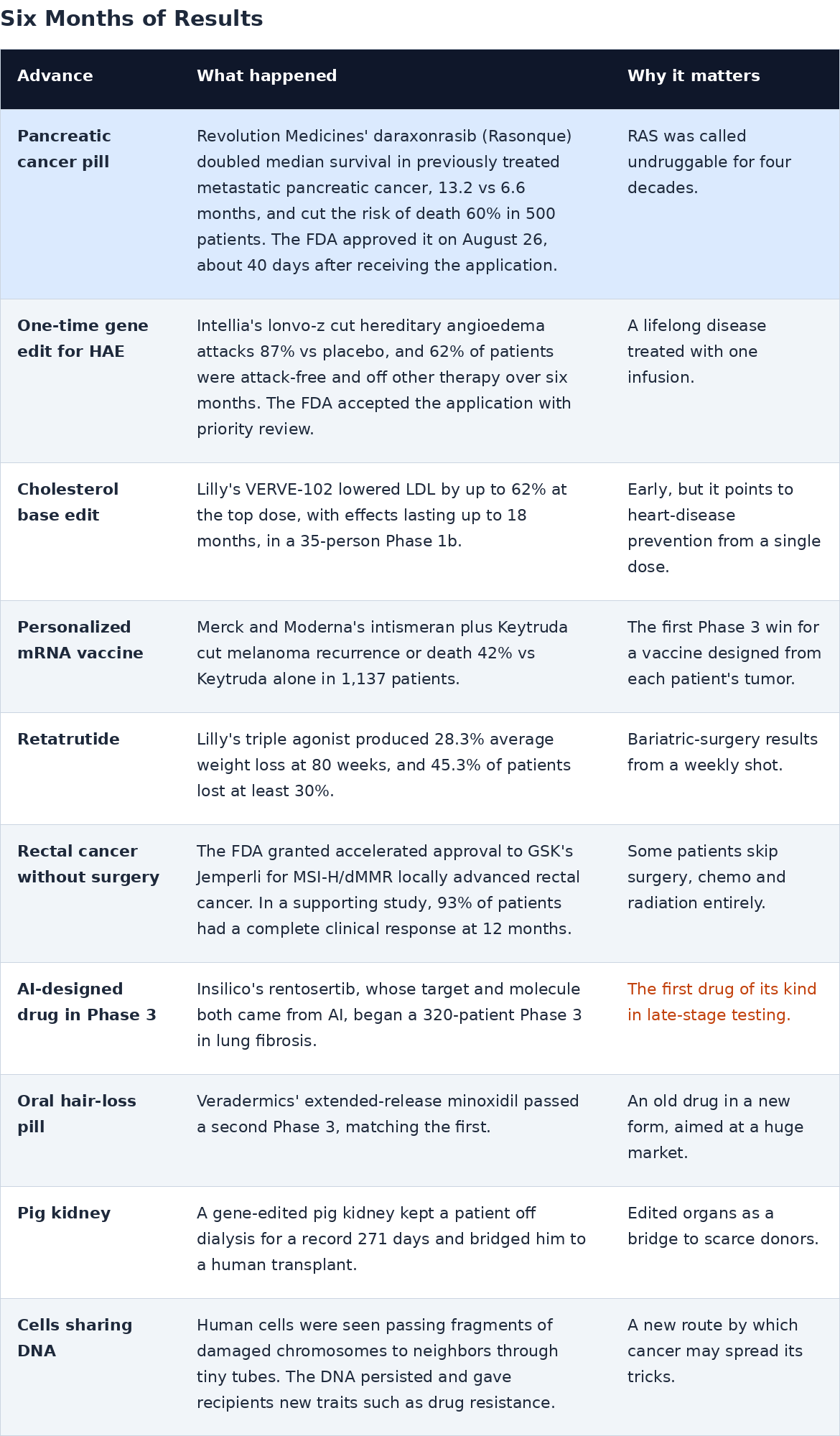
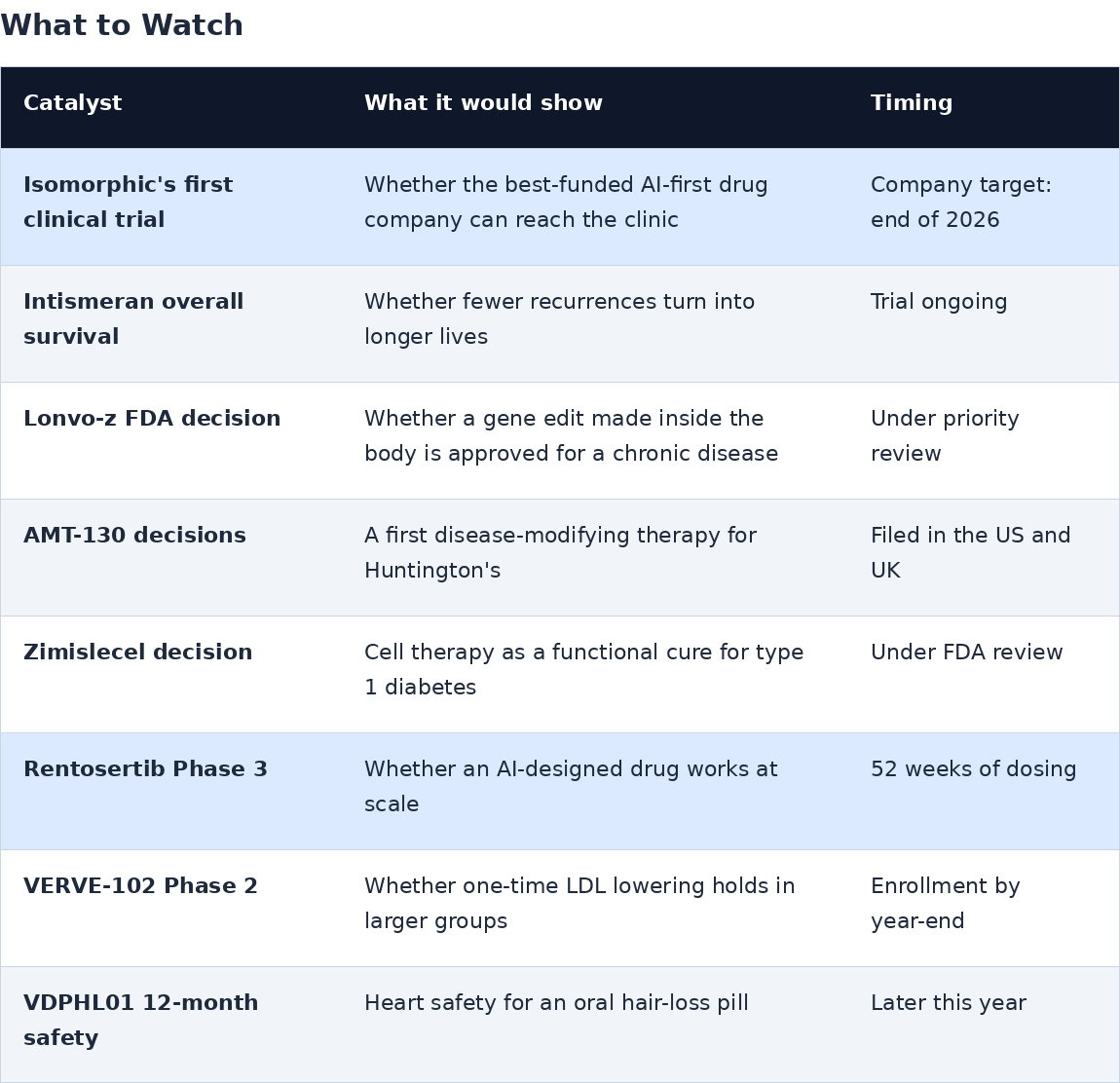
The list leaves out a good deal. Lilly's Foundayo, a once-daily GLP-1 pill, was approved 50 days after filing, the fastest approval of a new molecular entity since 2002. A single infusion of an in vivo CAR-T therapy generated engineered immune cells inside all 16 patients with multiple sclerosis and other neurologic autoimmune diseases, with no chemotherapy and no cell manufacturing. uniQure has filed for approval of AMT-130 in Huntington's disease after reporting 75 percent slowing of progression at three years in 12 high-dose patients against an external control. Vertex's zimislecel, lab-grown insulin-producing cells for type 1 diabetes, is under FDA review. And yesterday Neuralink reported that a participant with ALS reached 75 words per minute through its implant, at a 5.8 percent error rate, in the first week. A decade ago, any one of these would have led the year.
Part Two: Why It Is Happening All at Once
The cluster is not luck. Medicine sits on a stack of capabilities, and five layers of that stack matured within a few years of each other after decades of work.
Reading. Sequencing is approaching $100 a genome. Cheap reading is what makes a personalized cancer vaccine possible. Intismeran is designed from the mutations in each patient's own tumor, an idea that would have been absurd at $95 million a genome.
Writing. CRISPR was described in 2012. Its first approved therapy, Casgevy for sickle cell disease, arrived in December 2023 and required removing a patient's stem cells, editing them in a lab and infusing them back. Three years later, editors are given as a single IV infusion and do their work inside the body. Base editing goes further, changing a single letter of DNA without cutting both strands.
Delivery. The lipid nanoparticles proven at scale by COVID vaccines carry editors and mRNA to the liver efficiently. That is why lonvo-z, VERVE-102 and the custom therapy built for an infant named KJ all target liver genes. Solving delivery to one organ unlocked a dozen diseases at once.
The immune system as a drug. Checkpoint inhibitors like Keytruda and Jemperli taught the immune system to see tumors. Personalized vaccines now aim it, and in vivo CAR-T builds engineered killer cells inside the patient.
Chemistry against impossible targets. In the daraxonrasib trial, about 92 percent of patients had tumors driven by RAS G12 mutations. For forty years, chemists could not find a molecule that would grip RAS. Decades of structural work produced one that binds it in its active state.
The regulator. The FDA moved too. Foundayo was approved in 50 days, Rasonque in about 40, and Jemperli nearly four months ahead of schedule. After KJ's case, the agency created a plausible-mechanism pathway so that bespoke therapies can be judged on how they work rather than on trials that could never enroll enough patients.
These layers multiply rather than add. A personalized mRNA vaccine needs cheap sequencing, software to pick the targets, mRNA manufacturing, nanoparticle delivery and a checkpoint drug, all at once. Remove any one and the product does not exist. When several layers cross the line together, a field goes from one breakthrough a year to one a month. That is the convergence Musk is describing, and almost all of it happened before AI could help. That is the bullish point. The AI wave is landing on a stack that already works.
Part Three: Where AI Enters the Pipeline
The old math of drug development is brutal. It takes 10 to 15 years and more than $1 billion to $2 billion per approved drug, and about 90 percent of candidates that enter human trials fail, 40 to 50 percent for lack of efficacy and about 30 percent for toxicity. The World Economic Forum puts the average cost above $2.5 billion, with about eight years in the clinic for most drugs and nearly twelve for cancer drugs. AI is now working on almost every stage of that process. Here is where.
Finding the target. Insilico's PandaOmics software combed gene-expression and protein data and identified TNIK as a driver of fibrosis. Its generative chemistry system then designed rentosertib. The program reached a preclinical candidate in about 18 months. At venture firm The Column Group, a Claude-based target-assessment tool cut literature review from weeks to days, and a program it evaluated became the first nominated at the firm's new company, Pleiades.
Seeing the molecule. AlphaFold has predicted more than 200 million protein structures, work that would have taken hundreds of millions of years in the lab, and more than three million researchers in over 190 countries use it. In February, Isomorphic Labs said its new design engine more than doubles AlphaFold 3's accuracy on a hard protein-drug benchmark and predicts binding strength better than gold-standard physics methods, at a fraction of the time and cost.
Designing the drug. Anthropic published partner results on Tuesday that show what this looks like inside a lab. At Divergence Labs, Claude generated about 35,000 antibody designs for a food-allergy treatment. First lab results came back in three weeks, against up to nine months before, and three designs appeared to outperform Xolair at realistic doses. At BigHat Biosciences, two antibody fragments bound six to nine times more tightly and stayed stable at temperatures 8 to 18 degrees Celsius higher after seven design rounds in about ten weeks. At Generate Biomedicines, a redesigned CAR-T signaling domain was about 70 percent shorter and put roughly ten times as many receptors on the cell surface in lab tests. All of these are lab results, not patients, and the companies say so.
Writing new biology. Arc Institute's Evo 2 model is trained on DNA from more than 100,000 species. Researchers at Stanford and Arc used Evo models to write complete bacteriophage genomes from scratch. Of nearly 300 they synthesized, 16 produced working viruses, and a cocktail of them killed bacteria that had become resistant to the original. Profluent used language models to design gene editors that do not exist in nature and showed them editing human cells precisely. AI is no longer only finding drugs. It is designing the tools that the writing layer uses.
Running the lab. Lilly and NVIDIA will invest up to $1 billion over five years in a co-innovation lab that includes robotics and physical AI. Lilly also offers its TuneLab models, built on about $1 billion of research data, to biotechs for free in exchange for training data. Lila Sciences runs autonomous labs that execute experiments and feed the results back into its models. On September 21, the FDA issued a rule clarifying that non-animal methods, including AI models and organ chips, can be used to test drug safety before human trials.
Handling the paperwork. At Enveda, Claude drafted the first version of a section of an Investigational New Drug application in four hours. Writing it by hand had taken about three months, and both figures exclude a three-week human review. Its manufacturing-record review cut review time 89 percent, catching all 11 issues human reviewers had found plus seven more. The FDA has rolled out Elsa 4.0, its internal AI tool, across the agency and consolidated more than 40 submission systems into one platform.
Shrinking the team. Before Anthropic acquired it in July, Mithril Medicine had one full-time employee. Working with Claude and 11 outside labs, it took a muscular dystrophy treatment from idea to promising mouse results in under 18 months. That is a biotech pipeline run by one person.
The scorecard so far. Boston Consulting Group found that AI-discovered molecules succeeded in Phase 1 80 to 90 percent of the time, well above historical averages of 40 to 60 percent. But in Phase 2, BCG's Chris Meier told Nature Biotechnology there is so far "no indication that AI-discovered targets or drugs are necessarily any more successful" than classically discovered ones. Phase 1 tests whether a molecule is safe and behaves well, and AI is very good at designing well-behaved molecules. Phase 2 tests whether the biological theory is right. That is still the hard part.
Part Four: Why the Next Wave Comes Faster
Three forces make the next cycle shorter than this one.
The front end is compressing. Before a drug reaches humans, the industry spends roughly five and a half years on target validation, screening, lead optimization and preclinical testing. Insilico reached a candidate in about 18 months. Divergence got lab answers in weeks instead of months. Mithril reached mouse data in under a year and a half with one employee. Every year cut from discovery is a year earlier to the clinic, and more programs per dollar.
The shots are better. A simple illustration shows why Phase 1 matters. If roughly 10 percent of drugs entering trials win approval, and AI lifts the Phase 1 pass rate from 50 to 85 percent while every later stage stays the same, overall success rises to about 17 percent. That is about 70 percent more approvals from the same number of clinical starts. It is arithmetic, not a forecast, and it assumes no improvement in Phase 2, where most failures happen. If AI eventually moves that number too, the gain compounds.
Platforms turn the next drug into an edit. Once an editor and a nanoparticle work in the liver, the next disease is largely a change in the guide sequence. KJ's therapy was designed and delivered in months, and the plausible-mechanism pathway lets similar bespoke therapies be evaluated on how they work. That is the closest biology has come to software, and it is where the update-cycle language is most accurate.
The money loop reinforces all three. Weight-loss drug revenue funds Lilly's AI lab and the models it gives away, and AI labs such as Anthropic now run drug programs of their own. Profits from the last breakthrough now pay for the tools that find the next one.
The limit is the clinic. Human biology runs on its own clock. Rentosertib's Phase 3 requires 52 weeks of dosing, and no model can shorten that. AI can now match cancer patients to trials with near-expert accuracy, yet it has not raised enrollment, because the bottleneck is logistics, workflow and consent rather than information. So the discovery side compounds while the clinical side improves more slowly. The steepest gains will show up where the clinic is short: rare diseases, cancers with fast endpoints, and one-time therapies with clear markers like LDL levels or attack counts.
Part Five: What Could Slow It
Efficacy is still the wall. AI-designed drugs have not yet shown better Phase 2 results, and no AI-originated drug has been approved.
Some claims are running ahead of the evidence. Isomorphic Labs has raised $2.7 billion and says its hypothesis "has been proven," yet as of September 30 it had named no drug candidate and started no trial, with its own year-end deadline approaching.
The liver is not the body. Delivery to the brain, muscle and solid tumors remains much harder. Even AMT-130's strong data drew an FDA request for more information before its filing.
Permanent edits carry unknown long-term risk, and many of the headline gene-editing results come from small groups of patients followed for a year or two. Faster approvals cut both ways: Jemperli's accelerated approval rests on a single-arm trial and still has to be confirmed. One-time therapies also break the subscription economics that insurers and drugmakers are built around, and someone has to pay up front.
And there is the lesson of 2000. Clinton's direction was right and his timing was not. Anyone pricing these stocks on the word exponential should remember how long the genome took to pay off.
Part Six: What It Means
For patients, medicine is shifting from management to repair. Hereditary angioedema, high cholesterol, sickle cell disease and possibly type 1 diabetes are moving from lifelong prescriptions toward a single treatment. Heart disease, cancer, obesity and neurodegeneration, the conditions behind most premature deaths, are all under attack with new tools at the same time. The bigger prize is not lifespan but years lived in good health.
For the industry, value is moving toward platforms, proprietary data and compute. Small AI-native teams can now do work that once required hundreds of scientists, and the largest drugmakers are becoming major buyers of AI infrastructure.
For society, the same tools raise new questions. Models that can write viable viral genomes need guardrails, and the United Nations has already warned that brain-implant data could be misused.
Part Seven: We Have Seen This Before
On March 8, JD Unfiltered published "Eli Lilly: The NVIDIA of Chronic Disease" and rated the stock a Strong Buy. The argument was that Wall Street saw an obesity drug company, while Lilly had built a platform that reached across the inflammation behind most chronic disease, much as NVIDIA had looked like a gaming chip company in 2022 while it was becoming the infrastructure of AI.
Lilly closed at $990.33 on March 6, the last trading day before the piece ran, and at $1,288.30 yesterday, a gain of about 30 percent in under eight months. The two biggest catalysts the piece named have both delivered. Orforglipron was approved as Foundayo on April 1, fifty days after filing, and retatrutide produced 28.3 percent weight loss in its first pivotal trial.
The call fits the argument of this article. Lilly now owns a piece of nearly every layer described above: an oral pill approved at record speed, a one-time gene edit for cholesterol, and its own AI lab built with NVIDIA. The market has started to price the platform. It has not finished. Our 2028 base case of $2,119 still sits about 64 percent above yesterday's close, and the company reports third-quarter results this morning.
Lilly will not be the last name we put on this curve. The same convergence is working its way through gene editing, cell therapy, cancer vaccines and AI-native drug design, and we will publish the next calls as the work on each is finished.
Conclusion: The Grammar
Twenty-six years ago, Clinton said we were learning the language of life. He was right about the language and wrong about how long it would take to speak it. The genome was the alphabet. Cheap sequencing, gene editing, nanoparticle delivery and immune engineering turned it into words. AI is starting to supply the grammar: which target, which molecule, which edit, and which patient.
The past six months came almost entirely from science that began before AI could help. The first drug designed end to end by AI has only just entered Phase 3, none has been approved, and the most heavily funded AI drug company has yet to dose a patient. If the breakthroughs are already arriving this fast without it, the next decade will be the first built with it.
That is the part that still looks small.
Sources
Regulators and government: the Clinton White House archive, remarks of June 26, 2000; the National Human Genome Research Institute's sequencing cost data; FDA approval announcements for daraxonrasib (August 26, 2026, and the NDA 220910 approval package), dostarlimab in rectal cancer (October 19, 2026), Foundayo under the national priority voucher program (April 1, 2026) and the first sickle cell gene therapies (December 8, 2023); FDA releases on alternatives to animal testing (September 21, 2026), new approach methodologies (April 20, 2026) and AI capabilities and data platform consolidation (May 6, 2026).
Companies: Element Biosciences on VITARI; Intellia's HAELO Phase 3 presentation and BLA priority review release; Lilly's VERVE-102 and retatrutide releases; Merck on the INTerpath-001 trial; uniQure's SEC filing; NVIDIA and Lilly on the co-innovation lab; Lila Sciences; Isomorphic Labs on its drug design engine; Arc Institute on Evo 2; Profluent; Google DeepMind on AlphaFold; Anthropic, "Early progress on accelerating drug development with Claude," October 27, 2026.
Research: Sun et al. in Acta Pharmaceutica Sinica B on clinical failure rates; the World Economic Forum's Intelligent Clinical Trials white paper; Boston Consulting Group on biopharma research; Nature Biotechnology on foundation models; medRxiv on transition probabilities in drug development; Yaacov, Levi and Peled in Patterns on AI and trial enrollment; PubMed Central on intercellular DNA transfer.
Reporting: The New York Times, June 13, 2010; NCI Frederick on daraxonrasib; Dermatology Times on intismeran; Children's Hospital of Philadelphia on KJ's therapy; MedPath on the FDA framework; Medscape on in vivo CAR-T; the Huntington's Disease Foundation and Huntington's Disease Association on AMT-130; MarketBeat on zimislecel; Yahoo Finance on Veradermics and Lilly price history; IFLScience on the pig kidney; Tesla North on Neuralink; Artificial Science on rentosertib; Drug Discovery News; Pharma Insight; CAS on genome-scale design; pharmaphorum on TuneLab; The Inference on Isomorphic; The Debrief on brain data; News4U and Elon Musk on X, October 29, 2026; JD Unfiltered, "Eli Lilly: The NVIDIA of Chronic Disease," March 8, 2026.
Important Disclosures
Position disclosure. The author may hold positions in the securities of companies discussed in this article, including Eli Lilly (LLY), Merck (MRK), Moderna (MRNA), Revolution Medicines (RVMD), Intellia Therapeutics (NTLA) and GSK (GSK), and may buy, sell, add to, reduce or hedge any such position at any time before or after publication without notice. Readers should treat this article as the opinion of a potentially interested party.
No investment advice. This article is for informational and educational purposes only. It is not investment, medical, legal, tax or accounting advice, and it is not a recommendation or solicitation to buy, sell or hold any security. It does not take into account the investment objectives, financial situation or needs of any reader. Consult a qualified, licensed financial adviser before making any investment decision, and a qualified physician before making any medical decision.
Opinion. The views expressed, including the assessment of AI's effect on drug development and the outlook in Parts Four and Six, are the author's opinion. Company statements about future trials, filings, approvals and timelines are management expectations, not achieved results. Investigational products discussed have not been approved unless stated. Laboratory and animal results do not establish safety or efficacy in humans. The success-rate calculation in Part Four is illustrative arithmetic, not a forecast.
Past performance. References to the performance of earlier JD Unfiltered calls, including the March 8, 2026 Eli Lilly report, are historical. Past performance is not a guarantee of future results, and price targets are opinions that may not be reached.
No affiliation or compensation. JD Unfiltered and the author are not affiliated with any company or person cited and received no compensation from any issuer or third party for preparing or distributing this article.
Forward-looking statements. This article contains forward-looking statements about technology, clinical development, regulation and markets. Such statements involve significant risks and uncertainties, and actual results may differ materially. The author undertakes no obligation to update this article.
Information and accuracy. Information is drawn from public sources believed to be reliable, including regulatory documents, company releases, peer-reviewed research and news coverage, but its accuracy and completeness are not guaranteed. Information is current as of October 29, 2026. All investments involve risk, including loss of principal.