
From Calles to Khamenei: Oil, Coercion, and the Architecture American Energy Dominance

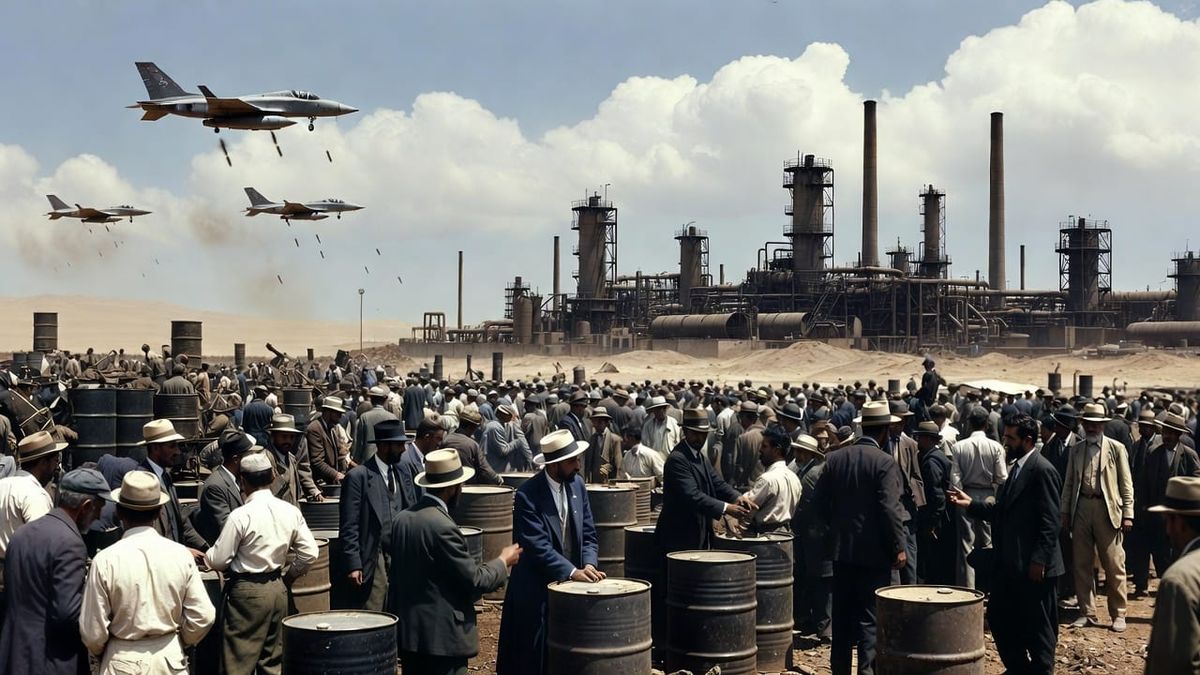
A Comparative Thesis on the 1926–27 Mexican Oil Crisis and the 2026 U.S.-Iran Conflict
I. Abstract
The 2026 U.S.-Iran war bears a structural resemblance to the 1926–27 Mexican oil crisis that extends well beyond superficial analogy. In both episodes, a U.S. president deployed overwhelming coercive leverage, military, economic, and diplomatic against a petrostate that had asserted sovereign control over its hydrocarbon resources.
In both cases, the adversary weaponized its oil infrastructure as a retaliatory chokepoint, provoking a global price spike. And in both cases, the resolution followed an identical arc: maximum escalation, followed by a pragmatic face-saving settlement that quietly conceded key economic demands while publicly declaring victory.
This thesis argues that the Trump administration's current posture, waging war on Iran while simultaneously lifting sanctions on Iranian and Russian oil, represents not strategic incoherence but a deliberate replay of the Coolidge-Morrow playbook.
Furthermore, the massive hedging activity by American shale producers, the reopening of Venezuelan production under Chevron and Repsol, and Saudi Arabia's preemptive output increases constitute a coordinated supply surge designed to collapse oil prices in the post-conflict period, permanently marginalizing Iran as an energy power and redirecting global oil flows toward U.S.-allied buyers, principally Japan, South Korea, and Italy, rather than China.
II. The 1926–27 Precedent: Anatomy of Coercive Energy Diplomacy
A. The Legal Trigger
Mexico's Constitution of 1917 declared all subsoil mineral wealth the property of the nation under Article 27. President Plutarco Elías Calles enacted enabling legislation in December 1925 that required foreign oil companies to apply for confirmatory concessions with a 50-year limit and narrowly defined "positive acts" as only actual drilling prior to May 1, 1917. This threatened holdings controlling roughly 90% of Mexico's oil-producing lands.
B. The Confrontation (January–April 1927)
When the compliance deadline expired on December 31, 1926, approximately twenty American oil companies refused to register. Calles canceled 149 drilling permits on January 26, 1927, and deployed troops to seal wells. Companies broke government seals and drilled illegally. Calles ordered General Lázaro Cárdenas to conduct strategic arson at foreign oil sites.
President Calvin Coolidge responded by:
- Allowing arms to flow to Calles's enemies (Cristero rebels)
- Issuing a corollary to the Monroe Doctrine declaring U.S. protection of American citizens and property abroad (April 1927)
- Deploying economic pressure through Wall Street's dominance of Mexican sovereign debt
Ambassador Dwight Morrow, a J.P. Morgan partner, negotiated a face-saving settlement.
C. The Resolution (November 1927 – March 1928)
The Mexican Supreme Court declared the 1925 Petroleum Act unconstitutional as retroactive legislation (November 17, 1927). Congress then amended the law to grant confirmatory concessions of indefinite duration.
On March 27, 1928, the State Department declared the controversy at "a practical conclusion".
The key mechanism: Coolidge did not topple Calles. He degraded Calles's leverage until Calles voluntarily restructured his own legal framework to accommodate American interests — through Mexican institutions, preserving the appearance of sovereignty.
III. The 2026 Replay: Trump, Iran, and the Donroe Doctrine
A. The Trigger
On February 28, 2026, the U.S. and Israel launched Operation Epic Fury, striking Iranian military and nuclear infrastructure. Ayatollah Khamenei was killed in the initial strikes. Iran responded by closing the Strait of Hormuz, attacking 21+ merchant vessels, and striking Gulf energy facilities in Kuwait, Qatar, and Saudi Arabia.
B. The Donroe Doctrine
Trump has explicitly extended the Monroe Doctrine into a global framework — what Middle East Eye termed the "Donroe Doctrine" — asserting American rights to intervene wherever energy security and national interests are threatened.
This mirrors Coolidge's April 1927 corollary precisely: the principle that American economic interests abroad enjoy the protection of American military power, regardless of the sovereignty claims of the host nation.
The doctrine was first applied in Venezuela (regime change, January 2026) and then extended to Iran — the last major petrostate openly hostile to Washington. The sequential targeting of two OPEC petrostates within two months is not coincidental; it represents a systematic assertion of American primacy over global oil supply chains.
C. The Paradox of Wartime Sanctions Relief
The Trump administration is simultaneously bombing Iran and lifting sanctions on Iranian and Russian oil at sea. Treasury Secretary Bessent described this as "utilizing the Iranian barrels against the Iranians". Critics call this incoherent. It is not. It is the precise equivalent of Coolidge arming the Cristeros with one hand while Morrow shook Calles's hand with the other.
The operational logic: flood the market with short-term supply to suppress the price spike caused by the war, preventing domestic political damage from gasoline prices, while the military campaign destroys Iran's capacity to ever threaten shipping again. The sanctions will be reimposed — or rendered irrelevant — once Iran's military leverage is neutralized.
IV. The Supply Surge: Hedging, Venezuela, and the Saudi Put
A. American Shale: The Hedging Windfall
U.S. shale producers entered 2026 historically under-hedged. However, hedging activity surged dramatically through the second half of 2025, with WTI options volume rising sharply year-on-year. By February 2026, oil and gas companies had hedged at record levels.
Producers locked in prices using swap contracts and limit orders, creating steep backwardation in the futures curve. The price surge generated billions in incremental cash flow and incentivized maximum production.
The strategic implication: American producers have locked in high prices for future delivery. They are now incentivized to maximize production, flooding the market with barrels that will be sold at elevated levels even as spot prices eventually decline.
B. Venezuela: The Reopened Flank
The removal of Maduro in January 2026 was not merely a geopolitical operation — it was a supply-side intervention. Venezuela holds the world's largest proven oil reserves.
Chevron was already producing 250,000 bpd and projected a 50% increase. Repsol announced plans to significantly expand production. Additional deals with Chevron and Shell are in progress.
Even a modest ramp — from roughly 900,000 bpd to 1.2–1.5 million bpd — represents meaningful incremental supply entering the market.
C. Saudi Arabia: The Swing Producer Returns
Saudi Arabia began increasing output in early 2026 and positioned itself as a reliable supplier to offset disruptions.
Key dynamics include:
- OPEC+ output increases
- Activation of the East-West pipeline bypassing Hormuz
- Approximately 2.4 million bpd of spare capacity
Saudi Arabia’s strategy combines compliance with U.S. pressure and a desire to reclaim market share.
V. The Post-War Price Collapse: The Larry Fink Thesis
BlackRock CEO Larry Fink articulated the post-war supply thesis most bluntly: "If the outcome of the war is a neutralized Iran, and they are allowed to be selling oil products into the market again, I mean there's probably a great probability that oil is gonna be below 50".
This is not speculative. The math supports it:
Pre-war baseline:
- ~2.4 million bpd global surplus
- Brent forecast near $50
Post-war supply additions:
- U.S. shale expansion
- Venezuelan ramp
- Saudi spare capacity
- Russian barrels returning
- Non-OPEC growth
Post-war demand:
- Slower GDP growth
- Trade contraction
- Stagflationary pressures
Conclusion: the convergence of these forces creates a supply glut capable of driving oil below $50.
VI. The Beneficiaries: Japan, South Korea, and Italy — Not China
Sanctions relief redirects oil flows toward allied nations:
- Japan
- South Korea
- Italy
This reduces China’s access to discounted Iranian crude and strengthens allied energy security.
VII. Regime Change: The April-to-September Arc
Phase 1: Combat Ends (Late March–April 2026)
Phase 2: Economic Asphyxiation (April–June 2026)
Phase 3: Internal Fracture (June–September 2026)
The likely outcome is a weakened state willing to accept Western investment in its energy sector.
VIII. Conclusion: The Doctrine of Managed Energy Dominance
The U.S. response follows a consistent four-step pattern:
- Escalate
- Absorb the shock
- Offer the off-ramp
- Flood the market
The 2026 Iran conflict appears to be following the same arc as the 1926–27 Mexican oil crisis.
History does not repeat, but the playbook rhymes.
References
- https://read.dukeupress.edu/hahr/article/66/2/319/147993/Mexico-the-United-States-and-the-1926-1927
- https://www.middleeasteye.net/opinion/venezuela-iran-trumps-donroe-doctrine-escalates-us-push-control-worlds-oil
- https://en.wikipedia.org/wiki/2026_Strait_of_Hormuz_crisis
- https://en.wikipedia.org/wiki/Mexican_oil_expropriation
- https://www.axios.com/2026/03/19/trump-iran-oil-sanctions
- https://www.bloomberg.com/news/articles/2026-03-02/oil-producers-pounce-on-price-surge-to-lock-in-future-revenue
- https://oilprice.com/Latest-Energy-News/World-News/Saudi-Arabia-Boosting-Oil-Output-In-Anticipation-of-US-Attacks-On-Iran.html
- https://oilnow.gy/news/chevron-says-it-can-boost-venezuela-production-up-to-50-in-24-months/
- https://www.nytimes.com/1927/04/10/archives/the-oil-war-in-mexico-grows-more-intense-american-companies-stand.html
- https://www.jstor.org/stable/45468799
- https://www.britannica.com/event/2026-Iran-Conflict
- https://www.washingtonpost.com/world/2026/03/19/us-iran-war-trump-gas-prices-qatar/
- https://www.foxnews.com/opinion/donroe-doctrine-trump-rewriting-power-politics-put-america-first
- https://www.forbes.com/sites/ianpalmer/2026/03/05/us-attacks-two-petrostates-is-there-a-colonial-motive-here/
- https://www.nytimes.com/2026/03/12/us/politics/trump-russia-oil-sanctions.html
- https://finance.yahoo.com/news/larry-fink-says-oil-could-113020227.html
- https://www.cmegroup.com/openmarkets/energy/2025/Shale-Producers-Flock-Back-to-Hedging.html
- https://www.businessreport.com/article/oil-and-gas-companies-hedged-at-record-levels-prior-to-commodities-sell-off
- https://newvision.io/industry-digest/oil-producers-lock-in-2026-hedges-after-crude-spikes-on-iran-conflict
- https://finance.yahoo.com/news/us-oil-companies-poised-60-213104053.html
- https://finance.yahoo.com/news/global-energy-giant-joins-chevron-024009774.html
- https://www.reuters.com/business/energy/chevron-shell-closing-first-big-oil-production-deals-venezuela-since-us-captured-2026-03-10/
- https://fortune.com/2026/03/17/venezuela-has-the-worlds-largest-proven-oil-reserves-but-it-cant-solve-for-the-math-problem-in-the-strait-of-hormuz/
- https://www.forbes.com/sites/gauravsharma/2026/03/01/opec-to-hike-oil-output-from-april-as-middle-east-crisis-escalates/
- https://fortune.com/2026/03/01/opec-oil-output-increase-saudi-arabia-russia-iran-conflict-crude-prices/
- https://www.iranintl.com/en/202508170065
- https://www.businessinsider.com/oil-price-shock-iran-war-supply-chain-crisis-goldman-sachs-2026-3
- https://en.people.cn/n3/2026/0320/c90000-20438021.html
- https://www.economist.com/leaders/2026/03/12/an-attack-on-the-world-economy
- https://www.steptoe.com/en/news-publications/international-compliance-blog/weekly-sanctions-update-march-16-2026.html
- https://kathmandupost.com/world/2026/03/19/europe-and-japan-ready-to-help-stabilise-energy-prices-and-secure-oil-chokepoint
- https://www.morningstar.com/news/marketwatch/2026031785/hundreds-of-ships-remain-trapped-at-the-strait-of-hormuz-as-iran-decides-which-can-pass
- https://www.spglobal.com/energy/en/news-research/latest-news/crude-oil/030926-us-to-remove-oil-sanctions-on-some-countries-until-iran-situation-straightens-out-trump
- https://www.aljazeera.com/news/2026/3/2/trump-says-iran-war-projected-to-last-4-to-5-weeks-could-go-far-longer
- https://www.stimson.org/2026/why-the-latest-iran-protests-started-in-the-tehran-bazaar/
- https://fortune.com/2026/03/09/u-s-intel-assessment-iran-regime-change-was-unlikely-in-either-short-or-long-war-sources-say/
- https://www.bbc.com/news/articles/cx2lgvg5rl1o
- https://en.wikipedia.org/wiki/2025–2026_Iranian_protests
- https://www.euronews.com/2026/01/08/a-big-storm-is-coming-triggering-major-upheaval-iranian-analyst-tells-euronews
- https://spectator.com/article/why-the-venezuela-model-would-be-a-disaster-for-iran/
- https://dialogueinitiatives.org/iran-conflict-chaos-or-change-in-2026/
- https://www.politico.com/news/2026/01/13/u-s-oil-producers-iran-00726363