
Apple Bends the Knee to Starlink

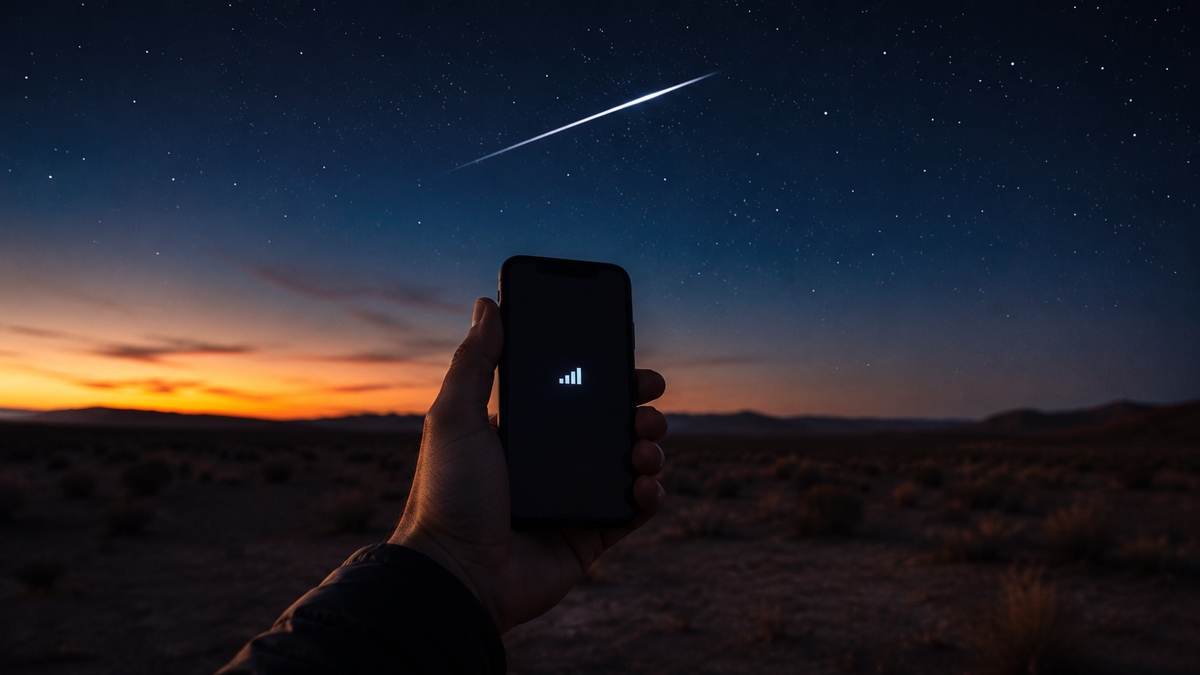
How a quiet iOS update confirmed what I've been writing for a year and what it means for companies, services, and chips.
Executive Summary
Apple has quietly partnered with SpaceX and T-Mobile to bring Starlink satellite messaging directly to the iPhone through a recent software update, breaking what had been a multi-year exclusivity with Globalstar for Apple's satellite features. The rollout is beta-gated today but signals a tectonic shift in how the modern smartphone connects to the network.
For readers who have followed my SpaceX series over the past year, this is the event I have repeatedly said was coming. Starlink Direct-to-Cell was never a feature — it was the end of the dead-zone era and the beginning of a new wireless stack in which the satellite is the tower.
"Texting on an iPhone over Starlink is a small UX change. Apple breaking Globalstar exclusivity to do it is a tectonic one."
Key takeaways:
- Apple enabled a settings toggle that routes standard SMS through Starlink Direct-to-Cell via T-Mobile spectrum — no dish, no app, no aiming at the sky.
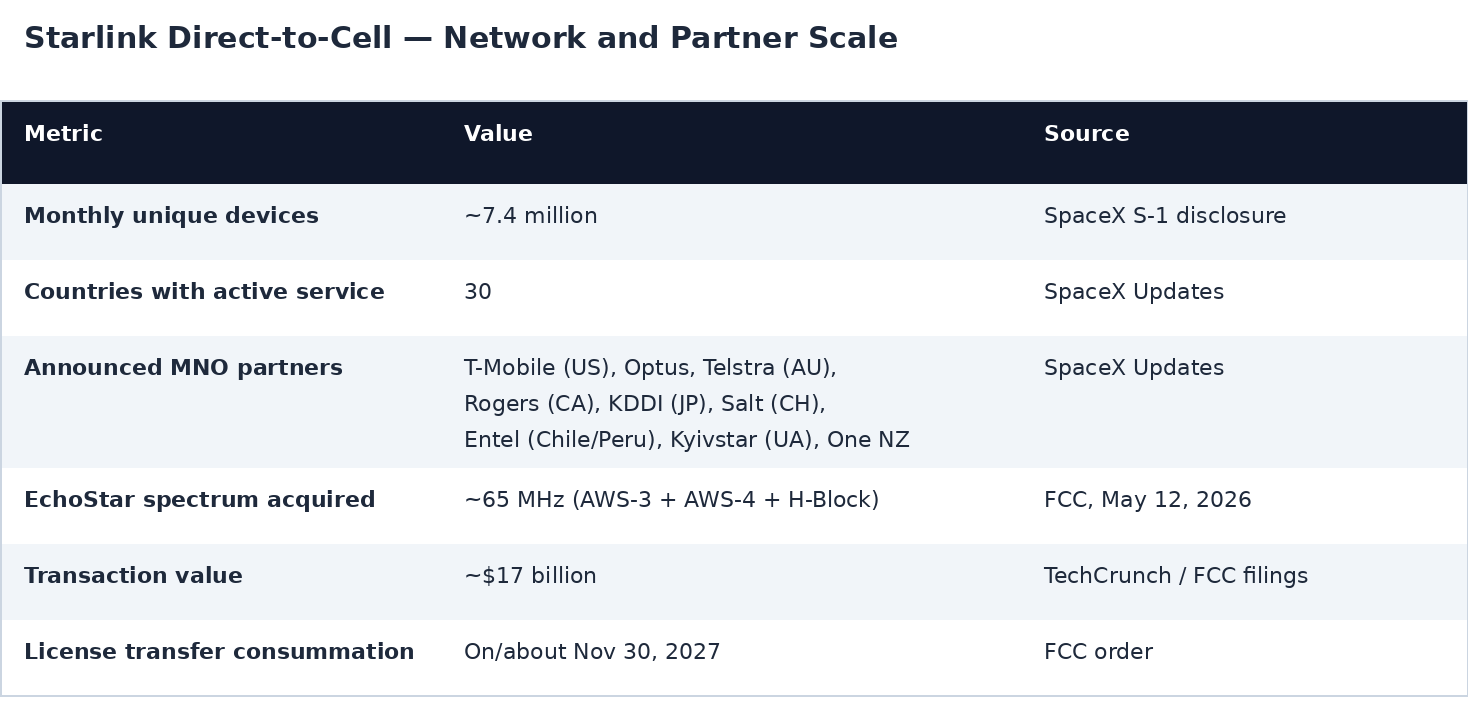
- Starlink Direct-to-Cell already serves ~7.4 million monthly unique devices across 30 countries, with MNO partners on five continents.
- The FCC's May 2026 approval of SpaceX's ~$17B EchoStar spectrum acquisition (~65 MHz nationwide, AWS-3 / AWS-4 / H-Block) is the regulatory backbone for full 5G direct-to-phone.
- AT&T, T-Mobile, and Verizon are pursuing a joint venture to pool spectrum and satellite capacity — a coordinated defensive response.
- Next 12–24 months: data → voice → media sharing from orbit; Apple, AAPL silicon, RF chip vendors, and 5G NTN modem leaders all get repriced.
1. What Actually Happened
Alongside a recent iOS update, Apple introduced a dedicated toggle in cellular settings that lets supported iPhones send and receive standard SMS over the Starlink Direct-to-Cell network using T-Mobile's spectrum. The feature is currently limited to a beta group, but the device baseline (iPhone 14 and later) is the same install base that today uses Apple's Globalstar-powered Emergency SOS.
When connected, the iPhone status bar identifies the link as "T-Mobile SpaceX" or "T-Sat+Starlink." The user does not need to aim at the sky, install an app, or change carriers. T-Satellite already supports texting, location sharing, picture/audio messaging, and select satellite-ready apps including X, WhatsApp, Google Maps, and AccuWeather.
2. Why This Was Inevitable
Three calls I have made repeatedly in this series have now all converged into a single event:
2.1 The constellation IS the moat
SpaceX is the only operator on Earth that launches its own rockets, builds its own satellites, and controls the launch cadence end-to-end. No competitor can replicate the unit economics. After years of Globalstar exclusivity, Apple had no commercially viable alternative for true direct-to-phone consumer service at scale.
2.2 Spectrum was the next domino
On May 12, 2026 the FCC approved SpaceX's acquisition of approximately 65 MHz of contiguous nationwide spectrum from EchoStar — 15 MHz AWS-3, 40 MHz AWS-4, and 10 MHz H-Block — in a transaction valued at roughly $17 billion (cash and SpaceX stock). The FCC explicitly granted "exclusive-use, contiguous spectrum nationwide," the phrase that matters: it is the regulatory foundation for full 5G cellular delivered from orbit to any standard smartphone, no dish required.
2.3 The incumbents have to respond together
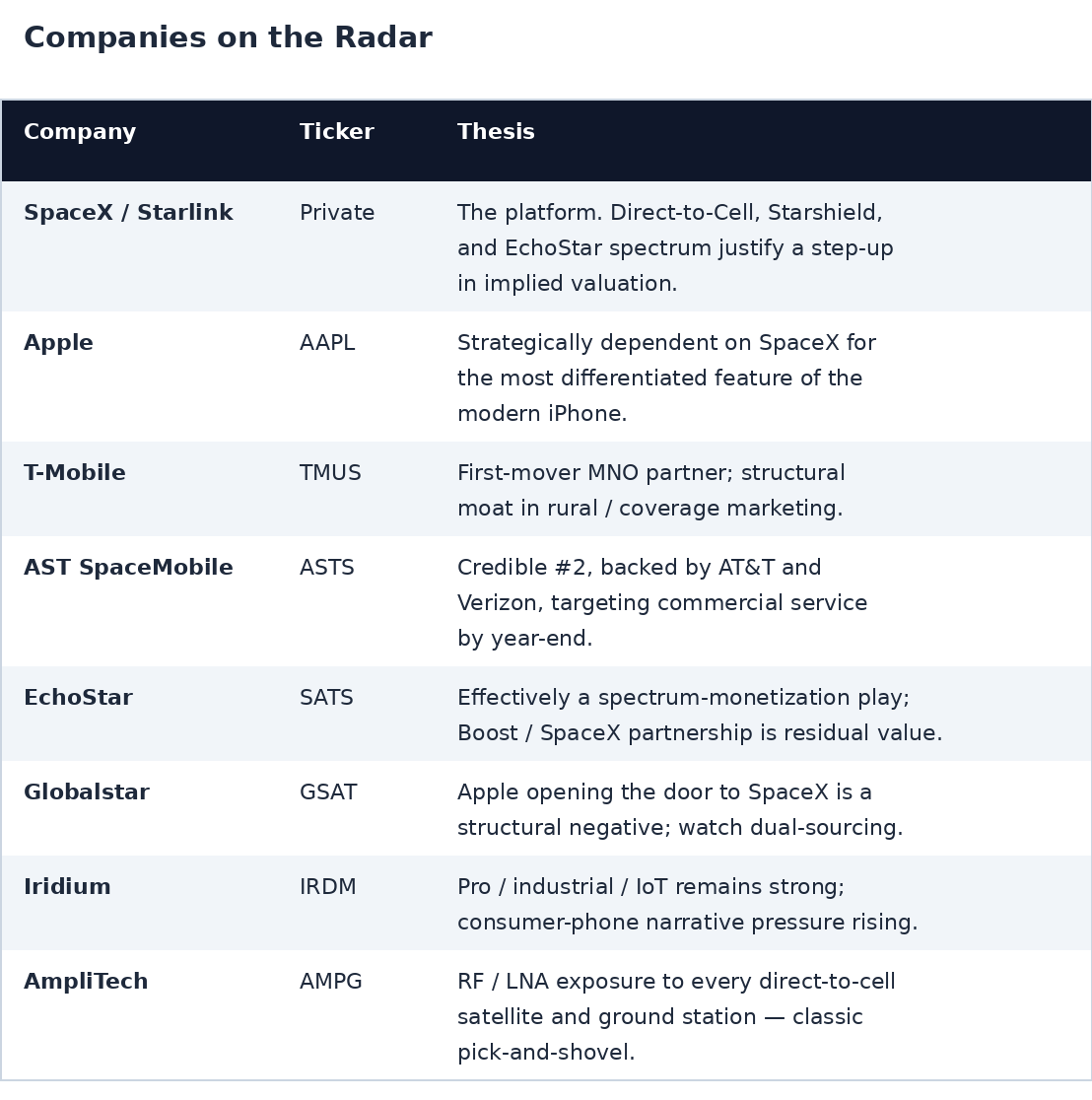
AT&T, T-Mobile, and Verizon are pursuing a joint venture to pool spectrum and satellite capacity to close cellular dead zones — a coordinated answer to the satellite players entering consumer wireless. T-Mobile already runs T-Satellite with SpaceX; AT&T and Verizon back AST SpaceMobile, which is targeting commercial service by year-end. Their individual agreements stand, and the JV is intended to layer a shared platform on top.
"When the Big Three carriers pool spectrum to fight you, you have already won the narrative."
3. What Comes Next — Services, Companies, Chips
Texting is the appetizer. SpaceX and T-Mobile have publicly outlined a roadmap that progresses from messaging to data, then voice and media sharing, delivered from orbit to a standard phone. The investable layers split cleanly into services, companies, and silicon.
3.1 Service roadmap (12–24 months)
- Beta texting → general availability across iPhone and Android.
- Satellite data already rolling on iOS 26 for T-Mobile customers; expands to background app data, low-bandwidth web, and richer media in messaging apps.
- Voice calls from orbit as V3 Direct-to-Cell satellites stack up and the EchoStar spectrum license consummates (on/about Nov 30, 2027).
- Boost Mobile / EchoStar subscribers gain Starlink Direct-to-Cell access through the long-term partnership embedded in the spectrum deal.
3.2 Companies on the radar
3.3 Chips and silicon — the quiet trillion-dollar layer
The story behind the story is silicon. Direct-to-cell at consumer scale requires baseband modems that understand 3GPP's 5G NTN (Non-Terrestrial Network) standard, RF front-ends that can close the link budget to LEO, and on-satellite compute that can keep up with data and voice loads.
- Qualcomm and MediaTek — integrating 5G NTN natively into baseband. The standards path lets any compliant phone — not only "satellite-optimized" models — talk to LEO constellations.
- Apple in-house C-series modem — the roadmap now has to assume native satellite. Satellite shifts from emergency bolt-on to primary connectivity stack inside Apple silicon planning.
- RF front-end — Qorvo, Skyworks, and Broadcom on the handset side; AmpliTech and other specialists on the satellite-side low-noise amplifier business.
- Compute-in-orbit — as the network moves from texting to data and voice, on-satellite processing becomes a real workload. A 2027–2028 story that ties directly into the data-centers-in-space thesis covered earlier in this series.
Bottom Line
SpaceX is not a rocket company, not a satellite-internet company, and not just a telecom company. It is becoming the connectivity layer of the planet, and the public markets, the MNOs, and now Apple are all being forced to acknowledge it in real time. The race to connect every smartphone on Earth from orbit isn't a race anymore. It is a rollout.
Sources & Footnotes
- Instagram recap of the Apple/SpaceX/T-Mobile rollout and the dedicated iOS toggle.
- SpaceX Updates — Starlink Direct-to-Cell scale, partner list, and supported apps.
- BASENOR — FCC approval of SpaceX's 65 MHz nationwide direct-to-phone spectrum (May 12, 2026).
- Broadband Breakfast — AT&T, T-Mobile, and Verizon plan satellite spectrum JV.
- Apple Support — Emergency SOS via satellite (Globalstar), device and OS requirements.
- T-Mobile Support — T-Satellite (T-Mobile SpaceX / T-Sat+Starlink) device and service details.
- TechCrunch — SpaceX's $17B EchoStar spectrum agreement for Direct-to-Phone (Sept 8, 2025).
- 5Gstore Telecom & Connectivity Market Watch — carrier JV and EchoStar spectrum sale.
- Starlink Updates — Direct-to-Cell roadmap (text 2024, voice / data / IoT 2025+).
- Reddit r/tmobile — T-Satellite / Starlink data on iPhone with iOS 26.
- Yahoo Finance — EchoStar spectrum sale and Boost Mobile long-term partnership with SpaceX.
- T-Mobile — T-Satellite with Starlink consumer landing page (eligibility and coverage).
Disclosure: The author has discussed personal exposure to SpaceX and other names referenced and reserves the right to buy or sell shares at any time without notice. This document is investment commentary, not investment advice. All figures are sourced from the publications cited above as of June 8, 2026.