
Andes Hantavirus: A Familiar Pattern Is Emerging — And This Time, Your Body Can Fight Back


In late 2018, a 68-year-old man walked into a birthday party in Epuyen, Argentina. He had just started running a fever. He stayed for 90 minutes. Around 100 people were at that party.
What happened next killed 11 people and infected 34.
The culprit was the Andes hantavirus — carried by the long-tailed pygmy rice rat, common throughout Argentina and Chile. That one man became what scientists now call a super-spreader. The New England Journal of Medicine published the landmark study in 2020, confirming for the first time that this virus can sustain human-to-human transmission through super-spreader events. The reproductive number was 2.12 — meaning each infected person spread it to more than two others before anyone knew what was happening.
Sound familiar?
In May 2026, the same virus infected passengers aboard the MV Hondius cruise ship — a closed environment with shared air, shared meals, and close quarters. Passengers have already scattered across the globe. The incubation window is 2–8 weeks. There is no approved drug. There is no vaccine. The government’s advice? Watch for symptoms and go to the hospital.
That’s not good enough. And this time, there is something you can do about it.
This Isn’t Just Hantavirus — It’s All of Them
Here is what most people don’t know: virtually every dangerous virus that has threatened humanity uses the same trick to survive inside your body.
The scale of this problem is staggering. Influenza A kills 290,000 to 650,000 people every year. Dengue infects 390 million people annually. HIV affects 39 million people living with active infection. Hepatitis B has 250 million chronic carriers worldwide. Hepatitis C maintains 58 million chronic infections. RSV is the leading cause of infant hospitalization. And now Andes hantavirus — with a 32–50% fatality rate once severe symptoms develop — is moving person-to-person on a cruise ship whose passengers have already dispersed across the globe.
What unites all of them is the mechanism. Whether it’s hantavirus, COVID-19, influenza, HIV, hepatitis, dengue, or RSV — they all do the same thing once they get inside your cells. They turn off your antioxidant system — the system your body uses to protect cells and eliminate invaders. They block your cells from self-destructing, which is how your body normally clears infected tissue. They hide from your immune system by keeping infected cells alive and silent. The virus needs your body’s defense system broken to survive and replicate.
This is why some people are devastated by viruses while others barely notice them. It depends on how strong your natural antioxidant defense system is — and that is written in your DNA.
Who Gets Hit the Hardest — And Who Spreads It the Fastest
Not everyone is equally vulnerable, and not everyone spreads viruses the same way. Your genetic makeup determines both how sick you get and how much you spread it to others. And here is the critical insight that most people miss:
The super-spreaders are not the sickest people.
The defining arbiter is a single gene: SOD2 rs4880 (Val16Ala). This one SNP determines how efficiently your mitochondria neutralize the oxidative damage that viral infection triggers. You inherited one copy from each parent, giving you one of three genotypes.
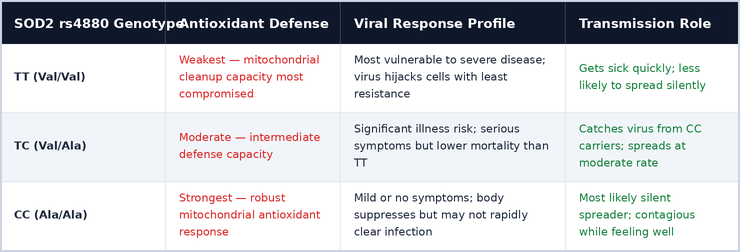
The CC carriers have strong enough antioxidant systems to suppress severe disease — but they don’t clear the infection rapidly. They feel fine. They go to work. They attend gatherings. They travel. All while shedding virus to everyone around them. The TT carriers catch it from them — and their weakened antioxidant systems offer far less resistance.
Who You Are Depends on Your Ancestry
This is not a rare variant. SOD2 rs4880 affects every human being on Earth, and its distribution varies significantly by ancestry.
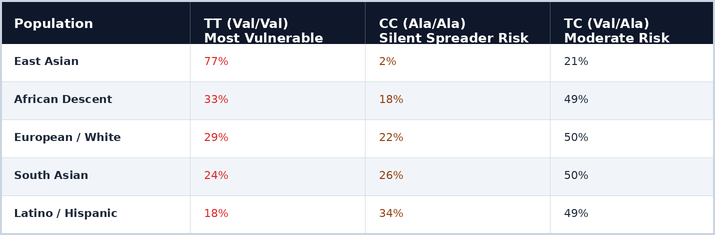
Source: gnomAD, NCBI dbSNP, 1000 Genomes Project. Genotype frequencies calculated via Hardy-Weinberg equilibrium from published allele frequency data.
In East Asian populations, 77% carry the TT genotype — when a virus with this transmission dynamic arrives, the severity concentrated in that population is extreme. In Latino and Hispanic populations, 34% carry the CC genotype — the highest concentration of potential silent spreaders among any group studied. In African American communities, 1 in 3 is TT and nearly 1 in 5 is CC — high vulnerability combined with meaningful internal transmission. In White and European communities, nearly 1 in 4 is a silent CC spreader while almost 1 in 3 is TT vulnerable.
Nobody knows which one they are — until they test.
How Viruses Exploit a Weakened Defense System
The mechanism through which viruses suppress innate cellular defenses is well-documented across multiple pathogen families in peer-reviewed literature.
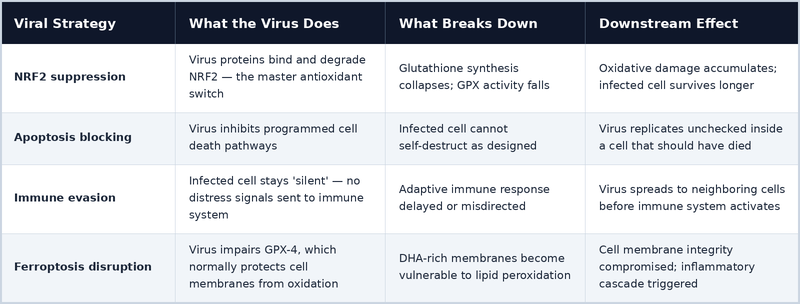
The common thread is that the virus is not simply attacking your cells — it is disabling the specific systems your cells use to detect infection, sound the alarm, and self-destruct when compromised. A cell with a strong antioxidant baseline is harder to silence. A cell with a compromised antioxidant system — whether from genetics, age, or nutritional deficit — is more easily hijacked and kept alive as a viral replication factory.
This is why the TT genotype correlates with worse outcomes across multiple viral diseases. It is not about the specific virus. It is about the baseline resilience of the defense system the virus encounters.
Tagatose: The Missing Link
Your body was designed with the most sophisticated virus-defense system ever created. It doesn’t need a pharmaceutical company to work. It needs to be running at optimal efficiency — and for most people, one critical fuel source is missing.
That missing link is tagatose.
D-Tagatose is a rare natural sugar that feeds the beneficial bacteria in your gut to produce butyrate endogenously — your body’s own HDAC inhibitor, the compound that flips the cellular defense switches back on that viruses work to turn off. Healthy cells burn butyrate as fuel, so it never accumulates. Virus-hijacked cells have broken metabolism — they cannot burn it efficiently, so it builds up inside them and only them. When it accumulates, it restores the antioxidant defense pathways the virus had suppressed. The cell’s own death program reactivates. And DHA — delivered through marine microalgae oil — becomes a weapon inside the hijacked cell where impaired GPX-4 can no longer protect it, triggering ferroptotic membrane destruction.
The cell self-destructs. It sends alarm signals to your immune system. Your immune system activates and hunts down remaining infected cells.
Tagatose, combined with Fibersol-2, is the fuel that makes this entire sequence possible. Without it, your gut bacteria don’t produce enough butyrate to run the system. With it, your body has what it needs to do what it was designed to do.
The ReBalU Approach: Test, Treat, Retest — In Addition to Your Doctor
SOD Sciences Inc. has developed a simple, inexpensive, three-step protocol using only GRAS (Generally Recognized As Safe) food-grade ingredients. This is not a replacement for medical care — it is what you can do for yourself, alongside whatever your doctor recommends, to support your body’s natural defenses.
Step 1: Test. A saliva-based genetic and biomarker panel identifies your SOD2 rs4880 genotype alongside NRF2 activity, GPX-1, GPX-4, total glutathione, DHA status, and butyrate production capacity. You find out exactly where you stand — are you a TT most vulnerable, a CC silent spreader, or a TC moderate risk? — before you need to know. The test is simple. The information is specific to you.
Step 2: Treat. The ReBalU protocol delivers targeted nutritional support across three delivery methods.
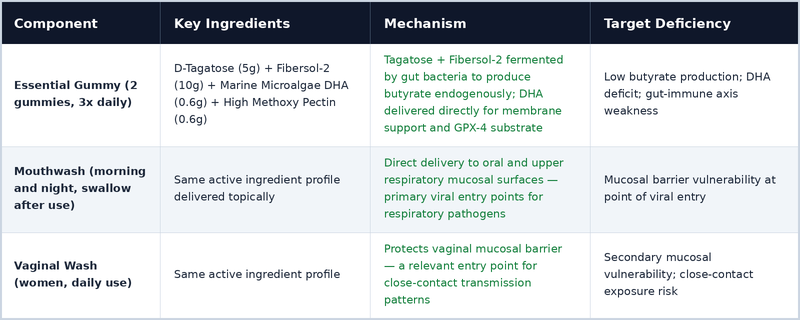
The protocol is available now — not in ten years after a drug trial. No prescriptions. No pharmaceuticals. All GRAS ingredients your body already knows how to use. And critically, it works differently for each genotype. For CC carriers, it helps the body clear the virus faster, reducing the window of shedding and protecting the TT and TC people around you. For TT carriers, it maximizes the antioxidant baseline that gives your cells a fighting chance. For TC carriers, it strengthens moderate defenses toward CC-level efficiency.
Step 3: Retest. Quarterly saliva testing confirms your levels are moving — butyrate up, DHA adequate, glutathione rising. Think of it like checking the oil in your car. You don’t wait for the engine to fail. You monitor, adjust, and keep the system running clean. If something hasn’t shifted, the protocol adjusts. This is personalized, ongoing, validated by your own biomarkers.
What the Government Can’t Do — You Can
We saw this with COVID-19. We are seeing it again with Andes hantavirus. Governments react after people are dying. Drug companies need 10 to 15 years to develop antivirals. Vaccines take years and may not cover mutations. The standard advice is always the same: wait and hope.
The Andes hantavirus has no approved drug, no vaccine, and a 32–50% fatality rate once severe symptoms develop. The same viral hijacking mechanism that drives its lethality also drives influenza, COVID-19, dengue, RSV, hepatitis, and HIV. Every one of them suppresses your antioxidant system to survive. Every one of them is harder to fight in a TT body than a CC body.
Knowing how viruses hijack your cells is the first step. Knowing which genotype you carry is the second. Fueling your body’s natural defense system — with tagatose, Fibersol-2, and DHA — is the third. SOD Sciences Inc. makes all three possible, today, with ingredients that are safe, accessible, and inexpensive.
God gave you the most powerful antiviral defense system ever designed. Viruses learned to shut it down. ReBalU — fueled by tagatose, the missing link — turns it back on.
This article is for informational purposes only and does not constitute medical advice. The ReBalU protocol uses only GRAS-designated food-grade ingredients and does not claim FDA approval for the treatment or prevention of any disease. The ReBalU protocol is intended to support your body’s natural defenses in addition to, not as a replacement for, medical care. Individuals experiencing symptoms consistent with viral infection should seek immediate medical attention.
Sources: “Super-Spreaders and Person-to-Person Transmission of Andes Virus in Argentina,” NEJM 2020; WHO Disease Outbreak News, May 3, 2026; CDC: About Andes Virus, updated May 6, 2026; SOD2 rs4880 allele frequency data: gnomAD, NCBI dbSNP, 1000 Genomes Project.